Compound shapes and parts of shapes · Formas compostas e partes de formas
| English | Português |
|---|---|
| compound shapes/ˈkɒmpaʊnd ʃeɪps/ | figuras compostas |
| hemisphere/ˈhemɪsfɪə/ | hemisfério |
| frustum/ˈfrʌstəm/ | tronco de cone |
Jigsaw shapes
- A patio is a rectangle with a semicircular flower bed on one end. How much paving do you need?
- Compound shapes 复合图形 are built from simple ones. Split, calculate, then add or subtract.
Formas compostas
- Um pátio é um retângulo com um canteiro de flores semicircular em uma extremidade. Quanto pavimentação você precisa?
- Figuras compostas são formadas por figuras simples. Separe, calcule e depois some ou subtraia.
Compound shape route · Rota de forma composta
Break a compound shape into simple parts, then recombine.
Strategy: split into known parts
- Break the shape into rectangles, triangles, circles — anything you have a formula for.
- Calculate each area separately, then add them together (or subtract if a piece is cut out).
A rectangle $8 \times 5$ with a semicircle (diameter $5$) on one end: Area $= 40 + \dfrac{1}{2}\pi(2.5)^2 = 40 + 3.125\pi \approx 49.8\text{ cm}^2$.
Watch for cut-outs. If a shape has a hole, you subtract the hole's area. A rectangle with a circular hole: total area $=$ rectangle area $-$ circle area.
Split a compound shape into parts you know, here a rectangle plus a semicircle, then add the areas
Estratégia: dividir em partes conhecidas
- Divida a forma em retângulos, triângulos, círculos — qualquer coisa que tenha uma fórmula.
- Calcule cada área separadamente, depois some-as (ou subtraia se uma peça for cortada).
Um retângulo $8 \times 5$ com um semicírculo (diâmetro $5$) em uma extremidade: Área $= 40 + \dfrac{1}{2}\pi(2.5)^2 = 40 + 3.125\pi \approx 49.8\text{ cm}^2$.
Atenção aos recortes. Se uma forma tem um buraco, você subtrai a área do buraco. Um retângulo com um buraco circular: área total $=$ área do retângulo $-$ área do círculo.
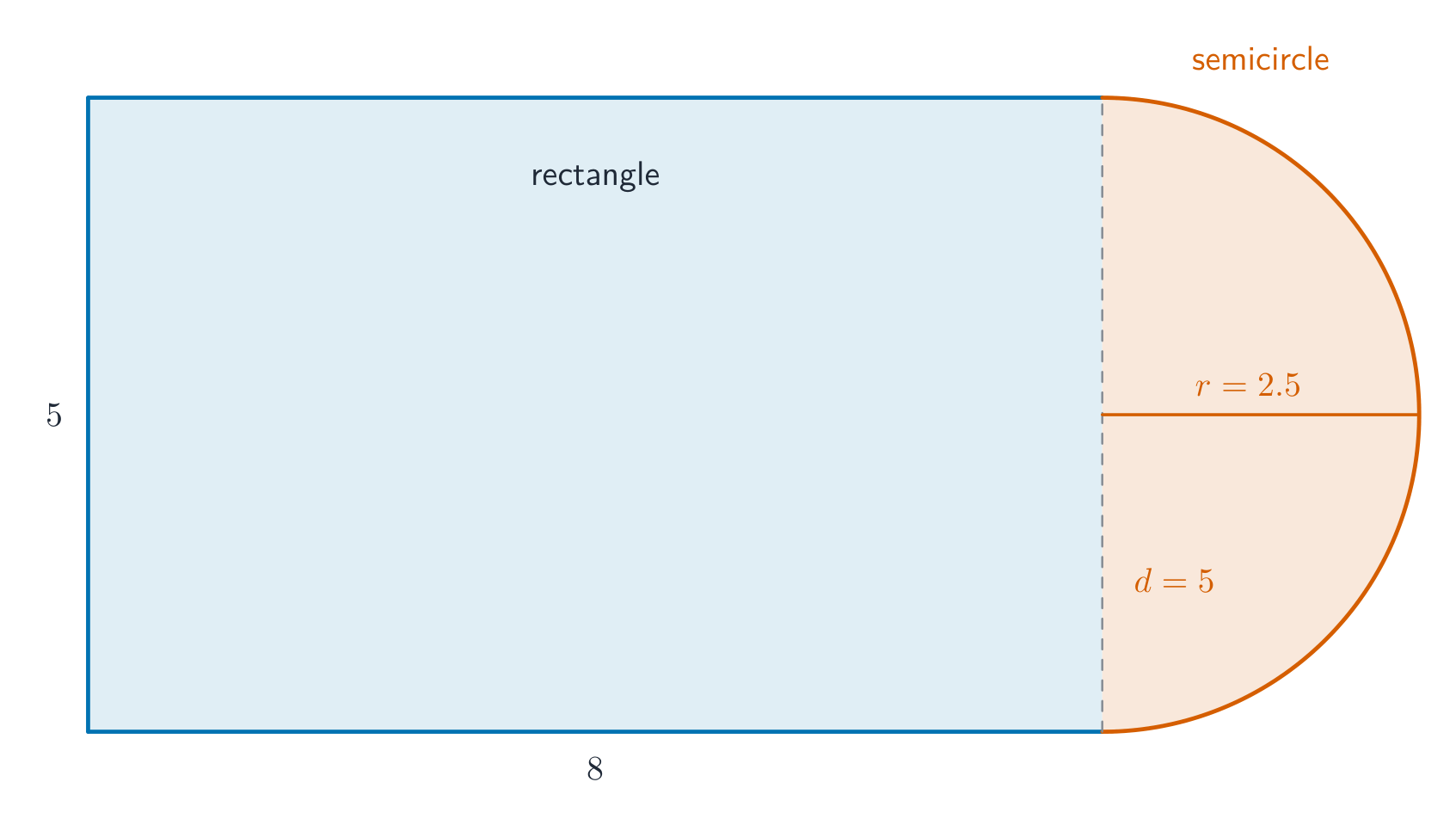
Divida uma forma composta em partes que você conhece, aqui um retângulo mais um semicírculo, depois some as áreas
To find the area of a rectangle with a semicircle on one end, you:
The shape is the rectangle plus the semicircle, so add the two areas.
A compound shape is a rectangle 8 cm by 5 cm plus a semicircle on the end. What is the rectangle part of the area (cm²)?
Rectangle area = 8 × 5 = 40 cm² (then add the semicircle).
If a shape has a circular hole cut out, you subtract the circle area from the outer shape area.
Cut-outs are subtracted: total = outer area − hole area.
Parts of solids
- A hemisphere 半球 is half a sphere: volume $= \dfrac{1}{2} \times \dfrac{4}{3}\pi r^3 = \dfrac{2}{3}\pi r^3$.
- A frustum 平截头体 is a cone or pyramid with the top sliced off parallel to the base.
- Find it by subtracting: whole cone minus small top cone.
Partes de sólidos
- Uma hemisfera é metade de uma esfera: volume $= \dfrac{1}{2} \times \dfrac{4}{3}\pi r^3 = \dfrac{2}{3}\pi r^3$.
- Um tronco é um cone ou pirâmide com o topo cortado paralelamente à base.
- Encontre-o subtraindo: cone inteiro menos cone pequeno no topo.
The volume of a hemisphere of radius r is:
Half of (4/3)πr³ is (2/3)πr³.
A hemisphere has radius 6 cm. Its volume is kπ cm³. What is k?
(2/3) × π × 6³ = (2/3) × 216π = 144π, so k = 144.
A frustum is found by subtracting the small top cone from the ______ cone.
Frustum = whole cone − small top cone (cut parallel to the base).
Worked example — hemisphere
- Hemisphere of radius $6\text{ cm}$:
- Volume $= \dfrac{2}{3}\pi(6)^3 = \dfrac{2}{3}\pi(216) = 144\pi\text{ cm}^3$.
Compound shapes are built from simple ones — here two squares of different sizes, like a rectangle made of two parts.
Exemplo resolvido — hemisfério
- Hemisfério de raio $6\text{ cm}$:
- Volume $= \dfrac{2}{3}\pi(6)^3 = \dfrac{2}{3}\pi(216) = 144\pi\text{ cm}^3$.
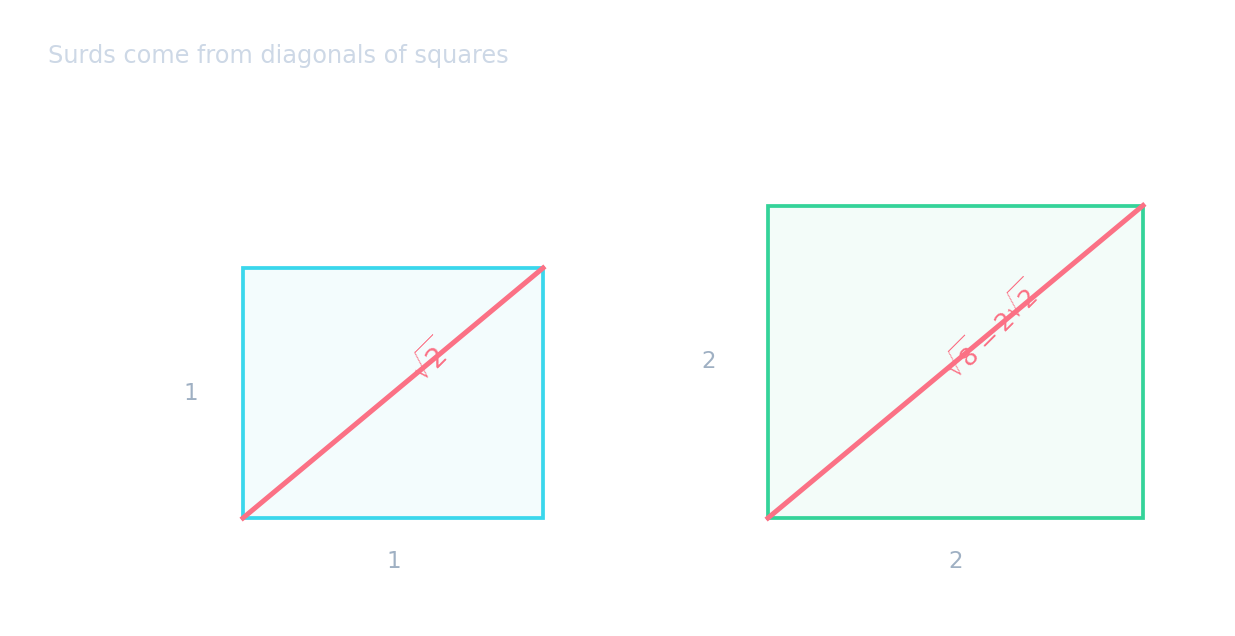
Formas compostas são construídas a partir de formas simples — aqui dois quadrados de tamanhos diferentes, como um retângulo feito de duas partes.
Why the frustum matters
- The frustum is the shape of most lampshades, buckets, and drinking glasses. Engineers and architects use the formula constantly.
Por que o frustum importa
- O frustum é a forma da maioria das luminárias, baldes e copos. Engenheiros e arquitetos usam a fórmula constantemente.
Exposed area at a join
- Two cubes of edge 3 cm join face to face. Their volume adds: $V=2(3^3)=54\text{ cm}^3$. Their area does not simply add: the two touching faces disappear from the outside, so $S=12(3^2)-2(3^2)=90\text{ cm}^2$.
- Half a sphere of radius 6 cm has curved area $2\pi r^2=72\pi\text{ cm}^2$; including the flat circular base gives total $3\pi r^2=108\pi\text{ cm}^2$. State whether the flat base is exposed.
Área exposta em junções
- Dois cubos de aresta 3 cm são unidos face a face. Seus volumes somam: $V=2(3^3)=54\text{ cm}^3$. Suas áreas não se somam simplesmente: as duas faces em contato desaparecem da superfície externa, então $S=12(3^2)-2(3^2)=90\text{ cm}^2$.
- Metade de uma esfera de raio 6 cm tem área curva $2\pi r^2=72\pi\text{ cm}^2$; ao incluir a base circular plana, o total é $3\pi r^2=108\pi\text{ cm}^2$. Indique se a base plana está exposta.
Two 3 cm cubes join face to face. Find the exposed area in cm².
Ten square faces remain exposed: 10 × 9 = 90 cm².
You've got it
- split a compound shape into known parts, then add or subtract
- hemisphere volume $= \dfrac{2}{3}\pi r^3$
- a frustum = whole cone minus the small top cone
Entendeu?
- divida uma forma composta em partes conhecidas, depois some ou subtraia
- volume do hemisfério $= \dfrac{2}{3}\pi r^3$
- um frustum = cone inteiro menos o cone pequeno no topo