Perimeter and area of basic shapes · Perímetro e área de formas básicas
| English | Português |
|---|---|
| area/ˈeərɪə/ | área |
| perimeter/pəˈrɪmɪtə/ | perímetro |
| perpendicular height/ˌpɜːpənˈdɪkjʊlə haɪt/ | altura perpendicular |
How big is your garden?
- Estate agents quote floor area 面积 in square metres. A "50 m² flat" is one whose floor covers 50 squares, each 1 m on a side.
- Finding area is one of the most practical things mathematics does — and it starts with a few key formulas.
Quão grande é seu jardim?
- Corretores imobiliários citam a área do piso 面积 em metros quadrados. Um "apartamento de 50 m²" é aquele cujo piso cobre 50 quadrados, cada um com 1 m de lado.
- Encontrar a área é uma das coisas mais práticas que a matemática faz — e começa com algumas fórmulas-chave.
Area scaling lab · Laboratório de escalonamento de área
area = side^2 · área = lado^2
Change side length and see why area grows quadratically. · Alterar o comprimento do lado e ver por que a área cresce quadraticamente.
Perimeter 周长
- Perimeter = the distance all the way round the outside of a shape.
- Rectangle: $P = 2(\text{length} + \text{width})$.
A rectangle $8\text{ cm} \times 5\text{ cm}$: $P = 2(8 + 5) = 26\text{ cm}$.
Area of the basic shapes; $b$ is the base, $h$ the perpendicular height 垂直高度, and $a$, $b$ the parallel sides of a trapezium
Perímetro 周长
- Perímetro = a distância ao redor todo o exterior de uma figura.
- Retângulo: $P = 2(\text{length} + \text{width})$.
Um retângulo $8\text{ cm} \times 5\text{ cm}$: $P = 2(8 + 5) = 26\text{ cm}$.

Área das formas básicas; $b$ é a base, $h$ a altura perpendicular 垂直高度, e $a$, $b$ os lados paralelos de um trapézio
A rectangle is 8 cm by 5 cm. Find its perimeter (cm). · Um retângulo é 8 cm por 5 cm. Encontre seu perímetro (cm).
Perimeter = 2(8 + 5) = 26 cm. · Perímetro = 2(8 + 5) = 26 cm.
Match each shape to its area formula. · Combine cada forma com sua fórmula de área.
Each shape has its own area rule; the trapezium averages the parallel sides. · Cada forma tem sua própria regra de área; o trapézio faz a média dos lados paralelos.
Area formulas
| Shape | Area | Notes |
|---|---|---|
| rectangle | $\text{length} \times \text{width}$ | |
| triangle | $\dfrac{1}{2} \times b \times h$ | $h$ is perpendicular height |
| parallelogram | $b \times h$ | $h$ is perpendicular height |
| trapezium | $\dfrac{1}{2}(a+b)h$ | $a, b$ are the parallel sides |
Perpendicular height, not slant height. For triangles and parallelograms, $h$ must be measured at right angles to the base. Using the slant side gives the wrong answer.
Common solids and the dimensions used in their volume and surface-area formulas
Fórmulas de área
| Forma | Área | Notas |
|---|---|---|
| retângulo | $\text{length} \times \text{width}$ | |
| triângulo | $\dfrac{1}{2} \times b \times h$ | $h$ é a altura perpendicular |
| paralelogramo | $b \times h$ | $h$ é a altura perpendicular |
| trapézio | $\dfrac{1}{2}(a+b)h$ | $a, b$ são os lados paralelos |
Altura perpendicular, não altura oblíqua. Para triângulos e paralelogramos, $h$ deve ser medida em ângulo reto em relação à base. Usar o lado oblíquo dá a resposta errada.
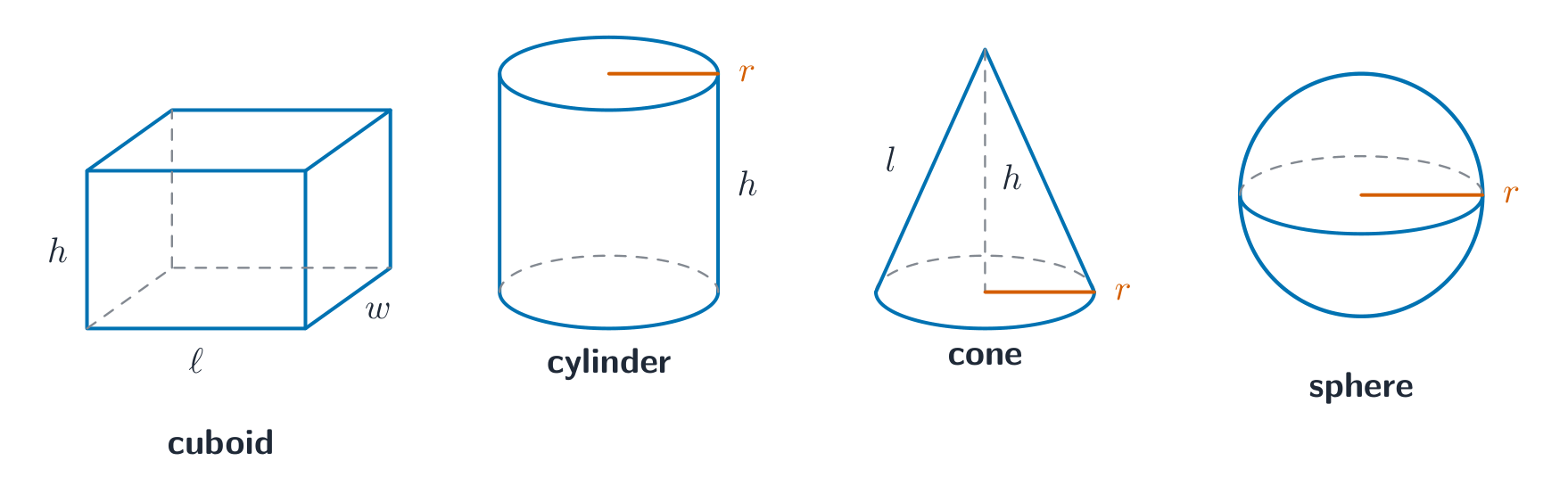
Sólidos comuns e as dimensões usadas em suas fórmulas de volume e área superficial
A triangle has base 10 cm and height 6 cm. Find its area (cm²). · Um triângulo tem base 10 cm e altura 6 cm. Encontre sua área (cm²).
½ × 10 × 6 = 30 cm².
A parallelogram has base 12 cm and perpendicular height 7 cm. Find its area (cm²). · Um paralelogramo tem base 12 cm e altura perpendicular 7 cm. Encontre sua área (cm²).
Area = b × h = 12 × 7 = 84 cm². · Área = b × h = 12 × 7 = 84 cm².
In the triangle area formula, h is the slant height of the triangle. · Na fórmula da área do triângulo, h é a altura oblíqua do triângulo.
h must be the perpendicular height (at 90° to the base), not the slant side. · h deve ser a altura perpendicular (a 90° em relação à base), não o lado oblíquo.
A rectangle is 8 cm by 5 cm. Find its area (cm²). · Um retângulo é 8 cm por 5 cm. Encontre sua área (cm²).
Area = length × width = 8 × 5 = 40 cm². · Área = comprimento × largura = 8 × 5 = 40 cm².
Worked example — trapezium
- Parallel sides $6\text{ cm}$ and $10\text{ cm}$, height $4\text{ cm}$.
- Area $= \dfrac{1}{2}(6+10) \times 4 = \dfrac{1}{2} \times 16 \times 4 = 32\text{ cm}^2$.
A triangle's area uses the perpendicular height — the height at $90^{\circ}$ to the base, not the slant side.
Exemplo resolvido — trapézio
- Lados paralelos $6\text{ cm}$ e $10\text{ cm}$, altura $4\text{ cm}$.
- Área $= \dfrac{1}{2}(6+10) \times 4 = \dfrac{1}{2} \times 16 \times 4 = 32\text{ cm}^2$.
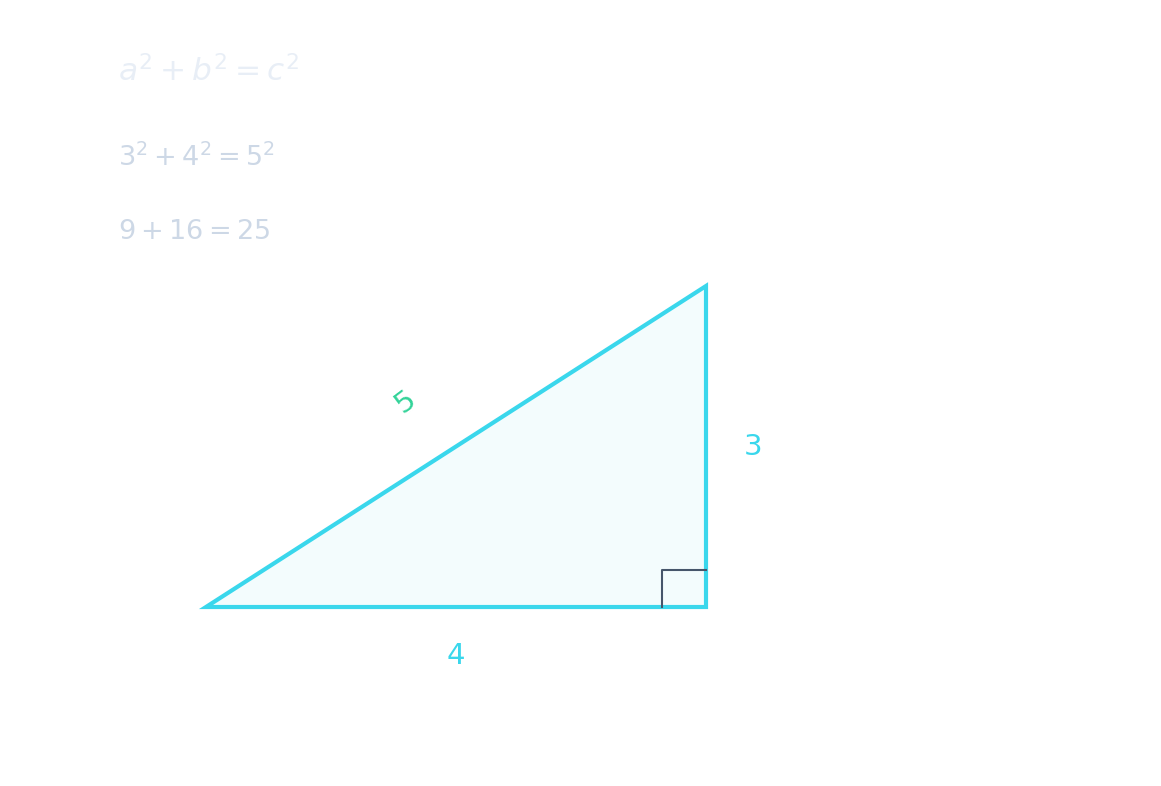
A área de um triângulo usa a altura perpendicular — a altura em $90^{\circ}$ à base, não o lado oblíquo.
A trapezium has parallel sides 6 cm and 10 cm and height 4 cm. Find its area (cm²). · Um trapézio tem lados paralelos de 6 cm e 10 cm e altura 4 cm. Encontre sua área (cm²).
½(6 + 10) × 4 = ½ × 16 × 4 = 32 cm².
Why does the triangle formula work?
- Any triangle is exactly half of a parallelogram with the same base and height.
- That's why the formula has the $\dfrac{1}{2}$ — it's half the parallelogram's area.
Por que a fórmula do triângulo funciona?
- Qualquer triângulo é exatamente metade de um paralelogramo com a mesma base e altura.
- É por isso que a fórmula tem o $\dfrac{1}{2}$ — é metade da área do paralelogramo.
You've got it
- rectangle area $= l \times w$; triangle $= \dfrac{1}{2}bh$; parallelogram $= bh$
- trapezium $= \dfrac{1}{2}(a+b)h$ ($a, b$ are the parallel sides)
- $h$ is always the perpendicular height
Entendeu?
- área do retângulo $= l \times w$; triângulo $= \dfrac{1}{2}bh$; paralelogramo $= bh$
- trapézio $= \dfrac{1}{2}(a+b)h$ ($a, b$ são os lados paralelos)
- $h$ é sempre a altura perpendicular