Bearings · Rumos (Bearing)
| English | Português |
|---|---|
| bearing/ˈbeərɪŋ/ | rumo |
| back bearing/bæk ˈbeərɪŋ/ | rumo de retrocesso |
Lost at sea — saved by a bearing 方位角
- Before GPS, sailors navigated using bearings — a precise angle from north.
- A single mistake (reading anticlockwise instead of clockwise, or writing "45" instead of "045") could put a ship miles off course.
Perdido no mar — salvo por um rumo 方位角
- Antes do GPS, marinheiros navegavam usando rumos — um ângulo preciso a partir do norte.
- Um único erro (ler anti-horário em vez de horário, ou escrever "45" em vez de "045") poderia colocar um navio a milhas fora do curso.
Bearings route · Rota de rumos
Follow how to measure a bearing correctly from north. · Siga como medir corretamente um rumo a partir do norte.
What is a bearing?
- A bearing gives a direction as a three-figure angle, measured clockwise from north.
- Due north $= 000^{\circ}$ (or $360^{\circ}$); due east $= 090^{\circ}$; due south $= 180^{\circ}$; due west $= 270^{\circ}$.
- Always write three figures: $5^{\circ}$ becomes $005^{\circ}$, $45^{\circ}$ becomes $045^{\circ}$.
Bearings are always measured clockwise from north, and always written as three figures.
Three figures, always. A bearing of $45^{\circ}$ is written $045^{\circ}$. Writing just "45" loses marks — the leading zero shows it's a bearing, not an ordinary angle.
O que é um rumo?
- Um rumo fornece uma direção como um ângulo de três algarismos, medido horariamente a partir do norte.
- Norte exato $= 000^{\circ}$ (ou $360^{\circ}$); leste exato $= 090^{\circ}$; sul exato $= 180^{\circ}$; oeste exato $= 270^{\circ}$.
- Sempre escreva três algarismos: $5^{\circ}$ torna-se $005^{\circ}$, $45^{\circ}$ torna-se $045^{\circ}$.
Rumos são sempre medidos horariamente a partir do norte, e sempre escritos como três algarismos.
Três algarismos, sempre. Um rumo de $45^{\circ}$ é escrito como $045^{\circ}$. Escrever apenas "45" perde pontos — o zero à esquerda mostra que é um rumo, não um ângulo comum.
What three-figure bearing points due east? · Qual rumo de três algarismos aponta para o leste exato?
Clockwise from north, east is 090°. · Horário a partir do norte, leste é 090°.
Bearings are measured clockwise from north. · Rumos são medidos horário a partir do norte.
Always clockwise from north, written as three figures. · Sempre horário a partir do norte, escrito com três algarismos.
A bearing of 45° should be written as ______°. · Um rumo de 45° deve ser escrito como ______°.
Bearings are always written as three figures: 045°, not 45°. · Rumos são sempre escritos com três algarismos: 045°, não 45°.
Back bearings 反方位角
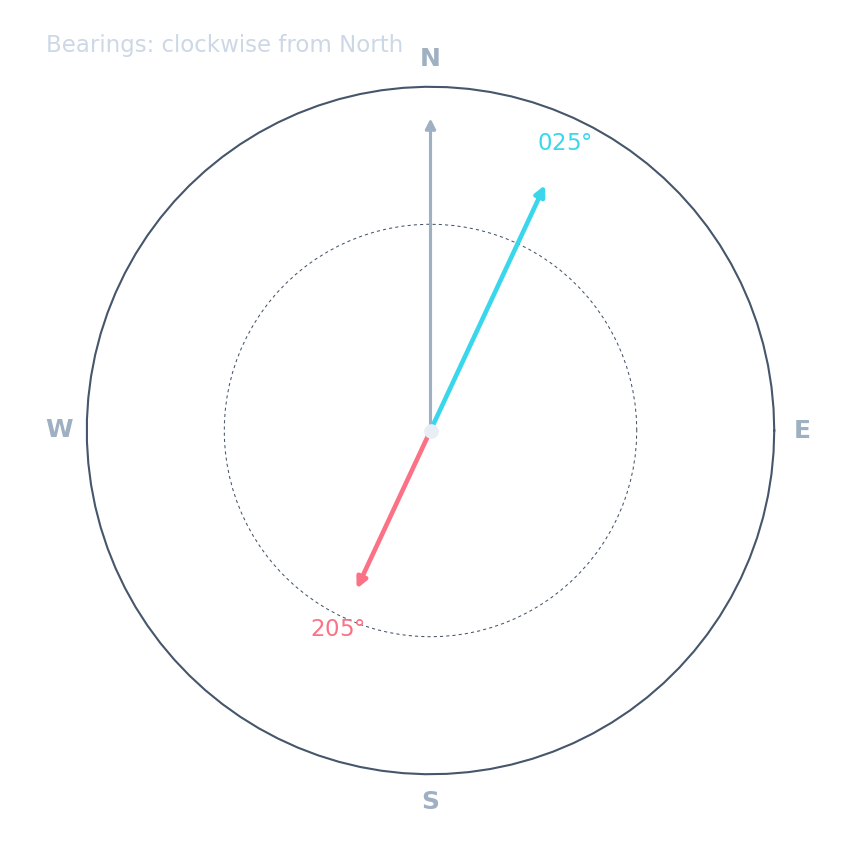
- The back bearing (the return direction) differs from the forward bearing by $180^{\circ}$.
- If the bearing is under $180^{\circ}$, add $180^{\circ}$; if over, subtract $180^{\circ}$.
- Bearing of $B$ from $A$ is $025^{\circ}$ → bearing of $A$ from $B$ is $025 + 180 = 205^{\circ}$.
Bearing of $P$ from $Q$ is $310^{\circ}$. Back bearing: $310 - 180 = 130^{\circ}$. The bearing of $Q$ from $P$ is $130^{\circ}$.
Bearings are measured clockwise from north as three figures; the back bearing differs by $180^\circ$
Rumos inversos 反方位角
- O rumo inverso (a direção de retorno) difere do rumo direto em $180^{\circ}$.
- Se o rumo for inferior a $180^{\circ}$, some $180^{\circ}$; se superior, subtraia $180^{\circ}$.
- Rumo de $B$ de $A$ é $025^{\circ}$ → rumo de $A$ de $B$ é $025 + 180 = 205^{\circ}$.
Rumo de $P$ de $Q$ é $310^{\circ}$. Rumo inverso: $310 - 180 = 130^{\circ}$. O rumo de $Q$ de $P$ é $130^{\circ}$.

Rumos são medidos horariamente a partir do norte como três algarismos; o rumo inverso difere em $180^\circ$
The bearing of B from A is 025°. What is the bearing of A from B? · O rumo de B a partir de A é 025°. Qual é o rumo de A a partir de B?
Back bearing: 025 + 180 = 205°. · Rumo inverso: 025 + 180 = 205°.
The bearing of P from Q is 310°. What is the back bearing (bearing of Q from P)? · O rumo de P a partir de Q é 310°. Qual é o rumo inverso (rumo de Q a partir de P)?
310° > 180°, so subtract: 310 − 180 = 130°. · 310° > 180°, então subtraia: 310 − 180 = 130°.
Worked example — three-figure bearings
- A ship sails on bearing $135^{\circ}$ for $20$ km, then turns to bearing $225^{\circ}$.
- The angle turned through $= 225 - 135 = 90^{\circ}$ — a right-angle turn to starboard.
Exemplo resolvido — rumos de três algarismos
- Um navio navega no rumo $135^{\circ}$ por $20$ km, depois vira para o rumo $225^{\circ}$.
- O ângulo virado foi $= 225 - 135 = 90^{\circ}$ — uma virada de ângulo reto para bombordo.
A ship changes from bearing 135° to bearing 225°. How many degrees did it turn? · Um navio muda de rumo 135° para rumo 225°. Quantos graus ele virou?
225 − 135 = 90° (a right-angle turn). · 225 − 135 = 90° (uma virada de ângulo reto).
Bearings in the real world
- Aviation: runways are numbered by their bearing divided by 10 (Runway 27 faces roughly $270^{\circ}$).
- Hiking: a compass bearing tells you which direction to walk, even in fog.
Rumos no mundo real
- Aviação: pistas são numeradas pelo rumo dividido por 10 (Pista 27 olha aproximadamente para $270^{\circ}$).
- Trilha: um rumo de bússola diz a qual direção andar, mesmo na neblina.
You've got it
- a bearing is three figures, measured clockwise from north
- east $090^{\circ}$, south $180^{\circ}$, west $270^{\circ}$
- back bearing differs by $180^{\circ}$ (add if $<180^{\circ}$, subtract if $>180^{\circ}$)
Entendeu?
- um rumo é três algarismos, medido horariamente a partir do norte
- leste $090^{\circ}$, sul $180^{\circ}$, oeste $270^{\circ}$
- rumo inverso difere em $180^{\circ}$ (some se $<180^{\circ}$, subtraia se $>180^{\circ}$)