Length and midpoint · Comprimento e ponto médio
| English | Português |
|---|---|
| line segment/laɪn ˈseɡmənt/ | segmento de reta |
| hypotenuse/haɪˈpɒtənjuːs/ | hipotenusa |
| Pythagoras/paɪˈθæɡərəs/ | Pitágoras |
| midpoint/ˈmɪdpɔɪnt/ | ponto médio |
How far, really?
- Your phone says the café is 1.2 km away — but that's the straight-line distance, not the zigzag walk along streets.
- In coordinate geometry we often need the exact straight-line distance between two points.
- The tool? A 2500-year-old theorem.
Quão longe, realmente?
- Seu celular indica que o café está a 1.2 km de distância — mas essa é a distância em linha reta, não o trajeto em ziguezague pelas ruas.
- Na geometria analítica, muitas vezes precisamos da distância em linha reta exata entre dois pontos.
- A ferramenta? Um teorema de 2500 anos.
Length and midpoint lab · Lab de comprimento e ponto médio
midpoint is halfway between endpoints · ponto médio é metade entre as extremidades
Move along a line segment and see midpoint as halfway. · Mova-se ao longo de um segmento de reta e veja o ponto médio como o meio.
Length of a segment (Extended)
- A line segment 线段 is the straight piece between two points $(x_1, y_1)$ and $(x_2, y_2)$.
- Draw a right triangle with the segment as the hypotenuse 斜边:
- The horizontal gap is $x_2 - x_1$ and the vertical gap is $y_2 - y_1$.
- By Pythagoras 勾股定理, the length is:
The gap across (3) and the gap up (4) give the length by Pythagoras; the midpoint 中点 is the average of the coordinates
Comprimento de um segmento (Ampliado)
- Um segmento de reta 线段 é a parte reta entre dois pontos $(x_1, y_1)$ e $(x_2, y_2)$.
- Desenhe um triângulo retângulo com o segmento como hipotenusa 斜边:
- O espaço horizontal é $x_2 - x_1$ e o espaço vertical é $y_2 - y_1$.
- Pelo Teorema de Pitágoras 勾股定理, o comprimento é:

O espaço lateral (3) e o espaço vertical (4) dão o comprimento pelo Teorema de Pitágoras; o ponto médio 中点 é a média das coordenadas
Worked example — length
- Find the length from $(1, 2)$ to $(4, 6)$.
- Horizontal gap $= 4 - 1 = 3$; vertical gap $= 6 - 2 = 4$.
- Length $= \sqrt{3^2 + 4^2} = \sqrt{9 + 16} = \sqrt{25} = 5$.
- The classic 3-4-5 right triangle makes a clean answer.
Pythagoras finds the length (hypotenuse); averaging finds the midpoint (star).
From the origin. Length from $(0, 0)$ to $(3, 4)$: $\sqrt{3^2 + 4^2} = \sqrt{25} = 5$. Same triangle, different starting point.
Exemplo resolvido — comprimento
- Encontre o comprimento de $(1, 2)$ a $(4, 6)$.
- Espaço horizontal $= 4 - 1 = 3$; espaço vertical $= 6 - 2 = 4$.
- Comprimento $= \sqrt{3^2 + 4^2} = \sqrt{9 + 16} = \sqrt{25} = 5$.
- O clássico triângulo retângulo 3-4-5 resulta em uma resposta limpa.
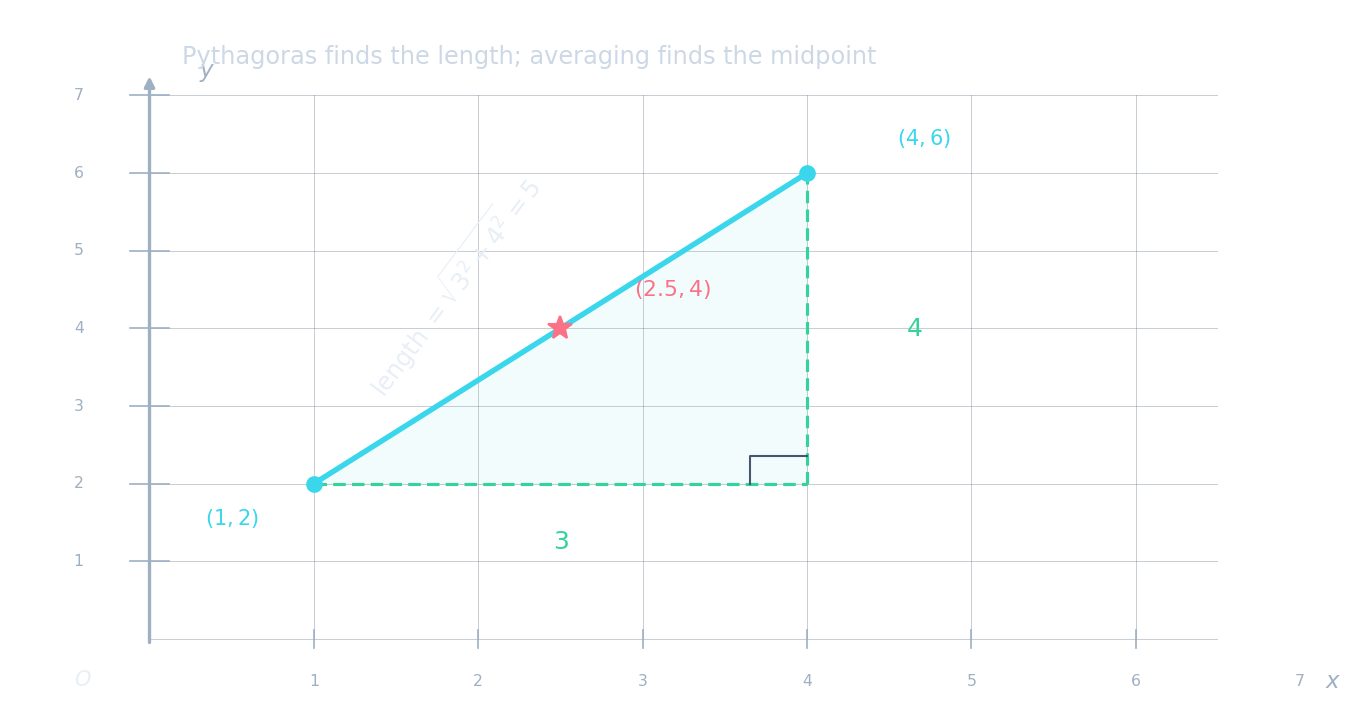
Pitágoras encontra o comprimento (hipotenusa); a média encontra o ponto médio (estrela).
Da origem. Comprimento de $(0, 0)$ a $(3, 4)$: $\sqrt{3^2 + 4^2} = \sqrt{25} = 5$. Mesmo triângulo, ponto de partida diferente.
Find the length of the segment from (1, 2) to (4, 6). · Encontre o comprimento do segmento de (1, 2) a (4, 6).
√((4−1)² + (6−2)²) = √(9 + 16) = √25 = 5.
Find the length of the segment from (0, 0) to (3, 4). · Encontre o comprimento do segmento de (0, 0) a (3, 4).
√(3² + 4²) = √(9 + 16) = √25 = 5. The classic 3-4-5 triangle. · √(3² + 4²) = √(9 + 16) = √25 = 5. O clássico triângulo 3-4-5.
Find the length of the segment from (1, 5) to (7, 5). · Encontre o comprimento do segmento de (1, 5) a (7, 5).
Both points have y = 5 (horizontal segment). Length = 7 − 1 = 6. · Ambos os pontos têm y = 5 (segmento horizontal). Comprimento = 7 − 1 = 6.
Midpoint of a segment (Extended)
- The midpoint is the point exactly halfway between the two endpoints.
- Find it by averaging each coordinate:
- It's the "halfway" $x$ paired with the "halfway" $y$.
Ponto médio de um segmento (Ampliado)
- O ponto médio é o ponto exatamente no meio entre as duas extremidades.
- Encontre-o mediando cada coordenada:
- É o "meio" $x$ combinado com o "meio" $y$.
Worked example — midpoint
- Find the midpoint from $(1, 2)$ to $(4, 6)$.
- Mid-$x = \dfrac{1 + 4}{2} = \dfrac{5}{2} = 2.5$.
- Mid-$y = \dfrac{2 + 6}{2} = \dfrac{8}{2} = 4$.
- Midpoint $= (2.5,\, 4)$ — exactly halfway along.
Average, don't add. The midpoint of $(1, 2)$ and $(4, 6)$ is $(2.5, 4)$, not $(5, 8)$. You must divide by 2 — averaging, not summing.
Exemplo resolvido — ponto médio
- Encontre o ponto médio de $(1, 2)$ a $(4, 6)$.
- Meio-$x = \dfrac{1 + 4}{2} = \dfrac{5}{2} = 2.5$.
- Meio-$y = \dfrac{2 + 6}{2} = \dfrac{8}{2} = 4$.
- Ponto médio $= (2.5,\, 4)$ — exatamente ao meio.
Média, não soma. O ponto médio de $(1, 2)$ e $(4, 6)$ é $(2.5, 4)$, não $(5, 8)$. Você deve dividir por 2 — mediar, não somar.
The midpoint of (1, 2) and (4, 6) is (a, 4). What is a? · O ponto médio de (1, 2) e (4, 6) é (a, 4). Qual é a?
Average the x-values: (1 + 4)/2 = 2.5. · Média dos valores x: (1 + 4)/2 = 2.5.
The midpoint of (2, 3) and (8, 9) is (5, b). What is b? · O ponto médio de (2, 3) e (8, 9) é (5, b). Qual é b?
Average the y-values: (3 + 9)/2 = 6. · Média dos valores y: (3 + 9)/2 = 6.
The x-coordinate of the midpoint of (x₁, y₁) and (x₂, y₂) is: · A coordenada x do ponto médio de (x₁, y₁) e (x₂, y₂) é:
The midpoint is the average of each coordinate: (x₁ + x₂)/2. Choice 2 forgets to divide; choice 3 gives half the gap, not the position. · O ponto médio é a média de cada coordenada: (x₁ + x₂)/2. A opção 2 esquece de dividir; a opção 3 dá metade da distância, não a posição.
Complete: the midpoint x-coordinate = (x₁ + ______) / 2. · Complete: a coordenada x do ponto médio = (x₁ + ______) / 2.
The midpoint x-coordinate is the average of the two x-values: (x₁ + x₂)/2. · A coordenada x do ponto médio é a média dos dois valores x: (x₁ + x₂)/2.
The 3-4-5 triangle family
- The triangle with sides $3, 4, 5$ is the smallest right triangle with whole-number sides.
- Multiples work too: $6, 8, 10$ and $9, 12, 15$ are also right triangles.
- You'll see this family a lot in exam questions — recognise it and save time.
A família do triângulo 3-4-5
- O triângulo com lados $3, 4, 5$ é o menor triângulo retângulo com lados de números inteiros.
- Múltiplos também funcionam: $6, 8, 10$ e $9, 12, 15$ também são triângulos retângulos.
- Você verá essa família muito em questões de prova — reconheça-a e economize tempo.
For a horizontal segment (both y-values the same), the length is simply the difference of the x-values. · Para um segmento horizontal (ambos os valores de y são iguais), o comprimento é simplesmente a diferença dos valores de x.
When y₁ = y₂, the formula simplifies to √((x₂−x₁)²) = |x₂ − x₁|. · Quando y₁ = y₂, a fórmula simplifica para √((x₂−x₁)²) = |x₂ − x₁|.
Match each segment to its length. · Combine cada segmento com seu comprimento.
(0,0)–(5,0) is horizontal, length 5. (1,1)–(1,4) is vertical, length 3. (0,0)–(6,8): √(36+64) = √100 = 10. (2,3)–(5,7): √(9+16) = √25 = 5. · (0,0)–(5,0) é horizontal, comprimento 5. (1,1)–(1,4) é vertical, comprimento 3. (0,0)–(6,8): √(36+64) = √100 = 10. (2,3)–(5,7): √(9+16) = √25 = 5.
You've got it
- length $= \sqrt{(x_2 - x_1)^2 + (y_2 - y_1)^2}$ (Pythagoras on the horizontal and vertical gaps)
- midpoint $= \left( \dfrac{x_1 + x_2}{2}, \; \dfrac{y_1 + y_2}{2} \right)$ (average each coordinate)
- $(1,2)$ to $(4,6)$: length $5$, midpoint $(2.5,\, 4)$
- the 3-4-5 right triangle appears often — spot it early
Entendeu?
- comprimento $= \sqrt{(x_2 - x_1)^2 + (y_2 - y_1)^2}$ (Pitágoras nos espaços horizontal e vertical)
- ponto médio $= \left( \dfrac{x_1 + x_2}{2}, \; \dfrac{y_1 + y_2}{2} \right)$ (media cada coordenada)
- de $(1,2)$ a $(4,6)$: comprimento $5$, ponto médio $(2.5,\, 4)$
- o triângulo retângulo 3-4-5 aparece frequentemente — identifique-o cedo