Functions · Funções
| English | Português |
|---|---|
| function/ˈfʌŋkʃn/ | função |
| domain/dəˈmeɪn/ | domínio |
| range/reɪndʒ/ | range |
| inverse function/ɪnˈvɜːs ˈfʌŋkʃn/ | função inversa |
| composite function/ˈkɒmpəzɪt ˈfʌŋkʃn/ | função composta |
A machine with an input and an output
- A vending machine: you put in a code (input), it gives you a snack (output). A function 函数 works the same way — each input produces exactly one output.
- $f(x) = 3x - 5$ is a function: put in $x = 2$, get out $f(2) = 1$.
Uma máquina com entrada e saída
- Uma máquina de vending: você insere um código (entrada), ela te dá um lanche (saída). Uma função 函数 funciona da mesma maneira — cada entrada produz exatamente uma saída.
- $f(x) = 3x - 5$ é uma função: insira $x = 2$, obtenha $f(2) = 1$.
Evaluating functions
- $f(x) = 3x - 5$: $\;f(2) = 3(2) - 5 = 1$; $\;f(0) = -5$; $\;f(-1) = -8$.
- The domain 定义域 is the set of allowed inputs. The range 值域 is the set of possible outputs.
$f(x) = \sqrt{x}$ has domain $x \geq 0$ (can't square-root a negative) and range $f(x) \geq 0$.
Avaliando funções
- $f(x) = 3x - 5$: $\;f(2) = 3(2) - 5 = 1$; $\;f(0) = -5$; $\;f(-1) = -8$.
- O domínio 定义域 é o conjunto de entradas permitidas. O contradomínio/imagem 值域 é o conjunto de saídas possíveis.
$f(x) = \sqrt{x}$ tem domínio $x \geq 0$ (não se pode extrair raiz quadrada de negativo) e imagem $f(x) \geq 0$.
Functions · Funções
y = f(x)
A function turns each input · entrada into exactly one output · produção — watch its shape. · Uma função transforma cada entrada em exatamente uma saída — observe sua forma.
For f(x) = 3x − 5, what is f(2)? · Para f(x) = 3x − 5, qual é f(2)?
f(2) = 3(2) − 5 = 6 − 5 = 1.
For f(x) = x² + 1, what is f(3)? · Para f(x) = x² + 1, qual é f(3)?
f(3) = 3² + 1 = 9 + 1 = 10.
Inverse functions 反函数
- The inverse $f^{-1}$ undoes $f$: if $f$ turns $2$ into $1$, then $f^{-1}$ turns $1$ back into $2$.
- Method: write $y = f(x)$, swap $x$ and $y$, then make $y$ the subject.
- $f(x) = 3x - 5$: $y = 3x - 5$, swap: $x = 3y - 5$, solve: $y = \dfrac{x+5}{3}$.
- So $f^{-1}(x) = \dfrac{x+5}{3}$. Check: $f^{-1}(1) = \dfrac{6}{3} = 2$ ✓.
$f^{-1}$ is NOT $f$ to the power $-1$. The notation $f^{-1}(x)$ means "the inverse of $f$", not "$\dfrac{1}{f(x)}$". These are completely different.
Funções inversas 反函数
- A inversa $f^{-1}$ desfaz $f$: se $f$ transforma $2$ em $1$, então $f^{-1}$ transforma $1$ de volta em $2$.
- Método: escreva $y = f(x)$, troque $x$ e $y$, então faça $y$ o sujeito.
- $f(x) = 3x - 5$: $y = 3x - 5$, trocar: $x = 3y - 5$, resolver: $y = \dfrac{x+5}{3}$.
- Então $f^{-1}(x) = \dfrac{x+5}{3}$. Verifique: $f^{-1}(1) = \dfrac{6}{3} = 2$ ✓.
$f^{-1}$ NÃO É $f$ elevado à potência $-1$. A notação $f^{-1}(x)$ significa "a inversa de $f$", não "$\dfrac{1}{f(x)}$". São completamente diferentes.
The inverse of f(x) = 3x − 5 is f⁻¹(x) = (x + 5)/3. What is f⁻¹(1)? · O inverso de f(x) = 3x − 5 é f⁻¹(x) = (x + 5)/3. Qual é f⁻¹(1)?
f⁻¹(1) = (1 + 5)/3 = 6/3 = 2.
To find the inverse of f(x), write y = f(x), swap x and y, then make ______ the subject. · Para encontrar o inverso de f(x), escreva y = f(x), troque x por y, e deixe ______ em evidência.
After swapping, solve for y — that gives you f⁻¹(x). · Após trocar, resolva para y — isso lhe dará f⁻¹(x).
Composite functions 复合函数
- $gf(x)$ means "do $f$ first, then apply $g$ to the result".
- $f(x) = 2x$, $g(x) = x + 3$: $gf(x) = g(2x) = 2x + 3$.
- $fg(x) = f(x+3) = 2(x+3) = 2x + 6$. Order matters!
Funções compostas 复合函数
- $gf(x)$ significa "faça $f$ primeiro, depois aplique $g$ ao resultado".
- $f(x) = 2x$, $g(x) = x + 3$: $gf(x) = g(2x) = 2x + 3$.
- $fg(x) = f(x+3) = 2(x+3) = 2x + 6$. A ordem importa!
If f(x) = 2x and g(x) = x + 3, what is gf(x) at x = 5? (gf means do f first) · Se f(x) = 2x e g(x) = x + 3, qual é gf(x) em x = 5? (gf significa aplicar f primeiro)
gf(5) = g(f(5)) = g(10) = 10 + 3 = 13.
For f(x) = 2x and g(x) = x + 3, gf(x) and fg(x) give the same result. · Para f(x) = 2x e g(x) = x + 3, gf(x) e fg(x) dão resultados diferentes.
gf(x) = 2x + 3, but fg(x) = 2(x+3) = 2x + 6. The order matters. · gf(x) = 2x + 3, mas fg(x) = 2(x+3) = 2x + 6. A ordem importa.
Fun fact
- The identity function $I(x) = x$ leaves everything unchanged. For any function, $f \circ f^{-1} = I$ — composing a function with its inverse gives back the original input.
Every curve here is a function: for each input $x$, there's exactly one output $y$.
Dado curioso
- A função identidade $I(x) = x$ deixa tudo inalterado. Para qualquer função, $f \circ f^{-1} = I$ — compor uma função com sua inversa devolve a entrada original.
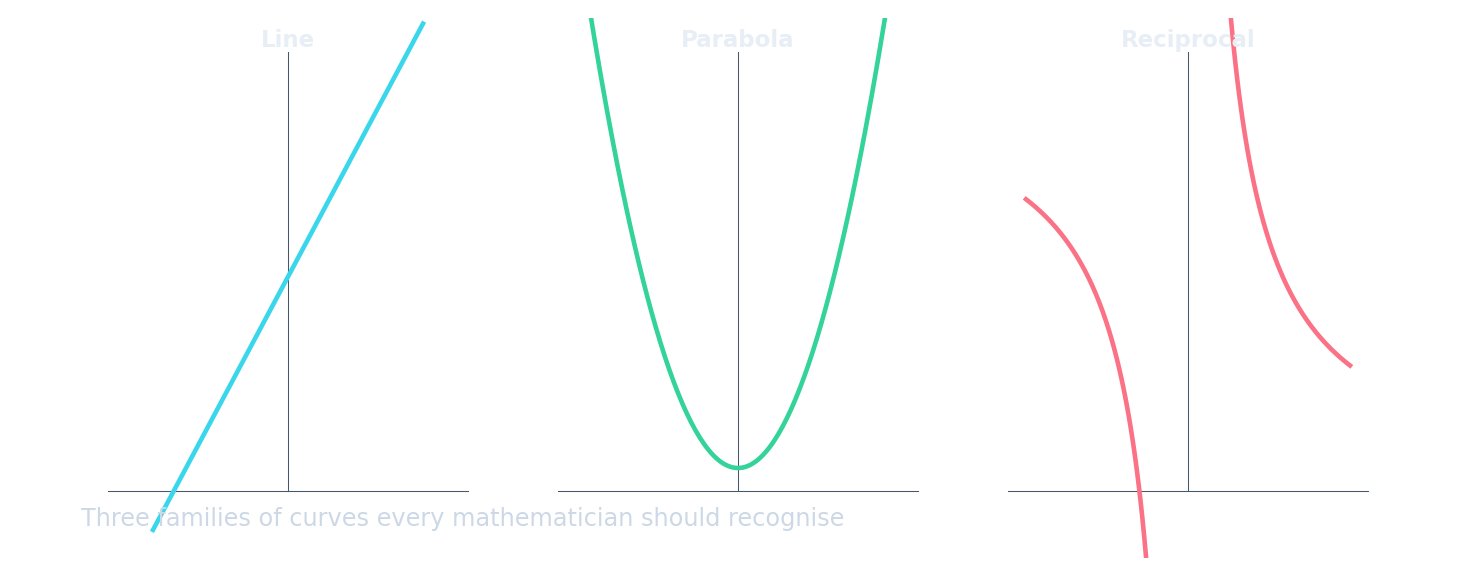
Todas as curvas aqui são funções: para cada entrada $x$, há exatamente uma saída $y$.
You've got it
- $f(x) = 3x - 5 \Rightarrow f(2) = 1$; domain = inputs, range = outputs
- inverse $f^{-1}$ undoes $f$: swap $x$ and $y$, then solve for $y$
- composite $gf(x)$ = do $f$ first, then $g$; order matters ($gf \neq fg$)
Entendeu?
- $f(x) = 3x - 5 \Rightarrow f(2) = 1$; domínio = entradas, imagem = saídas
- inversa $f^{-1}$ desfaz $f$: troque $x$ e $y$, depois resolva para $y$
- composta $gf(x)$ = faça $f$ primeiro, depois $g$; a ordem importa ($gf \neq fg$)