Exponential growth and decay · Crescimento e decaimento exponencial
| English | Português |
|---|---|
| exponential growth/ˌekspəˈnenʃl ɡrəʊθ/ | crescimento exponencial |
| compound/ˈkɒmpaʊnd/ | composto |
| decay/dɪˈkeɪ/ | decaimento |
| depreciation/dɪˌpriːʃɪˈeɪʃn/ | depreciação |
| half-life/hɑːf laɪf/ | vida média |
One bacterium becomes a billion
- A bacterium divides every 20 minutes. After 10 hours (30 divisions), one cell becomes $2^{30} \approx 1\,073\,741\,824$ — over a billion.
- That's exponential growth 指数增长: the same percentage increase every period, compounding 复利.
- Linear growth adds a fixed amount; exponential growth multiplies — and it always wins in the end.
Uma bactéria se torna um bilhão
- Uma bactéria se divide a cada 20 minutos. Após 10 horas (30 divisões), uma célula se torna $2^{30} \approx 1\,073\,741\,824$ — mais de um bilhão.
- Isso é crescimento exponencial 指数增长: o mesmo aumento percentual a cada período, acumulando 复利.
- Crescimento linear adiciona uma quantidade fixa; crescimento exponencial multiplica — e sempre vence no final.
The compound formula
- When a quantity changes by the same percentage each period:
- $P$ = starting value, $r$ = percentage rate per period, $t$ = number of periods.
- Growth: $r > 0$; decay 衰减: $r < 0$ (or use a multiplier below 1).
Exponential growth (curve) starts slowly but eventually pulls far ahead of linear growth (straight line).
A fórmula do composto
- Quando uma quantidade muda na mesma porcentagem a cada período:
- $P$ = valor inicial, $r$ = taxa percentual por período, $t$ = número de períodos.
- Crescimento: $r > 0$; decaimento 衰减: $r < 0$ (ou use um multiplicador abaixo de 1).
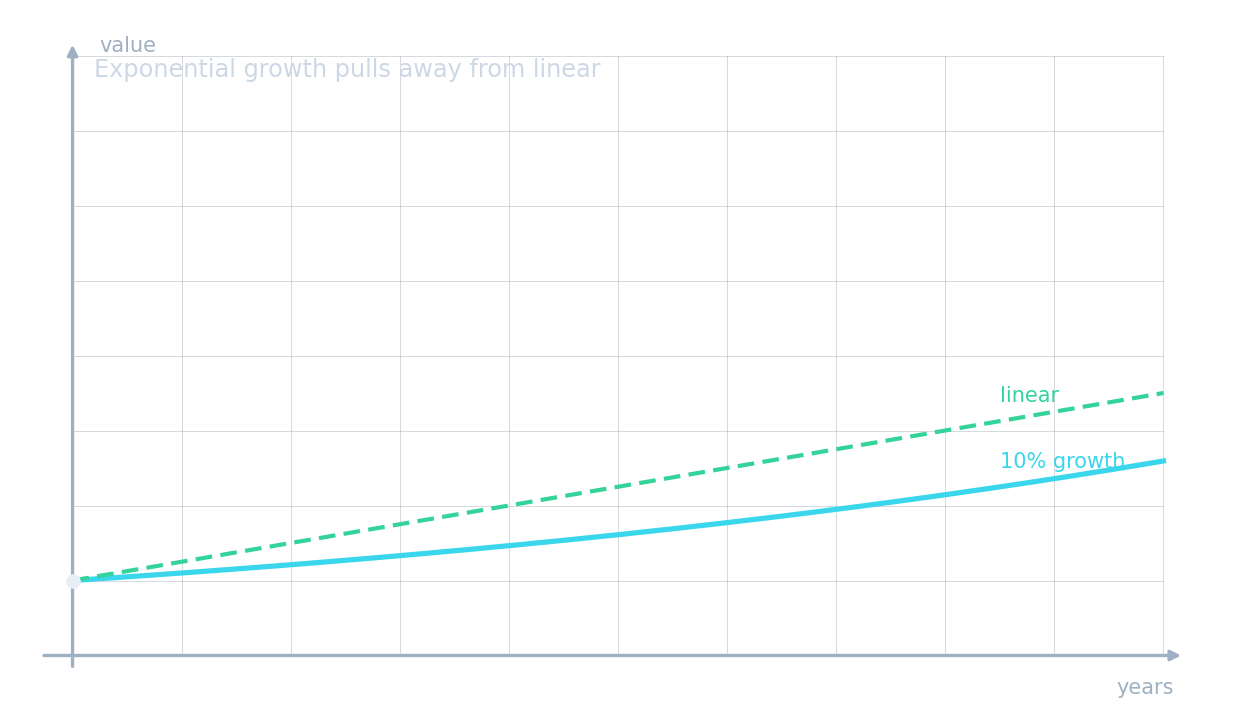
Crescimento exponencial (curva) começa devagar, mas eventualmente se afasta muito do crescimento linear (linha reta).
Compound interest
Money grows by (1 + r) every year, so compound interest curves above simple interest. Drag the rate and the number of years. · O dinheiro cresce em (1 + r) todos os anos, então as curvas de juros compostos ficam acima dos juros simples. Arraste a taxa e o número de anos.
Exponential growth & decay · Crescimento & decaimento exponencial
y = a·bˣ
Change the base b: b > 1 grows, 0 < b < 1 decays · decai — useful for interest and populations. · Mude a base b: b > 1 cresce, 0 < b < 1 decai — útil para juros e populações.
A car loses 15% of its value each year. What yearly multiplier do you use? · Um carro perde 15% de seu valor cada ano. Qual multiplicador anual você usa?
Losing 15% leaves 85%, so the multiplier is 0.85. · Perder 15% deixa 85%, então o multiplicador é 0.85.
Depreciation of a car's value each year is an example of: · A depreciação do valor de um carro anualmente é um exemplo de:
Losing a fixed percentage each year is exponential decay (multiplier < 1, applied repeatedly). · Perder uma porcentagem fixa cada ano é decaimento exponencial (multiplicador < 1, aplicado repetidamente).
The compound growth formula is: final = P × (1 + ______)^t, where r is the percentage rate. · A fórmula de crescimento composto é: final = P × (1 + ______)^t, onde r é a taxa percentual.
The rate r% must be converted to a decimal: r/100. So the multiplier is (1 + r/100). · A taxa r% deve ser convertida para decimal: r/100. Então o multiplicador é (1 + r/100).
Exponential decay and depreciation 折旧
- Decay works the same way with a multiplier below 1.
- A car worth 20 000 loses 15% each year → multiplier $0.85$.
- After 4 years: $20\,000 \times 0.85^4 = 20\,000 \times 0.5220 \approx 10\,440$.
Half-life 半衰期. A radioactive isotope decays 10% per year. Its "half-life" (time to halve) is $\dfrac{\ln 2}{\ln(1/0.9)} \approx 6.6$ years — you can find it by solving $0.9^t = 0.5$.
Decaimento exponencial e depreciação 折旧
- Decaimento funciona da mesma forma com um multiplicador abaixo de 1.
- Um carro valendo 20 000 perde 15% a cada ano → multiplicador $0.85$.
- Após 4 anos: $20\,000 \times 0.85^4 = 20\,000 \times 0.5220 \approx 10\,440$.
Meia-vida 半衰期. Um isótopo radioativo decai 10% ao ano. Sua "meia-vida" (tempo para reduzir à metade) é $\dfrac{\ln 2}{\ln(1/0.9)} \approx 6.6$ anos — você pode encontrá-la resolvendo $0.9^t = 0.5$.
A car worth 20000 depreciates 15% per year. Its value after 4 years (to the nearest 10) is: · Um carro avaliado em 20000 deprecia-se 15% ao ano. O seu valor após 4 anos (arredondado para o inteiro mais próximo 10) é:
20000 × 0.85⁴ = 20000 × 0.5220 ≈ 10440.
Worked example
- Population of 5000 grows 8% per year. After 6 years:
- $5000 \times 1.08^6 = 5000 \times 1.5869 \approx 7934$.
Compound ≠ simple. 8% per year for 6 years is not $8 \times 6 = 48\%$ total (that would give $5000 \times 1.48 = 7400$). Compounding gives $58.7\%$ total — almost 11% more, because each year's growth earns growth too.
Exemplo resolvido
- População de 5000 cresce 8% ao ano. Após 6 anos:
- $5000 \times 1.08^6 = 5000 \times 1.5869 \approx 7934$.
Composto ≠ simples. 8% ao ano por 6 anos não é $8 \times 6 = 48\%$ total (isso daria $5000 \times 1.48 = 7400$). Composto resulta em $58.7\%$ total — quase 11% a mais, porque o crescimento de cada ano rende crescimento também.
A population of 5000 grows 8% per year. What is the population after 6 years (nearest whole number)? · Uma população de 5000 cresce 8% ao ano. Qual é a população após 6 anos (número inteiro mais próximo)?
5000 × 1.08⁶ = 5000 × 1.5869 ≈ 7934.
8% growth per year for 6 years gives a total increase of exactly 48%. · Crescimento de 8% ao ano por 6 anos dá um aumento total de exatamente 48%.
Compounding gives 1.08⁶ ≈ 1.587, a 58.7% increase — more than 48% because growth earns growth. · Juros compostos dão 1.08⁶ ≈ 1.587, um aumento de 58.7% — mais que 48% porque o crescimento gera crescimento.
Where exponential growth shows up
- Epidemics: early spread is often exponential (each infected person infects others).
- Investments: compound interest is exponential growth of your money.
- Technology: Moore's Law predicted computing power doubling every ~2 years for decades.
Onde o crescimento exponencial aparece
- Epidemias: a propagação inicial é frequentemente exponencial (cada pessoa infectada infecta outras).
- Investimentos: juros compostos são crescimento exponencial do seu dinheiro.
- Tecnologia: a Lei de Moore previu o dobramento do poder de computação a cada ~2 anos durante décadas.
You've got it
- exponential change uses the compound formula $P(1 + r/100)^t$
- growth = multiplier $> 1$; decay/depreciation = multiplier $< 1$
- a 15% yearly loss → multiplier $0.85$; after 4 years: $20\,000 \times 0.85^4 \approx 10\,440$
- exponential always beats linear eventually — compounding earns growth on growth
Entendeu?
- mudança exponencial usa a fórmula composta $P(1 + r/100)^t$
- crescimento = multiplicador $> 1$; decaimento/depreciação = multiplicador $< 1$
- perda anual de 15% → multiplicador $0.85$; após 4 anos: $20\,000 \times 0.85^4 \approx 10\,440$
- exponencial sempre supera o linear eventualmente — compounding rende crescimento sobre crescimento