Surds · Radicais
| English | Português |
|---|---|
| surd/sɜːd/ | irrational |
| irrational/ɪˈræʃənl/ | irrational |
| rationalising/ˈræʃənəlaɪzɪŋ/ | racionalização |
The number that broke the Greeks
- The diagonal of a unit square is $\sqrt{2} \approx 1.41421356\dots$ — the digits never repeat and never end.
- No fraction equals it exactly. That's why we call it a surd 根式: an irrational 无理数 root that we leave in its exact form.
Surd simplification route · Rota de simplificação de radicais
Break a surd into square factors and simplify it. · Quebre um radical em fatores quadrados e simplifique.
What is a surd?
- A surd is a root that cannot be simplified to a rational number.
- $\sqrt{5}$, $\sqrt{7}$, $\sqrt[3]{10}$ are surds — they are irrational.
- $\sqrt{4} = 2$ and · e $\sqrt[3]{27} = 3$ are not · não surds — they simplify to integers.
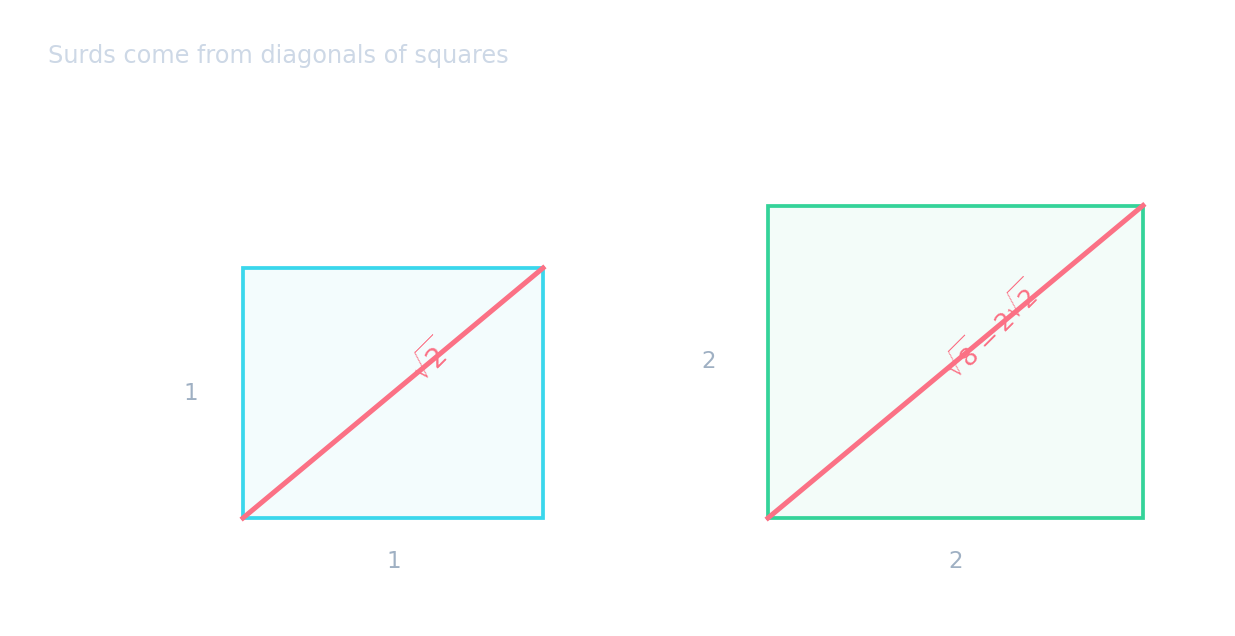
Surds come from diagonals: a $1 \times 1$ square has diagonal $\sqrt{2}$; a $2 \times 2$ square has diagonal $\sqrt{8} = 2\sqrt{2}$.
Surd rules
- $\sqrt{a} \times \sqrt{b} = \sqrt{ab}$ — combine under one root.
- $\dfrac{\sqrt{a}}{\sqrt{b}} = \sqrt{\dfrac{a}{b}}$ — divide under one root.
- Simplify by pulling out the largest perfect square factor:
Roots don't add. $\sqrt{a} + \sqrt{b} \neq \sqrt{a+b}$. For example, $\sqrt{9} + \sqrt{16} = 3 + 4 = 7$, but $\sqrt{25} = 5 \neq 7$.
Simplify √20 into the form k√5. What is k? · Simplifique √20 na forma k√5. Qual é k?
√20 = √(4×5) = √4 × √5 = 2√5, so k = 2. · √20 = √(4×5) = √4 × √5 = 2√5, logo k = 2.
Which surd rule is correct? · Qual regra de radical está correta?
√a × √b = √(ab); roots do not add like √a + √b = √(a+b). · √a × √b = √(ab); raízes não somam como √a + √b = √(a+b).
Simplify √72 into the form k√2. What is k? · Simplifique √72 na forma k√2. Qual é k?
√72 = √(36×2) = 6√2, so k = 6. · √72 = √(36×2) = 6√2, logo k = 6.
√9 + √16 = √25.
√9 + √16 = 3 + 4 = 7, but √25 = 5. Roots do not add: √a + √b ≠ √(a+b). · √9 + √16 = 3 + 4 = 7, mas √25 = 5. Raízes não somam: √a + √b ≠ √(a+b).
Complete the rule: √a × √b = √(). · Complete a regra: √a × √b = √().
√a × √b = √(ab). You can combine two square roots into one by multiplying under the root. · √a × √b = √(ab). Você pode combinar duas raízes quadradas em uma multiplicando dentro da raiz.
Rationalising 有理化 the denominator
- A fraction with a surd in the denominator is not in simplest form.
- Multiply top and bottom by the surd to remove it from the bottom:
$\dfrac{6}{\sqrt{3}} = \dfrac{6\sqrt{3}}{3} = 2\sqrt{3}$. Multiply by $\dfrac{\sqrt{3}}{\sqrt{3}} = 1$, then simplify.
Rationalise 10/√5 into the form k√5. What is k? · Racionalize 10/√5 na forma k√5. Qual é k?
10/√5 × √5/√5 = 10√5/5 = 2√5, so k = 2. · 10/√5 × √5/√5 = 10√5/5 = 2√5, logo k = 2.
Why keep surds exact?
- $\sqrt{2} \approx 1.414$ is an approximation; $\sqrt{2}$ is exact.
- In engineering and physics, rounding too early causes errors to accumulate — keeping surds preserves accuracy through long calculations.
Like surds and two-term denominators
- Simplify each root first: $\sqrt{200}-\sqrt{32}=10\sqrt2-4\sqrt2=6\sqrt2$. Combine only matching surd parts.
- For · A favor $1/(\sqrt3-1)$ multiply by the conjugate $\sqrt3+1$: the denominator is $(\sqrt3-1)(\sqrt3+1)=3-1=2$. Thus the result is $(\sqrt3+1)/2$; the multiplying fraction equals 1.
In √200 − √32 = k√2, find k. · Em √200 − √32 = k√2, encontre k.
√200 = 10√2 and √32 = 4√2, so k = 6. · √200 = 10√2 e √32 = 4√2, então k = 6.
You've got it
- a surd is an irrational root; keep it exact (don't approximate)
- simplify by the largest square factor: $\sqrt{20} = 2\sqrt{5}$, $\sqrt{72} = 6\sqrt{2}$
- rationalise the denominator by multiplying top and bottom by the surd
- $\sqrt{a} + \sqrt{b} \neq \sqrt{a+b}$ — roots don't add