Powers, roots and indices
| English | Português |
|---|---|
| power/ˈpaʊə/ | potência |
| index/ˈɪndeks/ | interface |
| base/beɪs/ | fundamentais |
| square root/skweə ruːt/ | raiz quadrada |
| cube root/kjuːb ruːt/ | raiz cúbica |
| laws of indices/lɔːz ɒv ˈɪndɪsiːz/ | leis dos índices |
| reciprocal/rɪˈsɪprəkl/ | recíproco |
The chessboard grain problem
- A king offered a reward for the invention of chess. The inventor asked for 1 grain of rice on the first square, 2 on the second, 4 on the third, doubling each time.
- By the 64th square: $2^{63}$ grains — more rice than has ever existed on Earth.
- That's the power 幂 of indices — repeated multiplication grows astonishingly fast.
O problema dos grãos no tabuleiro de xadrez
- Um rei ofereceu uma recompensa pela invenção do xadrez. O inventor pediu 1 grão de arroz no primeiro quadrado, 2 no segundo, 4 no terceiro, dobrando a cada vez.
- Até o 64º quadrado: $2^{63}$ grãos — mais arroz do que já existiu na Terra.
- Esse é o poder dos índices — a multiplicação repetida cresce assombrosamente rápido.
Powers and roots lab
square = x^2
Change the base and see powers grow while roots undo powers. · Altere a base e observe as potências crescerem enquanto as raízes desfazem as potências.
Powers
- A power (or index 指数) shows repeated multiplication: $2^5 = 2 \times 2 \times 2 \times 2 \times 2 = 32$.
- The base 底数 is the number being multiplied ($2$); the index (or exponent) tells you how many times ($5$).
- Know your squares up to $15^2 = 225$ and cubes up to $5^3 = 125$.
Potências
- Uma potência (ou índice) mostra multiplicação repetida: $2^5 = 2 \times 2 \times 2 \times 2 \times 2 = 32$.
- A base é o número que está sendo multiplicado ($2$); o índice (ou expoente) diz quantas vezes ($5$).
- Conheça seus quadrados até $15^2 = 225$ e cubos até $5^3 = 125$.
Roots
- A square root 平方根 reverses squaring: $\sqrt{169} = 13$ (because $13^2 = 169$).
- A cube root 立方根 reverses cubing: $\sqrt[3]{8} = 2$ (because $2^3 = 8$).
- Roots and powers are inverse operations.
The diagonal of a square is the square root of twice the side squared — geometry gives us roots.
$5^2 \times \sqrt[3]{8} = 25 \times 2 = 50$. Evaluate the power and root first, then multiply.
Raízes
- Uma raiz quadrada inverte o quadrado: $\sqrt{169} = 13$ (porque $13^2 = 169$).
- Uma raiz cúbica inverte o cubo: $\sqrt[3]{8} = 2$ (porque $2^3 = 8$).
- Raízes e potências são operações inversas.
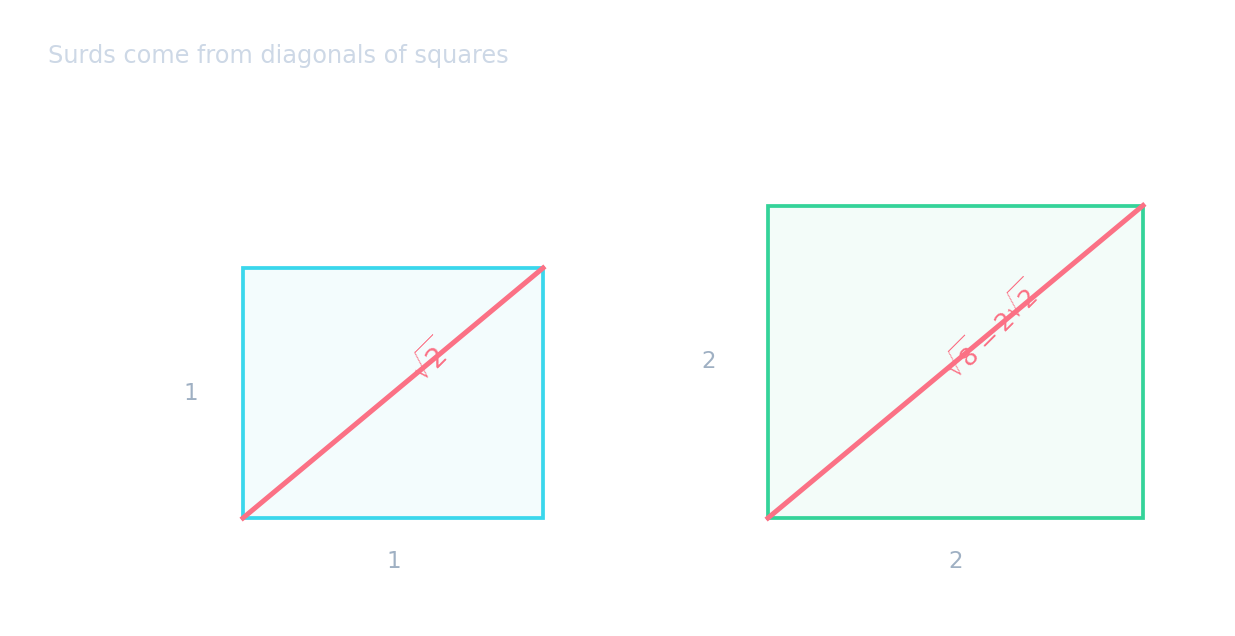
A diagonal de um quadrado é a raiz quadrada do dobro do lado ao quadrado — a geometria nos dá as raízes.
$5^2 \times \sqrt[3]{8} = 25 \times 2 = 50$. Avalie a potência e a raiz primeiro, depois multiplique.
Work out 5² × ∛8.
5² = 25 and ∛8 = 2, so 25 × 2 = 50.
The laws of indices 指数定律
- These three rules let you simplify any power expression:
Same base only. You can only add/subtract indices when the bases match. $2^3 \times 3^2$ does not simplify to $6^5$ — the bases are different.
As leis dos índices
- Estas três regras permitem simplificar qualquer expressão de potência:
Mesma base apenas. Você só pode somar/subtrair índices quando as bases forem iguais. $2^3 \times 3^2$ não se simplifica para $6^5$ — as bases são diferentes.
Using the index laws, what is 2³ × 2⁴ as a single number? · Usando as leis dos índices, qual é 2³ × 2⁴ como um único número?
2³ × 2⁴ = 2⁷ = 128.
Zero, negative and fractional powers
- $a^0 = 1$ for any non-zero $a$ (even $7^0 = 1$).
- $a^{-n} = \dfrac{1}{a^n}$ — a negative index means a reciprocal 倒数 ($3^{-2} = \dfrac{1}{9}$).
- Extended: $a^{1/n} = \sqrt[n]{a}$ — fractional powers are roots ($8^{1/3} = \sqrt[3]{8} = 2$).
Potências zero, negativas e fracionárias
- $a^0 = 1$ para qualquer não-zero $a$ (mesmo $7^0 = 1$).
- $a^{-n} = \dfrac{1}{a^n}$ — um índice negativo significa o inverso ($3^{-2} = \dfrac{1}{9}$).
- Ampliado: $a^{1/n} = \sqrt[n]{a}$ — potências fracionárias são raízes ($8^{1/3} = \sqrt[3]{8} = 2$).
Evaluate 81^(1/2).
81^(1/2) = √81 = 9.
What does 3⁻² equal?
3⁻² = 1/3² = 1/9. A negative index means reciprocal, not negative.
For any non-zero number a, a⁰ = 1.
The zero-index rule gives a⁰ = 1 for all a ≠ 0. · A regra do índice zero fornece a⁰ = 1 para todo a ≠ 0.
Complete: 4⁻¹ = ______.
4⁻¹ = 1/4 = 0.25. A power of −1 gives the reciprocal.
You've got it
- multiply same-base powers → add indices; divide → subtract; power of a power → multiply
- $a^0 = 1$, $\;a^{-n} = \dfrac{1}{a^n}$, $\;a^{1/n} = \sqrt[n]{a}$
- $5^2 \times \sqrt[3]{8} = 25 \times 2 = 50$; $\;2^3 \times 2^4 = 2^7 = 128$
Entendeu?
- multiplique potências de mesma base → some os índices; divida → subtraia; potência de uma potência → multiplique
- $a^0 = 1$, $\;a^{-n} = \dfrac{1}{a^n}$, $\;a^{1/n} = \sqrt[n]{a}$
- $5^2 \times \sqrt[3]{8} = 25 \times 2 = 50$; $\;2^3 \times 2^4 = 2^7 = 128$