Induced Currents and Magnetic Forces · Correntes Induzidas e Forças Magnéticas
| English | Português |
|---|---|
| Lenz's law/ˈlentsɪz lɔː/ | Lei de Lenz |
| eddy currents/ˈedi ˈkʌrənts/ | correntes de Foucault |
The induced current always fights the change that made it
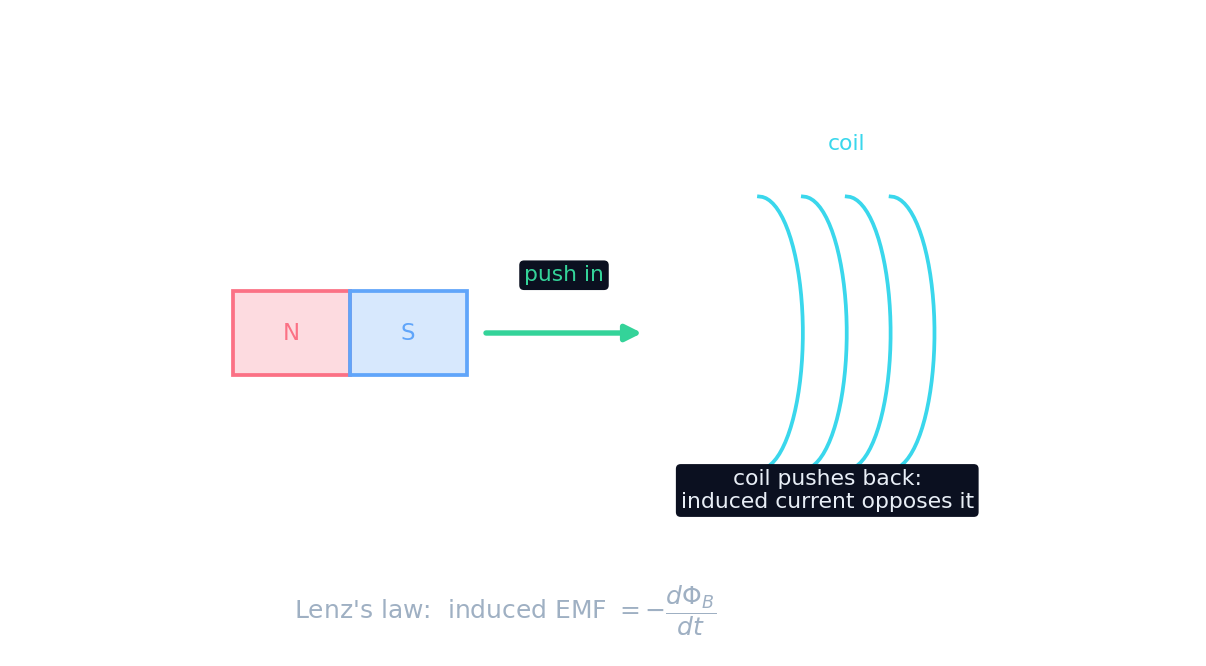
- Push a magnet at a coil and the coil pushes back.
- The induced current flows the way that opposes the incoming change.
- This stubborn opposition is Lenz's law 楞次定律.
- It is the minus sign in Faraday's law, and it comes from energy conservation.
A corrente induzida sempre se opõe à mudança que a gerou
- Empurre um ímã contra uma bobina e a bobina empurra de volta.
- A corrente induzida flui de modo a opor-se à mudança entrante.
- Essa resistência teimosa é a Lei de Lenz 楞次定律.
- É o sinal negativo na Lei de Faraday, e vem da conservação de energia.
Lenz's law: oppose the change
- The induced current makes its own magnetic field.
- That field points so as to fight the change in flux.
- Push a north pole in, and the coil's near face becomes a north pole to repel it.
- Pull it out, and the coil turns south to try to hold it back.
Lei de Lenz: oponha-se à mudança
- A corrente induzida cria seu próprio campo magnético.
- Esse campo aponta para lutar contra a mudança no fluxo.
- Empurre um polo norte para dentro, e a face próxima da bobina torna-se um polo norte para repeli-lo.
- Puxe-o para fora, e a bobina vira sul para tentar segurá-lo.
Watch the opposition · Observe a oposição
Push the magnet in and out and see the induced current reverse to always oppose the change. · Empurre o ímã para dentro e para fora e veja a corrente induzida inverter para sempre se opor à mudança.
The induced current in a coil always flows so that its magnetic field: · A corrente induzida em uma bobina sempre flui de modo que seu campo magnético:
Lenz's law: the induced field always opposes the change. · Lei de Lenz: o campo induzido sempre se opõe à mudança.
You push a north pole toward a coil. The coil's near face becomes a: · Você empurra um polo norte em direção a uma bobina. A face próxima da bobina torna-se um:
To oppose the approach, the near face turns north and repels. · Para se opor à aproximação, a face próxima vira norte e repele.
Why: you can't get free energy
- Suppose the induced current helped the magnet instead of opposing it.
- Then the magnet would speed up on its own, making even more current — free energy.
- That would break energy conservation, so nature forbids it.
- You must do work against the opposition to keep the flux changing.
Por quê: você não pode obter energia grátis
- Suponha que a corrente induzida ajudasse o ímã em vez de se opor a ele.
- Então o ímã aceleraria sozinho, gerando ainda mais corrente — energia grátis.
- Isso violaria a conservação de energia, então a natureza o proíbe.
- Você deve fazer trabalho contra essa oposição para manter o fluxo variando.
Lenz's law is a direct consequence of the conservation of: · A lei de Lenz é uma consequência direta da conservação de:
If the current helped the change, you would get free energy — forbidden. · Se a corrente ajudasse a mudança, você obteria energia livre — proibido.
The opposition feels like a drag
- Because it opposes the motion, the induced current creates a resisting force.
- Move the magnet faster and the drag grows — you push harder, and more current flows.
- The mechanical work you do becomes the electrical energy induced.
- Opposition is exactly what makes induction an energy converter.
A oposição parece um arrasto
- Como se opõe ao movimento, a corrente induzida cria uma força resistente.
- Mova o ímã mais rápido e o arrasto aumenta — você empurra mais forte, e mais corrente flui.
- O trabalho mecânico que você faz torna-se a energia elétrica induzida.
- A oposição é exatamente o que torna a indução um conversor de energia.
The induced current creates a force that opposes the motion causing it (a drag). · A corrente induzida cria uma força que se opõe ao movimento que a causou (um arrasto).
The opposition acts as a drag; your work becomes electrical energy. · A oposição age como um arrasto; seu trabalho se torna energia elétrica.
Select all · todos true statements about Lenz's law. · Selecione todas as afirmações verdadeiras sobre a Lei de Lenz.
Opposes the change, from energy conservation, acts as a drag. It never helps the change. · Opõe-se à mudança, vem da conservação de energia, age como um arrasto. Ela nunca ajuda a mudança.
Everyday uses of the drag
- Eddy currents 涡电流 induced in a metal disc brake a train smoothly, with no pads.
- Induction cooktops heat a pan by driving eddy currents in its base.
- Metal detectors sense the eddy currents a coin induces.
- Each turns a changing flux into heat or a braking force.
Usos cotidianos do arrasto
- Correntes de Foucault 涡电流 induzidas em um disco metálico freiam um trem suavemente, sem pastilhas.
- Fogões de indução aquecem uma panela acionando correntes de Foucault em sua base.
- Detectores de metal sentem as correntes de Foucault que uma moeda induz.
- Cada uma converte um fluxo variável em calor ou força de frenagem.
The swirling induced currents used for smooth braking are called ____ currents. · As correntes giratórias induzidas usadas para freios suaves são chamadas de correntes ____.
Eddy currents brake trains and heat induction cooktops. · Correntes eddy freiam trens e aquecem panelas de indução.
You push the north pole of a magnet toward a coil.
- By Lenz's law, the coil's near face becomes a north pole to repel it.
- You must do work pushing against that repulsion — that work becomes the induced electrical energy.
Você empurra o polo norte de um ímã em direção a uma bobina.
- Pela Lei de Lenz, a face próxima da bobina torna-se um polo norte para repeli-lo.
- Você deve fazer trabalho empurrando contra essa repulsão — esse trabalho torna-se a energia elétrica induzida.
The induced current always opposes the change, never helps it. If you ever find an induced current that reinforces the change, you have the direction backward — check with Lenz's law, which guarantees energy conservation.
A corrente induzida sempre se opõe à mudança, nunca a ajuda. Se você encontrar alguma corrente induzida que reforça a mudança, inverteu o sentido — verifique com a Lei de Lenz, que garante a conservação de energia.
Lenz's law: the induced current always opposes the change in flux — the minus sign in $\varepsilon = -d\Phi_B/dt$. It follows from energy conservation (no free energy), so the opposition feels like a drag; eddy currents use it for braking and induction heating.
Lei de Lenz: a corrente induzida sempre se opõe à mudança no fluxo — o sinal negativo em $\varepsilon = -d\Phi_B/dt$. Ela decorre da conservação de energia (nenhuma energia grátis), por isso a oposição parece um arrasto; correntes de Foucault usam isso para frenagem e aquecimento por indução.