Inductance · Indutância
| English | Português |
|---|---|
| inductance/ɪnˈdʌktəns/ | indutância |
| henries/ˈhenriz/ | henries |
A coil resists changes to its own current — electrical inertia
- Try to switch a coil's current on suddenly and it fights back.
- Its own changing flux induces an EMF that opposes the change.
- This self-opposition is called inductance 电感.
- Think of it as electrical inertia: current in a coil doesn't like to change quickly.
Uma bobina resiste a mudanças em sua própria corrente — inércia elétrica
- Tente ligar a corrente de uma bobina de repente e ela se opõe.
- Seu próprio fluxo variável induz uma FEM que se opõe à mudança.
- Essa autoodposição chama-se indutância 电感.
- Pense nela como inércia elétrica: a corrente em uma bobina não gosta de mudar rapidamente.
The self-induced EMF
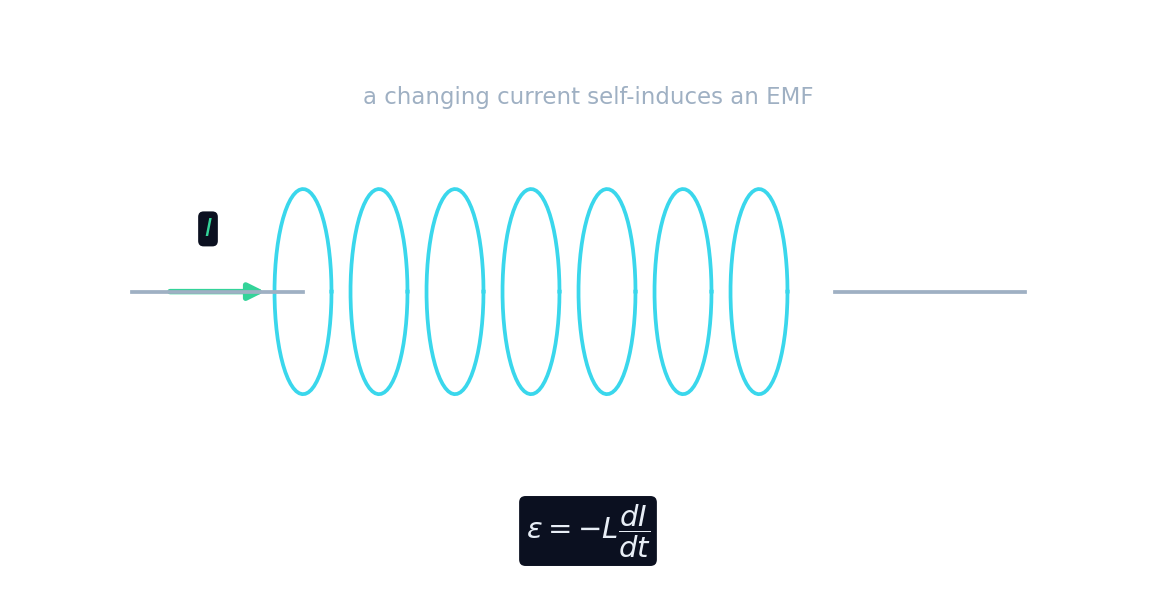
- A changing current makes a changing flux through the coil's own turns.
- By Faraday and Lenz, this induces a back-EMF: $\varepsilon = -L\dfrac{dI}{dt}$.
- $L$ is the inductance, measured in henries 亨利 (H).
- The faster you change the current, the harder the coil pushes back.
A FEM auto-induzida
- Uma corrente variável produz um fluxo variável através das próprias espiras da bobina.
- Pela Lei de Faraday e Lenz, isso induz uma FEM contrária: $\varepsilon = -L\dfrac{dI}{dt}$.
- $L$ é a indutância, medida em henries 亨利 (H).
- Quanto mais rápido você alterar a corrente, mais forte a bobina se opõe.
The self-induced EMF of an inductor is: · A FEM autorinduzida de um indutor é:
$\varepsilon = -L\,dI/dt$ — proportional to the rate of current change. · $\varepsilon = -L\,dI/dt$ — proporcional à taxa de mudança da corrente.
A $4\ \text{H}$ inductor's current changes at $2\ \text{A/s}$. Find the induced EMF magnitude (in V). · Um indutor de $4\ \text{H}$ tem sua corrente mudando a $2\ \text{A/s}$. Encontre a magnitude da FEM induzida (em V).
$|\varepsilon| = L\,dI/dt = 4 \times 2 = 8\ \text{V}$.
The SI unit of inductance is the ____. · A unidade SI de indutância é o ____.
Inductance · Indutância $L$ is measured in henries (H). · Indutância $L$ é medida em henries (H).
What sets the inductance
- Like capacitance, $L$ depends on geometry, not on the current.
- More turns, a bigger area, or a longer coil change $L$.
- A tightly wound solenoid with many turns has a large inductance.
- Add an iron core and $L$ grows much larger still.
O que determina a indutância
- Assim como a capacitância, $L$ depende da geometria, não da corrente.
- Mais espiras, uma área maior ou uma bobina mais longa alteram $L$.
- Um solenóide bem enrolado com muitas espiras tem grande indutância.
- Adicione um núcleo de ferro e $L$ cresce muito ainda mais.
Energy stored in the field
- Building up a current stores energy in the coil's magnetic field.
- The stored energy is $U = \tfrac12 L I^2$.
- Compare it with a capacitor's $\tfrac12 C V^2$ — the magnetic twin.
- Switch the current off suddenly and this energy has to go somewhere (often a spark).
Energia armazenada no campo
- Construir uma corrente armazena energia no campo magnético da bobina.
- A energia armazenada é $U = \tfrac12 L I^2$.
- Compare-a com a $\tfrac12 C V^2$ de um capacitor — o gêmeo magnético.
- Desligue a corrente de repente e essa energia precisa ir para algum lugar (geralmente um faísca).
Inductance opposes change · A indutância se opõe à mudança
A changing current in a coil induces a back-EMF proportional to how fast the current changes. · Uma corrente variável em uma bobina induz uma FEM contrária proporcional à rapidez com que a corrente muda.
The energy stored in an inductor carrying current $I$ is: · A energia armazenada em um indutor carregando corrente $I$ é:
$U = \tfrac12 LI^2$ — the magnetic twin of $\tfrac12 CV^2$. · $U = \tfrac12 LI^2$ — o gêmeo magnético de $\tfrac12 CV^2$.
The mirror image of a capacitor
- A capacitor opposes sudden changes in voltage.
- An inductor opposes sudden changes in current.
- A capacitor stores energy in an electric field; an inductor in a magnetic field.
- Together they are the two energy-storing circuit elements.
A imagem espelhada de um capacitor
- Um capacitor se opõe a mudanças súbitas em tensão.
- Um indutor se opõe a mudanças súbitas em corrente.
- Um capacitor armazena energia em um campo elétrico; um indutor em um campo magnético.
- Juntos, são os dois elementos de circuito que armazenam energia.
With a steady, unchanging current, an ideal inductor behaves like an ordinary wire. · Com uma corrente constante e invariável, um indutor ideal comporta-se como um fio comum.
$dI/dt = 0$ gives zero back-EMF, so it acts like a plain wire. · $dI/dt = 0$ dá FEM contrária zero, então age como um fio simples.
Select all · todos true statements about an inductor. · Selecione todas as afirmações verdadeiras sobre um indutor.
Opposes current change, stores ½LI², geometric L. Opposing voltage change is a capacitor. · Opõe-se à mudança de corrente, armazena ½LI², L geométrica. Opor-se à mudança de tensão é um capacitor.
A coil has $L = 2\ \text{H}$ and its current changes at $3\ \text{A/s}$. Find the induced EMF.
- $|\varepsilon| = L\dfrac{dI}{dt} = 2 \times 3$.
- $|\varepsilon| = 6\ \text{V}$, opposing the change.
Uma bobina tem $L = 2\ \text{H}$ e sua corrente muda em $3\ \text{A/s}$. Encontre a FEM induzida.
- $|\varepsilon| = L\dfrac{dI}{dt} = 2 \times 3$.
- $|\varepsilon| = 6\ \text{V}$, opondo-se à mudança.
An inductor opposes a change in current, not the current itself. A steady current ($dI/dt = 0$) induces no back-EMF at all — the coil then behaves like an ordinary wire. It only fights while the current is changing.
Um indutor se opõe a uma mudança na corrente, não à corrente em si. Uma corrente constante ($dI/dt = 0$) não induz nenhuma FEM contrária — a bobina então se comporta como um fio comum. Ela só luta enquanto a corrente está mudando.
Inductance $L$ (in henries) is a coil's electrical inertia: a changing current self-induces a back-EMF $\varepsilon = -L\,dI/dt$. It depends on geometry and stores energy $U = \tfrac12 LI^2$. An inductor opposes changes in current, the mirror of a capacitor opposing changes in voltage.
Indutância $L$ (em henries) é a inércia elétrica de uma bobina: uma corrente variável auto-induz uma FEM contrária $\varepsilon = -L\,dI/dt$. Depende da geometria e armazena energia $U = \tfrac12 LI^2$. Um indutor se opõe a mudanças em corrente, o espelho de um capacitor que se opõe a mudanças em tensão.