Interference · Interferência
| English | Português |
|---|---|
| interference/ˌɪntəˈfɪərəns/ | interferência |
| coherent/kəʊˈhɪərənt/ | coerente |
| constructive/kənˈstrʌktɪv/ | construtiva |
| destructive/dɪˈstrʌktɪv/ | destrutiva |
| fringe/frɪndʒ/ | franja |
| path difference/pæθ ˈdɪfrəns/ | diferença de caminho |
| antiphase/ˌæntɪˈfeɪz/ | antifase |
| double slit/ˈdʌbl slɪt/ | fenda dupla |
Two stones in a pond
- Drop two stones together and the ripples cross, making a steady criss-cross pattern.
- Some places churn; others stay almost still.
- This is interference 干涉 — superposition from two sources.
Dois pedras em um lago
- Jogue duas pedras juntas e as ondulações se cruzam, criando um padrão regular de intersecção.
- Alguns lugares agitam-se; outros permanecem quase parados.
- Isso é interferência 干涉 — superposição de duas fontes.
What interference is
- Two coherent 相干 waves overlap to give a fixed pattern.
- Bright (constructive 相长) where they add; dark (destructive 相消) where they cancel.
Two-source interference in a ripple tank: circular waves overlap to give lines of cancellation
O que é interferência
- Duas ondas coerentes 相干 se sobrepõem para dar um padrão fixo.
- Brilhante (construtiva 相长) onde se somam; escura (destrutiva 相消) onde se cancelam.

Interferência de duas fontes em tanque de ondulações: ondas circulares se sobrepõem para dar linhas de cancelamento
Interference · Interferência
y = y₁ + y₂
In phase → constructive · construtiva (bright/loud); antiphase → destructive · destrutiva (dark/quiet). · Em fase → construtiva (brilhante/forte); fora de fase → destrutiva (escura/silenciosa).
Coherence
- Two sources are coherent if they keep a constant phase difference (same frequency).
- Two separate lamps are not coherent — their phases jump randomly, so any pattern flickers away.
The colours on a soap bubble come from interference of light
Coerência
- Duas fontes são coerentes se mantiverem uma diferença de fase constante (mesma frequência).
- Duas lâmpadas separadas não são coerentes — suas fases saltam aleatoriamente, então qualquer padrão pisca e desaparece.

As cores numa bolha de sabão vêm da interferência da luz
Two coherent sources have: · Duas fontes coerentes possuem:
Coherence means a constant phase difference (and so the same frequency) — needed for a steady pattern. · Coerência significa uma diferença de fase constante (e, portanto, a mesma frequência) — necessária para um padrão estável.
Two separate lamps make a steady, visible interference pattern. · Duas lâmpadas separadas formam um padrão de interferência estável e visível.
No — their phase difference changes randomly, so any pattern flickers too fast to see. · Não — sua diferença de fase muda aleatoriamente, então qualquer padrão piscaria rápido demais para ser visto.
Coherent sources have a ____ phase difference, and therefore the same frequency. · Fontes coerentes têm uma diferença de fase ____ e, portanto, a mesma frequência.
Constant, not zero. Two sources permanently out of step by a quarter cycle are still coherent, and "in phase" is the wrong word here. · Constante, não zero. Duas fontes permanentemente defasadas por um quarto de ciclo ainda são coerentes, e "em fase" é a palavra errada aqui.
Path difference 路程差
- Constructive: path difference $= n\lambda$ (a whole number of wavelengths) — the waves arrive in phase.
- Destructive: path difference $= \left(n + \tfrac{1}{2}\right)\lambda$ — the waves arrive in antiphase 反相.
Two coherent sources give lines of maximum displacement where crests meet crests
Diferença de caminho 路程差
- Construtiva: diferença de caminho $= n\lambda$ (um número inteiro de comprimentos de onda) — as ondas chegam em fase.
- Destrutiva: diferença de caminho $= \left(n + \tfrac{1}{2}\right)\lambda$ — as ondas chegam em antifase 反相.
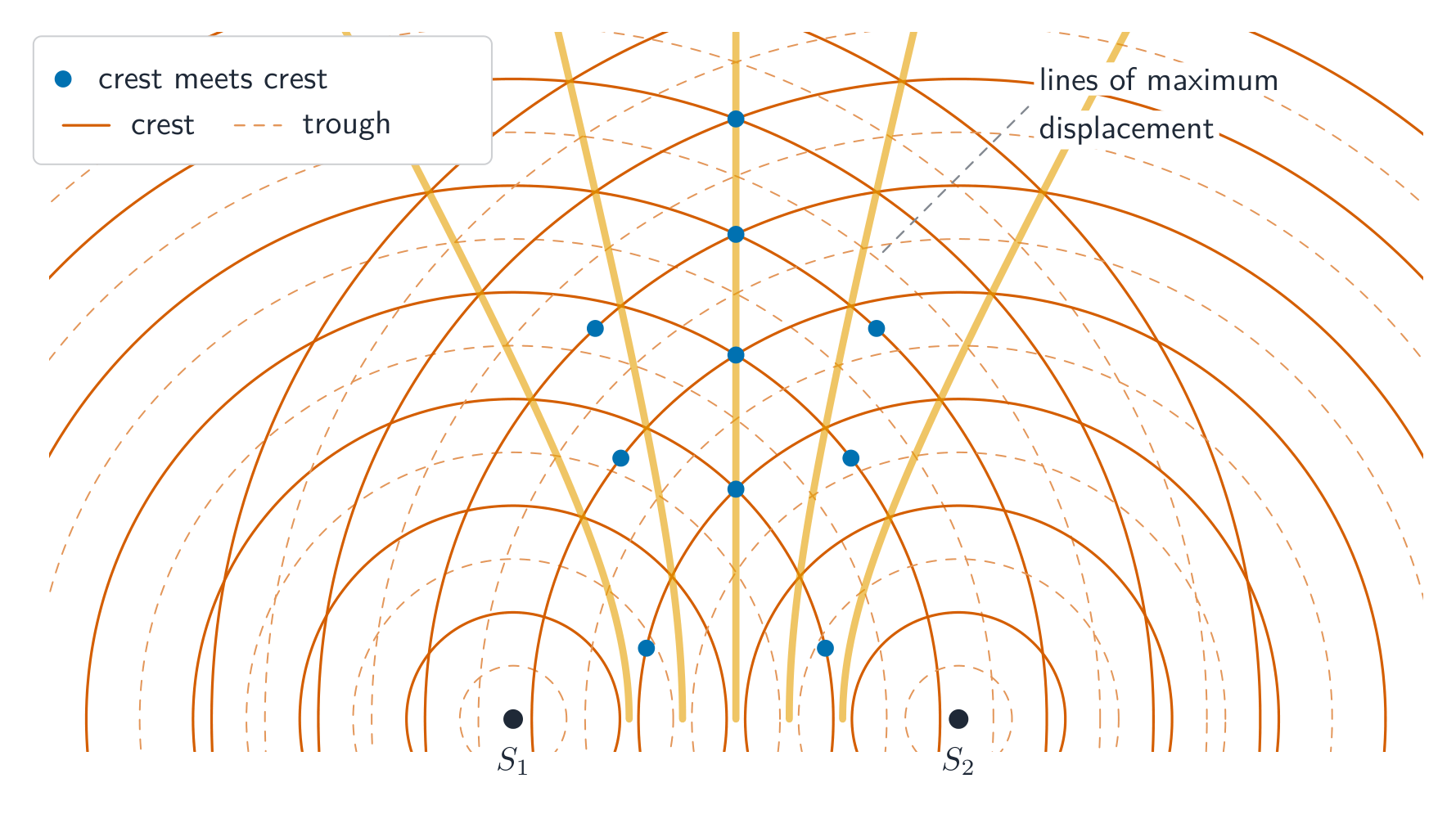
Duas fontes coerentes dão linhas de deslocamento máximo onde cristas encontram cristas
Constructive interference happens when the path difference is: · A interferência construtiva ocorre quando a diferença de caminho é:
$\Delta x = n\lambda$ → crests arrive together → they add. $(n+\tfrac{1}{2})\lambda$ gives cancellation. · $\Delta x = n\lambda$ → cristas chegam juntas → elas se somam. $(n+\tfrac{1}{2})\lambda$ causa cancelamento.
Destructive interference happens when the path difference is a whole number plus a ____ of a wavelength. · A interferência destrutiva ocorre quando a diferença de caminho é um número inteiro mais um ____ de um comprimento de onda.
$\Delta x = \left(n + \tfrac{1}{2}\right)\lambda$ — a crest meets a trough, so they cancel. · $\Delta x = \left(n + \tfrac{1}{2}\right)\lambda$ — uma crista encontra um vale, então se cancelam.
Explaining the pattern in exam words
- Four marks, four sentences. 1. The two slits act as coherent sources (constant phase difference), because the same wave reaches both.
- 2. The waves from the two slits overlap and superpose.
- 3. Where the path difference is a whole number of wavelengths the waves arrive in phase → constructive interference → a bright fringe.
- 4. Where it is an odd number of half-wavelengths they arrive in antiphase → destructive → a dark fringe.
Explicando o padrão com palavras de prova
- Quatro marks, quatro frases. 1. As duas fendas atuam como fontes coerentes (diferença de fase constante), porque a mesma onda atinge ambas.
- 2. As ondas das duas fendas se sobrepõem e superpõem-se.
- 3. Onde a diferença de caminho é um número inteiro de comprimentos de onda, as ondas chegam em fase → interferência construtiva → uma franja brilhante.
- 4. Onde é um número ímpar de meios-comprimentos de onda, elas chegam em antifase → destrutiva → uma franja escura.
Put the steps of the explanation of a double-slit pattern in order. · Organize as etapas da explicação do padrão de fenda dupla em ordem.
Coherence first, then superposition, then the two path-difference conditions — each is a separate mark. · Primeiro a coerência, depois a superposição, e então as duas condições de diferença de caminho — cada uma vale uma marca.
Young's double slit 双缝
- One source lights two slits, so they act as coherent sources.
- Fringe 条纹 spacing $x = \dfrac{\lambda D}{a}$ ($a$ = slit gap, $D$ = distance to screen).
Dupla fenda de Young 双缝
- Uma fonte ilumina duas fendas, então elas atuam como fontes coerentes.
- Espaçamento de franjas 条纹 spacing $x = \dfrac{\lambda D}{a}$ ($a$ = separação das fendas, $D$ = distância ao ecrã).

Light of wavelength $600\ \text{nm}$ passes through slits $1.0\ \text{mm}$ apart onto a screen $2.0\ \text{m}$ away. Find the fringe spacing, in mm. · Luz de comprimento de onda $600\ \text{nm}$ passa por fendas $1.0\ \text{mm}$ separadas num ecrã $2.0\ \text{m}$ distante. Encontre o espaçamento das franjas, em mm.
$x = \dfrac{\lambda D}{a} = \dfrac{600 \times 10^{-9} \times 2.0}{1.0 \times 10^{-3}} = 1.2 \times 10^{-3}\ \text{m} = 1.2\ \text{mm}$.
Which changes increase the fringe spacing in a double-slit experiment? Select all · todos that apply. · Quais mudanças aumentam o espaçamento entre franjas em um experimento de fenda dupla? Selecione todos os que se aplicam.
x = lambda D / a has no brightness in it. A brighter source gives brighter fringes in the same places, which is a favourite distractor. · x = lambda D / a não inclui brilho. Uma fonte mais brilhante produz franjas mais brilhantes nos mesmos lugares, o que é um distrator favorito.
Changing the fringe spacing
- From $x = \dfrac{\lambda D}{a}$: closer fringes need bigger $a$, smaller $D$, or shorter $\lambda$.
- Bluer light gives tighter fringes than red.
Alterando o espaçamento das franjas
- De $x = \dfrac{\lambda D}{a}$: franjas mais próximas exigem maior $a$, menor $D$, ou menor $\lambda$.
- Luz azul dá franjas mais apertadas do que vermelha.
Select all · todos the changes that make the fringes closer together. · Selecione todos os cambios que tornam as franjas mais próximas umas das outras.
From $x = \dfrac{\lambda D}{a}$: smaller $x$ needs a bigger $a$, a smaller $D$, or a shorter $\lambda$. · De $x = \dfrac{\lambda D}{a}$: menor $x$ precisa de maior $a$, menor $D$, ou menor $\lambda$.
Two slits 0.50 mm apart are lit by 600 nm light, with a screen 2.0 m away. What is the fringe spacing, in mm? · Duas fendas 0.50 mm separadas são iluminadas por luz de 600 nm, com uma tela a 2.0 m de distância. Qual é o espaçamento entre as franjas, em mm?
x = lambda D/a = (600e-9)(2.0)/(0.50e-3) = 2.4e-3 m. Convert both the wavelength and the slit separation to metres before dividing. · x = lambda D/a = (600e-9)(2.0)/(0.50e-3) = 2.4e-3 m. Converta tanto o comprimento de onda quanto o espaçamento entre fendas para metros antes de dividir.
Worked example: from fringes to a frequency
A laser lights a double slit of separation $0.16\ \text{mm}$; the screen is $1.2\ \text{m}$ away. The distance from the centre of the first dark fringe to the centre of the ninth is $3.2\ \text{cm}$. Find the wavelength and the frequency of the light.
- Count the gaps: first to ninth is eight spacings, so $x = \dfrac{3.2}{8} = 0.40\ \text{cm} = 4.0 \times 10^{-3}\ \text{m}$.
- Wavelength: $\lambda = \dfrac{xa}{D} = \dfrac{(4.0 \times 10^{-3})(0.16 \times 10^{-3})}{1.2} = 5.3 \times 10^{-7}\ \text{m}$ — green light.
- Frequency: $f = \dfrac{c}{\lambda} = \dfrac{3.00 \times 10^{8}}{5.3 \times 10^{-7}} = 5.6 \times 10^{14}\ \text{Hz}$.
- Check: dark fringes are spaced the same as bright ones, so either kind gives $x$. Dividing by nine instead of eight is the usual slip.
Exemplo resolvido: de franjas para uma frequência
Um laser ilumina uma dupla fenda de separação $0.16\ \text{mm}$; o ecrã está $1.2\ \text{m}$ afastado. A distância do centro da primeira franja escura ao centro da nona é $3.2\ \text{cm}$. Encontre o comprimento de onda e a frequência da luz.
- Conte os espaços: da primeira à nona há oito espaçamentos, logo $x = \dfrac{3.2}{8} = 0.40\ \text{cm} = 4.0 \times 10^{-3}\ \text{m}$.
- Comprimento de onda: $\lambda = \dfrac{xa}{D} = \dfrac{(4.0 \times 10^{-3})(0.16 \times 10^{-3})}{1.2} = 5.3 \times 10^{-7}\ \text{m}$ — luz verde.
- Frequência: $f = \dfrac{c}{\lambda} = \dfrac{3.00 \times 10^{8}}{5.3 \times 10^{-7}} = 5.6 \times 10^{14}\ \text{Hz}$.
- Verifique: as franjas escuras têm o mesmo espaçamento que as brilhantes, logo qualquer tipo dá $x$. Dividir por nove em vez de oito é o erro comum.
In a double-slit pattern the centres of the first and sixth dark fringes are $2.0\ \text{cm}$ apart. What is the fringe spacing, in mm? · Em um padrão de fenda dupla, os centros da primeira e da sexta franja escura estão $2.0\ \text{cm}$ apartados. Qual é o espaçamento entre franjas, em mm?
First to sixth is five spacings: $x = \dfrac{2.0\ \text{cm}}{5} = 0.40\ \text{cm} = 4\ \text{mm}$. · Da primeira à sexta há cinco espaçamentos: $x = \dfrac{2.0\ \text{cm}}{5} = 0.40\ \text{cm} = 4\ \text{mm}$.
Worked example: two microwave sources
Two microwave transmitters emit in phase. A detector moved along a line finds the first minimum from the centre at a point where the two path lengths differ by $4.5\ \text{cm}$.
- First minimum: path difference $= \tfrac{1}{2}\lambda$, so $\lambda = 9.0\ \text{cm}$.
- Frequency: $f = \dfrac{c}{\lambda} = \dfrac{3.00 \times 10^{8}}{0.090} = 3.3 \times 10^{9}\ \text{Hz}$.
- Next maximum out from the centre: path difference $= \lambda = 9.0\ \text{cm}$.
- Check: the pattern is symmetrical about the centre line, so every point has a twin on the other side with the same intensity — that is the point an exam asks you to mark.
Exemplo resolvido: duas fontes de micro-ondas
Dois transmissores de micro-ondas emitem em fase. Um detector movido ao longo de uma linha encontra o mínimo primeiro em relação ao centro num ponto onde os dois caminhos diferem em $4.5\ \text{cm}$.
- Primeiro mínimo: diferença de caminho $= \tfrac{1}{2}\lambda$, logo $\lambda = 9.0\ \text{cm}$.
- Frequência: $f = \dfrac{c}{\lambda} = \dfrac{3.00 \times 10^{8}}{0.090} = 3.3 \times 10^{9}\ \text{Hz}$.
- Próximo máximo afastando-se do centro: diferença de caminho $= \lambda = 9.0\ \text{cm}$.
- Verifique: o padrão é simétrico em relação à linha central, logo cada ponto tem um gêmeo no outro lado com a mesma intensidade — esse é o ponto que uma prova pede para assinalar.
Coherent means a constant phase difference — not "in phase" and not merely "the same frequency". Two independent lamps of the same colour share a frequency but are not coherent, so no steady pattern forms. And fringe spacing is between adjacent fringes: the first-to-ninth distance is eight spacings, not nine.
Coerente significa diferença de fase constante — não "em fase" nem meramente "mesma frequência". Duas lâmpadas independentes da mesma cor partilham uma frequência mas não são coerentes, logo nenhum padrão estável se forma. E o espaçamento de franjas é entre franjas adjacentes: a distância da primeira à nona é oito espaçamentos, não nove.
You've got it
- interference needs coherent sources (constant phase difference)
- constructive: $\Delta x = n\lambda$ (in phase); destructive: $\Delta x = \left(n+\tfrac{1}{2}\right)\lambda$ (antiphase)
- double-slit fringe spacing $x = \dfrac{\lambda D}{a}$; count the gaps between fringes, not the fringes
Entendeu?
- interferência precisa de fontes coerentes (diferença de fase constante)
- construtiva: $\Delta x = n\lambda$ (em fase); destrutiva: $\Delta x = \left(n+\tfrac{1}{2}\right)\lambda$ (antifase)
- espaçamento de franjas de dupla fenda $x = \dfrac{\lambda D}{a}$; conte os espaços entre as franjas, não as franjas