Probability generating functions · Funções geradoras de probabilidade
| English | Português |
|---|---|
| discrete distribution/dɪˈskriːt ˌdɪstrɪˈbjuːʃn/ | distribuição discreta |
| probability generating function/ˌprɒbəˈbɪlɪti ˈdʒenəreɪtɪŋ ˈfʌŋkʃn/ | função geradora de probabilidade |
| coefficient/ˌkəʊɪˈfɪʃənt/ | coeficiente |
| variance/ˈveərɪəns/ | variação |
| derivative/dɪˈrɪvətɪv/ | derivada |
| independent/ˌɪndɪˈpendənt/ | independente |
A distribution in a single function
- A discrete distribution 离散分布 is a list of probabilities — clumsy to manipulate.
- A probability generating function 概率母函数 (PGF) packs the whole list into one tidy function, turning hard probability sums into easy calculus.
Uma distribuição em uma única função
- Uma distribuição discreta 离散分布 é uma lista de probabilidades — complicada de manipular.
- Uma função geradora de probabilidades 概率母函数 (PGF) compacta toda a lista em uma única função limpa, transformando somas complexas de probabilidade em cálculo fácil.
Probability generating function lab · Laboratório de função geradora de probabilidade
G(x) = p0 + p1 x + p2 x^2 + ...
Change x and see how a PGF stores probabilities in powers of x. · Altere x e veja como uma PGF armazena probabilidades em potências de x.
Defining the PGF
- For a discrete variable $X$ taking values $0, 1, 2, \dots$:
- The coefficient 系数 of $t^x$ is exactly $P(X = x)$ — the function encodes the distribution.
A probability generating function stores all the probabilities as coefficients
Definindo a PGF
- Para uma variável discreta $X$ assumindo valores $0, 1, 2, \dots$:
- O coeficiente 系数 de $t^x$ é exatamente $P(X = x)$ — a função codifica a distribuição.
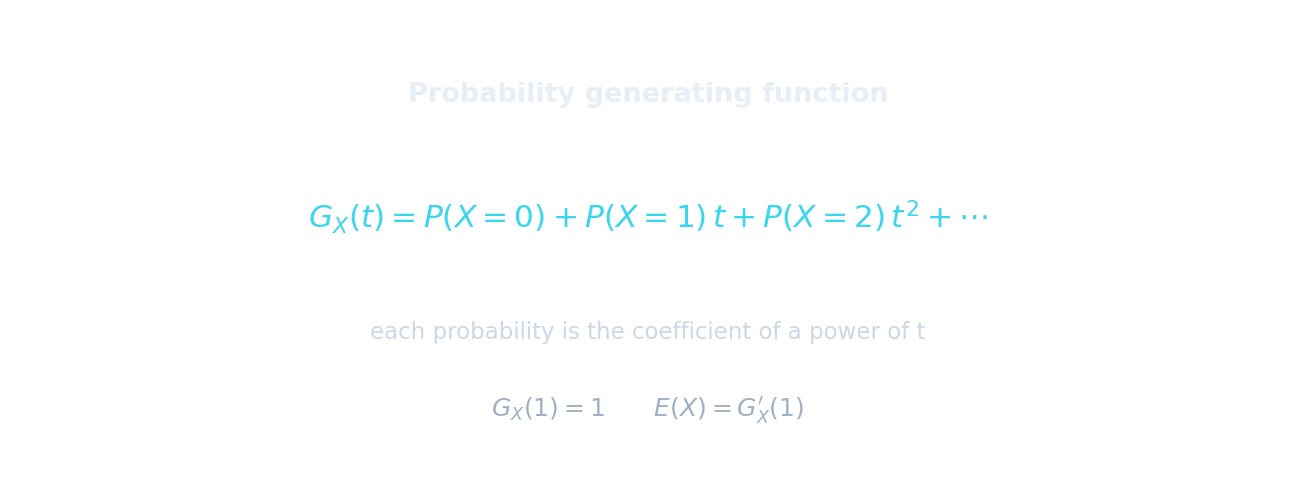
Uma função geradora de probabilidades armazena todas as probabilidades como coeficientes
The probability generating function of X is defined as: · A função geradora de probabilidade de X é definida como:
G(t) = E(tˣ) = Σ P(X=x) tˣ.
Mean and variance 方差 from derivatives 导数
- Differentiate and evaluate at $t = 1$:
Worked example. $G(t) = 0.5 + 0.3t + 0.2t^2$. Then $G'(t) = 0.3 + 0.4t$, so $E(X) = G'(1) = 0.3 + 0.4 = 0.7$.
Média e variância 方差 a partir de derivadas 导数
- Derive e avalie em $t = 1$:
Exemplo resolvido. $G(t) = 0.5 + 0.3t + 0.2t^2$. Então $G'(t) = 0.3 + 0.4t$, logo $E(X) = G'(1) = 0.3 + 0.4 = 0.7$.
X has G(t) = 0.5 + 0.3t + 0.2t². Since E(X) = G′(1) and G′(t) = 0.3 + 0.4t, what is E(X)? · X tem G(t) = 0.5 + 0.3t + 0.2t². Como E(X) = G′(1) e G′(t) = 0.3 + 0.4t, qual é E(X)?
G'(1) = 0.3 + 0.4(1) = 0.7.
The mean is found from the PGF by E(X) = G′(). · A média é encontrada da PGF via E(X) = G′().
E(X) = G'(1).
Sums of independent 独立 variables
- The single most useful property: the PGF of a sum of independent variables is the product of their PGFs:
- This makes adding independent variables (e.g. total of several dice) almost effortless.
Somas de variáveis independentes 独立
- A propriedade mais útil: a PGF de uma soma de variáveis independentes é o produto de suas PGFs:
- Isso torna adicionar variáveis independentes (ex.: total de vários dados) quase sem esforço.
For any valid PGF, what is the value of G(1)? · Para qualquer PGF válida, qual é o valor de G(1)?
G(1) = Σ P(X=x) = 1, since probabilities sum to 1. · G(1) = Σ P(X=x) = 1, já que as probabilidades somam 1.
The PGF of a sum of two independent variables is the product of their PGFs. · A PGF de uma soma de duas variáveis independentes é o produto de suas PGFs.
G_{X+Y}(t) = G_X(t) G_Y(t) for independent X and Y. · G_{X+Y}(t) = G_X(t) G_Y(t) para X e Y independentes.
Check it's a valid PGF
$G(1)$ must equal 1. Since $G(1) = \sum P(X = x)$, a valid PGF always gives $G(1) = 1$ — a quick sanity check before you differentiate.
Verificar se é uma PGF válida
$G(1)$ deve ser igual a 1. Como $G(1) = \sum P(X = x)$, uma PGF válida sempre resulta em $G(1) = 1$ — uma verificação rápida de sanidade antes de derivar.
You've got it
- PGF: $G(t) = E(t^X) = \sum P(X=x)\,t^x$ (and $G(1) = 1$)
- $E(X) = G'(1)$; $\text{Var}(X) = G''(1) + G'(1) - (G'(1))^2$
- the PGF of a sum of independent variables is the product of their PGFs
Entendeu?
- PGF: $G(t) = E(t^X) = \sum P(X=x)\,t^x$ (e $G(1) = 1$)
- $E(X) = G'(1)$; $\text{Var}(X) = G''(1) + G'(1) - (G'(1))^2$
- a PGF de uma soma de variáveis independentes é o produto de suas PGFs