Side-chain, ring and directing effects · Efeitos de cadeia lateral, anel e direção
| English | Português |
|---|---|
| side-chain/saɪd tʃeɪn/ | cadeia lateral |
| directing effect/daɪˈrektɪŋ ɪˈfekt/ | efeito orientador |
| electron-donating/ɪˈlektrɒn dəʊˈneɪtɪŋ/ | doador de elétrons |
| activated/ˈæktɪveɪtɪd/ | ativado |
| electron-withdrawing/ɪˈlektrɒn wɪθˈdrɔːɪŋ/ | retirador de elétrons |
| deactivated/diːˈæktɪveɪtɪd/ | desativado |
Side-chain 侧链 or ring, and directing
- A halogen can react in the ring or the side-chain.
- The conditions decide which.
- A group already on the ring directs the next one.
Cadeia lateral 侧链 ou anel, e orientação
- Um halogênio pode reagir no anel ou na cadeia lateral.
- As condições decidem qual.
- Um grupo já presente no anel orienta o próximo.
Directing effects lab · Laboratório de efeitos de direção
Classify substituents by how they affect the benzene ring. · Classifique substituintes por como afetam o anel de benzeno.
Groups already on a benzene ring direct where the next group attaches. · Grupos já presentes em um anel de benzeno direcionam onde o próximo grupo se liga.
This is the directing effect. · Este é o efeito orientador.
Side-chain vs ring
- with a halogen-carrier catalyst (AlCl₃) and no UV → substitution in the ring.
- with UV light and no catalyst → free-radical substitution in the side-chain.
The conditions choose the site: catalyst + no UV → ring; UV + no catalyst → side-chain
Directing effects 定位效应 of groups on a benzene ring
Cadeia lateral vs anel
- com catalisador de portador de halogênio (AlCl₃) e sem UV → substituição no anel.
- com luz UV e sem catalisador → substituição por radical livre na cadeia lateral.
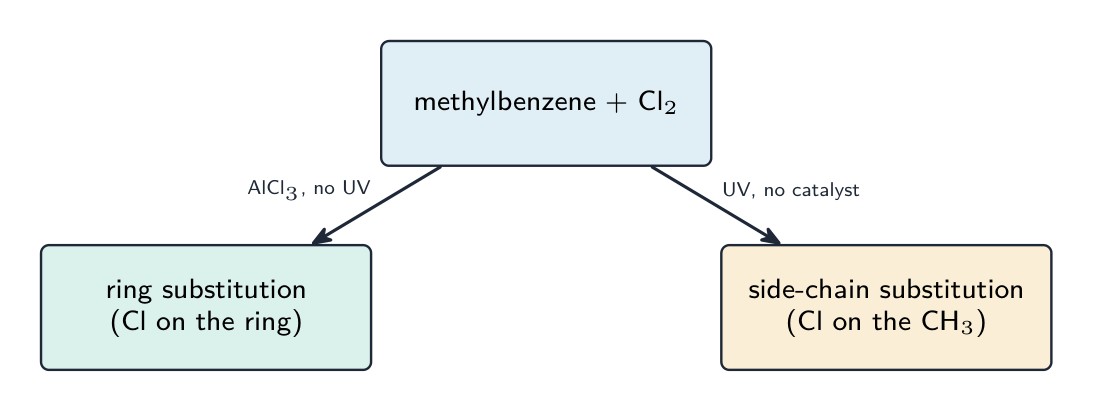
As condições escolhem o local: catalisador + sem UV → anel; UV + sem catalisador → cadeia lateral
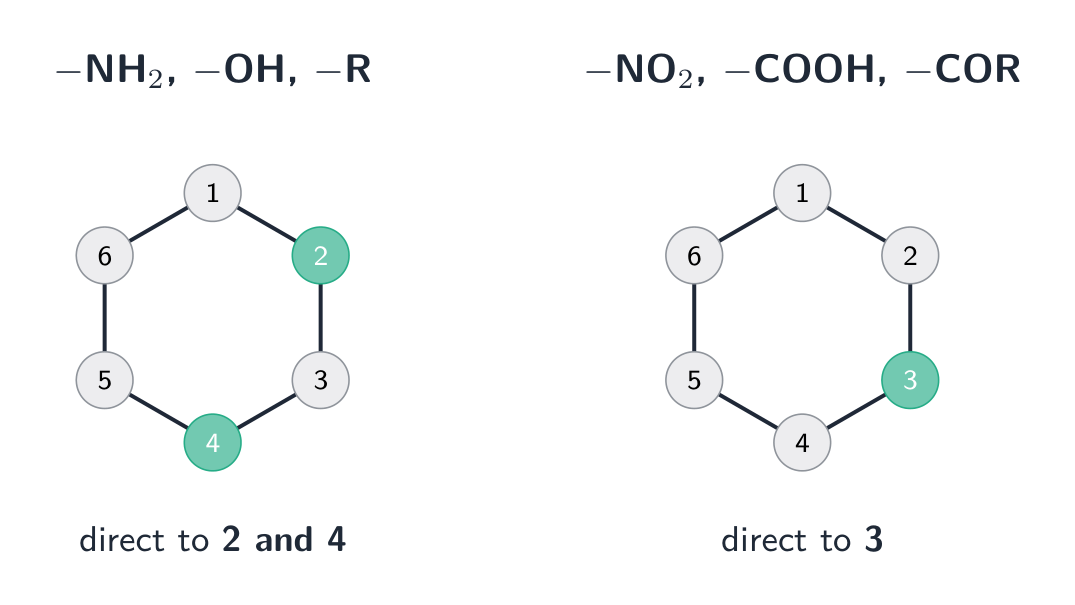
Efeitos orientadores 定位效应 de grupos em um anel de benzeno
A halogen reacts in the ring (not the side-chain) when there is: · Um halogênio reage no anel (não na cadeia lateral) quando há:
The catalyst makes the electrophile for ring substitution; UV with no catalyst gives side-chain free-radical substitution. · O catalisador gera o eletrófilo para substituição no anel; a luz UV sem catalisador resulta em substituição radicalar na cadeia lateral.
Under UV light with no catalyst, the halogen substitutes: · Sob luz UV sem catalisador, o halogênio substitui:
UV light starts free-radical substitution in the alkyl side-chain. · A luz UV inicia a substituição radicalar na cadeia lateral alquila.
Directing effects
| Group already present | Directs the new group to |
|---|---|
| $\text{–NH}_2$, $\text{–OH}$, $\text{–R}$ | positions 2 and 4 |
| $\text{–NO}_2$, $\text{–COOH}$, $\text{–COR}$ | position 3 |
Electrophilic substitution: nitration of benzene
Efeitos orientadores
| Grupo já presente | Orienta o novo grupo para |
|---|---|
| $\text{–NH}_2$, $\text{–OH}$, $\text{–R}$ | posições 2 e 4 |
| $\text{–NO}_2$, $\text{–COOH}$, $\text{–COR}$ | posição 3 |
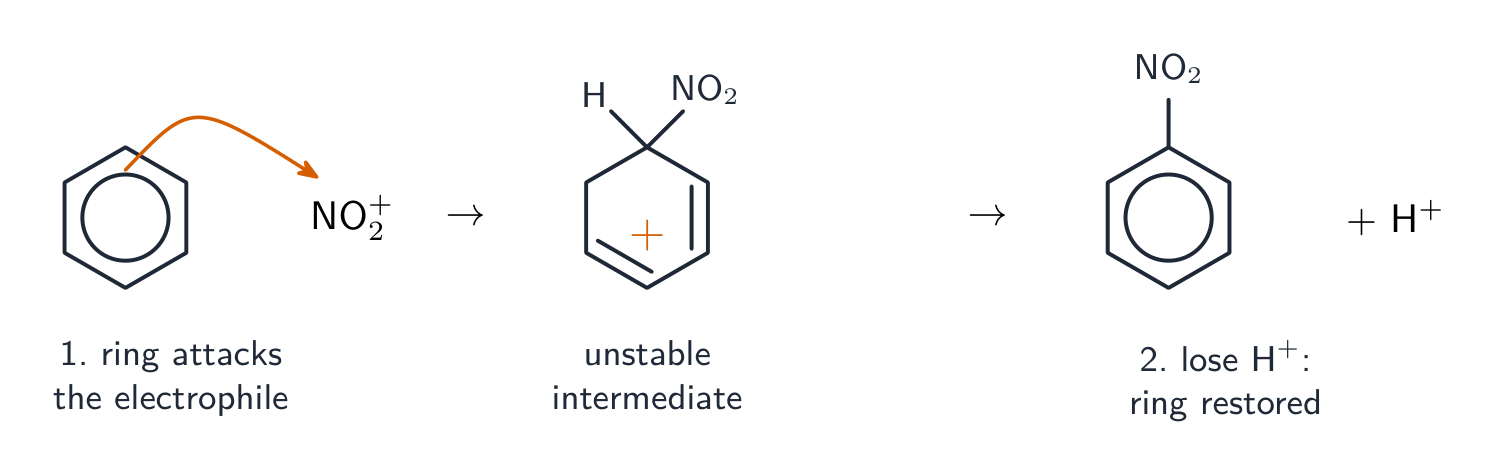
Substituição eletrofílica: nitração do benzeno
An –OH group already on the ring directs the next substituent to: · Um grupo –OH já presente no anel direciona o próximo substituinte para:
–NH₂, –OH and –R are 2,4-directing; –NO₂, –COOH and –COR are 3-directing. · –NH₂, –OH e –R são orientadores 2,4; –NO₂, –COOH e –COR são orientadores 3.
Match each group to where it directs the next substituent. · Combine cada grupo com a posição onde ele direciona o próximo substituinte.
Activating groups (–OH, –NH₂, –R) direct to 2,4; deactivating groups (–NO₂, –COOH, –COR) direct to 3. · Grupos ativantes (–OH, –NH₂, –R) direcionam para 2,4; grupos desativantes (–NO₂, –COOH, –COR) direcionam para 3.
Activators and deactivators
- Electron-donating 给电子 groups (–NH₂, –OH, –R) push electrons into the ring → it reacts faster (activated 活化) and they direct to 2,4.
- Electron-withdrawing 吸电子 groups (–NO₂, –COOH) pull electrons out → the ring reacts slower (deactivated 钝化) and they direct to 3.
Nitrating phenol: the –OH is electron-donating, so it activates the ring and directs to 2,4.
- Products: 2-nitrophenol and 4-nitrophenol.
- And phenol nitrates faster than benzene — so easily it even reacts with dilute nitric acid.
Ativadores e desativadores
- Grupos doadores de elétrons 给电子 (–NH₂, –OH, –R) empurram elétrons para dentro do anel → ele reage mais rápido (ativado 活化) e orientam para 2,4.
- Grupos retiradores de elétrons 吸电子 (–NO₂, –COOH) puxam elétrons para fora → o anel reage mais devagar (desativado 钝化) e orientam para 3.
Nitrar fenol: o –OH é doador de elétrons, então ele ativa o anel e orienta para 2,4.
- Produtos: 2-nitrofenol e 4-nitrofenol.
- E o fenol nitra mais rápido que o benzeno — tão facilmente que reage até com ácido nítrico diluído.
You've got it
- ring substitution: catalyst (AlCl₃) + no UV; side-chain: UV + no catalyst (free-radical)
- a group already on the ring directs the next: –NH₂/–OH/–R → 2,4; –NO₂/–COOH/–COR → 3
- donating groups activate (react faster); withdrawing groups deactivate (react slower)
Entendeu?
- substituição no anel: catalisador (AlCl₃) + sem UV; cadeia lateral: UV + sem catalisador (radical livre)
- um grupo já presente no anel orienta o próximo: –NH₂/–OH/–R → 2,4; –NO₂/–COOH/–COR → 3
- grupos doadores ativam (reagem mais rápido); grupos retiradores desativam (reagem mais devagar)