Halogenoarenes · Haloarenos
| English | Português |
|---|---|
| halogenoarene/ˈheɪləʊdʒnɔːren/ | haloareno |
| aryl halide/ˈɑːrɪl ˈhælaɪd/ | haleto arílico |
| nucleophilic substitution/ˌnjuːklɪəˈfɪlɪk ˌsʌbstɪˈtjuːʃn/ | substituição nucleofílica |
| persistent/pəˈsɪstənt/ | persistente |
| pesticide/ˈpestɪsaɪd/ | pesticida |
| bioaccumulate/ˌbaɪəʊəˈkjuːmjʊleɪt/ | bioacumular |
Halogens on a ring
- A halogenoarene 卤代芳烃 (aryl halide 芳基卤) has a halogen joined to a benzene ring.
- It is made by electrophilic substitution.
- It is far less reactive than a halogenoalkane.
Halogênios em um anel
- Uma haloareno 卤代芳烃 (haletos arílicos 芳基卤) tem um halogênio ligado a um anel de benzeno.
- É feita por substituição eletrofílica.
- É muito menos reativa que um haleto alílico.
Halogenoarene lab · Laboratório de haloareno
Compare halogenoarenes with halogenoalkanes.
The C–halogen bond in a halogenoarene is less reactive than in a halogenoalkane.
The ring's delocalised electrons strengthen the bond.
Making one
- An arene reacts with $\text{Cl}_2$ or $\text{Br}_2$ using $\text{AlCl}_3$/$\text{AlBr}_3$ as catalyst — the halogen replaces a ring hydrogen.
- benzene → chlorobenzene; methylbenzene → 2- and 4-chloromethylbenzene.
Benzene + Cl₂ with an AlCl₃ catalyst → chlorobenzene, by electrophilic substitution
Fazendo um
- Um areno reage com $\text{Cl}_2$ ou $\text{Br}_2$ usando $\text{AlCl}_3$/$\text{AlBr}_3$ como catalisador — o halogênio substitui um hidrogênio do anel.
- benzeno → clorobenzeno; metilbenzeno → 2- e 4-clorometilbenzeno.
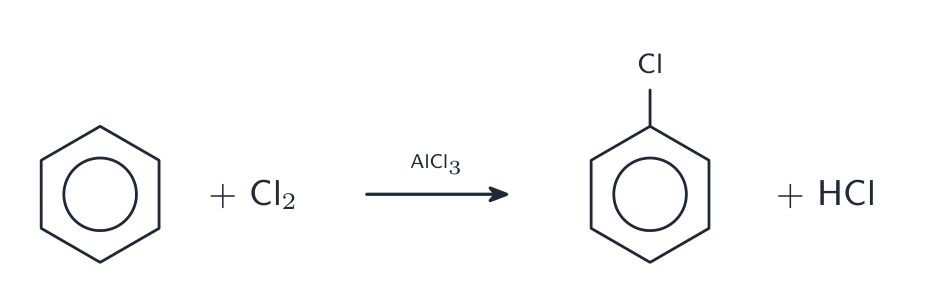
Benzeno + Cl₂ com catalisador AlCl₃ → clorobenzeno, por substituição eletrofílica
A halogenoarene is made by reacting an arene with a halogen and:
The halogen-carrier catalyst enables electrophilic substitution of a ring hydrogen.
Match each term to its meaning.
Each item links the term to its correct meaning.
Benzene reacts with Cl₂ using the catalyst AlCl₃ to form ____.
Electrophilic substitution replaces a ring hydrogen with chlorine.
Why it is unreactive
A halogenoalkane reacts easily by nucleophilic substitution 亲核取代 (polar C–Cl). A halogenoarene does not, for two reasons:
- a lone pair on the halogen overlaps the delocalised ring, giving the C–Cl bond partial double-bond character — shorter and stronger, so hard to break.
- the electron-rich ring repels an approaching nucleophile.
So chlorobenzene does not react with $\text{OH}^-$ under normal conditions, while chloroethane does.
Why a halogenoarene is much less reactive than a halogenoalkane
Por que é inerte
Um haleto alílico reage facilmente por substituição nucleofílica 亲核取代 (C–Cl polar). Uma haloareno não faz isso, por duas razões:
- um par de elétrons não ligantes no halogênio se sobrepõe ao anel deslocalizado, conferindo à ligação C–Cl caráter parcial de dupla — mais curta e mais forte, portanto difícil de quebrar.
- o anel rico em elétrons repele um nucleófilo que se aproxima.
Assim, o clorobenzeno não reage com $\text{OH}^-$ em condições normais, enquanto o cloroetano faz isso.
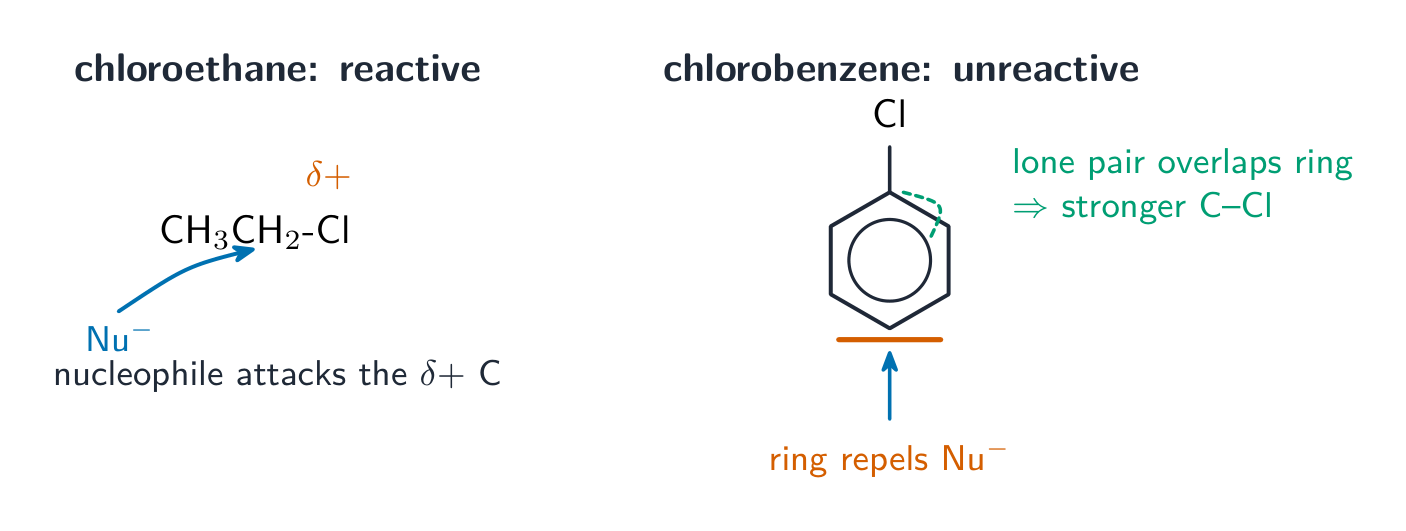
Por que um haloareno é muito menos reativo do que um haloalcano
A halogenoarene is unreactive towards nucleophiles partly because:
The lone-pair overlap gives partial double-bond character, making C–Cl shorter and stronger.
The second reason a halogenoarene resists nucleophiles is that the ring:
The delocalised, electron-rich ring repels electron-rich nucleophiles.
Under normal conditions, with OH⁻:
The halogenoalkane (chloroethane) undergoes nucleophilic substitution; the halogenoarene (chlorobenzene) does not.
Lone-pair overlap with the ring makes the C–Cl bond in chlorobenzene easier to break.
Overlap gives partial double-bond character, so the bond is shorter and stronger.
Which is more readily hydrolysed by aqueous OH⁻ under usual laboratory conditions?
Chloroethane undergoes nucleophilic substitution. The aryl C–Cl bond is strengthened by overlap with the ring.
Useful but persistent 持久
- That same stability makes halogenoarenes useful — in pesticides 农药 (e.g. DDT), dyes and many synthesis intermediates.
- But being unreactive, they do not break down in the environment.
- So they persist and bioaccumulate 生物累积 up food chains — which is why several, including DDT, have been banned.
Many pesticides and herbicides are halogenoarenes — chlorine atoms bonded to a benzene ring.
Úteis, mas persistentes 持久
- Essa mesma estabilidade torna os haloarenos úteis — em pesticidas 农药 (ex.: DDT), corantes e muitos intermediários de síntese.
- Por serem pouco reativos, eles não se degradam no meio ambiente.
- Portanto, eles persistem e bioacumulam 生物累积 ao longo das cadeias alimentares — sendo por isso que vários, incluindo o DDT, foram proibidos.
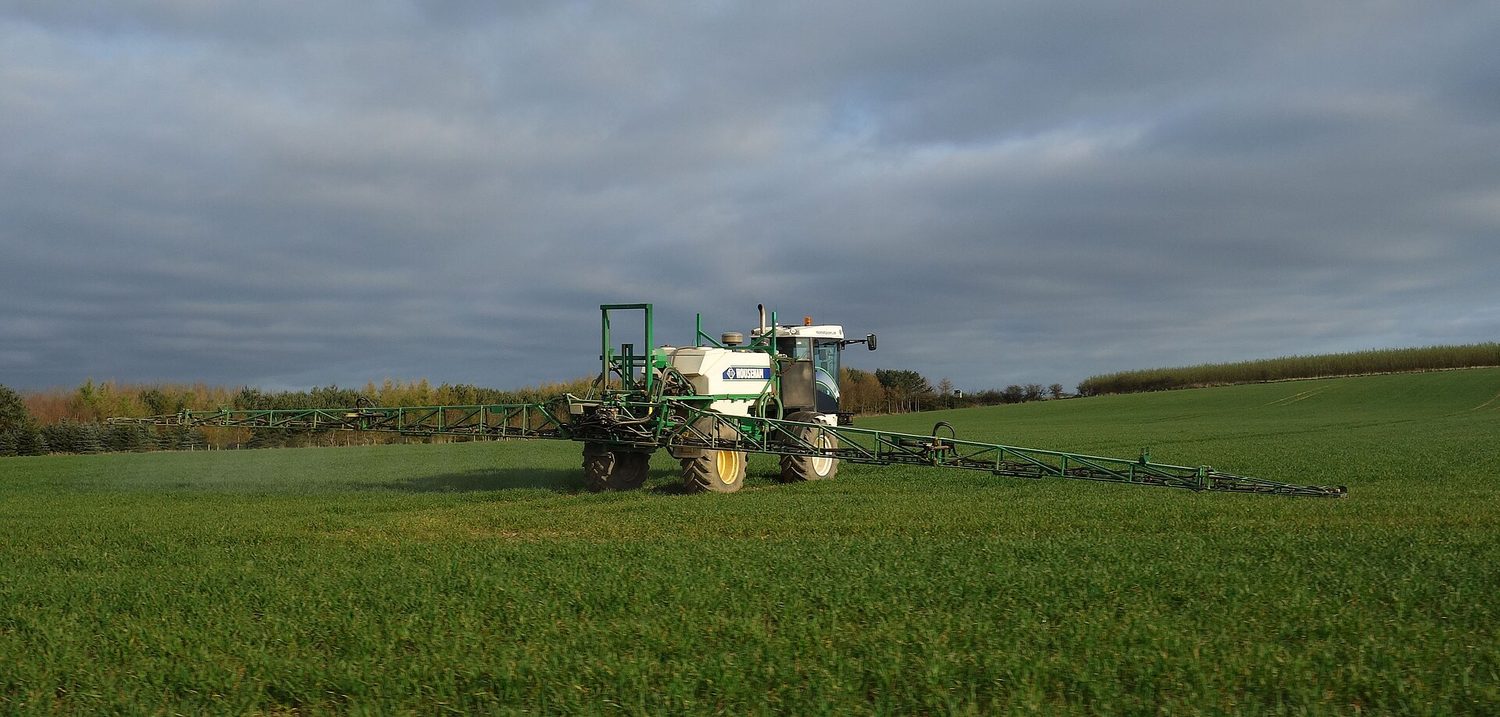
Muitos pesticidas e herbicidas são haloarenos — átomos de cloro ligados a um anel de benzeno.
You've got it
- a halogenoarene is made by electrophilic substitution (arene + Cl₂/AlCl₃)
- it is unreactive to nucleophiles: the Cl lone pair strengthens the C–Cl bond, and the ring repels nucleophiles
- chlorobenzene does not react with OH⁻; chloroethane does
- that stability makes them useful (pesticides, dyes) but persistent pollutants (DDT was banned)
Entendeu?
- um haloareno é formado por substituição eletrofílica (areno + Cl₂/AlCl₃)
- ele é pouco reativo frente a nucleófilos: o par de elétrons não ligantes do Cl fortalece a ligação C–Cl, e o anel repele nucleófilos
- o clorobenzeno não reage com OH⁻; o cloroetano reage
- essa estabilidade os torna úteis (pesticidas, corantes) mas poluentes persistentes (o DDT foi proibido)