Standard electrode potentials · Potenciais padrão de eletrodo
| English | Português |
|---|---|
| electrode potential/ɪˈlektrəʊd pəˈtenʃl/ | potencial de eletrodo |
| half-cell/hɑːf sel/ | meia-célula |
| cell potential/sel pəˈtenʃl/ | potencial de célula |
| standard hydrogen electrode/ˈstændəd ˈhaɪdrədʒn ɪˈlektrəʊd/ | eletrodo padrão de hidrogênio |
| oxidising agent/ˈɒksɪdaɪzɪŋ ˈeɪdʒənt/ | agente oxidante |
| reducing agent/rɪˈdjuːsɪŋ ˈeɪdʒənt/ | agente redutor |
Ranking the electron-grabbers
- The electrode potential 电极电势 $E$ shows how easily a half-cell 半电池 is reduced.
- We measure it against a fixed reference under standard conditions.
- Combining two half-cells gives a cell potential 电池电势.
Ordenando os capturadores de elétrons
- O potencial eletrodico 电极电势 $E$ mostra quão facilmente uma semipilha 半电池 é reduzida.
- É medida contra uma referência fixa sob condições padrão.
- Combinar duas semipilhas resulta em um potencial de pilha 电池电势.
Electrode potential lab · Laboratório de potencial de eletrodo
Ecell = Eright - Eleft · Ecel = Edireita - Esquerda
Change cell potential and see oxidising power increase. · Alterar o potencial da célula e ver o poder oxidante aumentar.
A more negative standard electrode potential means a stronger reducing agent. · Um potencial de eletrodo padrão mais negativo significa um agente redutor mais forte.
It loses electrons more readily. · Ele perde elétrons com mais facilidade.
The reference and measuring E°
- The standard hydrogen electrode 标准氢电极 is the zero reference: $\text{H}_2$ at 1 atm over platinum in $1\ \dfrac{\text{mol}}{\text{dm}^3}$ $\text{H}^+$, defined as 0.00 V.
- To measure a half-cell's $E^{\ominus}$, connect it to the hydrogen electrode and read the voltage (always written as a reduction).
The electrochemical series of standard electrode potentials
A referência e a medição de E°
- O eletrodo padrão de hidrogênio 标准氢电极 é a referência zero: $\text{H}_2$ a 1 atm sobre platina em $1\ \dfrac{\text{mol}}{\text{dm}^3}$ $\text{H}^+$, definido como 0.00 V.
- Para medir o $E^{\ominus}$ de uma semipilha, conecte-a ao eletrodo de hidrogênio e leia a tensão (sempre escrita como redução).
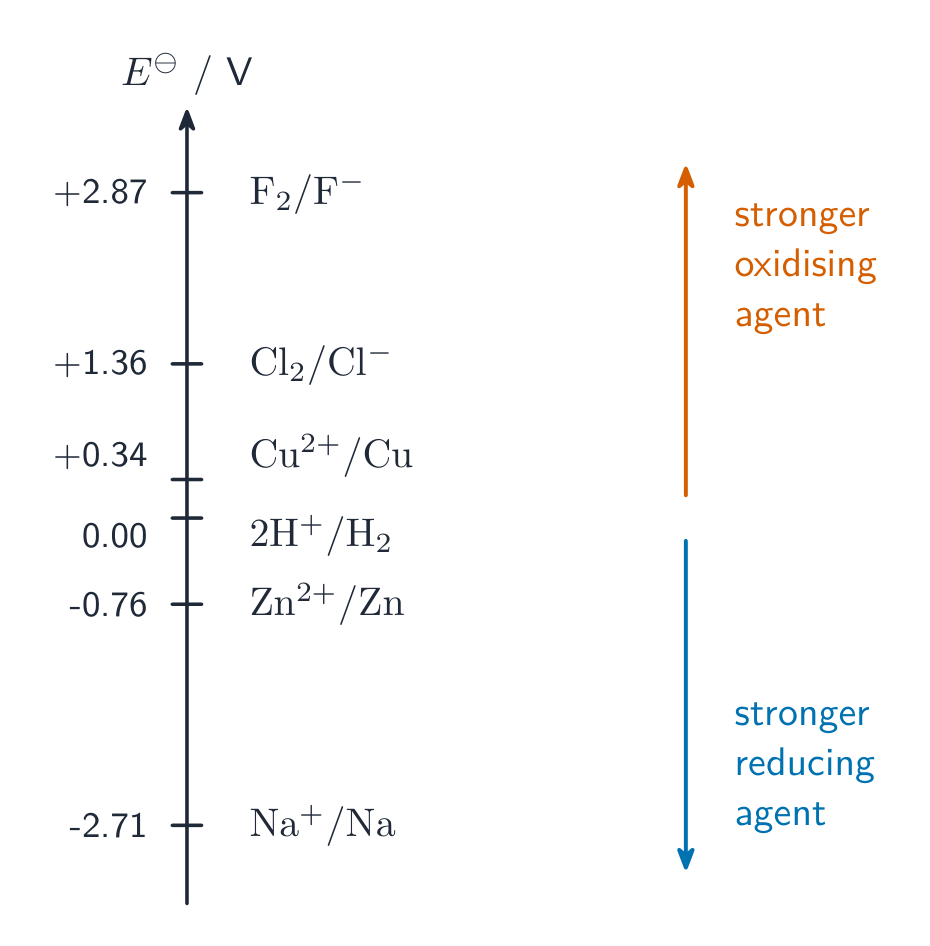
A série eletroquímica de potenciais eletrodicos padrão
The standard hydrogen electrode is defined as having a potential of: · O eletrodo padrão de hidrogênio é definido como tendo um potencial de:
It is the reference half-cell, set at exactly 0.00 V; all other E° values are measured against it. · É a semicélula de referência, definida exatamente em 0.00 V; todos os outros valores de E° são medidos em relação a ela.
Match each electrode-potential idea. · Combine cada ideia sobre potencial de eletrodo.
Each item links the term to its correct meaning. · Cada item associa o termo ao seu significado correto.
Combining half-cells
- Polarity: the more negative electrode is the negative terminal; electrons flow from it through the circuit.
- Reactivity: a more positive $E^{\ominus}$ → better oxidising agent 氧化剂; a more negative $E^{\ominus}$ → better reducing agent 还原剂.
Electrolysis electroplates an object with a thin, shiny layer of metal such as chromium.
Combinando semipilhas
- Polaridade: o eletrodo mais negativo é o terminal negativo; elétrons fluem dele pelo circuito.
- Reatividade: um $E^{\ominus}$ mais positivo → melhor agente oxidante 氧化剂; um $E^{\ominus}$ mais negativo → melhor agente redutor 还原剂.

Eletrólise electroplata um objeto com uma camada fina e brilhante de metal como cromo.
The standard cell potential is: · O potencial padrão da célula é:
Subtract the less positive electrode potential from the more positive one. · Subtrair o potencial de eletrodo menos positivo do mais positivo.
A half-cell with a more positive E° is: · Uma semi-célula com E° mais positivo é:
A more positive E° means the species is readily reduced — a stronger oxidising agent. · Um E° mais positivo significa que a espécie é facilmente reduzida — um agente oxidante mais forte.
In a cell, electrons flow through the external circuit from the: · Em uma célula, os elétrons fluem pelo circuito externo desde o:
The more negative electrode is the negative terminal; electrons flow from it to the more positive electrode. · O eletrodo mais negativo é o terminal negativo; os elétrons fluem dele para o eletrodo mais positivo.
Reading the electrode-potential table
- The more positive E°, the more easily the species is reduced (a stronger oxidising agent).
- The more negative, the stronger the reducing agent.
The standard hydrogen electrode reference
Lendo a tabela de potenciais eletrodicos
- Quanto mais positivo o E°, mais facilmente a espécie é reduzida (um agente oxidante mais forte).
- Quanto mais negativo, mais forte é o agente redutor.
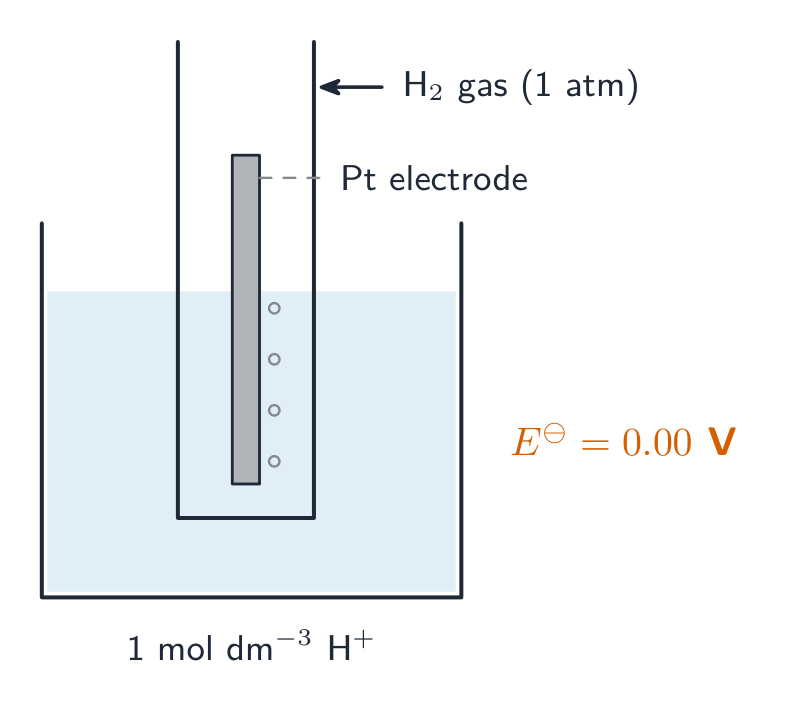
Referência do eletrodo padrão de hidrogênio
You've got it
- $E^{\ominus}$ shows how easily a half-cell is reduced (written as a reduction)
- the standard hydrogen electrode = 0.00 V reference
- $E^{\ominus}_{\text{cell}} = E^{\ominus}(\text{more positive}) - E^{\ominus}(\text{less positive})$
- more positive $E^{\ominus}$ = stronger oxidising agent; more negative = stronger reducing agent
Entendeu?
- $E^{\ominus}$ mostra quão facilmente uma semipilha é reduzida (escrita como redução)
- o eletrodo padrão de hidrogênio = referência de 0.00 V
- $E^{\ominus}_{\text{cell}} = E^{\ominus}(\text{more positive}) - E^{\ominus}(\text{less positive})$
- $E^{\ominus}$ mais positivo = agente oxidante mais forte; mais negativo = agente redutor mais forte