Duas coisas no seu bolso funcionam com a mesma química. Uma bateria: uma reação que quer acontecer empurra elétrons por um fio. E o carregador: nós empurramos esses…
English narration · English + 中文 subtitles burned in · Narração em inglês · Legendas em inglês + 中文 gravadas
24.1
Electrolysis · Eletrólise
Syllabus · Programa
English
predict the identities of substances liberated during electrolysis from the state of electrolyte (molten or aqueous), position in the redox series (electrode potential) and concentration
state and apply the relationship $F = Le$ between the Faraday constant, $F$, the Avogadro constant, $L$, and the charge on the electron, $e$
calculate: (a) the quantity of charge passed during electrolysis, using $Q = It$ (b) the mass and/or volume of substance liberated during electrolysis
describe the determination of a value of the Avogadro constant by an electrolytic method
Português
prever as identidades das substâncias liberadas durante a eletrólise a partir do estado do eletrólito (fundido ou aquoso), posição na série redox (potencial de eletrodo) e concentração
enunciar e aplicar a relação $F = Le$ entre a constante de Faraday, $F$, a constante de Avogadro, $L$, e a carga do elétron, $e$
calcular: (a) a quantidade de carga passada durante a eletrólise, usando $Q = It$ (b) a massa e/ou volume de substância liberada durante a eletrólise
descrever a determinação de um valor da constante de Avogadro por um método eletrolítico
Source: Cambridge International syllabus · Fonte: Programa Cambridge International
English
Electrolysis: ions discharge at the electrodes
Electrolysis 电解 uses electricity to break down a molten or aqueous electrolyte 电解质. Positive ions move to the negative electrode and negative ions move to the positive electrode.
At each electrode 电极 a half-reaction happens:
at the cathode 阴极 (negative): positive ions gain electrons (reduction).
at the anode 阳极 (positive): negative ions lose electrons (oxidation).
Predicting the products
a molten electrolyte gives the metal at the cathode and the non-metal at the anode.
an aqueous electrolyte also contains water. At the cathode, a less reactive metal is released, but for a reactive metal you get hydrogen instead. At the anode you usually get oxygen, but a concentrated halide solution gives the halogen.
Calculations
The charge on one mole of electrons is the Faraday constant 法拉第常量, linked to the Avogadro constant 阿伏伽德罗常量 ($L$) and the charge on one electron ($e$) by $F = Le$.
The charge passed is $Q = It$ (current $\times$ time). Then:
moles of electrons $= Q / F$.
use the half-equation to find moles of product.
find the mass ($\times M_r$) or the gas volume.
Measuring the mass deposited for a known charge lets you work back to a value of the Avogadro constant.
Worked example. A current of $2.0\ \text{A}$ flows for $30$ minutes through copper(II) sulfate solution, depositing copper at the cathode: $\text{Cu}^{2+} + 2\text{e}^- \rightarrow \text{Cu}$. Find the mass of copper deposited. ($F = 96\,500\ \text{C mol}^{-1}$, $A_r$ Cu $= 64$.)
Charge passed: $Q = It = 2.0 \times (30 \times 60) = 3600\ \text{C}$. Moles of electrons $= Q/F = 3600/96\,500 = 0.0373\ \text{mol}$. From the half-equation, $2\ \text{mol}$ of electrons give $1\ \text{mol}$ of Cu, so $n(\text{Cu}) = 0.0187\ \text{mol}$ and
Eletrólise 电解 usa eletricidade para decompor um eletrólito 电解质 fundido ou aquoso. Íons positivos movem-se para o eletrodo negativo e íons negativos movem-se para o eletrodo positivo.
Em cada eletrodo 电极 ocorre uma semirreação:
no catodo 阴极 (negativo): íons positivos ganham elétrons (redução).
no ânodo 阳极 (positivo): íons negativos perdem elétrons (oxidação).
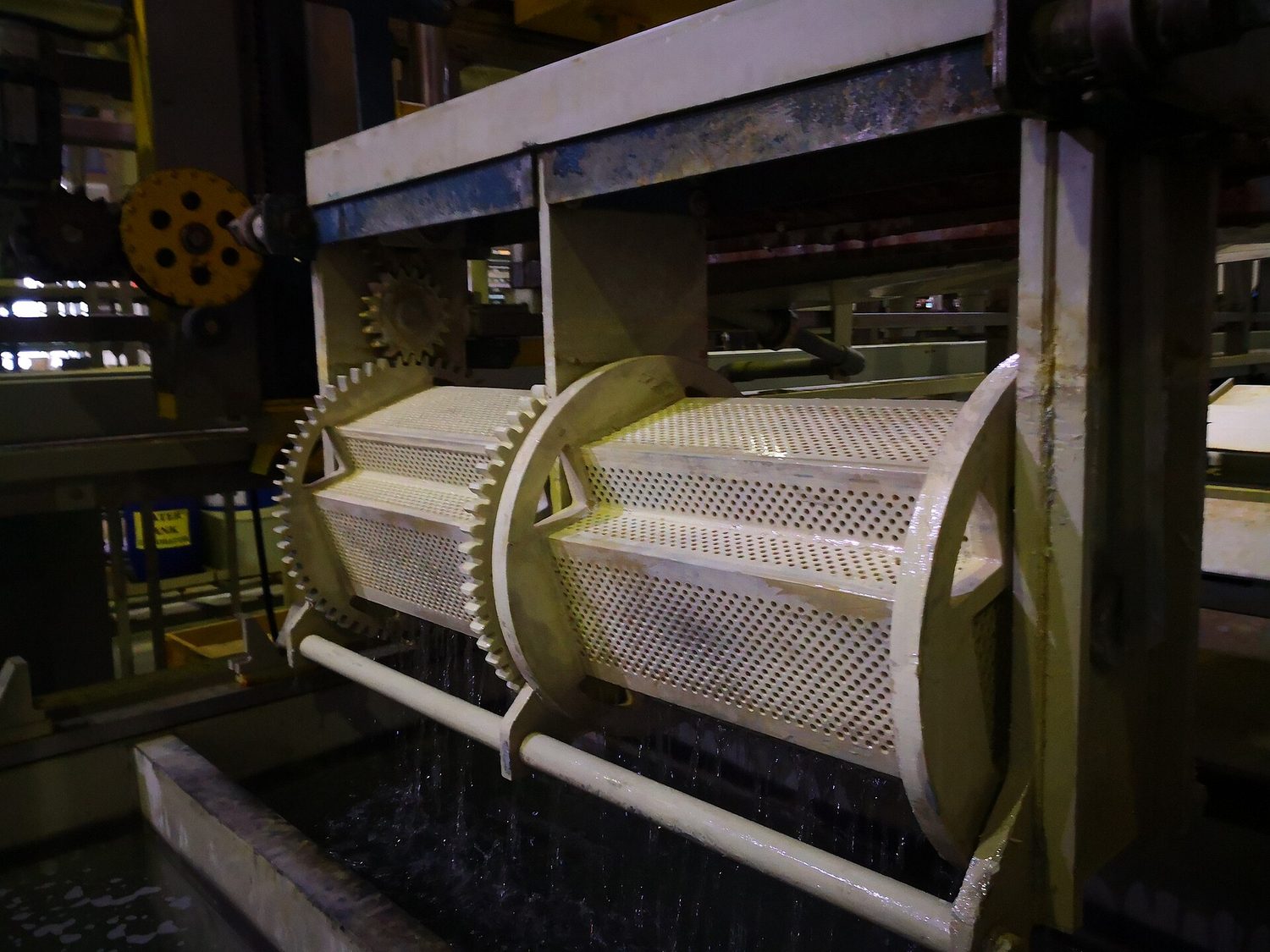
Eletrólise: a fonte de CC direciona íons positivos para o cátodo (redução) e íons negativos para o ânodo (oxidação)Voltametro de Hofmann para eletrólise da água: a fonte de alimentação faz circular corrente através de dois eletrodos, e o gás produzido em cada um se coleta em seu tubo lateral
Prevendo os produtos
um eletrólito fundido produz o metal no cátodo e o não-metal no ânodo.
um eletrólito aquoso também contém água. No cátodo, um metal menos reativo é liberado, mas para um metal reativo você obtém hidrogênio em vez disso. No ânodo geralmente você obtém oxigênio, mas uma solução concentrada de haleto produz o halogênio.
Um eletrólito fundido produz metal e não-metal; aquoso também tem água
Cálculos
A carga em um mol de elétrons é a constante de Faraday 法拉第常量, ligada à constante de Avogadro 阿伏伽德罗常量 ($L$) e à carga de um único elétron ($e$) por $F = Le$.
A carga transferida é $Q = It$ (corrente $\times$ × tempo). Então:
mols de elétrons $= Q / F$.
use a semirreação para encontrar os mols de produto.
encontre a massa ($\times M_r$) ou o volume do gás.
Medir a massa depositada para uma carga conhecida permite calcular um valor da constante de Avogadro.
Exemplo resolvido. Uma corrente de $2.0\ \text{A}$ flui durante $30$ minutos através de uma solução de sulfato de cobre(II), depositando cobre no cátodo: $\text{Cu}^{2+} + 2\text{e}^- \rightarrow \text{Cu}$. Encontre a massa de cobre depositada. ($F = 96\,500\ \text{C mol}^{-1}$, $A_r$ Cu $= 64$.)
Carga transferida: $Q = It = 2.0 \times (30 \times 60) = 3600\ \text{C}$. Mols de elétrons $= Q/F = 3600/96\,500 = 0.0373\ \text{mol}$. Da semirreação, $2\ \text{mol}$ de elétrons produzem $1\ \text{mol}$ de Cu, logo $n(\text{Cu}) = 0.0187\ \text{mol}$ e
Standard electrode potentials and cell potentials · Potenciais padrão de eletrodo e potenciais de célula
Syllabus · Programa
English
define the terms: (a) standard electrode (reduction) potential (b) standard cell potential
describe the standard hydrogen electrode
describe methods used to measure the standard electrode potentials of: (a) metals or non-metals in contact with their ions in aqueous solution (b) ions of the same element in different oxidation states
calculate a standard cell potential by combining two standard electrode potentials
use standard cell potentials to: (a) deduce the polarity of each electrode and hence explain/deduce the direction of electron flow in the external circuit of a simple cell (b) predict the feasibility of a reaction
deduce from $E^{\ominus}$ values the relative reactivity of elements, compounds and ions as oxidising agents or as reducing agents
construct redox equations using the relevant half-equations
predict qualitatively how the value of an electrode potential, $E$, varies with the concentrations of the aqueous ions
use the Nernst equation, e.g. $E = E^{\ominus} + (0.059/z) \log \frac{[\text{oxidised species}]}{[\text{reduced species}]}$, to predict quantitatively how the value of an electrode potential varies with the concentrations of the aqueous ions; examples include $\text{Cu}^{2+}(\text{aq}) + 2\text{e}^- \rightleftharpoons \text{Cu}(\text{s})$, $\text{Fe}^{3+}(\text{aq}) + \text{e}^- \rightleftharpoons \text{Fe}^{2+}(\text{aq})$
understand and use the equation $\Delta G^{\ominus} = -n E^{\ominus}_{\text{cell}} F$
Português
definir os termos: (a) potencial padrão de eletrodo (redução) (b) potencial padrão de célula
descrever o eletrodo padrão de hidrogênio
descrever métodos usados para medir os potenciais padrão de eletrodo de: (a) metais ou não-metais em contato com seus íons em solução aquosa (b) íons do mesmo elemento em diferentes estados de oxidação
calcular um potencial padrão de célula combinando dois potenciais padrão de eletrodo
usar potenciais padrão de célula para: (a) deduzir a polaridade de cada eletrodo e, consequentemente, explicar/deduzir a direção do fluxo de elétrons no circuito externo de uma célula simples (b) prever a viabilidade de uma reação
deduzir de $E^{\ominus}$ valores a reatividade relativa de elementos, compostos e íons como agentes oxidantes ou como agentes redutores
construir equações redox usando as semi-equações relevantes
prever qualitativamente como o valor de um potencial de eletrodo, $E$, varia com as concentrações dos íons aquosos
usar a equação de Nernst, p.ex. $E = E^{\ominus} + (0.059/z) \log \frac{[\text{oxidised species}]}{[\text{reduced species}]}$, para prever quantitativamente como o valor de um potencial de eletrodo varia com as concentrações dos íons aquosos; exemplos incluem $\text{Cu}^{2+}(\text{aq}) + 2\text{e}^- \rightleftharpoons \text{Cu}(\text{s})$, $\text{Fe}^{3+}(\text{aq}) + \text{e}^- \rightleftharpoons \text{Fe}^{2+}(\text{aq})$
compreender e usar a equação $\Delta G^{\ominus} = -n E^{\ominus}_{\text{cell}} F$
Source: Cambridge International syllabus · Fonte: Programa Cambridge International
English
The electrode potential 电极电势 ($E$) of a half-cell shows how easily it is reduced. We measure it against a reference, under standard conditions, to get the standard electrode potential 标准电极电势 ($E^{\ominus}$), always written as a reduction.
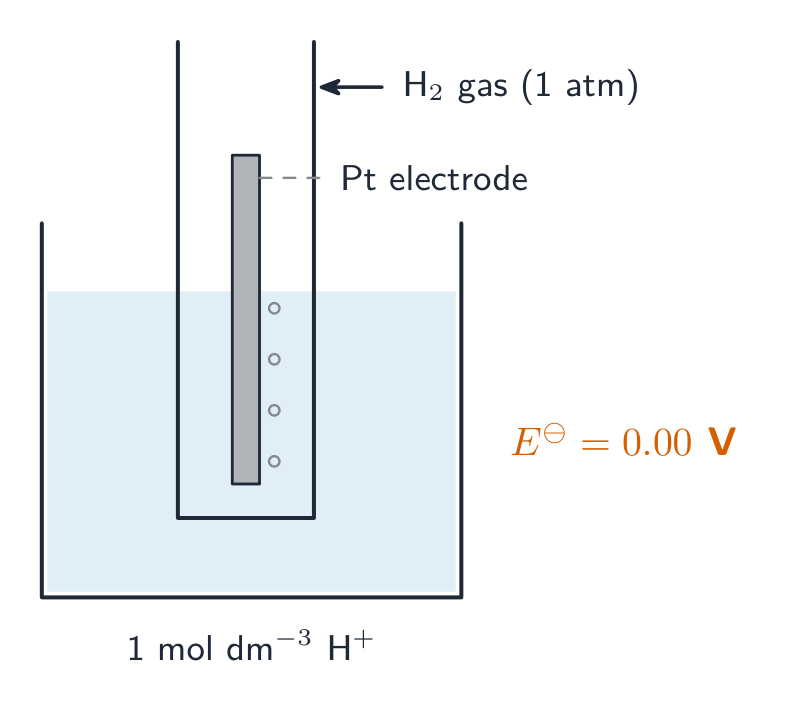
The reference is the standard hydrogen electrode 标准氢电极: hydrogen gas at $1\ \text{atm}$ over platinum in $1\ \text{mol dm}^{-3}$$\text{H}^+$, defined as exactly $0.00\ \text{V}$.
To measure an $E^{\ominus}$, connect the half-cell to the standard hydrogen electrode and read the voltage. A metal sits in a solution of its ions; for two ions of the same element (such as $\text{Fe}^{3+}/\text{Fe}^{2+}$), a platinum electrode dips into a solution containing both.
Combining half-cells
The standard cell potential 标准电池电势 is the difference between the two standard electrode potentials:
Worked example. Find the standard cell potential of a cell built from the $\text{Zn}^{2+}/\text{Zn}$ half-cell ($E^{\ominus} = -0.76\ \text{V}$) and the $\text{Cu}^{2+}/\text{Cu}$ half-cell ($E^{\ominus} = +0.34\ \text{V}$).
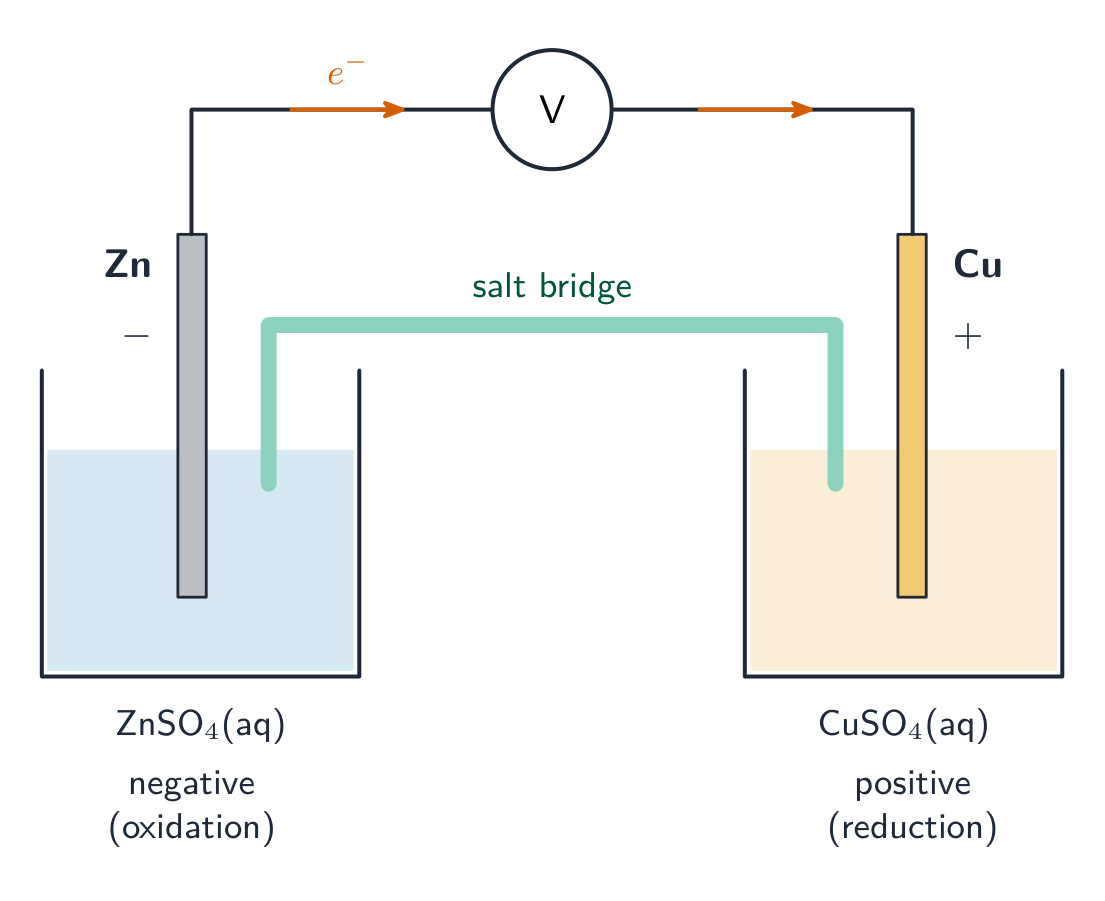
find the polarity: the more negative electrode is the negative terminal, and electrons flow from it through the external circuit to the positive electrode.
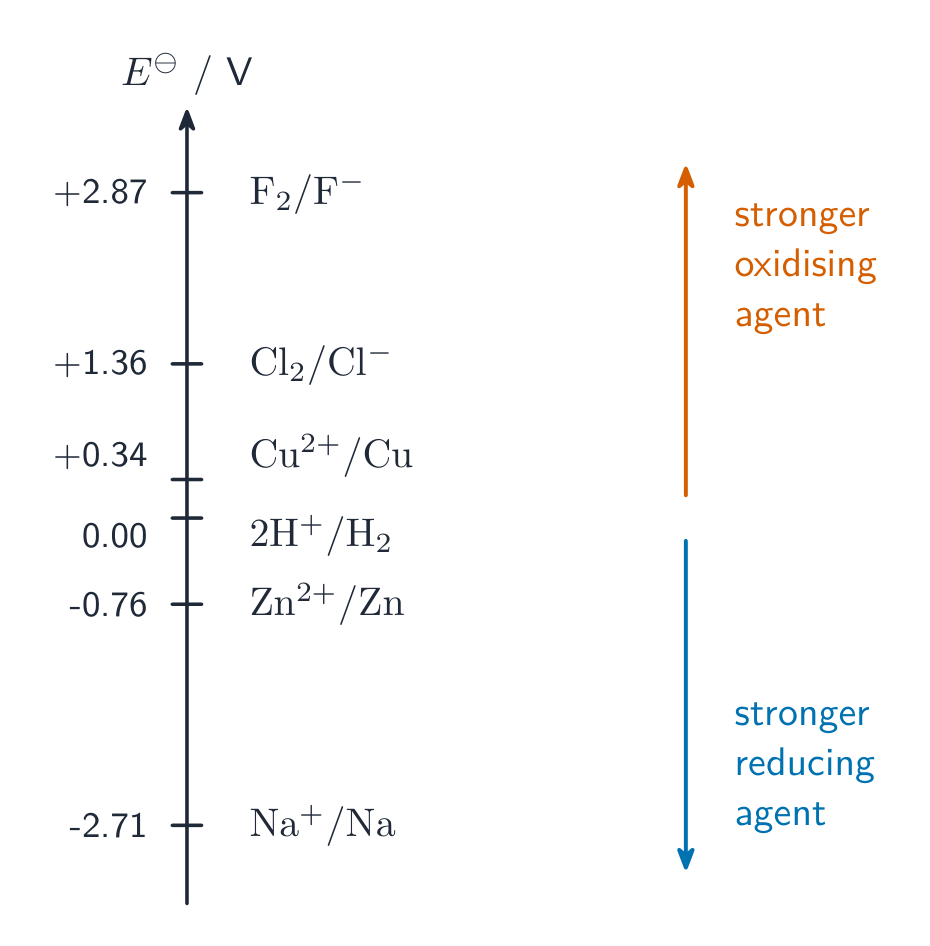
judge reactivity: a more positive $E^{\ominus}$ means a better oxidising agent 氧化剂 (easily reduced); a more negative $E^{\ominus}$ means a better reducing agent 还原剂.
Feasibility and redox equations
A reaction is feasible when $E^{\ominus}_{\text{cell}}$ is positive. To build the full equation, take the two half-equations 半反应方程式, reverse the one that is oxidised, and add them so the electrons cancel. This $E^{\ominus}$ test tells you the feasibility 可行性 of the reaction.
You can also link it to free energy: $\Delta G^{\ominus} = -n E^{\ominus}_{\text{cell}} F$, where $n$ is the moles of electrons.
The Nernst equation
If the concentrations are not standard, the electrode potential changes. Raising the concentration of the oxidised species makes $E$ more positive. The Nernst equation 能斯特方程 gives the exact value:
where $z$ is the number of electrons in the half-equation.
Português
O potencial de eletrodo 电极电势 ($E$) de uma semicélula mostra quão facilmente ela é reduzida. Medimos esse potencial contra uma referência, sob condições padrão, para obter o potencial de eletrodo padrão 标准电极电势 ($E^{\ominus}$), sempre escrito como redução.
A referência é o eletrodo padrão de hidrogênio 标准氢电极: gás hidrogênio a $1\ \text{atm}$ sobre platina em $1\ \text{mol dm}^{-3}$$\text{H}^+$, definido exatamente como $0.00\ \text{V}$.
O eletrodo padrão de hidrogênio: H$_2$ a 1 atm sobre platina em 1 mol dm$^{-3}$ H$^+$, a referência de $0.00$ V para cada potencial de eletrodo
Para medir um $E^{\ominus}$, conecte a semicélula ao eletrodo padrão de hidrogênio e leia a tensão. Um metal está imerso em uma solução de seus íons; para dois íons do mesmo elemento (como $\text{Fe}^{3+}/\text{Fe}^{2+}$), um eletrodo de platina é mergulhado em uma solução contendo ambos.
Combinando semicélulas
O potencial padrão de célula 标准电池电势 é a diferença entre os dois potenciais de eletrodo padrão:
Uma célula simples: duas semicélulas unidas por uma ponte salina, com um voltímetro. Elétrons fluem do eletrodo negativo (Zn) para o positivo (Cu)
Exemplo resolvido. Encontre o potencial padrão de célula de uma célula construída a partir da semicélula $\text{Zn}^{2+}/\text{Zn}$ ($E^{\ominus} = -0.76\ \text{V}$) e da semicélula $\text{Cu}^{2+}/\text{Cu}$ ($E^{\ominus} = +0.34\ \text{V}$).
encontrar a polaridade: o eletrodo mais negativo é o polo negativo, e os elétrons fluem dele através do circuito externo para o eletrodo positivo.
julgar a reatividade: um $E^{\ominus}$ mais positivo significa um melhor agente oxidante 氧化剂 (facilmente reduzido); um $E^{\ominus}$ mais negativo significa um melhor agente redutor 还原剂.
A série eletroquímica: um $E^{\ominus}$ mais positivo (topo) é um agente oxidante mais forte; um $E^{\ominus}$ mais negativo (base) é um agente redutor mais forte
Viabilidade e equações redox
Uma reação é viável quando $E^{\ominus}_{\text{cell}}$ é positivo. Para montar a equação completa, pegue as duas meias-equações 半反应方程式, inverta a que sofre oxidação e adicione-as para que os elétrons se cancelem. Este teste $E^{\ominus}$ indica a viabilidade 可行性 da reação.
Você também pode vinculá-la à energia livre: $\Delta G^{\ominus} = -n E^{\ominus}_{\text{cell}} F$, onde $n$ são os mols de elétrons.
A equação de Nernst
Se as concentrações não forem padrões, o potencial do eletrodo muda. Aumentar a concentração da espécie oxidada torna $E$ mais positivo. A equação de Nernst 能斯特方程 fornece o valor exato:
$E^{\ominus}_{\text{cell}} = E^{\ominus}(\text{more positive}) - E^{\ominus}(\text{less positive})$; a positive$E^{\ominus}_{\text{cell}}$ means the reaction is feasible.
Standard conditions for $E^{\ominus}$: 298 K, $1\ \text{mol dm}^{-3}$, 100 kPa, platinum electrode — state them if asked.
A more negative electrode potential means a stronger reducing agent; use the series to predict the direction.
For electrolysis quantities use $Q = It$ and moles of electrons $= Q/F$.
Português
$E^{\ominus}_{\text{cell}} = E^{\ominus}(\text{more positive}) - E^{\ominus}(\text{less positive})$; um $E^{\ominus}_{\text{cell}}$positivo significa que a reação é viável.
Condições padrão para $E^{\ominus}$: 298 K, $1\ \text{mol dm}^{-3}$, 100 kPa, eletrodo de platina — mencione-as se solicitado.
Um potencial de eletrodo mais negativo significa um agente redutor mais forte; use a série para prever a direção.
Para quantidades em eletrólise use $Q = It$ e mols de elétrons $= Q/F$.
Interactive lessons on this topic · Aulas interativas sobre este tópico
Work through it step by step, with instant-check exercises. · Passe por ele passo a passo, com exercícios de verificação instantânea.
Pick one and the site follows you — notes, papers, videos and practice all open on it. · Escolha uma e o site te seguirá — notas, provas, vídeos e prática abrirão nela.
Type to search notes, lessons, code, vocabulary and past-paper questions across every subject. · Digite para pesquisar notas, aulas, código, vocabulário e questões de provas anteriores em todas as disciplinas.