Ionic bonding · Ligação iônica
| English | Português |
|---|---|
| ionic bonding/aɪˈɒnɪk ˈbɒndɪŋ/ | ligação iônica |
| electrostatic attraction/ɪˌlektrəʊˈstætɪk əˈtrækʃn/ | atração eletrostática |
| cation/ˈkætaɪən/ | catião |
| anion/ˈænaɪən/ | ânion |
| lattice/ˈlætɪs/ | rede |
| molten/ˈməʊltn/ | fundido |
Giving electrons away
- Ionic bonding 离子键 is the electrostatic attraction 静电引力 between oppositely charged ions.
- Positive cations 阳离子 attract negative anions 阴离子.
- The ions pack into a giant lattice 晶格.
Ceder elétrons
- A ligação iônica 离子键 é a atração eletrostática 静电引力 entre íons de cargas opostas.
- Cátions positivos atraem ânions negativos.
- Os íons se organizam em uma rede gigante 晶格.
Ionic bonding is the electrostatic attraction between oppositely charged ions. · A ligação iônica é a atração eletrostática entre íons de cargas opostas.
It forms by transferring electrons from a metal to a non-metal. · Ela se forma pela transferência de elétrons de um metal para um não-metal.
Ionic bonding is: · A ligação iônica é:
Ionic bonding is the attraction between positive cations and negative anions. · A ligação iônica é a atração entre cátions positivos e ânions negativos.
How it forms
- A metal gives electrons to a non-metal — e.g. $\text{NaCl}$, $\text{MgO}$, $\text{CaF}_2$.
- The ions form a regular giant lattice, held by attraction in every direction.
A salt crystal's cubic shape comes straight from the giant ionic lattice inside.
Como se forma
- Um metal transfere elétrons para um ametal — ex.: $\text{NaCl}$, $\text{MgO}$, $\text{CaF}_2$.
- Os íons formam uma rede gigante regular, mantida por atração em todas as direções.
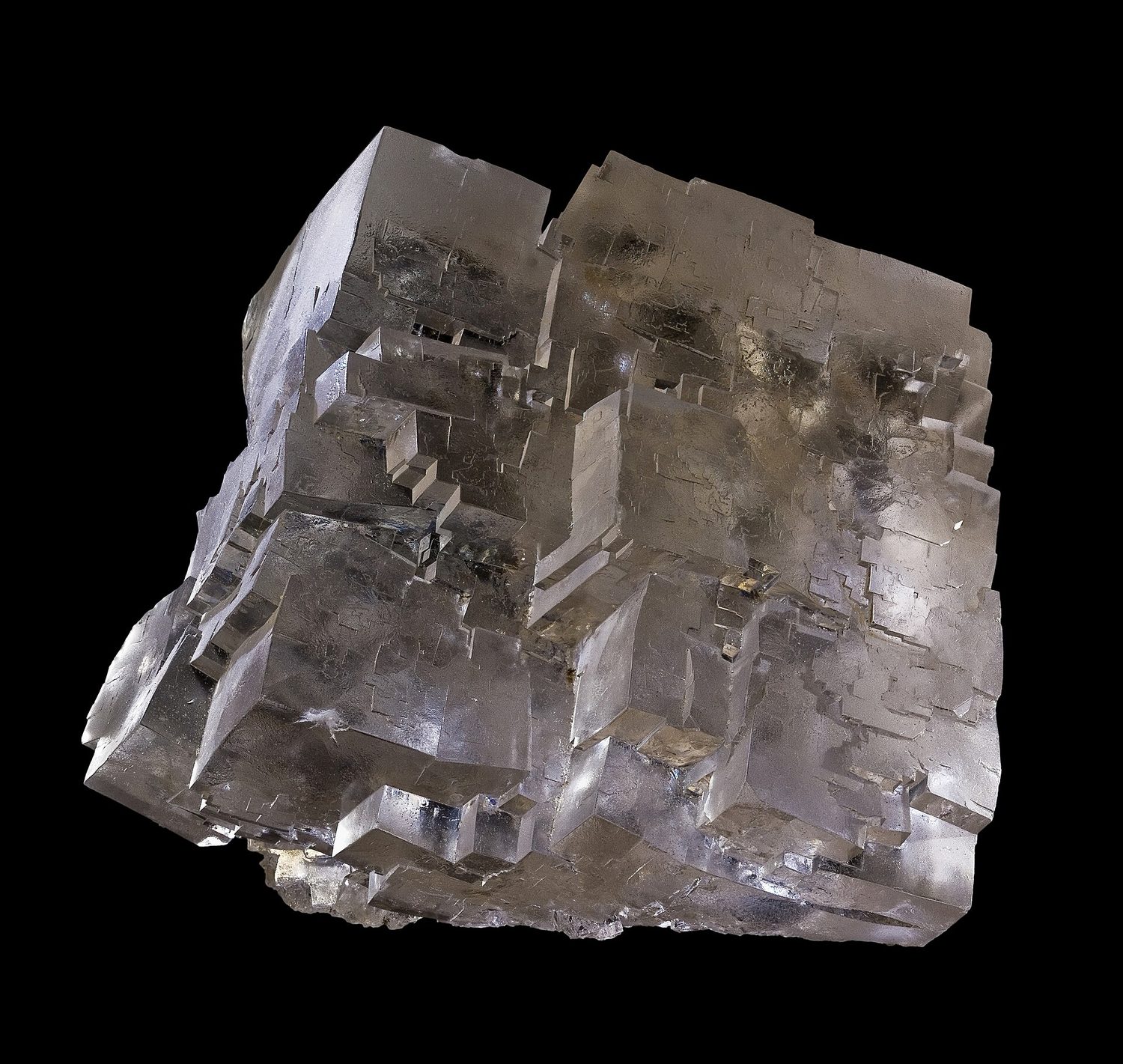
A forma cúbica de um cristal de sal vem diretamente da rede iônica gigante interna.
Forming an ionic bond (NaCl) · Formando uma ligação iônica (NaCl)
Step through it. A metal hands its outer electron to a non-metal; the oppositely charged ions then attract in a giant lattice. · Passe por isso. Um metal cede seu elétron externo para um não-metal; os íons de cargas opostas então se atraem em uma rede gigante.
Ionic bonding forms when: · A ligação iônica se forma quando:
A metal transfers electrons to a non-metal, making oppositely charged ions (e.g. NaCl). · Um metal transfere elétrons para um não-metal, formando íons de cargas opostas (ex. NaCl).
In an ionic solid the ions are packed into a regular giant ______, held by attraction in every direction. · Em um sólido iônico, os íons estão empacotados em uma regular ______ gigante, mantida por atração em todas as direções.
Each ion is surrounded by oppositely charged neighbours, so the structure is very strong. · Cada íon é cercado por vizinhos de carga oposta, tornando a estrutura muito forte.
In an ionic solid, the ions are arranged in: · Em um sólido iônico, os íons estão dispostos em:
Ions pack into a giant lattice, with each ion attracted to oppositely charged neighbours all around. · Íons se empacotam em uma rede gigante, com cada íon atraído por vizinhos de carga oposta ao redor.
Dot-and-cross
- In $\text{NaCl}$, sodium transfers its single outer electron to chlorine.
- This gives $\text{Na}^{+}$ and a full-octet $\text{Cl}^{-}$, drawn with dots and crosses.
Sodium gives its single outer electron to chlorine, forming Na⁺ and a full-octet Cl⁻.
Ponto e cruz
- Em $\text{NaCl}$, o sódio transfere seu único elétron externo para o cloro.
- Isso resulta em $\text{Na}^{+}$ e octeto completo $\text{Cl}^{-}$, desenhado com pontos e cruzes.

O sódio cede seu único elétron externo ao cloro, formando Na⁺ e Cl⁻ com octeto completo.
In the NaCl dot-and-cross diagram: · No diagrama de pontos e cruzes do NaCl:
Sodium loses one electron to chlorine, forming Na⁺ and a full-octet Cl⁻. · O sódio perde um elétron para o cloro, formando Na⁺ e um Cl⁻ com octeto completo.
Put the formation of an ionic bond in order. · Coloque a formação de uma ligação iônica em ordem.
Transfer the electron → make ions → they attract → giant lattice. · Transfere o elétron → faz íons → eles se atraem → rede gigante.
Properties from ionic bonding
- Ionic compounds have high melting points (strong attractions in a giant lattice).
- They conduct only when molten 熔融 or dissolved, when the ions are free to move.
Rock salt (halite): an ionic compound held in a giant lattice
Propriedades da ligação iônica
- Compostos iônicos têm pontos de fusão altos (fortes atrações em rede gigante).
- Conduzem apenas quando fundidos 熔融 ou dissolvidos, quando os íons estão livres para mover-se.
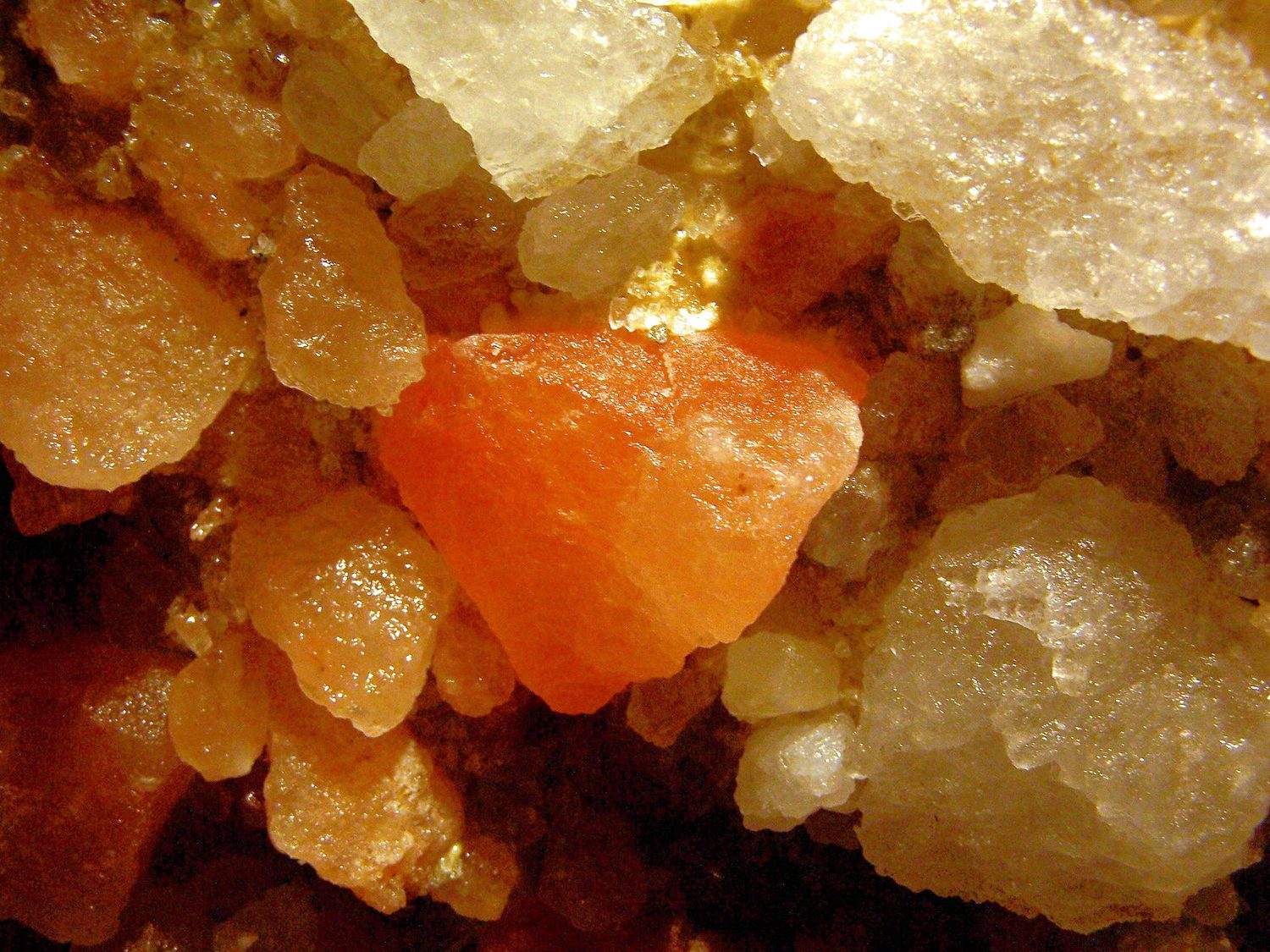
Sal de rocha (halita): composto iônico mantido em rede gigante
You've got it
- ionic bonding = electrostatic attraction between cations and anions
- forms when a metal transfers electrons to a non-metal ($\text{NaCl}$, $\text{MgO}$, $\text{CaF}_2$)
- the ions form a giant lattice held in every direction
Entendeu?
- ligação iônica = atração eletrostática entre cátions e ânions
- forma-se quando um metal transfere elétrons para um ametal ($\text{NaCl}$, $\text{MgO}$, $\text{CaF}_2$)
- os íons formam uma rede gigante mantida em todas as direções