The gaseous state
Introduced| English | Meaning |
|---|---|
| collide/kəˈlaɪd/ | To strike or come into contact with another moving or stationary object or particle. |
| pressure/ˈpreʃə/ | Force acting normally per unit area. |
| real gas/rɪəl ɡæs/ | An actual gas, whose behaviour departs from the ideal model at high pressure and low temperature. |
| ideal gas/aɪˈdɪəl ɡæs/ | A model of a gas with point particles that exert no intermolecular forces except during perfectly elastic collisions. |
| molar mass/ˈməʊlə mæs/ | The mass of one mole of a substance. |
The freedom of gases
- Gas molecules move fast in all directions and collide 碰撞 with the walls.
- The many tiny pushes add up to the gas pressure 压强.
- We model gases as ideal to make calculations simple.
Gas pressure is caused by:
Difficulty 1/5 · 100 coins + a small bonus on first completion today
Each collision with the wall gives a tiny push; the many pushes add up to the pressure.
Ideal vs real gases 实际气体
- An ideal gas 理想气体 assumes: the particles take up zero volume, and there are no forces between them.
- A real gas follows this closely at low pressure and high temperature.
- It behaves least ideally at high pressure and low temperature (particles crowded, forces matter).
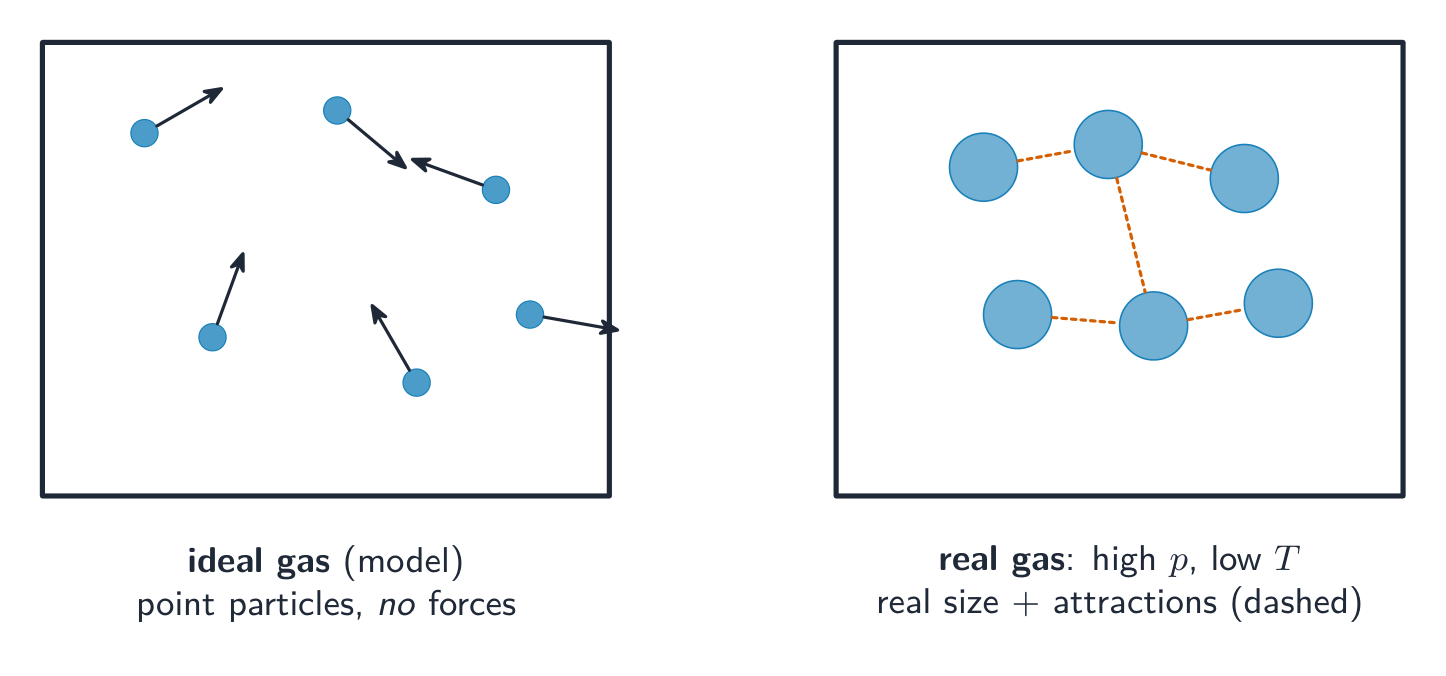
The ideal-gas model: point particles of zero volume with no forces between them
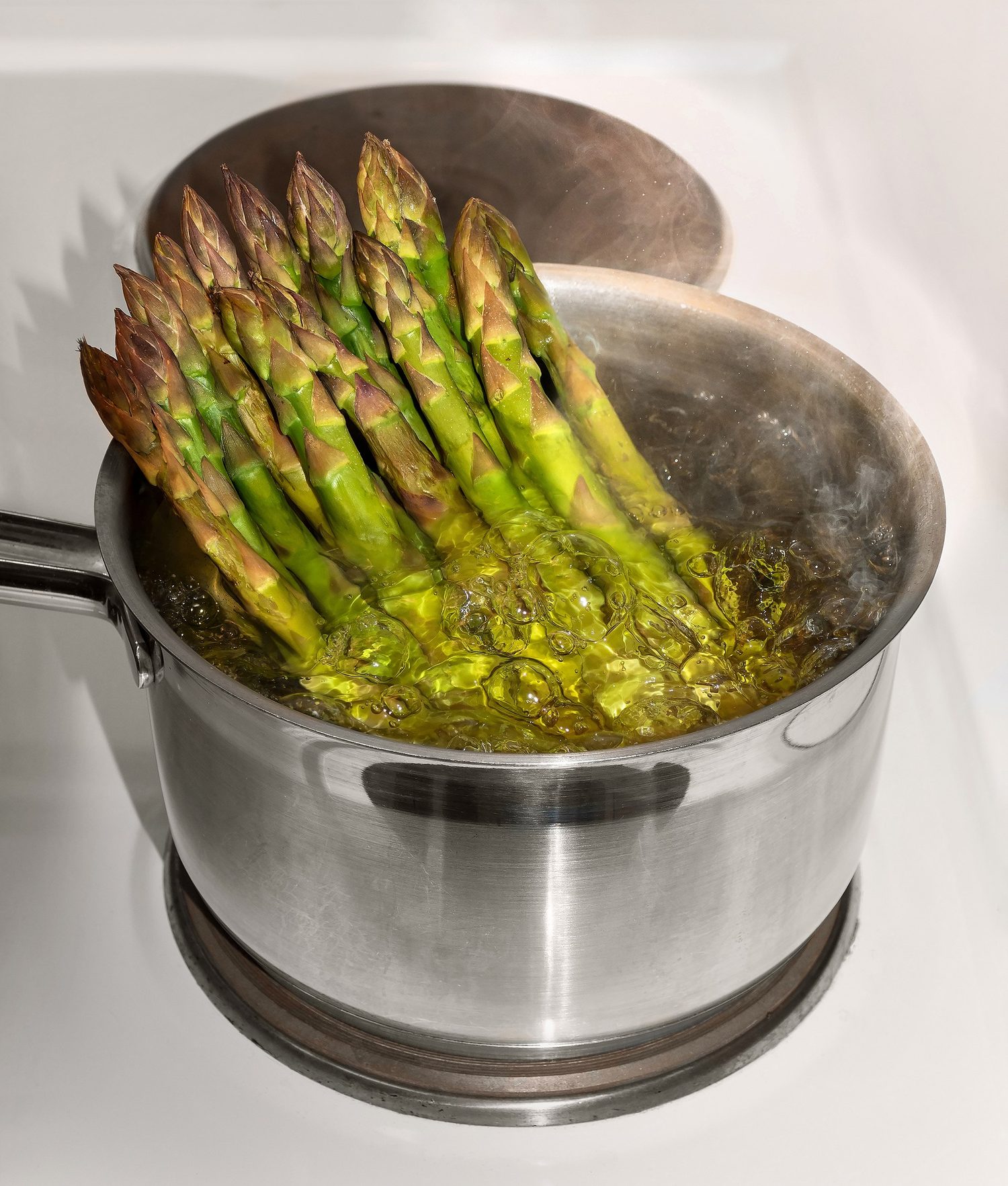
Boiling turns liquid water into steam, a change between states of matter
The gaseous state
p = k / V
Boyle's law: at constant temperature pressure ∝ 1/volume.
An ideal gas is assumed to have:
Difficulty 1/5 · 100 coins + a small bonus on first completion today
The ideal-gas model assumes point particles (zero volume) with no intermolecular forces.
A real gas behaves LEAST like an ideal gas at:
Difficulty 1/5 · 100 coins + a small bonus on first completion today
At high pressure and low temperature the particles are crowded, so their size and attractions matter.
Match each gas idea to its meaning.
Difficulty 2/5 · 140 coins + a small bonus on first completion today
Pressure comes from collisions; an ideal gas ignores particle volume and forces; pV = nRT links them.
Real gases behave most like an ideal gas at high pressure and low temperature.
Difficulty 1/5 · 100 coins + a small bonus on first completion today
False. Real gases deviate most at high pressure and low temperature, where particles are close together and their volume and attractions matter. They are most ideal at low pressure and high temperature.
The ideal gas equation
- $p$ in Pa, $V$ in $\text{m}^3$, $n$ in mol, $T$ in kelvin (K), $R = 8.31\ \text{J}/(\text{K}\cdot\text{mol})$.
- Convert first: °C → K (add 273), and $\text{cm}^3$/$\text{dm}^3$ → $\text{m}^3$.
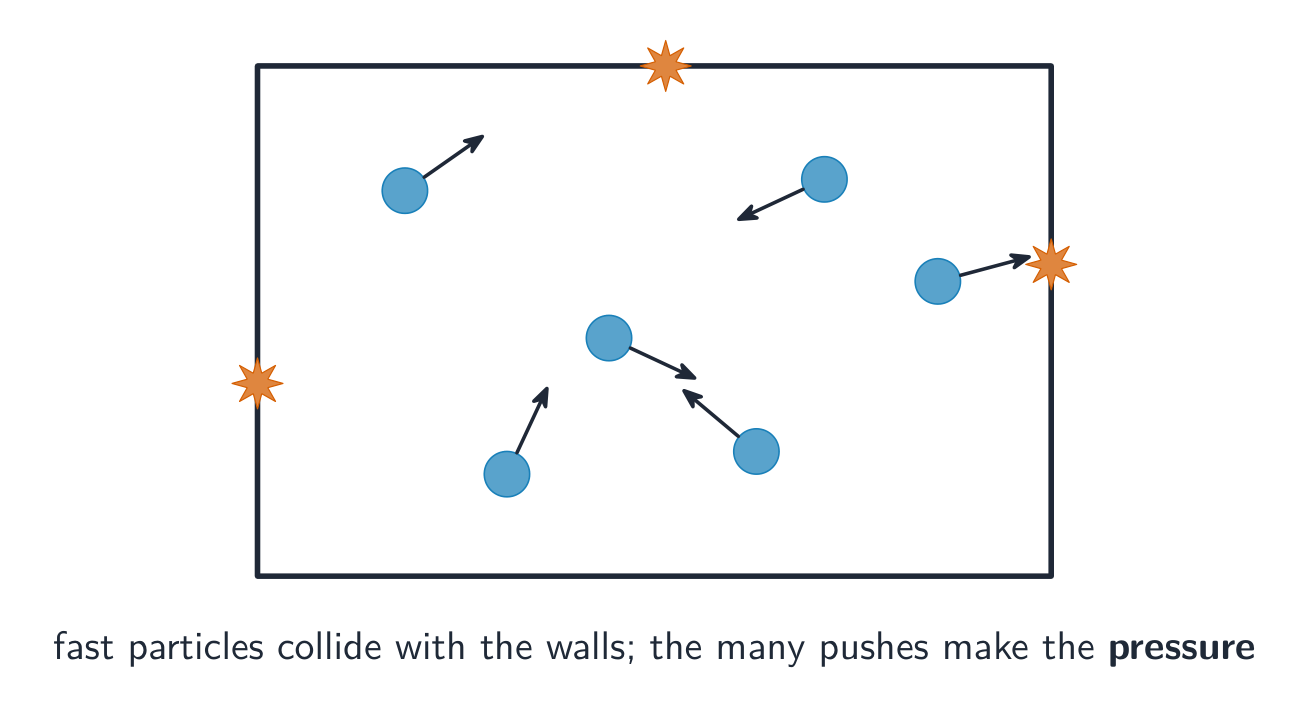
Gas pressure comes from many fast molecules colliding with the container walls
In pV = nRT, the temperature T must be in:
Difficulty 1/5 · 100 coins + a small bonus on first completion today
T must be in kelvin; convert °C to K by adding 273 (and volumes to m³).
Finding molar mass 摩尔质量
Since $n = m/M$:
- This finds $M_r$ from the mass (or density) of a gas.
Which equation gives the molar mass of a gas?
Difficulty 1/5 · 100 coins + a small bonus on first completion today
From pV = (m/M)RT, rearranging gives M = mRT/(pV).
Worked examples
1. Find the volume of $0.0200\ \text{mol}$ of gas at $300\ \text{K}$ and $100\ \text{kPa}$. Convert first: $p = 1.00 \times 10^5\ \text{Pa}$. $V = \dfrac{nRT}{p} = \dfrac{0.0200 \times 8.31 \times 300}{1.00 \times 10^5} = 4.99 \times 10^{-4}\ \text{m}^3$, which is $499\ \text{cm}^3$.
2. The commonest slip is leaving the temperature in °C or the pressure in kPa: $pV = nRT$ needs Pa, $\text{m}^3$ and K.
You've got it
- gas pressure = sum of molecule–wall collisions
- ideal gas: zero particle volume, no forces; real gases deviate at high P, low T
- $pV = nRT$ (T in K, convert units first; $R = 8.31\ \text{J}/(\text{K}\cdot\text{mol})$)
- molar mass: $M = \dfrac{mRT}{pV}$