Três coisas muito diferentes: um corante laranja brilhante, um analgésico e uma plástico resistente. Os três começam como o mesmo líquido incolor — benzeno. Mas nenhum único…
English narration · English + 中文 subtitles burned in · Narração em inglês · Legendas em inglês + 中文 gravadas
36.1
Organic synthesis · Síntese orgânica
Syllabus · Programa
English
for an organic molecule containing several functional groups: (a) identify organic functional groups using the reactions in the syllabus (b) predict properties and reactions
devise multi-step synthetic routes for preparing organic molecules using the reactions in the syllabus
analyse a given synthetic route in terms of type of reaction and reagents used for each step of it, and possible by-products
Português
para uma molécula orgânica contendo vários grupos funcionais: (a) identifique grupos funcionais orgânicos usando as reações do programa; (b) preveja propriedades e reações
elabore rotas sintéticas em várias etapas para preparar moléculas orgânicas usando as reações do programa
analise uma rota sintética dada em termos do tipo de reação e reagentes usados em cada etapa, e possíveis subprodutos
Source: Cambridge International syllabus · Fonte: Programa Cambridge International
English
Like the AS synthesis topic, this asks you to join up known reactions to build a target molecule. Now you also have the A Level reactions of arenes, phenol, amines, amides and acyl chlorides.
Identifying functional groups
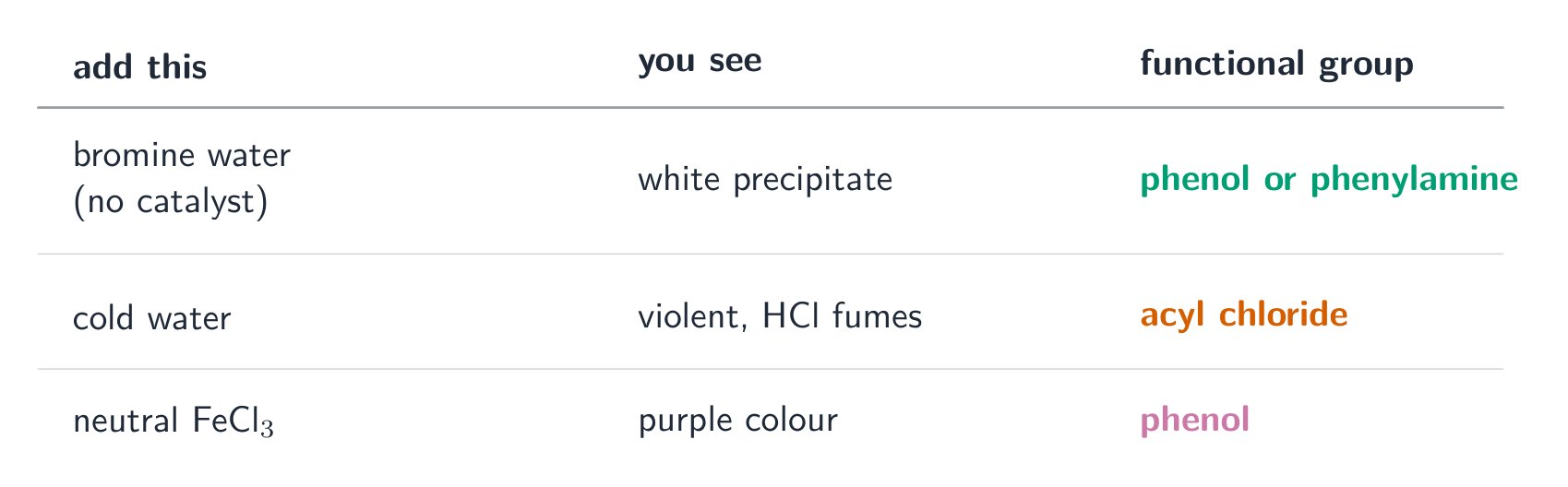
A molecule may carry several functional group 官能团 types. Use the test reactions to spot each one, then predict its behaviour. For example:
decolourises bromine water with no catalyst, giving a white precipitate → a phenol or a phenylamine (the ring is activated).
reacts violently with cold water, giving fumes of $\text{HCl}$ → an acyl chloride 酰氯.
gives a purple colour with neutral $\text{FeCl}_3$ → a phenol 苯酚.
$\text{Sn}$ / conc $\text{HCl}$, then $\text{NaOH}$ (reduction 还原)
phenylamine
phenylamine
$\text{HNO}_2$, below $10\,°\text{C}$
a diazonium salt
diazonium salt
warm water
phenol; or couple with phenol → azo dye
methylbenzene
hot $\text{KMnO}_4$ (oxidation 氧化)
benzoic acid
carboxylic acid 羧酸
$\text{SOCl}_2$ or $\text{PCl}_5$
acyl chloride
acyl chloride
alcohol / phenol
an ester 酯
acyl chloride
ammonia / amine 胺
an amide 酰胺
amide or nitrile 腈
$\text{LiAlH}_4$
an amine
halogenoalkane
$\text{KCN}$
a nitrile (adds one carbon)
Planning and analysing a route
To devise a synthetic route 合成路线, work backwards from the target: which single reaction makes it, and from what? Repeat until you reach the starting material, then write each step with its reagent 试剂 and conditions.
When you analyse a route, state the type of reaction for each step (for example electrophilic substitution, addition–elimination 加成消去, oxidation or reduction) and watch for likely by-products 副产物 — for example, making an amine from a halogenoalkane also gives over-substituted amines, lowering the yield.
Worked example. Devise a route from benzene to phenylamine, $\text{C}_6\text{H}_5\text{NH}_2$. Work backwards: phenylamine comes from reducing nitrobenzene, and nitrobenzene comes from nitrating benzene - so the route is two steps. Step 1: benzene with concentrated $\text{HNO}_3$ and concentrated $\text{H}_2\text{SO}_4$ at $55\ °\text{C}$; electrophilic substitution gives nitrobenzene (keep below $55\ °\text{C}$, or further substitution follows). Step 2: reduce the nitrobenzene with tin and concentrated $\text{HCl}$, then add $\text{NaOH}$ to free the amine from its salt. There is no direct route - you cannot put an $\text{–NH}_2$ straight onto a ring, which is exactly why this nitrate-then-reduce pair is worth knowing by heart.
Português
Assim como o tópico de síntese AS, isso pede para você conectar reações conhecidas para construir uma molécula-alvo. Agora você também tem as reações de nível A de arenos, fenol, aminas, amidas e cloretos de acila.
Identificando grupos funcionais
Uma molécula pode carregar vários tipos de grupo funcional 官能团. Use as reações de teste para identificar cada um, depois preveja seu comportamento. Por exemplo:
decoloriza a água brominada sem catalisador, dando um precipitado branco → um fenol ou uma fenilamina (o anel está ativado).
reage violentamente com água fria, dando fumos de $\text{HCl}$ → um cloreto de acila 酰氯.
dá uma cor roxa com $\text{FeCl}_3$ neutro → um fenol 苯酚.
Testes de identificação adicionados no nível A: cada reagente dá um resultado característico que aponta para um grupo funcional
$\text{Sn}$ / conc. $\text{HCl}$, depois $\text{NaOH}$ (redução 还原)
fenilamina
fenilamina
$\text{HNO}_2$, abaixo $10\,°\text{C}$
um sal diazonio
sal diazonio
água morna
fenol; ou acoplar com fenol → corante azoico
metilbenzeno
$\text{KMnO}_4$ quente (oxidação 氧化)
ácido benzoico
ácido carboxílico 羧酸
$\text{SOCl}_2$ ou $\text{PCl}_5$
cloreto de acila
cloreto de acila
álcool / fenol
um éster 酯
cloreto de acila
amônia / amina 胺
uma amida 酰胺
amida ou nitrila 腈
$\text{LiAlH}_4$
uma amina
halogeneto de alquila
$\text{KCN}$
uma nitrila (adiciona um carbono)
Um mapa das reações de nível A: a cadeia aromática (topo) e a cadeia de cloreto de acila (inferior), com seus insumos. Trabalhe de trás para frente a partir do seu alvo
Planejar e analisar uma rota
Para elaborar uma rota sintética 合成路线, trabalhe de trás para frente a partir do alvo: qual única reação o produz e a partir do quê? Repita até chegar ao material inicial, depois escreva cada etapa com seu reagente 试剂 e condições.
*Planeje uma rota trabalhando de trás para frente a partir do alvo, uma reação por vez, até chegar ao material inicial
Ao analisar uma rota, indique o tipo de reação para cada etapa (por exemplo, substituição eletrofílica, adição–eliminação 加成消去, oxidação ou redução) e observe os prováveis subprodutos 副产物 — por exemplo, ao produzir uma amina a partir de um halogenoalcano, também se formam aminas super-substituídas, reduzindo o rendimento.
Exemplo resolvido. Elabore uma rota do benzeno à fenilamina, $\text{C}_6\text{H}_5\text{NH}_2$. Trabhe de trás para frente: a fenilamina resulta da redução da nitrobenzeno, e a nitrobenzeno resulta da nitração do benzeno — logo, a rota tem duas etapas. Etapa 1: benzeno com concentrado $\text{HNO}_3$ e concentrado $\text{H}_2\text{SO}_4$ a $55\ °\text{C}$; a substituição eletrofílica produz nitrobenzeno (mantenha abaixo de $55\ °\text{C}$, caso contrário ocorrerá substituição adicional). Etapa 2: reduza a nitrobenzeno com estanho e concentrado $\text{HCl}$, depois adicione $\text{NaOH}$ para libertar a amina do seu sal. Não existe rota direta — não se pode introduzir um $\text{–NH}_2$ diretamente num anel, razão pela qual este par nitrar-reduzir deve ser decorado.
Explore · Explorar
Planejador de síntese A-Level
Construa uma rota correspondendo mudanças de grupo funcional a reagentes.
Pick one and the site follows you — notes, papers, videos and practice all open on it. · Escolha uma e o site te seguirá — notas, provas, vídeos e prática abrirão nela.
Type to search notes, lessons, code, vocabulary and past-paper questions across every subject. · Digite para pesquisar notas, aulas, código, vocabulário e questões de provas anteriores em todas as disciplinas.


 *Planeje uma rota trabalhando de trás para frente a partir do alvo, uma reação por vez, até chegar ao material inicial