Analysis of accounts
Introduced| English | Meaning |
|---|---|
| profitability/ˌprɒfɪtəˈbɪlɪti/ | The ability of a business to generate profit in relation to its sales, costs, assets or investment. |
| liquidity/lɪˈkwɪdɪti/ | The ease of converting assets into cash without substantial loss, or the ability to meet short-term payment obligations. |
| gross profit margin/ɡrəʊs ˈprɒfɪt ˈmɑːdʒɪn/ | Gross profit expressed as a percentage of sales revenue. |
| profit margin/ˈprɒfɪt ˈmɑːdʒɪn/ | profit margin |
| net profit margin/net ˈprɒfɪt ˈmɑːdʒɪn/ | net profit margin |
| return on capital employed/rɪˈtɜːn ɒn ˈkæpɪtl emˈplɔɪd/ | Profit compared with the long-term capital used in the business. |
| capital employed/ˈkæpɪtl emˈplɔɪd/ | The long-term funds used in a business, commonly measured as total assets minus current liabilities. |
| percentage points/pəˈsentɪdʒ pɔɪnts/ | percentage points |
| current ratio/ˈkʌrənt ˈreɪʃɪəʊ/ | Current assets divided by current liabilities, used as an indicator of short-term liquidity. |
| acid test ratio/ˈæsɪd test ˈreɪʃɪəʊ/ | A check of whether short-term assets, excluding stock, cover short-term debts. |
Which shop earns more from each pound of sales?
- Shop A earns £20,000 profit on £200,000 revenue. Shop B earns £15,000 on £100,000 revenue. A makes more total profit, but B keeps more profit from each pound of sales.
- Profitability 盈利能力 measures profit in relation to sales or capital. Liquidity 流动性 is the ability to pay short-term debts. A business can be profitable yet lack cash when a bill is due.
Calculate the two sales margins
- Gross profit margin 毛利率 = gross profit ÷ revenue × 100%. Profit margin 利润率 = profit for the year ÷ revenue × 100%. Some questions call this the net profit margin 净利率. Use the stated profit figure; do not use revenue as the numerator.
- For the worked cycle shop, revenue is £150,000, gross profit £60,000 and profit for the year £25,000. Gross margin = 60 ÷ 150 × 100 = 40%; profit margin = 25 ÷ 150 × 100 ≈ 16.7%. Each £1 of sales leaves 40p before other expenses and about 16.7p after them.
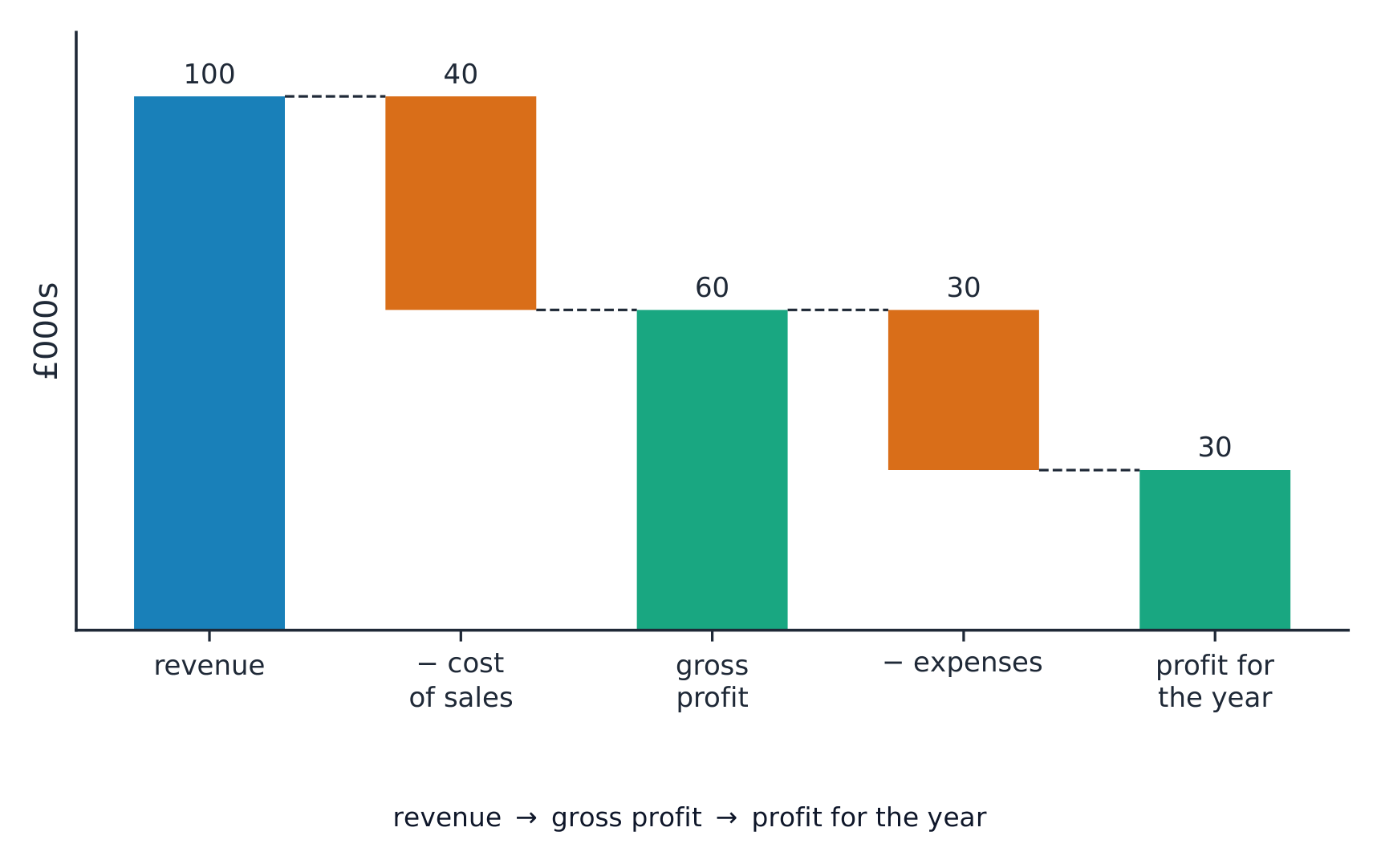
A separate example (£000): revenue 100, gross profit 60 and profit 30 give margins of 60% and 30%.
Gross profit is 80 and revenue is 200. What is the gross profit margin (%)?
Difficulty 2/5 · 140 coins + a small bonus on first completion today
80 ÷ 200 × 100 = 40%.
The profit margin for the year is calculated as:
Difficulty 1/5 · 100 coins + a small bonus on first completion today
Profit margin = profit for the year ÷ revenue × 100. Gross profit would give the gross margin instead.
Revenue is £240000 and profit for the year is £30000. Calculate the profit margin (%).
Difficulty 2/5 · 140 coins + a small bonus on first completion today
£30000 ÷ £240000 × 100 = 12.5%. This is profit after expenses per £1 of sales.
Compare profit with the capital used
- Return on capital employed 资本回报率 (ROCE) = profit ÷ capital employed 所用资本 × 100%. Capital employed is the long-term funds used in the business: owners' equity + non-current liabilities, or total assets − current liabilities. Use the profit figure specified in the question.
- The cycle shop's £25,000 profit and £125,000 capital employed give ROCE = 25 ÷ 125 × 100 = 20%. That is 20p profit for each £1 of capital employed during the year. It is not a cash payment of 20p to every owner, or profit as a percentage of sales.
A business has total assets £220000 and current liabilities £70000. Calculate capital employed (£).
Difficulty 2/5 · 140 coins + a small bonus on first completion today
Capital employed = total assets − current liabilities = £220000 − £70000 = £150000.
Profit is £48000 and capital employed is £300000. Calculate ROCE (%).
Difficulty 2/5 · 140 coins + a small bonus on first completion today
£48000 ÷ £300000 × 100 = 16%: 16p profit per £1 of capital employed.
Diagnose a change, rather than just name it
- In Year 2 the cycle shop has revenue £180,000, gross profit £63,000, profit £20,000 and capital employed £160,000. Gross margin is 35%, profit margin about 11.1%, and ROCE 12.5%. All three fell, despite higher revenue and a higher gross-profit amount.
- Gross margin falling from 40% to 35% is a fall of 5 percentage points 百分点. More of each sales pound goes to cost of sales. A lower selling price, changed product mix, higher buying costs or waste could explain it; investigate before choosing a remedy.

Gross profit margin falls from 42% to 36%. How many percentage points has it fallen?
Difficulty 2/5 · 140 coins + a small bonus on first completion today
42 − 36 = 6 percentage points. This is not a 6% relative fall.
A business has revenue £120000 and a loss for the year of £6000. Enter its profit margin (%), using a minus sign.
Difficulty 2/5 · 140 coins + a small bonus on first completion today
Profit is −£6000, so −6000 ÷ 120000 × 100 = −5%.
A repair company earns profit £20000 with capital employed £100000 in Year A. In Year B profit rises to £24000 and capital employed to £160000. Calculate ROCE for both years and assess the claim that a higher profit always means a better return on capital.
Calculate from the supplied data, explain the business meaning and qualify the decision with relevant evidence.
Read the current ratio as a ratio
- Current ratio 流动比率 = current assets ÷ current liabilities. Current assets of £36,000 and current liabilities of £24,000 give 1.5:1. There is £1.50 of current assets for each £1 of current liabilities; do not multiply by 100 or write 1.5%.
- In this example the assets are £18,000 stock, £12,000 owed by customers and £6,000 cash. Most are not cash now. The ratio is one sign of liquidity, but it does not prove that bills due today can be paid today.
Current assets are 90 and current liabilities are 45. What is the current ratio?
Difficulty 2/5 · 140 coins + a small bonus on first completion today
90 ÷ 45 = 2 (i.e. 2:1).
The current ratio is a measure of a business's ______ (ability to pay short-term debts).
Difficulty 1/5 · 100 coins + a small bonus on first completion today
Liquidity measures short-term ability to pay debts.
Current assets £54000 and current liabilities £36000 give 1.5. Which interpretation is correct?
Difficulty 1/5 · 100 coins + a small bonus on first completion today
1.5:1 compares current assets with current liabilities. Current assets include stock and customer debts; they are not all immediately spendable cash.
Apply the stricter acid test
- Acid test ratio 速动比率, also called the quick ratio, = (current assets − inventory) ÷ current liabilities. For the same business, (36 − 18) ÷ 24 = 0.75:1. Subtract stock from the numerator before dividing, not from the final ratio.
- Without selling stock, recorded current assets cover 75p for each £1 of current liabilities. Some of that 75p is still money owed by customers. Stock may sell slowly or below its recorded value; even a quick ratio above 1 does not guarantee payment on the due date.
Current assets are £84000, including £36000 inventory. Current liabilities are £60000. Enter the acid test ratio as a number, such as 1.2.
Difficulty 2/5 · 140 coins + a small bonus on first completion today
(£84000 − £36000) ÷ £60000 = 0.8, or 0.8:1.
Current assets are £70000 and current liabilities £40000. The acid test ratio is 1:1. What is inventory (£)?
Difficulty 2/5 · 140 coins + a small bonus on first completion today
Current assets excluding inventory must equal £40000. Inventory = £70000 − £40000 = £30000.
Higher liquidity ratios are not always better
- At a later date current assets total £48,000: stock £36,000, customer debts £6,000 and cash £6,000. Current liabilities stay £24,000. Current ratio rises to 2:1, but acid test falls to (48 − 36) ÷ 24 = 0.5:1. More stock makes the first ratio look stronger while reducing cover without stock sales.
- A current ratio around 1.5–2 is a common guide, not a rule for every business. Fast cash sales, stock type, customer payment dates and supplier terms matter. Very high ratios may mean idle cash or excess stock, while very low cover may mean payment risk.

Which question does each ratio answer?
Sort the five IGCSE ratios into profitability or liquidity.
All figures are £000. Year A current assets 80, inventory 40 and current liabilities 40. Year B current assets 100, inventory 80 and current liabilities 40. The owner says the higher current ratio proves liquidity has improved. Calculate both ratios in each year and assess the claim.
Calculate from the supplied data, explain the business meaning and qualify the decision with relevant evidence.
Link the ratio to the user's decision
- Owners and managers compare margins and ROCE with earlier years or similar businesses before setting prices, cutting waste or investing. A higher return may be attractive, but cutting essential maintenance or quality could harm future sales.
- A lender or supplier needs repayment dates, a cash-flow forecast and existing debts as well as liquidity ratios. Accounts describe past performance or one dated position. Different products, business sizes or unusual events can make comparisons misleading; customer loyalty and service quality also matter.
A ratio is most useful when compared with past years, rivals or targets.
Difficulty 1/5 · 100 coins + a small bonus on first completion today
Comparison helps judge performance, but also check the business context, payment dates and whether the figures are comparable.
Shop A earns profit £20000 on revenue £200000. Shop B earns £15000 on £100000. An owner must choose one business to investigate for investment. Calculate profit margins, distinguish the two possible “better” claims, and suggest two further checks.
Calculate from the supplied data, explain the business meaning and qualify the decision with relevant evidence.
Give a meaning, a comparison and a judgement
- Choose the correct numerator and denominator. Margins and ROCE are percentages; current and acid-test ratios are written as numbers or ratios to 1. Keep units consistent and round only the final answer as requested.
- A ratio has a meaning even on its own, but a sound judgement needs context. State what it shows, compare it, explain a possible cause and its effect, then name the evidence needed before recommending a decision.
Gross profit is 45 and revenue is 150. Current assets are 48 and current liabilities are 32. Calculate the gross profit margin and current ratio. Explain what each shows and why more evidence is needed to judge performance.
Gross profit margin is gross profit divided by revenue. The current ratio is current assets divided by current liabilities.
Review the same figures: gross profit 45, revenue 150, current assets 48 and current liabilities 32. What is the gross profit margin?
Difficulty 1/5 · 100 coins + a small bonus on first completion today
45 ÷ 150 × 100 = 30%. The current ratio is 1.5:1, not a percentage.
A seasonal shop asks for £6000 extra supplier credit. Its current ratio is 2:1 and acid test ratio 0.6:1. Most stock is last season’s clothing; large bills fall due before the next busy season. Would these ratios alone justify approval? Recommend evidence and a possible response.
Calculate from the supplied data, explain the business meaning and qualify the decision with relevant evidence.