Belief Systems, 1450–1750
Introduced| English | Meaning |
|---|---|
| The Protestant Reformation/ðə ˈprɒtɪstənt rɪfɔːˈmeɪʃn/ | The Protestant Reformation |
| Sunni/ˈsʌni/ | The largest branch of Islam, whose traditions recognise the early caliphal succession and emphasise the community's inherited religious practice. |
| Shi'a/ʃɪə/ | A major branch of Islam that gives particular religious authority to Ali and the line of imams descended from him. |
| Sikhism/ˈsiːkɪzəm/ | A religion founded in the Punjab that drew on both Islamic and Hindu settings. |
| syncretic/sɪnˈkretɪk/ | syncretic |
A break that grew the whole
- The Protestant Reformation 新教改革 marked a break with existing Christian traditions, and both the Protestant and Catholic reformations contributed to the growth of Christianity.
- The CED's sentence contains a paradox worth noticing: a split grew the religion.
- Reform on both sides produced new institutions, new schools and new missionary effort.
The Reformation reduced the overall reach of Christianity.
Difficulty 1/5 · 100 coins + a small bonus on first completion today
The CED says both the Protestant and Catholic reformations contributed to the growth of Christianity.
A political rivalry deepened a religious split
- Political rivalries between the Ottoman and Safavid empires intensified the split within Islam between Sunni 逊尼派 and Shi'a 什叶派.
- Note the direction of causation: politics intensified a religious division that already existed.
- It is the clearest case in the unit of 3.1's political and religious disputes running together.
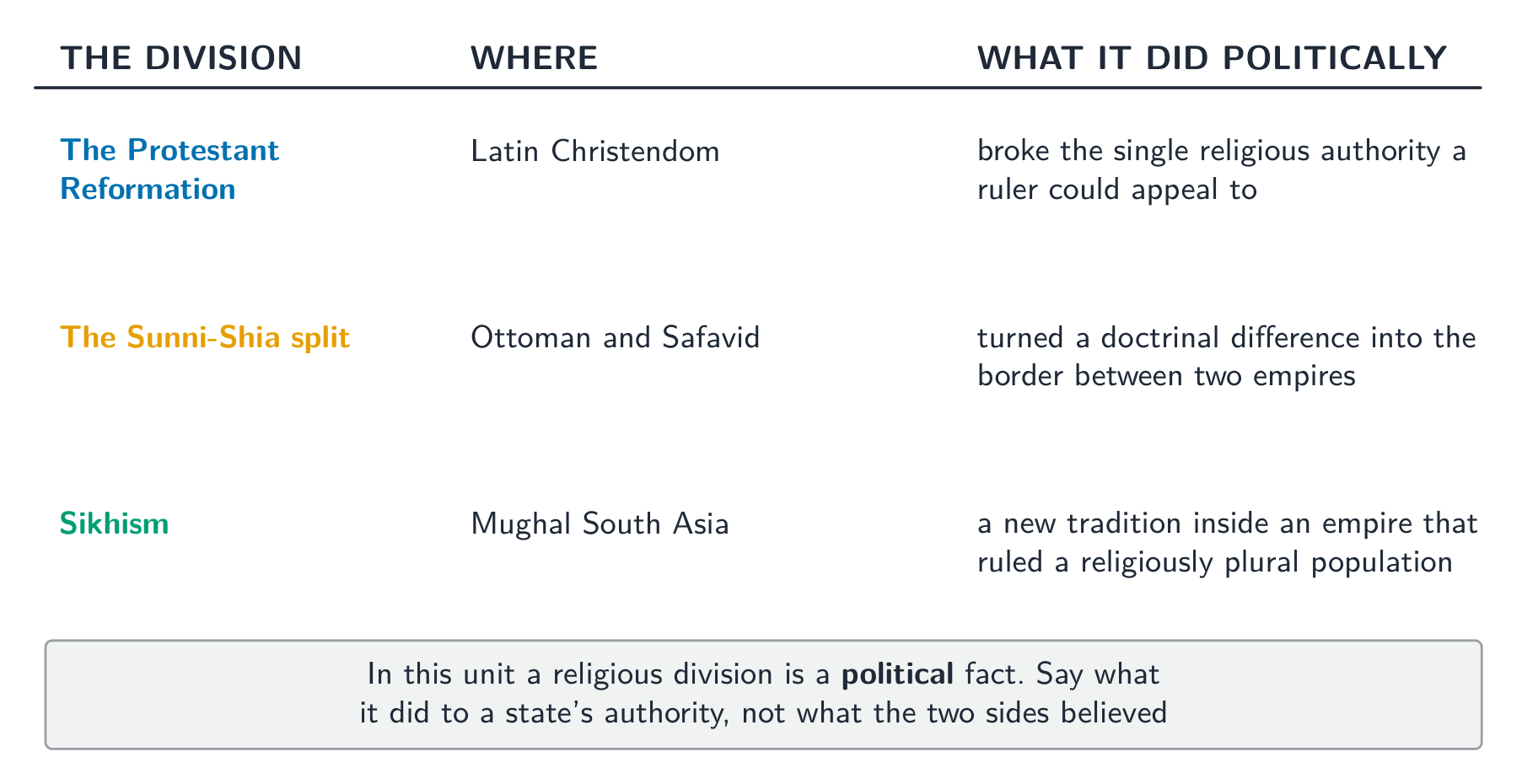
Three religious divisions, read for what each one did to a state's authority
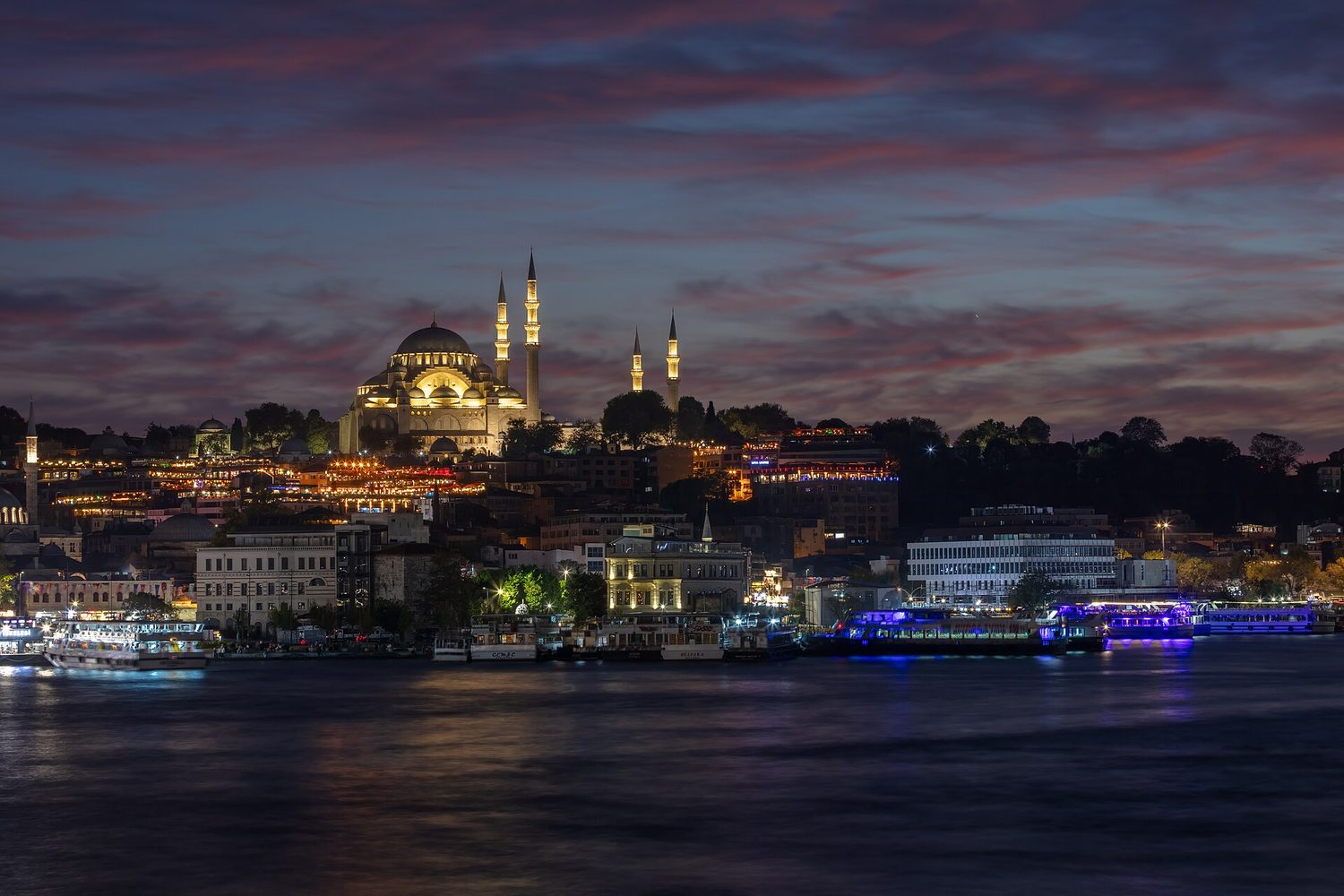
The Süleymaniye Mosque- monumental architecture as an instrument of legitimacy
The Ottoman–Safavid rivalry's effect on the Sunni–Shi'a split was to...
Difficulty 1/5 · 100 coins + a small bonus on first completion today
The division long predates both empires; the CED's verb is intensified.
A new religion from an interaction
- Sikhism 锡克教 developed in South Asia in a context of interactions between Hinduism and Islam.
- The CED's phrase is in a context of interactions — not "a mixture of".
- It is a syncretic 融合的 development: something new emerging where two traditions met, not a blend of both.
Which mechanism is at work?
Sort each case by how the change happened.
Sikhism developed in a context of ____ between Hinduism and Islam.
Difficulty 1/5 · 100 coins + a small bonus on first completion today
The CED's phrase is in a context of interactions, not "a mixture of".
The Ottoman–Safavid rivalry did not create the Sunni–Shi'a split; it intensified it. The CED's verb is intensified, and the division long predates both empires. Getting the direction of causation right is what separates a correct answer from a plausible one.
Select all the changes the CED names in this subtopic.
Difficulty 2/5 · 140 coins + a small bonus on first completion today
The CED never describes a religion disappearing in this period.
Continuity and change, together
- The objective asks for continuity and change within the various belief systems.
- Change: a new branch of Christianity, an intensified Sunni–Shi'a split, a new religion in South Asia.
- Continuity: all three happen inside traditions that continue — the CED never describes a religion disappearing.
Match each case to its mechanism.
Difficulty 2/5 · 140 coins + a small bonus on first completion today
Name the mechanism, not just the case.
Three cases, three mechanisms
- Reformation: internal reform producing a break, and growth on both sides of it.
- Sunni–Shi'a: an external political rivalry deepening an internal division.
- Sikhism: contact between two traditions producing a third. Name the mechanism, not just the case.
Two empires with a contested frontier each adopt the other's rival branch of Islam as a state creed. The theological difference is old; what is new is that crossing the border now means changing which authority you are supposed to obey. Politics did not invent the split — it made it a matter of state.
The Protestant Reformation marked a break, and both reformations grew Christianity. Ottoman–Safavid political rivalry intensified the existing Sunni–Shi'a split. Sikhism developed in a context of interactions between Hinduism and Islam. Three cases, three different mechanisms — name the mechanism.
Write from Sikhism and contact
- In northern South Asia, Hindu and Muslim communities lived side by side.
- Sikhism emerged in that setting.
What kind of religious change was this?
The new religion formed where two traditions met.
Where did Sikhism grow from?
Difficulty 1/5 · 100 coins + a small bonus on first completion today
Interaction, not isolation, is the setting.