Rotational Kinetic Energy
Introduced| English | Meaning |
|---|---|
| rotational kinetic energy/rəʊˈteɪʃənl kɪˈnetɪk ˈenədʒi/ | Energy due to rotation, equal to one half of the moment of inertia times angular speed squared for a rigid body about a fixed axis. |
| angular speed/ˈæŋɡjʊlə spiːd/ | The rate at which angular position changes, measured as angle per unit time. |
The wheel that stores its spin
- A heavy potter's wheel keeps turning long after you let go.
- A spinning flywheel can drive a machine for seconds on its own.
- All that motion is stored, ready to do work.
- A spinning object carries a store of motion we can calculate.
Kinetic energy of a spin
- A spinning object has rotational kinetic energy 转动动能:
- $I$ is the rotational inertia, $\omega$ the angular speed 角速度.
- It mirrors $\tfrac{1}{2}mv^2$, with $I$ for mass and $\omega$ for speed.
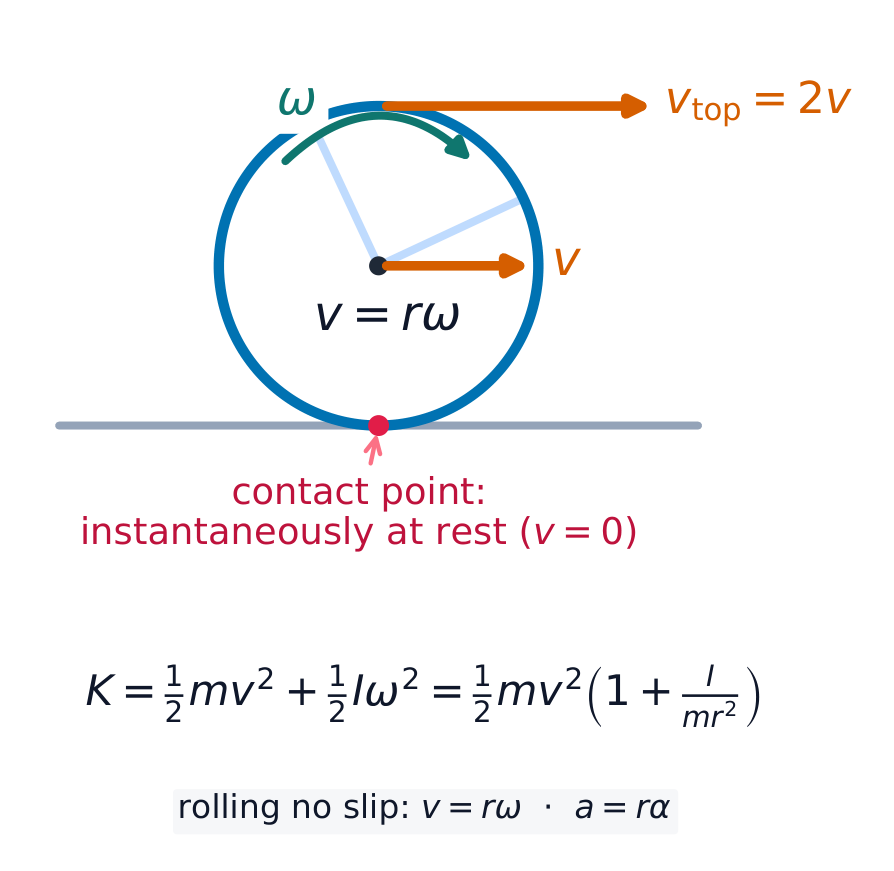
Rolling without slipping: v = rω, and the kinetic energy has translational and rotational parts
A wheel with $I = 2\ \text{kg}\cdot\text{m}^2$ spins at $\omega = 3\ \text{rad/s}$. Its rotational kinetic energy (in J)?
Difficulty 2/5 · 140 coins + a small bonus on first completion today
$K = \tfrac{1}{2}I\omega^2 = \tfrac{1}{2}(2)(3)^2 = 9\ \text{J}$.
Rotational kinetic energy is one-half times I times omega ____.
Difficulty 1/5 · 100 coins + a small bonus on first completion today
$K = \tfrac{1}{2}I\omega^2$ -- omega is squared.
Why the square matters
- Double the angular speed and you get four times the energy.
- $\omega$ is squared, just like $v$ in $\tfrac{1}{2}mv^2$.
- Doubling $I$ only doubles the energy — speed is the stronger lever.
If you triple a wheel's angular speed but keep its rotational inertia, its rotational kinetic energy becomes...
Difficulty 1/5 · 100 coins + a small bonus on first completion today
$\omega$ is squared, so $3^2 = 9$ times the energy.
Rolling: two motions at once
- A rolling wheel moves forward and spins.
- Its total kinetic energy adds both parts:
- The centre-of-mass motion, plus the spin about that centre.
Rotational kinetic energy
A spinning body's kinetic energy grows with the square of its angular speed.
A rolling ball's total kinetic energy includes both a translational and a rotational term.
Difficulty 1/5 · 100 coins + a small bonus on first completion today
$K = \tfrac{1}{2}mv^2 + \tfrac{1}{2}I\omega^2$ -- it moves and spins.
A rolling object has $\tfrac{1}{2}mv^2 = 6\ \text{J}$ and $\tfrac{1}{2}I\omega^2 = 4\ \text{J}$. Its total kinetic energy (in J)?
Difficulty 2/5 · 140 coins + a small bonus on first completion today
Add the two shares, $6 + 4 = 10\ \text{J}$.
A solid disc with $I = 0.5\ \text{kg}\cdot\text{m}^2$ spins at $\omega = 4\ \text{rad/s}$.
- $K_{rot} = \tfrac{1}{2}I\omega^2 = \tfrac{1}{2}(0.5)(4)^2 = 4\ \text{J}$.
- Speed it up to $8\ \text{rad/s}$ and it stores $16\ \text{J}$ — four times as much.
Before using $K = \tfrac{1}{2}I\omega^2$, the angular speed $\omega$ must be in...
Difficulty 1/5 · 100 coins + a small bonus on first completion today
SI rotational formulas need $\omega$ in rad/s; convert rpm or rev/s first.
Two traps. First, $\omega$ must be in radians per second, not rev/s or rpm. Second, anything that rolls has both terms: a rolling ball carries $\tfrac{1}{2}mv^2$ and $\tfrac{1}{2}I\omega^2$. Leaving out the spin term undercounts the energy.
A spinning object stores rotational kinetic energy $K_{rot} = \tfrac{1}{2}I\omega^2$ — the twin of $\tfrac{1}{2}mv^2$, with $I$ for mass and angular speed for speed. Because $\omega$ is squared, doubling the spin quadruples the energy. A rolling object owns both a translational and a rotational share.
Write from a rotational kinetic energy of 8 J
- Rotational inertia is 4 kg m squared and angular speed is 2 rad/s.
- Find the rotational kinetic energy.
A wheel has rotational inertia 4 kg m squared and spins at 2 rad/s. What is its rotational kinetic energy?
One half of 4 is 2, and 2 times 4 is 8.
What is the rotational kinetic energy?
Difficulty 1/5 · 100 coins + a small bonus on first completion today
Half of 4 times 2 squared is 8 J.