Fiscal and Monetary Policy Actions in the Short Run
Introduced| English | Meaning |
|---|---|
| Monetary policy/ˈmʌnɪtəri ˈpɒlɪsi/ | Actions by a monetary authority to influence interest rates, credit or money conditions in pursuit of economic objectives. |
| business cycle/ˈbɪznəs ˈsaɪkl/ | Fluctuations in economic activity between expansion and contraction over time. |
| money market/ˈmʌni ˈmɑːkɪt/ | The setting in which money demand and money supply determine interest rates in a macroeconomic model; also a market for short-term financial instruments. |
| investment/ɪnˈvestmənt/ | Spending on assets intended to provide future returns or increase productive capacity. |
| Stabilization policy/ˌsteɪbɪlaɪˈzeɪʃn ˈpɒlɪsi/ | Fiscal or monetary measures intended to reduce fluctuations in output, employment or the price level. |
| Full employment/fʊl emˈplɔɪmənt/ | Pull real output back to potential GDP GDP, so unemployment returns to its natural rate. |
| potential GDP/pəˈtenʃl ˌdʒiː diː ˈpiː/ | The level of output an economy can sustainably produce when its resources are employed at normal capacity. |
| Price stability/praɪs stəˈbɪlɪti/ | Keep inflation low and steady. |
Two hands on the same wheel
- The government steers aggregate demand with fiscal policy — spending and taxes.
- The central bank steers it with monetary policy — the money supply and interest rates.
- Both can push AD the same way, at the same time.
- Together they aim to smooth the business cycle.
The monetary chain
- Monetary policy 货币政策 works through the money market 货币市场: buying bonds raises the money supply and lowers the interest rate.
- A lower interest rate makes borrowing cheaper, so investment 投资 rises, lifting $C + I$.
- So AD shifts right — the same direction as expansionary fiscal policy.
- The chain: money supply ↑ → interest rate ↓ → investment ↑ → AD →.
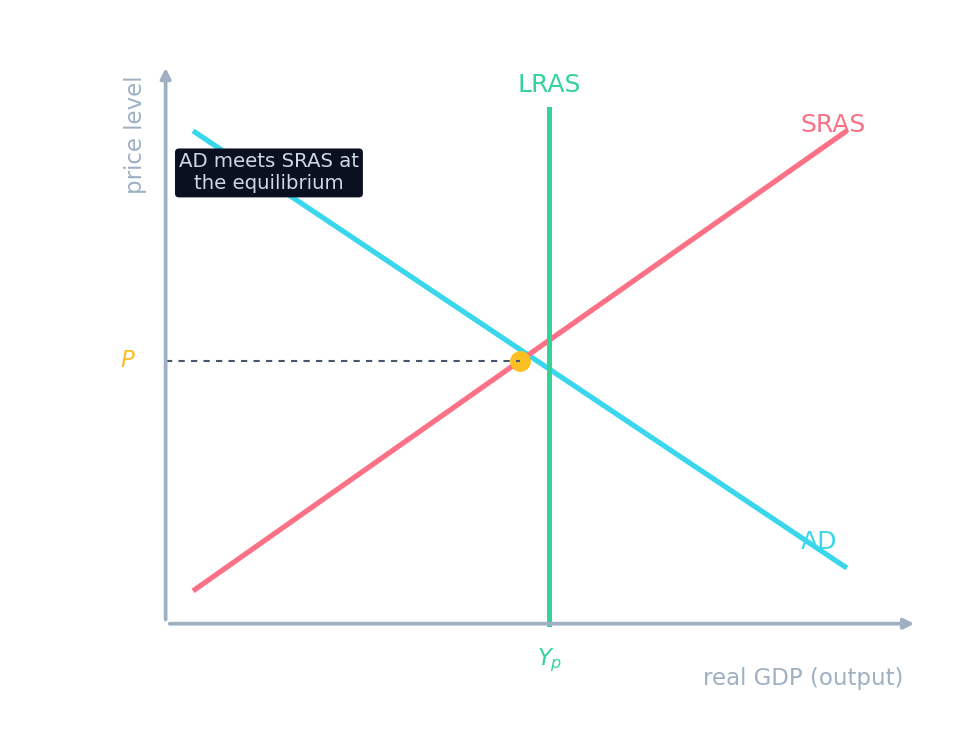
The AD-AS model
Both fiscal and monetary policy shift AD. Combine expansionary versions and the rightward shifts add up, closing a recessionary gap faster.
Put the expansionary monetary chain in order.
Difficulty 3/5 · 200 coins + a small bonus on first completion today
More money lowers the rate, which lifts investment and shifts AD right.
Expansionary monetary policy shifts AD in the same direction as:
Difficulty 1/5 · 100 coins + a small bonus on first completion today
Both cut interest rates or taxes to raise spending, shifting AD right.
When the central bank buys bonds, the interest rate:
Difficulty 1/5 · 100 coins + a small bonus on first completion today
Buying bonds raises the money supply, lowering the equilibrium interest rate.
Two goals of stabilization
- Stabilization policy 稳定政策 smooths the business cycle 经济周期, aiming for two things.
- Full employment 充分就业: pull real output back to potential GDP 潜在GDP, so unemployment returns to its natural rate.
- Price stability 价格稳定: keep inflation low and steady.
Select both goals of stabilization policy.
Difficulty 2/5 · 140 coins + a small bonus on first completion today
Stabilization aims for full employment and price stability.
Stabilization policy tries to pull real output back to ______ GDP.
Difficulty 1/5 · 100 coins + a small bonus on first completion today
At potential GDP, unemployment is at its natural rate.
Combining the tools
- Fiscal and monetary policy can be combined for a stronger effect.
- Worked idea. An economy is in a recessionary gap: output is 1,000b, potential is 1,080b.
- The central bank buys bonds (rate 5% → 3%, lifting investment) and the government cuts taxes (lifting consumption).
- Both shifts push AD right, so the joint policy closes the gap faster than either tool alone.
To fight a deep recession, a tax cut and lower interest rates together shift AD further right than either alone.
Difficulty 1/5 · 100 coins + a small bonus on first completion today
Both are expansionary, so their rightward shifts add up.
Fiscal and monetary policy both shift AD, and can be combined. The monetary chain is money supply ↑ → interest rate ↓ → investment ↑ → AD →. Stabilization policy targets full employment and price stability by pulling output back to potential.
Write from a combined shift further right
- A tax cut and a cut in the interest rate are used together in a deep recession.
- Compare the AD shift with either policy alone.
In a deep recession the government cuts taxes and the central bank cuts the interest rate. How does the shift in aggregate demand compare with using only one of those policies?
Two rightward shifts add to a larger rise in spending.
What does using both policies do to AD?
Difficulty 1/5 · 100 coins + a small bonus on first completion today
Both tools raise spending, so their shifts add.