The Phillips Curve
Introduced| English | Meaning |
|---|---|
| trade-off/treɪd ɒf/ | A choice that involves giving up some benefit or objective to gain another. |
| Phillips curve/ˈfɪlɪps kɜːv/ | A relationship between inflation and unemployment, often represented as an inverse association in the short run. |
| short-run Phillips curve/ʃɔːt rʌn ˈfɪlɪps kɜːv/ | A modelled inverse relationship between inflation and unemployment in the short run, holding expected inflation and relevant supply conditions constant. |
| long-run Phillips curve/lɒŋ rʌn ˈfɪlɪps kɜːv/ | In the expectations-adjusted model, a vertical relationship at the natural unemployment rate, indicating no permanent inflation-unemployment trade-off. |
| natural rate of unemployment/ˈnætʃərəl reɪt ɒv ʌnemˈplɔɪmənt/ | The unemployment rate associated with normal frictional and structural unemployment when the economy has no cyclical unemployment. |
| inflationary expectations/ɪnˈfleɪʃənəri ekspɪkˈteɪʃnz/ | Beliefs about how much the general price level will rise in the future. |
| supply shock/səˈplaɪ ʃɒk/ | An unexpected change in production conditions or costs that shifts aggregate supply. |
| stagflation/stæɡˈfleɪʃn/ | A combination of inflation with stagnant economic activity and high unemployment. |
The inflation-unemployment trade-off
- The AD-AS model says a rightward AD shift raises output and prices.
- So unemployment falls while inflation rises — they move opposite.
- The Phillips curve 菲利普斯曲线 plots that same link on its own diagram.
- Inflation on the vertical axis, unemployment on the horizontal.
The short-run curve slopes down
- The short-run Phillips curve 短期菲利普斯曲线 (SRPC) slopes downward — a short-run trade-off 权衡取舍.
- Lower unemployment costs higher inflation; lower inflation costs higher unemployment.
- A move up-left along it mirrors a rightward AD shift; a move down-right mirrors a leftward AD shift.
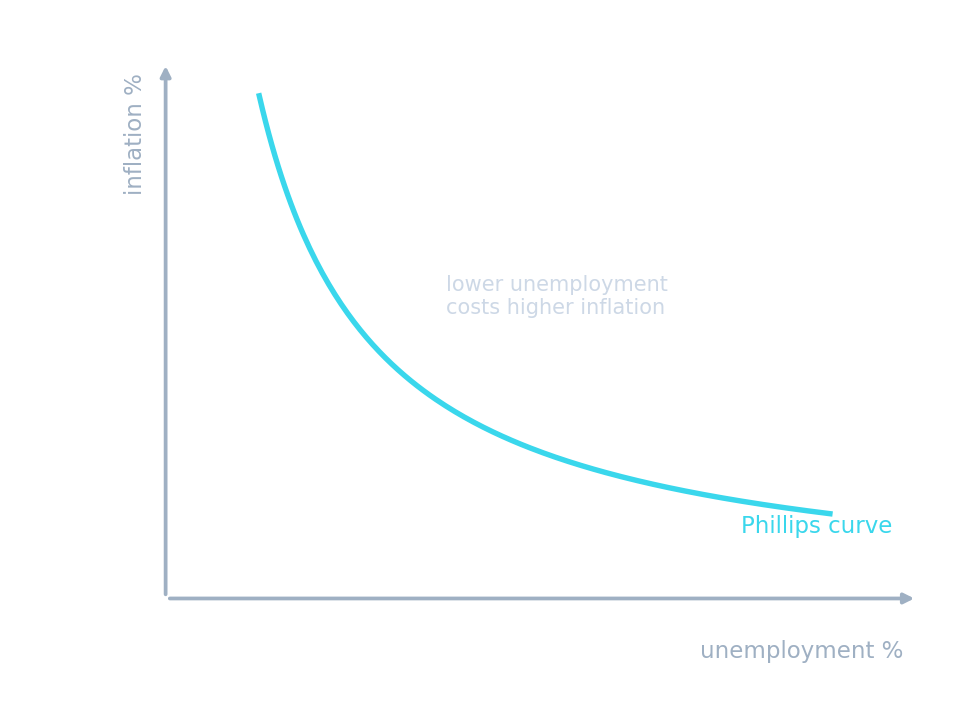
The short-run Phillips curve slopes downward, showing:
Difficulty 1/5 · 100 coins + a small bonus on first completion today
Lower unemployment comes with higher inflation, and vice versa — a short-run trade-off.
A move up-left along the SRPC (lower unemployment, higher inflation) matches:
Difficulty 1/5 · 100 coins + a small bonus on first completion today
More spending pushes output past potential, so jobs rise and prices climb.
The long-run curve is vertical
- The long-run Phillips curve 长期菲利普斯曲线 (LRPC) is a vertical line at the natural rate of unemployment 自然失业率.
- In the long run there is no trade-off: whatever the inflation rate, unemployment returns to its natural rate.
- Once people fully expect higher inflation, wages rise, costs climb, and the jobs boost vanishes.
Move along, or shift the SRPC?
A change in AD moves you along the short-run Phillips curve; a change in inflation expectations or a supply shock shifts the whole curve.
The long-run Phillips curve is:
Difficulty 1/5 · 100 coins + a small bonus on first completion today
In the long run there is no trade-off; unemployment returns to its natural rate.
The long-run Phillips curve is vertical at the ______ rate of unemployment.
Difficulty 1/5 · 100 coins + a small bonus on first completion today
The LRPC and SRPC cross exactly at the natural rate.
What shifts the SRPC
- A change in inflationary expectations 通货膨胀预期: expecting higher inflation shifts the SRPC up.
- A supply shock 供给冲击: a negative one raises inflation and unemployment together (stagflation 滞胀), shifting the SRPC right.
- Worked idea. Printing money cuts unemployment 5% → 3% but inflation jumps 2% → 6%; then expectations catch up, the SRPC shifts up, and unemployment returns to 5% with permanently higher inflation.
Expectations shift the SRPC up
Extra money spending moves the economy along the SRPC: unemployment 5% → 3%, inflation 2% → 6%. Once expectations catch up the SRPC shifts up, and unemployment returns to the natural rate of 5% with inflation now 6%: no lasting trade-off on the vertical LRPC.
If people begin to expect higher inflation, the short-run Phillips curve:
Difficulty 1/5 · 100 coins + a small bonus on first completion today
Higher expected inflation means more inflation at every unemployment rate — the SRPC shifts up.
A negative supply shock shifts the short-run Phillips curve left, improving both inflation and unemployment.
Difficulty 1/5 · 100 coins + a small bonus on first completion today
False. A negative supply shock shifts the SRPC right, worsening both inflation and unemployment: stagflation.
The short-run Phillips curve slopes down — a trade-off between inflation and unemployment, mirroring AD shifts. The long-run Phillips curve is vertical at the natural rate: no lasting trade-off. The SRPC shifts with inflationary expectations and supply shocks.
Write from expected inflation of 6 percent
- People raise their expected inflation from 2 percent to 6 percent.
- The natural rate of unemployment stays at 5 percent.
Expected inflation rises from 2 percent to 6 percent. The natural rate of unemployment stays at 5 percent. What happens to the short-run Phillips curve, and where does unemployment settle in the long run?
Higher expected inflation means more inflation at the same unemployment rate.
What does the rise in expected inflation do?
Difficulty 1/5 · 100 coins + a small bonus on first completion today
Expected inflation of 6 percent shifts the short-run trade-off up.