Supply
Introduced| English | Meaning |
|---|---|
| supply/səˈplaɪ/ | The quantity sellers are willing and able to offer at different prices over a specified period. |
| law of supply/lɔː ɒv səˈplaɪ/ | The tendency for quantity supplied to rise as price rises, with other relevant factors held constant. |
| quantity supplied/ˈkwɒntɪti səˈplaɪd/ | The amount sellers are willing and able to offer at a particular price over a specified period. |
| costs/kɒsts/ | The resources or money given up in producing goods or carrying out activities. |
| subsidies/ˈsʌbsɪdiz/ | Financial assistance that reduces costs or supports a particular activity, commonly provided by government. |
The sellers' side of every market
- Buyers are only half of a market — someone has to make the goods.
- Sellers, like buyers, respond to price, but in the opposite direction.
- A higher price is an invitation to produce more.
- That is the idea of supply 供给.
The law of supply
- Supply is the quantity producers are willing and able to sell at each price.
- The law of supply 供给定律: a higher price leads to a higher quantity supplied 供给量 — so the curve slopes up.
- A higher price makes producing more profitable, drawing out extra output.
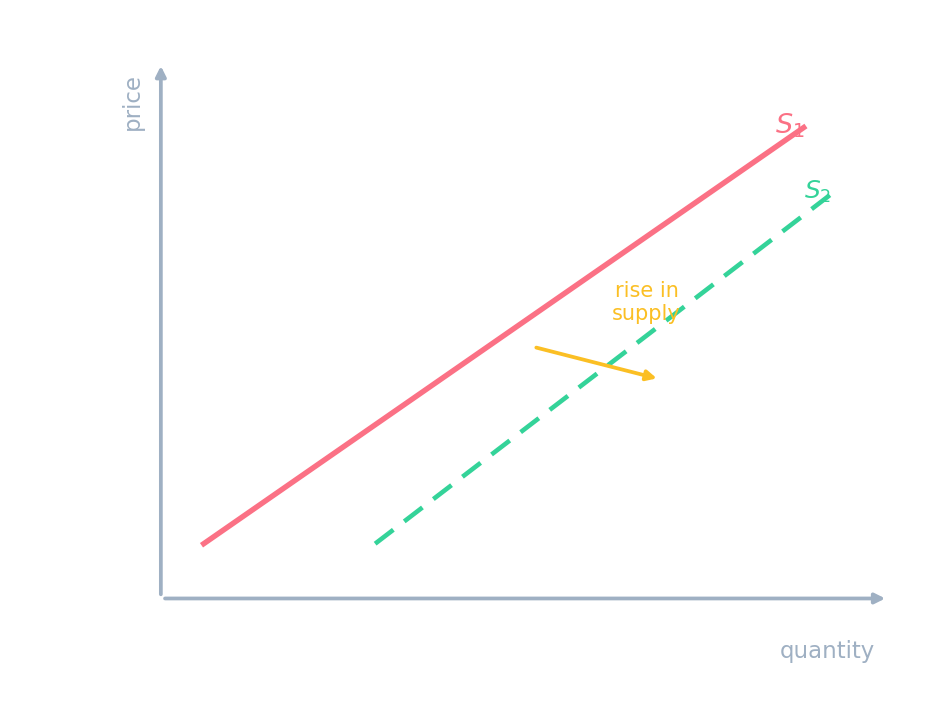
Supply and demand
The supply curve slopes up — a higher price draws out more. Cheaper inputs or better technology shift the whole curve right.
The law of supply says a higher price leads to a:
Difficulty 1/5 · 100 coins + a small bonus on first completion today
A higher price makes producing more profitable, so quantity supplied rises.
Movement vs shift
- A change in the good's own price moves you along the curve — a change in quantity supplied.
- A change in a determinant shifts the whole curve.
Same trap as demand. Only the good's own price moves you along the supply curve. Costs, technology, and taxes shift it — draw the diagram carefully.
A fall in input costs causes a movement along the supply curve.
Difficulty 1/5 · 100 coins + a small bonus on first completion today
Input costs are not the good's own price — cheaper inputs shift the whole curve right.
What shifts supply
- Input costs 成本 — cheaper inputs shift supply right, dearer inputs left.
- Technology — better technology lowers cost, shifting supply right.
- The number of sellers, taxes, subsidies 补贴, and producer expectations all shift it too.
- A new tax on sellers shifts supply left; a subsidy shifts it right.
Better production technology shifts the supply curve:
Difficulty 1/5 · 100 coins + a small bonus on first completion today
Better technology lowers cost, so firms supply more at every price.
A government payment per unit to sellers is a ______, which shifts supply right.
Difficulty 1/5 · 100 coins + a small bonus on first completion today
A subsidy lowers sellers' costs, shifting supply to the right.
A new per-unit tax on sellers shifts the supply curve:
Difficulty 1/5 · 100 coins + a small bonus on first completion today
A tax raises sellers' costs, so they supply less at every price — a leftward shift.
Select all that shift the supply curve to the right.
Difficulty 2/5 · 140 coins + a small bonus on first completion today
Cheaper inputs, technology and more sellers raise supply; a tax shifts it left.
Supply slopes up (the law of supply). The good's own price = a movement along; costs, technology, taxes, and subsidies = a shift. Cheaper inputs or better technology shift supply right; a new tax shifts it left.
Write from a supply increase of 10
- At the same price, better machines raise quantity supplied from 15 to 25.
- Describe the shift.
At one unchanged price, better machines raise the quantity firms supply from 15 units to 25. By how much does supply shift, and which way?
25 minus 15 is 10.
What does the new machinery do?
Difficulty 1/5 · 100 coins + a small bonus on first completion today
The same price now brings 10 more units, a rightward shift.