Market Equilibrium, Disequilibrium, and Changes
Introduced| English | Meaning |
|---|---|
| equilibrium/ˌiːkwɪˈlɪbrɪəm/ | A state in which opposing influences balance so there is no tendency for the relevant quantities to change. |
| surplus/ˈsɜːpləs/ | An amount exceeding what is required; in a market, quantity supplied above quantity demanded at a given price. |
| shortage/ˈʃɔːtɪdʒ/ | A situation in which quantity demanded exceeds quantity supplied at the prevailing price. |
| disequilibrium/ˌdɪˌsiːkwɪˈlɪbrɪəm/ | A situation in which the forces or quantities in a model are not balanced, creating pressure for adjustment. |
Where buyers and sellers agree
- Demand pulls the price down; supply pushes it up.
- Somewhere between, the two forces meet and settle.
- At that one price, buyers' and sellers' plans match exactly.
- This is equilibrium 均衡 — the heart of the supply-and-demand model.
Equilibrium, surplus, and shortage
- Equilibrium is where demand and supply cross — the equilibrium price and quantity.
- Away from it the market is in disequilibrium 非均衡, and prices are pushed back.
- Above equilibrium: quantity supplied exceeds quantity demanded — a surplus 过剩, so sellers cut the price.
- Below equilibrium: quantity demanded exceeds quantity supplied — a shortage 短缺, so buyers bid the price up.
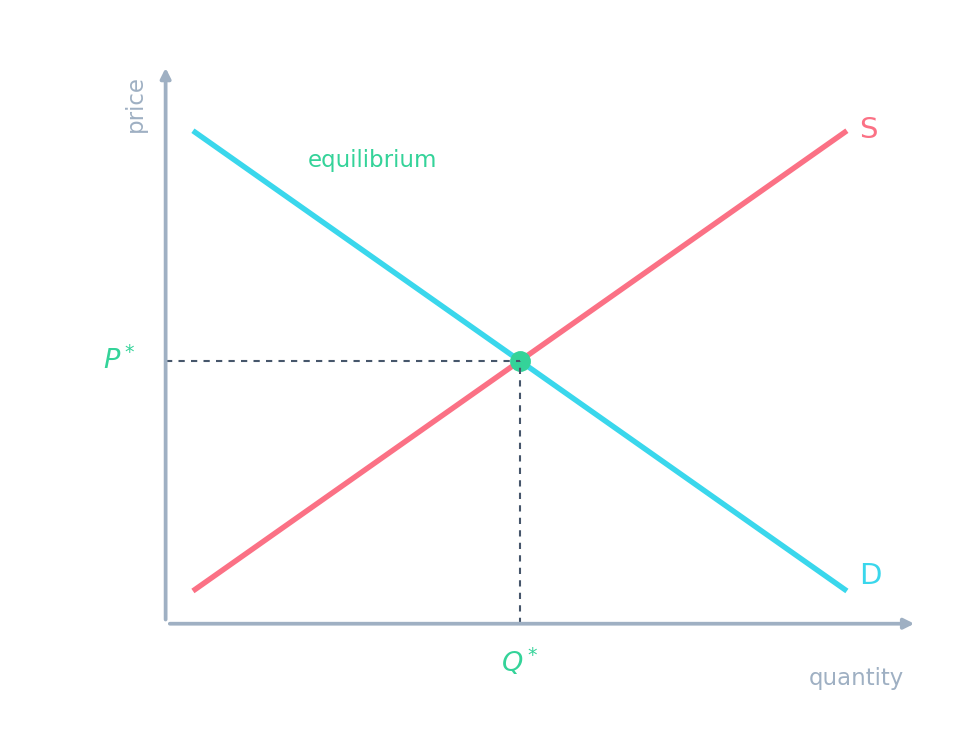
Find the equilibrium
Equilibrium sits where supply crosses demand. Above it there is a surplus; below it a shortage — the price is pushed back to where the curves meet.
At market equilibrium:
Difficulty 1/5 · 100 coins + a small bonus on first completion today
Equilibrium is where the two quantities match and the curves cross.
If the price is set above equilibrium, the market has a:
Difficulty 1/5 · 100 coins + a small bonus on first completion today
Above equilibrium, unsold stock piles up — a surplus, so sellers cut the price.
When the price is below equilibrium, excess demand creates a ______.
Difficulty 1/5 · 100 coins + a small bonus on first completion today
A shortage makes buyers bid the price up toward equilibrium.
The four shift cases
- Demand rises → price up, quantity up. Demand falls → price down, quantity down.
- Supply rises → price down, quantity up. Supply falls → price up, quantity down.
- When a determinant shifts a curve, the equilibrium simply moves to the new crossing point.
Demand shifts right (supply unchanged). Price and quantity:
Difficulty 1/5 · 100 coins + a small bonus on first completion today
A rightward demand shift raises both the equilibrium price and quantity.
Put the steps to find the new equilibrium after a change in order.
Difficulty 3/5 · 200 coins + a small bonus on first completion today
Name the shifter, move the right curve the right way, then read the new crossing point.
A supply curve shifts left (demand unchanged). The equilibrium price and quantity:
Difficulty 1/5 · 100 coins + a small bonus on first completion today
Less supply at every price pushes the price up and the quantity down.
A worked case
- A hot summer raises demand for ice cream (demand shifts right).
- At the old price a shortage appears, so the price rises to a new, higher equilibrium — with a higher quantity too.
- If at the same time a dairy shortage raises input costs (supply shifts left), the price rises even more.
- But the change in quantity is now ambiguous — it depends on which shift is larger.
A market settles at equilibrium (demand meets supply). In disequilibrium, a surplus (above) pushes the price down and a shortage (below) pushes it up. A single shift moves price and quantity predictably; when both curves shift, one result is clear and the other is ambiguous.
Write from a surplus of 35
- At a price of 14 dollars, quantity supplied is 90 and quantity demanded is 55.
- Name the imbalance.
At a price of 14 dollars, quantity supplied is 90 and quantity demanded is 55. What is the imbalance, and what is likely to happen to the price?
90 minus 55 is 35.
What is the imbalance at 14 dollars?
Difficulty 1/5 · 100 coins + a small bonus on first completion today
Supply is 35 above demand, so sellers cut the price.