Opportunity Cost and the Production Possibilities Curve
Introduced| English | Meaning |
|---|---|
| opportunity cost/ɒpəˈtjuːnɪti kɒst/ | The value of the best alternative forgone when a choice is made. |
| production possibilities curve/prəˈdʌkʃn ˌpɒsəˈbɪlɪtiz kɜːv/ | A curve showing the maximum attainable combinations of two outputs using given resources and technology efficiently. |
| efficient/ɪˈfɪʃənt/ | Using resources without avoidable waste, or allocating them to maximise the relevant net benefit. |
| increasing opportunity cost/ɪnˈkriːsɪŋ ɒpəˈtjuːnɪti kɒst/ | A situation in which additional units of one good require sacrificing progressively more units of another good. |
| economic growth/ˌiːkəˈnɒmɪk ɡrəʊθ/ | An increase in an economy's real output of goods and services over time. |
The road you build is the school you don't
- A government has a fixed pool of workers, steel, and money.
- Spend it on a new motorway, and those same resources can't build a hospital.
- The real cost of the road isn't just dollars — it's the hospital forgone.
- Economists capture this with opportunity cost 机会成本.
Opportunity cost
- The opportunity cost of a choice is the value of the single best alternative you give up.
- It is measured in what you sacrifice, not only in money.
- The opportunity cost of a new road is the schools or hospitals those resources could have built instead.
The opportunity cost of a choice is:
Difficulty 1/5 · 100 coins + a small bonus on first completion today
It is the next-best alternative sacrificed — measured in what you give up, not just money.
The production possibilities curve
- The production possibilities curve 生产可能性曲线 (PPC) shows the most an economy can make of two goods.
- Points on it are efficient 有效率; points inside are wasteful (a recession looks like this); points outside are unattainable.
- It usually bows outward — increasing opportunity cost 机会成本递增, since resources aren't equally suited to both goods.
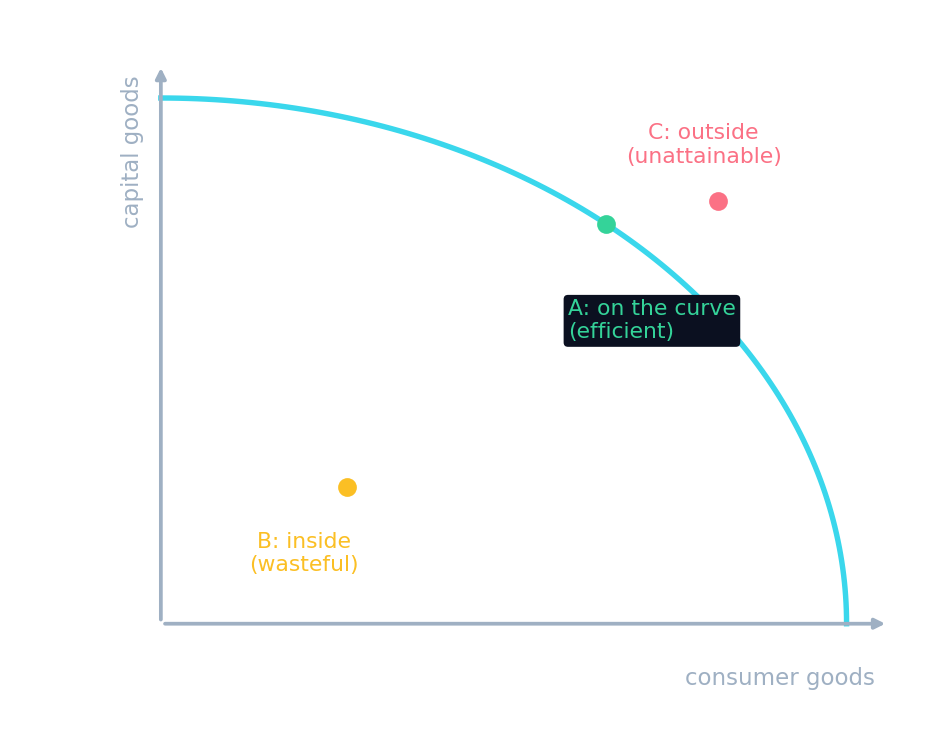
Explore the production possibilities curve
Making more of one good means giving up some of the other — the opportunity cost. Drag along the curve, then grow the economy to push the whole frontier outward.
An economy producing at a point inside its PPC is:
Difficulty 1/5 · 100 coins + a small bonus on first completion today
Inside the curve, some resources are unused — a recession looks like this.
A PPC that bows outward reflects constant opportunity cost.
Difficulty 1/5 · 100 coins + a small bonus on first completion today
False. Constant opportunity cost gives a straight-line PPC. An outward bow reflects increasing opportunity cost, because resources are not equally suited to both goods.
Economic growth shifts it out
- Worked idea. At point A an economy makes 60 consumer and 10 capital goods; at B, 50 consumer and 25 capital.
- Moving A → B it gains 15 capital goods by giving up 10 consumer, so each capital good costs $10/15 \approx 0.67$ consumer goods.
- Choosing more capital goods today sacrifices consumer goods now, but shifts the whole curve outward later.
- That outward shift — from more resources, better skills, or new technology — is economic growth 经济增长.
Moving from A (60 consumer, 10 capital) to B (50 consumer, 25 capital), what is the opportunity cost of ONE capital good, in consumer goods?
Difficulty 2/5 · 140 coins + a small bonus on first completion today
Give up 10 consumer to gain 15 capital, so each capital good costs $10/15 \approx 0.67$ consumer goods.
When the whole PPC shifts outward from more or better resources, we call it economic ______.
Difficulty 1/5 · 100 coins + a small bonus on first completion today
Economic growth is the outward shift of the production possibilities curve.
Select all that shift an economy's PPC outward.
Difficulty 2/5 · 140 coins + a small bonus on first completion today
Capital, technology and skills grow the economy; a recession just moves production inside the curve.
Opportunity cost is the value of the best alternative given up. The PPC shows it: on = efficient, inside = wasteful, outside = unattainable, with an outward bow for increasing opportunity cost. Investing in capital goods today drives economic growth — the curve shifting outward.
Write from an opportunity cost of 3 food
- An economy moves from 80 food and 0 capital goods to 50 food and 10 capital goods.
- Find the opportunity cost of one capital good.
An economy moves from 80 food and 0 capital goods to 50 food and 10 capital goods. What is the opportunity cost of one capital good, in food?
30 divided by 10 is 3.
What is the opportunity cost of one capital good?
Difficulty 1/5 · 100 coins + a small bonus on first completion today
30 food divided by 10 capital goods is 3 food each. Other options — 0.67 consumer goods (the lesson figure); 30 food (the whole loss).