Comparative Advantage and Gains from Trade
Introduced| English | Meaning |
|---|---|
| comparative advantage/kəmˈpærətɪv ədˈvæntɪdʒ/ | The ability to produce a good or service at a lower opportunity cost than another producer. |
| absolute advantage/ˈæbsəluːt ədˈvæntɪdʒ/ | The ability to produce more output with the same resources, or the same output with fewer resources, than another producer. |
| opportunity cost/ɒpəˈtjuːnɪti kɒst/ | The value of the best alternative forgone when a choice is made. |
| specialise/ˈspeʃəlaɪz/ | To concentrate on a particular product, task or area of activity. |
| terms of trade/tɜːmz ɒv treɪd/ | The ratio of a country's export prices to its import prices, usually expressed as an index. |
Why nations trade at all
- If a country could make everything more cheaply, why buy from abroad?
- Yet even then, trade leaves both countries better off.
- The reason is one of the most powerful ideas in economics.
- It rests on comparative advantage 比较优势, not on being best at everything.
Absolute vs comparative advantage
- Absolute advantage 绝对优势 means making more of a good with the same resources.
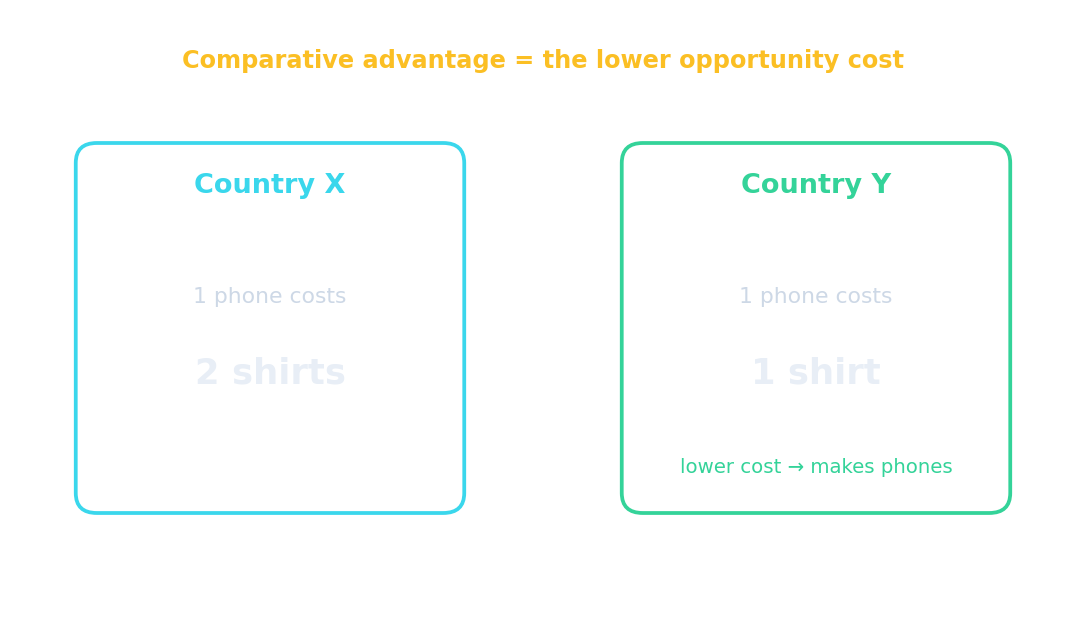
- Comparative advantage means having the lower opportunity cost 机会成本 of making it.
- A country can hold the absolute advantage in everything, yet the comparative advantage in only some things.
- For trade, the rule that matters is comparative, not absolute.
Absolute or comparative?
Absolute advantage is about making more; comparative advantage is about the lower opportunity cost. Only comparative advantage decides who specialises.
A country has a comparative advantage in a good when it has:
Difficulty 1/5 · 100 coins + a small bonus on first completion today
Comparative advantage is about opportunity cost, not raw output.
Work out who makes what
- Worked idea. In a day, Country A makes 12 wheat or 6 cloth; Country B makes 4 wheat or 4 cloth.
- A's opportunity cost of 1 cloth is $12/6 = 2$ wheat; B's is $4/4 = 1$ wheat — so B has the comparative advantage in cloth.
- A's cost of 1 wheat is $6/12 = 0.5$ cloth; B's is 1 cloth — so A has the comparative advantage in wheat.
A: 12 wheat or 6 cloth. B: 4 wheat or 4 cloth. Who has the comparative advantage in cloth?
Difficulty 1/5 · 100 coins + a small bonus on first completion today
B gives up 1 wheat per cloth vs A's 2 — B has the lower opportunity cost in cloth.
Country A makes 12 wheat OR 6 cloth in a day. What is the opportunity cost of ONE cloth, in wheat?
Difficulty 2/5 · 140 coins + a small bonus on first completion today
Giving up 12 wheat frees enough to make 6 cloth, so each cloth costs $12/6 = 2$ wheat.
Specialise, then trade
- Each country specialises 专业化 where its opportunity cost is lower (A in wheat, B in cloth).
- They then trade, and both consume beyond their own PPC.
- The terms of trade 贸易条件 must fall between the two opportunity costs for both to gain.
- This holds even though one country may be absolutely better at everything.
If one country is absolutely better at making everything, trade cannot benefit both.
Difficulty 1/5 · 100 coins + a small bonus on first completion today
As long as opportunity costs differ, both gain from specialising and trading.
Each country should ______ in the good where its opportunity cost is lower.
Difficulty 1/5 · 100 coins + a small bonus on first completion today
Specialise by comparative advantage, then trade for the rest.
For both countries to gain, the terms of trade must lie:
Difficulty 1/5 · 100 coins + a small bonus on first completion today
A swap rate between the two costs leaves both better off than in isolation.
Comparative advantage is the lower opportunity cost — not making more (that is absolute advantage). Each country should specialise where its opportunity cost is lower and trade for the rest, gaining even if one is better at everything. The terms of trade sit between the two opportunity costs.
Write from car costs of 2 rice and 5 rice
- Country C makes 8 rice or 4 cars. Country D makes 10 rice or 2 cars.
- Find each country's opportunity cost of one car.
In one day, C makes 8 rice or 4 cars, and D makes 10 rice or 2 cars. What is each country's opportunity cost of one car, in rice, and who has the comparative advantage in cars?
8 divided by 4 is 2, and 10 divided by 2 is 5.
Who has the comparative advantage in cars?
Difficulty 1/5 · 100 coins + a small bonus on first completion today
2 rice is a lower opportunity cost than 5 rice.