Malthusian Theory
Introduced| English | Meaning |
|---|---|
| exponentially/ˌekspəˈnenʃəli/ | Changing by a constant proportional factor over equal steps, rather than by a constant absolute amount. |
| linearly/ˈlɪnɪəli/ | Changing by a constant absolute amount for each equal step in the input, as in a straight-line relationship. |
| Neo-Malthusians/ˈniːəʊ mælˈθjuːzɪənz/ | Thinkers who argue that population growth can outstrip resources or environmental capacity unless checked by changes in behaviour, technology or policy. |
Malthus's warning
- In 1798, Thomas Malthus warned that population would outrun food.
- He argued population grows exponentially 指数式 (1, 2, 4, 8...).
- But food supply grows only linearly 线性 (1, 2, 3, 4...).
According to Malthus, population grows ____ while food grows ____.
Difficulty 1/5 · 100 coins + a small bonus on first completion today
Population exponential (1,2,4,8), food linear (1,2,3,4) — so population outruns food.
The predicted crisis
- Malthus predicted population would hit a ceiling set by food.
- Beyond it, positive checks (famine, disease, war) would raise the death rate.
- Preventive checks (later marriage, fewer children) could lower births instead.
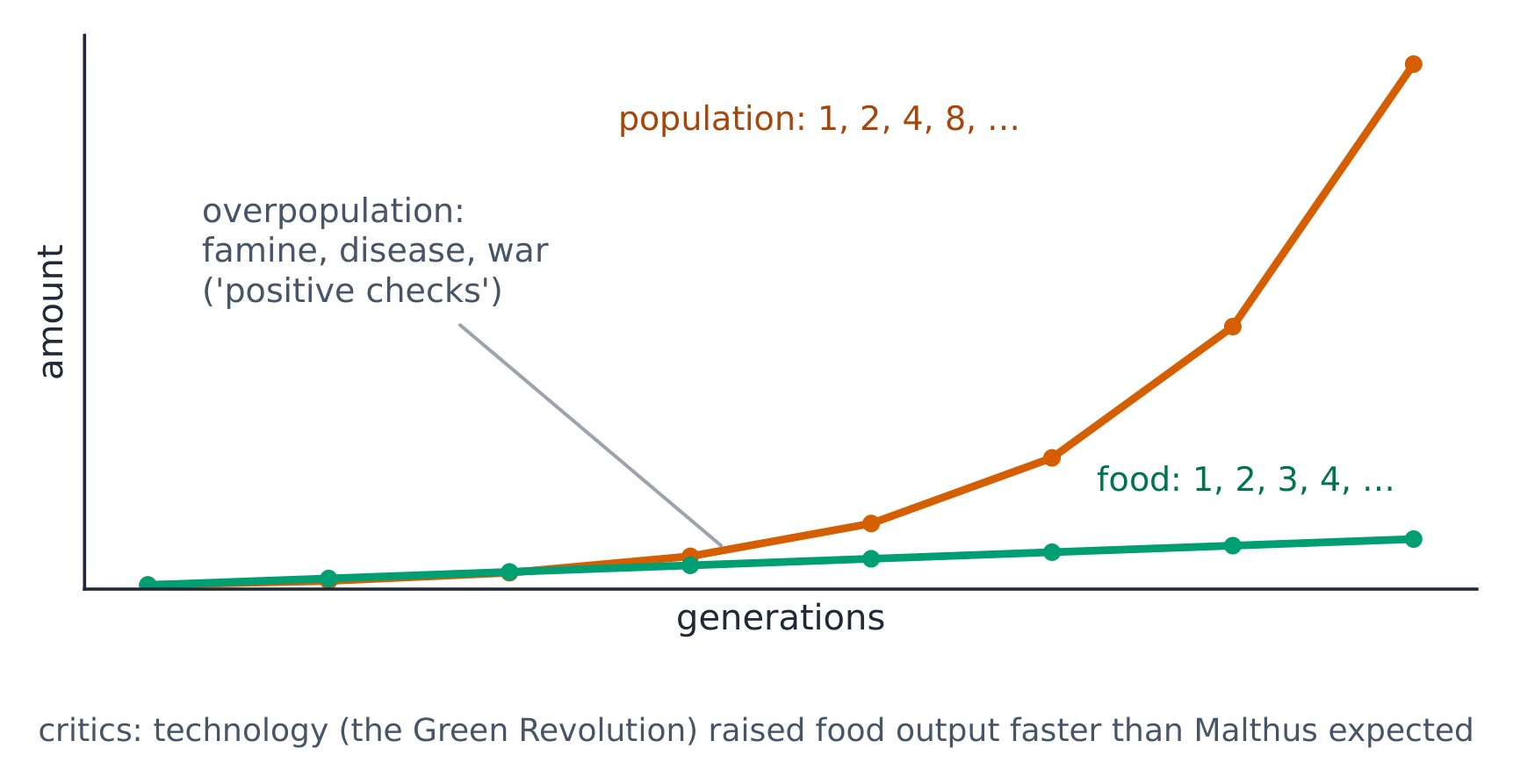
Malthus: population grows geometrically while food supply grows arithmetically
Malthusian idea or criticism?
Sort each statement as a Malthusian claim or a criticism of Malthus.
Select all of Malthus's "positive checks" that raise the death rate.
Difficulty 2/5 · 140 coins + a small bonus on first completion today
Famine, disease, and war are positive checks; later marriage is a preventive check.
Why Malthus was (mostly) wrong
- Malthus underestimated technology: the Green Revolution hugely raised food output.
- Trade, fertilisers, and machines let food grow faster than he imagined.
- Neo-Malthusians 新马尔萨斯主义者 update the fear to include water, energy, and other limits.
Malthus correctly predicted the effect of modern farming technology.
Difficulty 1/5 · 100 coins + a small bonus on first completion today
He underestimated technology; the Green Revolution raised food far beyond his forecast.
Thinkers who apply Malthus's warning to modern limits like water and energy are ____-Malthusians.
Difficulty 1/5 · 100 coins + a small bonus on first completion today
Neo-Malthusians update the concern to finite resources beyond food.
Match each idea to its source.
Difficulty 2/5 · 140 coins + a small bonus on first completion today
Malthus = original warning; criticism = technology; neo-Malthusians = modern resource limits.
Malthus's core prediction — mass starvation from population outrunning food — has not happened globally, because he could not foresee modern farming. But do not dismiss him entirely: neo-Malthusians argue the warning still applies to finite resources like water and energy.
Malthus expected famine as populations grew in the 1800s. Instead, the Green Revolution of the 1900s introduced high-yield seeds and fertilisers, and food output soared past population growth — the opposite of his prediction.
Malthus argued population grows exponentially while food grows linearly, so population would outrun food and be checked by famine. He underestimated technology (the Green Revolution). Neo-Malthusians revive the worry for finite resources.
Write from evidence that supports Boserup
- Food output was nearly flat.
- A new rice variety then raised yields on the same land.
Whose argument does the new variety support?
Boserup argued that necessity can drive farming innovation.
Who expected innovation to raise food supply?
Difficulty 1/5 · 100 coins + a small bonus on first completion today
The new variety is an innovation response.