Plate Tectonics
Introduced| English | Meaning |
|---|---|
| plate tectonics/pleɪt tekˈtɒnɪks/ | The theory that moving plates cause earthquakes, volcanoes and mountain building. |
| tectonic plate/tekˈtɒnɪk pleɪt/ | tectonic plate |
| convergent/kənˈvɜːdʒənt/ | Describes a plate boundary where two plates move toward each other. |
| divergent/daɪˈvɜːdʒənt/ | Describes a plate boundary where two plates move apart. |
| transform/trænsˈfɔːm/ | At a transform plate boundary, describing plates that move sideways past one another. |
The moving Earth
- The ground feels solid and still, but it is slowly moving.
- Earth's outer shell is cracked into giant pieces.
- These pieces drift over the hot, soft layer beneath.
- Their slow motion shapes mountains, oceans, and earthquakes.
Plates on the move
- Plate tectonics 板块构造 is the idea that Earth's shell is broken into moving plates.
- Each tectonic plate 构造板块 carries continents and ocean floor.
- They move only centimetres a year — about as fast as your nails grow.
- Where their edges meet, dramatic things happen.
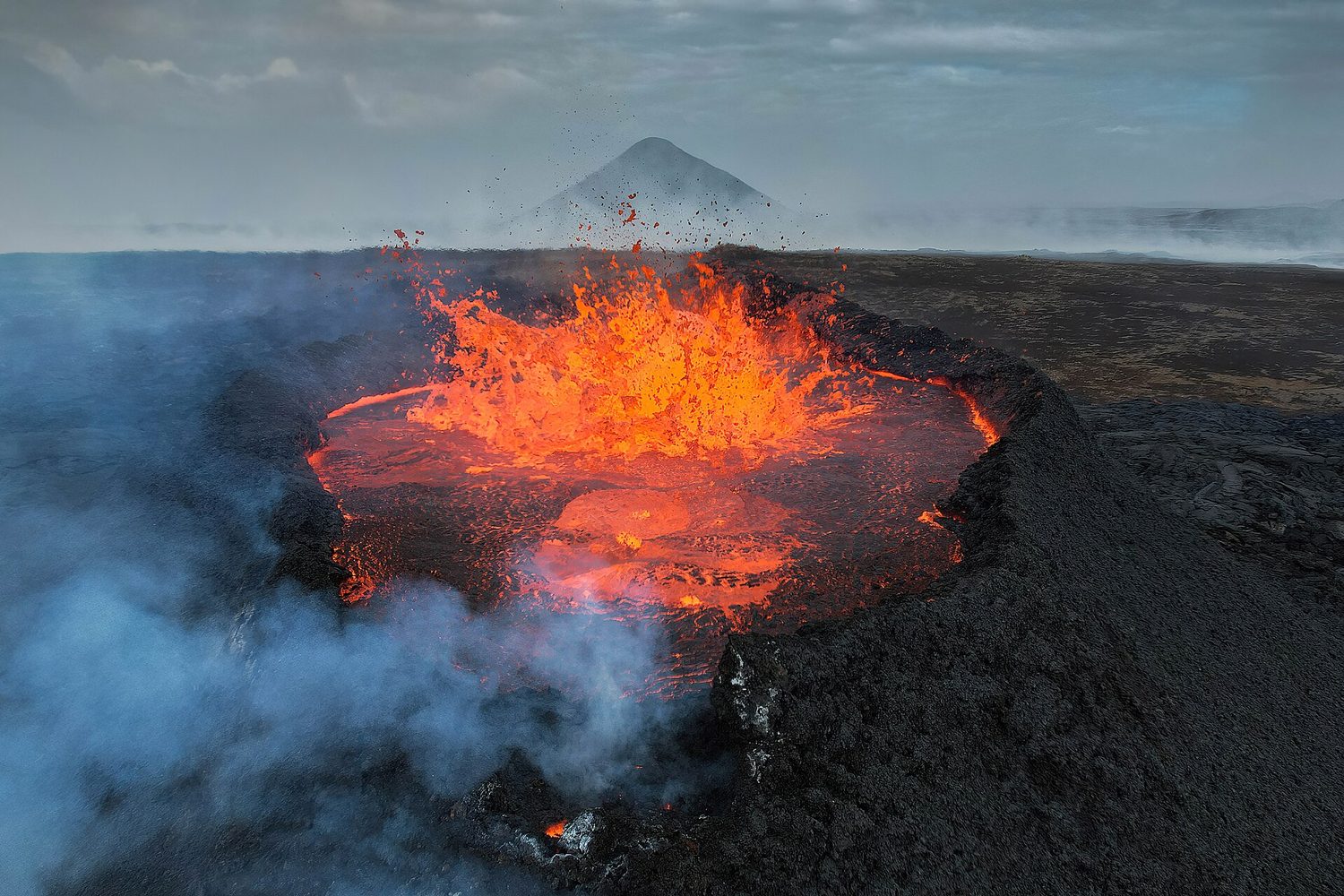
A volcano erupting at a plate boundary in Iceland. Molten rock rising between spreading plates builds new crust
Plate tectonics is the idea that…
Difficulty 1/5 · 100 coins + a small bonus on first completion today
Plate tectonics: Earth's rigid outer shell is broken into tectonic plates that slowly move.
Three kinds of boundary
- At a convergent 汇聚型 boundary, plates push together — raising mountains or deep trenches.
- At a divergent 离散型 boundary, plates pull apart, and new crust forms in the gap.
- At a transform 转换 boundary, plates slide past each other.
- The type of boundary decides what landforms and hazards appear.
At a convergent boundary, plates…
Difficulty 1/5 · 100 coins + a small bonus on first completion today
At a convergent boundary plates collide, raising mountains or forming deep trenches.
Where plates move apart and new crust forms, the boundary is called ____.
Difficulty 1/5 · 100 coins + a small bonus on first completion today
At a divergent boundary plates pull apart, and new crust rises to fill the gap.
Boundaries and hazards
- Most earthquakes and volcanoes happen along plate boundaries.
- As plates grind past or under one another, stress builds and releases as quakes.
- Melting rock rises at boundaries to form volcanoes.
- This is why some regions face far more geologic hazards than others.
What kind of boundary?
Sort each event by the type of plate boundary that causes it - plates moving apart, together, or sliding past.
Earthquakes and volcanoes are common along plate boundaries.
Difficulty 1/5 · 100 coins + a small bonus on first completion today
The grinding of plates at their boundaries causes most earthquakes and volcanoes.
Select all true statements about plate tectonics.
Difficulty 2/5 · 140 coins + a small bonus on first completion today
Boundaries are where earthquakes and volcanoes cluster, not calm. The other three are correct.
Earthquakes and volcanoes are not random — they cluster along plate boundaries. The "Ring of Fire" around the Pacific is a chain of convergent boundaries, which is why that region has so many of the world's earthquakes and volcanoes.
The Himalayas, still rising:
- The plate carrying India is pushing north into the plate carrying Asia.
- This convergent boundary crumples the crust upward.
- The collision built the Himalayas — and the mountains are still slowly rising today.
Plate tectonics is the theory that Earth's shell is broken into moving tectonic plates. Their boundaries come in three kinds: convergent (colliding, building mountains and trenches), divergent (spreading, making new crust), and transform (sliding past). Most earthquakes and volcanoes occur along these boundaries.