Cell Structure and Function
Introduced| English | Meaning |
|---|---|
| organelle/ˌɔːɡəˈnel/ | A specialised structure within a cell that carries out a particular function. |
| nucleus/ˈnjuːklɪəs/ | A membrane-bound organelle in eukaryotic cells that contains most of the genetic material. |
| mitochondria/ˌmaɪtəˈkɒndrɪə/ | Organelles in eukaryotic cells where most aerobic respiration and ATP production occur. |
| ribosomes/ˈrɪbəsəʊmz/ | A cellular structure that joins amino acids into a polypeptide using information from messenger RNA. |
| prokaryote/ˈprɒkərɪəʊt/ | An organism whose cells lack a membrane-bound nucleus and other membrane-bound organelles. |
| eukaryote/ˈjuːkərɪəʊt/ | eukaryote |
The smallest unit of life
- Every living thing is made of cells — the smallest unit that counts as alive.
- Inside each cell is a set of tiny machines, each doing one job.
- A cell is like a factory: departments that specialise and cooperate.
- Knowing the parts and their jobs explains how a cell stays alive.
Organelles: the working parts
- An organelle 细胞器 is a small structure inside a cell with a specific job.
- The nucleus 细胞核 stores the DNA and controls the cell.
- Mitochondria 线粒体 release energy as ATP by respiration.
- Ribosomes 核糖体 read the genetic message and build proteins.

A generalised animal cell and its organelles
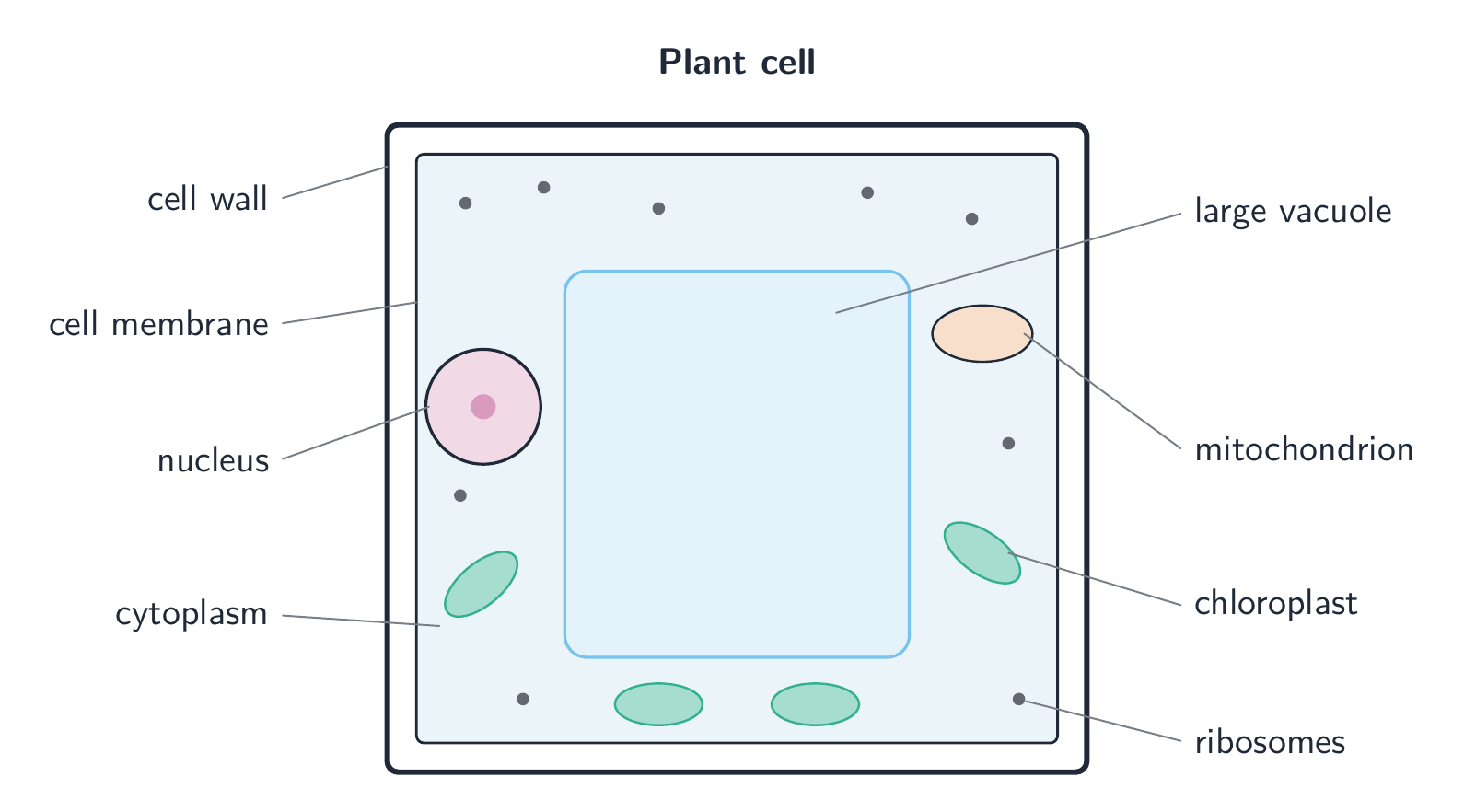
A plant cell also has a cell wall, a large vacuole, and chloroplasts
An organelle is…
Difficulty 1/5 · 100 coins + a small bonus on first completion today
An organelle is a specialised structure inside a cell — like the nucleus or a mitochondrion — each doing a specific job.
The organelle that stores DNA and controls the cell is the ____.
Difficulty 1/5 · 100 coins + a small bonus on first completion today
The nucleus holds the DNA and directs everything the cell does.
Two kinds of cell
- A prokaryote 原核生物 (like a bacterium) has no nucleus — its DNA floats free.
- A eukaryote 真核生物 (plants, animals, fungi) has a true nucleus and membrane-bound organelles.
- Eukaryotic cells are larger and more complex.
- Both kinds still run on the same basic chemistry of life.
What is the key difference between a prokaryote and a eukaryote?
Difficulty 1/5 · 100 coins + a small bonus on first completion today
Eukaryotes (plants, animals, fungi) have a true nucleus and organelles; prokaryotes (bacteria) do not.
Extra parts in plant cells
- Plant cells add a stiff cell wall outside the membrane for support.
- Chloroplasts capture light and make sugar by photosynthesis.
- A large central vacuole stores water and keeps the cell firm.
- Animal cells have none of these three.
Match the organelle to its job
Sort each organelle by the main job it does inside the cell.
The mitochondrion is where the cell makes most of its ATP energy.
Difficulty 1/5 · 100 coins + a small bonus on first completion today
The mitochondrion carries out aerobic respiration, the cell's main ATP supply.
Select all true statements about cells.
Difficulty 2/5 · 140 coins + a small bonus on first completion today
Bacteria are prokaryotes and have no nucleus. The other three are correct.
Do not mix up an organelle with an organ. An organelle is a tiny structure inside a single cell (like a mitochondrion). An organ (like the heart) is made of many cells working together. They differ by a factor of millions in size.
Why muscle cells are packed with mitochondria:
- Muscle contracts constantly and needs a huge, steady ATP supply.
- Mitochondria are the ATP factories.
- So an active muscle cell holds thousands of them — far more than a skin cell.
Cells are built from organelles, each with a job: the nucleus stores DNA, mitochondria make ATP, ribosomes build proteins. A prokaryote (bacterium) has no nucleus; a eukaryote (plant, animal, fungus) has a true nucleus and membrane-bound organelles.
Write from a eukaryotic cell
- A cell has a nucleus and mitochondria.
- It also has ribosomes.
Is this cell prokaryotic or eukaryotic?
A nucleus marks a eukaryotic cell.
What kind of cell has a nucleus and mitochondria?
Difficulty 1/5 · 100 coins + a small bonus on first completion today
Membrane-bound nucleus means eukaryotic.