Skip to content · ⁨본문 바로가기⁩
Subjects · ⁨과목⁩

AP 2-D Art and Design · ⁨AP 2D 예술 및 디자인⁩

Tips · ⁨팁⁩

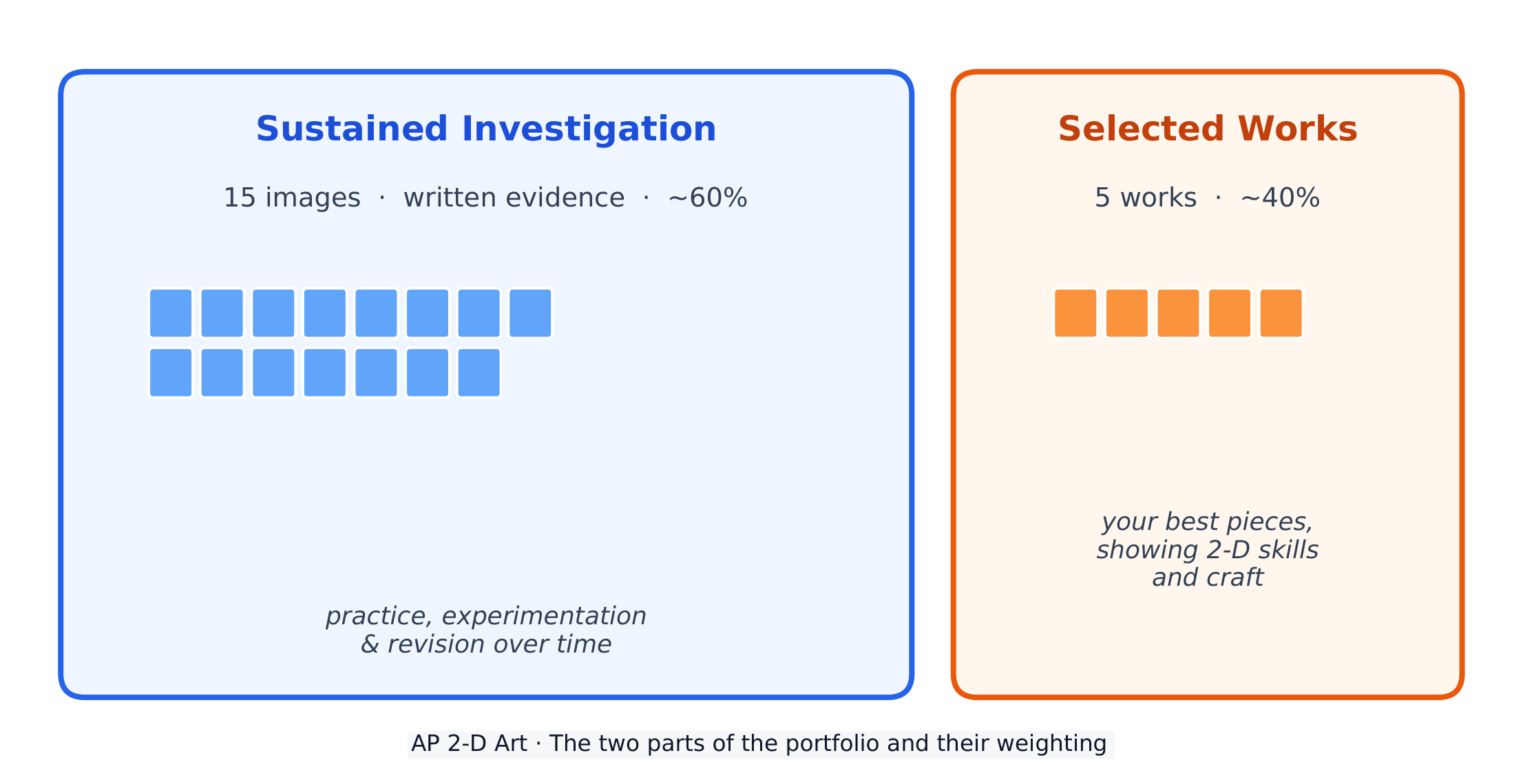
AP 2-D Art and Design is a portfolio course, not an exam course. You submit fifteen Selected Works demonstrating 2-D design skills, and a Sustained Investigation of fifteen images with written evidence showing how one inquiry question developed over time.

The Sustained Investigation is judged on the process, not on fifteen finished pieces. Work that experiments, revises and visibly changes scores higher than fifteen polished but unrelated images.

The writing is assessed too. A vague inquiry question — "I explored colour" — cannot be evidenced; a specific one can. Photograph and date every stage as you go, because the evidence of development cannot be reconstructed at the end.

This is a portfolio course, so the notes deal with what Selected Works and Sustained Investigation actually require, and with writing the accompanying text inside the character limits. There is no written exam to revise for; the library carries the published scoring guidelines instead.

Train all vocabulary · ⁨전체 어휘 연습⁩
  • 1

    Elements of Art · ⁨예술의 요소⁩

    Watch lesson · ⁨수업 보기⁩
    1.1

    Line

    Syllabus
    English

    Focus: Line is the most basic element of art — a moving point that the eye follows across a surface.

    • A line is a mark with length and direction: straight, curved, angular, or freeform.
    • Lines vary in quality — thick or thin, smooth or rough, continuous or broken, dark or light.
    • Contour lines trace the edges of a form; gesture lines quickly capture movement and energy.
    • Implied lines are suggested, not drawn — by a row of objects, a pointing arm, or a gaze.
    • Direction carries feeling: horizontal reads as calm, vertical as strength, diagonal as action.
    • Artists use line to build shape, shade value (hatching, cross-hatching), imply texture, and lead the eye.
    한국어

    포커스: 선은 예술의 가장 기본적 요소이다 — 눈이 표면을 따라 따르는 움직이는 점.

    • 선은 길이와 방향을 가진 표시: 직선, 곡선, 각진 선 또는 자유로운 형태.
    • 선은 품질이 다양하다 — 두껍거나 얇음, 매끄럽거나 거칠음, 연속적이거나 끊김, 짙거나 밝음.
    • 콘투어 선은 형상의 가장자리를 따르며, 제스처 선은 빠르게 움직임과 에너지를 포착한다.
    • 암시된 선은 그려지지 않지만 — 물건의 행렬, 가리키는 팔 또는 시선을 통해 암시된다.
    • 방향은 감정을 전달한다: 수평은 평온함, 수직은 힘, 대각선은 행동으로 읽힌다.
    • 아티스트들은 선을 사용하여 형태를 구성하고, 명암(value)(해칭, 크로스 해칭), 질감 암시를 만들며, 눈을 이끈다.

    Source: College Board AP Course and Exam Description · ⁨출처: College Board AP Course and Exam Description⁩

    The elements of art 艺术元素 are the visual "building blocks" every artist uses. The first is line 线条 — a moving point that the eye follows.

    • A line has length and direction; it can be straight, curved, angular, or freeform.
    • Lines have quality: thick or thin, smooth or rough, continuous or broken, dark or light.
    • Contour 轮廓 lines trace the edges of a form; gesture 动态速写 lines capture movement quickly.
    • Implied lines 隐含线 are not drawn but suggested — by a row of objects or a person's gaze.
    Hokusai's woodblock print of a giant curling wave about to crash over small boats, with Mount Fuji small in the distance
    Hokusai's The Great Wave off Kanagawa: bold curved outlines carry the eye along the wave, and the claw-like lines of foam create movement
    Line qualities and the difference between geometric and organic shapes
    Line varies in weight and character; shapes are either geometric (regular) or organic (natural)

    Direction carries feeling: horizontal lines feel calm, vertical lines feel strong, and diagonal lines feel active. Artists use line to build shape, shade value (hatching), imply texture, and lead the viewer's eye.

    Van Gogh's self-portrait: short restless diagonal brushstrokes fill the background, while the shoulders and collar stay broad and calm
    Van Gogh's self-portrait: restless diagonal strokes behind calm horizontal shoulders — the same two directions doing opposite jobs in one picture
    Vocabulary · ⁨어휘⁩ Train · ⁨연습하기⁩
    English 한국어
    elements of art/ˈelɪmənts ɒv ɑːt/ 미술의 요소
    line/laɪn/ 선
    Contour/ˈkɒntʊə/ Contour
    gesture/ˈdʒestʃə/ 제스처
    Implied lines/ɪmˈplaɪd laɪnz/ 암시된 선
    1.2

    Shape and Form

    Syllabus
    English

    Focus: Shape is a flat, enclosed area; form is the illusion of a three-dimensional object on a 2-D surface.

    • A shape is a two-dimensional area with a boundary; form appears three-dimensional (height, width, depth).
    • Geometric shapes (circle, square, triangle) are regular and mechanical; organic shapes are free and natural.
    • Positive shapes are the objects; negative shapes are the empty spaces around and between them.
    • Form is created on a flat surface through value (shading), overlapping, and perspective.
    • Recognising negative space helps an artist see and compose more accurately.
    한국어

    핵심 개념: 형태(Shape)는 평면의 닫힌 영역이며, 입체(Form)는 2차원表面上에 표현된 입체적 사물의 환상입니다.

    • 형태는 경계가 있는 2차원 영역이며, 입체는 높이, 너비, 깊이로 인해 입체적으로 보입니다.
    • 기하학적 형태(원, 사각형, 삼각형)는 규칙적이고 기계적입니다. 유기적 형태는 자유롭고 자연스럽습니다.
    • 양(Positive) 형태는 대상lication 자체이며, 음(Negative) 형태는 그 주위와 사이를 채우는 빈 공간입니다.
    • 입체는 평면表面上에서 명도(Value), 중첩, 원근법을 통해 만들어집니다.
    • 음영(负空间)을 인식하면 작가가 더 정확하게 관찰하고 구도를 세울 수 있습니다.

    Source: College Board AP Course and Exam Description · ⁨출처: College Board AP Course and Exam Description⁩

    A shape 形状 is a flat, enclosed area; a form 形体 has the illusion of three dimensions (height, width, and depth).

    • Geometric 几何 shapes (circle, square, triangle) are regular and mechanical; organic 有机 shapes are free and natural.
    • Positive shape 正形 is the object; negative shape 负形 is the empty space around and between objects — learning to see it makes drawing far more accurate.
    • Form is created on a flat surface with value (shading), overlapping, and perspective.
    Vocabulary · ⁨어휘⁩ Train · ⁨연습하기⁩
    English 한국어
    shape/ʃeɪp/ 형상(shape)
    form/fɔːm/ 형상
    Geometric/ˌdʒiːəʊˈmetrɪk/ 기하학적(Geometric)
    organic/ɔːˈɡænɪk/ 유기적
    Positive shape/ˈpɒzɪtɪv ʃeɪp/ 양수 모양
    negative shape/ˈneɡətɪv ʃeɪp/ 양의 형태(negative shape)
    1.3

    Value

    Syllabus
    English

    Focus: Value is the lightness or darkness of a colour or tone — the key to showing form and depth.

    • Value runs from white through greys to black; a value scale shows the gradual steps.
    • Highlight, midtone, core shadow, reflected light, and cast shadow describe light on a form.
    • Strong value contrast creates drama and a clear focal point; close values feel soft and calm.
    • Chiaroscuro is the bold use of light and dark to model three-dimensional form.
    • Squinting removes colour and helps an artist judge value relationships.
    한국어

    핵심 개념: 명도는 색조나 톤의 밝기 또는 어두움을 의미하며, 입체와 깊이를 표현하는 핵심 요소입니다.

    • 명도는 흰색부터 회색을 거쳐 검은색까지 이어지며, 명도 스케일은 이러한 단계적 변화를 보여줍니다.
    • 하이라이트, 중간톤(Midtone), 코어 쉐도우(Core Shadow), 반사광(Reflected Light), 그림자(Cast Shadow) 는 입체에 비친 빛을 설명하는 용어입니다.
    • 강렬한 명도 대비는 드라마틱한 효과와 명확한 시선을 생성하며, 유사한 명도는 부드럽고 차분한 느낌을 줍니다.
    • 키아로스크루(Chiaroscuro) 는 밝기와 어둠을 대조하여 입체를 입체적으로 조형하는 기법입니다.
    • 눈을 반쯤 감으면 색상이 제거되고 작가가 명도 간의 관계를 판단하는 데 도움이 됩니다.

    Source: College Board AP Course and Exam Description · ⁨출처: College Board AP Course and Exam Description⁩

    Light logic: how light describes form
    The value scale

    Value 明度 is the lightness or darkness of a tone — the single most powerful tool for showing three-dimensional form.

    A value scale runs in even steps from white to black
    A value scale steps evenly from white to black; strong value contrast creates drama and a focal point
    • A value scale 明度阶 runs from white through greys to black.
    • Light on a form has a highlight 高光, midtones 中间调, a core shadow 明暗交界线, reflected light 反光, and a cast shadow 投影.
    • Chiaroscuro 明暗对照法 is the bold use of light and dark to model form. Squinting removes colour and helps you judge value.
    A candle-lit 18th-century painting where people gather around a model of the solar system, their faces glowing against a dark background
    Joseph Wright's A Philosopher Lecturing on the Orrery: one hidden light in the centre creates strong value contrast (chiaroscuro), lifting each face out of the dark
    Vocabulary · ⁨어휘⁩ Train · ⁨연습하기⁩
    English 한국어
    Value/ˈvæljuː/ 명도(Value)
    value scale/ˈvæljuː skeɪl/ 명도 계층
    highlight/ˈhaɪlaɪt/ 하이라이트(highlight)
    midtones/ˈmɪdtəʊnz/ 중간색조
    core shadow/kɔː ˈʃædəʊ/ 코어 쉐도우(core shadow)
    reflected light/rɪˈflektɪd laɪt/ 반사광
    cast shadow/kæst ˈʃædəʊ/ cast shadow(투영 그림자)
    Chiaroscuro/ˌtʃaɪərəˈskjʊərəʊ/ 키아로스쿠로
    1.4

    Color

    Syllabus
    English

    Focus: Colour is light reflected from a surface; it has three properties and follows the logic of the colour wheel.

    • Colour has three properties: hue (its name), value (light/dark), and saturation/intensity (dull to vivid).
    • Primary colours (red, yellow, blue) mix to make secondary (orange, green, violet) and tertiary colours.
    • Colour schemes: complementary, analogous, monochromatic, triadic, warm, and cool.
    • Warm colours (red, orange, yellow) advance and energise; cool colours (blue, green, violet) recede and calm.
    • Adding white makes a tint, black makes a shade, grey makes a tone.
    • Complementary colours placed side by side intensify each other; mixed together they dull (neutralise).
    한국어

    핵심 개념: 색채는 표면에서 반사된 빛이며, 세 가지 속성을 가지고 있으며 색채 원리의 논리에 따릅니다.

    • 색채는 세 가지 속성을 가집니다: 후(Hue) (색의 이름), 명도 (밝기/어두움), 포화도/강도(Saturation/Intensity) (칙칙함에서 생생함까지).
    • 원색(빨강, 노랑, 파랑)이 혼합되어 보색(주황, 초록, 보라)과 보조색을 만듭니다.
    • 색채 계획: 보충색, 인접색, 단색, 삼원색, 온색, 냉색.
    • 온색(빨강, 주황, 노랑)은 전진하고 에너지를 주며, 냉색(파랑, 초록, 보라)은 후퇴하고 차분함을 줍니다.
    • 흰색을 더하면 투명색(Tint), 검은색을 더하면 암색(Shade), 회색을 더하면 톤(Tone) 이 됩니다.
    • 보충색을 나란히 배치하면 서로를 강화하지만, 섞이면 칙칙해지거나 무색화(Neutralize)됩니다.

    Source: College Board AP Course and Exam Description · ⁨출처: College Board AP Course and Exam Description⁩

    The colour wheel and its schemes

    Colour 色彩 is light reflected from a surface. It has three properties and follows the logic of the colour wheel 色轮.

    The colour wheel: primary, secondary, and tertiary hues, with warm and cool halves
    Primary colours mix to secondary and tertiary hues; complementary colours sit opposite each other
    • Colour's three properties: hue 色相 (its name), value (light/dark), and saturation 饱和度 (dull to vivid).
    • Primary 三原色 (red, yellow, blue) mix to make secondary 间色 and tertiary colours.
    • Complementary 互补色 colours sit opposite on the wheel: placed side by side they intensify each other, but mixed together they neutralise 中和 into a dull grey-brown. Analogous 邻近色 colours sit next to each other and harmonise.
    • Warm 暖色 colours (red, orange, yellow) advance; cool 冷色 colours (blue, green, violet) recede. A tint adds white, a shade adds black.
    Van Gogh's still-life painting of a vase of sunflowers, painted almost entirely in shades of yellow and gold
    Van Gogh's Sunflowers is built almost entirely from warm yellows and oranges, an analogous colour scheme that feels bright and unified
    Explore · ⁨탐색하기⁩

    Warm or cool colour? · ⁨따뜻한 색조인지 차가운 색조인가?⁩

    Warm colours (red, orange, yellow) feel energetic and seem to advance; cool colours (blue, green, violet) feel calm and seem to recede. · ⁨따뜻한 색조(빨강, 주황, 노랑)는 역동적으로 느껴지며 앞으로 나아가는 듯한 느낌을 줍니다. 차가운 색조(파랑, 초록, 보라)는 차분하게 느껴지며 뒤로 물러나는 듯한 느낌을 줍니다.⁩

    Vocabulary · ⁨어휘⁩ Train · ⁨연습하기⁩
    English 한국어
    Colour/ˈkʌlə/ 색
    colour wheel/ˈkʌlə wiːl/ 색채 원(colour wheel)
    hue/hjuː/ 색조(Hue)
    saturation/ˌsætʃəˈreɪʃn/ 포화
    Primary/ˈpraɪməri/ 일차
    secondary/ˈsekəndəri/ 이차(Secondary)
    Complementary/ˌkɒmplɪˈmentəri/ 보완색(Complementary)
    neutralise/ˈnjuːtrəlaɪz/ 중화하다(neutralise)
    Analogous/əˈnæləɡəs/ 인접색(Analogous)
    Warm/wɔːm/ 따뜻한(Warm)
    cool/kuːl/ 차가운(Cool)
    1.5

    Texture

    Syllabus
    English

    Focus: Texture is the surface quality of a work — how it feels or how it appears to feel.

    • Actual (tactile) texture can be physically touched (thick paint, collage, rough paper).
    • Implied (visual) texture is the illusion of a surface, created with marks, value, and pattern.
    • Texture is built through mark-making: stippling, hatching, dry-brush, impasto, and frottage (rubbing).
    • Contrasting smooth and rough areas adds interest and can direct attention.
    • In photography and digital work, texture comes from light, focus, and surface detail.
    한국어

    핵심 개념: 질감은 작품의 표면적 특성으로, 실제触感이나 시각적으로 느껴지는质感을 말합니다.

    • 실제(물리적/촉각적) 질감은 물리적으로 만질 수 있습니다(두꺼운 물감, 콜라주, 거친 종이 등).
    • 상상(시각적) 질감은 선, 명도, 패턴을 사용하여 표면의 환상을 만드는 것입니다.
    • 질감은 mark-making을 통해 구축됩니다: 스티플링, 해칭, 드라이 브러시, 임파스토, 프라타주(문질러서 옮기기).
    • 매끄럽고 거친 부위를 대비시키면 흥미를 더하고 시선을 유도할 수 있습니다.
    • 사진 및 디지털 작업에서 질감은 빛, 초점, 표면 디테일에서 비롯됩니다.

    Source: College Board AP Course and Exam Description · ⁨출처: College Board AP Course and Exam Description⁩

    Texture 肌理 is the surface quality of a work — how it feels, or how it appears to feel.

    • Actual (tactile) texture 实际肌理 can be physically touched (thick paint, collage, rough paper).
    • Implied (visual) texture 视觉肌理 is the illusion of a surface, made with marks, value, and pattern.
    • Techniques include stippling, hatching, impasto 厚涂 (thick paint), and dry-brush. Contrasting smooth and rough areas adds interest and can direct the eye.
    Woven denim close-up: texture is the surface quality you can see or feel — actual or implied
    Woven denim close-up: texture is the surface quality you can see or feel — actual or implied
    Vocabulary · ⁨어휘⁩ Train · ⁨연습하기⁩
    English 한국어
    Texture/ˈtekstʃə/ 질감(Direction/Texture)
    Actual (tactile) texture/ˈæktʃuːəl ˈtekstʃə/ 실제(촉각) 질감
    Implied (visual) texture/ɪmˈplaɪd ˈtekstʃə/ 암시(시각) 질감
    impasto/ɪmˈpæstəʊ/ 임파스토(Impasto)
    1.6

    Space

    Syllabus
    English

    Focus: Space is the area within, around, and between the parts of a work, including the illusion of depth.

    • Positive space is filled by the subject; negative space is the empty area around it.
    • Artists create the illusion of depth with overlapping, size, placement, and detail.
    • Linear perspective uses a horizon line and vanishing point(s) so parallel lines converge.
    • Atmospheric (aerial) perspective makes distant objects paler, bluer, and less detailed.
    • Foreground, middle ground, and background organise a scene from near to far.
    • The format and cropping of the picture plane shape how space is read.
    한국어

    핵심 개념: 공간은 작품의 내부, 주변, 그리고 부분들 사이의 영역을 의미하며, 깊이의 환상까지 포함합니다.

    • 양(Positive) 공간은 주제(object)가 차지하는 영역이며, 음(Negative) 공간은 그 주위의 빈 공간입니다.
    • 작가는 중첩, 크기, 배치, 디테일을 통해 깊이의 환상을 만듭니다.
    • 선원근법은 지평선과 소실점을 사용하여 평행선이 수렴하도록 합니다.
    • 대기원근법(Aerial Perspective) 은 멀리 있는 사물을 게, 파래지고 디테일이 적게 표현합니다.
    • 전경, 중경, 배경은 장면을 앞뒤로 구성합니다.
    • 그림판의 포맷과 크롭은 공간의 해석 방식을 형성합니다.

    Source: College Board AP Course and Exam Description · ⁨출처: College Board AP Course and Exam Description⁩

    Atmospheric perspective
    One-point perspective

    Space 空间 is the area within, around, and between the parts of a work, including the illusion of depth on a flat surface.

    • Positive space is filled by the subject; negative space is the empty area around it.
    • Depth is created with overlapping 重叠, size, placement, and detail.
    • A scene organises into three depth planes: foreground 前景 (nearest), middle ground 中景, and background 背景 (farthest). The nearest plane usually carries the most detail and contrast, the farthest the least.
    • Linear perspective 线性透视 uses a horizon line and vanishing point 灭点 so parallel lines converge; atmospheric perspective 空气透视 makes distant things paler, bluer, and less detailed.
    • The format and cropping of the picture plane shape how the space is read.

    Worked example (applying the concept). Asked to describe how line creates meaning in a portrait, a strong answer names the element, its quality, and its effect: "The artist uses thick, jagged diagonal lines in the background, and their restless, active direction makes the calm horizontal lines of the sitter's shoulders feel even more still." Naming the element and linking it to a feeling is what portfolio written evidence and analysis questions both reward.

    Vocabulary · ⁨어휘⁩ Train · ⁨연습하기⁩
    English 한국어
    Space/speɪs/ 공간(Space)
    overlapping/ˌəʊvəˈlæpɪŋ/ 중첩
    foreground/ˈfɔːɡraʊnd/ 전경
    middle ground/ˈmɪdl ɡraʊnd/ 중간 거리
    background/ˈbækɡraʊnd/ 배경
    Linear perspective/ˈlɪnɪə pəˈspektɪv/ 선형 원근법(Linear perspective)
    vanishing point/ˈvænɪʃɪŋ pɔɪnt/ 소실점(vanishing point)
    atmospheric perspective/ˌætməsˈferɪk pəˈspektɪv/ 대기 원근법
    1.6

    Exam tips

    • Name the element precisely — line, shape or form, value, colour, texture, space — in any analysis.
    • Justify how form is modelled with a value scale and a single light source.
    • Read the colour wheel: identify complementary versus analogous schemes and warm or cool temperature.
    • Separate shape (2-D) from form (3-D) and actual from implied texture.
    • Explain depth with overlap, size, linear perspective, and atmospheric perspective.
  • 2

    Principles of Design · ⁨디자인의 원칙⁩

    Watch lesson · ⁨수업 보기⁩
    2.1

    Balance

    Syllabus
    English

    Focus: Balance is the visual distribution of weight in a composition so it feels stable.

    • Symmetrical (formal) balance mirrors both sides of a central axis — calm and orderly.
    • Asymmetrical (informal) balance uses different elements of equal visual weight — dynamic and lively.
    • Radial balance arranges elements around a central point.
    • Visual weight is affected by size, colour, value, texture, and position.
    • A large, dull shape can balance a small, bright one on the other side.
    한국어

    핵심 개념: 균형은 구성 내에서 시각적 무게가 분배되어 안정적으로 느껴지는 상태입니다.

    • 대칭(공식적) 균형은 중심축 양측을 대칭시켜 차분하고 질서 있게 만듭니다.
    • 비대칭(비공식적) 균형은 동일한 시각적 무게를 가진 다른 요소를 사용하여 역동적이고 활기찬 효과를 줍니다.
    • 방사형 균형은 요소들을 중심점 주위로 배열합니다.
    • 시각적 무게는 크기, 색상, 명도, 질감, 위치에 의해 영향을 받습니다.
    • 큰 크기의 칙칙한 형태는 작은 크기의 밝은 형태를 반대편에서 균형 잡을 수 있습니다.

    Source: College Board AP Course and Exam Description · ⁨출처: College Board AP Course and Exam Description⁩

    Balance: symmetrical, asymmetrical, radial

    The principles of design 设计原则 are the "rules" for arranging the elements of art. The first is balance 平衡 — the visual distribution of weight so a work feels stable.

    Three kinds of balance: symmetrical, asymmetrical, and radial
    Symmetrical balance mirrors a central axis; asymmetrical balance weighs different elements; radial balance radiates from a centre
    • Symmetrical (formal) balance 对称平衡 mirrors both sides of a central axis — calm and orderly.
    • Asymmetrical (informal) balance 非对称平衡 uses different elements of equal visual weight 视觉重量 — dynamic and lively.
    • Radial balance 辐射平衡 arranges elements around a central point.

    Visual weight is affected by size, colour, value, and position: a small bright shape can balance a large dull one.

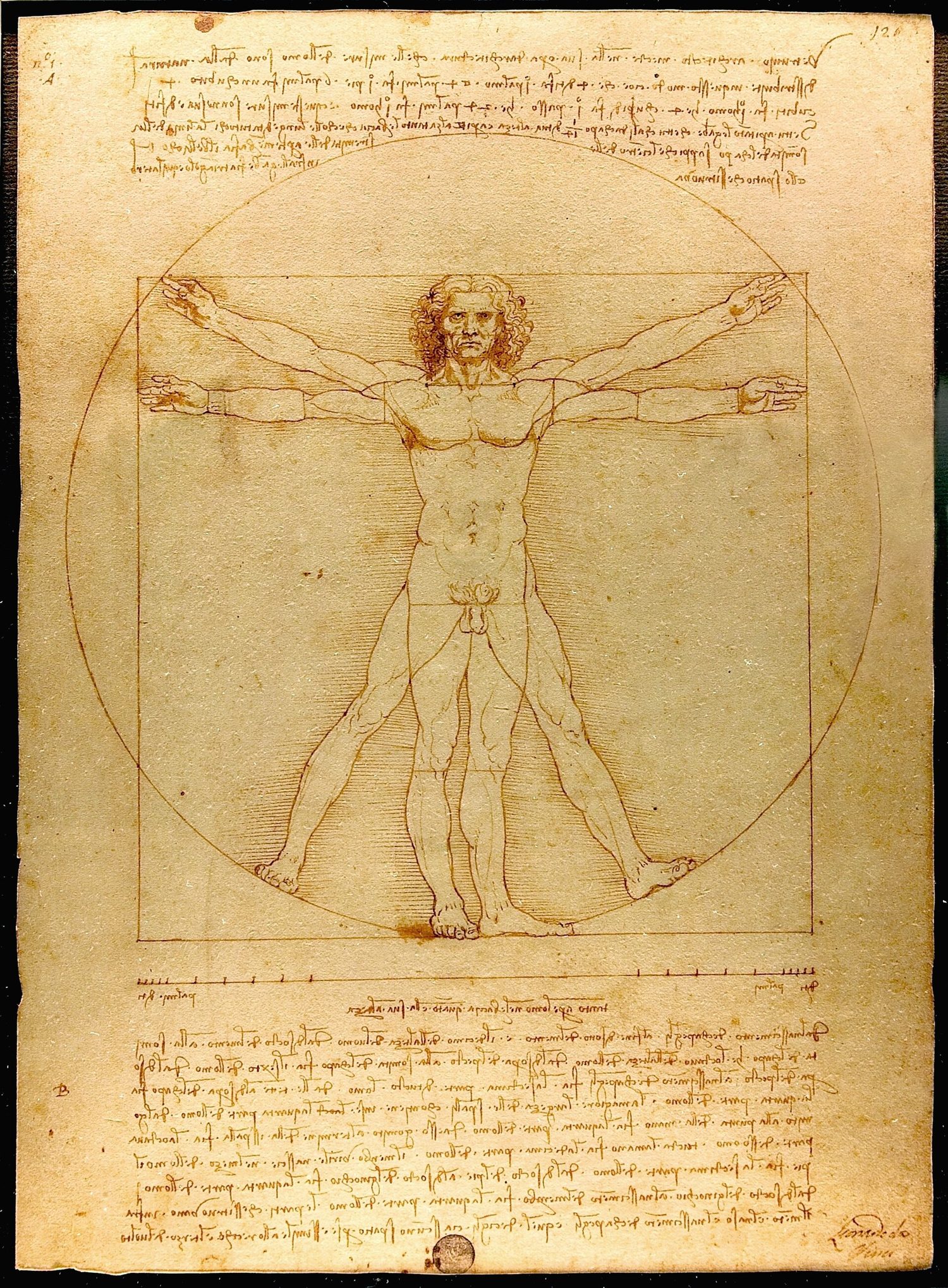
    Leonardo's ink drawing of a man with arms and legs outstretched, fitted inside both a circle and a square
    Leonardo's Vitruvian Man: the figure is drawn with near-perfect symmetry about a central vertical axis, and the surrounding circle gives it radial balance too
    Composition balances light, mass, and interest across the picture plane
    Composition balances light, mass, and interest across the picture plane
    Explore · ⁨탐색하기⁩

    Which kind of balance? · ⁨어떤 종류의 균형인가?⁩

    Symmetrical balance mirrors a central axis; asymmetrical balance weighs different elements of equal visual weight; radial balance radiates from a centre. · ⁨대칭 균형은 중앙 축을 거울처럼 대칭시킵니다. 비대칭 균형은 시각적 무게가 동일한 서로 다른 요소들을 조화롭게 배합합니다. 방사형 균형은 중심에서 바깥쪽으로 퍼져 나갑니다.⁩

    Vocabulary · ⁨어휘⁩ Train · ⁨연습하기⁩
    English 한국어
    principles of design/ˈprɪnsɪplz ɒv dɪˈzaɪn/ 디자인의 원칙
    balance/ˈbæləns/ 균형(balance)
    Symmetrical (formal) balance/sɪˈmetrɪkl ˈbæləns/ 대칭(형식적) 균형
    Asymmetrical (informal) balance/ˌeɪsɪˈmetrɪkl ˈbæləns/ 비대칭(비형식적) 균형
    visual weight/ˈvɪʒuːəl weɪt/ 시각적 무게
    Radial balance/ˈreɪdɪəl ˈbæləns/ 방사형 균형
    2.2

    Emphasis and Focal Point

    Syllabus
    English

    Focus: Emphasis makes one part of a work stand out as the centre of interest (the focal point).

    • A focal point is where the eye is drawn first; emphasis creates it.
    • Emphasis is built through contrast — of size, colour, value, isolation, or placement.
    • Convergence (lines that point) and the rule of thirds help locate a strong focal point.
    • Subordination keeps other areas quieter so the focal point leads.
    • A work may have one dominant focal point and smaller secondary accents.
    한국어

    핵심 개념: 강조는 작품의 한 부분이 중심 관심사(시점)로 두드러지게 보이도록 합니다.

    • 시점은 눈이 먼저 끌리는 곳이며, 강조를 통해 형성됩니다.
    • 강조는 대비를 통해 구축됩니다: 크기, 색상, 명도, 고립성, 배치 등의 대비.
    • 수렴(선들이 향하는 방향)과 삼등분 법칙은 강력한 시점을 locating하는 데 도움을 줍니다.
    • 종속성은 시선의 초점이 주도할 수 있도록 다른 영역을 조용하게 유지합니다.
    • 작품은 하나의 지배적인 시점과 여러 개의 작은 보조 accent를 가질 수 있습니다.

    Source: College Board AP Course and Exam Description · ⁨출처: College Board AP Course and Exam Description⁩

    Emphasis 强调 makes one part of a work stand out as the centre of interest — the focal point 视觉焦点, where the eye is drawn first.

    • Emphasis is created through contrast — of size, colour, value, isolation, or placement.
    • Leading lines and the rule of thirds help place a strong focal point.
    • Subordination 从属 keeps other areas quieter so the focal point leads.
    Vocabulary · ⁨어휘⁩ Train · ⁨연습하기⁩
    English 한국어
    Emphasis/ˈemfəsɪs/ 주목
    focal point/ˈfəʊkl pɔɪnt/ 초점(focal point)
    Subordination/ˌsʌbɔːdɪˈneɪʃn/ 부차성
    2.3

    Contrast

    Syllabus
    English

    Focus: Contrast is the difference between elements — it creates energy, variety, and readability.

    • Contrast can be of value (light/dark), colour (complementary), shape, texture, or size.
    • Strong contrast attracts attention and defines a focal point.
    • Low contrast unifies a work and can feel calm, subtle, or moody.
    • Contrast in direction (horizontal vs diagonal) adds movement.
    • In graphic design, value and size contrast create clear visual hierarchy.
    한국어

    핵심 개념: 대비는 요소 간의 차이로, 에너지, 다양성, 가독성을 생성합니다.

    • 대비는 명도(밝기/어두움), 색채(보충색), 형태, 질감, 크기 등으로 나타날 수 있습니다.
    • 강한 대비는 시선을 끌고 초점 지점을 형성합니다.
    • 낮은 대비는 작품을 통일시키고 차분하거나 미묘하며, 혹은 무거운 분위기를 줄 수 있습니다.
    • 방향에서의 대비(수평 vs 대각선)는 움직임을 추가합니다.
    • 그래픽 디자인에서 명도와 크기의 대비는 명확한 시각적 계층을 만듭니다.

    Source: College Board AP Course and Exam Description · ⁨출처: College Board AP Course and Exam Description⁩

    Contrast 对比 is the difference between elements — it creates energy, variety, and readability.

    • Contrast can be of value (light/dark), colour (complementary), shape, texture, or size.
    • Strong contrast attracts attention and defines a focal point; low contrast unifies and calms.
    • In design, value and size contrast create clear visual hierarchy 视觉层次.
    Vocabulary · ⁨어휘⁩ Train · ⁨연습하기⁩
    English 한국어
    Contrast/ˈkɒntræst/ 대비
    visual hierarchy/ˈvɪʒuːəl ˈhaɪərɑːki/ 시각적 계층 구조
    2.4

    Movement and Rhythm

    Syllabus
    English

    Focus: Movement leads the viewer's eye through a work; rhythm is the repetition that creates a visual beat.

    • Movement is the path the eye takes, guided by line, edges, colour, and placement.
    • Rhythm is created by repeating elements with regular or varied spacing.
    • Types of rhythm: regular (even), flowing (curving), progressive (gradual change), and random.
    • Directional forces (leading lines, gazes, gestures) create implied motion.
    • Repetition with variation keeps rhythm interesting rather than monotonous.
    한국어

    핵심 개념: 움직임은 관람자의 눈을 작품 속으로 이끌고, 리듬은 시각적 박자를 만드는 반복입니다.

    • 움직임은 선, 가장자리, 색상, 배치를 따라 눈이 이동하는 경로입니다.
    • 리듬은 규칙적이거나 다양한 간격으로 요소를 반복하여 생성됩니다.
    • 리듬의 유형: 정규(Regular) (균등함), 유동(Flowing) (곡선), 점진적(Progressive) (점진적 변화), 무작위(Random).
    • 방향성 힘(인도선, 시선, 제스처)은 상상적인 운동을 만듭니다.
    • 변주를 더한 반복은 리듬을 단조롭기보다 흥미롭게 유지합니다.

    Source: College Board AP Course and Exam Description · ⁨출처: College Board AP Course and Exam Description⁩

    Movement 动感 leads the viewer's eye through a work; rhythm 节奏 is the repetition that creates a visual "beat".

    • Movement is the path the eye takes, guided by line, edges, colour, and placement.
    • Rhythm types: regular (even), flowing (curving), progressive 渐进 (gradual change), and random.
    • Repetition with variation keeps rhythm interesting rather than monotonous.
    Van Gogh's painting of a night sky full of large swirling spirals of light above a quiet village
    Van Gogh's The Starry Night: swirling brushstrokes sweep the eye across the sky (movement), and the repeated curls give it a rolling rhythm
    Vocabulary · ⁨어휘⁩ Train · ⁨연습하기⁩
    English 한국어
    Movement/ˈmuːvmənt/ 움직임
    rhythm/ˈrɪðəm/ 리듬
    progressive/prəˈɡresɪv/ 점진적
    2.5

    Pattern and Repetition

    Syllabus
    English

    Focus: Repetition reuses an element; pattern is the repeated element arranged in a predictable way.

    • Repetition of shape, colour, or line builds unity and rhythm.
    • A pattern is a repeated motif — regular (grid, tessellation) or irregular.
    • Patterns can fill a shape, define a texture, or become the subject itself.
    • Motif is the single unit that repeats; changing scale or colour varies the pattern.
    • Too much repetition can feel monotonous; variation keeps it engaging.
    한국어

    핵심 개념: 반복은 요소를 다시 사용하는 것이며, 패턴은 반복된 요소를 예측 가능한 방식으로 배열한 것입니다.

    • 형태, 색상, 선의 반복은 통일성과 리듬을 만듭니다.
    • 패턴은 반복되는 모티프로, 규칙적( 그리드, 타일링)이거나 불규칙할 수 있습니다.
    • 패턴은 형태를 채우거나, 질감을 정의하거나, 자체 주제가 될 수 있습니다.
    • 모티프는 반복되는 단일 단위이며, 크기나 색상을 변경하면 패턴이 달라진다.
    • 반복이 과도하게 많아지면 단조로워 보일 수 있으며, 변화는 작품의 흥미를 유지해 준다.

    Source: College Board AP Course and Exam Description · ⁨출처: College Board AP Course and Exam Description⁩

    Repetition 重复 reuses an element; a pattern 图案 is the repeated element arranged in a predictable way.

    • Repetition of shape, colour, or line builds unity and rhythm.
    • A pattern is a repeated motif 母题 — regular (a grid or tessellation) or irregular.
    • Too much repetition feels monotonous; changing scale or colour adds variety.
    A patterned fabric of blue birds among red strawberries and green leaves, the same motif repeating across it
    William Morris's Strawberry Thief: one motif of birds among strawberries repeats in a regular pattern across the whole cloth
    Vocabulary · ⁨어휘⁩ Train · ⁨연습하기⁩
    English 한국어
    Repetition/ˌrepəˈtɪʃn/ 반복
    pattern/ˈpætn/ 패턴(pattern)
    motif/məʊˈtiːf/ 모티프
    2.6

    Proportion and Scale

    Syllabus
    English

    Focus: Proportion is the size relationship between parts; scale is the size of the work or an element relative to something else.

    • Proportion compares the sizes of parts within a work (e.g. head to body).
    • Scale compares an element to the whole, to the human body, or to the real world.
    • Hierarchical scale makes the most important element largest.
    • Exaggerated or distorted proportion can express emotion or draw attention.
    • The golden ratio and canon of proportions are historic guides to pleasing relationships.
    한국어

    핵심: 비례는 구성 요소 간의 크기 관계를 의미하며, 규모는 작품 전체나 특정 요소가 다른 대상(예: 인간, 현실)에 비해 가지는 상대적 크기를 뜻한다.

    • 비례는 작품 내부의 부분들 간 크기 비교를 말한다.(예: 머리부터 몸까지의 비율)
    • 규모는 특정 요소를 작품 전체, 인간 신장 또는 실제 세계와 비교하여 그 크기를 판단한다.
    • 계층적 규모는 가장 중요한 요소를 가장 크게 표현하는 방식이다.
    • 과장되거나 왜곡된 비율은 감정 표현이나 주목을 끌 때 사용된다.
    • 황금비 및 비례의 정석은 시각적으로 만족스러운 관계를 위한 역사적 가이드라인으로 활용된다.

    Source: College Board AP Course and Exam Description · ⁨출처: College Board AP Course and Exam Description⁩

    Proportion 比例 is the size relationship between parts; scale 尺度 is the size of an element relative to something else.

    Composition tools: the rule of thirds and hierarchical scale
    The rule of thirds places key elements on the third-lines; hierarchical scale makes the important element largest
    • Proportion compares the sizes of parts within a work (head to body).
    • Hierarchical scale 等级比例 makes the most important element the largest.
    • Exaggerated or distorted proportion can express emotion or draw attention. The golden ratio 黄金比例 is a historic guide to pleasing proportions.
    Vocabulary · ⁨어휘⁩ Train · ⁨연습하기⁩
    English 한국어
    Proportion/prəˈpɔːʃn/ 비율
    scale/skeɪl/ 스케일(scale)
    Hierarchical scale/haɪəˈrɑːkɪkl skeɪl/ 계층적 규모
    golden ratio/ˈɡəʊldn ˈreɪʃɪəʊ/ 황금비율
    2.7

    Unity and Variety

    Syllabus
    English

    Focus: Unity holds a work together as a whole; variety adds interest so it is not dull. Good design balances the two.

    • Unity is a sense that all parts belong together (through repetition, proximity, and a limited palette).
    • Variety is difference that adds interest and prevents monotony.
    • Harmony comes from elements that are similar; tension from those that differ.
    • Proximity (grouping) and continuity (alignment) strengthen unity.
    • The best works achieve unity with variety — order that still surprises.
    한국어

    핵심: 통일성은 작품을 하나의 일체감 있는整体上 유지하게 하고, 다양성은 지루함을 방지하며 흥미를 더한다.出色的한 디자인은 이 두 가지의 균형을 맞춘다.

    • 통일성은 반복, 근접성, 제한된 색상 팔레트 등을 통해 모든 요소들이 서로 연결되어 있다는 느낌을 준다.
    • 다양성은 차이점을 통해 작품에 흥미를 더하고 단조로움을 방지하는 요소이다.
    • 화합은 유사한 요소들에서 비롯되며, 긴장감은 상이한 요소들에서 발생한다.
    • 근접성(그룹링)과 연속성(정렬)은 통일성을 강화하는 데 기여한다.
    • 최고의 작품들은 다양성을 갖춘 통일성을 달성합니다 — 여전히 놀라움을 주는 질서입니다.

    Source: College Board AP Course and Exam Description · ⁨출처: College Board AP Course and Exam Description⁩

    Unity 统一 holds a work together as a whole; variety 变化 adds interest so it is not dull. Good design balances the two.

    • Unity comes from repetition, proximity 邻近 (grouping), continuity 连续性 (aligning elements along a line or edge so they read as one group), and a limited palette.
    • Variety is difference that prevents monotony. Harmony 和谐 comes from similar elements.
    • The best works achieve unity with variety — order that still surprises.
    Vocabulary · ⁨어휘⁩ Train · ⁨연습하기⁩
    English 한국어
    Unity/ˈjuːnɪti/ 통일성
    variety/vəˈraɪəti/ 다양성(variety)
    proximity/prɒkˈsɪmɪti/ 근접성
    continuity/kɒntɪˈnjuːɪti/ 지속성
    Harmony/ˈhɑːməni/ 조화
    2.8

    Composition

    Syllabus
    English

    Focus: Composition is how all the elements and principles are arranged within the picture plane.

    • The picture plane is the flat surface; its format (portrait, landscape, square) shapes the design.
    • The rule of thirds places key elements along thirds lines and their intersections.
    • Cropping decides what is included and what is cut, changing emphasis and tension.
    • Leading lines, framing, and balance guide the eye and hold the composition together.
    • A strong composition unifies the elements while creating a clear focal point.
    한국어

    핵심: 구도는 그림 평면 내에 모든 요소와 원리가 어떻게 배치되어 있는지를 의미한다.

    • 그림 평면은 평평한 표면을指하며, 그 포맷(세로, 가로, 정사각형)은 디자인의 형태를 결정한다.
    • 삼등분 법칙은 주요 요소들을 화면을 세 등분한 선상이나 교차점에 배치하는 구도 기법이다.
    • ** 팅**은 포함하고 자를 것을 결정하여 강조점과 긴장을 바꿉니다.
    • 인引导선, 구도 framing 및 균형은 시선을 이끌어 구성을 한데 모은다.
    • 강력한 구성은 요소를 통합하면서 명확한 초점점을 형성한다.

    Source: College Board AP Course and Exam Description · ⁨출처: College Board AP Course and Exam Description⁩

    Composition 构图 is how all the elements and principles are arranged within the picture plane 画面.

    • The format 画幅 (portrait, landscape, square) shapes the design.
    • The rule of thirds 三分法 places key elements along third-lines and their intersections.
    • Cropping 裁剪 decides what is included and what is cut, changing emphasis and tension.
    • A strong composition unifies the elements while creating a clear focal point — this is what the AP portfolio's 2-D skills are judged on.

    Worked example (applying the concept). To explain balance in a composition: "The large dark shape on the left is balanced by three small bright shapes on the right — this is asymmetrical balance, which gives the piece visual weight on both sides while keeping it dynamic rather than static." A full answer names the principle, points to specific evidence in the work, and states the effect on the viewer.

    Vocabulary · ⁨어휘⁩ Train · ⁨연습하기⁩
    English 한국어
    Composition/ˌkɒmpəˈzɪʃn/ 구도
    picture plane/ˈpɪktʃə pleɪn/ 그림 면
    format/ˈfɔːmæt/ 포맷
    rule of thirds/ruːl ɒv θɜːdz/ 삼등분 법칙(rule of thirds)
    Cropping/ˈkrɒpɪŋ/ 클로핑
    2.8

    Exam tips

    • For every work, state which principle organises it — balance, emphasis, contrast, movement, or unity.
    • Justify balance through visual weight, not just symmetry.
    • Ensure one clear focal point, and name the emphasis technique that creates it.
    • Aim for unity with variety — name the unifying device and the source of interest.
    • Plan composition with the rule of thirds and thumbnails before committing.
  • 3

    2-D Media, Materials, and Techniques · ⁨2D 미디어, 재료 및 기법⁩

    Watch lesson · ⁨수업 보기⁩
    3.1

    Drawing Media · ⁨드로잉 매체⁩

    Syllabus
    English

    Focus: Drawing media make marks directly on a surface — the foundation of most 2-D work.

    • Dry media: graphite (pencil), charcoal, conte, chalk and oil pastel, coloured pencil.
    • Wet media: pen and ink, brush and ink, markers.
    • Mark-making techniques: hatching, cross-hatching, stippling, blending, and scribbling.
    • Choice of media and paper (tooth/texture) changes the line and value possible.
    • Drawing is used both to investigate ideas (studies, sketches) and to make finished works.
    한국어

    중점: 드로잉 매체는 표면 위에 직접 자국을 남기며, 대부분의 2D 작품의 기초가 된다.

    • 건식 매체: 연필(그래파이트), 숯, 콩테, 분필, 유채색연필, 색연필.
    • 습식 매체: 펜과 먹, 붓과 먹, 마커.
    • 자국 만들기 기법: 해칭, 크로스해칭, 스틤플링, 블렌딩, 스크리블링.
    • 매체와 종이의 선택(토스/질감)에 따라 가능한 선과 명암이 달라진다.
    • 드로잉은 아이디어를 탐구하는 용도(연구, 스케치)와 완성된 작품을 만드는 용도로 모두 사용된다.

    Source: College Board AP Course and Exam Description · ⁨출처: College Board AP Course and Exam Description⁩

    English

    Media 媒介 are the materials an artist works with. Drawing media make marks directly on a surface and are the foundation of most 2-D work.

    • Dry media 干性媒介: graphite (pencil), charcoal, conté, chalk and oil pastel, coloured pencil.
    • Wet media 湿性媒介: pen and ink, brush and ink, markers.
    • Mark-making techniques: hatching 排线, cross-hatching 交叉排线, stippling 点画, blending, and scribbling.
    • The tooth 纸纹 (texture) of the paper changes the line and value possible.

    Drawing is used both to investigate ideas (studies and sketches) and to make finished works.

    한국어

    매체는 예술가가 작업하는 재료입니다. 드로잉 매체는 표면에 직접 자국을 남기며 대부분의 2-D 작업의 기초입니다.

    • 건식 매체: 연필(그래파이트), 채코, 콘테, 보드, 오일 파스텔, 색연필.
    • 습식 매체: 펜과 먹, 붓과 먹, 마커.
    • 자국 만들기 기술: 해칭, 크로스 해칭, 스틸링, 블렌딩 및 스크리빙.
    • 종이의 거친감(tooth)(질감)이 가능한 선과 가치를 변경합니다.

    드로잉은 아이디어를 탐구하는 데(연구 및 스케치) 사용되고 완성된 작품을 만드는 데에도 사용됩니다.

    Vocabulary · ⁨어휘⁩ Train · ⁨연습하기⁩
    English 한국어
    tooth/tuːθ/ 치아(거칠기)
    3.2

    Painting Media · ⁨페인팅 매체⁩

    Syllabus
    English

    Focus: Painting applies pigment suspended in a binder to a surface, building colour, value, and texture.

    • Common media: watercolour (transparent), gouache (opaque water-based), acrylic (fast-drying), oil (slow, blendable).
    • Support and ground (paper, canvas, board; primer/gesso) affect how paint behaves.
    • Techniques: washes, glazing, wet-on-wet, dry-brush, impasto, and layering.
    • Water-based paints dry quickly and clean with water; oils dry slowly and blend richly.
    • Brush choice, dilution, and paint thickness control mark, edge, and texture.
    한국어

    중점: 페인팅은 바인더에 현무된 안료를 표면에 적용하여 색, 명암, 질감을 쌓아 올린다.

    • 일반 매체: 수채(투명), 구아시(불투명 수성), 아크릴(빠른 건조), 유화(느린 건조, 블렌딩 가능).
    • 지지체와 바닥층(종이, 캔버스, 보드; 프라이머/제소)은 물감이 어떻게 행동할지에 영향을 미친다.
    • 기법: 워싱, 글레이징,/material-on-wet, 드라이브러시, 임페스토, 레이어링.
    • 수성 물감은 빠르게 건조되어 물로 지울 수 있으며, 유화 물감은 느리게 건조되어 풍부하게 블렌딩된다.
    • 브러시 선택, 희석, 물감 두께는 자국, 가장자리, 질감을 통제한다.

    Source: College Board AP Course and Exam Description · ⁨출처: College Board AP Course and Exam Description⁩

    English

    Painting 绘画 applies pigment held in a binder 粘合剂 to a surface, building colour, value, and texture.

    • Watercolour 水彩 is transparent; gouache 水粉 is opaque and water-based; acrylic 丙烯 dries fast; oil 油画 dries slowly and blends richly.
    • The support 底材 and ground (paper, canvas, board; primer or gesso 石膏底料) affect how paint behaves.
    • Techniques include washes, glazing 罩染, wet-on-wet, dry-brush, and impasto.
    한국어

    페인팅은 바인더에 포함된 안료를 표면에 적용하여 색상, 가치 및 질감을 쌓아 올립니다.

    • 수채는 투명합니다; 구아슈는 불투명하고 수溶性이며; 아크릴은 빠르게 마릅니다; 유화는 느리게 마르고 풍부하게 블렌딩됩니다.
    • 지지체와 readcrumb(종이, 캔버스, 보드; 프라이머 또는 제소)는 물약의 행동에 영향을 미칩니다.
    • 기법에는 워싱, 글레이징(glazing), Wet-on-wet, dry-brush, 임파스토가 포함됩니다.
    유화 페인팅은 색을 층별로 쌓아 올린다: 매체 선택이 표면, 명도 및 공간에 영향을 미친다
    유화는 층을 쌓아 색상을 만듭니다: 매체 선택이 표면, 가치 및 공간을 형성함
    Vocabulary · ⁨어휘⁩ Train · ⁨연습하기⁩
    English 한국어
    Media/ˈmiːdiːə/ 매체
    Dry media/draɪ ˈmiːdiːə/ 건식 매체
    Wet media/wet ˈmiːdiːə/ 습식 매체
    hatching/ˈhætʃɪŋ/ 해치기
    cross-hatching/krɒs ˈhætʃɪŋ/ 교차 해치기
    stippling/ˈstɪplɪŋ/ 스-tippling(점묘법)
    Painting/ˈpeɪntɪŋ/ 그림
    binder/ˈbaɪndə/ 바인더
    Watercolour/ˈwɔːtəkʌlə/ 물감
    gouache/ɡwɑːtʃ/ 구아슈
    acrylic/əˈkrɪlɪk/ 아크릴
    oil/ɔɪl/ 유채물감
    support/səˈpɔːt/ 지지체
    gesso/ˈdʒesəʊ/ 제소
    glazing/ˈɡleɪzɪŋ/ 유리 코팅
    3.3

    Printmaking · ⁨프린팅⁩

    Syllabus
    English

    Focus: Printmaking transfers an image from a prepared surface (matrix) to paper, allowing multiple copies (an edition).

    • Relief (linocut, woodcut): ink the raised surface; the cut-away areas stay blank.
    • Intaglio (etching, engraving): ink sits in incised lines below the surface.
    • Planographic (lithography): image and non-image areas are on the same level, using grease and water.
    • Stencil (screen printing): ink is pushed through open areas of a mesh.
    • Prints are usually made in a numbered edition; the reversed matrix flips the image.
    한국어

    중점: 프린트메이킹은 준비된 표면(매트릭스)에서 이미지를 종이로 전사하여 여러 부본(에디션)을 만들 수 있게 한다.

    • 저판(린올컷, 목판): 돌출된 부분에 먹칠하고, 잘려나간 부분은 비워둔다.
    • 고판(에칭, 각인): 먹이 표면 아래로 파인 홈에 들어간다.
    • 플랜오그래픽(planographic) (석판화): 이미지 및 비이미지 영역이 동일한 수준에 있으며, 기름기와 물을 이용합니다.
    • 스텐실(stencil) (스크린 프린팅): 잉크가 메쉬의開放된 부분을 통해 밀려 나갑니다.
    • 프린트는 일반적으로 번호가 매겨진 에디션으로 제작되며, 반전된 매트릭스가 이미지를 뒤집습니다.

    Source: College Board AP Course and Exam Description · ⁨출처: College Board AP Course and Exam Description⁩

    English

    Printmaking 版画 transfers an image from a prepared surface (the matrix 版) to paper, so many copies (an edition 版数) can be made.

    • Relief 凸版 (linocut, woodcut) — ink sits on the raised surface; cut-away areas stay blank.
    • Intaglio 凹版 (etching, engraving) — ink sits in lines cut below the surface.
    • Planographic 平版 (lithography) — image and non-image areas are on the same level, using grease and water.
    • Stencil 孔版 (screen printing) — ink is pushed through open areas of a mesh.

    The matrix is reversed, so the printed image is a mirror of the plate.

    한국어

    프린팅은 준비된 표면(행렬)에서 이미지를 종이로 전달하여 여러 사본(에디션)을 만들 수 있게 합니다.

     네 가지 판화 가계: 부조판, 음각판, 평판, 스텐실
    레리프는 돌출된 표면에서; 인타尼奥는 각인된 선에서; 평판 인쇄는 평면 한 번지 이미지에서; 스텐실은 망을 통해 잉크를 밀어냅니다
    • 레리프(리노컷, 목판) — 잉크가 돌출된 표면에 위치하며, 잘려 나온 부분은 비워 둡니다.
    • 인타尼奥( 에칭, 각인) — 잉크가 표면 아래로 깎인 선에 위치합니다.
    • 평판 인쇄(석판화) — 이미지 및 비이미지 영역이 같은 수준에 있으며, 기름기와 물을 사용합니다.
    • 스텐실 (스크린 인쇄) — 잉크가 메쉬의 개방된 부분을 통해 밀려 나간다.

    매트릭스는 반대로 되어 있으므로, 인쇄된 이미지는 플레이트의 거울상이다.

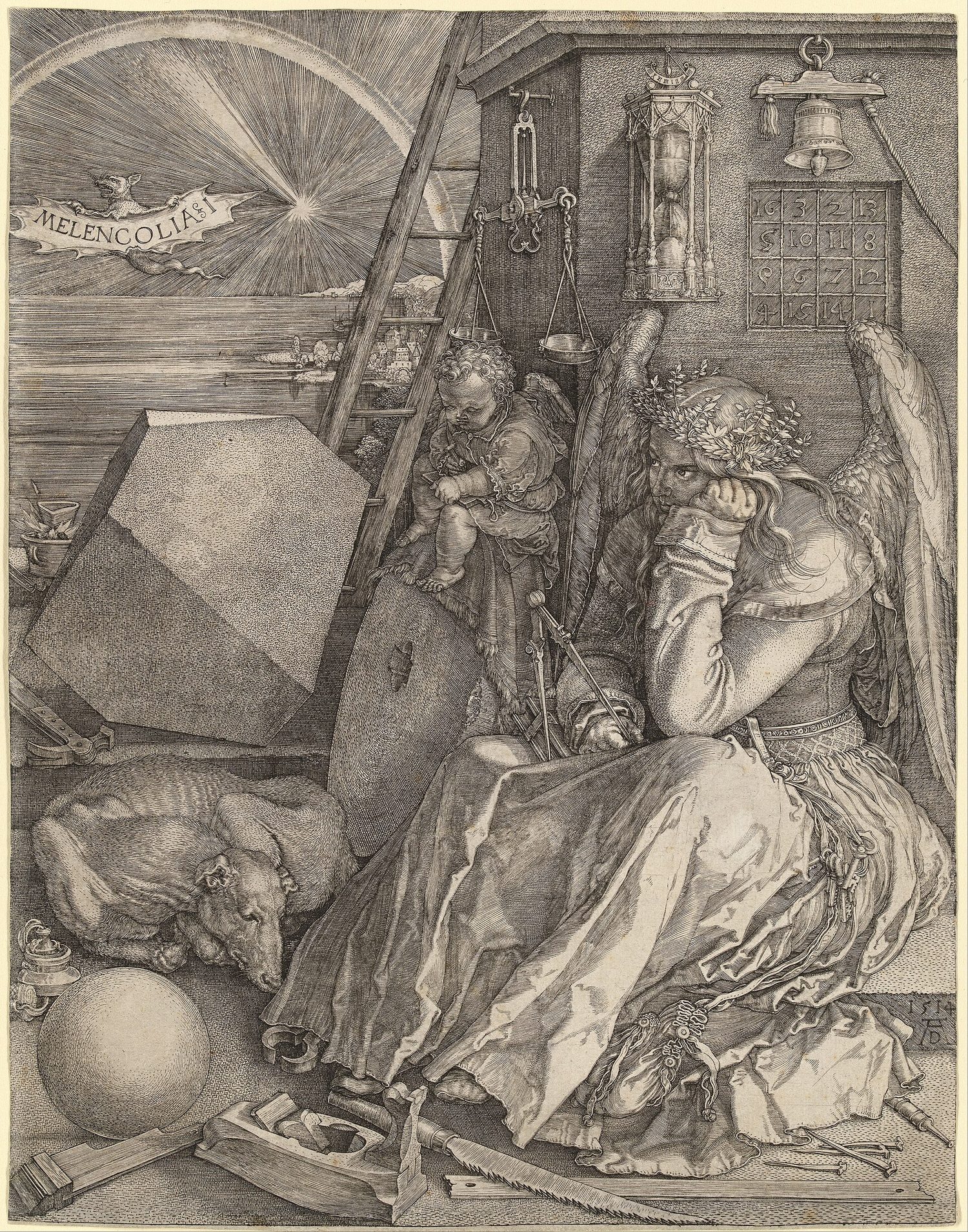
    다양한 도구와 상징으로 둘러싸인 날개가 달린 앉아 있는 인물상의 밀도 높은 고세밀도 오래된 인쇄물, 모든 것이 미세한 각인 선들로 구성됨
    뒤러의 각인화 '멜렌콜리아 I': 인테이리오 기법에서 선은 금속 플레이트에 파여지며, 각인이 가능하게 하는 세밀하고 밀집된 선들은 깊은 그림자와 풍부한 디테일을 형성한다
    Explore · ⁨탐색하기⁩

    Which printmaking process? · ⁨어떤 인쇄(process) 방식입니까?⁩

    Relief prints from the raised surface; intaglio from lines cut below the surface; planographic from a flat greasy image; stencil pushes ink through a mesh. · ⁨레리프(relief) 인화는 돌출된 표면에서; 인타리오(intaglio) 는 표면 아래에 파인 선에서; 플라노그래픽(planographic) 은 평평한 기름 얼룩 이미지에서; 스텐실(stencil) 은 망사(mesh)를 통해 잉크를 밀어 넣습니다.⁩

    Vocabulary · ⁨어휘⁩ Train · ⁨연습하기⁩
    English 한국어
    Printmaking/ˈprɪntmeɪkɪŋ/ 프린팅
    matrix/ˈmeɪtrɪks/ 매트릭스(matrix)
    edition/ɪˈdɪʃn/ 에디션
    Relief/rɪˈliːf/ 리리프
    Intaglio/ɪnˈtæɡlɪəʊ/ 안티갈로
    Planographic/ˌplænəˈɡræfɪk/ 플라노그래픽
    Stencil/ˈstensl/ 스텐실
    Collage/kɒˈlɑːʒ/ 콜라주
    mixed media/mɪkst ˈmiːdiːə/ 믹스 미디어
    3.4

    Collage and Mixed Media · ⁨콜라주 및 복합 매체⁩

    Syllabus
    English

    Focus: Collage assembles found materials onto a surface; mixed media combines two or more materials or processes.

    • Collage glues papers, photos, fabric, or found objects into a composition.
    • Mixed media layers, for example, drawing over paint, or print with stitching.
    • These processes add actual texture and unexpected juxtapositions of image and meaning.
    • Materials can carry meaning (a ticket, a map) beyond their visual role.
    • Good mixed-media work still uses the elements and principles to stay unified.
    한국어

    핵심 개념: 콜라주는 발견한 소재를 배경 위에 배치하여 구성하는 것이고, 믹스 미디어는 두 개 이상의 소재나 기법을 결합합니다.

    • 콜라주는 종이, 사진, 천 또는 수집한 물건을 접착하여 작곡을 만듭니다.
    • 믹스 미디어는 예를 들어, 페인트 위에 드로잉을 하거나 인쇄물에 스티치(바느질)를 더하는 식의 레이어링 기법입니다.
    • 이러한 과정들은 실제 질감(actual texture) 을 추가하고 이미지와 의미의 예상치 못한 병치를 만들어냅니다.
    • 소재는 시각적 역할 이상으로 의미를 담을 수 있습니다(예: 표, 지도).
    • 훌륭한 믹스 미디어 작품은 여전히 요소와 원리를 사용하여 통일성을 유지해야 합니다.

    Source: College Board AP Course and Exam Description · ⁨출처: College Board AP Course and Exam Description⁩

    English

    Collage 拼贴 assembles found materials onto a surface; mixed media 综合媒介 combines two or more materials or processes.

    • Collage glues papers, photos, fabric, or found objects into a composition.
    • Mixed media layers processes — for example, drawing over paint, or print with stitching.
    • These add actual texture and unexpected meaning; a found material (a ticket, a map) can carry meaning beyond its look.
    한국어

    콜라주는 발견된 재료를 표면에 조립하는 것이며, 복합 매체는 두 개 이상의 재료나 공정을 결합하는 것이다.

    • 콜라주는 종이, 사진, 천 또는 발견된 물체를 접착제에 붙여 구상을 만든다.
    • 복합 매체는 공정을 층층이 쌓는다. 예를 들어, 페인트 위에 그리거나, 스티치로 프린트를 추가하는 경우.
    • 이들은 실재하는 질감과 예상치 못한 의미를 더합니다. 발견된 재료(티켓, 지도 등)는 외관 이상으로 의미를 담을 수 있다.
    3.5

    Photography and Lens-Based Media · ⁨사진 및 렌즈 기반 매체⁩

    Syllabus
    English

    Focus: Photography makes images with light and a lens; the same elements and principles apply to the frame.

    • Key controls: framing/composition, focus, exposure (light), depth of field, and viewpoint.
    • The rule of thirds, leading lines, and negative space compose a photograph.
    • Light direction and quality (hard/soft) shape value, form, and mood.
    • Editing (cropping, contrast, colour) is part of the creative process, not just correction.
    • Digital and darkroom processes both count as lens-based 2-D art and design.
    한국어

    핵심 개념: 사진은 빛과 렌즈를 사용하여 이미지를 생성하며, 동일한 요소와 원리가 프레임 구성에도 적용됩니다.

    • 주요 조절 요소: 구도/프레임 구성, 초점, 노출(빛), 심도(초점 거리), 시점입니다.
    • 삼등분 법則, 인引导선, 그리고 여백이 사진을 구성합니다.
    • 빛의 방향과 성질(단단함/부드러움)은 명암, 입체감, 분위기를 형성합니다.
    • 편집(editing) (잘라내기, 콘트라스트, 색상)은 단순한 수정이 아닌 창작 과정의 일부입니다.
    • 디지털 및 다크룸 처리 과정 모두 렌즈 기반 2-D 예술 및 디자인에 포함됩니다.

    Source: College Board AP Course and Exam Description · ⁨출처: College Board AP Course and Exam Description⁩

    English

    Photography 摄影 makes images with light and a lens; the elements and principles apply to the frame just as in any 2-D work.

    • Key controls: framing, focus 对焦, exposure 曝光 (light), depth of field 景深, and viewpoint.
    • The rule of thirds, leading lines, and negative space compose a photograph.
    • Editing 后期 (cropping, contrast, colour) is part of the creative process, not just correction.
    한국어

    사진은 빛과 렌즈를 사용하여 이미지를 만듭니다. 요소와 원리는 2-D 작품과 동일하게 프레임에 적용됩니다.

    拥挤한 배의 승객들을 담은 흑백 사진, 갑판 계단에 의해 두 층으로 분리되어 강력한 기하학적 형태를 형성함
    알프레드 스티글리츠의 '스티어리지': 유명한 초기 예술 사진作品; 계단, 연통 및 인물들이 강력한 기하학적 구도를 형성하므로, 요소와 원리는 사진에도 적용된다
    • 핵심 조절 변수: 구도(framing), 초점(focus), 노출(exposure) (빛), 심도(depth of field), 그리고 시점(viewpoint)입니다.
    • 삼등분 법칙, 유도선, 그리고 여백이 사진을 구성한다.
    • 편집(editing) (잘라내기, 콘트라스트, 색상)은 단순한 수정이 아닌 창작 과정의 일부입니다.
    Vocabulary · ⁨어휘⁩ Train · ⁨연습하기⁩
    English 한국어
    Photography/fəˈtɒɡrəfi/ 사진 촬영
    focus/ˈfəʊkəs/ 초점
    exposure/ekˈspəʊʒə/ 노출
    depth of field/depθ ɒv fiːld/ 초점 거리
    Editing/ˈedɪtɪŋ/ 편집
    Digital media/ˈdɪdʒɪtl ˈmiːdiːə/ 디지털 미디어
    Raster/ˈræstə/ 라스터
    vector/ˈvektə/ 벡터
    Layers/ˈleɪəz/ 층
    resolution/ˌrezəˈluːʃn/ 분해능(resolution)
    Graphic design/ˈɡræfɪk dɪˈzaɪn/ 그래픽 디자인
    illustration/ˌɪləˈstreɪʃn/ 일러스트레이션
    type/taɪp/ 글자
    3.6

    Digital Art and Design · ⁨디지털 아트 및 디자인⁩

    Syllabus
    English

    Focus: Digital tools create and edit images on a computer or tablet, working in layers and pixels or vectors.

    • Raster images are made of pixels (photo editing, painting apps); vector images use math paths (scalable).
    • Layers let an artist build, mask, and revise non-destructively.
    • Digital colour uses RGB (screen, additive) or CMYK (print, subtractive).
    • Resolution (DPI/PPI) affects print quality; keep files high-resolution for the portfolio.
    • The same elements and principles guide digital work as any other 2-D medium.
    한국어

    핵심 개념: 디지털 도구는 컴퓨터나 태블릿에서 이미지를 생성하고 편집하며, 레이어, 픽셀 또는 벡터 방식으로 작업합니다.

    • 래스터(raster) 이미지는 픽셀로 구성됩니다(사진 편집, 페인팅 앱용); 벡터 이미지는 수학적 경로를 사용합니다(확장 가능).
    • 레이어는 아티스트가 비파괴적으로作品을 구축, 가리키기 및 수정할 수 있게 합니다.
    • 디지털 색상은 RGB(화면, 가산법) 또는 CMYK(인쇄, 감산법)를 사용합니다.
    • 해상도(DPI/PPI)는 출력 품질에 영향을 미치므로 포트폴리오용 파일은 고해상도로 유지하십시오.
    • 디지털 작업에도 다른 모든 2-D 매체와 동일하게 요소와 원리가 적용됩니다.

    Source: College Board AP Course and Exam Description · ⁨출처: College Board AP Course and Exam Description⁩

    English

    Digital media 数字媒介 create and edit images on a computer or tablet, working in layers.

    • Raster 位图 images are made of pixels (photo editing, digital painting); vector 矢量 images use maths paths and scale without losing quality.
    • Layers 图层 let an artist build, mask, and revise without damaging earlier work.
    • Digital colour uses RGB (screen, additive) or CMYK (print, subtractive); keep files high-resolution 分辨率 for the portfolio.
    한국어

    디지털 매체는 컴퓨터나 태블릿 위에서 레이어를 사용하여 이미지를 생성하고 편집한다.

    • 래스터 이미지는 픽셀로 이루어져 있으며(포토 편집, 디지털 페인팅), 벡터 이미지는 수학적 경로를 사용하며 확대해도 품질이 떨어지지 않는다.
    • 레이어는 아티스트가 기존 작업을 손상시키지 않고 구축, 가림, 수정할 수 있게 한다.
    • 디지털 색상은 RGB(화면, 가산법) 또는 CMYK(인쇄, 감산법)를 사용하며, 포트폴리오용 파일은 고해상도로 유지해야 한다.
    가산법과 감산법의 색상 비교
    빛(RGB)을 섞으면 밝아져 하얀색으로趋向,.extent pigment(CMY)를 섞으면 어두워져 검은색으로趋向
    3.7

    Graphic Design and Illustration · ⁨그래픽 디자인 및 일러스트레이션⁩

    Syllabus
    English

    Focus: Graphic design communicates a message visually; illustration makes images that support or tell a story.

    • Design combines type, image, colour, and layout to communicate to a viewer or client.
    • Visual hierarchy (size, weight, contrast, placement) guides the eye to what matters first.
    • Typography — typeface, size, spacing, alignment — is a core design element.
    • Illustration serves a purpose: editorial, book, product, poster, or narrative.
    • Design and illustration are problem-solving: audience and message shape every choice.
    한국어

    핵심: 그래픽 디자인은 시각적으로 메시지를 전달하며; 일러스트레이션은 이미지를 제작하여-support하거나 이야기를 전한다.

    • 디자인은 타이포그래피, 이미지, 색상, 레이아웃을 결합하여 시청자나 클라이언트에게 전달한다.
    • 시각적 계층 구조(크기, 두께, 대비, 배치)는 시선을 가장 중요한 요소로 이끈다.
    • 타이포그래피—폰트, 크기, 간격, 정렬—은 핵심 디자인 요소이다.
    • 일러스트레이션은 목적이 있다: 편집, 책, 제품, 포스터, 또는 서사적 목적.
    • 디자인과 일러스트레이션은 문제 해결 과정이며; 대상과 메시지가 모든 선택을 형성한다.

    Source: College Board AP Course and Exam Description · ⁨출처: College Board AP Course and Exam Description⁩

    English

    Graphic design 平面设计 communicates a message visually; illustration 插画 makes images that support or tell a story.

    • Design combines type 字体, image, colour, and layout to reach a viewer or client.
    • Visual hierarchy guides the eye to what matters first, through size, weight, and placement.
    • Typography 字体排印 — typeface, size, spacing, alignment — is a core design tool.
    • Design and illustration are problem-solving: the audience and message shape every choice.

    Worked example (writing about process). When your written evidence must explain a material and process: "I used charcoal on toned paper because its soft, smudgeable line let me build deep shadow quickly, and I lifted highlights with an eraser to suggest form." Notice the shape — name the medium, say why you chose it, and connect it to the idea you were exploring. Listing a material with no reason earns little.

    한국어

    그래픽 디자인은 시각적으로 메시지를 전달하는 것이며, 일러스트레이션은 이야기를 지원하거나 서사하는 이미지를 만드는 것이다.

    • 디자인은 타입, 이미지, 색상, 레이아웃을 결합하여 시청자나 클라이언트에게 도달한다.
    • 시각적 계층 구조는 크기, 무게, 배치 등을 통해 시선이 가장 중요한 부분에 먼저 집중되게 안내한다.
    • 타이포그래피(typography) — 폰트, 크기, 간격, 정렬 —은 핵심 디자인 도구입니다.
    • 디자인과 일러스트레이션은 문제 해결입니다. 대상과 메시지가 모든 선택을 결정한다.

    작업 예시 (과정 설명). 작성된 증거가 재료와 과정을 설명해야 할 때: "부드럽고 번질 수 있는 선을 가진 채소를 톤纸张에 사용하여 깊은 그림자를 빠르게构建할 수 있었고, 지우개로 하이라이트를 제거하여 입체를 암시했다." 이 형식을 주의하라: 매체를 명시하고, 왜 선했는지 말하며, 탐구하던 아이디어와 연결하라. 이유 없이 재료를 나열하면 점수가 낮다.

    Vocabulary · ⁨어휘⁩ Train · ⁨연습하기⁩
    English 한국어
    Typography/taɪˈpɒɡrəfi/ 타이포그래피
    3.7

    Exam tips · ⁨시험 팁⁩

    English
    • Match the medium to the intended effect, and justify the choice.
    • For printmaking, state relief versus intaglio, and remember the printed image reverses.
    • Explain transparent versus opaque paint, and layers and vector versus raster in digital work.
    • Treat collage and mixed media materials as meaning, not just texture.
    • In graphic design, show a clear visual hierarchy serving the message.
    한국어
    • 의도한 효과에 맞는 매체를 맞추고, 그 선택을 정당화하라.
    • 인쇄의 경우 릴리프와 인테이리오를 명시하고, 인쇄된 이미지가 반전됨을 기억하라.
    • 투명과 불투명 페인트, 그리고 디지털 작업에서의 레이어와 벡터 versus 래스터를 설명하라.
    • 콜라주와 복합 매체의 재료를 단순히 질감이 아닌 의미로 처리하라.
    • 그래픽 디자인에서는 메시지를 지원하는 명확한 시각적 계층 구조를 보여라.
  • 4

    Investigate: Inquiry and the Artistic Process · ⁨탐구: 탐구와 예술적 과정⁩

    Watch lesson · ⁨수업 보기⁩
    4.1

    Inquiry and Asking Questions · ⁨탐구 및 질문하기⁩

    Syllabus
    English

    Focus: In AP Art and Design, making begins with inquiry — asking questions that guide a sustained investigation. (CED Big Idea 1)

    • Inquiry is asking questions to find information and drive investigation.
    • A sustained investigation is an in-depth, question-driven study of materials, processes, and ideas over time.
    • Questions can be simple — who, what, when, where, why, how, what if, and why not.
    • Investigation includes perception, curiosity, examination, discovery, imagination, and conversation.
    • Questions evolve: early questions lead to new questions as the work develops.
    한국어

    핵심: AP 예술 및 디자인에서 제작은 탐구에서 시작된다. 이는 지속 가능한 조사를 이끌어내는 질문을 던지는 것이다. (CED Big Idea 1)

    • **Inquiry(탐구)**는 정보를 찾고 조사를 촉진하기 위해 질문을 하는 것입니다.
    • **Sustained investigation(지속적 조사)**는 시간 경과에 따른 자료, 과정 및 아이디어에 대한 심층적이고 질문 중심의 연구입니다.
    • 질문은 간단할 수 있습니다 — 누가, 무엇을, 언제, 어디에서, 왜, 어떻게, 만약这样라면, 그리고 왜 안 되나.
    • 조사에는 지각, 호기심, 검토, 발견, 상상력 및 대화가 포함됩니다.
    • 질문은 진화합니다: 초기 질문들이 작품이 발전함에 따라 새로운 질문으로 이어집니다.

    Source: College Board AP Course and Exam Description · ⁨출처: College Board AP Course and Exam Description⁩

    English

    In AP Art and Design, making begins with inquiry 探究 — asking questions that guide a sustained investigation 持续探究 over time. This is Big Idea 1.

    • Inquiry is asking questions to find information and drive investigation.
    • A sustained investigation is an in-depth, question-driven study of materials, processes, and ideas.
    • Good questions can be simple — who, what, when, where, why, how, what if, and why not.
    • Questions evolve: early questions lead to new questions as the work develops.
    한국어

    AP 아트 & 디자인에서 제작은 탐구로부터 시작된다. 시간이 걸리는 지속적 탐구를 이끄는 질문을 던지는 것. 이것이 Big Idea 1이다.

    예술적 과정은 질문, 조사, 제작, 성찰의 순환임
    탐구는 순환을 이끈다: 질문을 던지고, 조사하고, 제작하고, 성찰하며, 각 답변이 새로운 질문을 Raised하다
    • 탐구는 정보를 찾고 조사를 추진하기 위해 질문을 던지는 것이다.
    • 지속적 탐구는 재료, 공정, 아이디어에 대한 심층적이고 질문 중심의 연구이다.
    • 좋은 질문은 간단할 수 있다. 누가, 무엇, 언제, 어디, 왜, 어떻게, 만약, 왜 안 doing 등의 질문들.
    • 질문은 진화합니다: 초기 질문들이 작품이 발전함에 따라 새로운 질문으로 이어집니다.
    4.2

    Sources of Ideas and Experiences · ⁨아이디어 및 경험의 출처⁩

    Syllabus
    English

    Focus: Artists' and designers' experiences inform why, how, and what they make. (CED 1.A)

    • An experience is an event or occurrence — real surroundings, imagined concepts, communication, or research.
    • Reflecting on experiences sparks questions and inspires investigation.
    • Experiences can be documented with drawings, photos, diagrams, notes, or sound.
    • Ideas come from observation, memory, other disciplines, and other artists' work.
    • Recording experiences becomes a resource for the sustained investigation.
    한국어

    Focus(중점): 예술가와 디자이너의 **experiences(경험)**은 그들이 왜, 어떻게, 무엇을 만드는지에 영향을 미칩니다. (CED 1.A)

    • **Experience(경험)**은 실제 환경, 상상의 개념, 소통 또는 연구인 사건이나 현상입니다.
    • 경험을 성찰하면 질문이 자라고 탐구를 영감시킨다.
    • 경험은 그림, 사진, 도표, 메모 또는 소리로 **documented(기록/문서화)**될 수 있습니다.
    • 아이디어는 관찰, 기억, 다른 학문 및 다른 예술가들의 작품을 통해 얻어집니다.
    • 경험을 기록하는 것은 지속적 조사의 자료가 됩니다.

    Source: College Board AP Course and Exam Description · ⁨출처: College Board AP Course and Exam Description⁩

    English

    Artists' and designers' experiences 经历 inform why, how, and what they make.

    • An experience is any event — real surroundings, imagined ideas, communication, or research.
    • Reflecting on experiences sparks questions and inspires investigation.
    • Ideas come from observation 观察, memory, other disciplines, and other artists' work.
    • Experiences can be documented with drawings, photos, notes, or sound, becoming a resource.
    한국어

    아티스트와 디자이너의 경험은 그들이 왜, 어떻게, 무엇을制作하는지에 영향을 미친다.

    • 경험은 어떤 사건이나 실제 환경, 상상의 아이디어, 의사소통, 혹은 연구일 수 있다.
    • 경험을 성찰하면 질문이 자라고 탐구를 영감시킨다.
    • 아이디어는 관찰, 기억, 다른 학문 및 다른 예술가의作品中에서옵니다.
    • 경험은 스케치, 사진, 메모, 음성 등으로 기록되어 자료가 될 수 있다.
    지속적 탐구의 아이디어가从何而来)
    강력한 탐구 질문은 경험, 관찰, 다른 예술, 문화, 이슈, 그리고 재료에서 자란다
    4.3

    Materials, Processes, and Ideas · ⁨재료, 공정, 아이디어⁩

    Syllabus
    English

    Focus: Every work is built from three interacting components — materials, processes, and ideas. (CED 1.C)

    • Materials are what a work is made of; processes are how it is made; ideas are what it is about.
    • These components interact: a material suggests a process; a process shapes an idea.
    • Investigating materials, processes, and ideas expands the possibilities for making.
    • The components an artist chooses influence how viewers interpret the work.
    • Documenting these choices shows the thinking behind the making.
    한국어

    Focus(중점): 모든 작품은 세 가지 상호작용하는 요소 — materials(재료), processes(과정), and ideas(아이디어) — 로 구성됩니다. (CED 1.C)

    • 재료는 작품이 무엇으로 만들어졌는지, 공정은 어떻게 만들어졌는지, 아이디어는 그것이 무엇에 대해인지다.
    • 이 요소들은 상호작용합니다: 재료가 과정을 시사하고, 과정이 아이디어를 형성합니다.
    • 재료, 과정 및 아이디어를 조사하면 제작의 가능성을 확장합니다.
    • 예술가가 선택한 구성 요소는 관람객이 작품을 해석하는 방식에 영향을 미칩니다.
    • 이러한 선택을 문서화하면 제작背后的思考(생각)를 보여줍니다.

    Source: College Board AP Course and Exam Description · ⁨출처: College Board AP Course and Exam Description⁩

    English

    Every work is built from three interacting components — materials, processes, and ideas 材料、过程与想法.

    • Materials are what a work is made of; processes are how it is made; ideas are what it is about.
    • The components interact: a material suggests a process; a process shapes an idea.
    • Investigating all three expands the possibilities for making, and influences how viewers interpret the work.
    한국어

    모든 작품은 세 가지 상호작용하는 요소인 재료, 공정, 아이디어로構成된다、.

    • 재료는 작품이 무엇으로 만들어졌는지, 공정은 어떻게 만들어졌는지, 아이디어는 그것이 무엇에 대해인지다.
    • 구성 요소는 상호작용합니다: 소재가 과정을 제안하고, 과정이 아이디어를 형성합니다.
    • 세 가지 모두를 조사하면 제작의 가능성을 확장하고, 관람자가 작품을 해석하는 방식에 영향을 미친다.
    시리즈를 위한 조화를 선택할 때 색원wheel을 다시 참고하라
    시리즈를 위한 조화를 선택할 때 색원wheel을 다시 참고하라
    Explore · ⁨탐색하기⁩

    Material, process, or idea? · ⁨소재, 과정, 아니면 아이디어?⁩

    Every work combines materials (what it is made of), processes (how it is made), and ideas (what it is about). · ⁨모든 작품은 재료(materials), 공정(processes), 그리고 아이디어(ideas) 를 결합합니다.⁩

    4.4

    Art and Design in Context · ⁨맥락 속의 아트 및 디자인⁩

    Syllabus
    English

    Focus: Works are made and understood within contexts — traditions, cultures, and other disciplines. (CED 1.D)

    • Context is when, where, how, why, and by whom a work was made and viewed.
    • Artists work within (or challenge) art and design traditions from cultures around the world.
    • Comparing works reveals similarities and differences in materials, processes, and ideas.
    • Acknowledging references and influences shows integrity.
    • Understanding context helps both makers and viewers interpret a work.
    한국어

    Focus(중점): 작품은 contexts(맥락) — 전통, 문화 및 다른 학문 — 안에서制作되고 이해됩니다. (CED 1.D)

    • Context(맥락) 은 작품이 언제, 어디에서, 어떻게, 왜, 그리고 누구에 의해 제작되고 감상되었는지를 의미합니다.
    • 예술가는 전 세계 다양한 문화의 예술 및 디자인 traditions(전통) 안에서 활동하거나 이를 도전합니다.
    • 작품을 비교하면 재료, 과정 및 아이디어의 유사점과 차이점을 파악할 수 있습니다.
    • 출처와 영향을 인정하는 것은 정직성을 보여줍니다.
    • 맥락을 이해하면 제작자와 관람자 모두 작품 해석에 도움이 됩니다.

    Source: College Board AP Course and Exam Description · ⁨출처: College Board AP Course and Exam Description⁩

    English

    Works are made and understood within a context 语境 — traditions, cultures, and other disciplines.

    • Context is when, where, how, why, and by whom a work was made and viewed.
    • Artists work within, or challenge, art and design traditions 传统 from cultures around the world.
    • Comparing works reveals similarities and differences in materials, processes, and ideas.
    • Acknowledging references and influences shows integrity 诚信 — never copying without credit.
    한국어

    작품은 맥락—전통, 문화, 다른 학문—안에서制作되고 이해된다.

    • 맥락은 작품이 언제, 어디에서, 어떻게, 왜, 그리고谁에 의해 제작되고 감상되었는지를 의미합니다.
    • 아티스트는 전 세계의 아트 및 디자인 전통 내에서 작업하거나, 이를 도전하기도 한다.
    • 작품을 비교하면 재료, 과정 및 아이디어의 유사점과 차이점을 파악할 수 있습니다.
    • 인용과 영향을 인정하는 것은 정직성을 보여주는 것이며, 출처를 명시하지 않은 도용은 절대 해서는 안 된다.
    -context中的Hokusai: 역사적 작품이 탐구를 위한 구도를 가르쳐줌
    Context 속의 후쿠사이: 역사적 작품은 조성을 위한 탐구 구성을 가르친다
    Vocabulary · ⁨어휘⁩ Train · ⁨연습하기⁩
    English 한국어
    inquiry/ɪnˈkwaɪəri/ 조사
    sustained investigation/səˈsteɪnd ɪnˌvestɪˈɡeɪʃn/ 지속적 탐구
    experiences/ekˈspɪərɪənsɪz/ 경험
    observation/ɒbzəˈveɪʃn/ 관찰
    materials, processes, and ideas/məˈtɪərɪəlz ˈprəʊsesɪz ænd aɪˈdɪəz/ 재료, 과정 및 아이디어
    context/ˈkɒntekst/ 맥락
    traditions/trəˈdɪʃnz/ 전통
    integrity/ɪnˈteɡrɪti/ 무결성
    evaluated/ɪˈvæljuːeɪtɪd/ 평가됨
    criteria/kraɪˈtɪərɪə/ 기준
    4.5

    Evaluating Art and Design · ⁨미술 및 디자인 평가⁩

    Syllabus
    English

    Focus: Works can be evaluated by using evidence to compare them with specific criteria. (CED 1.E)

    • Evaluation uses visual evidence to judge a work against criteria (as the AP scoring guidelines do).
    • Observe carefully: identify materials, processes, and ideas, and how they connect.
    • Consider whether the components show synthesis — parts working together for one effect.
    • Evaluation can be informal (as you work) or formal (peer critique, feedback).
    • Reflecting on evaluation improves later thinking and making.
    한국어

    Focus(중점): 작품은 특정 기준을 사용하여 증거를 비교함으로써 evaluated(평가) 될 수 있습니다. (CED 1.E)

    • Evaluation(평가) 은 AP 채점 지침과 같이 시각적 증거를 사용하여 기준에 따라 작품을 판단하는 것입니다.
    • 주의 깊게 관찰하세요: 재료, 과정 및 아이디어를 식별하고 이들이 어떻게 연결되는지 파악하십시오.
    • 요소들이 하나의 효과를 위해 서로协作하는 **융합(synthesis)**이 나타나는지 고려하라.
    • 평가는 비공식적(작업 중)이거나 공식적(동료 피드백, 피드백)일 수 있습니다.
    • 평가에 대한 성찰은 후속 사고와 제작을 향상시킵니다.

    Source: College Board AP Course and Exam Description · ⁨출처: College Board AP Course and Exam Description⁩

    English

    Works can be evaluated 评价 by using visual evidence to compare them with specific criteria 标准 (as the AP scoring guidelines do).

    • Observe carefully: identify the materials, processes, and ideas, and how they connect.
    • Consider whether the components show synthesis 综合 — parts working together for one effect.
    • Evaluation can be informal (as you work) or formal (a critique 评图 with peers or a teacher).
    • Reflecting on evaluation improves your later thinking and making.
    한국어

    작품은 시각적 증거를 사용하여 특정 기준과 비교함으로써 평가될 수 있다(예: AP 채점 지침).

    • 주의 깊게 관찰하세요: 재료, 과정, 아이디어를 식별하고 이들이 어떻게 연결되는지 확인하십시오.
    • 요소들이 하나의 효과를 위해 서로协作하는 **융합(synthesis)**이 나타나는지 고려하라.
    • 평가는 비공식적(작업 중)이거나 공식적(동료나 선생님과 함께하는 피드백)일 수 있습니다.
    • 평가에 대한 성찰은 향후 사고와 제작 능력을 향상시킵니다.
    비평이 명작 드로잉의 선, 톤, 조성을 통해 시각적 증거를 지칭함
    비평이 명작 드로잉의 선, 톤, 조성을 통해 시각적 증거를 지칭함
    Vocabulary · ⁨어휘⁩ Train · ⁨연습하기⁩
    English 한국어
    synthesis/ˈsɪnθəsɪs/ 합성
    critique/krɪˈtiːk/ 비평
    Documentation/ˌdɒkjuːmənˈteɪʃn/ 기록
    process journal/ˈprəʊses ˈdʒɜːnl/ 과정 일지(Process Journal)
    lines of inquiry/laɪnz ɒv ɪnˈkwaɪəri/ 탐구 방향
    4.6

    Documentation and the Process Journal · ⁨문서화 및 프로세스 저널⁩

    Syllabus
    English

    Focus: Documentation records information and becomes a resource for the sustained investigation. (CED 1.A/1.B)

    • Documentation takes many forms: images, notes, diagrams, samples, and written reflection.
    • A process journal (sketchbook) records questions, experiments, and revisions over time.
    • Documenting your lines of inquiry shows how the investigation developed.
    • Good documentation can be shared with viewers and included as part of the work.
    • Consistent documentation makes writing the portfolio's written evidence far easier.
    한국어

    Focus(중점): 문서화는 정보를 기록하여 지속적 조사의 자료가 됩니다. (CED 1.A/1.B)

    • Documentation(문서화) 은 이미지, 메모, 도표, 샘플 및 서면 성찰 등 다양한 형태로 나타납니다.
    • 과정 일지(스케치북)는 시간이 지남에 따라 질문, 실험, 수정 사항을 기록합니다.
    • 탐구 방향을 문서화하면 탐구가 어떻게 발전했는지 보여줍니다.
    • 훌륭한 문서화는 관람자와 공유할 수 있으며 작품의 일부로 포함될 수 있습니다.
    • 일관된 문서화는 포트폴리오 서술적 증거 작성에 훨씬 용이하다.

    Source: College Board AP Course and Exam Description · ⁨출처: College Board AP Course and Exam Description⁩

    English

    Documentation 记录 records information and becomes a resource for the sustained investigation.

    • It takes many forms: images, notes, diagrams, material samples, and written reflection.
    • A process journal 创作日志 (sketchbook) records questions, experiments, and revisions over time.
    • Documenting your lines of inquiry 探究路径 shows how the investigation developed.
    • Consistent documentation makes writing the portfolio's written evidence far easier.

    Worked example (framing an inquiry). A weak sustained-investigation question is really just a topic: "My investigation is about the ocean." A strong one is a real question that can drive many artworks: "How can I use colour and texture to show the ocean shifting from calm to dangerous?" The question names an idea and points to the visual choices you will test — exactly what raises a portfolio's score.

    한국어

    문서화는 정보를 기록하고 지속적 탐구를 위한 자료가 된다.

    • 다양한 형식을 취한다: 이미지, 메모, 도표, 소재 샘플, 서술적 성찰 등.
    • 과정 일지(스케치북)는 시간이 지남에 따라 질문, 실험, 수정 사항을 기록합니다.
    • 탐구 방향을 문서화하면 탐구가 어떻게 발전했는지 보여줍니다.
    • 일관된 문서화는 포트폴리오 서술적 증거 작성에 훨씬 용이하다.

    연습 예시 (질문 설정). 약한 지속적 탐구 질문은 사실상 주제일 뿐이다: “내 탐구는 바다에 관한 것이다.” 강력한 질문은 여러 작품을 주도할 수 있는 진정한 질문이어야 한다: “바다가 평온에서 위험으로 변모하는 모습을 색채와 질감으로 어떻게 표현할 수 있을까?” 이 질문은 아이디어를 명시하고 시각적 선택지를 테스트할 방향을 제시하며 —这正是提高 Portfolio 分数的关键。

    프로세스 저널 페이지: 탐구 메모와 소규모 실험이 아이디어가 발전하는 과정을 기록함
    프로세스 저널 페이지: 탐구 메모와 소규모 실험이 아이디어가 발전하는 과정을 기록함
    4.6

    Exam tips · ⁨시험 팁⁩

    English
    • Frame the work with an open guiding question, not a closed yes/no one.
    • Draw on varied sources — observation, experience, research — and cite your influences.
    • Aim for synthesis: materials and processes chosen because they carry the idea.
    • Evaluate through critique using the elements and principles, then plan a revision.
    • Keep a process journal: record experiments and failures as evidence of inquiry.
    한국어
    • 닫힌 예/아니오 질문이 아닌 열린 가이드 질문으로 작품을 구성한다.
    • 다양한 출처—관찰, 경험, 연구—를 활용하고 영감을 주린 sources를 인용하라.
    • 융합을 목표로 하라: 아이디어를 전달하기 때문에 선택된 소재와 과정을 사용하라.
    • 요소와 원칙을 사용하여 비평으로 평가하고 수정을 계획하라.
    • 프로세스 저널을 유지하라: 탐구의 증거로 험과 실패를 기록하라.
  • 5

    Make: Practice, Experimentation, and Revision · ⁨제작: 실습, 실험 및 수정⁩

    Watch lesson · ⁨수업 보기⁩
    5.1

    The Sustained Investigation · ⁨지속적 탐구⁩

    Syllabus
    English

    Focus: The Sustained Investigation is a body of work exploring one question or idea in depth over time. (CED Big Idea 2)

    • A sustained investigation is guided by questions or inquiry and develops as you make.
    • It shows practice, experimentation, and revision — not a set of unrelated pieces.
    • The 2-D portfolio's Sustained Investigation section is 15 images plus written evidence.
    • A clear, focused inquiry gives the whole body of work direction and coherence.
    • The investigation can change direction as new questions emerge — and that evolution is valued.
    한국어

    Focus(중점): **Sustained Investigation(지속적 조사)**는 시간이 지나며 하나의 질문이나 아이디어를 심도 있게 탐구하는 일련의 작품들입니다. (CED Big Idea 2)

    • 지속적 탐구는 질문 또는 탐구에 의해 지도되며 제작 과정에서 발전한다.
    • 연습, 실험, 수정을 보여준다——단순히 무관한 작품들의 나열이 아니다。
    • 2-D 포트폴리오의 지속적 탐구 섹션에는 이미지 15개와 서술적 증거가 포함된다。
    • 명확하고 집중된 탐구는 일련의 전체 작품에 방향성과 일관성을 제공합니다.
    • 새로운 질문이 등장함에 따라 조사의 방향이 바뀔 수 있으며, 이러한 진화는 가치 있게 여겨집니다.

    Source: College Board AP Course and Exam Description · ⁨출처: College Board AP Course and Exam Description⁩

    English

    Big Idea 2 is about making. Its heart is the Sustained Investigation 持续探究 — a body of work that explores one question or idea in depth over time.

    • A sustained investigation is guided by questions or inquiry and develops as you make.
    • It shows practice, experimentation, and revision — not a set of unrelated pieces.
    • The 2-D portfolio's Sustained Investigation section is 15 images plus written evidence.
    • A clear, focused inquiry gives the whole body of work direction and coherence 连贯性.
    한국어

    Big Idea 2는 제작에 관한 것이다. 그 핵심은 지속적 탐구——시간이 지나며 하나의 질문이나 아이디어를 심층적으로 탐구하는 일련의 작품群。

    • 지속적 탐구는 질문 또는 탐구에 의해 지도되며 제작 과정에서 발전한다.
    • 연습, 실험, 수정을 보여준다——단순히 무관한 작품들의 나열이 아니다。
    • 2-D 포트폴리오의 지속적 탐구 섹션에는 이미지 15개와 서술적 증거가 포함된다。
    • 명확하고 집중적인 탐구는 전체 작품群에 방향성과 일관성을 부여한다。
    5.2

    Practice, Experimentation, and Revision · ⁨연습, 실험, 그리고 수정⁩

    Syllabus
    English

    Focus: Making advances through three linked actions — practice, experimentation, and revision. (CED 2.B)

    • Practice is repeated work to build skill and understanding.
    • Experimentation tries new materials, processes, and ideas to discover possibilities.
    • Revision changes a work based on reflection, feedback, or new questions.
    • These actions are shown across the body of work, not just in one final piece.
    • Evidence of experimentation and revision is exactly what the AP readers look for.
    한국어

    Focus(중점): **practice(실습), experimentation(실험), and revision(수정)**이라는 세 가지 연결된 행동을 통해 진전을 이루는 것입니다. (CED 2.B)

    • 연습은 기술과 이해도를 쌓기 위해 반복적으로 수행하는 작업입니다.
    • 실험은 새로운 소재, 과정, 아이디어를 시도하여 가능성을 발견한다。
    • 수정은 성찰, 피드백, 또는 새로운 질문에 기반하여 작품을 변경하는 것입니다.
    • 이러한 행동은 단일 최종 작품뿐만 아니라 일련의 전체 작품 전반에 걸쳐 나타납니다.
    • 실험과 수정의 증거는 바로 AP 채점관이 원하는 것입니다.

    Source: College Board AP Course and Exam Description · ⁨출처: College Board AP Course and Exam Description⁩

    English

    Making advances through three linked actions.

    • Practice 练习 is repeated work to build skill and understanding.
    • Experimentation 实验 tries new materials, processes, and ideas to discover possibilities.
    • Revision 修改 changes a work based on reflection, feedback, or new questions.
    • These are shown across the body of work, not just in one final piece. Evidence of experimentation and revision is exactly what the AP readers look for.
    한국어

    세 가지 연결된 행동을 통해 제작을 진전시킨다。

    시간이 지나며 연습, 실험, 수정을 통해 제작이 진전됨 *연습은 기술을 쌓고, 실험은 새로운 가능성을 시도하며, 수정은 작품을 개선한다——이 과정이 작품群 전반에 반복된다。

    • 연습은 기술과 이해도를 쌓기 위해 반복적으로 수행하는 작업입니다.
    • 실험은 새로운 소재, 과정, 아이디어를 시도하여 가능성을 발견한다。
    • 수정은 성찰, 피드백, 또는 새로운 질문에 기반하여 작품을 변경하는 것입니다.
    • 이는 단일 최종 작품이 아닌 작품群 전반에 걸쳐 나타난다. 실험과 수정의 증거正是AP 채점관이 찾는 것이다。

    명작 연구: 연습, 실험, 수정은 시간이 지나며 2-D 기술이 축적되는 방식 *명작 연구: 연습, 실험, 수정은 시간이 지나며 2-D 기술이 축적되는 방식

    Explore · ⁨탐색하기⁩

    Practice, experiment, or revise? · ⁨연습, 실험, 아니면 수정?⁩

    Practice is repeated work to build skill; experimentation tries new materials or ideas; revision changes a work after reflection or feedback. · ⁨연습(practice) 은 기술을 기르기 위한 반복 작업; 실험(experimentation) 은 새로운 재료나 아이디어를 시도하는 것; 수정(revision) 은 성찰이나 피드백 후 작품을 변경하는 것입니다.⁩

    Vocabulary · ⁨어휘⁩ Train · ⁨연습하기⁩
    English 한국어
    Sustained Investigation/səˈsteɪnd ɪnˌvestɪˈɡeɪʃn/ 지속적 조사
    coherence/kəʊˈhɪərəns/ 일관성
    Practice/ˈpræktɪs/ 연습
    Experimentation/ekˌsperɪmənˈteɪʃn/ 실험
    Revision/rɪˈvɪʒn/ 수정
    5.3

    Synthesis of Materials, Processes, and Ideas · ⁨소재, 과정, 아이디어의 융합⁩

    Syllabus
    English

    Focus: Strong works show synthesis — materials, processes, and ideas integrated so the whole is more than its parts. (CED 2.C)

    • Synthesis means the components combine (coalesce) to create a unified effect.
    • The choice of material should support the idea; the process should serve both.
    • When components are integrated, viewers read one clear message rather than separate parts.
    • Synthesis develops through investigation — trying combinations and keeping what works.
    • The relationships among components are what evaluation and scoring examine.
    한국어

    Focus(중점): 강력한 작품은 synthesis(융합) 를 보여줍니다 — 재료, 과정 및 아이디어가 통합되어 전체가 부분의 합보다 크다는 것입니다. (CED 2.C)

    • Synthesis(융합) 은 요소들이 결합(결집)하여 통일된 효과를 창출함을 의미합니다.
    • 재료의 선택은 아이디어를 지원해야 하며, 과정은 그 둘 모두를服务于(복종)해야 합니다.
    • 요소들이 통합되면 관람자는 개별적인 부분보다는 하나의 명확한 메시지를 읽게 된다。
    • 통합(Synthesis)은 탐구를 통해 발전합니다—조합을 시도하고 잘-working하는 것을 유지해 나가는 과정입니다.
    • 요소 간의 관계가 평가와 채점이 examine(검토)하는 내용입니다.

    Source: College Board AP Course and Exam Description · ⁨출처: College Board AP Course and Exam Description⁩

    English

    Strong works show synthesis 综合 — materials, processes, and ideas integrated so the whole is more than its parts.

    • Synthesis means the components combine to create a unified effect.
    • The chosen material should support the idea; the process should serve both.
    • When components are integrated, viewers read one clear message rather than separate parts.
    • Synthesis develops through investigation — trying combinations and keeping what works.
    한국어

    강력한 작품들은 융합을 보여준다——소재, 과정, 아이디어가 통합되어 전체가 부분의 합보다 크다는 것을 증명한다。

    • 융합은 요소들이 결합하여 통일된 효과를 만드는 것을 의미한다。
    • 선택된 소재는 아이디어를 지원해야 하며, 과정은 그 둘을 모두 지향해야 합니다.
    • 요소들이 통합되면 관람자는 개별적인 부분보다는 하나의 명확한 메시지를 읽게 된다。
    • 통합(Synthesis)은 탐구를 통해 발전합니다—조합을 시도하고 잘-working하는 것을 유지해 나가는 과정입니다.
    Vocabulary · ⁨어휘⁩ Train · ⁨연습하기⁩
    English 한국어
    synthesis/ˈsɪnθəsɪs/ 합성
    2-D skills/tuː diː skɪlz/ 2D 기술
    Selected Works/sɪˈlektɪd wɜːks/ 선정된 작품
    5.4

    Demonstrating 2-D Skills · ⁨2-D 기술 입증⁩

    Syllabus
    English

    Focus: The portfolio must show 2-D skills — the elements and principles used to organise a two-dimensional surface. (CED 2.D)

    • 2-D skills are the use of the elements of art and principles of design on a flat surface.
    • Skilful work shows control of value, colour, composition, and mark-making.
    • Skills are demonstrated across many works, in a range of materials and processes.
    • The Selected Works section (5 works) is where 2-D skills are judged most directly.
    • Skill is shown by decisions that are clear, purposeful, and support the idea.
    한국어

    Focus(중점): 포트폴리오에는 2-D skills(2D 기술) — 평면 표면을 조직화하는 데 사용되는 요소와 원리 — 가 포함되어야 합니다. (CED 2.D)

    • 2-D 기술은 평면 매체 위에서 예술의 요소와 디자인의 원리를 사용하는 것이다.
    • 능숙한 작품은 명도, 색채, 구도, 마크 메이크ینگ에 대한 통제를 보여줍니다.
    • 기술은 다양한 재료와 과정에서 여러 작품을 통해 증명됩니다.
    • 선정된 작품 섹션(5점)은 2-D 기술을 가장 직접적으로 평가받는 곳입니다.
    • 기술은 명확하고 목적적이며 아이디어를 지지하는 결정으로 나타납니다.

    Source: College Board AP Course and Exam Description · ⁨출처: College Board AP Course and Exam Description⁩

    English

    The portfolio must show 2-D skills 二维技能 — the elements and principles used to organise a flat surface.

    • 2-D skills are the skilful use of line, shape, value, colour, texture, space, and the principles of design.
    • Skilful work shows control of value, colour, composition, and mark-making.
    • Skills are demonstrated across many works, in a range of materials and processes.
    • The Selected Works 精选作品 section is where 2-D skills are judged most directly.
    한국어

    포트폴리오는 2-D 기술——평면 표면을 조직화하는 데 사용되는 요소와 원칙——을 보여줘야 한다。

    • 2-D 기술은 선, 형태, 명도, 색채, 질감, 공간, 그리고 디자인의 원칙을 능숙하게 사용하는 것이다。
    • 능숙한 작품은 명도, 색채, 구도, 마크 메이크ینگ에 대한 통제를 보여줍니다.
    • 기술은 다양한 소재와 과정에서 여러 작품에 걸쳐 입증되어야 한다。
    • 선정된 작품 섹션은 2-D 기술이 가장 직접적으로 평가되는 곳이다。

    반 고흐의 별밤: 2-D 기술로서의 표현적 선, 색채, 리듬 *반 고흐의 별밤: 2-D 기술로서의 표현적 선, 색채, 리듬

    5.5

    Composition and Craft in Making · ⁨제작에서의 조성과 기술⁩

    Syllabus
    English

    Focus: Craft is the quality of making; composition is the arrangement of the work — both communicate care and intent.

    • Craftsmanship is the skilful, controlled handling of materials and processes.
    • Composition applies the principles of design to organise the picture plane.
    • Purposeful decisions about surface, edges, and finish strengthen a work.
    • Craft should serve the idea — sometimes rough or raw handling is the right choice.
    • Consistent quality across the body of work signals a developed artist.
    한국어

    Focus(중점): Craft(장인 정신/기술력)는 제작의 질이며, composition(구성)은 작품의 배치입니다 — 둘 다 세심함과 의도를 전달합니다.

    • 기술력은 소재와 과정을 능숙하고 통제되게 다루는 것이다。
    • Composition(구성) 은 그림 면을 조직화하기 위해 디자인의 원리를 적용합니다.
    • 표면, 가장자리 및 마감에 대한 의도적인 결정은 작품을 강화합니다.
    • 공예는 아이디어를服务于해야 하며, 때로는 거칠거나 생소한 처리가 적절한 선택이 될 수 있습니다.
    • 작품 전체에서 일관된 품질은 성숙한 작가임을 시사합니다.

    Source: College Board AP Course and Exam Description · ⁨출처: College Board AP Course and Exam Description⁩

    English

    Craft 工艺 is the quality of making; composition is the arrangement of the work — both communicate care and intent.

    • Craftsmanship 匠艺 is the skilful, controlled handling of materials and processes.
    • Composition applies the principles of design to organise the picture plane.
    • Craft should serve the idea — sometimes a rough or raw handling is the right choice.
    • Consistent quality across the body of work signals a developed artist.
    한국어

    기술은 제작의 품질이며, 조성은 작품의 배치——둘 다 세심함과 의도를 전달한다。

    • 기술력은 소재와 과정을 능숙하고 통제되게 다루는 것이다。
    • 구상은 디자인의 원리를 적용하여 그림 평면을 구성합니다.
    • 기술은 아이디어를服务于해야 한다——때로는 거칠거나 원초적인处理方式이 올바른 선택이기도 하다。
    • 작품 전체에서 일관된 품질은 성숙한 작가임을 시사합니다.

    후쿠사의 대파: 조성과 기술이 시선을 그림 전체로 이끌다 *후쿠사의 대파: 조성과 기술이 시선을 그림 전체로 이끌다

    5.6

    Developing Ideas Over Time · ⁨시간이 지나며 아이디어 개발⁩

    Syllabus
    English

    Focus: A sustained investigation shows ideas developing — growing and changing across the body of work. (CED 2.B)

    • Development is visible when later works build on discoveries in earlier ones.
    • New questions, materials, or processes push the investigation forward.
    • Not every experiment succeeds — evidence of what did not work is still valuable.
    • Documenting the sequence shows the readers a genuine journey of inquiry.
    • A body of work with clear development scores higher than a set of finished-but-static pieces.
    한국어

    Focus(중점): 지속적 조사는 **ideas(아이디어)가 developing(발전)**됨 — 일련의 작품 전체에 걸쳐 성장하고 변화함 — 을 보여줍니다. (CED 2.B)

    • 후속 작품이 초기 작품의 발견을 기반으로 확장될 때 발전이 명확해집니다.
    • 새로운 질문, 자재, 또는 과정이 조사를 추진합니다.
    • 모든 실험이 성공하지는 않습니다. 실패한 증거 역시 가치가 있습니다.
    • 시퀀스를 문서화하면 채점인에게 진정한 탐구의 여정을 보여줍니다.
    • 명확한 발전이 있는 작품群이 완성되었지만 정적인 작품들의 집합보다 높은 점수를 받는다。

    Source: College Board AP Course and Exam Description · ⁨출처: College Board AP Course and Exam Description⁩

    English

    A sustained investigation shows ideas developing 发展 — growing and changing across the body of work.

    • Development is visible when later works build on discoveries in earlier ones.
    • New questions, materials, or processes push the investigation forward.
    • Not every experiment succeeds — evidence of what did not work is still valuable.
    • A body of work with clear development scores higher than a set of finished-but-static pieces.

    Worked example (showing development). The Sustained Investigation is scored on evidence of thinking, not just finished pieces: "My first three works used flat colour; after seeing they felt lifeless, I experimented with layered glazes in works 4–6, then in works 7–9 I combined the best of both." Describing a change and the reason for it is how you demonstrate practice, experimentation, and revision.

    한국어

    지속적 탐구는 아이디어가 개발됨——작품群 전반에 걸쳐 성장하고 변화함을 보여준다。

    • 후속 작품이 초기 작품의 발견을 기반으로 확장될 때 발전이 명확해집니다.
    • 새로운 질문, 자재, 또는 과정이 조사를 추진합니다.
    • 모든 실험이 성공하는 것은 아니지만, 실패한 사례에 대한 증거 역시 가치가 있습니다.
    • 명확한 발전이 있는 작품群이 완성되었지만 정적인 작품들의 집합보다 높은 점수를 받는다。

    작품이 발전함에 따라 지속적 탐구가 깊어짐 *초기 탐구는 실험과 수정으로 이어지고, 마침내 융합으로 이어진다——생각이 작품 전반에 걸쳐 명확히 깊어지는 모습。

    연습 예시 (발전을 보여주는 것). 지속적 탐구는 완성된 작품뿐만 아니라 사고의 증거를 기반으로 점수가 매겨진다: “첫 세 작품에서는 평면색을 사용했으나, 이것이 생기가 없다고 느껴져 4-6번 작품에서 중첩 유막을 실험했고, 7-9번 작품에서는 두 가지의 장점을 결합했다.” 변화와 그에 대한 이유를 서술하는 것이 연습, 실험, 수정을 입증하는 방법이다。

    5.6

    Exam tips · ⁨시험 팁⁩

    English
    • Build the sustained investigation as a connected body of work, not one-offs.
    • Show practice, experimentation, and revision — a documented failure still earns credit.
    • Push synthesis and clear 2-D skills, and keep craft clean to the edges.
    • Let each work develop from the last, raising the next question.
    • Choose materials and processes that embody the guiding question.
    한국어
    • 지속적 탐구를 일회성 작업이 아닌 연결된 작품의 집합체로 구축하십시오.
    • 연습, 실험, 수정 과정을 보여주십시오 — 기록된 실패도 점수를 받을 수 있습니다.
    • 통합과 명확한 2D 기술을 발전시키고, 가장자리까지 깔끔하게 작품 제작(Craft) 을 유지하십시오.
    • 각 작품이 이전 작품을 바탕으로 발전하여 다음 질문을 제기하도록 하십시오.
    • 지향 문제를 구현하는 재료와 공정을 선택하십시오.
    Vocabulary · ⁨어휘⁩ Train · ⁨연습하기⁩
    English 한국어
    Craft/kræft/ 장인 정신
    Craftsmanship/ˈkræftsmənʃɪp/ 장인정신
    developing/dɪˈveləpɪŋ/ 발전하는
  • 6

    Present: Communication and the AP Portfolio · ⁨제출: 소통과 AP 포트폴리오⁩

    Watch lesson · ⁨수업 보기⁩
    6.1

    The AP 2-D Art and Design Portfolio

    Syllabus

    Focus: The AP exam is a portfolio, not a written test. It has two sections that are submitted digitally. (CED Big Idea 3)

    • The Sustained Investigation section: 15 images showing inquiry, practice, experimentation, and revision, plus written evidence.
    • The Selected Works section: 5 works that best show your 2-D skills and synthesis, with written information.
    • Works may be physical or digital, but all are submitted as digital images (and short video where relevant).
    • There is no written exam and no timed section — the portfolio is built across the whole course.
    • Both sections are scored against the College Board scoring guidelines.

    Source: College Board AP Course and Exam Description · ⁨출처: College Board AP Course and Exam Description⁩

    Big Idea 3 is about presenting your work. The AP exam is a portfolio 作品集 — not a written test. It has two sections, both submitted digitally.

    The 2-D portfolio has two parts: a 15-image Sustained Investigation and 5 Selected Works
    The portfolio is a 15-image Sustained Investigation plus 5 Selected Works, submitted as digital images
    • The Sustained Investigation 持续探究 section: 15 images showing inquiry, practice, experimentation, and revision, plus written evidence.
    • The Selected Works 精选作品 section: 5 works that best show your 2-D skills, with written information.
    • Works may be physical or digital, but all are submitted as digital images. There is no timed exam — the portfolio is built across the whole course.
    The two parts of the AP 2-D Art and Design portfolio
    The Sustained Investigation (15 images, plus written evidence) is weighted more than Selected Works (5 pieces)
    Vocabulary · ⁨어휘⁩ Train · ⁨연습하기⁩
    English 한국어
    portfolio/pɔːtˈfəʊlɪəʊ/ 포트폴리오
    Sustained Investigation/səˈsteɪnd ɪnˌvestɪˈɡeɪʃn/ 지속적 조사
    Selected Works/sɪˈlektɪd wɜːks/ 선정된 작품
    6.2

    Sustained Investigation: Images and Written Evidence

    Syllabus
    English

    Focus: The Sustained Investigation is judged on the inquiry and the practice, experimentation, and revision it shows. (CED 3.A/3.B)

    • Submit 15 images — works and process documentation that show the investigation over time.
    • Provide written evidence: identify the questions that guided the investigation, and describe how the work shows practice, experimentation, and revision.
    • Images should tell the story of the inquiry, not just show finished pieces.
    • Detail images and in-progress shots are allowed and often helpful.
    • Clear writing (within the character limit) makes the investigation easy to follow.
    한국어

    Focus(중점): 지속적 조사는 그것이 보여주는 inquiry(탐구) 와 practice, experimentation, and revision(실습, 실험, 수정) 에 대해 평가됩니다. (CED 3.A/3.B)

    • 15장의 이미지를 제출하십시오 — 시간이流过하며 진행된 탐구를 보여주는 작품과 공정 문서화입니다.
    • written evidence(서면 증거) 를 제공하십시오: 조사를 주도한 질문을 명시하고, 작품이 실습, 실험, 수정을 어떻게 보여주는지 설명하십시오.
    • 이미지는 완성된 작품을 단순히 보여주는 것이 아니라, 탐구 과정의 이야기를 전달해야 합니다.
    • 디테일 이미지와 진행 중 샷을 포함해도 좋으며, 종종 유용합니다.
    • 글자 수 제한 내에서 명확하게 작성하면 연구 내용을 쉽게 따라갈 수 있습니다.

    Source: College Board AP Course and Exam Description · ⁨출처: College Board AP Course and Exam Description⁩

    The Sustained Investigation is judged on the inquiry and the practice, experimentation, and revision it shows.

    • Submit 15 images — works and process documentation that show the investigation over time.
    • Provide written evidence 书面材料: identify the guiding questions 引导性问题, and describe how the work shows practice, experimentation, and revision.
    • Images should tell the story of the inquiry, not just show finished pieces. Detail and in-progress shots are allowed.
    Vocabulary · ⁨어휘⁩ Train · ⁨연습하기⁩
    English 한국어
    written evidence/ˈrɪtn ˈevɪdəns/ 서술적 증거
    guiding questions/ˈɡaɪdɪŋ ˈkwestʃnz/ 안내 질문
    6.3

    Selected Works: Demonstrating Skills

    Syllabus
    English

    Focus: The Selected Works section shows your best evidence of 2-D skills and synthesis of materials, processes, and ideas. (CED 3.D/3.E)

    • Submit 5 works (physical or digital) as high-quality images.
    • For each, give the materials, processes, and ideas used, plus the size.
    • These works are judged mainly on the skilful use of the elements and principles.
    • They do not have to belong to the sustained investigation.
    • Choose works that most clearly show control, decision-making, and synthesis.
    한국어

    핵심: 선정 작품 섹션은 2-D 기술 및 재료, 과정, 아이디어의 융합에 대한 가장 우수한 증거를 보여줍니다. (CED 3.D/3.E)

    • 5점의 작품(물리적 또는 디지털 형식)을 고품질 이미지로 제출하십시오.
    • 각 작품에 사용된 재료, 공정, 아이디어와 크기를 명시하십시오.
    • 이 작품들은 주로 요소와 원리의 숙련된 활용을 기준으로 평가됩니다.
    • 반드시 지속적 탐구와 관련되어 있을 필요는 없습니다.
    • 통제력, 의사결정 및 통합을 가장 명확하게 보여주는 작품을 선택하십시오.

    Source: College Board AP Course and Exam Description · ⁨출처: College Board AP Course and Exam Description⁩

    The Selected Works section shows your best evidence of 2-D skills 二维技能 and synthesis of materials, processes, and ideas.

    • Submit 5 works (physical or digital) as high-quality images.
    • For each, give the materials, processes, and ideas used, plus the size.
    • These works are judged mainly on the skilful use of the elements and principles; they need not belong to the sustained investigation.
    A finished Selected Work: craft, composition and skill must read clearly in the submitted image
    A finished Selected Work: craft, composition and skill must read clearly in the submitted image
    Monet water lilies: selected works need clear craft and presentation in the image
    Monet water lilies: selected works need clear craft and presentation in the image
    Vocabulary · ⁨어휘⁩ Train · ⁨연습하기⁩
    English 한국어
    2-D skills/tuː diː skɪlz/ 2D 기술
    6.4

    Writing About Your Work

    Syllabus
    English

    Focus: Writing communicates your inquiry, processes, and ideas to viewers who cannot ask you questions. (CED 3.A/3.B/3.C)

    • Written evidence must fit within the College Board character limits — be concise and specific.
    • State the question(s) that guided the sustained investigation clearly.
    • Describe how the work shows practice, experimentation, and revision — use evidence.
    • For Selected Works, name the materials, processes, and ideas.
    • Write plainly; the reader should understand your intent from the words plus the images.
    한국어

    핵심: 서술은 질문할 수 없는 관람자에게 여러분의 탐구, 과정, 아이디어를 전달합니다. (CED 3.A/3.B/3.C)

    • 서술 증거는 College Board의 문자 수 제한 내에 맞춰야 하므로 간결하고 구체적으로 작성하십시오.
    • 지속적 탐구를 이끄는 질문을 명확히 명시하십시오.
    • 작품이 연습, 실험, 수정 과정을 어떻게 보여주는지 서술하십시오 — 근거를 제시하십시오.
    • 선정 작품에 대해서는 사용된 재료, 과정, 아이디어를 명시하십시오.
    • 간결하고 명확하게 작성하여, 글과 이미지를 통해 독자가 의도를 이해할 수 있게 하십시오.

    Source: College Board AP Course and Exam Description · ⁨출처: College Board AP Course and Exam Description⁩

    Writing communicates your inquiry, processes, and ideas to viewers who cannot ask you questions.

    • Written evidence must fit within the College Board character limits 字数限制 — be concise and specific.
    • State the guiding question(s) of the sustained investigation clearly.
    • Describe how the work shows practice, experimentation, and revision — use evidence, not vague claims.
    Written evidence starts from inquiry notes: describe materials, process, and ideas with specific visual language
    Written evidence starts from inquiry notes: describe materials, process, and ideas with specific visual language
    Vocabulary · ⁨어휘⁩ Train · ⁨연습하기⁩
    English 한국어
    character limits/ˈkærɪktə ˈlɪmɪts/ 문자 수 제한
    6.5

    Presentation and Image Quality

    Syllabus
    English

    Focus: How work is presented affects how viewers interpret it — image quality is part of the grade. (CED 3.F)

    • Photograph work with even lighting, sharp focus, true colour, and no distracting background.
    • Crop images to the work; avoid glare, shadows, and keystoning (tilted edges).
    • Follow the required file formats and sizes; keep resolution high.
    • Consistent, clean presentation lets the readers see the work, not the photograph.
    • Poor images can hide real skill — good documentation protects your score.
    한국어

    핵심: 작품의 발표 방식은 관람자의 해석에 영향을 미치며, 이미지 품질은 점수 산정에 포함됩니다. (CED 3.F)

    • 작품 사진은 균일한 조명, 선명한 초점, 정확한 색상, 시선을 흐리는 배경 없음으로 촬영하십시오.
    • 이미지는 작품을 프레임 안에 맞추고, 반사광, 그림자, 키스톤 현상(테두리가 기울어진 상태)을 피하십시오.
    • 요구되는 파일 형식과 크기를 준수하십시오; 해상도는 높게 유지하십시오.
    • 일관되고 깔끔한 발표는 독자로 하여금 사진 자체가 아닌 작품 자체를 볼 수 있게 합니다.
    • 열악한 이미지는 실제 기술을 숨길 수 있으므로, 적절한 문서화가 점수를 보호합니다.

    Source: College Board AP Course and Exam Description · ⁨출처: College Board AP Course and Exam Description⁩

    How work is presented affects how viewers interpret it — image quality is part of the grade.

    • Photograph work with even lighting, sharp focus, true colour, and no distracting background.
    • Crop to the work; avoid glare, shadows, and tilted edges (keystoning 梯形失真).
    • Follow the required file formats and sizes; keep resolution 分辨率 high. Poor images can hide real skill.
    Explore · ⁨탐색하기⁩

    Helps or hurts your portfolio image? · ⁨포트폴리오 이미지에 도움이 되거나 해가 되는가?⁩

    Good documentation lets the readers see your work clearly; poor images can hide real skill. · ⁨좋은 문서화(documentation)는 독자들이 작품을 명확히 볼 수 있게 하며, 나쁜 이미지는 실제 실력을 숨길 수 있습니다.⁩

    Vocabulary · ⁨어휘⁩ Train · ⁨연습하기⁩
    English 한국어
    keystoning/ˈkiːstənɪŋ/ 키 톤링
    resolution/ˌrezəˈluːʃn/ 분해능(resolution)
    6.6

    Understanding the Scoring Guidelines

    Syllabus
    English

    Focus: Both portfolio sections are scored against published guidelines — knowing them helps you build the portfolio.

    • The Sustained Investigation is scored on inquiry and on evidence of practice, experimentation, and revision (and their visual relationships).
    • Selected Works are scored on 2-D skills and the synthesis of materials, processes, and ideas.
    • Readers use visual evidence in the work plus your writing to apply the criteria.
    • Scores use a rubric with described levels; the top levels show clear, sustained, well-integrated evidence.
    • Designing your work with the criteria in mind (not to a formula) leads to a stronger portfolio.
    한국어

    핵심: 포트폴리오의 모든 섹션은 공개된 채점 기준에 따라 평가되므로, 이를 이해하는 것이 포트폴리오 구성에 도움이 됩니다.

    • 지속적 탐구는 탐구 내용과 연습, 실험, 수정의 증거(그리고 시각적 관계)를 바탕으로 점수가 매겨집니다.
    • **선정 작품(Selected Works)**은 2차원 기술과 재료, 과정, 아이디어의 통합 능력을 기준으로 평가됩니다.
    • 독자들은 작품 속 시각적 증거와 당신의 서술을 종합하여 기준을 적용합니다.
    • 점수는 설명된 수준이 있는 채점 표(rubric)를 사용하여 매겨지며, 최상위 수준은 명확하고 지속적이며 잘 통합된 증거를 보여줍니다.
    • 공식에 맞춰 설계하기보다 기준을 염두에 두고 작품을 디자인하는 것이 더 강력한 포트폴리오를 만듭니다.

    Source: College Board AP Course and Exam Description · ⁨출처: College Board AP Course and Exam Description⁩

    Both sections are scored against published scoring guidelines 评分标准 — knowing them helps you build the portfolio.

    • The Sustained Investigation is scored on inquiry and on evidence of practice, experimentation, and revision.
    • Selected Works are scored on 2-D skills and the synthesis of materials, processes, and ideas.
    • Readers use visual evidence in the work plus your writing to apply the criteria. Design your work with the criteria in mind — not to a formula.
    Vocabulary · ⁨어휘⁩ Train · ⁨연습하기⁩
    English 한국어
    scoring guidelines/ˈskɔːrɪŋ ˈɡaɪdlaɪnz/ 채점 기준
    6.7

    Academic Integrity and Citing Sources

    Syllabus
    English

    Focus: Portfolios must be your own work; using others' work without permission or citation is a serious violation.

    • Work based on published or photographic sources you did not take must move far beyond duplication and cite the source.
    • Never present another artist's work — or an AI-generated image — as your own.
    • Cite influences and references; acknowledging them shows integrity, not weakness.
    • The College Board can withhold scores for portfolios that violate integrity policies.
    • When in doubt, work from your own photos, observation, and imagination.
    한국어

    핵심: 포트폴리오는 반드시 본인의 본인 작업이어야 하며, 허락이나 인용 없이 타인의 작업을 사용하는 것은 중대한 위반 행위입니다.

    • 직접 촬영하지 않은 발간물 또는 사진 자료를 기반으로 한 작품은 단순 복제를 넘어선 차별화된 접근이 필요하며, 출처를 인용해야 합니다.
    • 다른 예술가의 작품이나 AI로 생성된 이미지를 본인의 것으로 주장해서는 안 됩니다.
    • 영감과 참고 문헌을 인용하십시오. 이를 인정하는 것은 정직성을 보여주는 것이지 약점이 아닙니다.
    • 학문적 정직성 규정을 위반하는 포트폴리오는 College Board에서 점수를 취소할 수 있습니다.
    • 불확실할 때는 본인의 본인 사진, 관찰, 그리고 상상을 바탕으로 작업하십시오.

    Source: College Board AP Course and Exam Description · ⁨출처: College Board AP Course and Exam Description⁩

    Portfolios must be your own work; using others' work without permission or citation is a serious violation.

    • Work based on published or photographic sources 参考来源 you did not create must move far beyond duplication and cite 注明出处 the source.
    • Never present another artist's work — or an AI-generated image — as your own.
    • Citing influences shows integrity 诚信, not weakness. When in doubt, work from your own photos, observation, and imagination.

    Worked example (portfolio written evidence). For the Sustained Investigation you write a short statement about your inquiry and how the work developed. A strong statement links idea, materials, and change: "My inquiry asked how repetition can show the passing of time. I began with pencil grids, then moved to printmaking so I could repeat one image with small changes, revising the spacing in later prints to slow the visual rhythm." One or two sentences that connect idea → process → revision score far better than a description of the finished pictures alone.

    Vocabulary · ⁨어휘⁩ Train · ⁨연습하기⁩
    English 한국어
    published or photographic sources/ˈpʌblɪʃt ɔː ˌfəʊtəˈɡræfɪk ˈsɔːsɪz/ 발매된 사진 자료
    cite/saɪt/ cite
    integrity/ɪnˈteɡrɪti/ 무결성
    6.7

    Exam tips

    • Know the two sections: the sustained investigation (15 images) and selected works (5 works).
    • Use images for process, not only finished pieces, and name the guiding question in the writing.
    • Write specifically and within the character limits — point to visible evidence.
    • Photograph well: even light, true colour, avoid keystoning, and keep resolution high.
    • Keep it your own work: transform any sources far beyond copying and cite them.

Log in or create account · ⁨로그인 또는 계정 만들기⁩

IGCSE, A-Level & AP