약장장을 열고 아스피린 한 봉지를 꺼내십시오. 그 정제는 에스터입니다. AS에서 접한 작은 그룹 중 하나가 있었을 것입니다: 카복실 기. A2에서는 세 가지 새로운…로 확장됩니다.
English narration · English + 中文 subtitles burned in · 영어 내레이션 · 영어 + 중국어 자막 burned-in
33.1
Carboxylic acids · 카복실산
Syllabus
English
recall the reaction by which benzoic acid can be produced: (a) reaction of an alkylbenzene with hot alkaline $\text{KMnO}_4$ and then dilute acid, exemplified by methylbenzene
describe the reaction of carboxylic acids with $\text{PCl}_3$ and heat, $\text{PCl}_5$ or $\text{SOCl}_2$ to form acyl chlorides
recognise that some carboxylic acids can be further oxidised: (a) the oxidation of methanoic acid, $\text{HCOOH}$, with Fehling’s reagent or Tollens’ reagent or acidified $\text{KMnO}_4$ or acidified $\text{K}_2\text{Cr}_2\text{O}_7$ to carbon dioxide and water (b) the oxidation of ethanedioic acid, $\text{HOOCCOOH}$, with warm acidified $\text{KMnO}_4$ to carbon dioxide
describe and explain the relative acidities of carboxylic acids, phenols and alcohols
describe and explain the relative acidities of chlorine-substituted carboxylic acids
한국어
벤조산이 생성되는 반응을 기억하시오: (a) 알킬벤젠을 뜨거운 알칼리 $\text{KMnO}_4$와 반응시킨 후 희석 산으로 처리하는 반응(메틸벤젠 등 예시)
카복실산과 $\text{PCl}_3$ 및 가열, $\text{PCl}_5$ 또는 $\text{SOCl}_2$ 사이의 반응을 서술하여 아실 염화물을 형성함을 기술하시오
일부 카복실산은 추가 산화될 수 있음을 인지하시오: (a) 메탄산 $\text{HCOOH}$의 산화: 푸링 시약 또는 톨렌스 시약 또는 산화된 $\text{KMnO}_4$ 또는 산화된 $\text{K}_2\text{Cr}_2\text{O}_7$에 의해 이산화탄소와 물로 산화됨 (b) 옥살산 $\text{HOOCCOOH}$의 산화: 따뜻한 산화된 $\text{KMnO}_4$에 의해 이산화탄소로 산화됨
카복실산, 페놀 및 알코올의 상대적 산성을 서술하고 설명하시오
염소 치환 카복실산의 상대적 산성을 서술하고 설명하시오
Source: Cambridge International syllabus · 출처: Cambridge International syllabus
English
Making and reacting
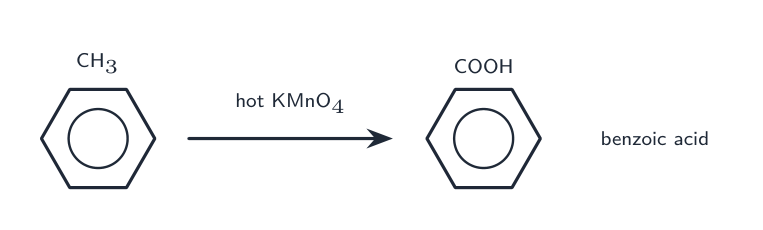
an alkylbenzene 烷基苯 (such as methylbenzene) is oxidised by hot alkaline $\text{KMnO}_4$, then dilute acid, to give benzoic acid 苯甲酸. The whole side-chain becomes a $\text{–COOH}$ group.
a carboxylic acid reacts with $\text{PCl}_3$ and heat, $\text{PCl}_5$, or $\text{SOCl}_2$ to form an acyl chloride 酰氯.
Acids that can be oxidised further
Two carboxylic acids 羧酸 are special because they can still be oxidised:
methanoic acid ($\text{HCOOH}$) is oxidised by Fehling's or Tollens' reagent, or acidified $\text{KMnO}_4$ / $\text{K}_2\text{Cr}_2\text{O}_7$, to carbon dioxide and water.
ethanedioic acid ($\text{HOOCCOOH}$) is oxidised by warm acidified $\text{KMnO}_4$ to carbon dioxide.
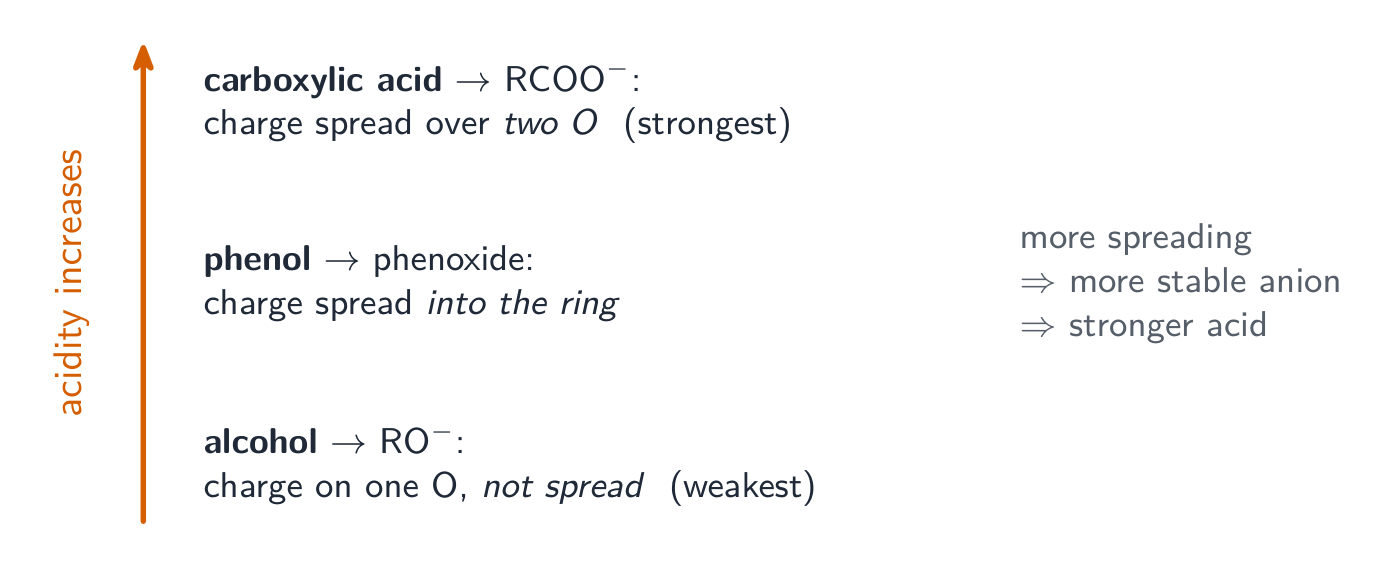
A carboxylic acid is the strongest because, when it loses $\text{H}^+$, the negative charge is spread over two oxygen atoms, making the ion very stable. In a phenol 苯酚 the charge spreads only into the ring, and in an alcohol 醇 (giving $\text{RO}^-$) it is not spread at all.
Chlorine atoms make a carboxylic acid more acidic. Chlorine is electron-withdrawing 吸电子: through the inductive effect 诱导效应 it pulls electron density away, helping to spread the negative charge and stabilise the ion. So more chlorine atoms (closer to the $\text{–COOH}$) give a stronger acid.
한국어
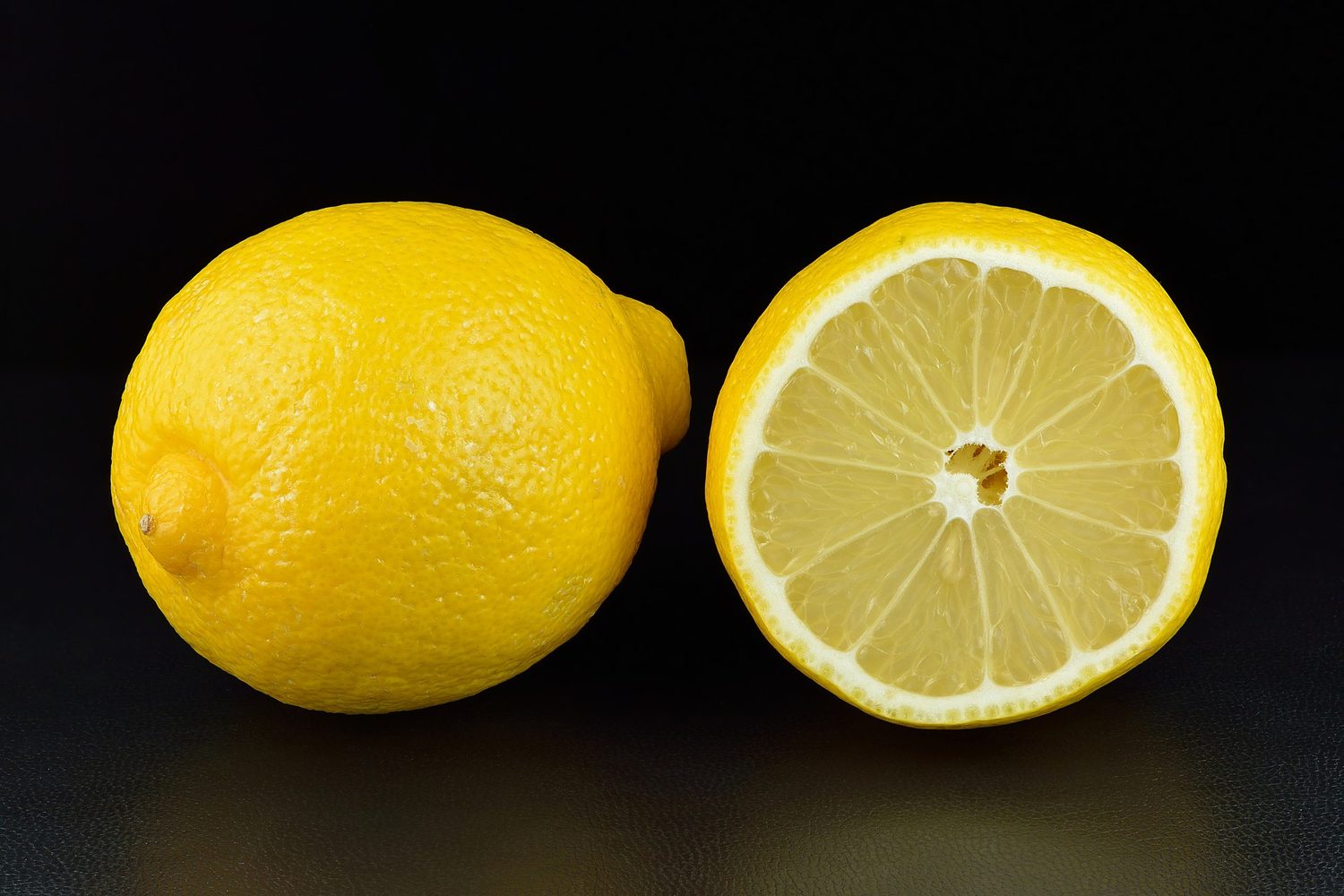
감귤류는 신맛이 나는 이유는 카복실산인 시트르산을 포함하고 있기 때문입니다
제조 및 반응
알킬벤젠(예: 메틸벤젠)은 뜨거운 알칼리성 $\text{KMnO}_4$에 의해 산화된 후 희석 산소로 처리되어 벤조산을 생성합니다. 전체 측쇄가 $\text{–COOH}$ 그룹이 됩니다.
카복실산은 $\text{PCl}_3$ 및 열, $\text{PCl}_5$, 또는 $\text{SOCl}_2$와 반응하여 아실 염화물을 만듭니다.
뜨거운 KMnO4는 메틸 측면사슬을 COOH 그룹으로 산화함
더 산화될 수 있는 산
두 가지 카복실산은 여전히 산화될 수 있어 특별합니다:
메탄산($\text{HCOOH}$)은 페링 시약이나 톨렌스 시액, 또는 산화된 $\text{KMnO}_4$ / $\text{K}_2\text{Cr}_2\text{O}_7$에 의해 산소와 물로 산화됩니다.
에탄산($\text{HOOCCOOH}$)은 따뜻한 산화된 $\text{KMnO}_4$에 의해 이산화탄소로 산화됩니다.
카복실산이 가장 강합니다. 왜냐하면 $\text{H}^+$를 잃었을 때 음전하가 두 산소 원자 위에 퍼지기 때문에 이온이 매우 안정적이기 때문입니다. 페놀에서는 전하가 고리 내부로만 퍼지고, 알코올($\text{RO}^-$ 생성)에서는 전하가 전혀 퍼지지 않습니다.
알코올에서 페놀, 그리고 카복실산으로 갈수록 산도가 증가합니다: 공유염기의 음전하가 더 넓게 퍼질수록 이온이 더 안정적이며, 따라서 산이 더 강합니다
염소 원자는 카복실산을 더 강하게 만듭니다. 염소는 전자 끌어당김 성질을 가지고 있으며, 유도 효과를 통해 전자 밀도를 away로 당겨 음전하를 퍼뜨리고 이온을 안정화하는 데 도움을 줍니다. 따라서 더 많은 염소 원자($\text{–COOH}$에 가까울수록일수록)는 더 강한 산을 만듭니다.
Explore · 탐색하기
Carboxylic acid A2 map · 카복실산 A2 지도
Follow carboxylic acids through acyl derivatives and salts. · 카복실산은 아실 유도체 및 염을 통해 따름.
recall the reaction by which esters can be produced: (a) reaction of alcohols with acyl chlorides using the formation of ethyl ethanoate and phenyl benzoate as examples
한국어
에스터가 생성되는 반응을 기억하시오: (a) 알코올과 아실 염화물의 반응(에틸 아세테이트 및 페닐 벤조에이트 형성을 예시로 사용)
Source: Cambridge International syllabus · 출처: Cambridge International syllabus
English
An alcohol (or phenol) reacts with an acyl chloride at room temperature to give an ester 酯 and $\text{HCl}$. Examples are ethyl ethanoate (from ethanol) and phenyl benzoate (from phenol).
한국어
알코올(또는 페놀)은 실온에서 아실 염화물과 반응하여 에스터와 $\text{HCl}$를 생성합니다. 예로는 에탄올로부터 얻는 에틸 에타노이트와 페놀로부터 얻는フェ닐 벤조에이트가 있습니다.
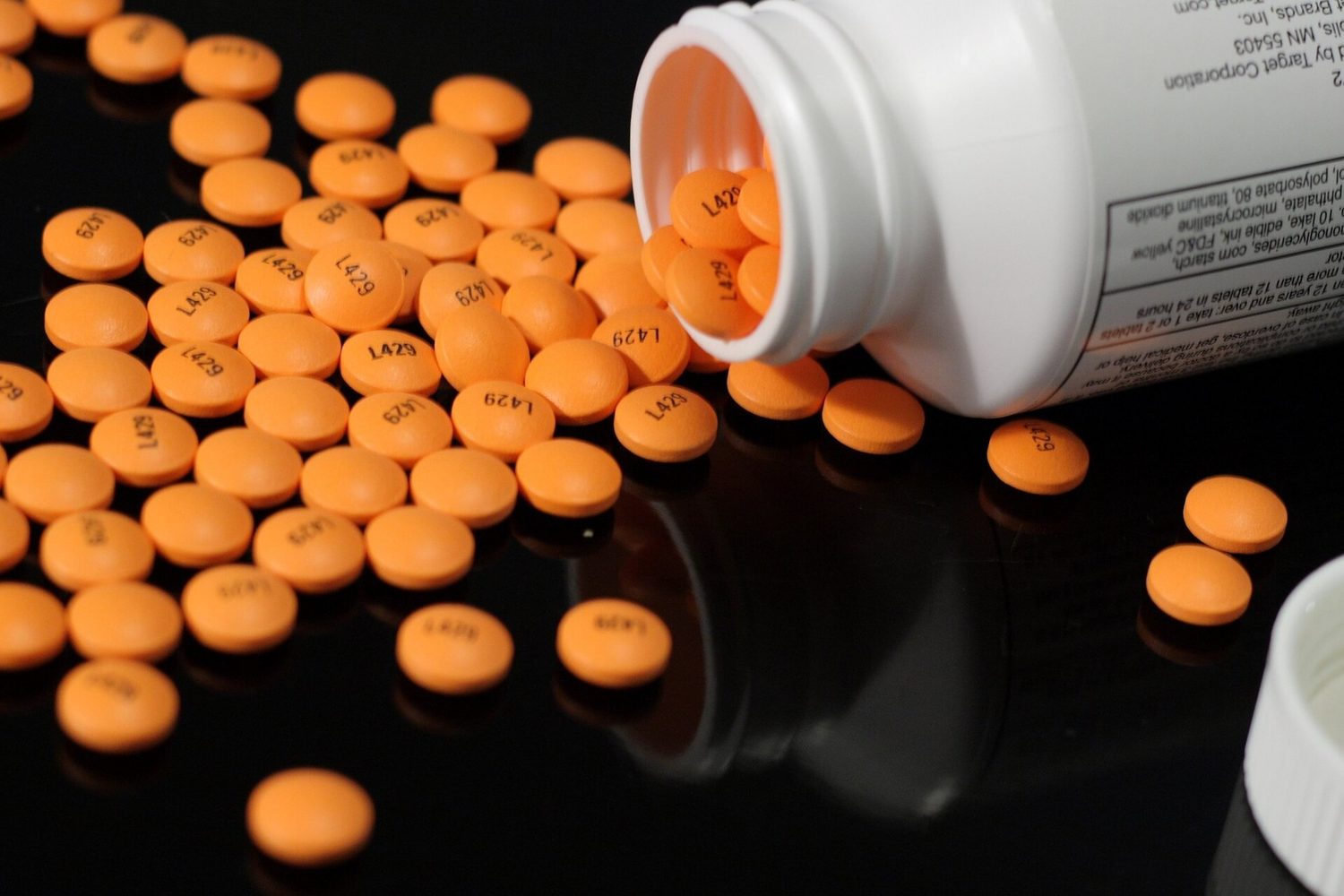
아스피린은 살리실산으로부터 만든 에스터입니다
Explore · 탐색하기
Ester A2 reaction map · 에스터 A2 반응도
Compare ester formation, hydrolysis and transesterification routes. · 에스터 형성, 가수분해 및 트랜스에스터화 경로를 비교하십시오.
33.3
Acyl chlorides · 아실 염화물
Syllabus
English
recall the reactions (reagents and conditions) by which acyl chlorides can be produced: (a) reaction of carboxylic acids with $\text{PCl}_3$ and heat, $\text{PCl}_5$ or $\text{SOCl}_2$
describe the following reactions of acyl chlorides: (a) hydrolysis on addition of water at room temperature to give the carboxylic acid and $\text{HCl}$ (b) reaction with an alcohol at room temperature to produce an ester and $\text{HCl}$ (c) reaction with phenol at room temperature to produce an ester and $\text{HCl}$ (d) reaction with ammonia at room temperature to produce an amide and $\text{HCl}$ (e) reaction with a primary or secondary amine at room temperature to produce an amide and $\text{HCl}$
describe the addition–elimination mechanism of acyl chlorides in reactions in 33.3.2(a)–(e)
explain the relative ease of hydrolysis of acyl chlorides, alkyl chlorides and halogenoarenes (aryl chlorides)
한국어
아실 염화물이 생성되는 반응(시약 및 조건)을 기억하시오: (a) 카복실산과 $\text{PCl}_3$ 및 가열, $\text{PCl}_5$ 또는 $\text{SOCl}_2$의 반응
아실 염화물의 다음 반응을 서술하십시오: (a) 상온에서 물 추가 시 가수분해되어 카복실산과 $\text{HCl}$ 생성 (b) 상온에서 알코올과 반응하여 에스터와 $\text{HCl}$ 생성 (c) 상온에서 페놀과 반응하여 에스터와 $\text{HCl}$ 생성 (d) 상온에서 암모니아와 반응하여 아마이드와 $\text{HCl}$ 생성 (e) 상온에서 일차 또는 이차 아민과 반응하여 아마이드와 $\text{HCl}$ 생성
33.3.2(a)–(e)의 반응에서 아실 염화물의 가입-제거 기전(addition–elimination mechanism) 을 서술하시오
아실 염화물, 알킬 염화물 및 할로겐아릴염화물(아릴 클로라이드)의 가수분해 용이도의 차이를 설명하시오
Source: Cambridge International syllabus · 출처: Cambridge International syllabus
English
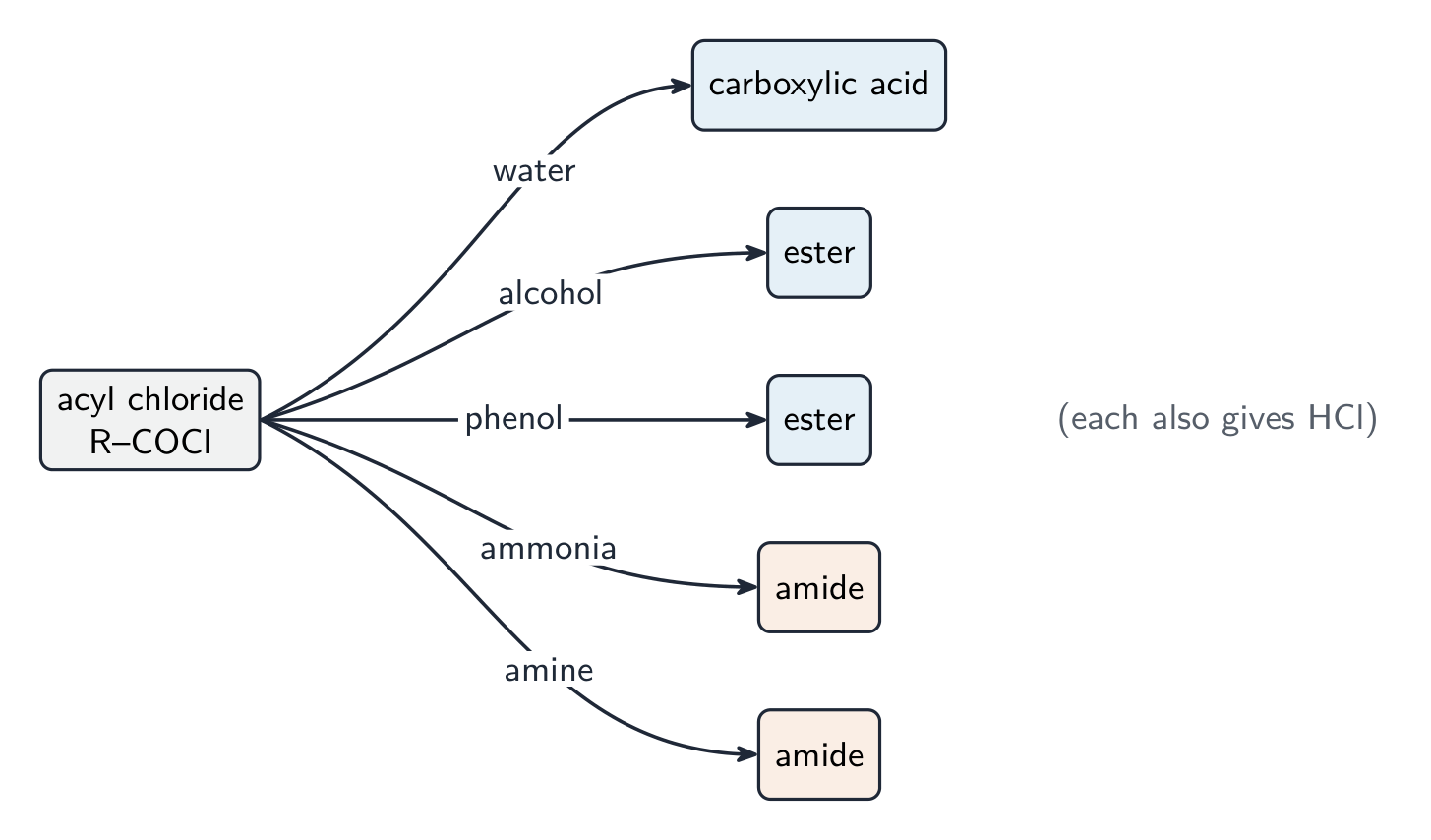
Acyl chlorides are made from carboxylic acids (with $\text{PCl}_3$, $\text{PCl}_5$ or $\text{SOCl}_2$). They are very reactive. At room temperature they react with:
Reactant
Product (plus $\text{HCl}$)
water
the carboxylic acid
an alcohol
an ester
phenol
an ester
ammonia 氨
an amide 酰胺
a primary or secondary amine 胺
an amide
The addition–elimination mechanism
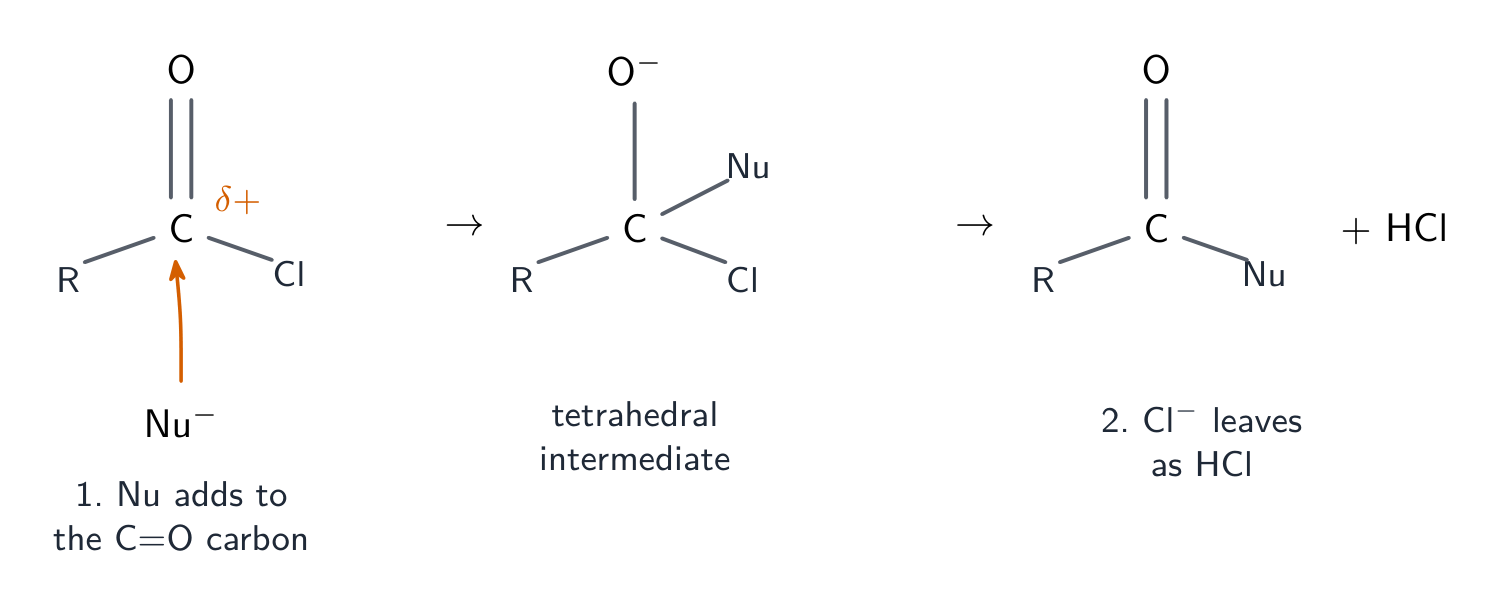
All these reactions follow an addition–elimination 加成消去 mechanism: a nucleophile first adds to the slightly positive carbonyl carbon, then $\text{HCl}$ is eliminated.
Ease of hydrolysis
Compare how easily three chlorides react with water (hydrolysis 水解):
An acyl chloride reacts violently with cold water; an alkyl chloride reacts slowly; an aryl chloride (halogenoarene) does not react, because its C–Cl bond is strengthened by the ring.
Worked example. Ethanoyl chloride reacts violently with cold water, while ethyl ethanoate needs prolonged reflux with acid or alkali. Explain the difference. Both are attacked at the carbonyl carbon, so compare how open that carbon is to attack and how good the leaving group is. In ethanoyl chloride the chlorine is strongly electronegative and withdraws electrons, making the carbonyl carbon much more $\delta+$ and so far more open to a nucleophile; and $\text{Cl}^{-}$, the anion of a strong acid, is a good leaving group. In the ester the $\text{–OR}$ oxygen donates a lone pair into the carbonyl, reducing that $\delta+$ charge, and $\text{RO}^{-}$ is a poor leaving group. So the acyl chloride hydrolyses far more easily. Argue from both the $\delta+$ on the carbon and the leaving group: either one alone is usually only half the marks.
한국어
아실 염화물은 카복실산($\text{PCl}_3$, $\text{PCl}_5$ 또는 $\text{SOCl}_2$ 포함)으로부터制备됩니다. 그들은 매우 반응성이 높습니다. 실온에서 다음과 반응합니다:
시약
생성물 ( plus $\text{HCl}$)
물
카복실산
알코올
에스터
페놀
에스터
암모니아
아마이드
일차 또는 이차 아민
아미드
아실 염화물은 매우 반응성이 높습니다: 물, 알코올, 페놀, 암모니아 또는 아민과 반응하면 표시된 생성물과 HCl을 만듭니다
첨가-제거 기전
이 모든 반응은 첨가-제거 기전을 따릅니다: 핵반응제가 먼저 약간의 양전하를 띤 카보닐 탄소에게 첨가되고, 이후 $\text{HCl}$가 제거됩니다.
아실 염화물은 찬 물과 격렬하게 반응하지만, 알킬 염화물은 천천히 반응하고, 아릴 염화물(할로겐아르엔)은 반응하지 않습니다. 이는 고리에 의해 C–Cl 결합이 강화되기 때문입니다.
작은 문제 풀이. 에탄oyl chloride은 찬 물과 격렬하게 반응하는 반면, 에틸 에타노이트는 산 또는 염기 존재 하에 장시간 환류가 필요합니다. 차이를 설명하십시오. 둘 다 카보닐 탄소에서 공격받으므로, 해당 탄소가 공격에 얼마나 개방되어 있는지와 departing group이 얼마나 좋은지를 비교하십시오. 에탄oyl chloride에서는 염소가 강하게 전기음성도를 가지고 전자를 빼앗아 카보닐 탄소를 훨씬 더 $\delta+$로 만들고 핵반응제의 공격에 훨씬 더 개방되게 하며, 또한 $\text{Cl}^{-}$은 강력한 산의 아니온으로서 좋은 departing group입니다. 에스터에서는 $\text{–OR}$ 산소가 고립전자쌍을 카보닐로 공여하여 그 $\delta+$ 전하를 감소시키고, $\text{RO}^{-}$은 나쁜 departing group입니다. 따라서 아실 염화물은 훨씬 더 쉽게 가수분해됩니다. 탄소에 대한 $\delta+$및 departing group의 관점에서 모두 논증하십시오: 보통 하나만 언급하면 점수의 절반만 받습니다.
Explore · 탐색하기
Acyl chloride reaction map · 아실 클로라이드 반응도
Follow why acyl chlorides are reactive acylating agents. · 아실 클로라이드가 반응성 있는 아실화제인 이유를 따르십시오.