언제나 당신의 몸은 약 50g의 ATP만 보유하고 있다. 하지만 하루 동안 당신은 자신의 몸무게에 해당하는 양을 만들고 쓴다. 같은…
English narration · English + 中文 subtitles burned in · 영어 내레이션 · 영어 + 중국어 자막 burned-in
12.1
Why living things need energy · 생명체가 에너지가 필요한 이유
Syllabus
English
outline the need for energy in living organisms, as illustrated by active transport, movement and anabolic reactions, such as those occurring in DNA replication and protein synthesis
describe the features of ATP that make it suitable as the universal energy currency
state that ATP is synthesised by: • transfer of phosphate in substrate-linked reactions • chemiosmosis in membranes of mitochondria and chloroplasts
explain the relative energy values of carbohydrates, lipids and proteins as respiratory substrates
state that the respiratory quotient (RQ) is the ratio of the number of molecules of carbon dioxide produced to the number of molecules of oxygen taken in, as a result of respiration
calculate RQ values of different respiratory substrates from equations for respiration
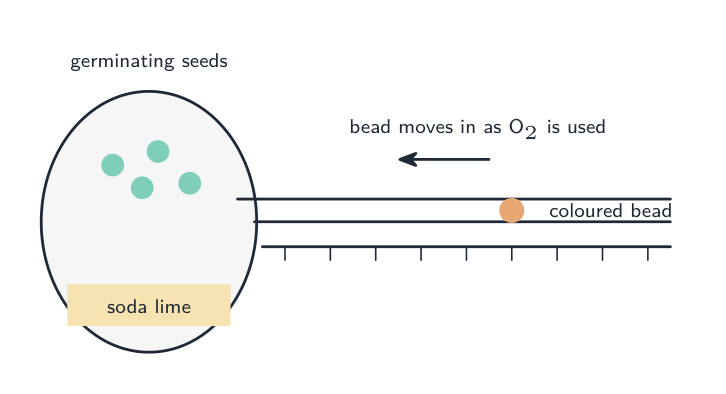
describe and carry out investigations, using simple respirometers, to determine the RQ of germinating seeds or small invertebrates (e.g. blowfly larvae)
한국어
생체에서 에너지가 필요한 이유를 서술하시되, 능동수송, 운동, 대사합성 반응(예: DNA 복제 및 단백질 합성에 일어나는 반응 등)을 예시로 들 것
ATP가 범용 에너지 화폐로서 적합한 특성을 서술하시오
ATP가 다음과 같이 합성됨을 명시하시오: • 기질연결반응에서의 인산기 이동 • 미토콘드리아 및 엽록체의 막에서 일어나는 화학삼투법(chemiosmosis)
호흡 기질로서의 탄수화물, 지질, 단백질의 상대적인 에너지 가치를 설명하시오
**호흡 계수(RQ)**가 호흡 결과 생성된 이산화탄소 분자의 수와 흡수된 산소 분자의 수의 비율임을 명시하시오
호흡 방정식을 사용하여 다양한 호흡 기질의 RQ 값을 계산하시오
간단한 호흡계를 사용하여 발아하는 씨앗이나 작은 무척추동물(예: 파蝇 유충)의 RQ를 결정하는 조사를 서술하고 수행하시오
Source: Cambridge International syllabus · 출처: Cambridge International syllabus
English
Cells need a steady supply of energy 能量, which they get from respiration 呼吸作用. Energy is needed for:
active transport 主动运输 (moving substances against a gradient),
movement (for example muscle contraction),
anabolic 合成代谢 reactions — the building of large molecules, such as in DNA replication and protein synthesis.
한국어
세포는 에너지의 지속적인 공급이 필요하며, 이를 호흡을 통해 얻는다. 에너지는 다음을 위해 필요하다:
능동 수송(농도 기울기에 반대하여 물질 이동),
운동(예: 근육 수축),
동화 반응—DNA 복제 및 단백질 합성과 같이 큰 분자를 구성하는 과정.
운동 중에는 근육이 호흡으로 방출되는 지속적인 에너지 공급이 필요하다
12.1
ATP — the energy currency · ATP — 에너지 화폐
English
ATP is the molecule that carries energy to where it is needed. It is made from ADP and a phosphate group; when it loses that phosphate again, it releases a small, usable burst of energy. ATP suits this job well, so we call it the universal energy currency:
it releases energy quickly, in small amounts that match a cell's needs.
it is easily made and re-made, again and again.
it is small and soluble, so it moves easily around the cell.
ATP is made in two ways: by direct transfer of a phosphate group in phosphorylation 磷酸化 reactions, and by chemiosmosis 化学渗透 across the membranes of mitochondria 线粒体 and chloroplasts.
한국어
ATP는 에너지가 필요한 곳으로運搬하는 분자이다. ADP와 인산 기로 만들어지며, 다시 인산을 잃으면 사용 가능한 작은 에너지 폭발을 방출한다. ATP는 이 역할에 적합하므로 우리가 이를 범용 에너지 화폐라고 부른다:
빠르게 에너지를 방출하며, 세포의 요구에 맞는 소량으로.
쉽게 만들고 다시 만들어지며, 반복적으로.
작고 수용성이 있어 세포 내에서 쉽게 이동한다.
호흡이 인산을 추가하여 ATP를 만듭니다; 세포가 이를 떼어내어 에너지를放出합니다
ATP는 두 가지 방법으로 생성됩니다: 인산화 반응에서의 인산 기 직접 전달 및 미토콘드리아와 엽록체의 막을 통한 화학삼투를 통한 것입니다.
Explore · 탐색하기
The ATP cycle · ATP 순환
Step around the loop. ATP is split to release a small burst of energy, then rebuilt by respiration — over and over. · 순환을 따라 돌아보십시오. ATP가 분해되어 작은 에너지 폭발을 방출하고, 호흡에 의해 다시 합성되며 — 이를 반복합니다.
12.1
Respiratory substrates and RQ · 호흡 기질 및 RQ
English
A respiratory substrate 呼吸底物 is a molecule that is broken down to release energy. Per gram, lipids release the most energy (they have the most hydrogen), proteins are next, and carbohydrates the least.
The respiratory quotient 呼吸商 (RQ) compares the gases exchanged:
$$\text{RQ} = \frac{\text{molecules of carbon dioxide produced}}{\text{molecules of oxygen taken in}}$$
You can work out the RQ from a respiration equation. Carbohydrates give an RQ of about 1.0, lipids about 0.7 and proteins about 0.9.
Worked example. Find the RQ for the aerobic respiration of glucose: $\text{C}_6\text{H}_{12}\text{O}_6 + 6\text{O}_2 \rightarrow 6\text{CO}_2 + 6\text{H}_2\text{O}$.
This is why an RQ near $1.0$ suggests the organism is respiring carbohydrate; a lower RQ (about $0.7$) suggests it is using lipid, which needs more oxygen per molecule of $\text{CO}_2$.
A respirometer 呼吸计 measures the oxygen 氧气 taken in by living things, such as germinating 萌发 seeds or small invertebrates 无脊椎动物, and is used to find their RQ.
한국어
**호흡 기질(respiratory substrate)**은 에너지를 방출하기 위해 분해되는 분자이다. 그램당 **지질(lipids)**이 가장 많은 에너지를 방출하며(수소가 가장 많음), 다음으로 단백질(proteins), 그리고 **탄수화물(carbohydrates)**이 가장 적다.
Aerobic respiration: the four stages · 유산소 호흡: 네 단계
Syllabus
English
State where each of the four stages in aerobic respiration occurs in eukaryotic cells: • glycolysis in the cytoplasm • link reaction in the mitochondrial matrix • Krebs cycle in the mitochondrial matrix • oxidative phosphorylation on the inner membrane of mitochondria
outline glycolysis as phosphorylation of glucose and the subsequent splitting of fructose 1,6-bisphosphate (6C) into two triose phosphate molecules (3C), which are then further oxidised to pyruvate (3C), with the production of ATP and reduced NAD
explain that, when oxygen is available, pyruvate enters mitochondria to take part in the link reaction
describe the link reaction, including the role of coenzyme A in the transfer of acetyl (2C) groups
outline the Krebs cycle, explaining that oxaloacetate (4C) acts as an acceptor of the 2C fragment from acetyl coenzyme A to form citrate (6C), which is converted back to oxaloacetate in a series of small steps
explain that reactions in the Krebs cycle involve decarboxylation and dehydrogenation and the reduction of the coenzymes NAD and FAD
describe the role of NAD and FAD in transferring hydrogen to carriers in the inner mitochondrial membrane
explain that during oxidative phosphorylation: • hydrogen atoms split into protons and energetic electrons • energetic electrons release energy as they pass through the electron transport chain (details of carriers are not expected) • the released energy is used to transfer protons across the inner mitochondrial membrane • protons return to the mitochondrial matrix by facilitated diffusion through ATP synthase, providing energy for ATP synthesis (details of ATP synthase are not expected) • oxygen acts as the final electron acceptor to form water
describe the relationship between the structure and function of mitochondria using diagrams and electron micrographs
outline respiration in anaerobic conditions in mammals (lactate fermentation) and in yeast cells (ethanol fermentation)
explain why the energy yield from respiration in aerobic conditions is much greater than the energy yield from respiration in anaerobic conditions (a detailed account of the total yield of ATP from the aerobic respiration of glucose is not expected)
explain how rice is adapted to grow with its roots submerged in water, limited to the development of aerenchyma in roots, ethanol fermentation in roots and faster growth of stems
describe and carry out investigations using redox indicators, including DCPIP and methylene blue, to determine the effects of temperature and substrate concentration on the rate of respiration of yeast
describe and carry out investigations using simple respirometers to determine the effect of temperature on the rate of respiration
한국어
유산소 호흡의 네 단계가 진핵세포 내에서 각각 어디에서 일어나는지 명시하시오: • 당분해 – 세포질 • 연결반응 – 미토콘드리아 기질 • 크렙스 회로 – 미토콘드리아 기질 • 산화인산화 – 미토콘드리아 내부막
당분해를 포도당의 인산화와 이후 프락토스 1,6-이인산(6C)이 두 개의 .size triose phosphate(3C) 분자로 쪼개지고, 이들이 더 산화되어 피루브산(3C)이 되면서 ATP와 환원 NAD가 생성되는 과정으로 서술하시오
산소가 존재할 때 피루브산이 미토콘드리아로 진입하여 연결반응에 참여함을 설명하시오
연결반응을 서술하되, 코엔자임 A가 아세틸(2C) 그룹의 전달에서 맡는 역할을 포함할 것
크렙스 회로를 서술하되, 옥살아세트산(4C)이 아세틸 코엔자임 A로부터 2C 조각을 받아 시트르산(6C)을 형성하고, 이것이 일련의 작은 단계들을 거쳐 다시 옥살아세트산으로 전환됨을 설명할 것
크렙스 회로의 반응이 탈탄산 및 탈수소를 포함하며, 코엔자임인 NAD와 FAD의 환원을 수반함을 설명하시오
NAD와 FAD가 수소를 미토콘드리아 내부막의 운반체에 전달하는 역할을 서술하시오
산화인산화 과정에서 다음이 일어난다고 설명하시오: • 수소 원자는 양성자와 높은 에너지를 가진 전자로 분해된다 • 높은 에너지를 가진 전자가 전자 운반 체인을 통과하면서 에너지를 방출한다 (운반체의 상세 내용은 요구되지 않음) • 방출된 에너지는 양성자를 미토콘드리아 내막을 가로질러 이동시키는 데 사용된다 • 양성자는 ATP 합성효소를 통한 촉진 확산을 통해 미토콘드리아 기질로 돌아가며, 이는 ATP 합성에 필요한 에너지를 제공한다 (ATP 합성효소의 상세 내용은 요구되지 않음) • 산소는 최종 전자 수용체 역할을 하여 물(수소)을 형성한다
유산소 조건에서의 호흡과 무산소 조건에서의 호흡 중 에너지 생성량이 후자가 전자보다 훨씬 큰 이유를 설명하시오 (포도당의 유산소 호흡으로 인한 ATP 총 생성량의 상세 내용은 요구되지 않음)
벼가 뿌리를 물 속에 잠기게 자라는 데 어떻게 적응했는지 설명하시오. 이适应性는 뿌리에서의 비단 조직 development, 뿌리에서의 에탄올 발효, 그리고 줄기의 빠른 성장에 국한됨
DCPIP 및 메틸렌 블루를 포함한 산화환원 지시제를 사용하여酵母의 호흡 속도에 온도와 기질 농도가 미치는 영향을 결정하는 실험을 서술하고 수행하시오
단순한 호흡계(respirometers)를 사용하여 호흡 속도에 온도가 미치는 영향을 결정하는 실험을 서술하고 수행하시오
Source: Cambridge International syllabus · 출처: Cambridge International syllabus
English
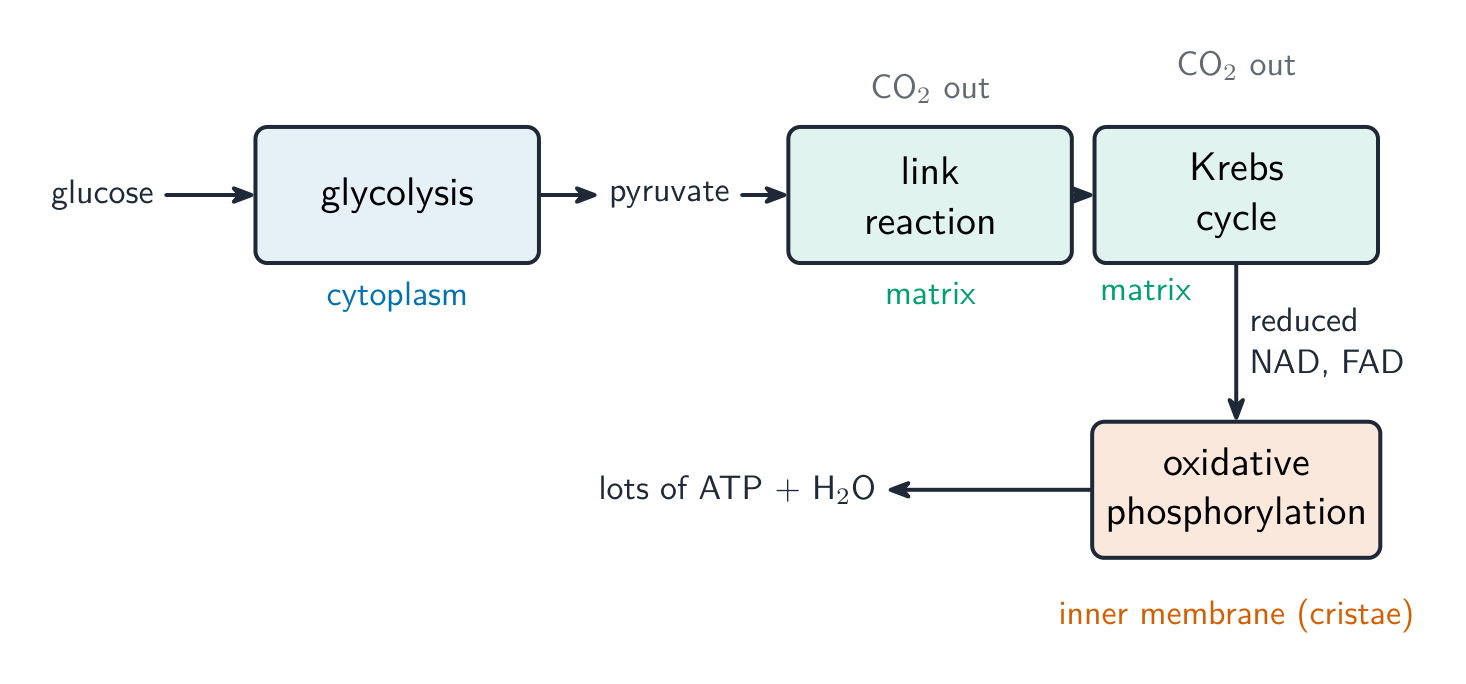
Aerobic 有氧 respiration (with oxygen) has four stages, each in a set place in the cell:
Stage
Where it happens
glycolysis 糖酵解
the cytoplasm 细胞质
link reaction 连接反应
the matrix 基质 of the mitochondria
Krebs cycle 克雷布斯循环
the matrix of the mitochondria
oxidative phosphorylation 氧化磷酸化
the inner membrane of the mitochondria
Glycolysis
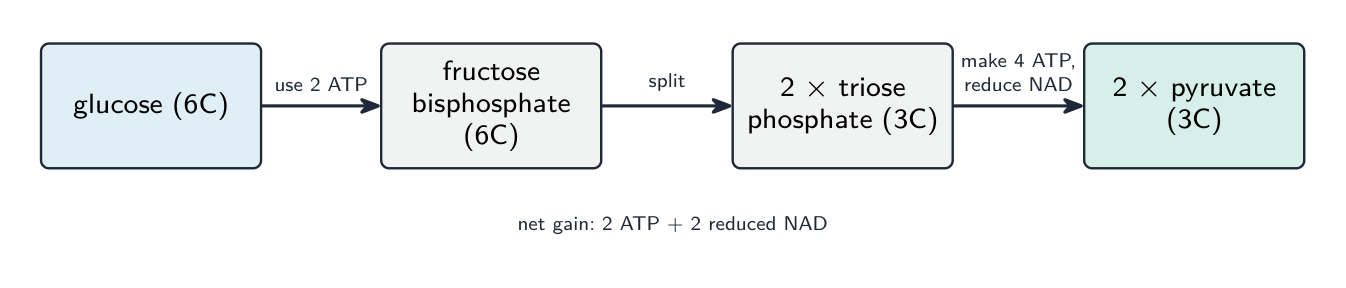
Glucose 葡萄糖 (6 carbons) is first phosphorylated, using 2 ATP, to form fructose bisphosphate (6C). This 6C molecule is split into two triose phosphate molecules (3C each). These are then oxidised 氧化 to pyruvate 丙酮酸 (3C). Glycolysis makes a net gain of 2 ATP and some reduced 还原 NAD (NAD is a coenzyme 辅酶, a helper molecule).
The link reaction
When oxygen is available, pyruvate enters the mitochondria. There each pyruvate loses a carbon dioxide 二氧化碳 and is turned into a 2-carbon acetyl 乙酰基 group. This group is carried by coenzyme A 辅酶A to form acetyl coenzyme A. Some carbon dioxide is released and NAD is reduced.
The Krebs cycle
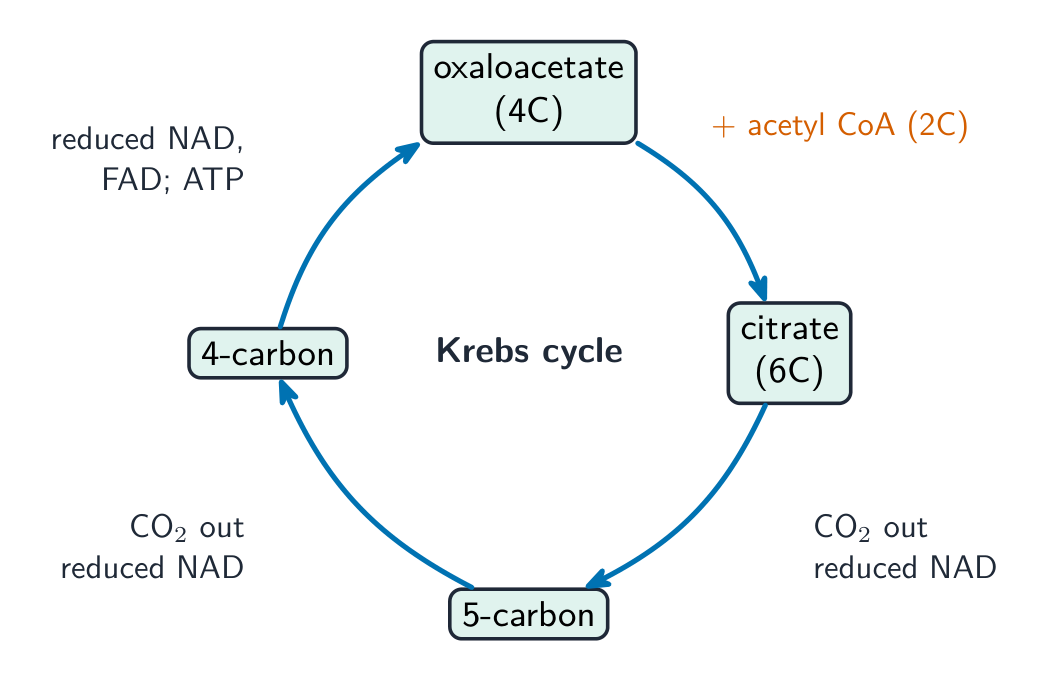
The 2C acetyl group joins a 4-carbon molecule, oxaloacetate 草酰乙酸, to make a 6-carbon molecule, citrate 柠檬酸. Citrate is then changed back to oxaloacetate in a series of small steps, ready to accept the next acetyl group. During these steps:
decarboxylation 脱羧 removes carbon as carbon dioxide.
dehydrogenation 脱氢 removes hydrogen, which reduces the coenzymes NAD and FAD.
The reduced NAD and FAD then carry the hydrogen to the carriers in the inner mitochondrial membrane.
Oxidative phosphorylation
This stage makes most of the ATP:
the hydrogen atoms split into protons 质子 and energetic electrons 电子.
the electrons pass along the electron transport chain 电子传递链, releasing energy as they go.
this energy is used to pump protons across the inner membrane.
the protons flow back into the matrix through a channel called ATP synthase ATP合酶. This flow provides the energy to make ATP (this is chemiosmosis).
oxygen is the final electron acceptor: it joins with electrons and protons to form water.
The structure of mitochondria
The inner membrane is folded into cristae 嵴, giving a large surface for the electron transport chain and ATP synthase. The matrix inside holds the substances and helpers for the link reaction and the Krebs cycle.
한국어
유산소(aerobic) 호흡(산소 존재 시)은 세포 내 특정 위치에서 일어나는 네 가지 단계를 가진다:
단계
발생 위치
글리콜리시스
세포질
연결 반응
미토콘드리아의 매트릭스
크렙스 회로(Krebs cycle)
미토콘드리아基质(matrix)
산화적 인산화(oxidative phosphorylation)
미토콘드리아 내막(inner membrane)
네 단계와 각 단계가 발생하는 위치; 환원 NAD와 FAD는 수소를 내막으로 운반하여 대부분 ATP가 생성됨
해당 과정(Glycolysis)
포도당(탄소 6개)은 먼저 2 ATP를 사용하여 인산화되어 프락토스 디인산(fructose bisphosphate, 6C)을 형성한다. 이 6C 분자는 두 개의 트리오스 인산(triose phosphate, 각 3C) 분자로 쪼개진다. 이들은 이후 산화되어 피루베이트(3C)가 된다. 해당 과정은 순 2 ATP 및 일부 환원된 NAD(보조 효소인 NAD는 보조 분자)를 생성한다.
해당 과정은 시작에 2 ATP를 쓰지만 4개를 만들어 순 2 ATP(plus 환원 NAD)를 얻으며 — 산소가 필요하지 않음
연결 반응(The link reaction)
산소가 이용 가능한 상태에서는 피루베이트가 미토콘드리아로 진입한다.那里서 각 피루베이트는 탄산가스(carbon dioxide) 하나를 잃고 2탄소 아세틸(acetyl) 그룹이 된다. 이 그룹은 **코엔자임 A(coenzyme A)**에 의해 운반되어 아세틸 코엔자임 A를 형성한다. 일부 탄산가스가 방출되고 NAD는 환원된다.
크렙스 회로(The Krebs cycle)
2C 아세틸 그룹이 4탄소 분자인 **옥살아세트산(oxaloacetate)**과 결합하여 6탄소 분자인 **시트레이트(citrate)**를 만든다. 시트레이트는 일련의 작은 단계들을 거쳐 다시 옥살아세트산으로 변하여 다음 아세틸 그룹을 받을 준비가 된다. 이 단계들 동안:
**탈탄산(decarboxylation)**은 탄소를 탄산가스 형태로 제거한다.
**탈수소(dehydrogenation)**은 수소를 제거하여 보조 효소인 NAD와 FAD를 환원시킨다.
환원된 NAD와 FAD는 이후 수소를 미토콘드리아 내막의 운반체로 운반한다.
각 회전은 탄산가스(탈탄산)와 환원된 NAD 및 FAD(탈수소)를 방출함
산화적 인산화(Oxidative phosphorylation)
이 단계는 대부분의 ATP를 생성한다:
수소 원자가 **양성자(protons)**와 에너지가 높은 **전자(electrons)**로 나뉜다.
전자들은 **전자 전달 사슬(electron transport chain)**을 따라 이동하며 에너지를 방출한다.
이 에너지는 양성자를 내막 너머로 펌핑하는 데 사용된다.
양성자들은 **ATP 합성효소(ATP synthase)**라는 채널을 통해基质로 다시 흐른다. 이 흐름은 ATP를 만드는 데 필요한 에너지를 제공한다(이것은 화학삼투 chemiosmosis이다).
**산소(oxygen)**는 최종 전자 수용체이다: 전자와 양성자와 결합하여 물을 형성한다.
전자들이 양성자(H⁺)를 간막 공간으로 펌핑합니다;它们是流经ATP合酶产生ATP(化学渗透)
미토콘드리아의 구조
내막은 **크리스타e(cristae)**로 접혀 있어 전자 전달 사슬과 ATP 합성효소에 대한 큰 표면을 제공한다. 내부基质는 연결 반응과 크렙스 회로에 필요한 물질과 보조 분자를 포함한다.
실제 미토콘드리아 두 개를 전자 현미경으로 촬영한 것. 내부를 가로지르는 어두운 줄무늬는 크리스타e입니다 — 모든 접힘이 전자 전달 사슬을 위한 거대한 표면을 만드는 이유입니다
Explore · 탐색하기
Glycolysis · 해당과정
Step through it. Glucose is split in the cytoplasm into two pyruvate, for a small net gain of ATP and reduced NAD. · 단계별로 살펴보자. 포도당은 세포질에서 2개의 피루브산으로 분해되어 ATP와 환원형 NAD의 소량 순증가를 얻는다.
Explore · 탐색하기
The four stages of respiration · 호흡의 네 단계
Step through where ATP comes from. Glucose is broken down in stages; most ATP is made at the last stage. · ATP가 어디에서 나오는지를 단계별로 확인하세요. 포도당은 단계별로 분해되며, 대부분의 ATP는 마지막 단계에서 생성됩니다.
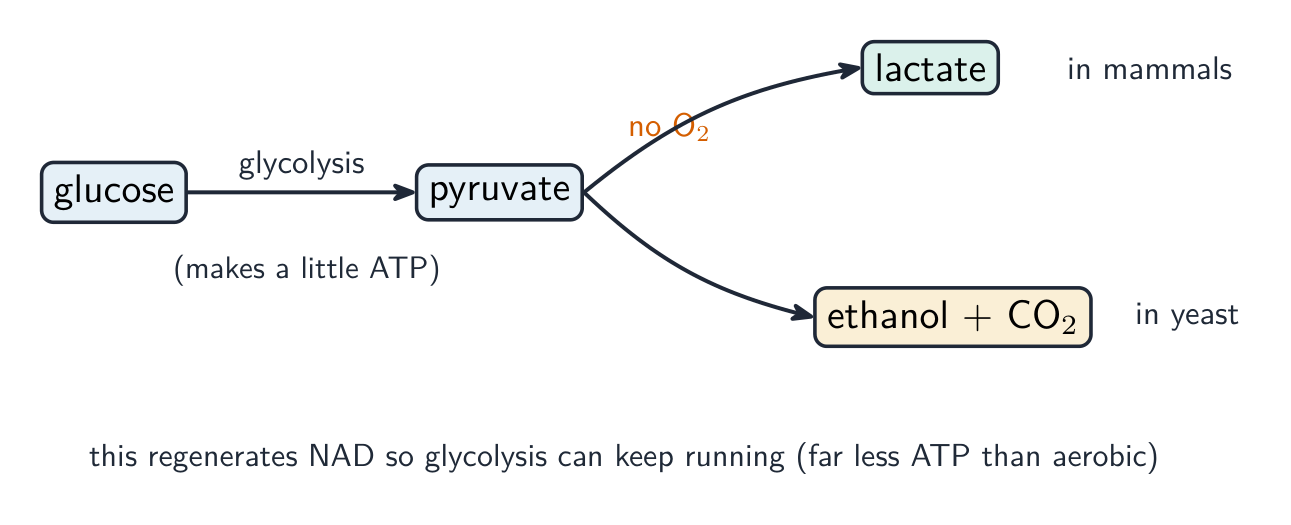
When there is no oxygen, only glycolysis can run. To keep glycolysis going, the cell must use up the reduced NAD. This happens by fermentation 发酵:
in mammals, pyruvate is turned into lactate 乳酸 (lactate fermentation). The lactate is later broken down when oxygen returns.
in yeast 酵母, pyruvate is turned into ethanol 乙醇 and carbon dioxide (ethanol fermentation).
Anaerobic 无氧 respiration gives far less energy than aerobic respiration. Aerobic respiration also runs the Krebs cycle and oxidative phosphorylation, which release a lot more ATP, while anaerobic respiration gains only the small amount from glycolysis.
한국어
산소가 없을 때는 해당 과정(glycolysis)만 작동할 수 있다. 해당 과정을 지속시키기 위해 세포는 환원된 NAD를 소모해야 한다. 이는 **발효(fermentation)**를 통해 이루어진다:
포유류에서는 피루베이트가 **락테이트(lactate)**로 변한다(락테이트 발효). 산소가 돌아올 때 락테이트는 나중에 분해된다.
산소가 없는 조건에서 피루브산은 젖산(포유류) 또는 에탄올(효모)로 변하며, 이는 해당과정을 위해 NAD를 재생시킨다
무산소 호흡은 유산소 호흡에 비해 훨씬 적은 에너지를 산출한다. 유산소 호흡은 크rebs 회로와 산화인산화도 수행하여 훨씬 많은 ATP를 방출하지만, 무산소 호흡은 해당과정에서 얻는 소량만 생산한다.
Explore · 탐색하기
Why fermentation matters · 발효의 중요성
Step through it. Without oxygen, fermentation regenerates NAD so glycolysis can keep making a little ATP. · 단계별로 살펴보자. 산소가 없으면 발효는 NAD를 재생하여 해당과정이 소량의 ATP를 계속 만들 수 있게 함.
Rice can grow with its roots under water, where there is little oxygen. It is adapted in three ways: it develops aerenchyma 通气组织 (air-filled spaces) in the roots to carry air down; the roots use ethanol fermentation to keep making some ATP; and the stems grow faster to reach the air above the water.
한국어
벼는 산소가 거의 없는 수중에서도 뿌리를 통해 자랄 수 있다. 세 가지 방식으로 적응되어 있다: 뿌리에 **기질(air-filled spaces)**을 발달시켜 공기를 아래로 운반하고; 뿌리는 에탄올 발효를 사용하여 일부 ATP를 계속 생성하며; 줄기는 물 위의 공기까지 도달하기 위해 더 빠르게 자란다.
수중에서 자라는 식물의 뿌리 단면. 큰 흰색 간극은 기질—산소가 부족한 진흙 속에 있는 뿌리까지 산소가 확산될 수 있게 연결된 공기 통로임
Investigating the rate of respiration · 호흡 속도 조사
English
A redox indicator 指示剂 such as DCPIP or methylene blue loses its colour when it gains hydrogen from respiring cells. The faster the colour is lost, the faster the yeast is respiring, so you can test the effect of temperature or substrate concentration. A respirometer can also be used to measure how temperature changes the rate of oxygen uptake.
한국어
DCPIP나 메틸렌 블루와 같은 산화환원 지시약은 호흡하는 세포로부터 수소(전자)를 받아 색이 사라진다. 색이 더 빨리 사라질수록 효모의 호흡 속도가 빠르므로, 온도나 기질 농도의 영향을 테스트할 수 있다. respirometer(호흡계)를 사용하여 온도가 산소 흡수 속도에 미치는 영향을 측정할 수도 있다.
12.2
Exam tips · 시험 팁
English
State where each stage happens and its ATP yield: glycolysis (cytoplasm), link reaction + Krebs (matrix), oxidative phosphorylation (inner membrane, most ATP).
Explain the roles of NAD/FAD (carry hydrogen to the electron transport chain) and of oxygen (the final electron acceptor).
RQ$=$ CO2 produced $\div$ O2 used ($\approx 1.0$ carbohydrate, $0.7$ lipid); know how a respirometer measures it.
Anaerobic respiration gives lactate (animals) or ethanol + CO2 (yeast/plants) and far less ATP (glycolysis only).
한국어
각 단계가 일어나는 위치와 ATP 산출량을 명시: 해당과정(세포질), 링크 반응 + Krebs(미토콘드리아 기질), 산화인산화(내막, 가장 많은 ATP).
NAD/FAD(수소를 전자전달계로 운반)와 산소(최종 전자 수용체)의 역할을 설명한다.
RQ$=$ CO2 생성량 $\div$ O2 소모량 ($\approx 1.0$ 탄수화물, $0.7$ 지질); 호흡계로 이를 측정하는 방법을 알고 있어야 합니다.
무산소 호흡은 젖산(동물) 또는 에탄올 + CO2(효모/식물)과 ATP를 거의 생산하지 않습니다(당분 해해 과정만 포함).
Interactive lessons on this topic · 이 주제에 대한 인터랙티브 수업
Work through it step by step, with instant-check exercises. · 즉시 체크 기능 exercises를 통해 단계별로 진행하세요.