Respiratory substrates and RQ
Introduced| English | Meaning |
|---|---|
| respiratory substrate/rɪˈspɪrətəri ˈsʌbstreɪt/ | A molecule broken down to release energy. |
| aerobic respiration/eəˈrəʊbɪk ˌrespɪˈreɪʃn/ | The release of usable energy from nutrients through pathways in which oxygen serves as the final electron acceptor. |
| respiratory quotient/rɪˈspɪrətəri ˈkwəʊʃənt/ | The ratio of carbon dioxide produced to oxygen consumed during respiration, measured in comparable amounts over the same period. |
| respirometer/rɪspɪˈrɒmɪtə/ | An apparatus for measuring respiration rate through changes in gas volume or pressure. |
Burning more than just sugar
- A respiratory substrate 呼吸底物 is a molecule broken down to release energy.
- Different substrates release different amounts of energy.
- The gases they use tell us which one is being respired.
Respiratory quotient lab
RQ = CO2 produced / O2 used
Change oxygen use and see how RQ compares fuels.
The respiratory quotient (RQ) is the ratio of CO₂ produced to:
Difficulty 1/5 · 100 coins + a small bonus on first completion today
RQ = CO₂ produced ÷ O₂ used.
Which respiratory substrate releases the most energy per gram?
Difficulty 1/5 · 100 coins + a small bonus on first completion today
Lipids release the most energy per gram (most hydrogen); then proteins, then carbohydrates.
Energy per gram
- Per gram, lipids release the most energy (they have the most hydrogen).
- Proteins are next.
- Carbohydrates release the least.
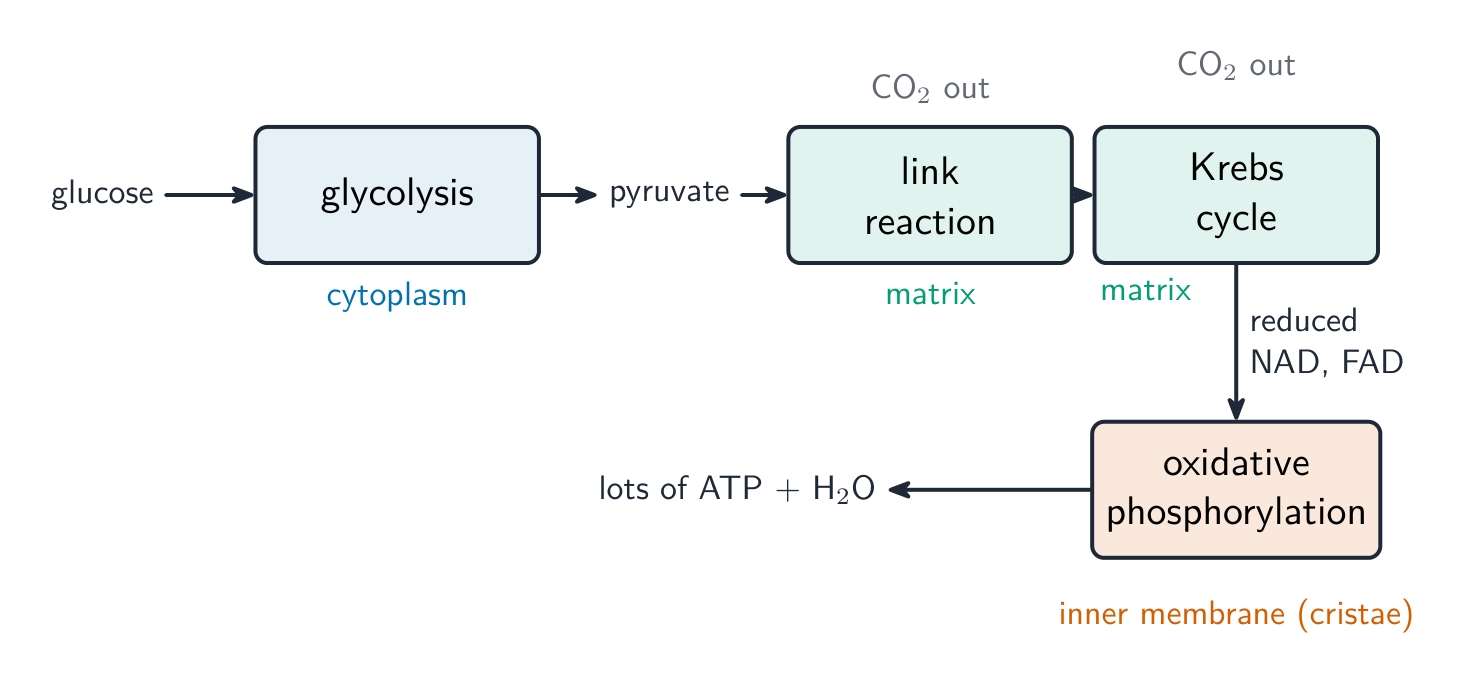
The four stages of aerobic respiration 有氧呼吸 and where they happen
The respiratory quotient 呼吸商 (RQ)
- Typical values: carbohydrate ≈ 1.0, lipid ≈ 0.7, protein ≈ 0.9.
- You can work out RQ from a respiration equation.
An organism produces 4 molecules of CO₂ and takes in 5 molecules of O₂. What is its RQ?
Difficulty 2/5 · 140 coins + a small bonus on first completion today
RQ = CO₂ produced ÷ O₂ taken in = 4 ÷ 5 = 0.8.
An organism makes 7 molecules of CO₂ and uses 10 molecules of O₂. What is its RQ?
Difficulty 2/5 · 140 coins + a small bonus on first completion today
RQ = 7 ÷ 10 = 0.7 — a value near 0.7 suggests it is respiring lipid.
Match each substrate to its typical RQ.
Difficulty 2/5 · 140 coins + a small bonus on first completion today
Carbohydrate gives RQ ≈ 1.0, protein ≈ 0.9, lipid ≈ 0.7 — and lipid also releases the most energy per gram.
RQ = carbon dioxide produced ÷ oxygen ______.
Difficulty 1/5 · 100 coins + a small bonus on first completion today
You measure CO₂ given out and O₂ taken in (e.g. with a respirometer) and divide.
The respirometer 呼吸计
- A respirometer measures the oxygen taken in by living things — e.g. germinating seeds or small invertebrates.
- From the gases exchanged, you can find their RQ, or test how temperature changes the rate of oxygen uptake.
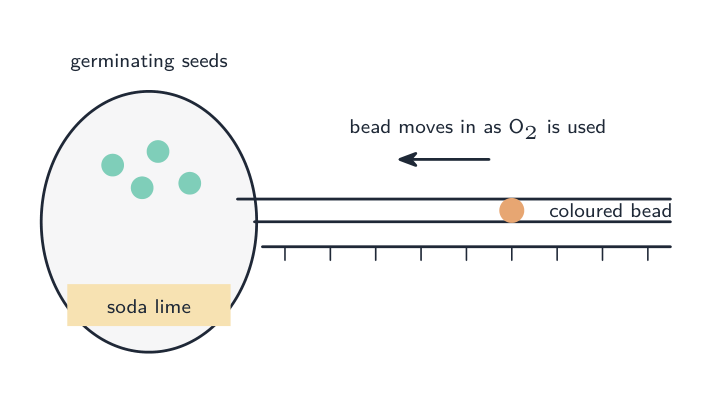
A respirometer measures the oxygen taken in by small organisms; the coloured liquid moves as oxygen is used
A respirometer is used to measure:
Difficulty 1/5 · 100 coins + a small bonus on first completion today
A respirometer measures oxygen uptake (e.g. of germinating seeds or invertebrates), used to find RQ.
Worked examples
1. Glucose: $\text{C}_6\text{H}_{12}\text{O}_6 + 6\text{O}_2 \rightarrow 6\text{CO}_2 + 6\text{H}_2\text{O}$, so $\text{RQ} = 6/6 = 1.0$.
2. A lipid, tripalmitin: $\text{C}_{51}\text{H}_{98}\text{O}_6 + 72.5\,\text{O}_2 \rightarrow 51\,\text{CO}_2 + 49\,\text{H}_2\text{O}$, so $\text{RQ} = 51/72.5 = 0.70$. Lipids hold little oxygen, so they need more $\text{O}_2$ per $\text{CO}_2$ released.
What is the respiratory quotient?
RQ is carbon dioxide produced divided by oxygen used.
What is the RQ for this carbohydrate?
Difficulty 1/5 · 100 coins + a small bonus on first completion today
Equal gas volumes give an RQ of 1.
You've got it
- respiratory substrate = molecule broken down for energy; per gram lipid > protein > carbohydrate
- $\text{RQ} = \dfrac{\text{CO}_2 \text{ produced}}{\text{O}_2 \text{ used}}$
- RQ values: carbohydrate ≈ 1.0, lipid ≈ 0.7, protein ≈ 0.9
- a respirometer measures oxygen uptake (germinating seeds / invertebrates) to find RQ
Write from an RQ of 1
- A seed is respiring carbohydrate.
- It produces 6 molecules of carbon dioxide and uses 6 molecules of oxygen. The lesson quotients 0.8 and 0.7 are other substrates.