Glycolysis and the link reaction
Introduced| English | Meaning |
|---|---|
| glycolysis/ɡlaɪˈkɒləsɪs/ | The cytoplasm. |
| link reaction/lɪŋk rɪˈækʃn/ | The matrix of the mitochondria. |
| Krebs cycle/krebz ˈsaɪkl/ | The matrix of the mitochondria. |
| oxidative phosphorylation/ˈɒksɪdətɪv ˌfɒsfɔːrɪˈleɪʃn/ | The inner membrane of the mitochondria. |
| pyruvate/ˈpaɪruːveɪt/ | A three-carbon product of glycolysis that can enter further respiratory reactions or fermentation pathways. |
| coenzyme/ˌkəʊˈenzaɪm/ | A small organic molecule that assists an enzyme, often by carrying electrons or chemical groups between reactions. |
| acetyl coenzyme A/ˈæsɪtaɪl ˌkəʊˈenzaɪm eɪ/ | acetyl coenzyme A |
Aerobic respiration: the first stages
- Aerobic respiration (with oxygen) runs in four stages.
- Each happens in a set place in the cell.
- We start with glycolysis 糖酵解 and the link reaction 连接反应.
Glycolysis takes place in the mitochondria and needs oxygen.
Difficulty 1/5 · 100 coins + a small bonus on first completion today
False. Glycolysis happens in the cytoplasm and is anaerobic. The later stages (link reaction, Krebs cycle, oxidative phosphorylation) are in the mitochondria.
Where each stage happens
| Stage | Location |
|---|---|
| glycolysis | the cytoplasm |
| link reaction | the matrix of the mitochondria |
| Krebs cycle 克雷布斯循环 | the matrix of the mitochondria |
| oxidative phosphorylation 氧化磷酸化 | the inner membrane of the mitochondria |
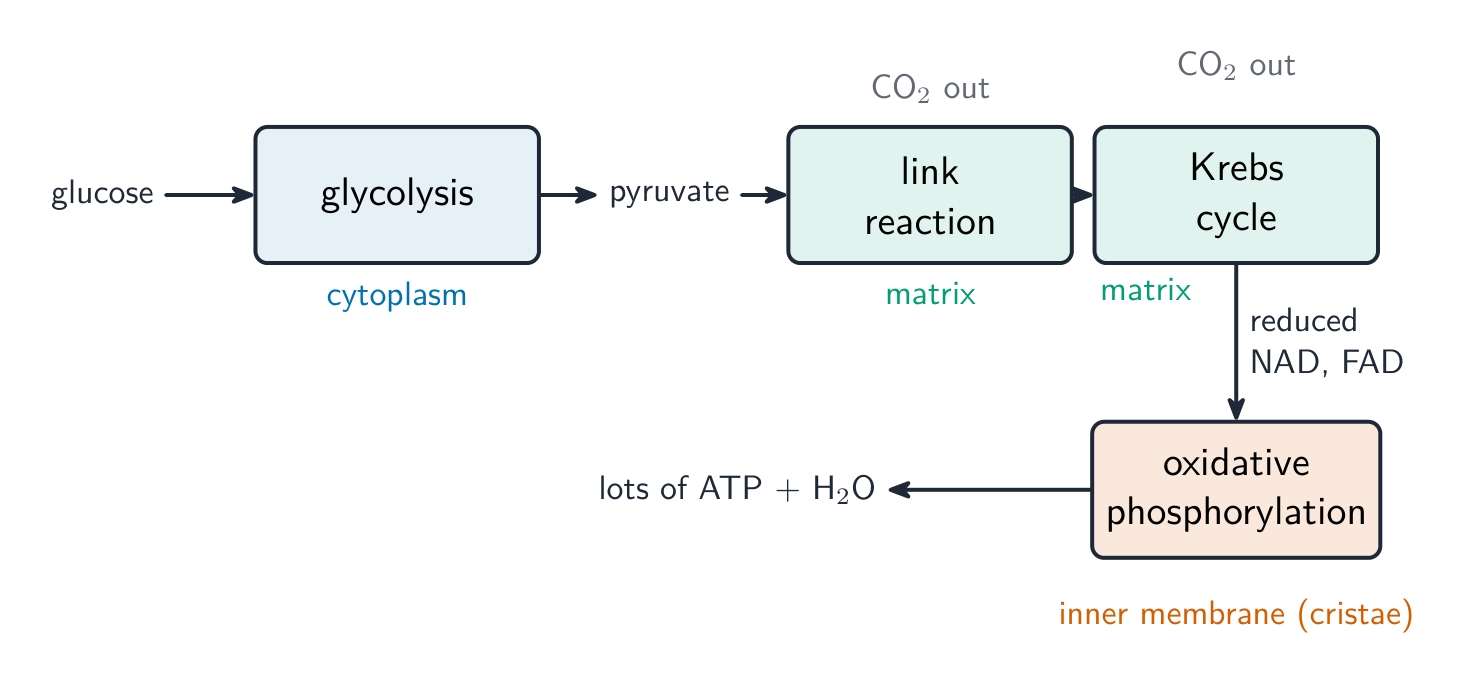
The four stages of aerobic respiration and where each one happens
Match each stage of aerobic respiration to where it happens.
Difficulty 2/5 · 140 coins + a small bonus on first completion today
Glycolysis = cytoplasm; link reaction & Krebs = matrix; oxidative phosphorylation = inner membrane.
Glycolysis
- In the cytoplasm, glucose (6C) is phosphorylated using 2 ATP, then split into two triose phosphate (3C) molecules.
- These are oxidised to two pyruvate 丙酮酸 (3C).
- Net result: a gain of 2 ATP and some reduced NAD (NAD is a coenzyme 辅酶, a helper molecule).

Glycolysis splits one glucose into two pyruvate, for a net gain of 2 ATP and reduced NAD
Glycolysis
Step through it. Glucose is split in the cytoplasm into two pyruvate, for a small net gain of ATP and reduced NAD.
The net yield of glycolysis is:
Difficulty 1/5 · 100 coins + a small bonus on first completion today
Glycolysis uses 2 ATP and makes 4, a net gain of 2 ATP, plus reduced NAD.
Glycolysis ends by splitting glucose into:
Difficulty 1/5 · 100 coins + a small bonus on first completion today
Glucose (6C) → 2 triose phosphate (3C) → 2 pyruvate (3C).
Glycolysis gives a net gain of ______ ATP per glucose molecule.
Difficulty 1/5 · 100 coins + a small bonus on first completion today
2 ATP are used and 4 are made — a net gain of 2 ATP (plus 2 reduced NAD).
Put the steps of glycolysis in order.
Difficulty 3/5 · 200 coins + a small bonus on first completion today
Phosphorylate → split → oxidise to pyruvate, for a net 2 ATP and 2 reduced NAD.
The link reaction
- When oxygen is available, pyruvate enters the mitochondrial matrix.
- Each pyruvate loses a CO₂ and becomes a 2-carbon acetyl group.
- Carried by coenzyme A, it forms acetyl coenzyme A 乙酰辅酶A; NAD is reduced.
In the link reaction, each pyruvate:
Difficulty 1/5 · 100 coins + a small bonus on first completion today
Pyruvate is decarboxylated (loses CO₂) to a 2C acetyl group, carried by coenzyme A as acetyl CoA.
You've got it
- aerobic respiration = 4 stages: glycolysis (cytoplasm), link + Krebs (matrix), oxidative phosphorylation (inner membrane)
- glycolysis: glucose → 2 pyruvate; net 2 ATP + reduced NAD
- link reaction: pyruvate → acetyl CoA (loses CO₂, reduces NAD)
Write from glycolysis in the cytoplasm
- Glucose is broken into pyruvate.
- A small net yield of ATP is made and NAD is reduced.
Where does this first stage happen?
Glycolysis does not need the mitochondria.
Where does glycolysis happen?
Difficulty 1/5 · 100 coins + a small bonus on first completion today
The enzymes of glycolysis are in the cytoplasm.