What this course is, and how to use it
This is the eleventh course in University Business: business law and ethics 商法与商业伦理 — the rules the game is actually played under, and the ones it should be played under. Every rule in this course is labelled with its jurisdiction: the working law is England and Wales, with named comparisons where the contrast teaches. No rule is presented as universal, because none is.
The running case is the Nimbus Kitchen legal file: one allegation of a bad bun, one flour contract that arrived twenty days late, one crew member whose status nobody wrote down, one name the founder wants to protect, one sponsor's claim the founder should not make, and one public collapse studied at arm's length. Every number in the file is checked against the statutes and public record.
- Units 11.1–11.2 build the frame: which court, which standard of proof, and what a contract is before it breaks.
- Units 11.3–11.5 run the business through the law: forms and liability, employment, intellectual property and data.
- Units 11.6–11.7 turn from law to ethics: how to reason to a decision you can defend, and what governance failures look like from the outside.
How to read each unit: the situation first, then the rules, then two escalating worked analyses, the mistakes people actually make, and a three-line summary. This is a study course, not legal advice.
Legal systems and jurisdiction
Why it matters. A customer alleges the festival buns made her ill. Before anyone argues about facts, three questions decide everything: is this civil or criminal, which court hears it, and who must prove what to what standard. Getting these wrong loses the case before it starts.
The idea, with a picture. Civil liability 民事责任 is the claimant's claim to be made whole (the customer's injury claim); criminal liability 刑事责任 is the state's claim that a rule of public law was broken (a food-safety prosecution by the authority). Same facts, different parties, different standards of proof 证明标准: the civil balance of probabilities (more likely than not, just past 50%); the criminal beyond reasonable doubt (no numeric standard, deliberately).
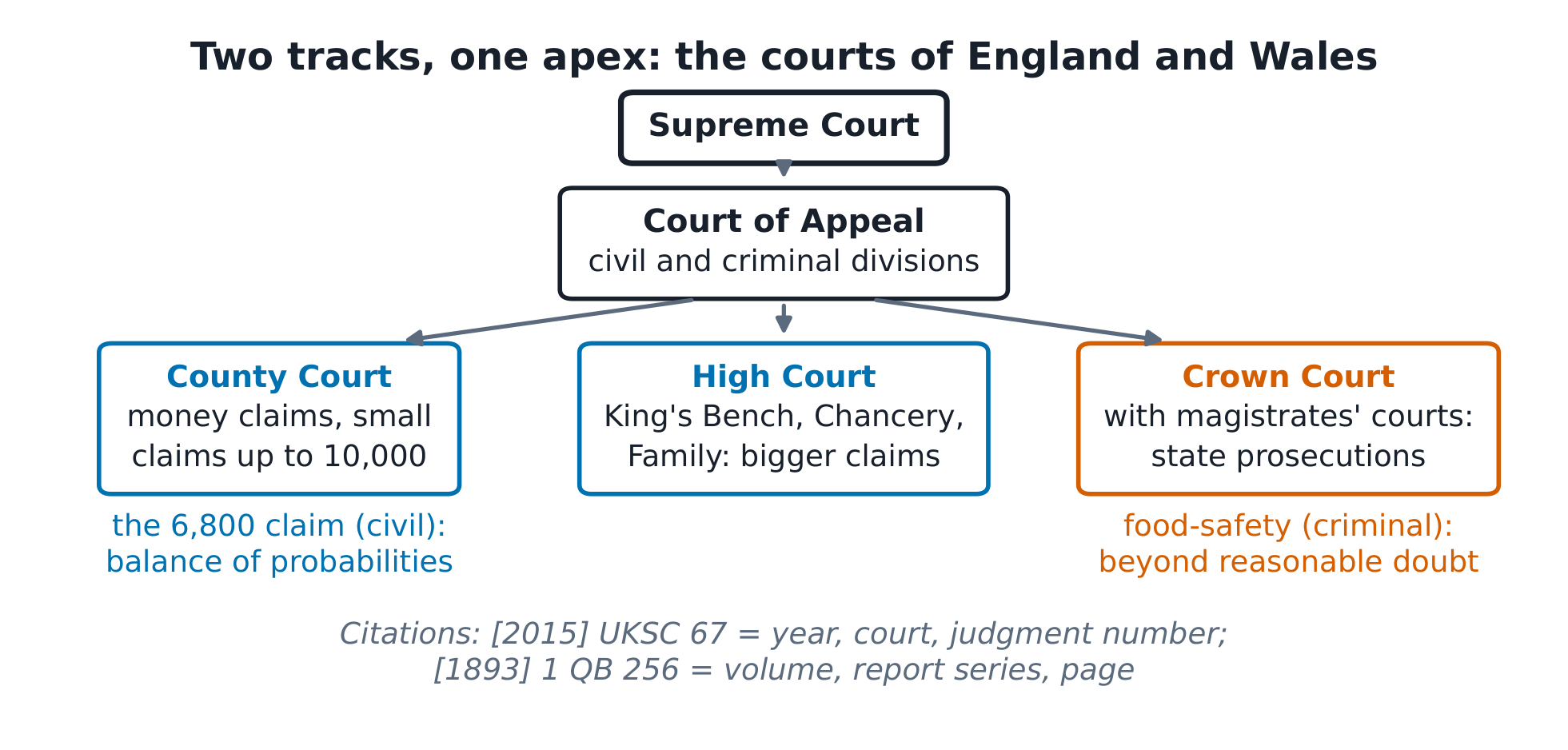
The definitions. Jurisdiction 管辖权: the power of a court to
hear a matter. Precedent 判例: like cases decided alike — the
Supreme Court binds every court below (and itself since 1966 only
exceptionally); the Court of Appeal binds itself subject to narrow
exceptions. A case citation [2015] UKSC 67 reads: year 2015,
court UKSC (Supreme Court), 67th judgment of that year; older cases
cite a law report: [1893] 1 QB 256 is volume 1 of the Queen's Bench
reports for 1893, page 256.
The derivation. The customer's claim: a private wrong (negligence or breach of statutory duty), so civil, so she sues in the County Court; alleged loss £6,800 (two days off work £340, medical £160, injury £6,300 — her schedule, uncontested arithmetic for this exercise). At £6,800 the claim falls under the £10,000 small-claims threshold: small claims track, no cost recovery to speak of, her own time. The regulator's parallel power: if inspection finds the fridge out of temperature range, that is a criminal matter under food-safety law, prosecuted by the authority, proved beyond reasonable doubt, and her civil claim does not depend on its outcome — different parties, different standards, different questions.
Worked example 1 — read the citation before the case. The founder is sent "Carlill v Carbolic Smoke Ball Co [1893] 1 QB 256" by a well-meaning friend. Reading it: 1893, volume 1 of the Queen's Bench law reports, page 256. "QB" names the report series, not the court: that series prints both High Court and Court of Appeal decisions, and Carlill was decided by the Court of Appeal, so its reasoning on unilateral offers binds the High Court, the county courts and the Court of Appeal itself. The lesson: the citation tells you the era and where to find the case, and the report's heading tells you the court and so the weight — and a case from 1893 still binding on offer law is the system working, not failing. Look up, never guess: the wrong level of court wastes a day.
Worked example 2 — escalate to the parallel proceedings. Six weeks in, the authority prosecutes (temperature log falsified by a supervisor — criminal, strict-liability flavour, unlimited fine headroom), the customer's civil claim continues, and the festival sponsor threatens to sue for its fee under the contract. Three proceedings, one set of facts, three different proofs. The operational rule the founder writes on the office wall: never let one proceeding's defence contradict another's admissions — the civil statement "our fridge failed" is prosecution evidence. Answers to any proceeding get written once, with all three in view.
Common mistakes. Treating "not guilty" as "not liable" (the standards differ on purpose). Suing in the wrong court because it felt right. And reading a Scottish, US or EU ruling as if it were English law — every rule in this course is jurisdiction-labelled, and so is every one you will ever rely on.
Summary. Civil makes the claimant whole on the balance of probabilities; criminal punishes beyond reasonable doubt. Money claims of £10,000 or less usually take the small claims track. Read the citation, check the court, label the jurisdiction.
Contract formation and breach
Why it matters. Nimbus buys 2,000 kg of flour a fortnight at £2.00 a kilogram. When the mill delivers twenty days late, whether Nimbus recovers £2,900 or nothing depends on four words taught in every first-year law course: offer, acceptance, consideration, intention.
The idea, with a picture. The flour deal: the mill's order confirmation (offer), Nimbus's signed order (acceptance), £4,000 for 2,000 kg (consideration — the price of the promise), two businesses (intention presumed commercially). Formed. Then broken: delivered 20 days late against a contract that named the festival date.
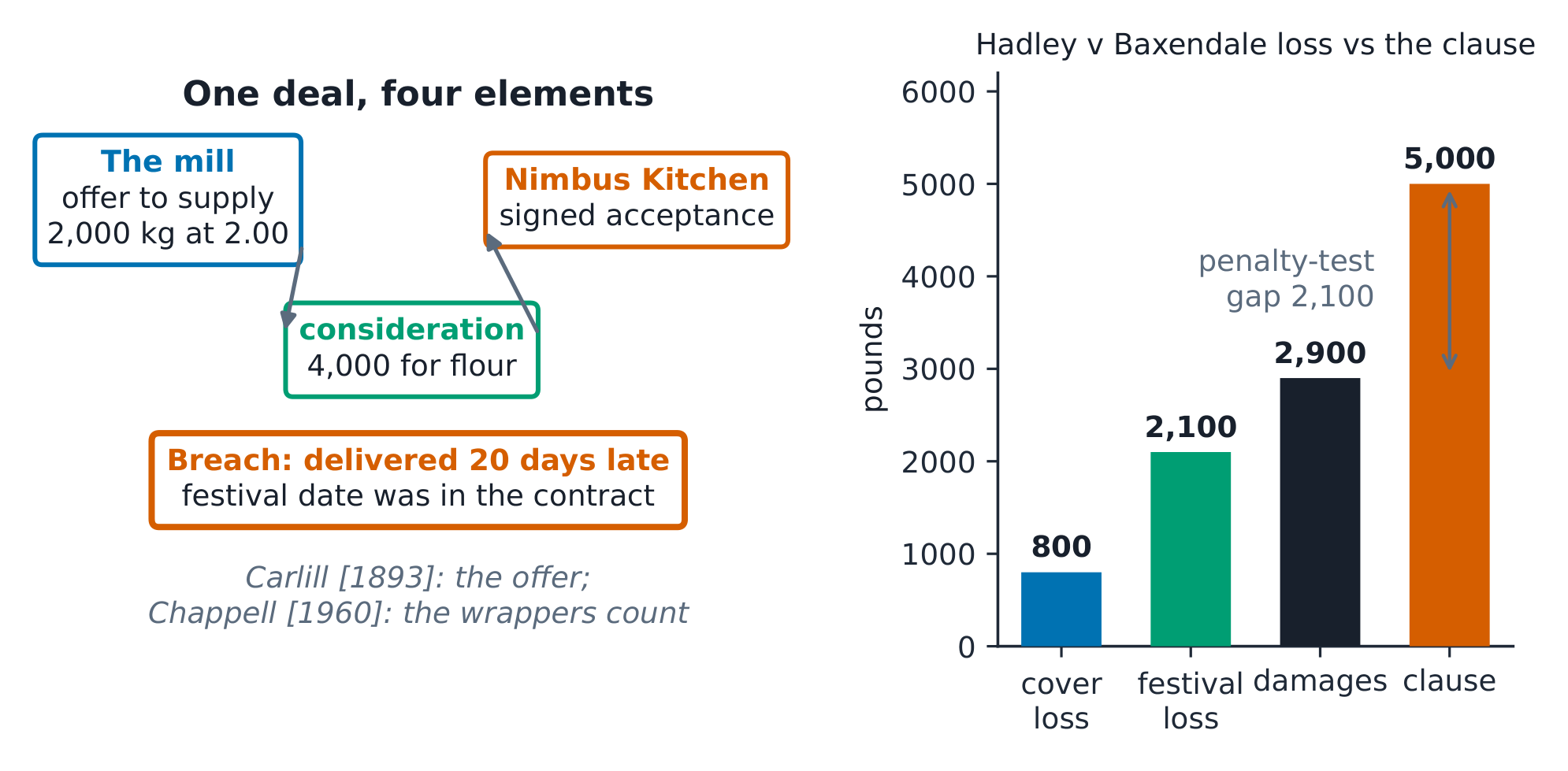
The definitions. Offer 要约: an intention to be bound on specified terms, distinguished from an invitation to treat (the shop shelf). Acceptance 承诺: unqualified assent, communicated. Consideration 对价: something of value moving each way — adequacy is not judged (the peppercorn), existence is (Chappell v Nestlé [1960] AC 87: the three wrappers were good consideration). Intention: presumed commercially, rebutted between family. Breach of contract 违约: failure to perform; expectation damages 期望损害赔偿 put the innocent party where performance would have (Hadley v Baxendale (1854) 9 Ex 341: losses arising naturally, or within the parties' contemplation). A liquidated damages 预定违约金 clause is a genuine pre-estimate; a penalty clause 罚金条款 is unenforceable — the test is legitimate interest proportionate to loss, not deterrence for its own sake (Cavendish v Makdessi [2015] UKSC 67).
The derivation. The breach arithmetic: cover purchase 2,000 kg at £2.40 = £4,800 against the contract £4,000 → £800 price-difference loss ✓. The festival weekend the flour missed, known to and contemplated by both parties at signing: £2,100 profit lost ✓. Expectation damages = 800 + 2,100 = £2,900 ✓. The contract's late-delivery clause, £250 a day × 20 days = £5,000 ✓ — £2,100 more than the loss, so the penalty question is live, not automatic.
Worked example 1 — the four elements on one deal. The mill's email quotes "2,000 kg, £2.00, delivery 30 May" — an offer (not a display or an advert). Nimbus replies "accepted" — unqualified assent, communicated. £4,000 moves for flour: consideration both ways. Both are companies: intention presumed. Four boxes, four ticks, one enforceable contract — and the founder's checklist for every order is exactly those four boxes, initialed on the confirmation.
Worked example 2 — escalate to the clause that failed its test. Nimbus claims the clause: £5,000. The mill says: penalty, your loss is £2,900. Applying Cavendish: is £250 a day a legitimate protection of Nimbus's interest in timely delivery (perishable stock, festival dates), or extravagant deterrence? The gap (5,000 − 2,900 = £2,100, 72% above loss ✓) is not decisive; what decides the essay is evidence that the daily figure tracked a genuine daily cost of lateness. The drafting lesson costs less than the litigation: a clause that states the daily loss it protects (cold storage, lost slots) with a reasonable sum survives; a round number plucked for pain does not. There is no middle path: if the clause fails the test, the court does not cut it down to the genuine part; it strikes the clause out and Nimbus recovers only its proven loss, £2,900.
Common mistakes. Treating an advertisement or shelf price as an offer (Carlill is the exception that proves the carve-out for unilateral offers). Judging consideration by adequacy rather than existence. Claiming the clause and skipping the loss proof — the penalty test is argued on both legs.
Summary. Offer + acceptance + consideration + intention = enforceable. Damages: the loss that flowed within contemplation — here £2,900. Liquidated must protect, not punish: £250 a day lives or dies on its evidence.
Business forms and liability
Why it matters. The raise succeeded (course 9), the site is growing, and the founder must choose the legal skin everything lives in: her house on the line, or not; her control diluted, or not. The form decides who bears the bad-bun claim and who owes what to whom.
The idea, with a picture. Four forms: sole trader (unlimited liability — the bad-bun claim is the founder's house), ordinary partnership (joint and several, unlimited), LLP (limited, but profit-taxed like a partnership), Ltd (limited liability 有限责任 — Salomon v Salomon [1897] AC 22: the company is a separate person).
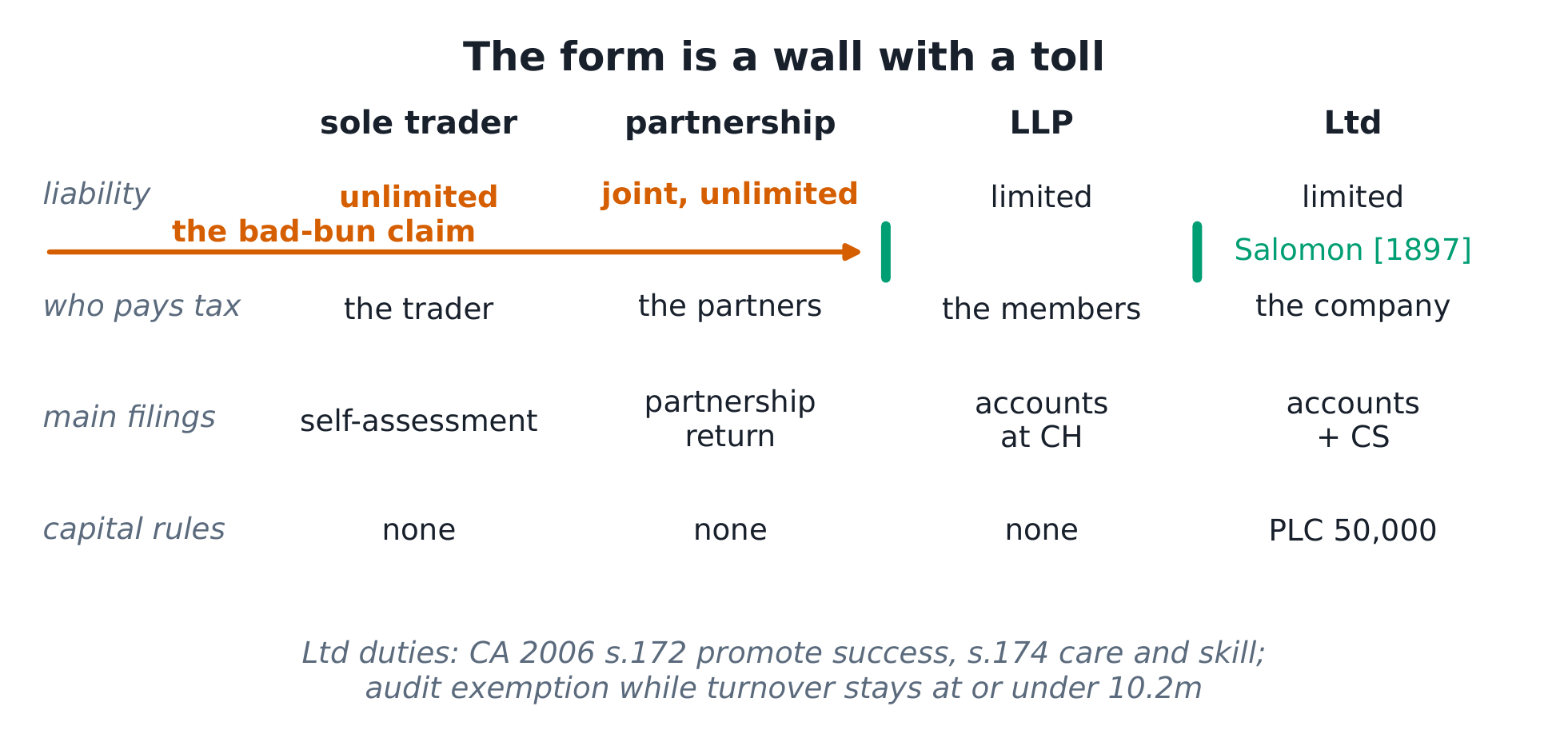
The definitions. Limited liability: shareholders lose only what they invested. Incorporation: a company exists when Companies House registers it — certificate, number, constitution; a PLC needs £50,000 allotted share capital ✓, a private Ltd needs none. Small companies escape audit while turnover stays ≤ £10.2m ✓. Director duties 董事义务 (Companies Act 2006): s.172 act to promote the success of the company; s.174 care, skill and diligence. Agency 代理: a principal is bound by an agent acting with authority — apparent authority 表见代理 binds when the principal's holding-out made the deal look authorised (Freeman & Lockyer v Buckhurst Park [1964] 2 QB 480).
The derivation. Nimbus Kitchen Ltd: 80,000 shares at £2.50 = £200,000 (the course-9 equity), one director-founder, small-company audit exemption (turnover £100,000 « £10.2m ✓, so no audit — but annual accounts and a confirmation statement still filed). The bad-bun claim, if it comes, is against the company — £6,800 of schedule loss against a company holding the raise, not the founder's house. The price of the wall: public filings, the duties in ss.172–174, and the no-conflict, no-profit rules (Regal (Hastings) [1967] 2 AC 134) that catch the founder's side-deal on packaging in unit 11.7's spirit.
Worked example 1 — the signature that bound the company. The festival sponsor's manager recalls a "deal" with the Saturday supervisor. Agency analysis: did the supervisor have actual authority (companies-house-checked list of directors: no)? Apparent authority — did the company hold her out as able to sign (title "Head of Operations", email signature, past conduct)? If yes, the company is bound; if no, the sponsor's claim fails. The operational fix the case teaches: a one-page authority schedule (who may sign what, up to how much) published internally and honoured — apparent authority is manufactured by what the business lets people look like.
Worked example 2 — escalate to the duty at the raise. Course 9's second site looked marginal at WACC 9.19% (NPV still positive). Now suppose a director had quietly taken a 5% interest in the fit-out contractor. Analysis: s.175 (avoid conflicts of interest) and s.177 (declare an interest in a proposed transaction) breached, s.172's duty to promote the company's success compromised, and the gain is held on trust for the company whatever the site's NPV — the duty is not a numbers test, it is a loyalty test. The comparison that teaches: a well-run Ltd does the same deal transparently — declares the interest, excludes itself from the vote, takes board approval — and keeps both the profit and the office. Disclosure converts a breach into governance.
Common mistakes. Believing "Ltd" ends personal exposure (personal guarantees, wrongful trading, and s.214 IA 1986 all punch through). Trading as partners "informally" (two people carrying on business for profit ARE a partnership). And appointing directors without the duties register, training and insurance the duties imply.
Summary. The form is a wall with a toll: Ltd/LLP stop the claim, at the price of filings and the Companies Act duties. Authority is what you appear to give, not what you meant. Declare interests; the no-profit rule is not a suggestion.
Employment
Why it matters. The Saturday crew has worked for three years on a handshake, one of them just asked about "redundancy if the festival ends", and nobody can find a contract. Whether she is an employee, a worker or self-employed decides what she is owed — and it is decided by law, not by what her invoices call her.
The idea, with a picture. Three statuses: employee 雇员 (all rights: unfair dismissal, notice, redundancy pay), worker (holiday, minimum wage, discrimination — no unfair dismissal), genuinely self-employed contractor 承包人 (contract rights only). The tests are about control, integration, mutuality and substitution — in that order of stubbornness.
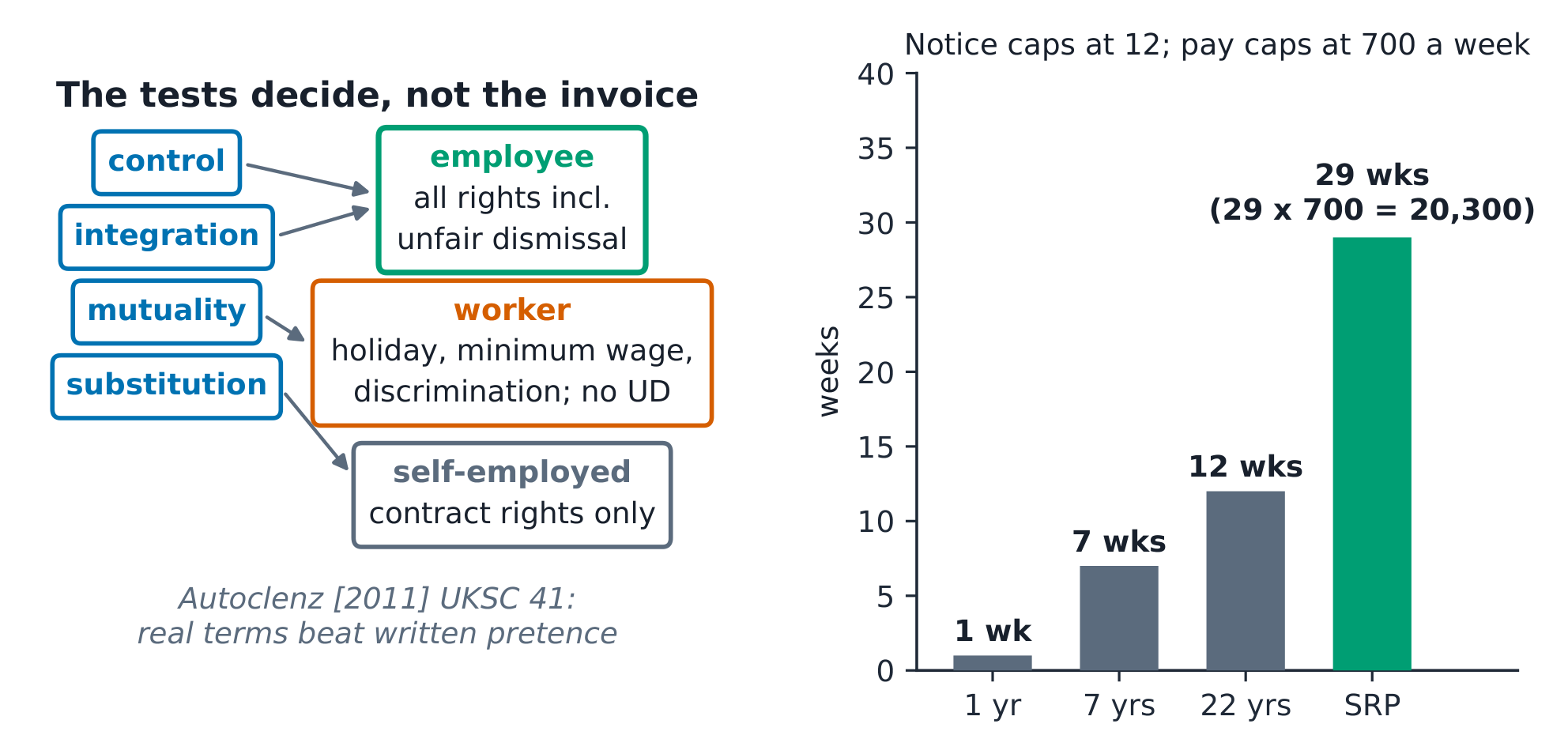
The definitions. Employee/contractor tests: control (Ready Mixed Concrete [1968] 2 QB 497), integration, mutuality of obligations, actual obligations over written pretence (Autoclenz v Belcher [2011] UKSC 41; Pimlico Plumbers v Smith [2018] UKSC 29). Unfair dismissal 不公平解雇: needs 2 years' service ✓, a fair reason and a fair process (ERA 1996). Notice: 1 week under 2 years, then a week a year capped at 12 weeks ✓. Statutory redundancy pay 法定遣散费: a week's pay capped at £700 ✓, 0.5/1.0/1.5 weeks by age band (under 22 / 22–40 / 41+), 20 years counted. The Equality Act 2010 prohibits discrimination on nine protected characteristics; UK GDPR duties apply to the loyalty app's data.
The derivation. The Saturday baker: 22 years' continuous service part-time ending at age 59, weekly pay £800. Redundancy pay: only the last 20 years count, so years at 41+ = 18 × 1.5 + years 22–40 = 2 × 1.0 = 29 weeks ✓, at the capped £700 = £20,300 ✓. Notice at 22 years: the 12-week cap ✓. (The basic award for unfair dismissal uses the same age-banded formula — also 20,300 here — which is why the arithmetic is worth drilling once.)
Worked example 1 — the handshake status. Facts: fixed shifts she cannot refuse, wears the brand apron, no substitute ever sent, paid weekly through payroll for twenty-two years (she is the Saturday baker above). Analysis: control high, integration high, mutuality high, substitution nil — employee, on any current authority, whatever her early "freelance" invoices said. Her entitlements on the festival ending: consultation, notice 12 weeks (paid), redundancy £20,300, and no unfair-dismissal issue because redundancy is a fair reason run fairly. The cost of the handshake was never zero; it was a liability accruing at 1.5 weeks a year.
Worked example 2 — escalate to the app's data. The loyalty app holds 14,000 festival customers' emails, orders and one allergy field. The marketer wants to sell the list. UK GDPR: Nimbus is the data controller 数据控制者; the allergy field is health data (special category); selling without a lawful basis is a breach. Exposure: the ICO's upper tier — up to £17.5m or 4% of worldwide turnover, whichever is higher ✓ (standard tier £8.7m / 2% ✓). On £100,000 turnover that reads absurd; on a growing group it reads existential — and the ICO publishes its fines, so it is brand risk too. The lawful alternative costs one afternoon: consent, purpose limitation, and a processor contract with the app vendor.
Common mistakes. Choosing the label before the facts (the tests decide, and sham terms are read against the draftsman). Forgetting the 2-year clock starts on day one, not at dismissal. Treating "we're small" as a data-law exemption — there isn't one.
Summary. Status by tests: control, integration, mutuality, substitution. Redundancy: capped £700, age-banded, 20-year limit — £20,300 in the worked case. Data duties scale with the fine tiers, not the company's size.
Intellectual property and data
Why it matters. The bun has a name ("Nimbus Bloomer"), the packaging has a design, the recipe is in a folder marked secret, and a rival has started selling a "Nimbus Blummer". Which of the four IP families protects what — and what it costs to find out — is a map, not a mood.
The idea, with a picture. The families: patent 专利 (inventions, 20 years ✓, new and inventive — the proving cabinet mechanism, if it were novel), trade mark 商标 (signs distinguishing goods — the name and logo, 10 years renewable for ever ✓), copyright 版权 (original works — the packaging artwork and the website, life + 70 years ✓, automatic), registered design (25 years ✓), and trade secret 商业秘密 (the recipe — protected as long as it stays secret and protected).
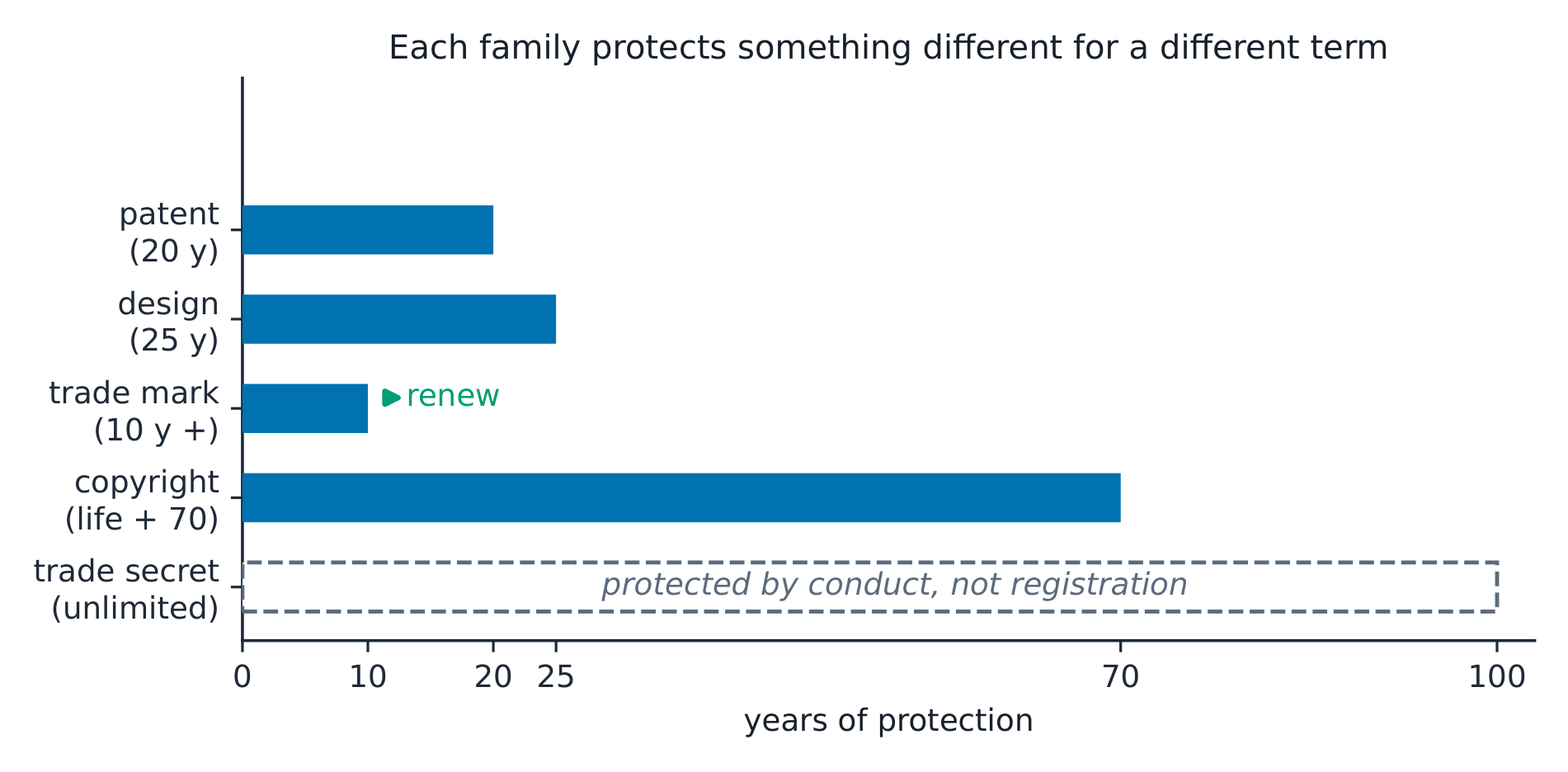
The definitions. Trade mark: registerable signs with distinctiveness; infringement by identical/similar marks on identical/similar goods with a likelihood of confusion. Copyright: subsists automatically in original artistic, literary and musical works. Patent: full disclosure for a 20-year monopoly — the deal is publication, which is exactly why the recipe stays a trade secret. Trade secret / confidentiality: protection by reasonable endeavours (NDA, access control, exit process); once disclosed, gone. Licensing: permitting use while owning — the sponsor's festival use of the logo is a licence with terms (territory, term, quality control), not a transfer.
The derivation. The rival's "Blummer": identical mark on identical goods — if Nimbus's "Bloomer" is registered, this is the textbook s.10(1) case: infringement without even a confusion argument. The arithmetic of protection: UK trade mark registration ≈ £170 for one class online (the official fee — checked against the registry fee schedule at authoring) against a passing-off claim's five-figure legal bill with an uncapped outcome; the registration is the cheapest insurance the business will ever buy. The recipe's alternative: patent = 20 years of monopoly but published; secret = indefinite but one leak from worthless — the choice is strategic, and the folder marked "secret" that everyone can open is neither.
Worked example 1 — the four families on one product. The Bloomer: name and logo (trade mark, register now), packaging artwork (copyright, automatic, keep dated originals), proving cabinet mechanism (patent only if novel and non-obvious — it is not: standard racking), recipe (trade secret: NDA, two named holders, exit interviews). One product, four regimes, four different actions — and the mistake that costs the case is treating "IP" as one thing on a form.
Worked example 2 — escalate to the licence the sponsor wrote. The sponsor's contract "grants all rights in the Bloomer name for festival use". Analysis: that is an assignment in the draftsmanship of someone who did not mean it — but the words bind. The fix negotiated in the case: a licence, exclusive only as to festival sites, two seasons, quality control retained, reversion on breach, and the mark never registered by anyone but Nimbus. The general lesson: never let a counterparty register your mark (the registry checks ownership, not fairness), and never sign a rights clause you have not read upside down.
Common mistakes. Disclosing the invention before filing (novelty dies). Trusting "©" without dated originals. And the classic: the founder who patents the recipe, publishing it, to stop a rival who only ever needed an NDA.
Summary. Trade mark 10 + renewals; copyright life + 70; patent 20 for disclosure; secret = conduct. Registration beats litigation on price every time it is available.
Ethical reasoning in business
Why it matters. Course 10's sponsor wants a "carbon-neutral bun". The founder can probably get away with the claim; the question in this unit is whether it would be right — and that question has method, not just instinct.
The idea, with a picture. Three lenses, one decision: consequentialism 后果主义 (what outcomes does the claim cause — the measured 156 g of unit 10.7 against the buyer who believed zero), deontology 义务论 (duties and rights — a promise of "neutral" you know to be unmeasured is a lie regardless of outcome), virtue ethics 德性伦理 (what would an honest baker do — the character the business is building with every claim it makes).
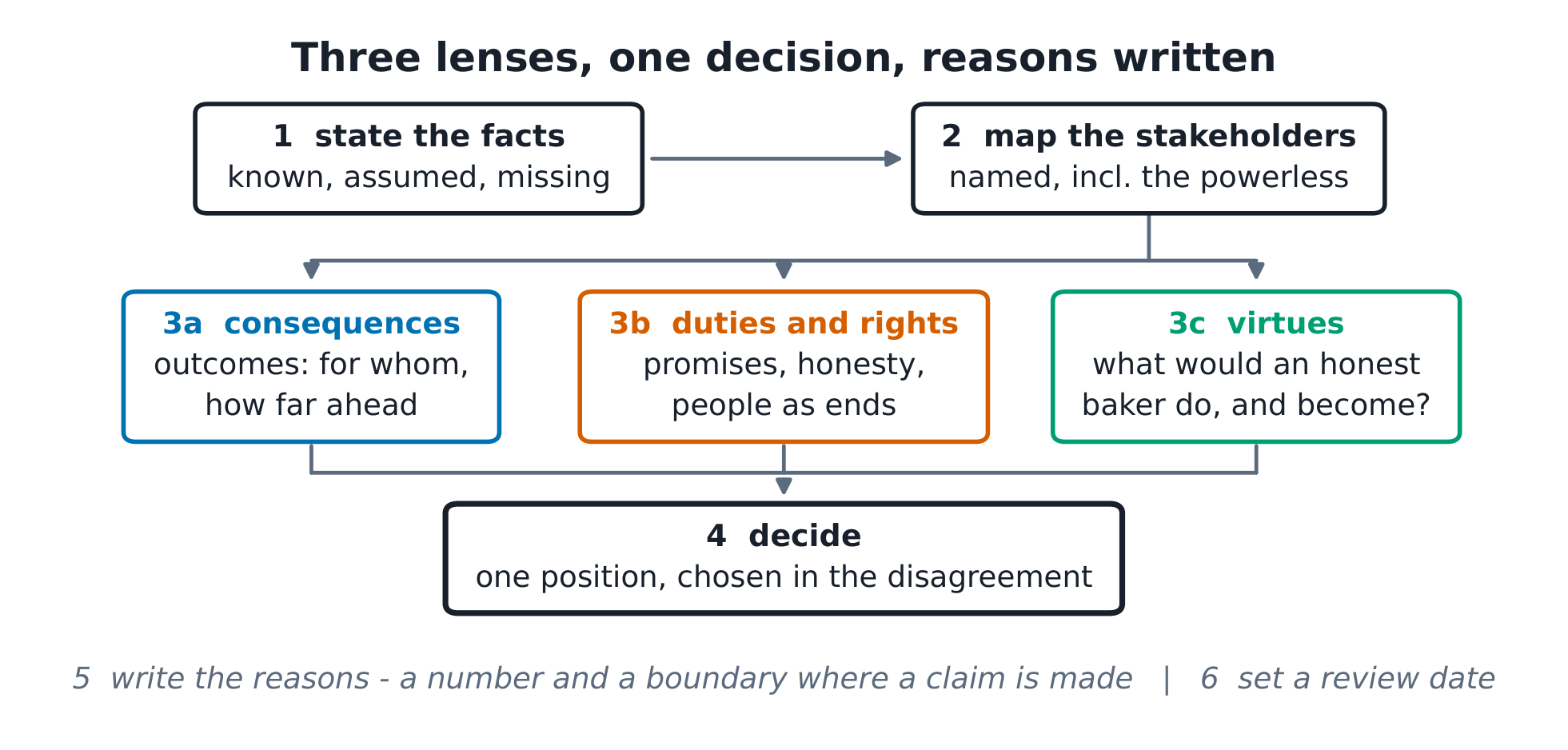
The definitions. Stakeholder 利益相关者: anyone the decision affects — mapped with power/interest and named, not averaged. Consequentialism: judge by outcomes (utilitarianism is the business default — and its trap). Deontology: some acts are wrong whatever the outcome (deception, breaking promises). Virtue ethics: judge the character the act builds. The decision protocol: facts → stakeholders → lenses → decision → written reasons → review date. Greenwashing: a claim without a number, boundary, date and verifiable method (unit 10.7's four-part standard) — an ethical defect before it is a legal one under consumer law.
The derivation. The neutral-bun claim through the tree: facts — cradle-to-gate 156 g measured, gate-to-gate 130, offsets unverified; stakeholders — sponsor (wants the word), customers (buy the feeling), staff (must answer questions), regulator (reads advertising law); lenses — consequentialist: brief sales bump, long trust damage when a journalist recomputes (they will; it is one division); deontological: the word says zero, the number says 156 — a false statement; virtue: the bakery's brand IS honesty at the counter. Decision: the reduced, numbered claim of unit 10.7 — "156 g a bun cradle-to-gate, measured, week-41 audit" — with the sponsor sold the stronger story: a number beats a word because a number can be defended.
Worked example 1 — the cheaper supplier's wage. Mill B (unit 10.5's 1.90) subcontracts harvesting to gang-labour rates below a living wage. Pure consequentialism says: 4,800 saved, no one sees. The tree: stakeholders include the harvest crew (affected, powerless to object — stakeholder theory's whole point is they still count); deontology: knowingly benefiting from a below-living wage treats people as means; virtue: the brand that audits its chain sleeps at night. The negotiated answer in the case: dual-source with a written wage clause in the contract (law gives the hook: supplier codes with audit rights), accepting +£400 a year of cost as the price of a claim Nimbus can make truthfully — an ethics decision with a number on it, which is the only kind that survives a board.
Worked example 2 — escalate to the deadline lie. A star engineer asks whether the refit will finish before the festival (course 10.6's day-10 SPI 0.909 says: probably not). The founder is tempted: "yes, on track". The tree compressed: consequences — the sponsor books around the lie; duties — truth-telling is not outcome-sensitive; virtue — organisations get the culture they rehearse. The honest version that still leads: "we are 9% behind schedule; here is the crash plan and the fallback" — deontology and management are not enemies; the lie is just lazier than the risk-adjusted truth.
Common mistakes. Averaging stakeholders into "the greater good" (the crew below the line is where ethics actually starts). Using a lens as a verdict-generator instead of a stress test — the lenses disagree, and the reasoning happens in the disagreement. And treating "legal" as the finish line (unit 11.1's standards are floors, not ceilings).
Summary. Facts, stakeholders, three lenses, decision, reasons, review. A claim you can defend has a number and a boundary. Ethics with a number on it survives the board; ethics without one is a mood.
Governance cases
Why it matters. Governance failures are legible in public: dates, numbers, and the controls that were missing. One studied honestly teaches more than a shelf of codes — and the bakery's own controls are the same controls in miniature.
The idea, with a picture. Carillion plc: the construction and outsourcing giant that entered compulsory liquidation on 15 January 2018 with roughly 43,000 jobs worldwide (about 20,000 in the UK) ✓, a pension deficit reported around £990m ✓ — after years of aggressive accounting, dividends paid while the dividend was being earned only on paper, and a board that heard the warnings and kept the music playing.
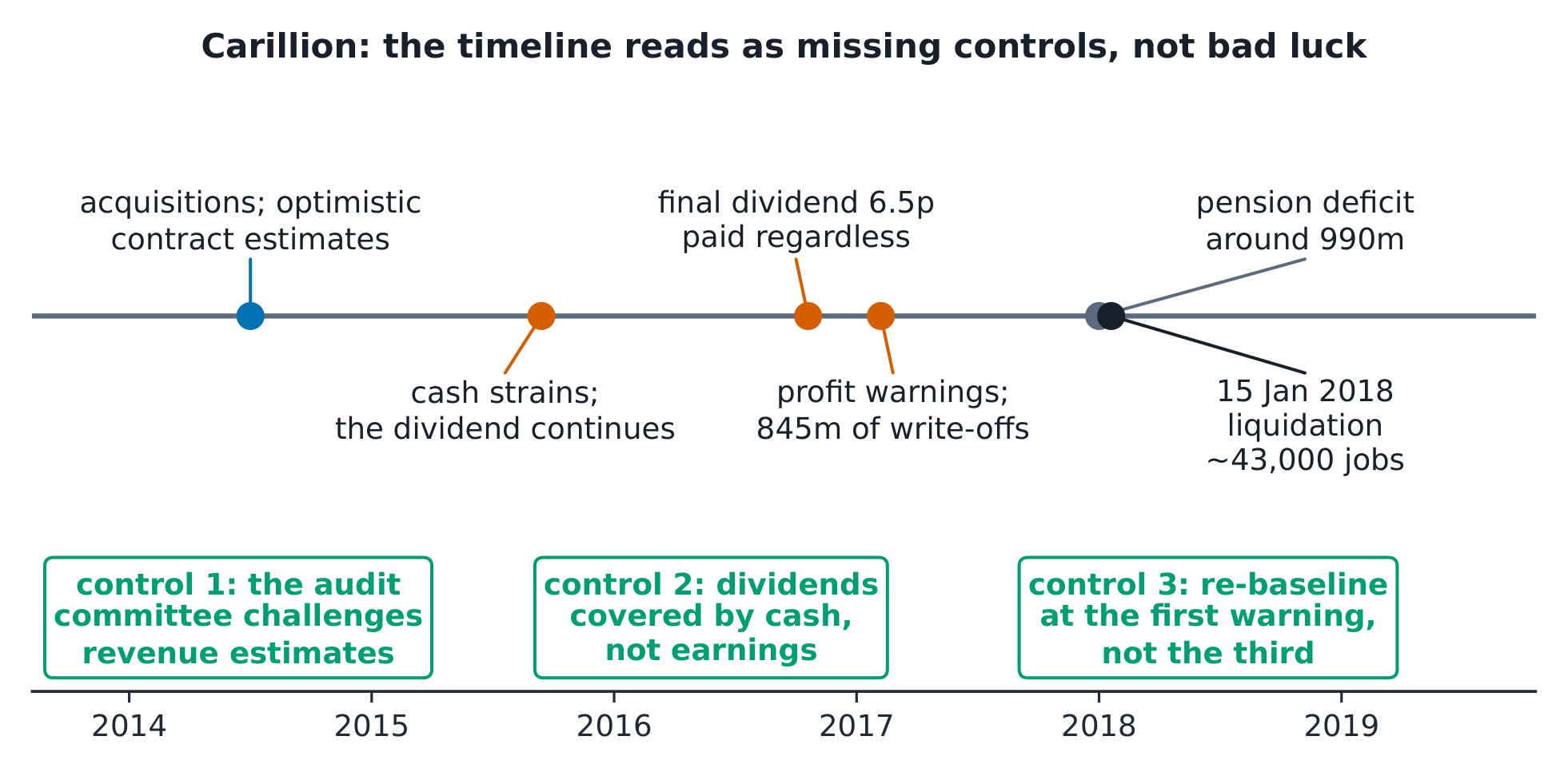
The definitions. Corporate governance 公司治理: the system by which companies are directed and controlled — board, risk, audit, remuneration. The trio this case makes concrete: board challenge (the non-execs' duty to ask), the audit relationship (challenge vs familiarity), and risk appetite said aloud (a written number, not a sentence). The UK Corporate Governance Code is comply-or-explain — which works only when the explaining is honest.
The derivation. The failure path, read as controls: (1) contract revenue recognised optimistically → control: revenue-recognition policy challenged by the audit committee (the write-offs that arrived in 2017 had lived in the estimates for years); (2) dividends paid while leverage rose → control: a distribution policy tied to cash cover, not earnings cover (the 2016 final dividend of 6.5p ✓ was paid into deteriorating liquidity); (3) warnings normalized (profit warnings in 2017 treated as the weather) → control: a board that re-baselines on the first warning, not the third. Each control was in the Code's letter; none was in the board's practice.
Worked example 1 — the audit committee's question. The July 2017 write-off (£845m of contract charges across 2017 — public record ✓) did not fall from the sky; it reversed years of estimates. The committee question that bites: "show me the ten largest contracts' assumptions, and what last year's assumptions on those same contracts would say today". If the answer is uncomfortable, that is the answer. Nimbus's miniature: the festival contract's revenue is recognised when the buns ship, not when the sponsor grins — one sentence of policy, worth more than the audit fee.
Worked example 2 — escalate to the mini-Carillion checklist. The founder writes three lines into the company's governance calendar: distributions only from cash cover (cash in bank after the dividend ≥ 3 months' payroll ✓ — at £8,000 monthly payroll, the dividend waits until £24,000 sits behind it); the first missed forecast triggers a written re-baseline, not a hopeful one; and every related-party deal (unit 11.3's packaging interest) goes to the minutes with the interest declared. None of this needs Carillion's scale — a company with £4,000 fortnightly flour orders and a £60,000 raise gets the same failure path in miniature, and the same three controls stop it.
Common mistakes. Studying the villain instead of the control (fraudsters are rare; missing controls are common). Treating the Code as a compliance form (comply-or-explain without honest explanation is comply-and-lie). And small businesses concluding governance is for giants — the failure path scales down; so does the cure.
Summary. Carillion: optimistic revenue, earnings-covered dividends, normalised warnings, £990m pension hole, 43,000 jobs, 15 January 2018. The controls: challenge estimates, cover dividends in cash, re-baseline at the first warning. Write the three lines; they scale down.
The project sheet (reproducible)
The Nimbus Kitchen legal file, one page:
- Jurisdiction: England and Wales throughout; civil balance of probabilities against criminal beyond reasonable doubt; small claims ≤ £10,000; limitation 6 years (12 by deed).
- Contract: offer + acceptance + consideration (the peppercorn counts, Chappell) + presumed intention. Breach arithmetic: cover £4,800 − contract £4,000 = £800 + £2,100 festival loss = £2,900 expectation damages; clause 20 × £250 = £5,000 survives only the Cavendish legitimate-interest test.
- Forms: Ltd wall (Salomon); PLC £50,000 capital; audit exemption ≤ £10.2m turnover; s.172 success, s.174 care; apparent authority is what you hold out (publish an authority schedule).
- Employment: tests — control, integration, mutuality, substitution (Autoclenz: real terms beat paper). Redundancy: £700-capped week, 0.5/1.0/1.5 by age, 20-year limit → 22 years ending at 59 = £20,300; notice caps at 12 weeks. Data: ICO tiers £8.7m/2% and £17.5m/4%.
- IP: trade mark 10 + renewals, copyright life + 70, patent 20, design 25, secret = conduct. Register before you litigate; license festival use, never assign.
- Ethics: facts → stakeholders → consequences/duties/virtues → decision with written reasons and a review date. A defensible claim has a number, a boundary, a date and a method.
- Governance: Carillion 15 Jan 2018 — 43,000 jobs, £990m pension deficit; controls = challenge revenue estimates, cash-cover dividends (≥ 3 months' payroll behind: £24,000 at Nimbus scale), re-baseline at the first warning.
Every rule in this handout is England and Wales unless a named comparison says otherwise, and every number recomputes from these values or the cited public record. This is a study course, not legal advice.