Scope and prerequisites
Digital SAT framework; original paper practice is nonadaptive and gives no scaled-score prediction.
- Factor 因式 and expand expressions without changing their values
- Simplify rational and radical expressions on the original domain
- Use expression structure to identify zeros and coefficients
Prerequisites: Distributive law; difference of squares; real square roots.
Explain and choose the method
Expansion distributes each factor across the others; factorisation reverses that process. x²-5x+6=(x-2)(x-3), so the product form exposes zeros while the expanded form exposes coefficients. Choose the form that serves the question rather than treating one representation as always preferable.
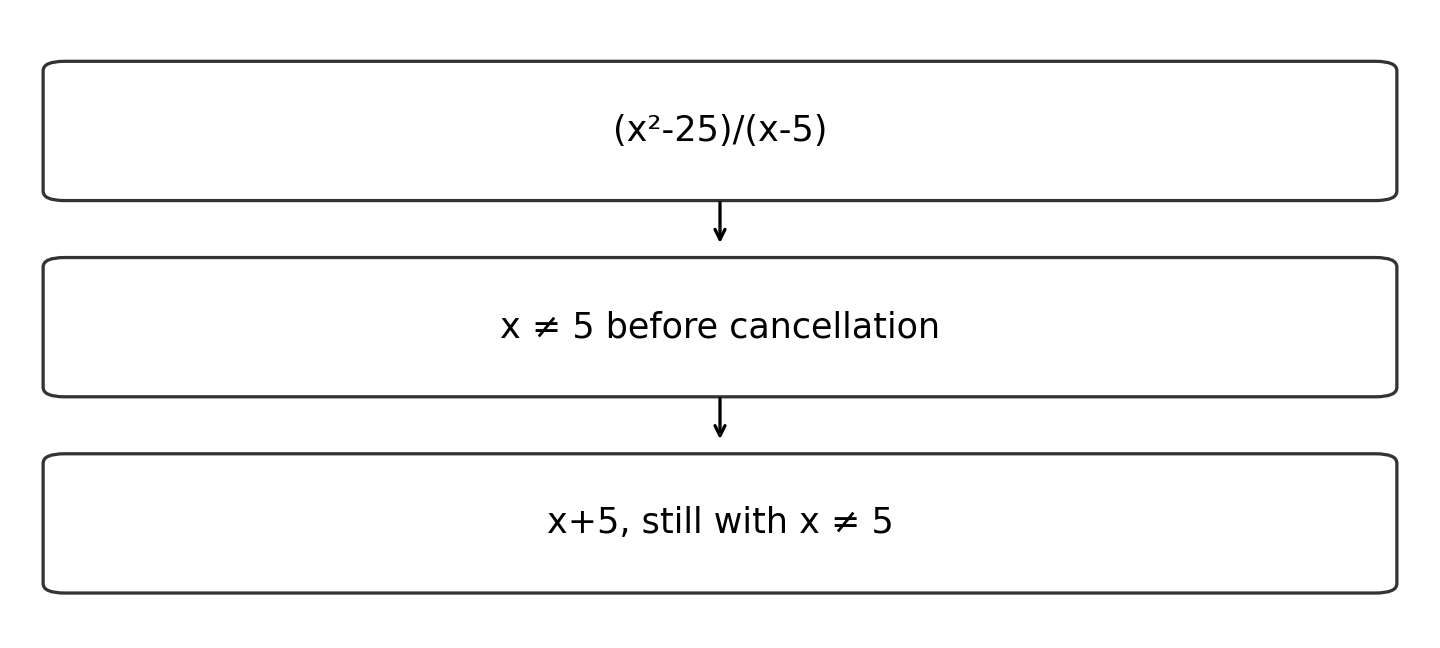
Cancel factors, never terms in a sum. (x²-4)/(x-2) becomes x+2 only for x≠2, because the original expression is undefined at 2. A restriction may remain after every denominator disappears from the simplified formula. State it before cancelling, then carry it through comparisons or equation solving.
Exponent rules depend on their setting: a^m a^n=a^(m+n) and (a^m)^n=a^(mn) in the permitted real domain. Negative exponents form reciprocals and require nonzero bases. With real square roots, √(x²)=|x|, because the principal square root is nonnegative; it is not x for every real x.
To check equivalence, a numerical substitution can expose a mistake, but one matching value does not prove two expressions equal. A valid algebraic identity plus matching domain does. When the question requests a coefficient, expand only as far as needed and account for every contribution to that power.
Equivalent expressions 等价表达式 must agree on the stated domain . $E(x)=(x^2-25)/(x-5)=(x+5)$ only for $x\ne5$. Cancellation removes a factor, but it cannot restore an excluded input. Also $\sqrt{x^2}=|x|$, because the principal square root cannot be negative.
Existing worked example: (x²-9)/(x-3)=(x-3)(x+3)/(x-3)=x+3 for x≠3. At x=3 the original is undefined. For x=-5, √(x²)=5=|x|. In (2x+1)(x-4), the x coefficient is -8+1=-7 and the full expression is 2x²-7x-4.
Complete original context
Every transfer question states all data it needs.
Independent practice and checked reasoning
Transfer 1
Simplify $F(x)=(x^2-4x)/(x^2-16)$. State every original restriction and explain why $F$ is not identical to $x/(x+4)$ on that latter formula's whole domain.
Reasoning: Factor numerator $x(x-4)$ and denominator $(x-4)(x+4)$. The original domain excludes $x=4,-4$. Cancellation gives $F(x)=x/(x+4)$ for $x\ne4,-4$. The latter formula alone permits $4$, where it gives $1/2$, while $F(4)$ is undefined.
Transfer 2
Find the coefficient of $x$ in $(3x-2)(x+5)$ and evaluate $\sqrt{(x-5)^2}$ when $x=1$.
Reasoning: Expansion gives $3x^2+15x-2x-10=3x^2+13x-10$, so the coefficient is 13. The root is $|x-5|$; at $x=1$, it is $|-4|=4$, not $-4$ or 16.
Transfer 3
A student tests $x=2$ and concludes that $x^2$ and $2x$ are equivalent. Refute the conclusion and solve where they actually agree.
Reasoning: At $x=3$ the outputs are 9 and 6, so one matching test is not proof. Solve $x^2=2x$ as $x(x-2)=0$, giving only $x=0,2$.
Limits and next use
A simplified formula is not automatically an equivalent function on a larger domain; cancelling terms across addition is invalid.
All tasks here are public original practice with authored guidance. They are not official questions or fresh diagnostics. Existing protected tests and mocks remain separate.