Scope and prerequisites
Digital SAT framework; original paper practice is nonadaptive and gives no scaled-score prediction.
- Solve and classify one-variable linear equations with parameters
- Interpret two-variable linear equations as sets of ordered pairs
- Interpret slope and intercept of a contextual linear function
- Classify two-equation linear systems and check their intersections
- Represent strict and inclusive inequalities in one or two variables
Prerequisites: Collect like terms; substitute ordered pairs; signed arithmetic.
Explain and choose the method
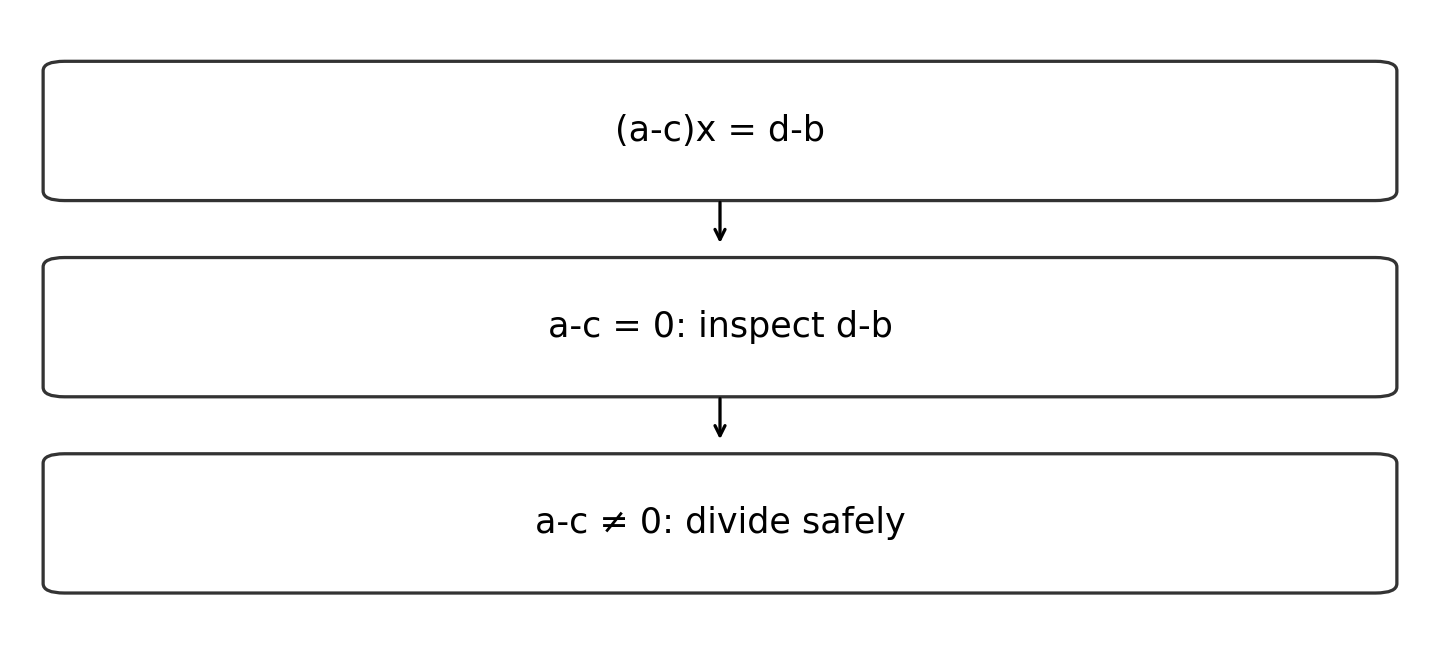
Collect variable terms and constants separately. An equation ax+b=cx+d becomes (a-c)x=d-b. If a-c is nonzero there is one solution; if both sides reduce to zero there are infinitely many; if the variable coefficient is zero but the constant is nonzero there are none. Never divide by a parameter before checking whether it can be zero.
A two-variable equation gives a set of ordered pairs. In y=mx+b, m is the change in y per unit x and b is y at x=0. For a contextual model, attach units to both: a taxi charge C=3t+5 has a 5-unit initial fee and 3 units per time unit. The intercept may be outside the practical domain even when it exists algebraically.
For a system, compare both coefficients and constants. Multiplying one whole equation by a nonzero number produces the same line; matching variable coefficients with different constants gives parallel distinct lines. Otherwise an intersection supplies the pair satisfying both equations. Substitute the pair into both original equations to check it.
Multiplying or dividing an inequality by a negative number reverses its direction. A strict inequality excludes the boundary, while ≤ or ≥ includes it. For two variables, draw the corresponding line and test a point away from it to identify the allowed half-plane. The diagram is a representation of all solutions, not a single preferred point.
An identity 恒等式 holds for every permitted input. Start with $ax+b=cx+d$. Collect terms: $(a-c)x=d-b$. Inspect $a-c$ before dividing. If $a=c$ and $b=d$, every real input works. If only $a=c$, no input works. Otherwise $x=(d-b)/(a-c)$ gives one solution.
Existing worked example: For kx+6=2x+6, k=2 gives 0=0 and infinitely many solutions; k≠2 gives x=0. For -2x+3<11, subtract 3 and divide by -2 to get x>-4. For y≤2x+1, (0,0) works and the solid boundary is included. The system 2x+4y=10 and x+2y=6 has no solution because doubling the second gives the same left side equal to 12, not 10.
Complete original context
Every transfer question states all data it needs.
Independent practice and checked reasoning
Transfer 1
Classify the solutions of $(p-1)x+3=2x+p$ for every real $p$.
Reasoning: Collect terms to get $(p-3)x=p-3$. At $p=3$, the equation is $0=0$, so every real $x$ works. At $p\ne3$, divide by $p-3$ to get $x=1$. There is no value of $p$ giving no solution. Substitution of $x=1$ gives $p+2$ on both sides.
Transfer 2
A hire charge $C$ yuan has a fixed fee $f$ yuan and rate 速率 $r$ yuan per hour. Three hours cost 31 yuan; seven hours cost 59 yuan. Find $f,r$ and the greatest affordable whole number of hours with 80 yuan.
Reasoning: Use $C=f+rt$. The equations are $31=f+r(3\,\mathrm{h})$ and $59=f+r(7\,\mathrm{h})$. Subtract: $r=(59-31)\,\mathrm{yuan}/(7-3)\,\mathrm{h}=7\,\mathrm{yuan/h}$. Then $f=31\,\mathrm{yuan}-(7\,\mathrm{yuan/h})(3\,\mathrm{h})=10\,\mathrm{yuan}$. Budget: $10+7t\le80$, so $t\le10$ hours. Ten whole hours is affordable; eleven costs 87 yuan.
Transfer 3
Describe all points satisfying $y>2x-1$ and $y\le-x+5$. Is $(2,3)$ included? State the possible $x$-values.
Reasoning: The first boundary is dashed and the second solid. The common region is above the first line and on or below the second. At $(2,3)$ the first condition is $3>3$, which fails. For the vertical interval to exist, $2x-1<-x+5$, hence $x<2$. The lines meet at $(2,3)$ but their meeting point is excluded.
Limits and next use
Do not confuse x=0 with a vanished variable coefficient, reverse only when multiplying/dividing by a negative, or shade a half-plane from the line’s slope alone.
All tasks here are public original practice with authored guidance. They are not official questions or fresh diagnostics. Existing protected tests and mocks remain separate.