Scope and prerequisites
Digital SAT framework; original paper practice is nonadaptive and gives no scaled-score prediction.
- Solve quadratic, absolute-value, rational and radical equations
- Reject candidate roots violating the original equation or domain
- Find intersections of a line and a nonlinear curve
Prerequisites: Factorisation; substitution; domain restrictions.
Explain and choose the method
Use structure before expanding. A factored quadratic equals zero when at least one factor is zero. An absolute-value equation |u|=a has no real solution for a<0, one condition u=0 when a=0 and two conditions u=±a when a>0. Account for all allowed cases, not just the positive branch.
For a rational equation, exclude denominator zeros before multiplying through. Multiplication may create a candidate at an excluded value. For a radical equation, note that a principal square root is nonnegative, isolate it and square carefully. Squaring is a one-way implication until every resulting candidate is checked in the original.
To solve a line–parabola 抛物线 system, substitute the line expression into the quadratic. The real roots give x-values; use the line to recover each y. No real root means no real intersection 交点. A repeated quadratic root gives tangency, while two different real roots give two intersections.
A graph or calculator can help locate candidates and check scale, but rounded intersections are not exact proof when the question asks an exact value or solution count. Relate graphical behaviour to the algebraic equation. A double root should not be counted twice as two different ordered pairs.
A candidate root 候选根 must satisfy the original equation. In $\sqrt{x+6}=x$, the right side must be nonnegative. Squaring gives $x^2-x-6=0$, so candidates are $3,-2$. Only $3$ survives the original check: $\sqrt9=3$.
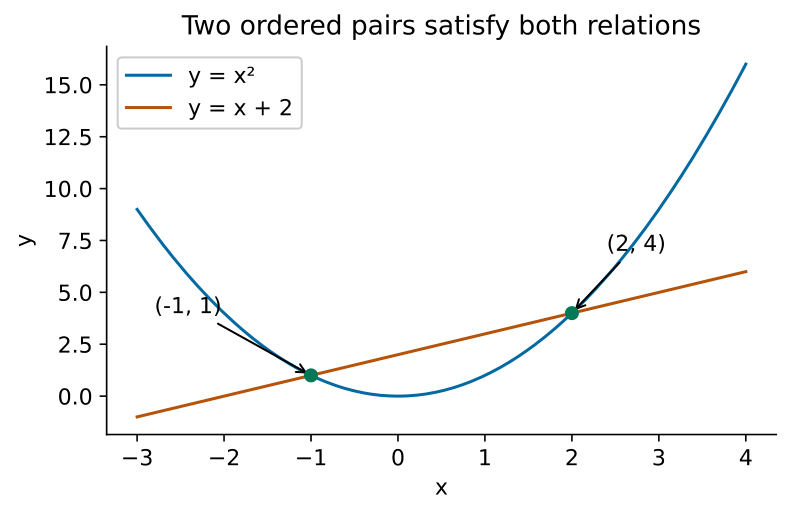
Existing worked example: √(x+2)=x requires x≥0. Squaring yields x²-x-2=0, so x=2 or -1; only 2 works in the original. For y=x+2 and y=x², solve x²-x-2=0: x=2,-1, giving (2,4) and (-1,1). For |2x-1|=5, solve 2x-1=5 or -5 to obtain x=3 or -2.
Complete original context
Every transfer question states all data it needs.
Independent practice and checked reasoning
Transfer 1
Solve $\sqrt{2x+3}=x$ over the real numbers, showing why any candidate is rejected.
Reasoning: Require $x\ge0$. Squaring yields $x^2-2x-3=(x-3)(x+1)=0$. Candidates are 3 and -1. The original gives $\sqrt9=3$ at 3, but $\sqrt1=1\ne-1$ at -1. Only $x=3$ works.
Transfer 2
Solve simultaneously $y=x+2$ and $y=(x-1)^2$. Give exact ordered pairs and verify the number of intersections.
Reasoning: Equate outputs to get $x+2=x^2-2x+1$, or $x^2-3x-1=0$. Thus $x=(3\pm\sqrt{13})/2$ and $y=(7\pm\sqrt{13})/2$ with matching signs. The discriminant 13 is positive, so there are two distinct real intersections; both expressions for $y$ agree by the derived equation.
Transfer 3
Solve $|3x+2|=7$ and $(x^2-9)/(x-3)=6$. Explain why these equations have different solution counts.
Reasoning: The absolute value gives $3x+2=7$ or $-7$, hence $x=5/3$ or $-3$. The rational equation requires $x\ne3$ and simplifies to $x+3=6$, whose sole candidate 3 is excluded. It has no solution.
Limits and next use
Do not report every root of a transformed equation before checking the original restriction and branch.
All tasks here are public original practice with authored guidance. They are not official questions or fresh diagnostics. Existing protected tests and mocks remain separate.