This unit has two engines running at once. An intellectual revolution that changed how people justified political authority, and an industrial revolution that…
English narration · English + 中文 subtitles burned in
5.1
The Enlightenment
Syllabus
5.1 The Enlightenment
Thematic Focus
Learning Objective
Historical Developments
SIO Social Interactions and Organization — The process by which societies group their members and the norms that govern the interactions between these groups and between individuals influence political, economic, and cultural institutions and organization.
Unit 5.A
Explain the intellectual and ideological context in which revolutions swept the Atlantic world from 1750 to 1900.
KC-5.3.I.A Enlightenment philosophies applied new ways of understanding and empiricist approaches to both the natural world and human relationships; they also reexamined the role that religion played in public life and emphasized the importance of reason. Philosophers developed new political ideas about the individual, natural rights, and the social contract.
KC-5.3.I The rise and diffusion of Enlightenment thought that questioned established traditions in all areas of life often preceded revolutions and rebellions against existing governments.
KC-5.3.II.i Nationalism also became a major force shaping the historical development of states and empires.
Unit 5.B
Explain how the Enlightenment affected societies over time.
KC-5.3.I.C Enlightenment ideas and religious ideals influenced various reform movements. These reform movements contributed to the expansion of rights, as seen in expanded suffrage, the abolition of slavery, and the end of serfdom.
KC-5.3.IV.B Demands for women’s suffrage and an emergent feminism challenged political and gender hierarchies.
Illustrative examples:
Demands:
Mary Wollstonecraft’s A Vindication of the Rights of Woman
Olympe de Gouges’s Declaration of the Rights of Woman and of the Female Citizen
Seneca Falls Conference (1848) organized by Elizabeth Cady Stanton and Lucretia Mott
Source: College Board AP Course and Exam Description
In August 1791 enslaved people in the French colony of Saint-Domingue,
the richest sugar colony in the world, rose up against their owners.
They had heard what the French Revolution was saying in Paris: that
"men are born and remain free and equal in rights". Led from 1793 by
Toussaint Louverture, a formerly enslaved man, they fought the French,
the Spanish and the British. In 1804 the colony became Haiti 海地,
the first independent state founded by people who had freed themselves
from slavery. An idea written in Europe had travelled across the
Atlantic and been used by the people its authors had left out.
Unit 5 covers 1750 to 1900, and it has two engines running at once: an intellectual revolution that changed how people justified political authority, and an industrial revolution that changed how societies produced and lived. Most questions ask you to connect them.
Enlightenment 启蒙运动 philosophies applied new ways of understanding and empirical approaches 实证方法 to both the natural world and human relationships. From that came ideas that questioned established traditions:
Individualism 个人主义, natural rights 天赋权利, and the social contract 社会契约.
Calls for religious tolerance 宗教宽容 and limits on established authority.
Those ideas influenced reform movements 改革运动: the expansion of suffrage, the abolition of slavery, and demands for women's suffrage 妇女选举权诉求 alongside an emergent feminism 女权主义 that challenged political and gender hierarchies.
Thinker
Key idea
Where it was used
John Locke (1689)
natural rights to life, liberty and property; government by consent
the US Declaration of Independence (1776)
Montesquieu (1748)
separation of powers between law-makers, government and courts
the US Constitution (1787)
Rousseau (1762)
the social contract; the "general will" of the people
the French Revolution
Mary Wollstonecraft (1792)
women have the same reason as men and deserve the same education
early feminism; the Seneca Falls meeting (1848) in the USA
Olympe de Gouges (1791)
a Declaration of the Rights of Woman, answering the 1789 declaration
French feminism
Idea, reason, movement - the middle column is where the marks are
Explore
Trace an idea to a movement
'Enlightenment ideas led to revolution' is the claim. The reason in the middle is the explanation.
demands for women's suffrage/dɪˈmændz fɔː ˈwɪmɪnz ˈsʌfrɪdʒ/
feminism/ˈfemɪnɪzəm/
Haiti
5.2
Nationalism and Revolution
Syllabus
5.2 Nationalism and Revolutions in the Period from 1750 to 1900
Thematic Focus
Learning Objective
Historical Developments
GOV Governance — A variety of internal and external factors contribute to state formation, expansion, and decline. Governments maintain order through a variety of administrative institutions, policies, and procedures, and governments obtain, retain, and exercise power in different ways and for different purposes.
Unit 5.C
Explain causes and effects of the various revolutions in the period from 1750 to 1900.
KC-5.3.II.ii People around the world developed a new sense of commonality based on language, religion, social customs, and territory. This was sometimes harnessed by governments to foster a sense of unity.
KC-5.3 The 18th century marked the beginning of an intense period of revolution and rebellion against existing governments, leading to the establishment of new nation-states around the world.
KC-5.3.IV.A.i Discontent with monarchist and imperial rule encouraged the development of systems of government and various ideologies, including democracy and 19th-century liberalism.
KC-5.3.III.B Colonial subjects in the Americas led a series of rebellions inspired by democratic ideals. The American Revolution, and its successful establishment of a republic, the United States of America, was a model and inspiration for a number of the revolutions that followed. The American Revolution, the Haitian Revolution, and the Latin American independence movements facilitated the emergence of independent states in the Americas.
KC-5.3.I.B The ideas of Enlightenment philosophers, as reflected in revolutionary documents— including the American Declaration of Independence during the American Revolution, the French “Declaration of the Rights of Man and of the Citizen” during the French Revolution, and Bolívar’s “Letter from Jamaica” on the eve of the Latin American revolutions— influenced resistance to existing political authority, often in pursuit of independence and democratic ideals.
KC-5.3.II.iii Newly imagined national communities often linked this new national identity with borders of the state, and in some cases, nationalists challenged boundaries or sought unification of fragmented regions.
Illustrative examples:
Call for national unification or liberation:
Propaganda Movement in the Philippines
Maori nationalism and the New Zealand wars in New Zealand
Puerto Rico—writings of Lola Rodríguez de Tió
German and Italian unifications
Balkan nationalisms
Ottomanism
Source: College Board AP Course and Exam Description
Nationalism 民族主义 became a major force shaping historical developments. People developed a new sense of commonality 共同体意识 based on language, religion, social customs, and territory, and these newly imagined national communities were often linked to state-building.
Discontent with monarchist and imperial rule encouraged revolution 革命. Enlightenment ideas, as reflected in revolutionary documents, justified those movements, and colonial subjects in the Americas led a series of rebellions inspired by them. The examinable set includes the American, French, Haitian, and Latin American revolutions; the French Revolution was a revolt within France, not an American colonial rebellion.
The pattern to hold: an idea (rights, consent, nation) plus a grievance (taxation, exclusion, slavery, colonial rule) produces a movement. Answers that give only the idea, or only the grievance, explain nothing.
Revolution
Grievance
Idea
Result
American, 1775–1783
British taxes without representation
natural rights; consent (Declaration of Independence, 1776)
independence; slavery kept
French, 1789–1799
royal debt, unfair taxes, privileges of nobles and clergy
the Declaration of the Rights of Man (1789)
the monarchy ended; then Napoleon
Haitian, 1791–1804
slavery and racial hierarchy
liberty and equality, taken literally
independence and the end of slavery
Latin American, 1810–1820s
creoles shut out of top posts by peninsulares
natural rights; Bolívar's Jamaica Letter (1815)
independent republics; creole elites kept power
Each revolution borrowed ideas from the one before, and each went further, or less far, than its authors meant.
Nationalism also built new states by joining smaller ones. Italy was
unified in 1861, led by Cavour and Garibaldi, and Germany in 1871, led
by the Prussian minister Bismarck, through three short wars. Other
national movements tried to break away from empires: Greeks won
independence from the Ottoman Empire in 1830, and Zionism, from the
1890s, called for a Jewish homeland.
ENV Humans and the Environments — The environment shapes human societies, and as populations grow and change, these populations in turn shape their environments.
Unit 5.D
Explain how environmental factors contributed to industrialization from 1750 to 1900.
KC-5.1.I.A A variety of factors contributed to the growth of industrial production and eventually resulted in the Industrial Revolution, including: Bullet Proximity to waterways; access to rivers and canals Bullet Geographical distribution of coal, iron, and timber Bullet Urbanization Bullet Improved agricultural productivity Bullet Legal protection of private property Bullet Access to foreign resources Bullet Accumulation of capital
KC-5.1.I.C The development of the factory system concentrated production in a single location and led to an increasing degree of specialization of labor.
Source: College Board AP Course and Exam Description
Industrialisation needed several conditions at once - which is why the question is always "why here, and why then"
A variety of factors contributed to the growth of industrial production: access to coal 煤炭 and iron 铁, navigable rivers and canals, agricultural productivity 农业生产率 that freed labour, capital 资本 and legal protection for it, urbanisation, and access to raw materials and markets through overseas empire.
The factory system 工厂制度 concentrated production in a single location under supervision, replacing dispersed household production. That change - as much organisational as technical - is what made the scale of output possible.
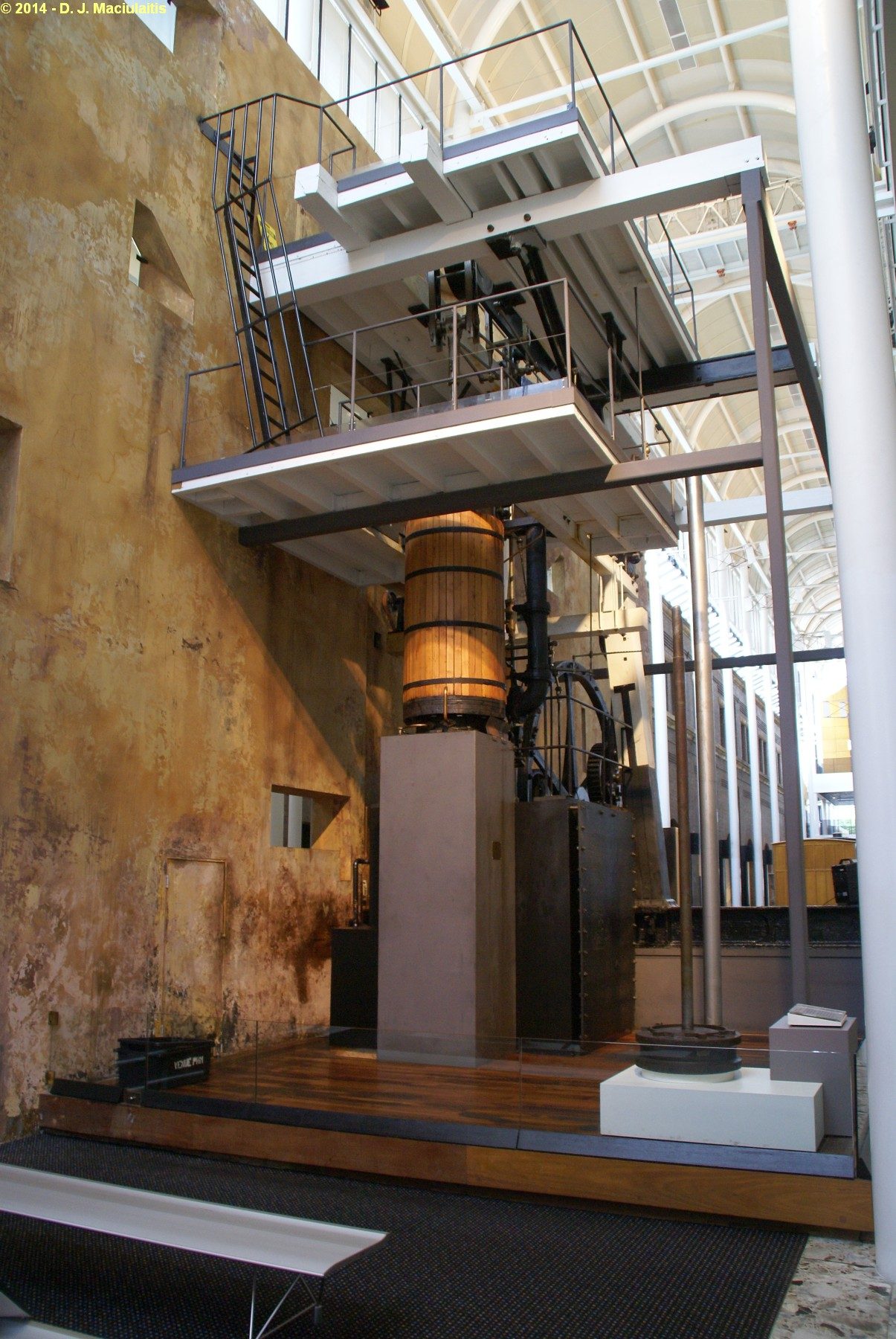
A Boulton and Watt steam engine - power that does not depend on a river, a wind or an animal
5.4 Industrialization Spreads in the Period from 1750 to 1900
Thematic Focus
Learning Objective
Historical Developments
TEC Technology and Innovation — Human adaptation and innovation have resulted in increased efficiency, comfort, and security, and technological advances have shaped human development and interactions with both intended and unintended consequences.
Unit 5.E
Explain how different modes and locations of production have developed and changed over time.
KC-5.1.II.B The rapid development of steam-powered industrial production in European countries and the U.S. contributed to the increase in these regions’ share of global manufacturing during the first Industrial Revolution. While Middle Eastern and Asian countries continued to produce manufactured goods, these regions’ share in global manufacturing declined.
KC-5.1.I.D As new methods of industrial production became more common in parts of northwestern Europe, they spread to other parts of Europe and the United States, Russia, and Japan.
Illustrative examples:
Decline of Middle Eastern and Asian share in global manufacturing:
Shipbuilding in India and Southeast Asia
Iron works in India
Textile production in India and Egypt
5.5 Technology of the Industrial Age
Thematic Focus
Learning Objective
Historical Developments
TEC Technology and Innovation — Human adaptation and innovation have resulted in increased efficiency, comfort, and security, and technological advances have shaped human development and interactions with both intended and unintended consequences.
Unit 5.F
Explain how technology shaped economic production over time.
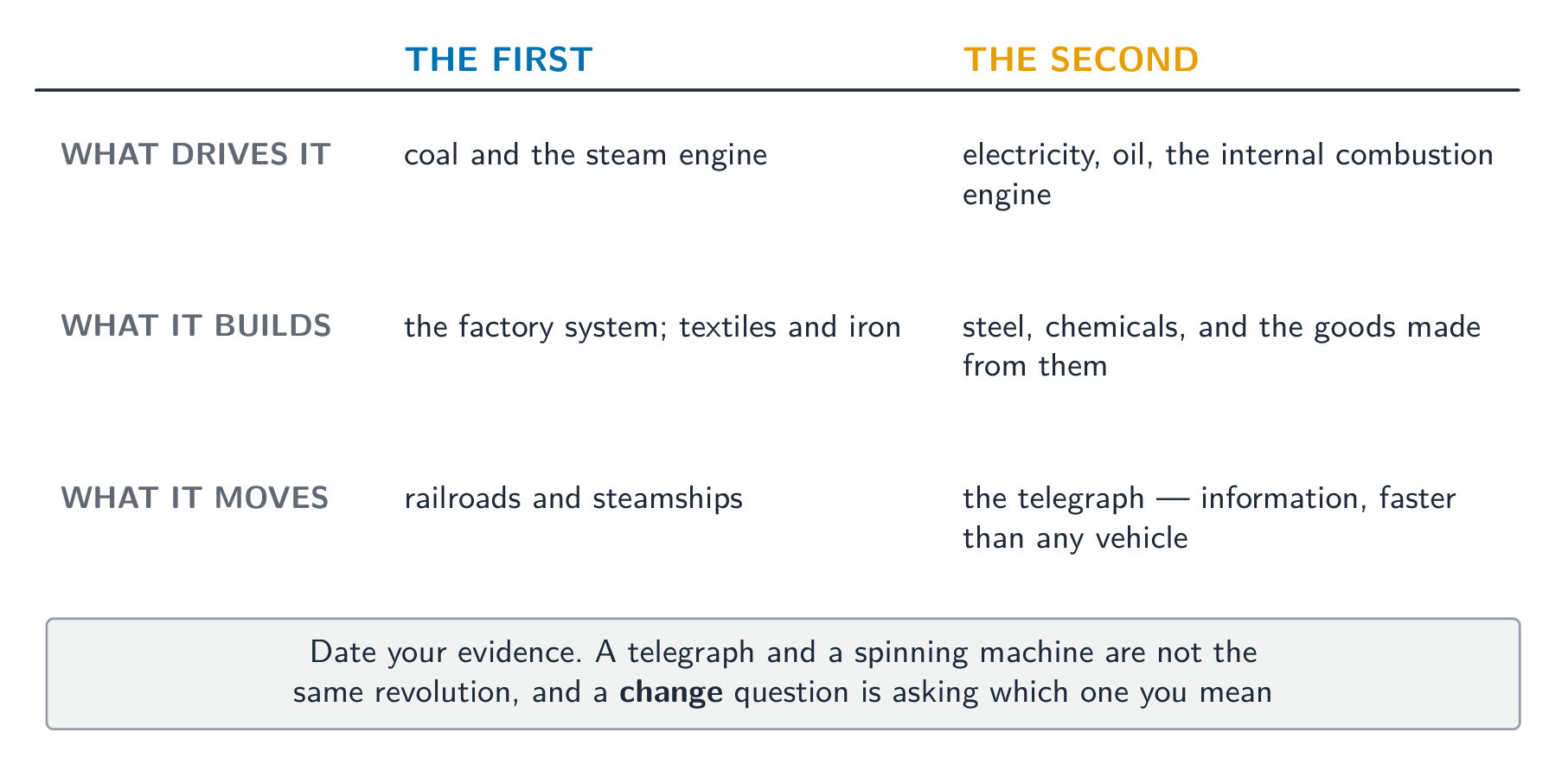
KC-5.1.I.B The development of machines, including steam engines and the internal combustion engine, made it possible to take advantage of both existing and vast newly discovered resources of energy stored in fossil fuels, specifically coal and oil. The fossil fuels revolution greatly increased the energy available to human societies.
KC-5.1.I.E The “second industrial revolution” led to new methods in the production of steel, chemicals, electricity, and precision machinery during the second half of the 19th century.
KC-5.1.IV Railroads, steamships, and the telegraph made exploration, development, and communication possible in interior regions globally, which led to increased trade and migration.
Source: College Board AP Course and Exam Description
The rapid development of steam-powered 蒸汽动力 industrial production in Europe spread to other regions, and as new methods became common, states that industrialised gained enormous advantages in wealth and military power over those that did not.
Technology compounded the change: the steam engine 蒸汽机 and later the internal combustion engine 内燃机; the second industrial revolution 第二次工业革命 in steel, chemicals, and electricity; and railroads 铁路, steamships 蒸汽船, and the telegraph 电报, which made exploration, colonisation, and administration at a distance possible.
The first industrial revolution and the second, kept apart so evidence can be dated
second industrial revolution/ˈsekənd ɪnˈdʌstrɪəl ˌrevəˈluːʃn/
railroads/ˈreɪlrəʊdz/
steamships/ˈstiːmʃɪps/
telegraph/ˈtelɪɡræf/
5.6 5.7 5.8
Government, Economy, and Reaction
Syllabus
5.6 Industrialization: Government’s Role from 1750 to 1900
Thematic Focus
Learning Objective
Historical Developments
GOV Governance — A variety of internal and external factors contribute to state formation, expansion, and decline. Governments maintain order through a variety of administrative institutions, policies, and procedures, and governments obtain, retain, and exercise power in different ways and for different purposes.
Unit 5.G
Explain the causes and effects of economic strategies of different states and empires.
KC-5.1.V.C As the influence of the Industrial Revolution grew, a small number of states and governments promoted their own state-sponsored visions of industrialization.
KC-5.2.II.A The expansion of U.S. and European influence in Asia led to internal reform in Japan that supported industrialization and led to the growing regional power of Japan in the Meiji Era.
Illustrative examples:
State-sponsored visions of industrialization:
Muhammad Ali’s development of a cotton textile industry in Egypt
5.7 Economic Developments and Innovations in the Industrial Age
Thematic Focus
Learning Objective
Historical Developments
ECN Economics Systems — As societies develop, they affect and are affected by the ways that they produce, exchange, and consume goods and services.
Unit 5.H
Explain the development of economic systems, ideologies, and institutions and how they contributed to change in the period from 1750 to 1900.
KC-5.1.III.A Western European countries began abandoning mercantilism and adopting free trade policies, partly in response to the growing acceptance of Adam Smith’s theories of laissez-faire capitalism and free markets.
KC-5.1.III.B The global nature of trade and production contributed to the proliferation of large-scale transnational businesses that relied on new practices in banking and finance.
KC-5.1 The development of industrial capitalism led to increased standards of living for some, and to continued improvement in manufacturing methods that increased the availability, affordability, and variety of consumer goods.
Illustrative examples:
Transnational businesses:
Hong Kong and Shanghai Banking Corporation (HSBC)
Unilever based in England and the Netherlands and operating in British West Africa and the Belgian Congo
Financial instruments:
Stock markets
Limited-liability corporations
5.8 Reactions to the Industrial Economy from 1750 to 1900
Thematic Focus
Learning Objective
Historical Developments
SIO Social Interactions and Organization — The process by which societies group their members and the norms that govern the interactions between these groups and between individuals influence political, economic, and cultural institutions and organization.
Unit 5.I
Explain the causes and effects of calls for changes in industrial societies from 1750 to 1900.
KC-5.1.V.D In response to the social and economic changes brought about by industrial capitalism, some governments, organizations, and individuals promoted various types of political, social, educational, and urban reforms.
KC-5.1.V.A In industrialized states, many workers organized themselves, often in labor unions, to improve working conditions, limit hours, and gain higher wages. Workers’ movements and political parties emerged in different areas, promoting alternative visions of society.
KC-5.3.IV.A.ii Discontent with established power structures encouraged the development of various ideologies, including those espoused by Karl Marx, and the ideas of socialism and communism.
KC-5.1.V.B In response to the expansion of industrializing states, some governments in Asia and Africa, including the Ottoman Empire and Qing China, sought to reform and modernize their economies and militaries. Reform efforts were often resisted by some members of government or established elite groups.
Source: College Board AP Course and Exam Description
As industrial influence grew, a small number of states sponsored industrialisation 国家推动工业化 directly - the standard examples being Meiji Japan, Russia under state-led programmes, and Egypt under Muhammad Ali.
State
What the state did
Example
Egypt under Muhammad Ali (ruled 1805–1848)
built state cotton and weapons factories; grew cotton for export
factories near Cairo making cloth and guns for his army
Meiji Japan (from 1868)
built model factories, railways and a modern army; later sold factories to private companies
the Tomioka silk mill (1872), built with French help
Russia under Sergei Witte (1890s)
borrowed foreign money; protected industry with tariffs
the Trans-Siberian Railway, begun in 1891
Western European countries began abandoning mercantilism and adopting free trade 自由贸易 policies, and the global nature of trade and production contributed to the proliferation of transnational businesses 跨国企业 and new financial instruments.
Reaction came from several directions:
Workers organised, often in labour unions 工会, and pressed for shorter hours, safety, and wages.
Alternative visions of society emerged - socialism 社会主义, communism 共产主义, and anarchism 无政府主义 - as critiques of industrial capitalism.
Some governments passed reform legislation 改革立法 on working conditions, child labour, and public health.
The expansion of industrialising states led to internal reform movements 内部改革运动 elsewhere in Asia, as states tried to respond to new pressure: the Ottoman Tanzimat reforms (1839–1876) and China's Self-Strengthening Movement 自强运动 (1860s–1890s), which built arsenals and shipyards but kept the old political order.
Worked example: reform by law. In Britain, children of five or
six worked long days in cotton mills. The Factory Act of 1833 banned
work in textile mills for children under nine, limited the hours of
children aged nine to thirteen, and, for the first time, paid
inspectors to check that factories obeyed. It shows the reform route:
correct industrial society by law, without ending it. Marx and Engels's
Communist Manifesto (1848) took the other route: end capitalism
itself.
Four responses split by one question: correct industrial society, or end it?
Explore
Sort each response by what it wants
Unions, socialism, communism, anarchism and reform legislation split on one question: correct industrial society, or end it?
SIO Social Interactions and Organization — The process by which societies group their members and the norms that govern the interactions between these groups and between individuals influence political, economic, and cultural institutions and organization.
Unit 5.J
Explain how industrialization caused change in existing social hierarchies and standards of living.
KC-5.1.VI.A New social classes, including the middle class and the industrial working class, developed.
KC-5.1.VI.B While women and often children in working class families typically held wage-earning jobs to supplement their families’ income, middle-class women who did not have the same economic demands to satisfy were increasingly limited to roles in the household or roles focused on child development.
KC-5.1.VI.C The rapid urbanization that accompanied global capitalism at times led to a variety of challenges, including pollution, poverty, increased crime, public health crises, housing shortages, and insufficient infrastructure to accommodate urban growth.
Source: College Board AP Course and Exam Description
New social classes 社会阶级 formed, including a middle class 中产阶级 and an industrial working class 工业工人阶级, each with its own culture and politics.
Other changes are examinable: rapid urbanisation 城市化 with overcrowding and disease; changes in family structure 家庭结构 and in women's work as production left the home; and rising standards of living 生活水平 over the long run, unevenly distributed and reached only after decades of hardship.
industrial working class/ɪnˈdʌstrɪəl ˈwɜːkɪŋ klæs/
urbanisation/ˌɜːbənaɪˈzeɪʃn/
family structure/ˈfæmɪli ˈstrʌktʃə/
standards of living/ˈstændədz ɒv ˈlɪvɪŋ/
5.10
Continuity and Change in the Industrial Age
Syllabus
5.10 Continuity and Change in the Industrial Age
Learning Objective
Review: Unit 5 Key Concepts
Unit 5.K
Explain the extent to which industrialization brought change from 1750 to 1900.
KC-5.1 The development of industrial capitalism led to increased standards of living for some, and to continued improvement in manufacturing methods that increased the availability, affordability, and variety of consumer goods.
KC-5.1.IV Railroads, steamships, and the telegraph made exploration, development, and communication possible in interior regions globally, which led to increased trade and migration.
KC-5.3 The 18th century marked the beginning of an intense period of revolution and rebellion against existing governments, leading to the establishment of new nation-states around the world.
KC-5.3.I.A Enlightenment philosophies applied new ways of understanding and empiricist approaches to both the natural world and human relationships; they also reexamined the role that religion played in public life and emphasized the importance of reason. Philosophers developed new political ideas about the individual, natural rights, and the social contract.
KC-5.3.I The rise and diffusion of Enlightenment thought that questioned established traditions in all areas of life often preceded revolutions and rebellions against existing governments.
KC-5.3.II.i Nationalism also became a major force shaping the historical development of states and empires
Source: College Board AP Course and Exam Description
The unit's reasoning skill is continuity and change. Production and class structure changed fundamentally, while imperial competition, coerced labour in colonised regions, and inequality persisted in new forms.
Original worked comparison. For original short-answer practice, try "Explain one way in which industrialisation changed social structures" between 1750 and 1900. An illustrative answer names the change and traces it: "Industrialisation created a large industrial working class, because the factory system concentrated production in single locations and drew rural labourers into cities to work for wages, replacing household production and the rural social order that depended on it." Notice the shape: explain requires the mechanism - factory system, urban migration, wage labour - not just the statement that new classes appeared.
5.10
Worked example: a short-answer question
Each part needs only one or two sentences: answer the question, cite one specific piece of evidence, and explain how it supports the answer.
Answer (a), (b) and (c).
(a) Briefly describe ONE Enlightenment idea that influenced revolutions in this period.
(b) Briefly explain ONE significance of the Haitian Revolution (1791–1804).
(c) Briefly explain ONE reason industrialisation began in Britain.
Model answer.
(a) The idea of natural rights and government by consent, argued by John Locke, appears in the Declaration of Independence and the Declaration of the Rights of Man.
(b) It was the first successful revolt of enslaved people that created an independent state, which inspired abolitionists and alarmed slaveholders across the Americas.
(c) Britain had large supplies of coal and iron, capital to invest, and colonial markets for its goods.
5.10
Exam tips
Answer "why Britain first" with several factors at once - coal, capital, agriculture, empire - not one cause.
The factory system is an organisational change; say what it replaced.
For revolutions, pair an idea with a grievance. Either alone explains nothing.
State-sponsored industrialisation (Meiji Japan, Russia, Egypt) is the contrast to the British pattern.
Give the reactions as a set: unions, socialism and communism, and reform legislation.
Living standards rose eventually and unevenly. Saying so is what makes an answer an evaluation.
Vocabulary card meanings
empirical approaches: Methods that rely on observation and evidence rather than on authority alone.
religious tolerance: Allowing more than one faith to be practised.
reform movements: Campaigns to change a state, a church, or a social practice.
demands for women's suffrage: Calls for women to have the right to vote.
feminism: A movement for women's equal rights.
Nationalism: Loyalty to a nation and the demand that it govern itself.
commonality: A sense of shared identity among people who see themselves as one nation.
revolution: A rapid overthrow of a political and social order.
coal: The mineral fuel that powered early steam engines.
agricultural productivity: How much food is produced from a given amount of land and labour.
steam-powered: Driven by engines that use steam from heated water.
steam engine: A machine that turns heat from steam into mechanical work.
internal combustion engine: An engine that burns fuel inside its cylinders.
second industrial revolution: The later industrial wave of steel, chemicals, electricity, and oil.
steamships: Ships driven by steam engines rather than only by sail.
telegraph: A device that sent coded electrical messages along a wire.
states sponsored industrialisation: Governments that funded factories, railways, and technical education.
transnational businesses: Firms that operated across several countries.
anarchism: A politics that rejects the state and organised coercion.
reform legislation: Laws passed to limit abuses, such as child labour or unsafe factories.
internal reform movements: Efforts inside a society to modernise its own institutions.
social classes: Groups distinguished by wealth, work, and status.
industrial working class: People who earned wages in factories and mines.
urbanisation: The shift of population into cities.
family structure: Who lives together and what roles they hold inside a household.
standards of living: The level of material comfort people can actually afford.
Interactive lessons on this topic
Work through it step by step, with instant-check exercises.