Scope and prerequisites
ACT framework, February 2026 revision. Original classroom cases are not an official form; preserve the scored/field-test boundaries of each source form.
- Add and scale vectors component by component
- Multiply a matrix 矩阵 and vector with matching dimensions
- Interpret entries and units in a quantitative model
Prerequisites: Ordered pairs; Pythagoras; multiplication and addition.
Explain and choose the method
A two-dimensional vector records an ordered displacement or another paired quantity. Add corresponding components and multiply both by a scalar. The vector from A to B is B-A, not A-B. Its magnitude is √(u²+v²) in a Euclidean coordinate plane; direction and magnitude are different pieces of information.
A matrix organises entries into rows and columns. Add only matrices of the same shape, entry by entry. For multiplication, the number of columns in the first factor must equal the number of rows in the second. A 2-by-3 matrix times a 3-by-1 vector produces a 2-by-1 result: each output is one row’s dot product 点积 with the vector.
Order matters: matrix multiplication is generally not commutative. If A times B is defined, B times A may be undefined or produce a different result. For a row containing item quantities and a column containing unit prices in the same item order, the dot product gives the total cost. A mismatched item order produces a numerically neat but meaningless answer.
Label each component and unit before calculating. A displacement vector 位移向量 uses distance units, while a matrix entry may be a count, cost or rate 速率. After multiplication, interpret the output’s units. ACT problems may supply the operation definition; follow that definition rather than assuming an unfamiliar symbol always means ordinary multiplication.
A matrix uses labelled rows and columns. A quantity row $(2,3)$ and price column $(4,5)^T$ give cost $2(4)+3(5)=23$. The inner dimensions must agree before a matrix product exists. A displacement vector from $A$ to $B$ is $B-A$.
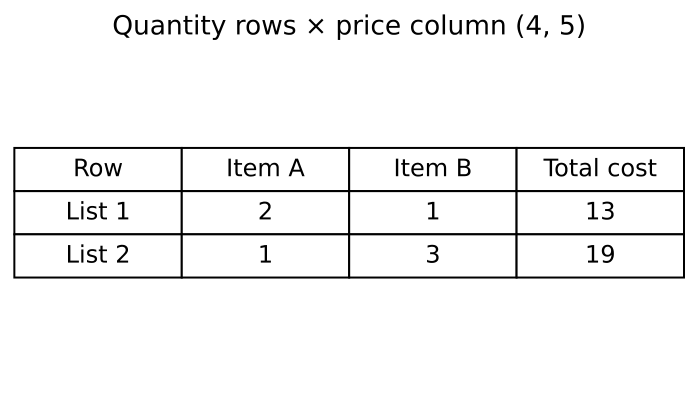
Existing worked example: Displacements (3,4) and (-1,2) sum to (2,6); the first has magnitude 5. Two shopping rows (2,1) and (1,3), with prices (4,5), give costs 2·4+1·5=13 and 1·4+3·5=19. The matrix [[2,1],[1,3]] times column [4,5] is column [13,19]. Entries represent counts times price per item.
Complete original context
Every transfer question states all data it needs.
Independent practice and checked reasoning
Transfer 1
Points A and B in metres are $(1,-2)$ and $(7,6)$. Find the displacement A to B and its magnitude. Then find the endpoint after adding displacement $(-3,2)$ metres to B.
Reasoning: $\overrightarrow{AB}=B-A=(6,8)\,\mathrm{m}$. Magnitude $|\overrightarrow{AB}|=\sqrt{6^2+8^2}\,\mathrm{m}=10\,\mathrm{m}$. New endpoint $B+(-3,2)=(4,8)$ metres. Direction must not be reversed.
Transfer 2
A shop's two orders have quantity rows $(3,2)$ and $(1,4)$ for pens and notebooks. Prices are 2 and 7 yuan respectively. Give the matrix product and both order costs.
Reasoning: $Q=\begin{pmatrix}3&2\\1&4\end{pmatrix}$, $p=\begin{pmatrix}2\\7\end{pmatrix}$ yuan per item. $Qp=\begin{pmatrix}3(2)+2(7)\\1(2)+4(7)\end{pmatrix}=\begin{pmatrix}20\\30\end{pmatrix}$ yuan. The item order must match the price order.
Transfer 3
A is 2 by 3 and B is 3 by 4. State the size of AB and whether BA is defined.
Reasoning: AB has matching inner dimension 3 and outer dimensions 2 by 4. BA would require 4=2, so it is undefined. Reversing a product is not harmless.
Limits and next use
Keep row/column shape and item order explicit. A vector’s magnitude is not the sum of its components.
All tasks here are public original practice with authored guidance. They are not official questions or fresh diagnostics. Existing protected tests and mocks remain separate.