Scope and prerequisites
ACT framework, February 2026 revision. Original classroom cases are not an official form; preserve the scored/field-test boundaries of each source form.
- Distinguish rational and irrational numbers without assuming their sums retain type
- Apply exponent and radical rules on the permitted domain
- Calculate with complex numbers using i²=-1 and conjugates
Prerequisites: Distributive law; principal roots; $i^2=-1$.
Explain and choose the method
A rational number is a ratio of integers with nonzero denominator; a terminating or repeating decimal is rational. An irrational real number is not such a ratio. Closure of rational numbers under addition and multiplication does not imply closure of irrational numbers. Exact roots may simplify: √18=3√2 remains irrational, whereas √16=4 is rational.
For a positive base, a^(m/n) combines an nth root and an integer power. A negative exponent forms a reciprocal and requires a nonzero base. Distinguish √(x²)=|x| from x. When an even root is involved, respect the real domain and the principal nonnegative root. Distribute powers across products, not across sums: (a+b)² includes the cross term.
Complex arithmetic uses i²=-1. Add real parts and imaginary parts separately, and multiply by distribution before reducing i². To divide by a+bi, multiply numerator and denominator by a-bi; the resulting denominator is a²+b² when the original is nonzero. Complex roots permit solutions to equations such as x²=-9 that have no real roots.
Enhanced ACT still includes selected advanced topics, and no formula sheet is supplied. Build familiarity with the defining rules rather than guessing from a calculator display. Check whether the question asks for real or complex solutions, an exact radical or a decimal approximation. The local checks here are formative, not an official scored form.
A complex conjugate 共轭复数 复共轭 changes the imaginary sign. $(a+bi)(a-bi)=a^2+b^2$ for real $a,b$. Thus $(2+i)/(2-i)=(2+i)^2/5=(3+4i)/5$. The denominator is nonzero; distinguish an exact value from its decimal approximation.
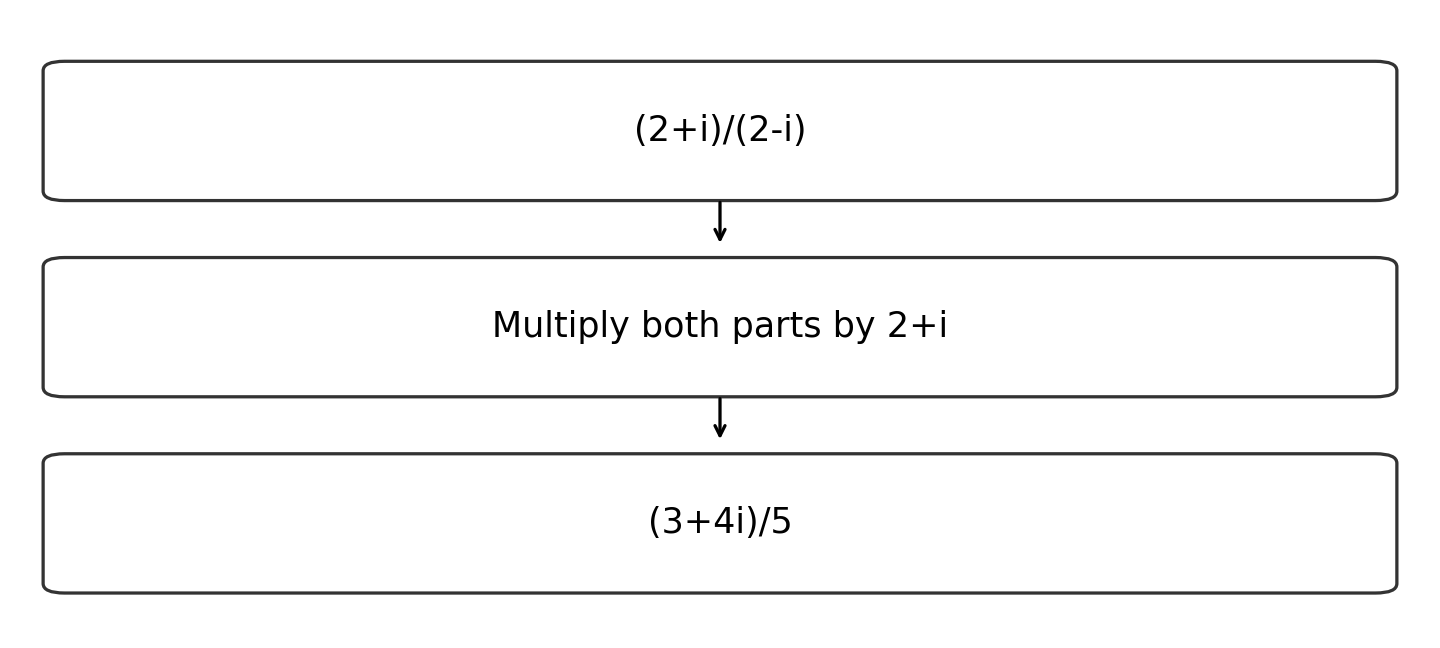
Existing worked example: 16^(3/4)=2³=8. (2+3i)(1-2i)=2-4i+3i-6i²=8-i. For (1+i)/(1-i), multiplying by 1+i gives (1+i)²/2=2i/2=i. The solutions of x²+9=0 are ±3i; neither is real.
Complete original context
Every transfer question states all data it needs.
Independent practice and checked reasoning
Transfer 1
Calculate $(3-2i)/(1+i)$ in form $a+bi$.
Reasoning: Multiply both parts by $1-i$. Numerator is $(3-2i)(1-i)=3-5i+2i^2=1-5i$. Denominator is 2. The answer is $1/2-(5/2)i$. Multiplying back by $1+i$ returns $3-2i$.
Transfer 2
Evaluate $32^{2/5}$ and $\sqrt{(-7)^2}$. Solve $z^2+16=0$ over the complex numbers.
Reasoning: The fifth root of 32 is 2, so $32^{2/5}=2^2=4$. The principal square root is $|-7|=7$. For the equation, $z^2=-16$ gives $z=4i,-4i$, both nonreal.
Transfer 3
Give one example showing that the product of two irrational numbers can be rational, and one where it is irrational.
Reasoning: $\sqrt2\sqrt2=2$ is rational. $\sqrt2\sqrt3=\sqrt6$ is irrational. Neither closure nor nonclosure for all products follows from the label irrational alone.
Transfer 4
Classify $\sqrt{50}$ and $\sqrt{50}\sqrt2$ as rational or irrational. Evaluate $32^{2/5}$ and $2^{-3}$. Use $\sqrt2$ and $-\sqrt2$ to test whether a sum of irrational numbers must be irrational.
Reasoning: $\sqrt{50}=5\sqrt2$ is irrational, while $\sqrt{50}\sqrt2=\sqrt{100}=10$ is rational. $32^{2/5}=(\sqrt[5]{32})^2=2^2=4$ and $2^{-3}=1/2^3=1/8$. The two irrational numbers sum to zero, which is rational; irrational numbers are not closed under addition. These even-root products use nonnegative real radicands.
Limits and next use
Do not infer that two irrational terms must have an irrational sum, distribute a square over addition, or replace √(x²) by x when x can be negative.
All tasks here are public original practice with authored guidance. They are not official questions or fresh diagnostics. Existing protected tests and mocks remain separate.