Scope and prerequisites
ACT framework, February 2026 revision. Original classroom cases are not an official form; preserve the scored/field-test boundaries of each source form.
- Interpret a population estimate and simulation evidence 证据 without claiming proof
- Calculate conditional, compound and expected-value quantities
- Choose permutations or combinations according to whether order matters
Prerequisites: Percentages; populations; random selection versus assignment.
Explain and choose the method
A random sample supports inference 推断 to its source population; a margin of error 误差范围 gives a sampling-uncertainty interval around an estimate. Random assignment instead supports a causal treatment comparison. In a simulation, a result rarely produced under a claim can be evidence against that claim; failure to find an unusual result does not prove the claim true.
Conditional probability 条件概率 restricts the denominator to the conditioning group. For either A or B, subtract their overlap after adding separate probabilities. Independence permits multiplication of unchanged probabilities; without-replacement draws require updated counts. Expected value 期望值 is the sum of each possible outcome times its probability, not necessarily an outcome achieved in one trial.
Use the multiplication principle for successive choices. For n distinct objects, choosing r in order gives n!/(n-r)!; choosing an unranked set gives n!/[r!(n-r)!]. Dividing by r! removes the multiple orderings of the same set. These formulas assume distinct objects and no replacement; different conditions need a corresponding count.
Translate the event to a count before calculating its probability. If a favourable event can occur in several disjoint ways, add those ways; if paths overlap, avoid double-counting. A numerical answer must be between zero and one for a probability, while an expected cost or score has the units of the outcomes.
A margin of error is added and subtracted in percentage points. Estimate 63% with margin 4 points gives 59%–67%. It is an interval from a procedure, not a guarantee that each person's response is near 63%. Random sampling supports population inference; random assignment addresses treatment comparisons.
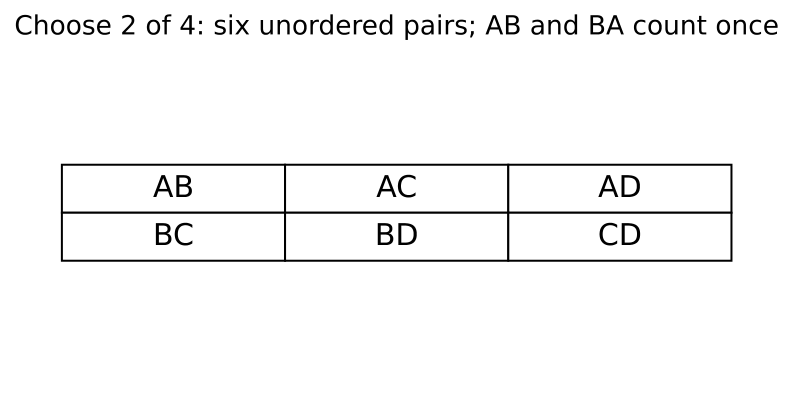
Existing worked example: From five students, captain/deputy pairs number 5·4=20; unranked pairs number 5·4/2=10. A game awards 4 points with probability 1/4 and 0 otherwise, so expected award is 1 point per play. A sample estimate 52% ±3 percentage points gives 49%–55%; it is not a guarantee about every sample or individual.
Complete original context
Every transfer question states all data it needs.
Independent practice and checked reasoning
Transfer 1
Six students choose a chairperson and a different secretary. How many assignments? How many unranked two-person committees? Explain the difference.
Reasoning: Ordered roles give $6(5)=30$. Unranked pairs count each pair twice in that product, so there are $6(5)/2=15$. Swapping people changes roles but not an unranked committee.
Transfer 2
A game pays 12 tokens with probability 0.1, 3 with probability 0.4, and zero otherwise. Entry costs 2 tokens. Find expected payout and expected net gain. Does a player receive that amount every time?
Reasoning: Remaining probability is 0.5. $E(P)=12(0.1)+3(0.4)+0(0.5)=2.4$ tokens. Expected net is $E(G)=E(P)-2=0.4$ token per play. Actual net outcomes are 10,1,-2; none equals 0.4, which is a long-run mean under the model.
Transfer 3
Two balls are drawn without replacement from a bag with 3 red and 2 blue balls. Find the probability both are red and of exactly one red.
Reasoning: $P(RR)=(3/5)(2/4)=3/10$. Exactly one red can occur as RB or BR: $P=(3/5)(2/4)+(2/5)(3/4)=3/5$. The second denominator is 4; the draws are dependent.
Transfer 4
A random sample of 500 registered library members reports 62% support for a change, with stated margin 4 percentage points. State the interval and population. Does it establish support among every town resident?
Reasoning: Interval is $62\%-4\%=58\%$ to $62\%+4\%=66\%$, where the subtraction denotes points. The population is registered members in the sampling frame. Nonmembers were not sampled, so the estimate does not establish all residents' support.
Transfer 5
Forty volunteers are randomly assigned to old or new instructions, with the same task and conditions. The new group finishes faster. What causal and population claims are reasonable?
Reasoning: Random assignment supports a causal comparison of the instruction versions for these participants under the tested conditions, subject to variation. Volunteer selection limits population generalisation. It does not establish that every future user will finish faster.
Transfer 6
A poll of 10000 website volunteers has a narrow reported margin. Explain why size alone cannot repair selection bias, and propose a better recruitment method.
Reasoning: People choosing to respond can differ systematically from those who do not. A margin for sampling variability does not remove that bias. Select randomly from the defined target population and follow up nonresponse; still report limitations.
Limits and next use
Order, replacement and conditioning change the calculation. Failing to reject a statistical claim is not proving it true.
All tasks here are public original practice with authored guidance. They are not official questions or fresh diagnostics. Existing protected tests and mocks remain separate.