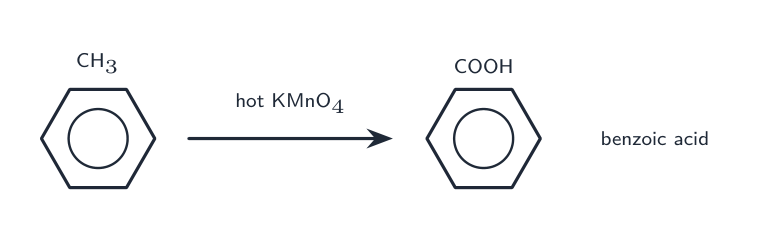
- recall the reaction by which benzoic acid can be produced: (a) reaction of an alkylbenzene with hot alkaline $\text{KMnO}_4$ and then dilute acid, exemplified by methylbenzene
- describe the reaction of carboxylic acids with $\text{PCl}_3$ and heat, $\text{PCl}_5$ or $\text{SOCl}_2$ to form acyl chlorides
- recognise that some carboxylic acids can be further oxidised: (a) the oxidation of methanoic acid, $\text{HCOOH}$, with Fehling’s reagent or Tollens’ reagent or acidified $\text{KMnO}_4$ or acidified $\text{K}_2\text{Cr}_2\text{O}_7$ to carbon dioxide and water (b) the oxidation of ethanedioic acid, $\text{HOOCCOOH}$, with warm acidified $\text{KMnO}_4$ to carbon dioxide
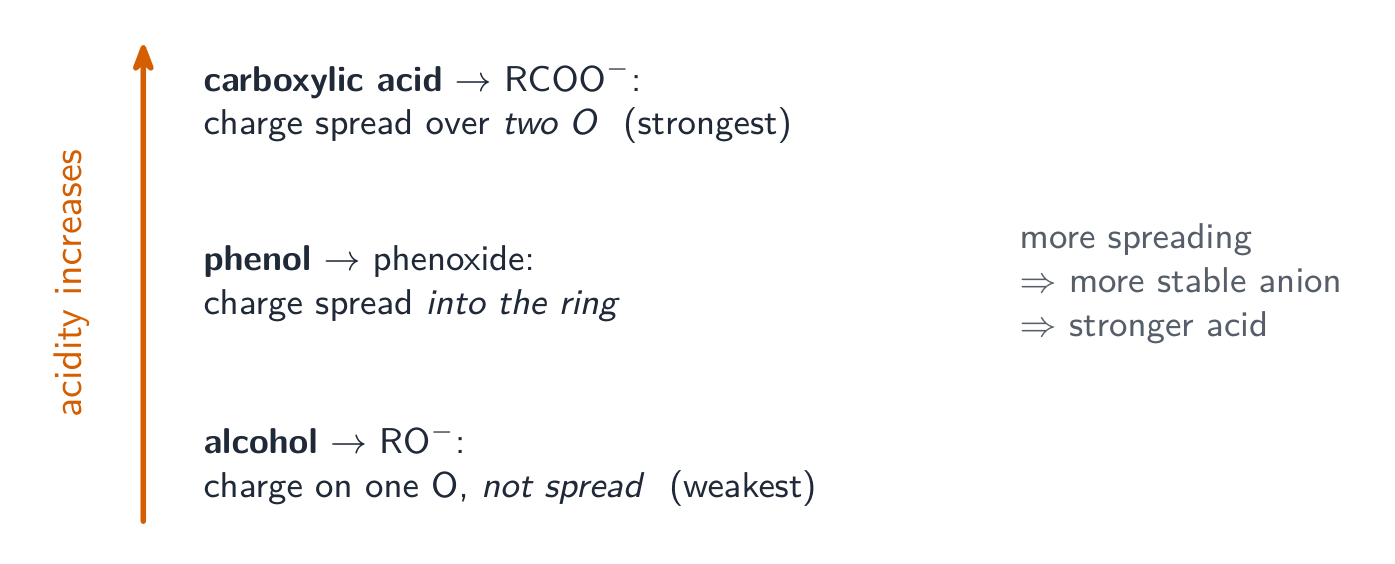
- describe and explain the relative acidities of carboxylic acids, phenols and alcohols
- describe and explain the relative acidities of chlorine-substituted carboxylic acids
Carboxylic acids and derivatives
A-Level Chemistry · Topic 33
 8:08
Carboxylic acids and derivatives (A2)
Open a medicine cabinet and pick up a packet of aspirin. That tablet is an ester. At AS you met one small group: the carboxyl group. At A2 it becomes three new…
English narration · English + 中文 subtitles burned in
33.1
Carboxylic acids
Syllabus
Source: Cambridge International syllabus
Making and reacting
- an alkylbenzene 烷基苯 (such as methylbenzene) is oxidised by hot alkaline $\text{KMnO}_4$, then dilute acid, to give benzoic acid 苯甲酸. The whole side-chain becomes a $\text{–COOH}$ group.
- a carboxylic acid reacts with $\text{PCl}_3$ and heat, $\text{PCl}_5$, or $\text{SOCl}_2$ to form an acyl chloride 酰氯.
Acids that can be oxidised further
Two carboxylic acids 羧酸 are special because they can still be oxidised:
- methanoic acid ($\text{HCOOH}$) is oxidised by Fehling's or Tollens' reagent, or acidified $\text{KMnO}_4$ / $\text{K}_2\text{Cr}_2\text{O}_7$, to carbon dioxide and water.
- ethanedioic acid ($\text{HOOCCOOH}$) is oxidised by warm acidified $\text{KMnO}_4$ to carbon dioxide.
Relative acidities
The acidity 酸性 order is:
$$\text{alcohol} < \text{phenol} < \text{carboxylic acid}$$
A carboxylic acid is the strongest because, when it loses $\text{H}^+$, the negative charge is spread over two oxygen atoms, making the ion very stable. In a phenol 苯酚 the charge spreads only into the ring, and in an alcohol 醇 (giving $\text{RO}^-$) it is not spread at all.
Chlorine atoms make a carboxylic acid more acidic. Chlorine is electron-withdrawing 吸电子: through the inductive effect 诱导效应 it pulls electron density away, helping to spread the negative charge and stabilise the ion. So more chlorine atoms (closer to the $\text{–COOH}$) give a stronger acid.
Explore
Carboxylic acid A2 map
Follow carboxylic acids through acyl derivatives and salts.
Vocabulary
Train
| English |
|---|
| carboxylic acid/ˌkɑːbəkˈsɪlɪk ˈæsɪd/ |
| alkylbenzene/ˈælkɪlbenziːn/ |
| benzoic acid/benˈzəʊɪk ˈæsɪd/ |
| acyl chloride/əˈkɪl ˈklɔːraɪd/ |
| acidity/æˈsɪdɪti/ |
| phenol/ˈfenɒl/ |
| alcohol/ˈælkəhɒl/ |
| electron-withdrawing/ɪˈlektrɒn wɪθˈdrɔːɪŋ/ |
| inductive effect/ɪnˈdʌktɪv ɪˈfekt/ |
33.2
Esters
Syllabus
- recall the reaction by which esters can be produced: (a) reaction of alcohols with acyl chlorides using the formation of ethyl ethanoate and phenyl benzoate as examples
Source: Cambridge International syllabus
An alcohol (or phenol) reacts with an acyl chloride at room temperature to give an ester 酯 and $\text{HCl}$. Examples are ethyl ethanoate (from ethanol) and phenyl benzoate (from phenol).
Explore
Ester A2 reaction map
Compare ester formation, hydrolysis and transesterification routes.
Vocabulary
Train
| English |
|---|
| ester/ˈestə/ |
33.3
Acyl chlorides
Syllabus
- recall the reactions (reagents and conditions) by which acyl chlorides can be produced: (a) reaction of carboxylic acids with $\text{PCl}_3$ and heat, $\text{PCl}_5$ or $\text{SOCl}_2$
- describe the following reactions of acyl chlorides: (a) hydrolysis on addition of water at room temperature to give the carboxylic acid and $\text{HCl}$ (b) reaction with an alcohol at room temperature to produce an ester and $\text{HCl}$ (c) reaction with phenol at room temperature to produce an ester and $\text{HCl}$ (d) reaction with ammonia at room temperature to produce an amide and $\text{HCl}$ (e) reaction with a primary or secondary amine at room temperature to produce an amide and $\text{HCl}$
- describe the addition–elimination mechanism of acyl chlorides in reactions in 33.3.2(a)–(e)
- explain the relative ease of hydrolysis of acyl chlorides, alkyl chlorides and halogenoarenes (aryl chlorides)
Source: Cambridge International syllabus
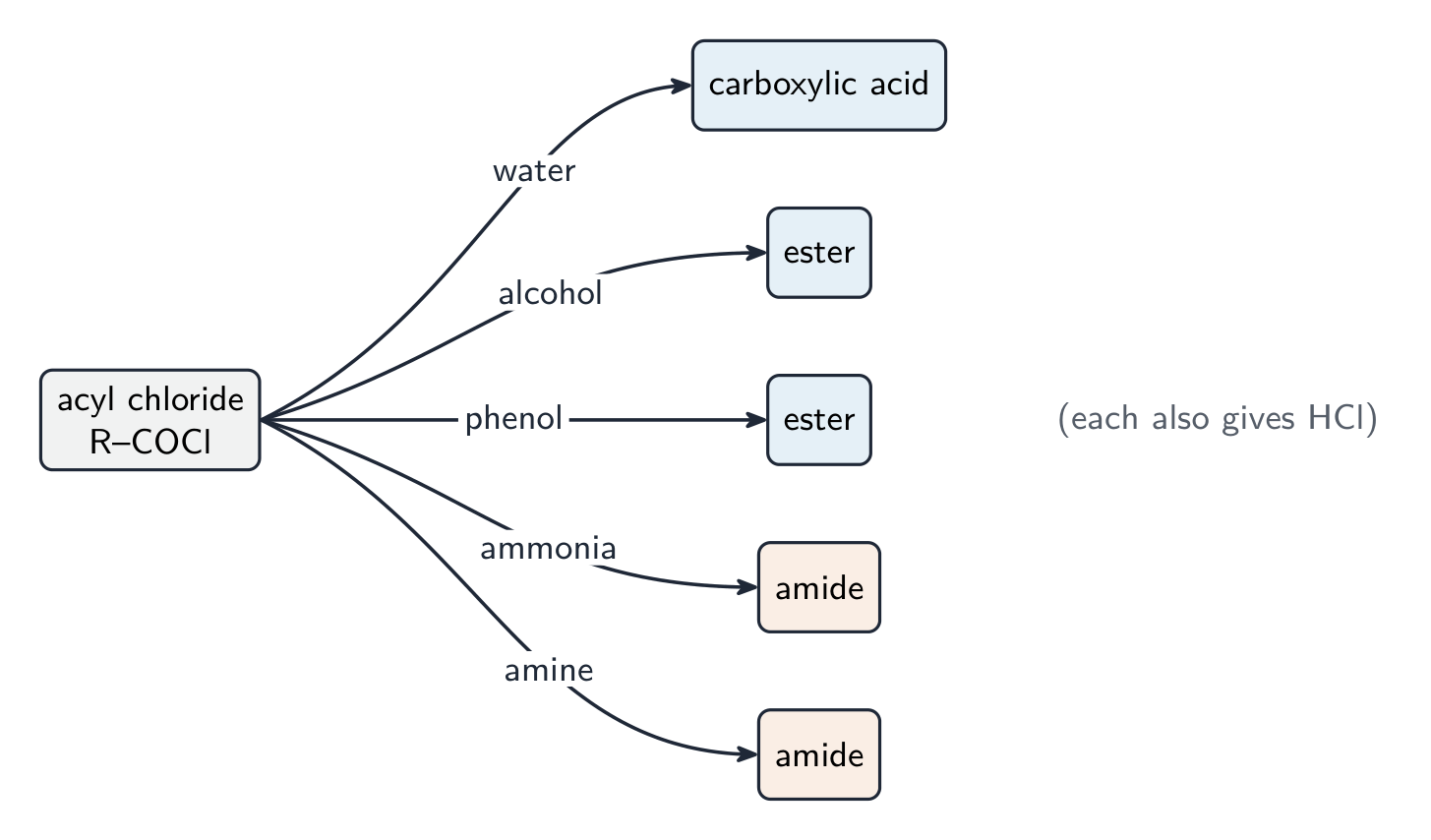
Acyl chlorides are made from carboxylic acids (with $\text{PCl}_3$, $\text{PCl}_5$ or $\text{SOCl}_2$). They are very reactive. At room temperature they react with:
| Reactant | Product (plus $\text{HCl}$) |
|---|---|
| water | the carboxylic acid |
| an alcohol | an ester |
| phenol | an ester |
| ammonia 氨 | an amide 酰胺 |
| a primary or secondary amine 胺 | an amide |
The addition–elimination mechanism
All these reactions follow an addition–elimination 加成消去 mechanism: a nucleophile first adds to the slightly positive carbonyl carbon, then $\text{HCl}$ is eliminated. The carbonyl carbon is very $\delta+$ because two electronegative atoms, O and Cl, pull electrons away from it. Water, alcohols, ammonia and amines are neutral, but each has a lone pair on its O or N, so each can act as a nucleophile.
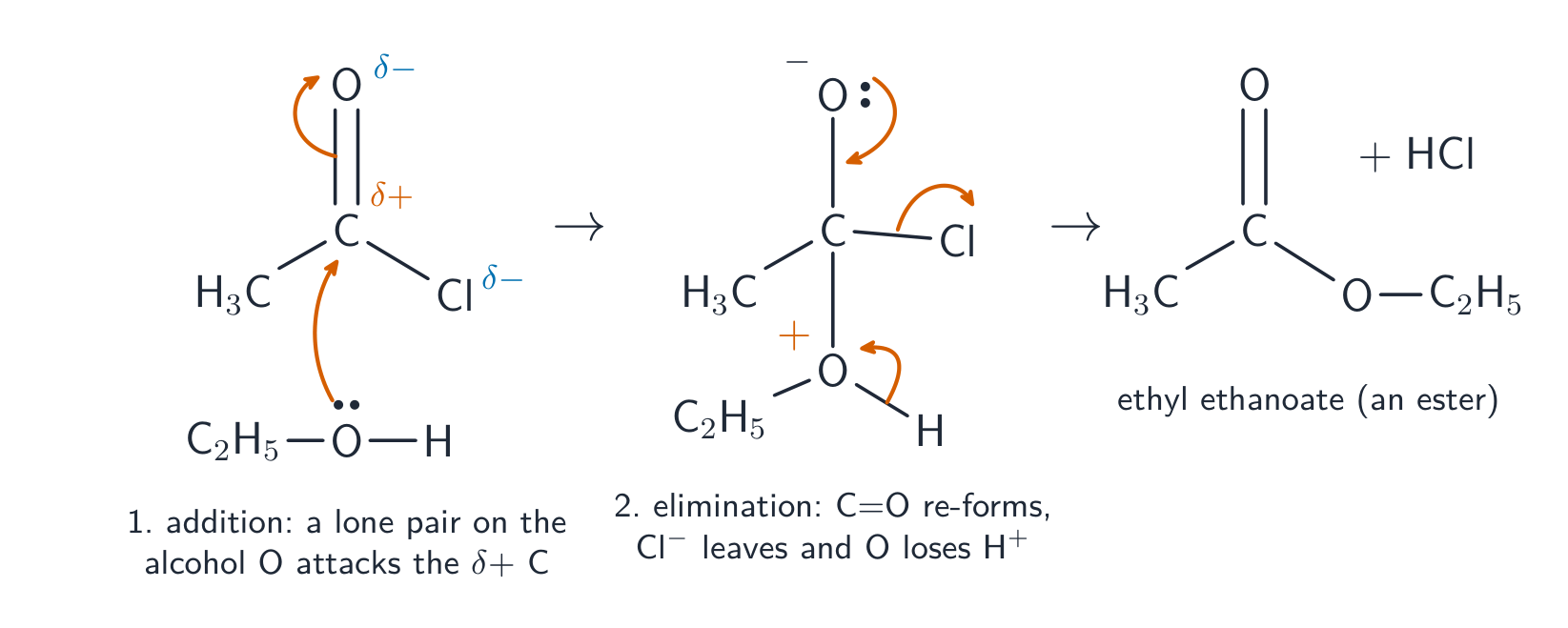
- Addition. A lone pair on the O of ethanol attacks the $\delta+$ carbon. One pair of the C=O bond moves onto the O, which becomes $\text{O}^-$. The ethanol O now has three bonds and a $+$ charge. The carbon is tetrahedral 四面体形 for a moment, with four groups around it.
- Elimination. A lone pair on the $\text{O}^-$ moves back to re-form C=O. The C–Cl bond pair goes onto the Cl, which leaves as $\text{Cl}^-$. The $\text{O}^+$ loses $\text{H}^+$, and $\text{H}^+ + \text{Cl}^-$ make $\text{HCl}$.
Swap the nucleophile and the same arrows give the other products: water gives ethanoic acid, ammonia gives ethanamide, and an amine gives an N-substituted amide. With ammonia or an amine, the $\text{HCl}$ then reacts with a second molecule of the base to form an ammonium salt.
Common mistakes.
- Drawing $\text{Cl}^-$ leaving in the first step, as if this were S$_\text{N}$1. The nucleophile adds first; Cl only leaves when the C=O re-forms.
- Starting the attacking arrow at the H of water or the alcohol. It must start at a lone pair on the O (or the N of ammonia).
- Missing the arrow that re-forms C=O, or the $+$ charge on the O (or N) of the intermediate.
Ease of hydrolysis
Compare how easily three chlorides react with water (hydrolysis 水解):
$$\text{acyl chloride} \gg \text{alkyl chloride} \gg \text{aryl chloride}$$
An acyl chloride reacts violently with cold water; an alkyl chloride reacts slowly; an aryl chloride (halogenoarene) does not react, because its C–Cl bond is strengthened by the ring.
Worked example. Ethanoyl chloride reacts violently with cold water, while ethyl ethanoate needs prolonged reflux with acid or alkali. Explain the difference. Both are attacked at the carbonyl carbon, so compare how open that carbon is to attack and how good the leaving group is. In ethanoyl chloride the chlorine is strongly electronegative and withdraws electrons, making the carbonyl carbon much more $\delta+$ and so far more open to a nucleophile; and $\text{Cl}^{-}$, the anion of a strong acid, is a good leaving group. In the ester the $\text{–OR}$ oxygen donates a lone pair into the carbonyl, reducing that $\delta+$ charge, and $\text{RO}^{-}$ is a poor leaving group. So the acyl chloride hydrolyses far more easily. Argue from both the $\delta+$ on the carbon and the leaving group: either one alone is usually only half the marks.
Explore
Acyl chloride reaction map
Follow why acyl chlorides are reactive acylating agents.
Vocabulary
Train
| English |
|---|
| ammonia/æˈməʊnɪə/ |
| amide/əˈmaɪd/ |
| amine/ˈæmaɪn/ |
| addition–elimination/əˈdɪʃn ɪˌlɪmɪˈneɪʃn/ |
| tetrahedral/ˌtetrəˈhiːdrəl/ |
| hydrolysis/haɪˈdrɒləsɪs/ |
33.3
Exam tips
- Acyl chlorides are very reactive — learn their products with water (HCl), alcohols (esters), ammonia (amides) and amines.
- Reactivity order of derivatives: acyl chloride > ester > amide.
- Acid strength: electron-withdrawing groups (e.g. Cl) increase it — explain via the carboxylate ion.
Interactive lessons on this topic
Work through it step by step, with instant-check exercises.