- describe and explain qualitatively the trend in the thermal stability of the nitrates and carbonates including the effect of ionic radius on the polarisation of the large anion
- describe and explain qualitatively the variation in solubility and of enthalpy change of solution, $\Delta H^{\ominus}_{\text{sol}}$, of the hydroxides and sulfates in terms of relative magnitudes of the enthalpy change of hydration and the lattice energy
Group 2
A-Level Chemistry · Topic 27
 8:06
Group 2 (A2)
Here is a puzzle. Go down Group 2, from magnesium to barium, and the hydroxides get more soluble. Go down the same group, and the sulfates get less soluble.…
English narration · English + 中文 subtitles burned in
27.1
Thermal stability of the nitrates and carbonates

Syllabus
Source: Cambridge International syllabus
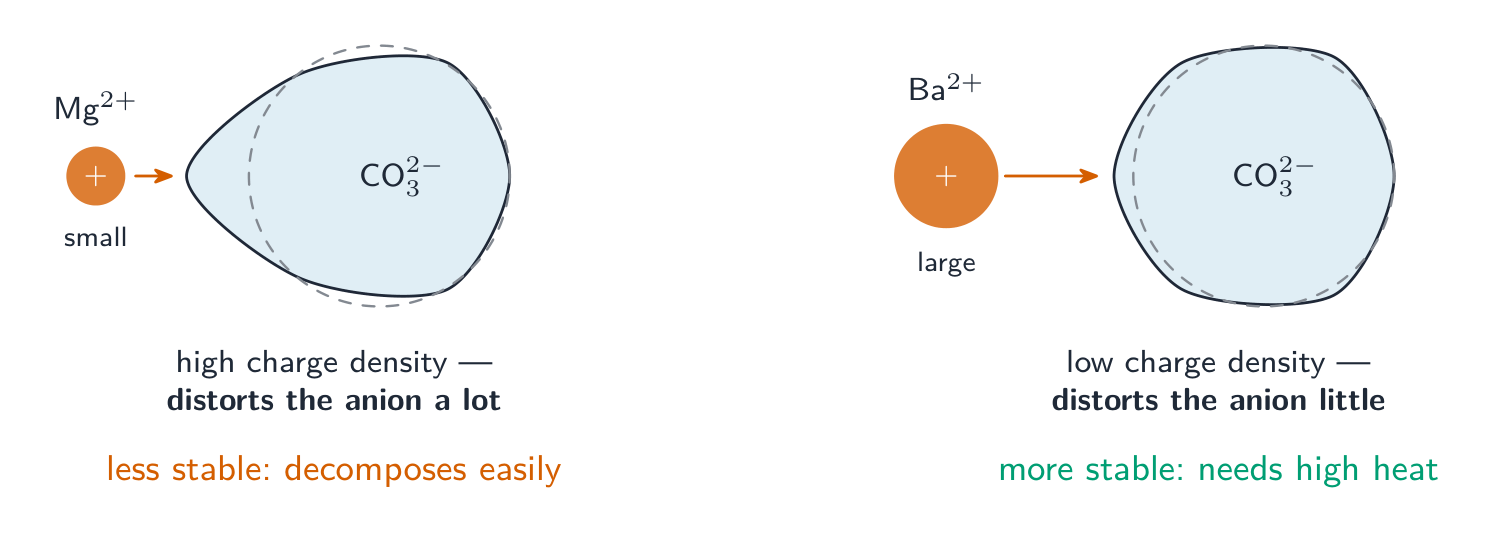
The thermal stability 热稳定性 of the Group 2 第2族 nitrates 硝酸盐 and carbonates 碳酸盐 increases down the group. Here is the reason, in terms of how the ions affect each other.
A small cation 阳离子 with a small ionic radius 离子半径 has a high charge density 电荷密度. It pulls on the electrons of the nearby anion and distorts 使变形 its shape — this is polarisation 极化. Distorting the large anion 阴离子 (the carbonate or nitrate ion) weakens a bond inside it, so the compound breaks down more easily.
Going down the group, the cation gets larger. Its charge density drops, so it polarises 使极化 the anion less. The anion is less distorted, so the compound is harder to break down — it is more thermally stable 热稳定的 and needs a higher temperature to decompose 分解.
Worked example. Down Group 2 the hydroxides become more soluble while the sulfates become less soluble. Explain why the two trends run in opposite directions. Solubility is a contest between the lattice energy holding the solid together and the hydration energy rewarding the ions for dissolving. Both get less exothermic as the cation grows, so whichever falls faster decides the trend. With the small hydroxide ion, the lattice energy depends strongly on the cation's size, so it falls faster than the hydration energy: the lattice gets relatively easier to break and solubility rises. With the large sulfate ion, the lattice energy is already dominated by that big anion and barely changes down the group, while the cation's hydration energy still falls - so solubility falls. Name both energies and say which one falls faster; simply restating the trends earns no explanation marks.
Explore
Group 2 thermal stability ladder
Move down Group 2 and see why carbonates become harder to decompose.
Explore
Group 2 solubility lab
Classify Group 2 compounds by solubility trend.
Vocabulary
Train
| English |
|---|
| thermal stability/ˈθɜːml stəˈbɪlɪti/ |
| Group 2 |
| nitrate/ˈnaɪtreɪt/ |
| carbonate/ˈkɑːbəneɪt/ |
| cation/ˈkætaɪən/ |
| ionic radius/aɪˈɒnɪk ˈreɪdɪəs/ |
| charge density/tʃɑːdʒ ˈdensɪti/ |
| distorts |
| polarisation/ˌpəʊləraɪˈzeɪʃn/ |
| anion/ˈænaɪən/ |
| decompose/ˌdiːkəmˈpəʊz/ |
| polarises/ˈpəʊləraɪzɪz/ |
| thermally stable |
27.1
Solubility of the hydroxides and sulfates
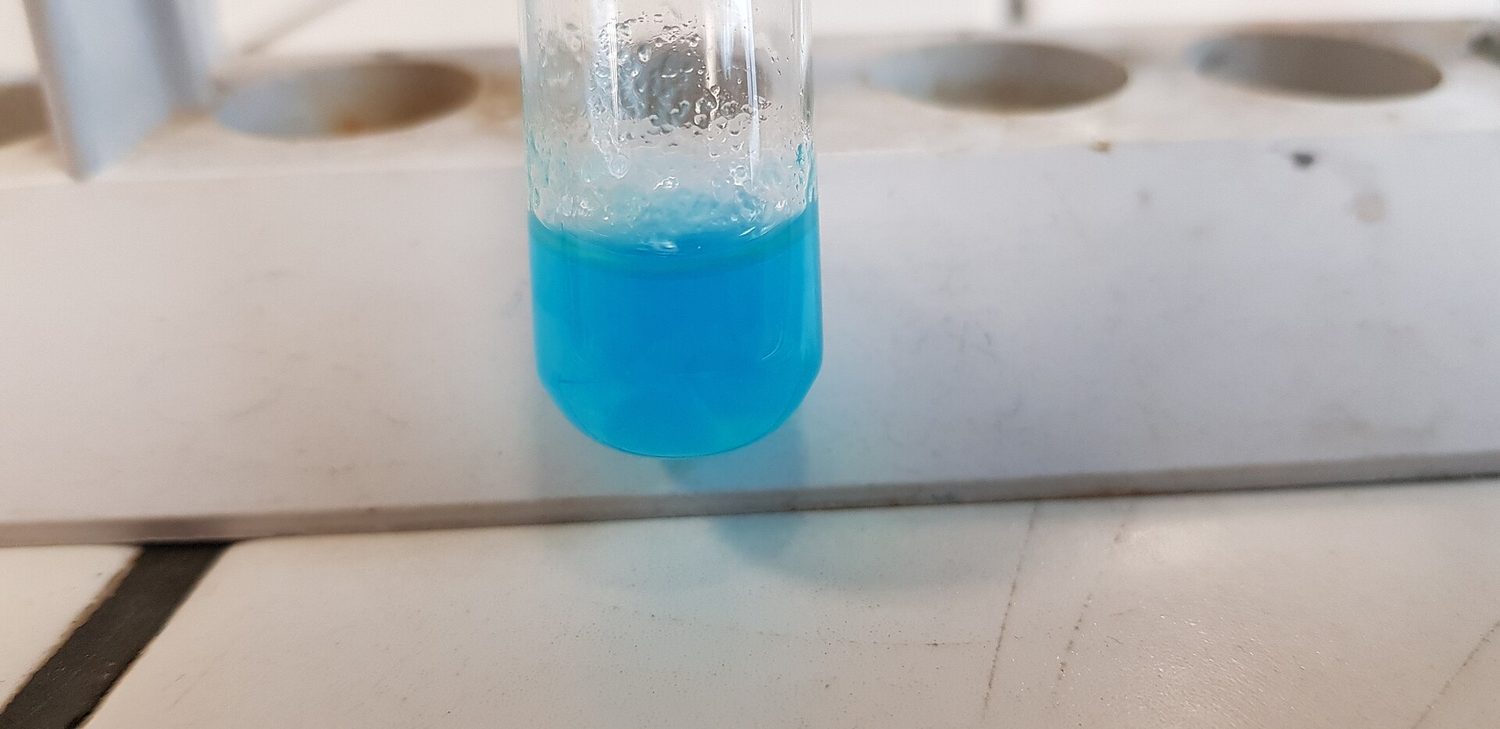
When an ionic solid 离子固体 dissolves 溶解, two energy changes compete. The enthalpy change of solution 溶解焓变 is the sum of them:
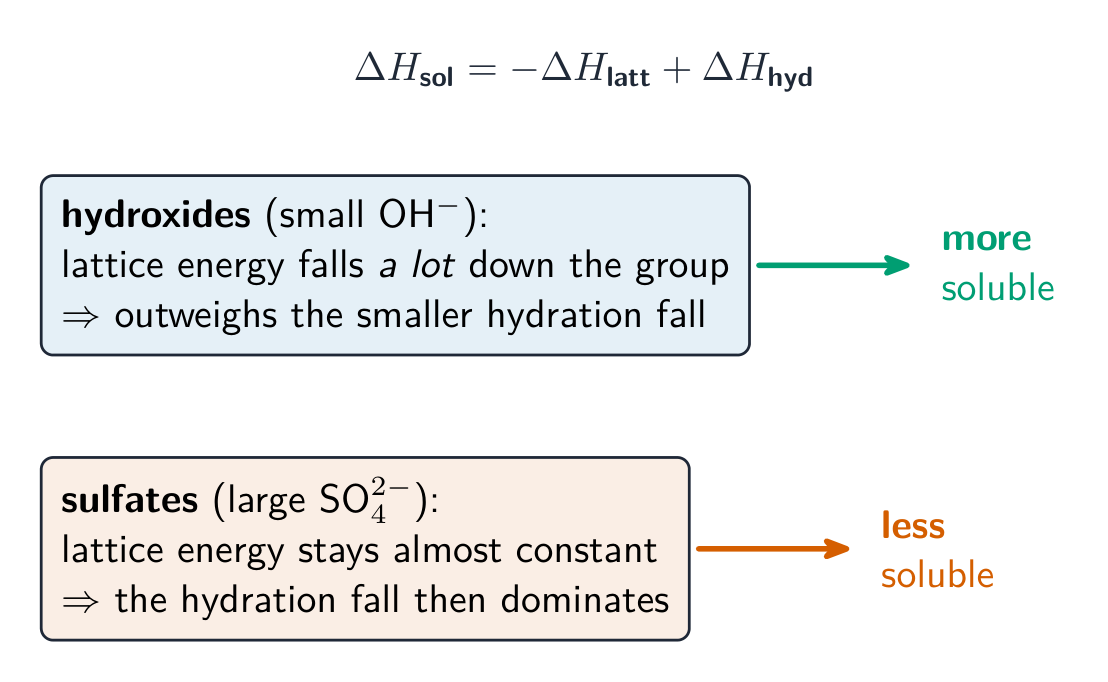
$$\Delta H^{\ominus}_{\text{sol}} = -\Delta H_{\text{latt}} + \Delta H_{\text{hyd}}$$
- you must first pull the lattice 晶格 apart (this needs the lattice energy 晶格能).
- then water surrounds the ions 离子 (this releases the enthalpy change of hydration 水合焓变).
If the energy released on hydration roughly matches (or beats) the energy needed to break the lattice, the solid dissolves easily.
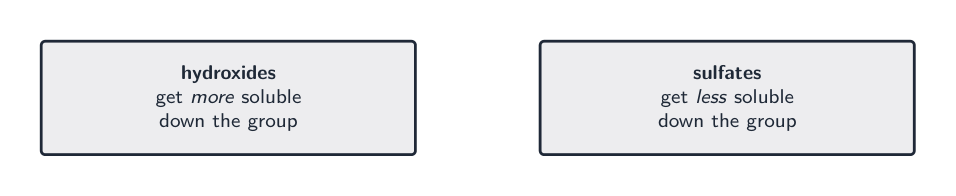
Going down the group, both the lattice energy and the hydration enthalpy 水合焓 get smaller (less negative), because the cation is larger. But they shrink at different rates, and this explains the opposite trends 趋势:
| Compound | Trend in solubility 溶解度 down the group | Why |
|---|---|---|
| hydroxides 氢氧化物 | increases | the $\text{OH}^-$ ion is small, so the lattice energy falls a lot down the group; this change outweighs 超过 the fall in hydration energy |
| sulfates 硫酸盐 | decreases | the $\text{SO}_4^{2-}$ ion is large, so the lattice energy stays almost the same; the fall in hydration energy then dominates 起主导作用, so dissolving becomes less favourable 有利的 |
Common mistakes.
- Saying the anion polarises the cation. The small, highly charged cation polarises (distorts) the large carbonate or nitrate anion.
- Explaining thermal stability by "bigger atoms" or "more shells" alone. Link the size to charge density: a larger cation with the same $2+$ charge has a lower charge density, so it polarises the anion less.
- Saying a larger lattice energy makes a solid more soluble. A more exothermic lattice energy means more energy is needed to break the lattice, so it makes dissolving less favourable.
- Explaining the sulfate trend by the lattice energy falling. For the large $\text{SO}_4^{2-}$ ion the lattice energy hardly changes; it is the fall in hydration enthalpy that makes the sulfates less soluble.
- Forgetting the oxygen when a nitrate decomposes. Group 2 nitrates give the oxide, brown $\text{NO}_2$ and $\text{O}_2$: $2\text{Mg(NO}_3)_2 \rightarrow 2\text{MgO} + 4\text{NO}_2 + \text{O}_2$.
Vocabulary
Train
| English |
|---|
| ionic solid/aɪˈɒnɪk ˈsɒlɪd/ |
| dissolves |
| enthalpy change of solution/enˈθælpi tʃeɪndʒ ɒv səˈluːʃn/ |
| lattice/ˈlætɪs/ |
| lattice energy/ˈlætɪs ˈenədʒi/ |
| ions/ˈaɪɒnz/ |
| enthalpy change of hydration/enˈθælpi tʃeɪndʒ ɒv haɪˈdreɪʃn/ |
| hydration enthalpy/haɪˈdreɪʃn enˈθælpi/ |
| trends/trendz/ |
| solubility/ˌsɒljuːˈbɪlɪti/ |
| hydroxide/haɪˈdrɒksaɪd/ |
| outweighs |
| sulfate/ˈsʌlfeɪt/ |
| dominates |
| favourable/ˈfeɪvərəbl/ |
27.1
Exam tips
- Thermal stability of carbonates and nitrates increases down the group — larger cations polarise the anion less.
- Give the decomposition products 分解产物: carbonates → oxide 氧化物 + $\text{CO}_2$; nitrates → oxide + $\text{NO}_2$ + $\text{O}_2$ (brown gas).
- Hydroxides get more soluble 可溶的 and sulfates less soluble down the group.
- Explain trends with cation charge density (polarising power 极化能力), not just size.
Vocabulary
Train
| English |
|---|
| decomposition products |
| oxide/ˈɒksaɪd/ |
| soluble/ˈsɒljuːbl/ |
| polarising power/ˈpəʊləraɪzɪŋ ˈpaʊə/ |
Interactive lessons on this topic
Work through it step by step, with instant-check exercises.