Skip to content · ⁨コンテンツへスキップ⁩
Subjects · ⁨科目⁩

AP Drawing · ⁨AP ドローイング⁩

Tips · ⁨ヒント⁩

AP Drawing is a portfolio course, not an exam course. You submit fifteen Selected Works demonstrating drawing skills — mark-making, line quality, composition, surface and light — and a Sustained Investigation of fifteen images with written evidence of how one inquiry question developed.

Drawing here is broader than pencil on paper. Painting, printmaking and digital work all qualify, provided the drawing decisions are what the work is built on.

The Sustained Investigation rewards visible development. Keep the experiments and the failures, photograph and date every stage, and write the inquiry question specifically enough that evidence of progress is possible.

A portfolio course rather than an exam: the notes cover what the Sustained Investigation and Selected Works sections ask for, including how the written responses are marked. The library carries the published scoring guidelines rather than past papers.

Train all vocabulary · ⁨全語彙を練習する⁩
  • 1

    Line and Mark-Making · ⁨線画とマーカー⁩

    Watch lesson · ⁨レッスンを視聴⁩
    1.1

    Line Quality

    Syllabus · ⁨シラバス⁩
    English

    Focus: Line quality is how a line looks and feels — the first drawing skill the AP rubric names is mark-making.

    • A line can be thick or thin, dark or light, smooth or rough, fast or slow.
    • Weighted line changes thickness along its length: press harder where a form turns away or carries weight.
    • Confident lines are drawn from the shoulder and elbow, not only the fingers.
    • Lost-and-found lines fade out and reappear — the viewer's eye completes the edge.
    • Line direction carries feeling: horizontal is calm, vertical is firm, diagonal is active.
    • Examiners read line quality instantly — scratchy, timid lines and one confident stroke tell different stories.
    日本語

    焦点: ラインの品質とは、線がどのように見えて感じられるか——APルーブリックで最初に挙げられる描画スキルは マークメイキング です。

    • ラインは太也可以是細く、濃也可以是淡く、滑らかな也可以是粗く、速也可以是遅く也可以是あります。
    • ウェイト付きライン は長さ全体で太さが変化します:形が背中へ向かう部分や重量を支える部分を強く押します。
    • 確信のあるラインは指だけでなく、肩と肘から描きます。
    • ロスト・アンド・ファウンド・ライン は消えたり再び現れたりし、鑑賞者の目が輪郭を補完します。
    • ラインの方向には感情が込められます:水平は穏やか、垂直は堅固、斜めは活発です。
    • 採点者はラインの品質を瞬時に読み取ります:こぼれや臆病な線と、自信ある一筆は異なる物語を語ります。

    Source: College Board AP Course and Exam Description · ⁨出典: College Board AP コースおよび試験説明書⁩

    English

    Line quality 线条质感 is how a line looks and feels. The AP Drawing rubric names mark-making 笔触 first in its list of drawing skills, and line is the most basic mark.

    • A line can be thick or thin, dark or light, smooth or rough, fast or slow.
    • A weighted line 轻重线条 changes thickness along its length. Press harder where a form turns away from the light or carries weight.
    • Lost-and-found lines 虚实线条 fade out and come back. The viewer's eye completes the missing edge.
    • Confident lines come from the shoulder and elbow, not only the fingers.

    Line direction carries feeling: horizontal lines feel calm, vertical lines feel firm, and diagonal lines feel active. Examiners read line quality instantly, so practise until your lines look decided, not timid.

    日本語

    Line quality 线条质感 is how a line looks and feels. The AP Drawing rubric names mark-making 笔触 first in its list of drawing skills, and line is the most basic mark.

    • A line can be thick or thin, dark or light, smooth or rough, fast or slow.
    • A weighted line 轻重线条 changes thickness along its length. Press harder where a form turns away from the light or carries weight.
    • Lost-and-found lines 虚实线条 fade out and come back. The viewer's eye completes the missing edge.
    • Confident lines come from the shoulder and elbow, not only the fingers.
    Line qualities: even, weighted, lost-and-found, and expressive lines compared
    The same edge drawn four ways: an even line, a weighted line, a lost-and-found line, and a fast expressive line

    Line direction carries feeling: horizontal lines feel calm, vertical lines feel firm, and diagonal lines feel active. Examiners read line quality instantly, so practise until your lines look decided, not timid.

    Vocabulary · ⁨語彙⁩ Train · ⁨練習する⁩
    English 日本語
    line quality/laɪn ˈkwɒlɪti/ ライン品質
    mark-making/mɑːk ˈmeɪkɪŋ/ マーク-making
    weighted line/ˈweɪtɪd laɪn/ 重み付けされた線
    lost-and-found lines/lɒst ænd faʊnd laɪnz/ lost-and-found lines(見つけ出し線)
    1.2

    Contour Drawing

    Syllabus · ⁨シラバス⁩
    English

    Focus: Contour drawing follows the edges of a form slowly and carefully — it trains eye-hand coordination.

    • A contour line traces the outer edge and the inner edges (folds, creases, overlaps) of a subject.
    • In blind contour you draw without looking at the paper — pure observation practice.
    • Cross-contour lines travel across the surface of a form, like latitude lines on a globe, and describe volume.
    • Draw slowly: match the speed of your eye moving along the edge with the speed of your pencil.
    • Overlapping contours (one edge passing in front of another) create instant depth.
    • Contour studies make strong Sustained Investigation process pages — they show observation skill.
    日本語

    焦点: コントゥア・ドローイング は、形のエッジをゆっくりかつ慎重にたどることで、_eye-hand coordination(眼の手調整)を鍛えます。

    • コントゥア・ライン は、被写体の外側のエッジおよび内側のエッジ(しわ、折り目、重なりの部分)を追跡します。
    • ブラインド・コントゥア では紙を見ずに描き、純粋な観察練習を行います。
    • クロス・コントゥア・ライン は形の表面を横切って走り、地球儀の緯度線のように体積を表現します。
    • ゆっくり描く:眼がエッジを移動する速度と鉛筆の動きの速度を合わせる。
    • 重なるコントゥア(一方のエッジが他方より手前を通る場合)は、瞬時に奥行きを生みます。
    • コントゥア・スタディは強力な Sustained Investigation(継続的調査)プロセスページとなります。観察力を示しています。

    Source: College Board AP Course and Exam Description · ⁨出典: College Board AP コースおよび試験説明書⁩

    English

    A contour line 轮廓线 traces the edges of a form — the outer edge and the inner edges made by folds, creases, and overlaps. Contour drawing is slow, careful looking.

    • Match the speed of your eye moving along the edge with the speed of your pencil.
    • In blind contour 盲画轮廓 you draw without looking at the paper. It feels strange, but it trains pure observation.
    • Cross-contour lines 横截轮廓线 travel across the surface of a form, like latitude lines on a globe. They describe volume, not edges.
    • Overlapping contours create instant depth: one edge passing in front of another says "this is closer".

    Contour studies make strong process pages for the Sustained Investigation because they show real observation skill.

    日本語

    A contour line 轮廓线 traces the edges of a form — the outer edge and the inner edges made by folds, creases, and overlaps. Contour drawing is slow, careful looking.

    • Match the speed of your eye moving along the edge with the speed of your pencil.
    • In blind contour 盲画轮廓 you draw without looking at the paper. It feels strange, but it trains pure observation.
    • Cross-contour lines 横截轮廓线 travel across the surface of a form, like latitude lines on a globe. They describe volume, not edges.
    • Overlapping contours create instant depth: one edge passing in front of another says "this is closer".

    Contour studies make strong process pages for the Sustained Investigation because they show real observation skill.

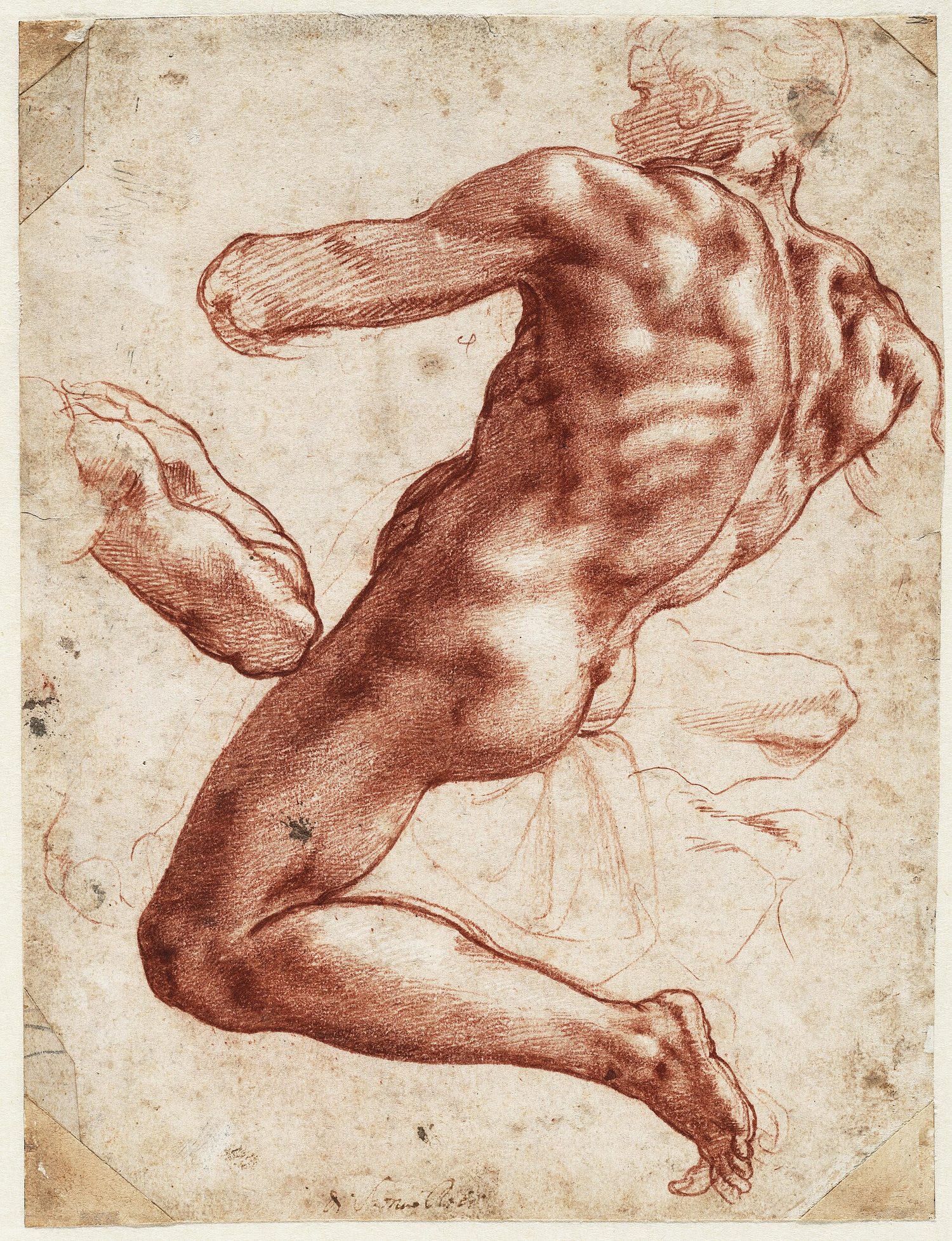
    Gesture and contour from a master study: line records form in one continuous look
    Gesture and contour from a master study: line records form in one continuous look
    Vocabulary · ⁨語彙⁩ Train · ⁨練習する⁩
    English 日本語
    contour line/ˈkɒntʊə laɪn/ コンターライン
    blind contour/blaɪnd ˈkɒntʊə/ blind contour(盲線)
    cross-contour lines/krɒs ˈkɒntʊə laɪnz/ クロスカントーア線
    1.3

    Gesture Drawing

    Syllabus · ⁨シラバス⁩
    English

    Focus: Gesture drawing captures the energy, movement, and weight of a subject in seconds — before any detail.

    • A gesture drawing takes 30 seconds to 3 minutes; it looks for the action line running through the pose.
    • Draw the whole subject at once — big loose lines from the shoulder — never one polished corner.
    • Look for the line of action first: one curve that summarises the pose's movement.
    • Gesture is about what the subject is doing, not what it looks like.
    • Daily gesture pages build speed and confidence, and they photograph well as process evidence.
    • Long drawings usually start as a gesture: energy first, structure second, detail last.
    日本語

    焦点: ジェスチャー・ドローイング は、詳細を描く前に、被写体のエネルギー、動き、重みを数秒で捉えます。

    • ジェスチャー・ドローイングは30秒〜3分で行われ、ポーズを通り抜ける アクション・ライン を探します。
    • 全体を一度に描く:肩からの大きく緩やかな線—— polished corner(整った角)を一つだけ描かない。
    • まず ライン・オブ・アクション を探す:ポーズの動きを要約する一本のカーブ。
    • ジェスチャーとは、それがどう見えるかではなく、被写体が何をしているか についてです。
    • 毎日のジェスチャー・ページはスピードと自信を高め、プロセス証拠として写真撮影にも適しています。
    • 長めの絵は通常ジェスチャーから始める:エネルギーを先に、構造をその後に、ディテールを最後に。

    Source: College Board AP Course and Exam Description · ⁨出典: College Board AP コースおよび試験説明書⁩

    English

    Gesture drawing 动态速写 captures the energy, movement, and weight of a subject in seconds — before any detail.

    • A gesture drawing takes 30 seconds to 3 minutes. Draw the whole subject at once with big, loose lines.
    • Look for the line of action 动势线 first: one curve that summarises the movement of the pose.
    • Gesture asks what the subject is doing, not what it looks like.
    • Long drawings usually start as a gesture: energy first, structure second, detail last.

    Daily gesture pages build speed and confidence, and they photograph well as evidence of practice.

    日本語

    Gesture drawing 动态速写 captures the energy, movement, and weight of a subject in seconds — before any detail.

    • A gesture drawing takes 30 seconds to 3 minutes. Draw the whole subject at once with big, loose lines.
    • Look for the line of action 动势线 first: one curve that summarises the movement of the pose.
    • Gesture asks what the subject is doing, not what it looks like.
    • Long drawings usually start as a gesture: energy first, structure second, detail last.

    Daily gesture pages build speed and confidence, and they photograph well as evidence of practice.

    Gesture captures action in a few lines before detail begins
    Gesture captures action in a few lines before detail begins
    Vocabulary · ⁨語彙⁩ Train · ⁨練習する⁩
    English 日本語
    gesture drawing/ˈdʒestʃə ˈdrɔːɪŋ/ ジェスチャー描画
    line of action/laɪn ɒv ˈækʃn/ アクションライン
    1.4

    Hatching and Cross-Hatching

    Syllabus · ⁨シラバス⁩
    English

    Focus: Hatching builds value with parallel lines; cross-hatching layers a second direction on top.

    • Closer, darker lines read as darker value; wider spacing reads as lighter value.
    • Cross-hatching adds layers at new angles — each layer deepens the tone step by step.
    • Curve the hatch lines around the form (cross-contour hatching) so the shading also describes volume.
    • Keep a consistent angle inside one plane; change angle when the plane changes — edges stay crisp.
    • Pen-and-ink drawing depends on hatching because ink has no grey — value comes only from line density.
    • Hatching shows control of mark-making and light and shade, two named AP drawing skills, in one technique.
    日本語

    焦点: ハッチング は平行線でトーン(値)を作り、クロス・ハッチング は上から別の方向の層を重ねます。

    • 密で暗い線は暗いバリューとして読み取られ、広い間隔は明るいバリューとして読み取られます。
    • クロス・ハッチング は新しい角度で層を追加し、各層が段階的にトーンを深めます。
    • 形に沿ってハッチラインを曲げる(クロス・コントゥア・ハッチング)ことで、陰影もまた体積を表現します。
    • 一つの面内では一定の角度を維持し、面が変わったら角度を変える——エッジはシャープに保たれます。
    • ペンとインクの絵画はハッチングに依存します。インクには灰色がないため、トーンは線の密度のみによって生まれます。
    • ハッチングは、単一技法の中で「マーク作成」と「明暗」の2つのAPドローイングスキルであるコントロール能力を示しています。

    Source: College Board AP Course and Exam Description · ⁨出典: College Board AP コースおよび試験説明書⁩

    English
    Building value with marks

    Hatching 排线 builds tone with parallel lines. Cross-hatching 交叉排线 layers a second set of lines at a new angle on top.

    • Closer, darker lines read as darker value 明度; wider spacing reads as lighter value.
    • Each cross-hatched layer deepens the tone step by step — build darkness gradually.
    • Curve the lines around the form (cross-contour hatching) so the shading also describes volume.
    • Keep one angle inside one plane; change the angle when the plane changes, and edges stay crisp.
    • Pen-and-ink drawing depends on hatching, because ink has no grey: value comes only from line density.
    日本語
    Building value with marks

    Hatching 排线 builds tone with parallel lines. Cross-hatching 交叉排线 layers a second set of lines at a new angle on top.

    A detailed old-master drawing of a pair of hands pressed together, modelled with dense fine ink lines on blue-grey paper
    Dürer built these hands from fine parallel hatching and cross-hatching; where the lines sit closer and cross, the tone darkens and the flat marks turn into rounded form
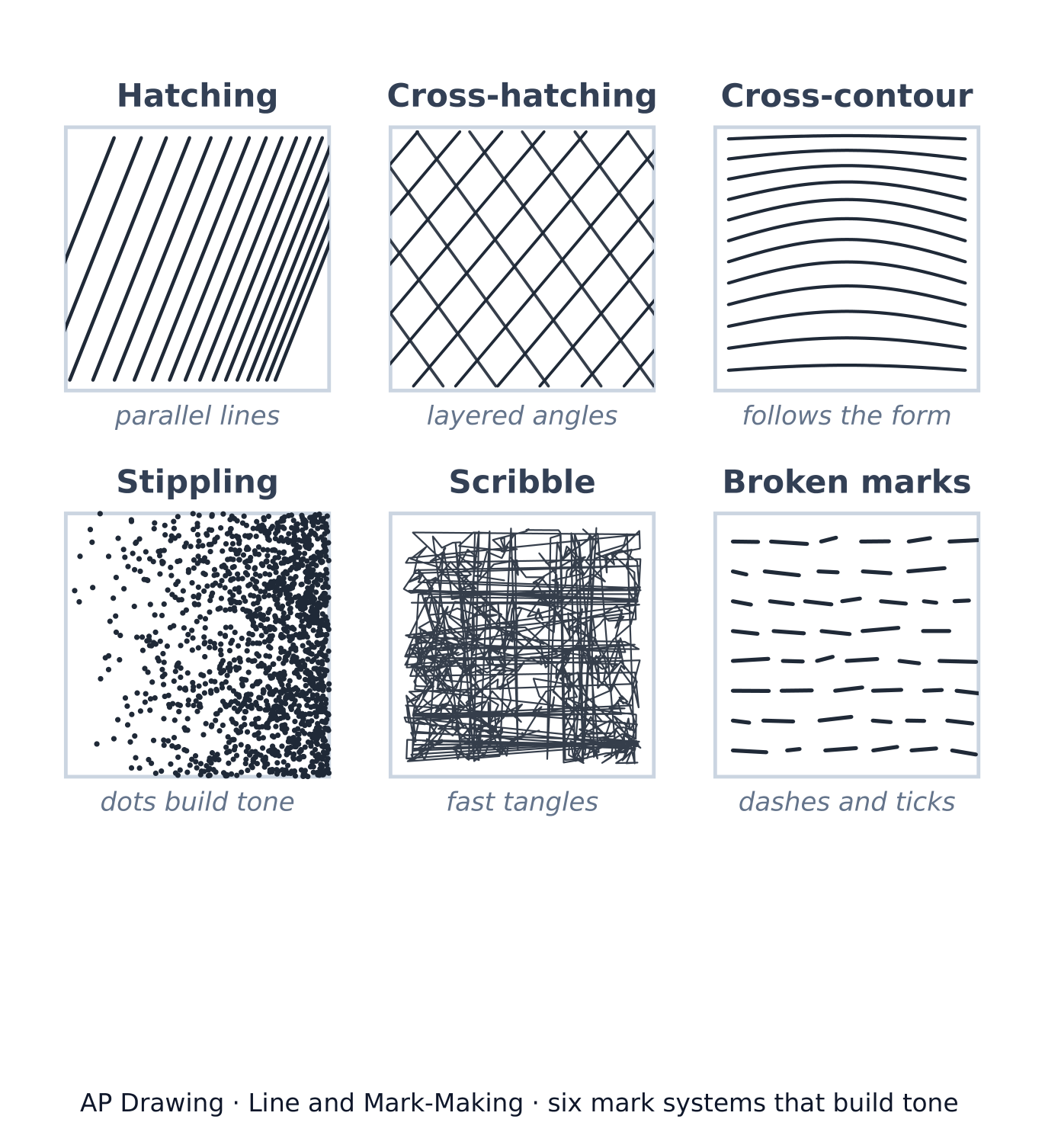
    Six mark systems: hatching, cross-hatching, cross-contour hatching, stippling, scribble, and broken marks
    Six ways to build tone with marks; closer and denser marks read as darker value
    • Closer, darker lines read as darker value 明度; wider spacing reads as lighter value.
    • Each cross-hatched layer deepens the tone step by step — build darkness gradually.
    • Curve the lines around the form (cross-contour hatching) so the shading also describes volume.
    • Keep one angle inside one plane; change the angle when the plane changes, and edges stay crisp.
    • Pen-and-ink drawing depends on hatching, because ink has no grey: value comes only from line density.
    Explore · ⁨探索⁩

    Which mark system is it?

    Hatching uses parallel lines, cross-hatching layers a second angle, stippling builds tone from dots, and scribble uses fast tangles. Naming mark systems helps you choose and describe your own.

    Vocabulary · ⁨語彙⁩ Train · ⁨練習する⁩
    English 日本語
    hatching/ˈhætʃɪŋ/ ハッチング
    cross-hatching/krɒs ˈhætʃɪŋ/ クロスハッチング
    value/ˈvæljuː/ 値
    1.5

    Stippling, Scribbling, and Alternative Marks

    Syllabus · ⁨シラバス⁩
    English

    Focus: Beyond hatching there is a whole vocabulary of marks — dots, scribbles, dashes, smears — each with its own texture and speed.

    • Stippling builds tone from dots: dense dots read dark, sparse dots read light — slow but very controllable.
    • Scribble (or scumbled) marks are fast tangles of line — lively, good for fur, foliage, and energy.
    • Dashes, ticks, and broken marks suggest texture without outlining every detail.
    • Marks can be additive (adding material) or subtractive (lifting material out with an eraser).
    • Try one subject rendered in four different mark systems — a classic experimentation page.
    • A personal mark vocabulary is part of your artistic voice — examiners look for it across the portfolio.
    日本語

    ポイント: ハッチング beyond には、点、スクラブル、破線、にじみなど、それぞれ固有の質感と速さを持つ多様なマークの語彙が存在します。

    • スティップリングは点からトーンを構築します: 密集した点は暗く、疎な点は明るく読まれます。ゆっくりとしていますが、非常に制御可能です。
    • スクラブル(またはスキャムブル)マークは、活発で素早い線の絡み合いです。毛皮、葉物、そしてエネルギー表現に適しています。
    • 破線、目印、途切れた标记は、細部を輪郭で描くことなくテクスチャを示唆する。
    • マークは加算的(素材を追加する)か減算的(消しゴムで素材を取り除く)かのどちらかです。
    • 4つの異なるマーク体系で同一の被写体を描いてみてください — これは古典的な実験ページです。
    • 独自のマーク語彙はあなたの芸術的ボイスの一部であり、採点者はポートフォリオ全体でそれを求めています。

    Source: College Board AP Course and Exam Description · ⁨出典: College Board AP コースおよび試験説明書⁩

    English

    Beyond hatching there is a whole vocabulary of marks — dots, tangles, dashes, smears — each with its own texture and speed.

    • Stippling 点画 builds tone from dots: dense dots read dark, sparse dots read light. Slow, but very controllable.
    • Scribble 乱线 marks are fast tangles of line — lively and good for fur, foliage, and energy.
    • Dashes, ticks, and broken marks suggest texture without outlining every detail.
    • Marks can be additive 加法 (putting material on) or subtractive 减法 (lifting material off with an eraser).
    • A classic experimentation page: one subject rendered in four different mark systems.
    日本語

    Beyond hatching there is a whole vocabulary of marks — dots, tangles, dashes, smears — each with its own texture and speed.

    • Stippling 点画 builds tone from dots: dense dots read dark, sparse dots read light. Slow, but very controllable.
    • Scribble 乱线 marks are fast tangles of line — lively and good for fur, foliage, and energy.
    • Dashes, ticks, and broken marks suggest texture without outlining every detail.
    • Marks can be additive 加法 (putting material on) or subtractive 减法 (lifting material off with an eraser).
    • A classic experimentation page: one subject rendered in four different mark systems.
    Vocabulary · ⁨語彙⁩ Train · ⁨練習する⁩
    English 日本語
    stippling/ˈstɪplɪŋ/ スティップリング
    scribble/ˈskrɪbl/ スクラブル
    additive/ˈædɪtɪv/ 加算的
    subtractive/sʌbˈtræktɪv/ subtractive
    1.6

    Texture and Surface

    Syllabus · ⁨シラバス⁩
    English

    Focus: Surface is a named AP drawing skill: how the drawing's physical texture and the depicted texture work together.

    • Actual texture is the real surface of the work (rough paper, layered charcoal, collage); implied texture is drawn illusion.
    • Frottage (rubbing over a textured surface) transfers real texture into a drawing.
    • Paper tooth (roughness) changes every mark: the same pencil reads differently on smooth and rough paper.
    • Contrast of textures — smooth skin against rough cloth — makes both read more strongly.
    • Build texture with the logic of the material: short strokes for fur, long strokes for hair, broken marks for stone.
    • Describing texture convincingly is visual evidence of observation and material control.
    日本語

    ポイント: 表面はAPドローイングの指定されたスキルです: ドローイング自体の物理的な質感と描写された質感がどのように機能するかです。

    • 実際の質感は作品の実在する表面(ざらついた紙、層状のチャコール、コラージュ)を指し、想像される質感は描画による錯覚です。
    • フロッタージュ(Frottage) は、質感のある表面の上をこすって、実際の質感を絵画に転写する方法です。
    • 紙の歯(ざらつき)はすべてのマークに影響を与えます: 同じ鉛筆でも滑らかな紙とざらついた紙では異なる結果になります。
    • 質感の対比(滑らかな肌と粗い布など)は、両方の質感をより明確に見せます。
    • 素材の論理に基づいて質感を構築します。毛皮には短いストローク、髪には長いストローク、石には破線を使います。
    • 説得力のある質感の描写は、観察力と素材の制御力を示す視覚的な証拠となります。

    Source: College Board AP Course and Exam Description · ⁨出典: College Board AP コースおよび試験説明書⁩

    English

    Surface 画面质感 is a named AP drawing skill: the physical texture of the drawing and the drawn illusion of texture work together.

    • Actual texture 实际肌理 is the real surface of the work — rough paper, layered charcoal, collage. Implied texture 视觉肌理 is drawn illusion.
    • Frottage 拓印法 (rubbing over a textured surface) transfers real texture into a drawing.
    • Paper tooth 纸纹 changes every mark: the same pencil reads differently on smooth and rough paper.
    • Contrast of textures — smooth skin against rough cloth — makes both read more strongly.
    • Build texture with the logic of the material: short strokes for fur, long strokes for hair, broken marks for stone.
    日本語

    Surface 画面质感 is a named AP drawing skill: the physical texture of the drawing and the drawn illusion of texture work together.

    • Actual texture 实际肌理 is the real surface of the work — rough paper, layered charcoal, collage. Implied texture 视觉肌理 is drawn illusion.
    • Frottage 拓印法 (rubbing over a textured surface) transfers real texture into a drawing.
    • Paper tooth 纸纹 changes every mark: the same pencil reads differently on smooth and rough paper.
    • Contrast of textures — smooth skin against rough cloth — makes both read more strongly.
    • Build texture with the logic of the material: short strokes for fur, long strokes for hair, broken marks for stone.
    Vocabulary · ⁨語彙⁩ Train · ⁨練習する⁩
    English 日本語
    surface/ˈsɜːfɪs/ 表面
    actual texture/ˈæktʃuːəl ˈtekstʃə/ 実際のテクスチャ
    implied texture/ɪmˈplaɪd ˈtekstʃə/ 暗示的テクスチャ
    frottage/ˈfrɒtɪdʒ/ フロタージュ
    tooth/tuːθ/ 歯(トース)
    1.7

    Expressive Mark-Making

    Syllabus · ⁨シラバス⁩
    English

    Focus: Marks carry emotion: the same subject drawn with angry, calm, or nervous marks tells three different stories.

    • Expressive lines exaggerate speed, pressure, and direction to communicate feeling, not just describe form.
    • Käthe Kollwitz's heavy charcoal and Egon Schiele's tense contours show how marks are the meaning.
    • Choose the mark to match the idea: soft graphite for quiet subjects, aggressive ink for conflict.
    • Distortion and exaggeration are legitimate drawing decisions when they serve intent — 'accurate' is not the only goal.
    • The AP rubric rewards ideas made visual: expressive marks link technique to meaning.
    • Test the same composition in two mark styles and write one sentence on which supports your inquiry better.
    日本語

    ポイント: マークには感情が込められます: 怒り、静けさ、緊張といった異なるマークで同じ被写体を描くと、3つの異なる物語が語られます。

    • 表現的なラインは、単に形を説明するだけでなく、感情を伝えるために速度、圧力、方向を誇張します。
    • カテ・コルヴィッツの重厚なチャコールとエゴン・シーレの緊迫した輪郭線は、マークそのものが意味であることを示しています。
    • アイディアに合うマークを選びましょう:静かな主題には柔らかいグラファイト、葛藤には鋭利なインクを使います。
    • 意図を満たす場合、歪みや誇張は正当なドローイングの選択であり、「正確性」だけが唯一の目標ではありません。
    • APルーブリックは視覚化されたアイデアを評価します: 表現的なマークは技術と意味を結びつけます。
    • 同一の構図を2つのマークスタイルで試行し、どちらが你的な探究をよりよく支えているかについて1文で記述してください。

    Source: College Board AP Course and Exam Description · ⁨出典: College Board AP コースおよび試験説明書⁩

    English

    Marks carry emotion. The same subject drawn with angry, calm, or nervous marks tells three different stories.

    • Expressive lines 表现性线条 exaggerate speed, pressure, and direction to communicate feeling, not just to describe form.
    • Käthe Kollwitz's heavy charcoal and Egon Schiele's tense contours show how the marks themselves carry the meaning.
    • Choose the mark to match the idea: soft graphite for quiet subjects, aggressive ink for conflict.
    • Distortion 变形 and exaggeration are legitimate drawing decisions when they serve your intent — "accurate" is not the only goal.
    • A personal mark vocabulary is part of your artistic voice 个人风格. Examiners look for it across the whole portfolio.
    日本語

    Marks carry emotion. The same subject drawn with angry, calm, or nervous marks tells three different stories.

    • Expressive lines 表现性线条 exaggerate speed, pressure, and direction to communicate feeling, not just to describe form.
    • Käthe Kollwitz's heavy charcoal and Egon Schiele's tense contours show how the marks themselves carry the meaning.
    • Choose the mark to match the idea: soft graphite for quiet subjects, aggressive ink for conflict.
    • Distortion 变形 and exaggeration are legitimate drawing decisions when they serve your intent — "accurate" is not the only goal.
    • A personal mark vocabulary is part of your artistic voice 个人风格. Examiners look for it across the whole portfolio.
    Vocabulary · ⁨語彙⁩ Train · ⁨練習する⁩
    English 日本語
    expressive lines/ekˈspresɪv laɪnz/ 表現的な線
    distortion/dɪˈstɔːʃn/ 歪曲
    voice/vɔɪs/ ボイス
    1.7

    Exam tips

    • Line quality is judged at a glance — one page of confident, varied strokes tells a scorer more than an hour of timid rendering. Warm up before every serious drawing.
    • Show the systems, not just the results: a portfolio image of hatching, stippling, and cross-contour studies is direct visual evidence of the mark-making skill the rubric names.
    • Photograph marks close up. A detail shot of your best passage of marks proves a skill that a full view only suggests.
    • Blind contour and gesture pages belong in your process images — they show observation and practice, exactly what the Sustained Investigation rubric asks to see.
    • Match marks to meaning in your written evidence: one sentence like "scratchy graphite lines echo the anxiety of exam season" links technique to idea, which is what scorers reward.
  • 2

    Value, Light, and Form · ⁨色味、明度、形状⁩

    Watch lesson · ⁨レッスンを視聴⁩
    2.1

    The Value Scale · ⁨バリュースケール⁩

    Syllabus · ⁨シラバス⁩
    English

    Focus: Value is lightness and darkness — the backbone of drawing, because we see form as light before we see colour.

    • A value scale runs from white through greys to black; a 9-step scale is the classic exercise.
    • Most beginners draw too light and too narrow — push the darks so the full range is used.
    • High-key drawings use mostly light values (airy, soft); low-key drawings use mostly dark values (heavy, dramatic).
    • Squint at the subject: squinting removes detail and shows the big value shapes.
    • Local value (how light the object's own surface is) is separate from lighting (how much light falls on it).
    • Control of the value scale is direct visual evidence of the AP skill light and shade.
    日本語

    ポイント: バリューは明るさと暗さのことであり、ドローイングの骨格です。なぜなら、私たちは色よりも先に光によって形を見ているからです。

    • バリュースケールは白からグレーを経て黒まで続きます。9段階スケールは古典的な練習法です。
    • 初心者は一般的に明るすぎたり範囲が狭すぎたりします。暗部を押し上げることで、全範囲を使用してください。
    • ハイキードローイングは主に明るいバリューを使用し(軽やかで柔らかい)、ロウキードローイングは主に暗いバリューを使用します(重厚で劇的)。
    • 被写体に目を細めて見てください: 細部がぼやけ、大きなバリューの形状が見えてきます。
    • ローカルバリュー(物体自身の表面の明るさ)と照明(当たっている光の量)は別ものです。
    • バリュースケールの制御は、APスキルである明暗への直接的な視覚的証拠となります。

    Source: College Board AP Course and Exam Description · ⁨出典: College Board AP コースおよび試験説明書⁩

    English
    The value scale

    Value 明度 is lightness and darkness — the backbone of drawing, because we see form as light before we see colour.

    • A value scale 明度阶 runs from white through greys to black. Drawing a smooth 9-step scale is the classic control exercise.
    • Most beginners draw too light and use too narrow a range. Push the darks so the drawing uses the full scale.
    • High-key 高调 drawings use mostly light values and feel airy; low-key 低调 drawings use mostly dark values and feel heavy or dramatic.
    • Local value 固有明度 is how light the object's own surface is; lighting is how much light falls on it. Keep the two ideas separate.
    • Squint 眯眼 at the subject: squinting removes detail and shows the big value shapes.
    日本語
    値スケール

    バリューとは明度と暗度のことです。私たちは色よりも先に光によって形を見るため、これは絵画の骨格となります。

    • バリュースケールは白からグレーを経て黒まで続きます。滑らかな9段階のスケールを描くことは、古典的なコントロール練習です。
    • 初心者は一般的に明るすぎ、範囲が狭すぎます。暗部を押し上げることで、絵画がスケール全体を使用できるようにしましょう。
    • ハイキーな絵画は主に明るいバリューを使用し、軽やかさを感じさせます。ローキーな絵画は主に暗いバリューを使用し、重厚感やドラマチックさを感じさせます。
    • ローカルバリューは物体自身の表面の明るさであり、照明は物体に当たる光の量です。この2つの概念を区別してください。
    • 対象を** squint(まぶす)** で見る: まぶすと詳細が失われ、大きなバリューの形状が見えてきます。
    Vocabulary · ⁨語彙⁩ Train · ⁨練習する⁩
    English 日本語
    value/ˈvæljuː/ 値
    value scale/ˈvæljuː skeɪl/ バリュースケール
    high-key/haɪ kiː/ ハイキー
    low-key/ləʊ kiː/ ローキー
    local value/ˈləʊkl ˈvæljuː/ ローカル値
    squint/skwɪnt/ 目を細める
    highlight/ˈhaɪlaɪt/ ハイライト
    halftone/ˈhɑːftəʊn/ ハーフトン
    core shadow/kɔː ˈʃædəʊ/ コア・シャドウ
    reflected light/rɪˈflektɪd laɪt/ 反射光
    cast shadow/kæst ˈʃædəʊ/ キャストシャドウ
    rendering/ˈrendərɪŋ/ レンダリング
    basic forms/ˈbeɪsɪk fɔːmz/ 基本形
    blending stump/ˈblendɪŋ stʌmp/ ブレンドスタンプ
    chiaroscuro/ˌtʃaɪərəˈskjʊərəʊ/ キアロスクuro(明暗法)
    tenebrism/ˈtenɪbrɪzəm/ テネブリズム
    focal point/ˈfəʊkl pɔɪnt/ 焦点
    toned paper/təʊnd ˈpeɪpə/ トーン紙
    2.2

    Light Logic: How Light Describes Form · ⁨光の論理:光が形をどう描写するか⁩

    Syllabus · ⁨シラバス⁩
    English

    Focus: One light source creates a predictable pattern of light and shadow — learn the pattern and any form becomes drawable.

    • The six zones: highlight, light, halftone, core shadow, reflected light, and cast shadow.
    • The core shadow is the darkest band on the form, where the surface turns fully away from the light.
    • Reflected light bounces back into the shadow side — it is always darker than any lit halftone.
    • The cast shadow is darkest and sharpest where it meets the object, softer and lighter further away.
    • Shadow edges tell the story: hard edges = sharp turn or cast shadow; soft edges = gradual turn.
    • Check the logic, not just the look: every value must be explainable by the light's direction.
    日本語

    ポイント: 1つの光源は予測可能な明暗のパターンを生み出します。このパターンを理解すれば、あらゆる形を描くことができます。

    • 6つの領域:ハイライト、ライト、ハルトーン、コアシャドウ、リフレクトッドライト、キャストシャドウ。
    • コアシャドウ(本影)は、面が完全に光から背いた部分にある最も暗い帯です。
    • 反射光は影の側面へ跳ね返ります。常に照らされたハルトーンよりも暗いです。
    • キャストシャドウ(投影影)は物体との接点で最も暗く鋭く、遠ざかるほど柔らかく薄くなります。
    • シャドウのエッジは物語を語ります: 硬いエッジ=急激な面の変化や投影影、柔らかいエッジ=緩やかな面の変化を示します。
    • 見た目だけでなく論理を確認してください: 各バリューは光の方向によって説明可能でなければなりません。

    Source: College Board AP Course and Exam Description · ⁨出典: College Board AP コースおよび試験説明書⁩

    English
    Light logic: how light describes form

    One light source creates a predictable pattern of light and shadow. Learn the pattern, and any form becomes drawable.

    • The six zones: highlight 高光, light, halftone 中间调, core shadow 明暗交界线, reflected light 反光, and cast shadow 投影.
    • The core shadow is the darkest band on the form, where the surface turns fully away from the light.
    • Reflected light bounces back into the shadow side — but it is always darker than any lit halftone.
    • The cast shadow is darkest and sharpest where it meets the object, then softer and lighter further away.
    • Shadow edges tell the story: hard edges mean a sharp turn or a cast shadow; soft edges mean a gradual turn.
    日本語
    光の論理:光が立体をどう描写するか

    1つの光源は、光と影の予測可能なパターンを生み出します。このパターンを理解すれば、どんな形でも描けるようになります。

    1つの光源の下にある球体、6つの領域にラベルが付いた図
    1つの光源、6つの領域:ハイライト、ライト、ハルトーン、コアシャドウ、リフレクトッドライト、キャストシャドウ
    • 6つの領域:ハイライト、ライト、ハルトーン、コアシャドウ、リフレクトッドライト、キャストシャドウ。
    • コアシャドウは形上で最も暗い帯であり、表面が完全に光から離れる場所です。
    • リフレクトッドライトは影側に反射しますが、常に照らされたハルトーンよりも暗いです。
    • キャストシャドウは物体との接点で最も暗くシャープであり、遠ざかるにつれて柔らかく明るくなります。
    • 影のエッジが物語を語ります。硬いエッジは急激な折れ目やキャストシャドウを示し、柔らかいエッジは緩やかな変化を示します。
    Explore · ⁨探索⁩

    Which zone of light? · ⁨光のどのゾーンですか?⁩

    One light source makes six zones. The core shadow is the darkest band on the form; reflected light stays darker than any lit halftone; the cast shadow is sharpest where it meets the object. · ⁨一つの光源は6つのゾーンを作ります。コアシャドウは形上の最も暗い帯で、リフレクトライトはどの照明半調よりも暗く残ります。キャストシャドウは物体に触れる部分で最も鋭いです。⁩

    2.3

    Rendering Form · ⁨形のレンダリング⁩

    Syllabus · ⁨シラバス⁩
    English

    Focus: Rendering means building smooth, believable volume — turning flat shapes into spheres, cylinders, and boxes.

    • Every complex subject simplifies into basic forms: sphere, cylinder, cube, cone — render those first.
    • Work dark to light or light to dark consistently; jumping around destroys the value structure.
    • Blend with intention: stumps and fingers smooth values, but preserved mark-making often reads stronger than over-blending.
    • Keep the lit side and shadow side clearly separated — form collapses when halftones creep into shadow.
    • A drawing of white objects (eggs, cups, cloth) is the classic rendering test: value comes only from light.
    • Rendered form demonstrates several AP drawing skills at once: light and shade, surface, and mark-making.
    日本語

    ポイント: レンダリングとは、滑らかで信憑性のある立体感を築くことです。平面的な形状を球体、円柱、箱に変換することです。

    • 複雑な被写体はすべて基本形(球体、円柱、立方体、円錐)に単純化できます。まずそれらをレンダリングしてください。
    • 一貫して暗から明へ、あるいは明から暗へと進めてください。行き来するとバリュー構造が崩壊します。
    • 意図を持ってブレンドしてください: スタンプや指でバリューを滑らかにしますが、マークを残す方が、過度なブレンドよりも強い印象を与えることがあります。
    • 照らされた側と影の側を明確に分離してください: ハルトーンが影に侵入すると形が崩れます。
    • 白い物体(卵、カップ、布)のドローイングは古典的なレンダリングテストです: バリューは光のみから生まれます。
    • レンダリングされた形は、複数のAPドローイングスキルを同時に示しています: 明暗、表面、マークmaking。

    Source: College Board AP Course and Exam Description · ⁨出典: College Board AP コースおよび試験説明書⁩

    English

    Rendering 塑造 means building smooth, believable volume — turning flat shapes into spheres, cylinders, and boxes.

    • Every complex subject simplifies into basic forms 基本形体: sphere, cylinder, cube, cone. Render those first.
    • Work dark-to-light or light-to-dark consistently; jumping around destroys the value structure.
    • Blend with intention: a blending stump 擦笔 smooths values, but preserved marks often read stronger than over-blending.
    • Keep the lit side and the shadow side clearly separated. Form collapses when halftones creep into the shadow.
    • A drawing of white objects (eggs, cups, cloth) is the classic rendering test: all the value comes from light alone.
    日本語

    レンダリングとは、滑らかで説得力のある体積を構築することです。平面的な形を球体、円柱、箱に変換します。

    • 複雑な対象はすべて基本的な形に単純化されます:球体、円柱、立方体、円錐。これらを最初にレンダリングしてください。
    • 暗部から明部へ、あるいは明部から暗部へと一貫して進め、途中で方向を変えるとトーン構造が崩れます。
    • 意図を持ってブレンドする:ブレンドスタンプはバリューを滑らかにしますが、残されたマークの方が過度なブレンドよりも強い印象を与えることがあります。
    • 照らされた側と影の側を明確に分離してください。ハルトーンが影に侵入すると、形が崩れてしまいます。
    • 白い物体(卵、コップ、布など)の描画は、古典的な明暗テストです:すべての価値は光のみから生じます。
    2.4

    Chiaroscuro and High-Contrast Drawing · ⁨キアロスクーロとハイコントラスト・ドローイング⁩

    Syllabus · ⁨シラバス⁩
    English

    Focus: Chiaroscuro ('light-dark') uses strong value contrast for drama — the language of Caravaggio and Rembrandt.

    • A single strong light against deep shadow pushes the subject forward and sets the mood.
    • Tenebrism is extreme chiaroscuro: most of the image sinks into darkness, one area blazes.
    • Reserve the strongest contrast for the focal point — contrast attracts the eye first.
    • Charcoal and ink wash suit chiaroscuro because they reach rich, deep darks quickly.
    • Working on toned paper with white and black media makes the light logic explicit.
    • High-contrast studies photograph impressively — strong candidates for Selected Works.
    日本語

    ポイント: シアロスクuro(「明と暗」)は、強烈なバリューのコントラストを用いてドラマを生み出します。カラヴァッジョやレンブラントの言語です。

    • 深い影に対して一本の強い光を当てることで、被写体を前景へ引き出し、雰囲気を演出します。
    • テネブリズムは極端なキアロスクーロです:画像の大部分が闇に沈み、一点だけが輝きます。
    • 最も強いコントラストを焦点に留めてください:コントラストが最初に視覚を惹きつけます。
    • コーラルとインク wash はキアロスクーロに適しており、素早く豊かで深い暗部を実現できます。
    • トーン纸上で白と黒の媒体を使うことで、光の論理が明確になります。
    • ハイコントラストの習作は写真映えします。セレクトワークの有力候補です。

    Source: College Board AP Course and Exam Description · ⁨出典: College Board AP コースおよび試験説明書⁩

    English

    Chiaroscuro 明暗对照法 ("light-dark") uses strong value contrast for drama — the language of Caravaggio and Rembrandt.

    • A single strong light against deep shadow pushes the subject forward and sets the mood.
    • Tenebrism 暗色调主义 is extreme chiaroscuro: most of the image sinks into darkness while one area blazes.
    • Save the strongest contrast for the focal point 视觉焦点 — contrast attracts the eye first.
    • Charcoal and ink wash suit chiaroscuro because they reach rich, deep darks quickly.
    • Working on toned paper 有色纸 with black and white media makes the light logic explicit.
    日本語

    キアロスクーロ(「明暗」)は、劇的効果のために強い明暗の対比を使用します——カラヴァッジョやレンブラントの表現言語です。

    座っている男性の柔らかく影のあるポートレートドローイング、硬い輪郭線なしで滑らかなグレース調で構築されている
    シーウールのコンテクレヨンによる肖像画は、ほぼ輪郭線なしに柔らかいトーンだけで構成されており、粗い紙がクレヨンを受け止めてベルベットのようなグレーを生み出します
    • 深い影に対して一本の強い光を当てることで、被写体を前景へ引き出し、雰囲気を演出します。
    • テンネブリズモとは極端なキアロスクーロです:画像の大部分が闇に沈む中、一点だけが輝いています。
    • 最も強いコントラストを焦点に留めます——コントラストはまず視覚を引きつけます。
    • コーラルとインク wash はキアロスクーロに適しており、素早く豊かで深い暗部を実現できます。
    • 黒と白の媒体でトーン纸上で作業すると、光の論理が明確になります。
    2.5

    Tonal Composition and Notan · ⁨トーナリッシュ・コンポジションとノタン⁩

    Syllabus · ⁨シラバス⁩
    English

    Focus: Notan is the design of light and dark shapes — a drawing works or fails at thumbnail size before any detail.

    • Reduce the scene to 2-3 flat values (a notan study): if the pattern reads clearly, the composition is strong.
    • Thumbnail sketches (5-8 cm) let you test several value plans in minutes.
    • Group values: many small lights scattered everywhere feel noisy; connected value shapes feel designed.
    • Place the darkest dark against the lightest light at the focal point.
    • A clear value hierarchy — one dominant value, one secondary, one accent — organises the whole page.
    • Keep the thumbnails in your process journal: they are ideal Sustained Investigation evidence of planning.
    日本語

    ポイント: ノタンは明と暗の形状のデザインです。詳細を描く前に、ミニチュアサイズでドローイングが成立するか失敗するかが決まります。

    • シーンを2〜3の平面的なバリューに簡略化してください(ノタンスタディ):パターンが明確に読み取れるなら、構図は強いです。
    • サマリースケッチ(5-8cm)により、数分間で複数の値計画を試すことができます。
    • バリューをグループ化してください: everywhere に散らばった小さな明るい部分は雑然として聞こえますが、つながったバリューの形状は意図的に設計されているように見えます。
    • 焦点において最も暗い暗部を最も明るい明部に配置してください。
    • 明確な値の階層——支配的な値が1つ、二次的な値が1つ、アクセントが1つ——によって、ページ全体が整理されます。
    • プロセスジャーナルにミニチュアを残してください: これらは計画の理想の持続的探究の証拠となります。

    Source: College Board AP Course and Exam Description · ⁨出典: College Board AP コースおよび試験説明書⁩

    English

    Notan 明暗构成 is the design of light and dark shapes. A drawing works or fails at thumbnail size, before any detail exists.

    • Reduce the scene to 2-3 flat values. If the pattern still reads clearly, the composition is strong.
    • Thumbnail sketches 小稿 (5-8 cm) let you test several value plans in minutes.
    • Group your values: many small lights scattered everywhere feel noisy; connected value shapes feel designed.
    • Place the darkest dark against the lightest light at the focal point.
    • A clear value hierarchy — one dominant value, one secondary, one accent — organises the whole page.
    日本語

    ノタンとは、光と影の形状のデザインです。詳細が存在する前に、ミニチュアサイズで描画が成立するか失敗するかを判定できます。

    二つのノタンのサマリー:接続された値のパターンは明確に読み取れるが、散在する値はノイズとして読まれる
    場面を2〜3の値に簡略化します:接続された値の形状は明確に読み取れますが、散在する斑点はノイズとして読まれます
    • 場面を2〜3の平面値に簡略化します。パターンがまだ明確に読み取れる場合、コンポジションは強いです。
    • サマリースケッチ(5-8cm)により、数分間で複数の値計画を試すことができます。
    • 値をグループ化します:あらゆる場所に散在する小さな光はノイジーに感じられます;接続された値の形状は意図的に設計されたように感じられます。
    • 焦点において最も暗い暗部を最も明るい明部に配置してください。
    • 明確な値の階層——支配的な値が1つ、二次的な値が1つ、アクセントが1つ——によって、ページ全体が整理されます。
    Vocabulary · ⁨語彙⁩ Train · ⁨練習する⁩
    English 日本語
    notan/ˈnəʊtn/ ノタン
    thumbnail sketches/ˈθʌmneɪl ˈsketʃɪz/ サムネイルスケッチ
    toned ground/təʊnd ɡraʊnd/ トーンviews
    lift out/lɪft aʊt/ リフトアウト
    subtractive drawing/sʌbˈtræktɪv ˈdrɔːɪŋ/ 減算的描画
    kneaded eraser/ˈniːdɪd ɪˈreɪzə/ こすれ消しゴム
    experimentation/ekˌsperɪmənˈteɪʃn/ 実験
    2.6

    Toned Grounds and Subtractive Drawing · ⁨トーングラウンドとサブトラクティブ・ドローイング⁩

    Syllabus · ⁨シラバス⁩
    English

    Focus: Starting from a toned ground lets you draw both directions: darker with media, lighter with an eraser.

    • Cover the paper with an even charcoal or graphite tone, then lift out lights with a kneaded eraser.
    • Subtractive drawing treats the eraser as a drawing tool — pulling light out of dark.
    • Toned or grey paper gives a ready-made middle value: add darks and white highlights only.
    • The mid-tone start forces value decisions early — nothing hides behind white paper.
    • Erasers make marks too: a dragged kneaded eraser leaves soft light strokes, a hard eraser leaves crisp ones.
    • This process shows experimentation with materials and processes — exactly what the CED asks you to document.
    日本語

    ポイント: トーングラウンドから始めることで、両方の方向で描くことができます: メディアで暗くし、消しゴムで明るくします。

    • 紙全体に均一なチャコールやグラフタイトーンを塗布し、 kneaded eraser で明るい部分を削り出す(リフトアウト)します。
    • サブトラクティブ・ドローイングは、消しゴムを描画道具として扱います:暗から光を取り出します。
    • トーン紙や灰色の紙は中間調を既提供しています: 暗部と白のハイライトのみを追加します。
    • 中程度のトーンからの開始は、早期にトーンの決定を迫ります:何も白い紙の奥に隠れません。
    • 消しゴムも線を描いてしまう:くねった消しゴムは柔らかく淡い線を残し、硬い消しゴムははっきりとした線を残す。
    • このプロセスは素材や手法の実験を示しており、これがCEDが記録を求める内容そのものである。

    Source: College Board AP Course and Exam Description · ⁨出典: College Board AP コースおよび試験説明書⁩

    English

    Starting from a toned ground 有色底 lets you draw in both directions: darker with media, lighter with an eraser.

    • Cover the paper with an even charcoal or graphite tone, then lift out 提白 the lights with an eraser.
    • Subtractive drawing 减法素描 treats the eraser as a drawing tool — pulling light out of dark.
    • A kneaded eraser 可塑橡皮 moulds to any shape: dab for soft lights, drag for soft strokes; a hard eraser cuts crisp lights.
    • Toned or grey paper gives a ready-made middle value: you add only the darks and the white highlights.
    • The mid-tone start forces value decisions early — nothing can hide behind white paper.
    • This process is visible experimentation 实验 with materials — exactly what the CED asks you to document.
    日本語

    トーングラウンドから始めることで、媒体で暗くし、消しゴムで明るくするという両方向での描画が可能になります。

    • 紙全体に均一なコーラルまたはグラファイトのトーンを塗り、リフトアウトして光を取り出します。
    • サブトラクティブ・ドローイングは、消しゴムを描画道具として扱います:暗から光を取り出します。
    • クネードエラサーは任意の形状に成型できます:软らかな光を作るためにポンポンと押し付けたり、柔らかいストロークを作るために引いたりします;硬い消しゴムはシャープな光を切り取ります。
    • トーン紙または灰色の紙は既成の中間値を提供します:暗部と白色のハイライトだけを足せばよいのです。
    • 中間値からの開始は、早期に値の決定を強制します——白い紙の背後に隠れることはできません。
    • このプロセスは材料に対する可见な実験であり——这正是CEDが記録を求める内容です。
    2.6

    Exam tips · ⁨試験対策⁩

    English
    • Full value range is a score signal. Scorers see weak, grey-on-grey drawings constantly; a confident black-to-white range stands out immediately.
    • Get the core shadow and reflected light right — they are what separates students who understand light logic from students who copy photos.
    • Include one white-object study in your practice images: value control with no local colour to hide behind is unmistakable visual evidence of the light and shade skill.
    • Photograph dark drawings carefully. Charcoal darks crush to a black mush in bad light; recheck the value range on screen before submitting.
    • Keep your notan thumbnails and submit a page of them as a process image — planning evidence directly supports the Sustained Investigation rubric.
    日本語
    • **完全な値範囲は採点信号です。**採点者は常に弱く、グレーがかったグレーの描画を見ますが、自信ある白から黒までの範囲は即座に際立ちます。
    • 核心影と反射光を正しく描く——これこそが光の論理を理解している学生と写真を模写している学生を区別するものです。
    • 練習画像に白色物体の写生を含めます——地色を背景にできる値管理は、明暗の技能を示す疑わしい視覚的証拠となります。
    • 暗い描画を注意深く撮影します。悪い光ではコーラルの暗部が黒い泥のように潰れます;提出前に画面で値範囲を確認してください。
    • ノタンのサマリーを残し、プロセス画像としてそのページを提出します——プランニングの証拠は直接、持続的探求ルブリックを支援します。
  • 3

    Space, Depth, and Proportion · ⁨空間、奥行き、比率⁩

    Watch lesson · ⁨レッスンを視聴⁩
    3.1

    Measuring and Sighting

    Syllabus · ⁨シラバス⁩
    English

    Focus: Sighting is measuring the subject with your pencil at arm's length — the observational drawing survival skill.

    • Hold the pencil at full arm's length, lock the elbow, close one eye: now it is a ruler and a protractor.
    • Pick one unit (often the head, or a cup's height) and measure everything in that unit: comparative measurement.
    • Check angles by rotating the pencil to match an edge, then carrying that angle to the paper.
    • Plumb lines (vertical checks) and level lines (horizontal checks) locate landmarks above and below each other.
    • Draw envelope shapes first: the big simple shape that contains the whole subject, then divide it.
    • Measured accuracy is visual evidence of space and proportion control in the AP rubric's drawing skills.
    日本語

    ポイント: **視点の合わせ方( sighting )**とは、腕を伸ばして鉛筆で被写体を測ることであり、これは観察描画の生存技能である。

    • 腕を fully 伸ばして鉛筆を持ち、肘を固定し、片目を閉じる:これで定規と分度器となる。
    • 単位を一つ選ぶ(頭部やコップの高さがよく使われる):すべてその単位で測ることで比較測定を行う。
    • 鉛筆を回転させて辺に合わせ、その角度を紙に持っていくことで角度を確認します。
    • 垂直線(plumb lines)(垂直チェック)と水平線(水平チェック)は、上下に位置するランドマークを特定する。
    • まず**包み形(envelope shapes)**を描く:被写体全体を含む大きな単純な形状を描き、それを分割する。
    • 測定による正確さは、APルーブリックスの描画技能における**空間(space)と比率(proportion)**のコントロールという視覚的証拠である。

    Source: College Board AP Course and Exam Description · ⁨出典: College Board AP コースおよび試験説明書⁩

    English

    Sighting 目测 means measuring the subject with your pencil at arm's length — the survival skill of observational drawing.

    • Hold the pencil at full arm's length with a locked elbow and one eye closed: now it is a ruler and a protractor.
    • Pick one unit (often the head, or a cup's height) and measure everything in that unit — comparative measurement 比较测量.
    • Check angles by rotating the pencil to match an edge, then carrying that angle to the paper.
    • A plumb line 铅垂线 (an imagined vertical) shows which landmarks sit exactly above or below each other.
    • Draw the envelope 外包形 first: the big simple shape that contains the whole subject, then divide it.
    日本語

    Sighting 目测 means measuring the subject with your pencil at arm's length — the survival skill of observational drawing.

    • Hold the pencil at full arm's length with a locked elbow and one eye closed: now it is a ruler and a protractor.
    • Pick one unit (often the head, or a cup's height) and measure everything in that unit — comparative measurement 比较测量.
    • Check angles by rotating the pencil to match an edge, then carrying that angle to the paper.
    • A plumb line 铅垂线 (an imagined vertical) shows which landmarks sit exactly above or below each other.
    • Draw the envelope 外包形 first: the big simple shape that contains the whole subject, then divide it.
    Vocabulary · ⁨語彙⁩ Train · ⁨練習する⁩
    English 日本語
    sighting/ˈsaɪtɪŋ/ 視点
    comparative measurement/kəmˈpærətɪv ˈmeʒəmənt/ 比較測定
    plumb line/plʌm laɪn/ 铅垂線
    envelope/ˈenvələʊp/ 包絡線(エンベロープ)
    3.2

    One-Point Perspective

    Syllabus · ⁨シラバス⁩
    English

    Focus: Linear perspective turns the picture plane into a window: in one-point, all depth lines meet at a single vanishing point.

    • The horizon line is the viewer's eye level — everything above it we look up at, everything below we look down on.
    • Lines parallel to the picture plane stay true; lines going into the scene converge to the vanishing point.
    • Equal spaces look smaller as they recede — use the diagonal trick to divide receding space evenly.
    • One-point suits rooms, streets, and corridors seen straight-on.
    • Objects overlap and rise toward the horizon as they get further away — perspective plus overlap is depth doubled.
    • Perspective errors are easy to spot: check every depth line actually aims at the point.
    日本語

    ポイント: **線透视(linear perspective)は絵面を窓のように見せ、一点透視ではすべての奥行き線が一つの消失点(vanishing point)**に収束する。

    • **地平線(horizon line)**は鑑賞者の目の高さであり、それ以上のものは上を見上げ、それ以下のものは下を見下ろすこととなる。
    • 絵面に平行な線は真実の姿を保ち、シーンへ奥へ向かう線は消失点に収束する。
    • 等間隔でも遠ざかるほど小さく見える:対角線の技を使って奥へ向かう空間を均等に分割する。
    • 一点透視は、正面から見た部屋、通り、廊下に適している。
    • 物体は離れるにつれて重なり合い、地平線に向かって上昇する——透視+**重なり(overlap)**は深さを倍増させる。
    • 透視の誤りは簡単に発見できる:すべての奥行き線が実際にその点に向かっているか確認する。

    Source: College Board AP Course and Exam Description · ⁨出典: College Board AP コースおよび試験説明書⁩

    English
    One-point perspective

    Linear perspective 线性透视 treats the picture as a window. In one-point perspective, all lines going into the depth meet at a single point.

    • The horizon line 视平线 is the viewer's eye level. We look down on everything below it and up at everything above it.
    • Lines parallel to the picture surface stay true; lines going into the scene converge to the vanishing point 灭点.
    • Equal spaces look smaller as they recede. Use diagonals to divide receding space evenly.
    • One-point perspective 一点透视 suits rooms, streets, and corridors seen straight-on.
    • Perspective plus overlap 遮挡 is depth doubled: near edges cover far edges.
    日本語
    One-point perspective

    Linear perspective 线性透视 treats the picture as a window. In one-point perspective, all lines going into the depth meet at a single point.

    A long, straight desert road running dead ahead to the horizon, its edges narrowing to a single point
    A straight desert road: its two edges appear to meet at a single vanishing point on the horizon, exactly the one-point perspective a drawing recreates to show depth
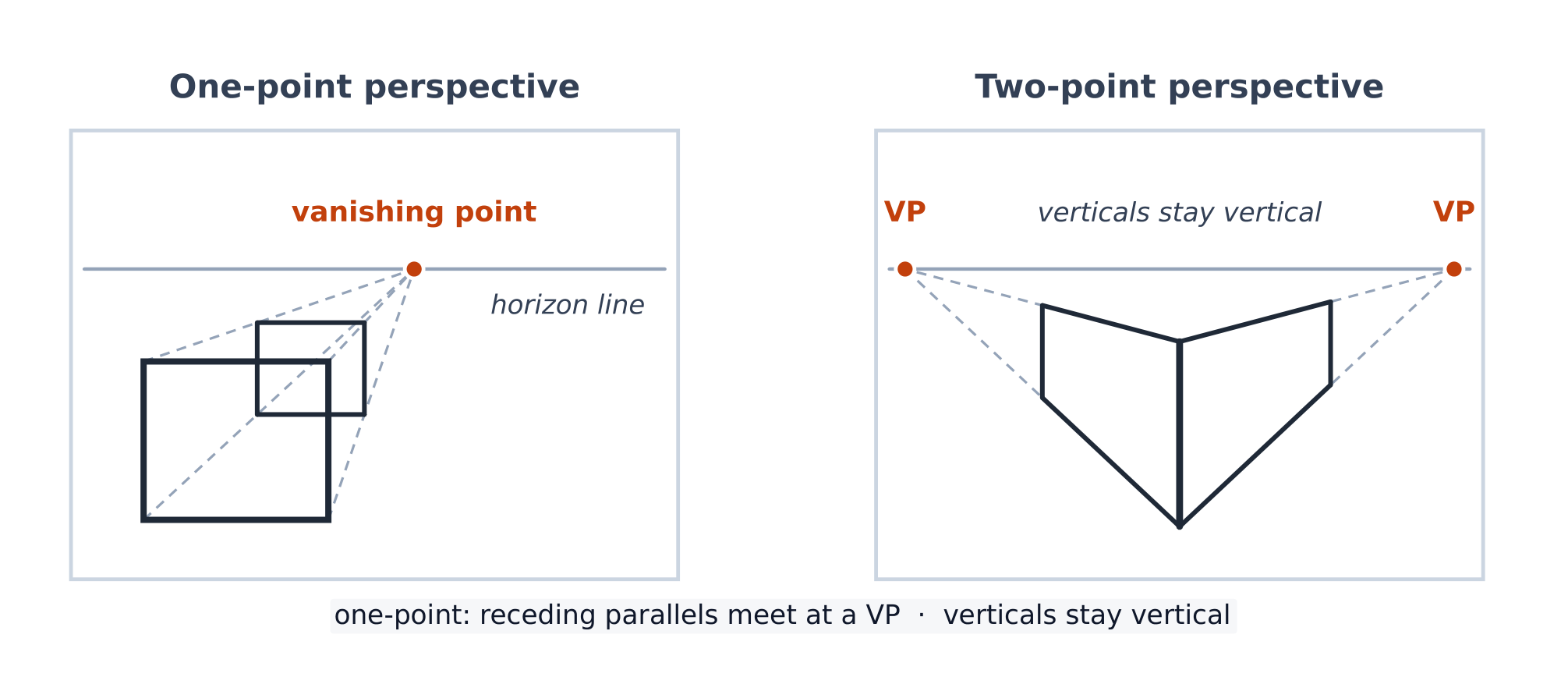
    One-point and two-point perspective: horizon line, vanishing points, and converging edges
    Left: one-point — depth lines meet at one vanishing point. Right: two-point — each set of edges meets its own point
    • The horizon line 视平线 is the viewer's eye level. We look down on everything below it and up at everything above it.
    • Lines parallel to the picture surface stay true; lines going into the scene converge to the vanishing point 灭点.
    • Equal spaces look smaller as they recede. Use diagonals to divide receding space evenly.
    • One-point perspective 一点透视 suits rooms, streets, and corridors seen straight-on.
    • Perspective plus overlap 遮挡 is depth doubled: near edges cover far edges.
    Vocabulary · ⁨語彙⁩ Train · ⁨練習する⁩
    English 日本語
    linear perspective/ˈlɪnɪə pəˈspektɪv/ 直線的透視法
    horizon line/həˈraɪzn laɪn/ 地平線
    vanishing point/ˈvænɪʃɪŋ pɔɪnt/ 消失点
    one-point perspective/wʌn pɔɪnt pəˈspektɪv/ 一点透視法
    overlap/ˌəʊvəˈlæp/ 重なり
    3.3

    Two-Point and Three-Point Perspective

    Syllabus · ⁨シラバス⁩
    English

    Focus: Turn the subject at an angle and you need two vanishing points; look steeply up or down and you need a third.

    • In two-point, verticals stay vertical; both sets of horizontal edges converge to left and right points on the horizon.
    • Keep both vanishing points far apart (often off the paper) — close points create fisheye distortion.
    • Three-point adds a vertical vanishing point: skyscrapers from below (looking up) or street scenes from a rooftop (looking down).
    • Boxes drawn in perspective become the scaffolding for everything: buildings, books, vehicles, even heads.
    • Cast shadows and reflections follow the same perspective system as the objects that make them.
    • A perspective grid underdrawing keeps complex scenes consistent — construct lightly, render on top.
    日本語

    ポイント: 被写体を角度をつけて配置すると二つの消失点が必要になり、激しく上または下を見上げると第三の消失点が必要になる。

    • 二点透視では垂直線は垂直のまま、両方の水平辺のセットは左と右の消失点に収束する。
    • 二つの消失点は離して置く(紙の外に出しても構わない):近接した点だと魚眼レンズのような歪みを生む。
    • 三点透視には垂直方向の消失点が加わる:地面から見上げる高層ビル(上向き)や、屋上から見下ろす街並み(下向き)。
    • 透視法で描いた箱は、建物、本、車、頭部に至るまで、あらゆるものの足場となります。
    • 影と反射は、それらを作る物体と同じ透視システムに従う。
    • 複雑なシーンを一貫性を持たせるための透視グリッド下書き:軽く構築し、その上に仕上げる。

    Source: College Board AP Course and Exam Description · ⁨出典: College Board AP コースおよび試験説明書⁩

    English
    Two-point perspective

    Turn the subject at an angle and you need two-point perspective 两点透视; look steeply up or down and you need a third point.

    • In two-point, verticals stay vertical; the two sets of horizontal edges converge to a left and a right vanishing point on the horizon.
    • Keep the two points far apart — often off the paper. Points placed too close create a fisheye distortion.
    • Three-point perspective 三点透视 adds a vertical vanishing point: a skyscraper from below, or a street from a rooftop.
    • Boxes drawn in perspective become scaffolding for everything: buildings, books, vehicles, even heads.
    • Cast shadows and reflections obey the same perspective system as the objects that make them.
    日本語
    Two-point perspective

    Turn the subject at an angle and you need two-point perspective 两点透视; look steeply up or down and you need a third point.

    • In two-point, verticals stay vertical; the two sets of horizontal edges converge to a left and a right vanishing point on the horizon.
    • Keep the two points far apart — often off the paper. Points placed too close create a fisheye distortion.
    • Three-point perspective 三点透视 adds a vertical vanishing point: a skyscraper from below, or a street from a rooftop.
    • Boxes drawn in perspective become scaffolding for everything: buildings, books, vehicles, even heads.
    • Cast shadows and reflections obey the same perspective system as the objects that make them.
    Vocabulary · ⁨語彙⁩ Train · ⁨練習する⁩
    English 日本語
    two-point perspective/tuː pɔɪnt pəˈspektɪv/ 二点透視法
    three-point perspective/θriː pɔɪnt pəˈspektɪv/ 三点透視法
    3.4

    Foreshortening

    Syllabus · ⁨シラバス⁩

    Focus: Foreshortening is perspective applied to a single form pointing toward you — lengths compress dramatically.

    • A pointing arm may appear one-third of its true length: draw the apparent shape, not the known one.
    • Overlap is the key signal: the hand overlaps the forearm, the forearm overlaps the upper arm.
    • Think in cross-sections: imagine rings around the form (like a wireframe) to feel how it turns toward you.
    • Measure foreshortened lengths by sighting — knowledge lies, observation tells the truth.
    • Classic practice: draw a figure lying down feet-first (like Mantegna's Dead Christ).
    • Strong foreshortening is high-difficulty visual evidence — examiners recognise the skill immediately.

    Source: College Board AP Course and Exam Description · ⁨出典: College Board AP コースおよび試験説明書⁩

    English

    Foreshortening 透视缩短 is perspective applied to a single form pointing toward you — lengths compress dramatically.

    • A pointing arm may appear one-third of its true length. Draw the apparent shape, not the length you know.
    • Overlap is the key signal: the hand overlaps the forearm, the forearm overlaps the upper arm.
    • Think in cross-sections 横截面: imagine rings around the form, like a wireframe, to feel how it turns toward you.
    • Measure foreshortened lengths by sighting — memory lies, observation tells the truth.
    • The classic practice piece: a figure lying down, drawn feet-first, like Mantegna's Dead Christ.
    日本語

    Foreshortening 透视缩短 is perspective applied to a single form pointing toward you — lengths compress dramatically.

    • A pointing arm may appear one-third of its true length. Draw the apparent shape, not the length you know.
    • Overlap is the key signal: the hand overlaps the forearm, the forearm overlaps the upper arm.
    • Think in cross-sections 横截面: imagine rings around the form, like a wireframe, to feel how it turns toward you.
    • Measure foreshortened lengths by sighting — memory lies, observation tells the truth.
    • The classic practice piece: a figure lying down, drawn feet-first, like Mantegna's Dead Christ.
    Vocabulary · ⁨語彙⁩ Train · ⁨練習する⁩
    English 日本語
    foreshortening/fɔːˈʃɔːtənɪŋ/ 短縮法
    cross-sections/krɒs ˈsekʃnz/ 断面
    3.5

    Atmospheric Perspective

    Syllabus · ⁨シラバス⁩
    English

    Focus: Atmospheric (aerial) perspective creates depth without lines: distant things are lighter, cooler, softer, and less detailed.

    • Air scatters light, so contrast fades with distance — the far mountain is a pale flat shape.
    • Foreground: darkest darks, sharpest edges, most texture; background: narrow value range, soft edges.
    • Reserve full black and full white for the foreground; the distance lives in the middle greys.
    • Detail density is a depth cue by itself — render the near leaf, suggest the far tree.
    • Combine linear and atmospheric perspective for maximum depth in landscape and cityscape drawing.
    • This is the AP skill space made visible through light and shade — two rubric skills in one device.
    日本語

    ポイント: **大気透視(aerial perspective)**は線を使わずに深さを作り出し、遠くの物は明るく、寒色で、柔らかく、詳細が少ない。

    • 空気は光を散乱するため、距離とともにコントラストが薄れ、遠くの山は淡い平面の形となる。
    • 手前:最も暗い黒、最も鋭利なエッジ、最も多いテクスチャ;奥:狭い値域、柔らかなエッジ。
    • 完全な黒と完全な白を手前に残し、奥は中間灰色に留める。
    • 細部の密度自体が深さの手掛かりとなる:近い葉は具体的に描き、遠い木は暗示する。
    • 風景画や都市風景画で最大の深さを出すため、線透视と大気透視を組み合わせる。
    • これはAP技能**空間(space)が明暗(light and shade)**によって可視化されたものであり、一つの技法で二つのルーブリックス技能を満たす。

    Source: College Board AP Course and Exam Description · ⁨出典: College Board AP コースおよび試験説明書⁩

    English
    Atmospheric perspective

    Atmospheric perspective 空气透视 creates depth without any lines: distant things become lighter, cooler, softer, and less detailed.

    • Air scatters light, so contrast fades with distance. The far mountain is a pale, flat shape.
    • Foreground: darkest darks, sharpest edges, most texture. Background: a narrow value range and soft edges.
    • Save full black and full white for the foreground; the distance lives in the middle greys.
    • Detail density is a depth cue by itself: render the near leaf, suggest the far tree.
    • Combine linear and atmospheric perspective for maximum depth in landscape drawing.
    日本語
    Atmospheric perspective

    Atmospheric perspective 空气透视 creates depth without any lines: distant things become lighter, cooler, softer, and less detailed.

    • Air scatters light, so contrast fades with distance. The far mountain is a pale, flat shape.
    • Foreground: darkest darks, sharpest edges, most texture. Background: a narrow value range and soft edges.
    • Save full black and full white for the foreground; the distance lives in the middle greys.
    • Detail density is a depth cue by itself: render the near leaf, suggest the far tree.
    • Combine linear and atmospheric perspective for maximum depth in landscape drawing.
    Layered mountain ridges fade with distance: atmospheric perspective cools and lightens far forms
    Layered mountain ridges fade with distance: atmospheric perspective cools and lightens far forms
    Explore · ⁨探索⁩

    Which depth cue is at work? · ⁨どの深さの手がかりが働いていますか?⁩

    Drawings create depth several ways at once: linear perspective (lines converge), atmospheric perspective (distance fades and softens), overlap (near covers far), and foreshortening (forms compress toward you). · ⁨絵画は同時に複数の方法で奥行きを作ります:ラインパースペクティブ(線が収束)、アトモスフィリックパースペクティブ(距離による淡さと柔らかさ)、オーバーラップ(手前が奥を覆う)、そしてフォアショートニング(形があなたに寄って圧縮)。⁩

    Vocabulary · ⁨語彙⁩ Train · ⁨練習する⁩
    English 日本語
    atmospheric perspective/ˌætməsˈferɪk pəˈspektɪv/ 大気透視法
    3.6

    Composition and the Picture Plane

    Syllabus · ⁨シラバス⁩
    English

    Focus: Composition — how everything is arranged inside the picture's edges — is a named AP drawing skill and the first thing a scorer sees.

    • The picture plane has edges: what you crop out is as expressive as what you keep in.
    • The rule of thirds places focal points on the third-lines — safer than dead centre.
    • Control the figure-ground relationship: negative space is a designed shape, not leftover paper.
    • Lead the eye with paths: lines, value contrast, and detail act as arrows toward the focal point.
    • Vary the viewpoint — eye level is neutral; a low or high viewpoint makes an ordinary subject fresh.
    • Test compositions with a viewfinder or phone camera crop before committing to the page.
    日本語

    ポイント: 構成(composition)—絵面の枠内でのすべての配置方法—は指定されたAP描画技能であり、採点者が最初に目にするものだ。

    • 絵画面には輪郭があります:切り落とされた部分も、残した部分同样に表現的です。
    • 三分割の法則は焦点を三分割線上に置き、真ん中に置くより安全である。
    • **図像関係(figure-ground relationship)**を制御する:ネガティブスペースは設計された形状であり、余った紙ではない。
    • パースで目を導く:線、値のコントラスト、細部が焦点への矢印として機能する。
    • 視点を変える:目の高さは中立だが、低いまたは高い視点は平凡な被写体を新鮮なものにする。
    • ページに描く前にファインダーやスマートフォンのカメラで切り取り、構成を試す。

    Source: College Board AP Course and Exam Description · ⁨出典: College Board AP コースおよび試験説明書⁩

    English

    Composition 构图 — the arrangement of everything inside the picture's edges — is a named AP drawing skill and the first thing a scorer sees.

    • The picture plane 画面 has edges: what you crop out is as expressive as what you keep in.
    • The rule of thirds 三分法 places focal points on the third-lines — stronger than dead centre.
    • Design the negative space 负空间: the empty shapes around the subject are shapes you drew, not leftovers.
    • The figure-ground relationship 图底关系 must stay readable: the eye should always know what is subject and what is background.
    • Lead the eye with paths — lines, value contrast, and detail act as arrows toward the focal point.
    • Test crops with a viewfinder 取景框 (or a phone camera) before committing to the page. Change the viewpoint 视点: eye level is neutral; low or high angles make ordinary subjects fresh.
    日本語

    Composition 构图 — the arrangement of everything inside the picture's edges — is a named AP drawing skill and the first thing a scorer sees.

    • The picture plane 画面 has edges: what you crop out is as expressive as what you keep in.
    • The rule of thirds 三分法 places focal points on the third-lines — stronger than dead centre.
    • Design the negative space 负空间: the empty shapes around the subject are shapes you drew, not leftovers.
    • The figure-ground relationship 图底关系 must stay readable: the eye should always know what is subject and what is background.
    • Lead the eye with paths — lines, value contrast, and detail act as arrows toward the focal point.
    • Test crops with a viewfinder 取景框 (or a phone camera) before committing to the page. Change the viewpoint 视点: eye level is neutral; low or high angles make ordinary subjects fresh.
    Vocabulary · ⁨語彙⁩ Train · ⁨練習する⁩
    English 日本語
    composition/ˌkɒmpəˈzɪʃn/ 構成
    picture plane/ˈpɪktʃə pleɪn/ 絵画面
    rule of thirds/ruːl ɒv θɜːdz/ 三分割の法則
    negative space/ˈneɡətɪv speɪs/ ネガティブスペース
    figure-ground relationship/ˈfɪɡə ɡraʊnd rɪˈleɪʃənʃɪp/ 図像と背景の関係
    viewfinder/ˈvjuːfaɪndə/ ビューファインダー
    viewpoint/ˈvjuːpɔɪnt/ 視点
    3.7

    Drawing the Figure and Portrait

    Syllabus · ⁨シラバス⁩
    English

    Focus: The figure combines every drawing skill at once — proportion, gesture, form, and likeness under one deadline.

    • The classic adult figure stands about 7.5 heads tall; the halfway point is near the hip, not the waist.
    • In the head, eyes sit at the halfway line of the skull — the beginner error is placing them too high.
    • Start with gesture and the big masses (ribcage, pelvis, skull); features and fingers come last.
    • Sight-size checks save likeness: compare distances between landmarks, not memorised rules alone.
    • Hands and feet earn their reputation — draw them as simple geometric mittens/wedges first, then divide.
    • Figure and portrait work is a portfolio staple: it demonstrates observation, proportion, and nerve.
    日本語

    ポイント: 人物画は比例、ジェスチャー、形状、類似性を一つの期限の下にまとめ、あらゆる描画技能を同時に試すもの。

    • 古典的な成人の身長は7.5頭程度で、中央点は腰ではなく骨盤付近にある。
    • 頭部において、目は頭蓋の中央線に位置する——初心者の間違いはこれを过高に配置することだ。
    • ジェスチャーと大きな塊(肋骨、骨盤、頭蓋骨)から始め、特徴や指は最後に描く。
    • ** sight-size checks** は類似性を保つために役立つ:記憶されたルールだけでなく、ランドマーク間の距離を比較する。
    • 手と足は名声に相応しい——まず単純な几何学的なミット/楔形で描き、その後分割する。
    • 人物画とポートレートワークはポートフォリオの必須項目であり、観察、比率、胆力を示す。

    Source: College Board AP Course and Exam Description · ⁨出典: College Board AP コースおよび試験説明書⁩

    English

    The human figure combines every drawing skill at once: proportion 比例, gesture, form, and likeness under one deadline.

    • The classic adult figure stands about 7.5 heads tall; the halfway point of the body is near the hip, not the waist.
    • In the head, the eyes sit at the halfway line 中线 of the skull — beginners always place them too high.
    • Start with gesture and the big masses (ribcage, pelvis, skull); features and fingers come last.
    • Check likeness with landmark distances, not memorised rules alone — every face bends the average.
    • Draw hands and feet as simple geometric mittens and wedges first, then divide them into parts.
    日本語

    The human figure combines every drawing skill at once: proportion 比例, gesture, form, and likeness under one deadline.

    Figure and head proportions: a standing figure about 7.5 heads tall; eyes at the halfway line of the skull
    The classic adult figure is about 7.5 heads tall; in the head, the eyes sit at the halfway line
    • The classic adult figure stands about 7.5 heads tall; the halfway point of the body is near the hip, not the waist.
    • In the head, the eyes sit at the halfway line 中线 of the skull — beginners always place them too high.
    • Start with gesture and the big masses (ribcage, pelvis, skull); features and fingers come last.
    • Check likeness with landmark distances, not memorised rules alone — every face bends the average.
    • Draw hands and feet as simple geometric mittens and wedges first, then divide them into parts.
    Vocabulary · ⁨語彙⁩ Train · ⁨練習する⁩
    English 日本語
    proportion/prəˈpɔːʃn/ 比例
    halfway line/ˈhɑːfweɪ laɪn/ 半分の線
    3.7

    Exam tips

    • Perspective errors are the easiest mistakes for a scorer to spot — check every depth line actually aims at its vanishing point before you render.
    • Include one strong observational space (an interior, a stairwell, a street) in the portfolio: it demonstrates the space skill the rubric names, unmistakably.
    • Foreshortening is high-value evidence. One convincing foreshortened limb or object tells scorers you draw what you see, not what you remember.
    • Crop like a designer. Before starting, test three viewfinder crops and pick the one with the strongest negative space — composition is judged at first glance.
    • Use atmospheric perspective in graphite too, not just paint: softening far edges with a kneaded eraser is quick and reads as skill.
  • 4

    Drawing Media and Processes · ⁨描画媒体とプロセス⁩

    Watch lesson · ⁨レッスンを視聴⁩
    4.1

    Graphite · ⁨グラファイト⁩

    Syllabus · ⁨シラバス⁩
    English

    Focus: Graphite is the everyday drawing medium — precise, erasable, and capable of a full (if silvery) value range.

    • Grades run hard to soft: 9H (palest, hardest) through HB to 9B (darkest, softest).
    • Hard grades suit construction lines and fine detail; soft grades build rich darks fast.
    • Graphite gets shiny when layered heavily — deepest blacks may need charcoal or carbon pencil instead.
    • Vary the grip: writing grip for detail, overhand grip for broad, light shading from the arm.
    • Woodless graphite sticks and powder cover big areas; erasers then carve lights back out.
    • A full-value graphite still life is the classic control test — worth one polished example in any portfolio.
    日本語

    ポイント: グラファイトは日常的な描画媒体であり、精密で消えやすく、銀色ではあるが完全な値域を持つ。

    • 硬度は硬から柔らかまでvaryする:9H(最も淡く、最も硬い)からHBを経て9B(最も暗く、最も柔らかい)まで。
    • 硬い級は構造線や細かいディテールに適し、柔らかい級は速く豊かな暗部を作る。
    • グラファイトは厚く重ねると光沢が出ますが、最も深い黒色を得るにはチャコールや炭筆を使う必要があります。
    • 握り方を変えてください:詳細な描写には書き手握り、腕から広範囲で淡い陰影をつけるにはオーバーハンドグリップが適しています。
    • 無芯グラファイト棒や粉は広い面積を覆うのに適しており、その後消しゴムでハイライトを削り出して作ります。
    • フルバリューのグラファイト静物画は古典的なコントロールテストであり、ポートフォリオに1つの磨き上げ例を含める価値がある。

    Source: College Board AP Course and Exam Description · ⁨出典: College Board AP コースおよび試験説明書⁩

    English

    Graphite 石墨 is the everyday drawing medium — precise, erasable, and capable of a full (if silvery) value range.

    • Pencil grades 硬度等级 run hard to soft: 9H (palest, hardest) through HB to 9B (darkest, softest).
    • Hard grades suit construction lines and fine detail; soft grades build rich darks fast.
    • Heavy graphite turns shiny. For the deepest blacks, switch to charcoal or a carbon pencil 炭笔.
    • Vary the grip: the writing grip for detail, the overhand grip 横握 for broad, light shading from the arm.
    • Woodless graphite sticks and graphite powder cover big areas; erasers then carve the lights back out.
    • A full-value graphite still life is the classic control test — worth one polished example in any portfolio.
    日本語

    グラファイトは日常的なドローイングメディアであり、精密で消せる、そしてフル(銀色の)値域を持つことができる。

    硬い 2H から柔らかい 8B までの鉛筆 grades と、それぞれ到達するトーン値
    鉛筆の級数:硬い級は明るく精密に留まり、柔らかい級は速く豊かな暗部に達する
    • 鉛筆の級数は硬い方から柔らかい方へ:9H(最も淡く硬い)からHBを経て9B(最も暗く柔らかい)まで。
    • 硬い級は構造線や細かいディテールに適し、柔らかい級は速く豊かな暗部を作る。
    • 重いグラファイトはツヤを出す。最も深い黒にするには、炭かカーボンペンシルに切り替える。
    • グリップを変える:ディテールには書き手のグリップ、腕からの広く柔らかいシェーディングにはオーバーハンドグリップ。
    • ウッドレスグラファイトスティックとグラファイトパウダーは広い面積を覆い、イレーザーでライトを削り出す。
    • フルバリューのグラファイト静物画は古典的なコントロールテストであり、ポートフォリオに1つの磨き上げ例を含める価値がある。
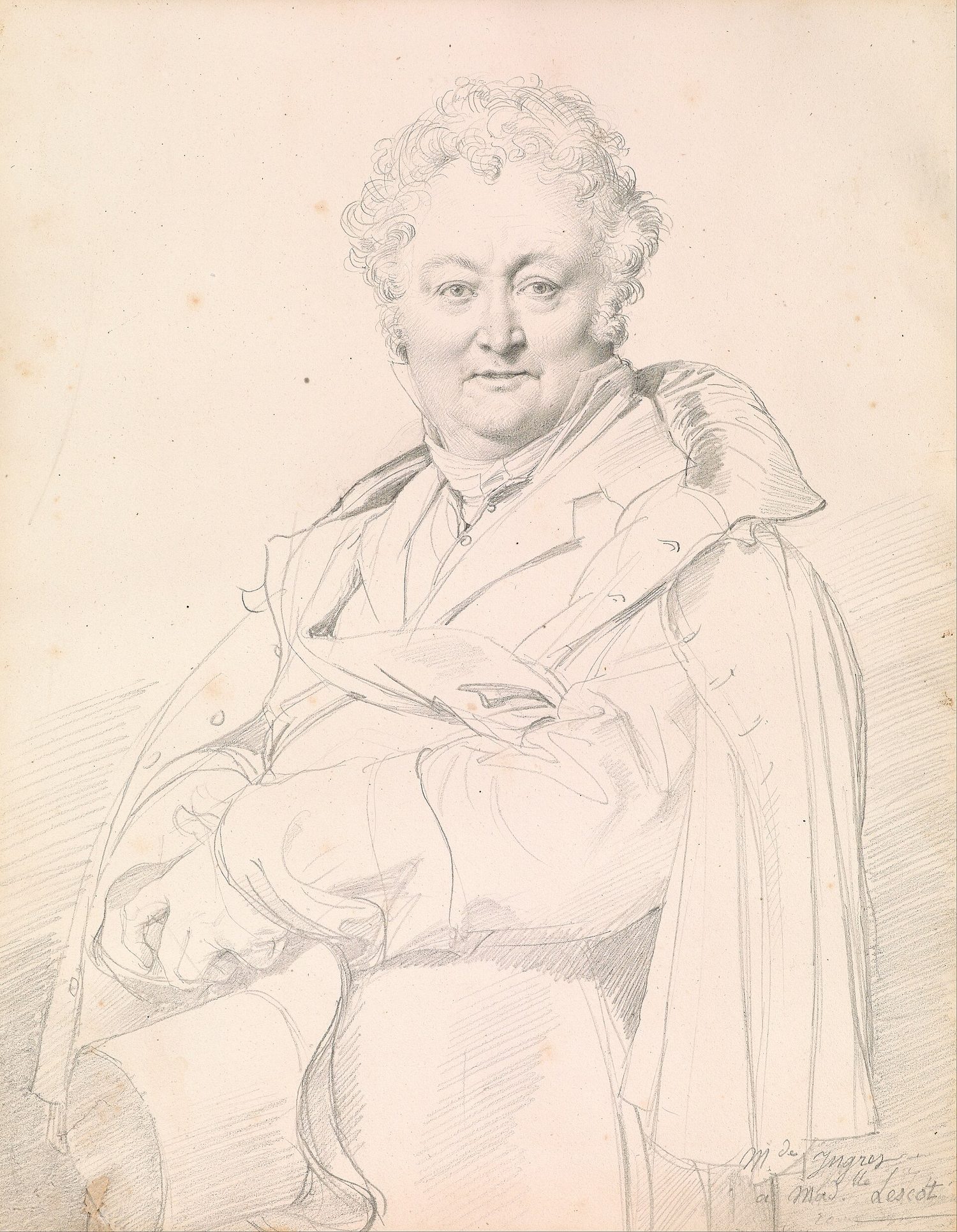
    アン格尔のグラファイト肖像:精密な硬い級ラインと統制された値が形を明確に描写する
    アン格尔のグラファイト肖像:精密な硬い級ラインと統制された値が形を明確に描写する
    Vocabulary · ⁨語彙⁩ Train · ⁨練習する⁩
    English 日本語
    graphite/ˈɡræfaɪt/ グラファイト
    grades/ɡreɪdz/ 等級
    carbon pencil/ˈkɑːbən ˈpensl/ 炭素鉛筆
    overhand grip/ˌəʊvəˈhænd ɡrɪp/ オーバーハンドグリップ
    4.2

    Charcoal and Conté · ⁨チャコールとコンテ⁩

    Syllabus · ⁨シラバス⁩
    English

    Focus: Charcoal is fast, bold, and deeply black — the medium of gesture, chiaroscuro, and large-scale drawing.

    • Vine/willow charcoal is soft and dusts off easily (great for starts); compressed charcoal is dense and permanent.
    • Charcoal loves toned and textured paper; it blends with stumps, cloth, and the side of the hand.
    • Conté crayons (sanguine, sepia, black, white) are waxier — crisper lines, classic figure-drawing look.
    • Work big: charcoal rewards shoulder-scale marks that graphite cannot make.
    • Fixative stops smudging — spray lightly in layers, and always in ventilation.
    • The trio of white conté + sanguine + black on toned paper (trois crayons) is a proven portfolio look.
    日本語

    ポイント: チャコールは速く、力強く、深く黒いです。ジェスチャー、キアロスクuro、大規模な絵画の媒材として最適です。

    • ヴァイン/ Willow(柳)チャコールは柔らかく、粉になりやすいため(初期段階に最適)、圧縮チャコールは密度が高く、永続的です。
    • チャコールはトーン入り紙や質感のある紙を好みます。ストンプ、布、手のひらの側面などでブレンドできます。
    • コンテクレヨン(サングリーヌ、セピア、ブラック、ホワイト)はワックス質で、シャープな線を描き、クラシックなフィギュアドローイングのスタイルを作ります。
    • 大きく描きます:肩の動きで作られるマークは、グラファイトでは表現できない rewards を得られます。
    • フィクサティブはにじみを防ぎます。層状に軽くスプレーし、必ず換気の良い場所で行ってください。
    • トーン入り紙上の白色コンテ+サングリーヌ+ブラックのトリオ(trois crayons)は、確かなポートフォリオのスタイルです。

    Source: College Board AP Course and Exam Description · ⁨出典: College Board AP コースおよび試験説明書⁩

    English

    Charcoal 木炭 is fast, bold, and deeply black — the medium of gesture, chiaroscuro, and large-scale drawing.

    • Vine charcoal 柳条木炭 is soft and dusts off easily, perfect for starts; compressed charcoal 压缩木炭 is dense and permanent.
    • Charcoal loves toned and textured paper. Blend it with stumps, cloth, or the side of your hand.
    • Conté 炭精条 crayons (sanguine, sepia, black, white) are waxier: crisper lines and the classic figure-drawing look.
    • Work big — charcoal rewards shoulder-scale marks that graphite cannot make.
    • Fixative 定画液 stops smudging. Spray lightly, in layers, and always with ventilation.
    • White conté plus sanguine 血色红棕 and black on toned paper (the trois crayons look) is a proven portfolio classic.
    日本語

    チャコールは速く力強く深く黒く、ジェスチャー、キアロスクuro、大規模なドローイングのためのメディアである。

    • ヴァインチャコールは柔らかく粉になりやすく、始まりに最適である;圧縮チャコールは密集しており永久的である。
    • チャコールはトーン入りおよびテクスチャのある紙を好む。スタンプ、布、または手のひら側でブレンドする。
    • コンテ鉛筆(サングイネ、セピア、黒、白)は蝋分が多く、線がシャープで、クラシックな人物画の表現に適しています。
    • 大きなスケールで描く — チョークや炭筆は、グラファイトでは出せない肩幅の広いマーカーに報います。
    • フィクサーでこすれを防ぎます。通風好的な環境下で、薄く、何層にもわたってスプレーしてください。
    • 色紙に白いコンテ、サングイネ、黒を用いる(trois crayonsスタイル)のは、確立されたポートフォリオの定番です。
     charcoal 静物画スケッチ:柔らかい媒材で詳細を描く前に大きな明暗の形を構築する
    炭画の静物画スケッチ: 柔らかい媒体で詳細を描く前に大きなトーンの形を築きます
    Explore · ⁨探索⁩

    Which medium behaves like this? · ⁨これはどの媒材の性質ですか?⁩

    Each drawing medium has a personality: graphite is precise and silvery, charcoal is fast and deeply black, ink commits without erasing, and pastel is almost pure pigment. · ⁨各絵画媒材には個性があります。グラファイトは精密で銀色、チャコールは速く深い黒、インクは消せない決意、パステルはほぼ純粋な顔料です。⁩

    Vocabulary · ⁨語彙⁩ Train · ⁨練習する⁩
    English 日本語
    charcoal/ˈtʃɑːkəʊl/ チョーク
    vine charcoal/vaɪn ˈtʃɑːkəʊl/ バーン炭
    compressed charcoal/kəmˈprest ˈtʃɑːkəʊl/ 圧縮チャコール
    conté/kɒnˈteɪ/ コンテ
    fixative/ˈfɪksətɪv/ フィクサー
    sanguine/ˈsæŋɡwɪn/ サンギン
    4.3

    Ink: Pen, Brush, and Wash · ⁨インク:ペン、ブラシ、および Wash⁩

    Syllabus · ⁨シラバス⁩
    English

    Focus: Ink commits — no erasing — which is exactly why it builds decisiveness and mark confidence.

    • Dip pens and fineliners build value by hatching and stippling; nib pressure varies the line's weight.
    • Brush and ink swings from hairline to broad stroke in one gesture — the most expressive line tool.
    • Ink wash (diluted ink applied in layers) works like watercolour: light washes first, darks last.
    • Combine a waterproof line with wet washes, or a water-soluble line that bleeds — two different looks.
    • East Asian ink painting (shuǐmò) treats the single loaded brushstroke as the whole discipline.
    • Mistakes become decisions in ink: incorporate them or design around them — strong process-journal material.
    日本語

    ポイント: インクは取り消しが効かないため、決断力を高め、マークに対する自信をつくるのに恰も良い媒材です。

    • デイプペンやファインライナーはハッチングやスティップリングによってバリューを作り、 nib の圧力で線の太さを変えます。
    • ブラシとインクは、一筆で毛のような細い線から太いストロークまで表現でき、最も表現力豊かなラインツールです。
    • インク Wash(希釈したインクを何層にも重ねる)は水彩のように機能し、薄い Wash を先に、濃いものを最後に塗ります。
    • 防水ラインと湿ったウォッシュを組み合わせるか、滲む水溶性ラインを使うことで、異なる視覚的効果を得られます。
    • 東アジア墨画(shuǐmò)は、一本の筆触そのものを芸術の全体として捉えます。
    • インクでのミスは決定となります。取り入れたり、デザインをそれに合わせて調整したりすることで、強力なプロセス・ジャーナルの素材になります。

    Source: College Board AP Course and Exam Description · ⁨出典: College Board AP コースおよび試験説明書⁩

    English

    Ink 墨水 commits — there is no erasing — and that is exactly why it builds decisiveness and mark confidence.

    • Dip pens and fineliners build value by hatching and stippling; nib 笔尖 pressure varies the line's weight.
    • Brush and ink 毛笔墨线 swings from hairline to broad stroke in one gesture — the most expressive line tool.
    • Ink wash 淡彩 (diluted ink applied in layers) works like watercolour: light washes first, darks last.
    • A waterproof line under wet washes keeps its edge; a water-soluble line bleeds — two different looks, both useful.
    • East Asian ink painting 水墨画 treats the single loaded brushstroke as a whole discipline of control.
    • Mistakes become decisions in ink: incorporate them or design around them — strong material for the process journal.
    日本語

    インクは取り消しが効かないという点に決断力を求めます。だからこそ、確実なラインとマーカーへの自信が育まれます。

    • デップペンやファインライナーはハッチングやステッピングで明暗を作り出し、Nibの圧力で線の太さを調整します。
    • ブラシとインクは、一筆で毛のような細い線から太いストロークまで表現でき、最も表現力豊かなラインツールです。
    • インク Wash(希釈したインクを何層にも重ねる)は水彩のように機能し、薄い Wash を先に、濃いものを最後に塗ります。
    • 湿った Wash の下に防水性のラインを引けば輪郭が保たれ、水溶性のラインは滲みます — どちらも異なる効果があり、有用です。
    • 東洋の水墨画では、インクを含んだ一本の筆触そのものが、完全なコントロールの範疇となります。
    • インクでのミステークも一つの決定となります。取り除くか、デザインに取り込むか — プロセスジャーナルの強力な素材になります。
    レンブラントペンの茶インクとwash: 消しゴムを使わずに決定的なラインと層状のトーンを作成
    レンブラントペンの茶インクとwash: 消しゴムを使わずに決定的なラインと層状のトーンを作成
    Vocabulary · ⁨語彙⁩ Train · ⁨練習する⁩
    English 日本語
    ink/ɪŋk/ インク
    nib/nɪb/ ペン先(ニブ)
    brush and ink/brʌʃ ænd ɪŋk/ ブラシとインク
    ink wash/ɪŋk wɒʃ/ インク Wash
    ink painting/ɪŋk ˈpeɪntɪŋ/ 水墨画
    dry colour media/draɪ ˈkʌlə ˈmiːdiːə/ 乾燥カラー媒体
    colored pencil/ˈkʌləd ˈpensl/ カラーペン
    burnishing/ˈbɜːnɪʃɪŋ/ バーニッシング(磨き)
    complement/ˈkɒmplɪmənt/ 補完
    soft pastel/sɒft ˈpæstl/ ソフトパステル
    oil pastel/ɔɪl ˈpæstl/ オイルパステル
    sgraffito/ˈesɡræfiːtəʊ/ スクラフィト(削り絵)
    painting/ˈpeɪntɪŋ/ 絵画
    grisaille/ˈɡrɪseɪl/ グリザイユ
    monotype/ˈmɒnəʊtaɪp/ モノタイプ
    relief prints/rɪˈliːf prɪnts/ レリーフ版画
    intaglio/ɪnˈtæɡlɪəʊ/ エンボス(凹版)
    resist/rɪˈzɪst/ レジスト
    gesso/ˈdʒesəʊ/ ゲッソ
    synthesis/ˈsɪnθəsɪs/ 統合
    sketchbook/ˈsketʃbʊk/ スケッチブック
    master copy/ˈmæstə ˈkɒpɪ/ マスターコピー
    practice/ˈpræktɪs/ 練習
    4.4

    Colored Pencil and Pastel · ⁨カラーペンスルとパステル⁩

    Syllabus · ⁨シラバス⁩
    English

    Focus: Colour enters drawing through dry colour media — layered, optical, and fully allowed in the AP Drawing portfolio.

    • Colored pencil builds colour in transparent layers; burnishing (heavy final layer) fuses them glossy and solid.
    • Layer complements to grey a colour down instead of reaching for black — shadows stay alive.
    • Soft pastel is pure pigment: paint-like colour with drawing gestures, blended or left in strokes.
    • Oil pastel is creamy and resists smudging; it layers into sgraffito (scratch-through) effects.
    • Toned paper unifies pastel work — let the ground colour breathe between strokes.
    • Value still rules: get the values right and almost any hue choice works; get them wrong and no hue can save it.
    日本語

    ポイント: ドライカラーメディアによる彩色がドローイングに入り込み、光学的に重ねられ、APドローイングポートフォリオでも完全に認められています。

    • カラートペンシルは透明な層を重ねて色を作ります。バーニッシング(最後に強い圧力をかける)により、光沢のある固体のような仕上がりになります。
    • 黒色を探す代わりに補色を重ねて色を灰色調にします。そうすることで、影が生きた状態を保ちます。
    • ソフトパステルは純粋な顔料です。絵画的な色合いにドローイングの手势を融合させたり、筆跡のまま残したりできます。
    • オイルパステルはクリーム状でにじみにくく、スグラフィーティオ(掻き通す)効果を作るために重ねることができます。
    • トーン入り紙はパステルの作業を統一し、筆跡の間に地色の息遣いを感じさせます。
    • バリューStill rules:値を正しく取ればほぼどの色使いでも成立しますが、間違えればどんな色も救えません。

    Source: College Board AP Course and Exam Description · ⁨出典: College Board AP コースおよび試験説明書⁩

    English

    Colour enters drawing through dry colour media 干性彩色媒介 — layered, luminous, and fully allowed in the AP Drawing portfolio.

    • Colored pencil 彩色铅笔 builds colour in transparent layers; burnishing 压光 (a heavy final layer) fuses them into a glossy, solid surface.
    • Grey a colour down by layering its complement 互补色 instead of reaching for black — the shadows stay alive.
    • Soft pastel 软色粉 is almost pure pigment: paint-like colour applied with drawing gestures, blended or left in strokes.
    • Oil pastel 油画棒 is creamy and smudge-resistant; layered, it can be scratched through — sgraffito 刮画法.
    • Toned paper unifies pastel work: let the ground colour breathe between the strokes.
    • Value still rules. Get the values right and almost any hue works; get them wrong and no hue can save the drawing.
    日本語

    色彩はドライカラー媒材を通じて絵画に入り込み、AP Drawing ポートフォリオでは、重ね合わせや発光性を十分に活用できます。

    • カラーペンスルは透明な層を重ねて色を buildup し、バーニッシング(最後の強い圧力の層)で光沢のある固い表面に統合します。
    • 影を黒で暗くせず、その補色を重ねて色を暗くすると、陰部が生き生きと残ります。
    • ソフトパステルはほぼ純粋な顔料で、絵画のような色を、絵画のような手势で塗り、混ぜたり、そのままの筆跡を残したりできます。
    • オイルパステルは滑らかでこすれにくく、重ねると削り取ることができ、これがスクラフィトゥです。
    • 色紙はパステルの作業を統一します。ストロークの間に地色の息づかいを残してください。
    • 依然として明暗が最重要です。値を正しく得ればどんな色でも機能しますが、値を間違えればどの色も絵を救えません。
    デガのパステル:柔らかな色材が描画の手势によって光と形を構築する
    デガのパステル:柔らかな色材が描画の手势によって光と形を構築する
    4.5

    Paint and Printmaking as Drawing · ⁨絵画・版画における絵画としての側面⁩

    Syllabus · ⁨シラバス⁩
    English

    Focus: The AP Drawing portfolio welcomes painting and printmaking — when mark-making and drawing skills lead the work.

    • Monochrome painting (oil, acrylic, watercolour grisaille) is drawing with a brush: value, edge, and gesture.
    • Watercolour over a drawn line keeps the drawing visible — line carries structure, wash carries light.
    • Monotype (paint on a plate, printed once) gives painterly, unrepeatable drawing marks.
    • Relief and intaglio prints (linocut, drypoint, etching) are mark-making systems: every value is built from cut or scratched lines.
    • Choose the process because it serves your inquiry — then say so in the written evidence.
    • If the work's visual language is line, tone, and mark, it belongs in Drawing; if it is colour-shape design, 2-D may fit better.
    日本語

    ポイント: APドローイングポートフォリオは、マーク-makingとドローイングのスキルが作品を主導する限り、ペイントとプリントメーキングを受け入れます。

    • モノクロームペイント(油彩、アクリル、水彩のgrisaille)は、バリュー、エッジ、ジェスチャーを持つブラシによるドローイングです。
    • 描いたラインの上に水彩を塗ると、ドローイングが見えたままになります。ラインが構造を持ち、ウォッシュが光を担います。
    • モノタイプ(プレートにペイントを涂り、一度だけ印刷)は、絵画的で繰り返しの利かないドローイングマークを生み出します。
    • レリーフとエンボス印刷(リノカット、ドライポイント、エッチング)はマーク-makingシステムです。すべてのバリューは切り刻まれた線から構成されます。
    • そのプロセスがあなたの探究心に資するように選択し、記述資料でそれを説明してください。
    • 作品の視覚言語がライン、トーン、マークであればドローイングに属しますが、色形デザインであれば2-Dの方が適しているかもしれません。

    Source: College Board AP Course and Exam Description · ⁨出典: College Board AP コースおよび試験説明書⁩

    English

    The AP Drawing portfolio welcomes painting 绘画 and printmaking — when mark-making and drawing skills lead the work.

    • Monochrome painting (a grisaille 灰调单色画 in oil, acrylic, or watercolour) is drawing with a brush: value, edge, and gesture.
    • Watercolour over a drawn line keeps the drawing visible — the line carries structure, the wash carries light.
    • A monotype 独幅版画 (paint on a plate, printed once) gives painterly, unrepeatable drawing marks.
    • Relief prints 凸版画 (linocut) and intaglio 凹版画 (drypoint, etching) are mark-making systems: every value is built from cut or scratched lines.
    • Choose the process because it serves your inquiry — then say so in the written evidence.
    • If the work's visual language is line, tone, and mark, it belongs in Drawing; if it is colour-shape design, the 2-D portfolio fits better.
    日本語

    AP Drawing ポートフォリオは、マーカー作成と絵画技能が作品を主導する場合、絵画や版画を受け入れます。

    • 単色絵画(油彩、アクリル、水彩でのグリーザユ)は、ブラシを用いた絵画であり、明暗、エッジ、手势が重要です。
    • ラインの上に水彩を塗っても絵画が見え続けます — ラインが構造を担い、Wash が光を担います。
    • モノタイプ(プレートに塗料を涂り、一度だけ印刷)は、絵画的で反復不可能な絵画のラインを生み出します。
    • レリーフプリント(リノカット)とエンボス(ドライポイント、エッチング)はマーカー作成のシステムであり、すべての値は切り取られたまたは傷つけられた線から構築されます。
    • そのプロセスがあなたの探究心に資するように選択し、記述資料でそれを説明してください。
    • 作品の視覚言語がライン、トーン、マーカーであれば絵画に属し、色と形のデザインであれば2-Dポートフォリオの方が適しています。
    レンブラントのメゾタン版画:エッチングによる描画——傷ついた線からすべての明暗が構築される
    レンブラントのメゾタン:版画は描画そのものであり、すべてのトーンが刻まれた線から生み出される
    4.6

    Mixed Media and Experimental Surfaces · ⁨ミックスドメディアと実験的な表面⁩

    Syllabus · ⁨シラバス⁩
    English

    Focus: Combining media and preparing your own grounds turns the surface itself into a drawing decision.

    • Classic pairs: ink line over wash, charcoal over acrylic ground, pastel over watercolour, collage under drawing.
    • Resists (wax, masking fluid) protect lights; gesso grounds let wet media sit on almost any support.
    • Draw on non-white supports: kraft paper, book pages, maps, fabric — the ground becomes part of the meaning.
    • Test combinations on scraps first and glue the tests into the journal — perfect experimentation evidence.
    • Layering must stay archival enough to photograph well — heavy buildup can glare under lights.
    • The CED's synthesis of materials, processes, and ideas (CED 2.B) is exactly this: media choices that embody the idea.
    日本語

    ポイント: メディアを組み合わせ、独自にグラウンドを準備することは、表面自体をドローイングの意思決定に変えることです。

    • クラシックなペア:ウォッシュの上のインクライン、アクリルグラウンド上のチャコール、水彩上のパステル、ドローイング下のコラージュなど。
    • レジスタント(蝋、マスキングフライド)はハイライトを守り、ゲッソグラウンドは湿ったメディアをほぼあらゆるサポーターに乗せることを可能にします。
    • 白ではないサポートに描きます:クラフト紙、本のページ、地図、布など。地色が意味の一部となります。
    • まず破片で組み合わせを試して、それをジャーナルに貼り付けます。完璧な実験的证据です。
    • レイヤリングは写真撮影時に良好に映るよう保存性があるべきです。厚く積み重なると光の下で反射してしまいます。
    • CEDの材料、プロセス、アイデアの統合(CED 2.B)とはまさにこれです:アイデアを体現するメディア選びです。

    Source: College Board AP Course and Exam Description · ⁨出典: College Board AP コースおよび試験説明書⁩

    English

    Combining media and preparing your own grounds turns the surface itself into a drawing decision.

    • Classic pairs: ink line over wash, charcoal over an acrylic ground, pastel over watercolour, collage under drawing.
    • A resist 防染法 (wax, masking fluid) protects the lights; gesso 石膏底料 lets wet media sit on almost any support.
    • Draw on non-white supports: kraft paper, old book pages, maps, fabric — the ground becomes part of the meaning.
    • Test combinations on scraps first and glue the tests into your journal — perfect experimentation evidence.
    • Keep layering stable enough to photograph well: heavy, glossy buildup can glare under lights.
    • The CED's synthesis 综合 of materials, processes, and ideas is exactly this: media choices that embody the idea.
    日本語

    媒材を組み合わせ、独自のベースを準備することは、表面自体を絵画の決定要因へと変えます。

    絵画媒材の地図:横方向に乾媒材から湿媒材へ、縦方向に線画からトーンへ
    媒体の住む場所:乾いたものから湿ったものへ、線主導からトーン主導へ — 混合媒体はこの地図の角を組み合わせる
    • クラシックなペア:Wash 上のインクライン、アクリルベース上のチャコール、水彩上のパステル、絵画下のコラージュ。
    • リジスト(ワックス、マスキング流体)はハイライトを守り、ゲッソはウェット媒材をほぼあらゆるサポート上に定着させます。
    • 非白色のサポートに描く:クラフト紙、古い本のページ、地図、布 — 地色が意味の一部となります。
    • 試作片で組み合わせを試して journal に貼り付け — 完璧な実験証拠となります。
    • 撮影時に良好な結果が出るよう層を安定させる:厚く光沢のある buildup は照明の下で反射を起こすことがあります。
    • CED の合成とは、まさにこのことであり、アイデアを体現するメディアの選択です。
    4.7

    Sketchbooks and Daily Practice · ⁨スケッチブックと日常の実践⁩

    Syllabus · ⁨シラバス⁩
    English

    Focus: The sketchbook is the engine of the course: daily low-pressure drawing compounds into skill and into portfolio evidence.

    • Short daily sessions beat rare marathons — 20 focused minutes a day transforms a year.
    • Fill pages with studies: hands, cups, corners of rooms, copies of master drawings, colour tests.
    • Date pages and add one-line notes — a dated sketchbook is documentation of growth over time.
    • Master copies (Dürer, Rubens, Kollwitz, Hokusai) teach mark systems from the inside; label them as studies.
    • Photograph strong sketchbook spreads properly: process images are legitimate Sustained Investigation images.
    • Treat some pages as experiments you expect to fail — the CED rewards visible practice, experimentation, and revision.
    日本語

    ポイント: スケッチブックはコースのエンジンです。低負荷の毎日描きContinuesがスキルとポートフォリオ証拠に蓄積されます。

    • 稀なマラソンよりも短い日常のセッションが優れています——毎日20分集中して描くことで、一年で変化します。
    • ページに研究を詰めます:手、カップ、部屋の隅、名作模写、色テストなど。
    • ページに日付をつけ、一言メモを加えます。日付付きスケッチブックは時間経過による成長の記録そのものです。
    • 名作模写(Dürer, Rubens, Kollwitz, Hokusai)は、内側からマークシステムを教えます。それらを研究としてラベル付けしてください。
    • 強力なスケッチブックのスプレッドを適切に撮影 — プロセス画像は正当な持続的探究の証拠となります。
    • 失敗すると予想されるページを実験として扱いましょう。CEDは可視的な実践、実験、修正を評価します。

    Source: College Board AP Course and Exam Description · ⁨出典: College Board AP コースおよび試験説明書⁩

    English

    The sketchbook 速写本 is the engine of the course: daily low-pressure drawing compounds into skill — and into portfolio evidence.

    • Short daily sessions beat rare marathons. Twenty focused minutes a day transforms a year.
    • Fill pages with studies: hands, cups, corners of rooms, colour tests, and copies of master drawings.
    • Date every page and add one-line notes — a dated sketchbook is documentation of growth over time.
    • A master copy 临摹 (Dürer, Rubens, Kollwitz, Hokusai) teaches a mark system from the inside; label it clearly as a study.
    • Photograph strong sketchbook spreads properly: process images are legitimate Sustained Investigation images.
    • Treat some pages as experiments you expect to fail — the CED rewards visible practice 练习, experimentation, and revision.
    日本語

    スケッチブックはコースのエンジンです — 毎日低負荷で描き続けることで技術が積み上がり、ポートフォリオの証拠となります。

    • 稀なマラソンより短い日常のセッションが優れています。一日に集中して20分描くことが、一年を変えます。
    • ページを研究で埋め尽くす — 手、カップ、部屋の隅、色テスト、名作の模写など。
    • 全ページに日付をつけ、一行のメモを添える — 日付付きのスケッチブックこそが、時間の経過に伴う成長の記録そのものです。
    • マスターコピー(デューラー、ルーベンス、コルヴィッツ、北斎)は、内部からマーカーのシステムを学びます。明確に「研究」としてラベル付けしてください。
    • 強力なスケッチブックのスプレッドを適切に撮影 — プロセス画像は正当な持続的探究の証拠となります。
    • 失敗すると予想される実験として pages を扱う — CED は可視的な実践、実験、修正を評価します。
    4.7

    Exam tips · ⁨試験対策⁩

    English
    • Name materials precisely in written evidence — "compressed charcoal and white conté on toned paper" reads as expertise; "pencil and stuff" reads as guesswork.
    • Show at least two media families across the portfolio (for example graphite plus ink wash): range of material control is easy, visible evidence.
    • One ink piece is worth including — the medium's no-eraser honesty shows decisiveness that scorers recognise instantly.
    • Fix charcoal before photographing. A smudged transit mark across a finished drawing is a silly way to lose the craft impression.
    • Sketchbook spreads photograph beautifully as process images — pick spreads that show tests and notes, not just finished mini-drawings.
    日本語
    • 書き出しの証拠で材料を正確に命名する — 「トーンペーパー上の圧縮炭とホワイトコンテ」は専門性を感じさせますが、「鉛筆とその他」は推測のように読めます。
    • ポートフォリオ全体で少なくとも2つのメディアファミリーを示す(例:グラファイト+インク wash): 材料の操作範囲の広さが容易に見え、明確な証拠となる。
    • インク作品を1点必ず含める — 消しゴムを使わないこの媒体の誠実さが、採点者が直ちに認める決断力を示す。
    • 撮影前に炭を固定する。完成した絵画を横たえる際に生じる擦り傷跡は、技術への印象を損なう愚蠢な失策である。
    • スケッチブックの見開きはプロセス画像として美しく撮影できる — 完成したミニ絵画だけでなく、テストやメモが含まれる見開みを選ぶ。
  • 5

    Investigate: Inquiry and the Artistic Process · ⁨探求:インクワイアリと創造プロセス⁩

    Watch lesson · ⁨レッスンを視聴⁩
    5.1

    Inquiry and Asking Questions · ⁨探究と質問⁩

    Syllabus · ⁨シラバス⁩
    English

    Focus: Inquiry is the intentional process of questioning that guides exploration and discovery over time. (CED Big Idea 1)

    • A workable inquiry is open, personal, and visual — answerable through drawing, not through a paragraph.
    • 'How can line weight express my grandmother's hands aging?' beats 'I will draw hands.'
    • Strong questions generate the next drawing: each work answers a little and asks a little more.
    • Test a question by listing ten works it could produce — fewer than five means it is too narrow.
    • Questions may evolve mid-investigation; document the turn in your journal and written evidence.
    • The Sustained Investigation is scored on how clearly works relate to and develop the stated inquiry.
    日本語

    ポイント: Inquiry は、調査と発見を長時間にわたって導く意図的な問いのプロセスです。(CED Big Idea 1)

    • 機能するインクワイアリーは開放的、個人的、視覚的である — パラグラフではなく絵画を通じて回答されるもの。
    • 「祖母の手が年をとる様子をラインの太さでどう表現できるか」は、「手を描く」より優れています。
    • 強力な質問が次の絵画を生む: 各作品が少し答え、さらに少し問いかける。
    • 一つの質問から生成可能な作品を10個リストアップしてテストしてください——5つ未満なら、質問は狭すぎます。
    • 質問は調査の途中で変化することがあります。ジャーナルと書面证据でその転点を記録してください。
    • Sustained Investigationは、作品が声明されたinquiryにどのように関連し、発展しているかを明確かに判断されます。

    Source: College Board AP Course and Exam Description · ⁨出典: College Board AP コースおよび試験説明書⁩

    English

    Inquiry 探究 is the intentional process of questioning that guides exploration and discovery over time — the engine of CED Big Idea 1.

    • A workable inquiry is open, personal, and visual — answerable through drawing, not through a paragraph.
    • "How can line weight express my grandmother's hands aging?" beats "I will draw hands."
    • Strong questions generate the next drawing: each work answers a little and asks a little more.
    • Test a question by listing ten works it could produce. Fewer than five means it is too narrow.
    • Questions may evolve mid-investigation — document the turn in your journal and written evidence.
    • The Sustained Investigation 持续探究 is scored on how clearly the works relate to and develop the stated inquiry.
    日本語

    「インクワイアリー」とは、探求と発見を導く意図的な質問のプロセスであり、CED Big Idea 1の原動力である。

    インクワイアリースタイル: 質問、探求、制作、反省、そして再度の質問
    探査はループである: 各絵画が少し答え、さらに少し問いかける
    • 機能するインクワイアリーは開放的、個人的、視覚的である — パラグラフではなく絵画を通じて回答されるもの。
    • 「祖母の手が年取っていく様子を、線の太さでどう表現できるか?」という問いは、「手を描く」という宣言よりも優れています。
    • 強力な質問が次の絵画を生む: 各作品が少し答え、さらに少し問いかける。
    • 質問が生成可能な10点の作品をリストアップして検証する。5点未満なら、質問が狭すぎると判断される。
    • 質問は探査の途中で変化する可能性がある — ジャーナルおよび書き出しの証拠でその転換点を記録する。
    • 「持続的探査」の採点は、作品が明示されたインクワイアリーにどれだけ明確に関連し、発展しているかに基づく。
    Explore · ⁨探索⁩

    Workable inquiry, or not yet? · ⁨実用的な探究か、それともまだか?⁩

    A workable inquiry is open, personal, and answerable through drawing itself. Questions that are closed, borrowed, or non-visual stall an investigation. · ⁨作業可能なインクライはオープンで個人的であり、絵画自体を通じて回答可能です。閉じた、借用された、非視覚的な質問は調査を停滞させます。⁩

    Vocabulary · ⁨語彙⁩ Train · ⁨練習する⁩
    English 日本語
    inquiry/ɪnˈkwaɪəri/ インクワイリ
    5.2

    Sources of Ideas and Experiences · ⁨アイデアと体験の源泉⁩

    Syllabus · ⁨シラバス⁩
    English

    Focus: Artists' experiences — surroundings, memory, culture, research — inform why, how, and what they draw. (CED 1.A)

    • Ideas come from direct observation, personal history, other disciplines, and other artists' work.
    • Document experiences as they happen: photos, thumbnail sketches, notes, collected objects.
    • Ordinary subjects carry authority — the kitchen table you know beats a fantasy castle you don't.
    • Research feeds drawing: anatomy pages, historical costume, botanical structure all sharpen observation.
    • Cultural sources (calligraphy, textiles, architecture) bring personal context into mark and composition choices.
    • Keep a source wall or folder; when momentum dips, the collected material restarts it.
    日本語

    ポイント: アーティストのexperiences—環境、記憶、文化、研究—は、彼らがなぜ、どう、何を描くかの根拠となります。(CED 1.A)

    • アイデアは直接観察、個人的歴史、他分野、他のアーティストの作品から生まれます。
    • 体験 happening する瞬間に記録する: 写真、 thumbnail スケッチ、メモ、収集した物体。
    • 日常の題材は権威を持ちます:知らないファンタジー城よりも、あなたが知っている台所の方が優れています。
    • リサーチはドローイングに役立ちます:解剖学ページ、歴史的衣装、植物構造などは観察力を研ぎ澄まします。
    • 文化的ソース(書道、織物、建築)は、マークと構成の選択に個人的な文脈をもたらす。
    • 素材壁やフォルダを維持する。意欲が低下したとき、収集した素材が再び勢いを起こさせる。

    Source: College Board AP Course and Exam Description · ⁨出典: College Board AP コースおよび試験説明書⁩

    English

    Artists' experiences 经验 — surroundings, memory, culture, research — inform why, how, and what they draw. (CED 1.A)

    • Ideas come from direct observation 观察, personal history, other school subjects, and other artists' work.
    • Document experiences as they happen: photos, thumbnail sketches, notes, collected objects.
    • Ordinary subjects carry authority: the kitchen table you know beats a fantasy castle you don't.
    • Research feeds drawing — anatomy pages, historical costume, botanical structure all sharpen observation.
    • Cultural sources (calligraphy, textiles, architecture) bring personal context into mark and composition choices.
    • Keep a source wall or folder; when momentum dips, the collected material restarts it.
    日本語

    アーティストの経験 — 周囲、記憶、文化、研究 — は、彼らが何を描き、どのように描き、なぜ描くのかを決定づける。(CED 1.A)

    • アイデアは直接的観察、個人的歴史、他の教科、他アーティストの作品から生まれる。
    • 体験 happening する瞬間に記録する: 写真、 thumbnail スケッチ、メモ、収集した物体。
    • 平凡な題材にも権威がある: 知らないファンタジー城より、あなたが知っている台所の方が優位だ。
    • 研究は絵画を補強する — 解剖学ページ、歴史的衣装、植物構造などは観察を研ぎ澄ます。
    • 文化的ソース(書道、織物、建築)は、マークと構成の選択に個人的な文脈をもたらす。
    • 素材壁やフォルダを維持する。意欲が低下したとき、収集した素材が再び勢いを起こさせる。
    5.3

    Materials, Processes, and Ideas · ⁨材料、プロセス、アイデア⁩

    Syllabus · ⁨シラバス⁩
    English

    Focus: The CED's three working components: materials (substances), processes (actions), ideas (concepts) — drawings happen where they meet.

    • Every work is a decision triangle: what it is made of, how it is made, why it is made.
    • Let one corner lead: an idea can demand a material (rust drawings about decay) or a material can spark an idea.
    • Change one component at a time to see its effect — the fair-test habit works in the studio too.
    • Name all three in written evidence: scorers look for the connection explicitly.
    • Charcoal-on-torn-paper and fineliner-on-mylar are different statements, not just different looks.
    • This triad vocabulary comes straight from the CED glossary — use the exact words in your writing.
    日本語

    焦点: CEDの3つの作業要素:素材(物質)、プロセス(行為)、アイデア(概念)— 描画はこれらが交差する地点で生まれる。

    • 全ての作品は意思決定の三角形である: 何が用什么で、どうやって、なぜ作られたか。
    • 一角を先導させる:アイデアが素材(腐敗に関する錆のスケッチなど)を要求することもあるし、素材がアイデアを刺激することもあります。
    • 影響を見るために一度に1つの要素だけ変更する — studio における公平試験の習慣はここでも機能する。
    • 書面証拠で3つすべてを名指ししてください:採点者はその接続性を明示的に探します。
    • 破れた紙へのチャコールとマイラーへのファインライナーは、単なる異なる外見ではなく、異なる表現です。
    • この三項語彙はCEDの用語集からそのまま引用されたものです:執筆では正確な言葉を使用してください。

    Source: College Board AP Course and Exam Description · ⁨出典: College Board AP コースおよび試験説明書⁩

    English

    The CED names three working components: materials 材料 (physical substances), processes 过程 (actions), and ideas 想法 (concepts). Drawings happen where they meet.

    • Every work is a decision triangle: what it is made of, how it is made, why it is made.
    • Let one corner lead. An idea can demand a material (rust drawings about decay), or a material can spark an idea.
    • Change one component at a time to see its effect — the fair-test habit works in the studio too.
    • Name all three in your written evidence: scorers look for the connection explicitly.
    • Charcoal on torn paper and fineliner on smooth film are different statements, not just different looks.
    • This vocabulary comes straight from the CED glossary — use the exact words in your writing.
    日本語

    CEDは3つの作業要素を名指している: 材料(物理的物質)、プロセス(行動)、アイデア(概念)。これらが出会う地点で絵画が生まれる。

    • 全ての作品は意思決定の三角形である: 何が用什么で、どうやって、なぜ作られたか。
    • 一隅をリードさせる。アイデアが材料を要求する(腐敗に関する錆の絵画など)場合もあれば、材料がアイデアを想起する場合もある。
    • 影響を見るために一度に1つの要素だけ変更する — studio における公平試験の習慣はここでも機能する。
    • 書き出しの証拠で3つ全てを名指す: 採点者は明示的な関連性を求める。
    • 破れた紙上面的の炭と滑らかなフィルム上のファインライナーは単なる外見の違いではなく、異なる声明である。
    • この語彙はCEDの用語集からそのまま採用されている — 文章では正確な言葉を使う。
    5.4

    Drawing in Context · ⁨文脈における絵画⁩

    Syllabus · ⁨シラバス⁩
    English

    Focus: Drawings mean more when you know when, where, and why they were made — context is an investigation tool. (CED 1.C)

    • Study master drawings as working documents: Leonardo's studies, Dürer's engravings, Rembrandt's ink landscapes.
    • Every tradition has a drawing language — Chinese ink line, Persian miniature, Renaissance chiaroscuro, manga screen-tone.
    • Ask of any drawing: what was it for — study, record, plan, or finished statement?
    • Historical technique is free training: copying a hatching system teaches decisions no video can.
    • Place your own work in context: which artists share your question, and how is your answer different?
    • Contextual notes in the journal strengthen written evidence and show intellectual depth.
    日本語

    焦点: 描画がいつ、どこで、なぜ作られたかを知ることで意味が増す——文脈は調査の道具である。(CED 1.C)

    • 巨匠のドローイングを作業資料として研究する:レオナルドのスケッチ、デューラーの銅版画、レンブラントのインク風景画など。
    • どの伝統にもドローイングの言語があります:中国墨線、ペルシャミニアチュール、ルネサンスのキアロスкуро、マンガのスクリーントーンなど。
    • いかなるドローイングに対しても問いかけてください:それは何のために描かれたのか——学習用、記録用、計画用、それとも完成した表現か?
    • 歴史的技法は無料のトレーニングである:ハッチング体系を模写することは、動画では教えられない判断を教える。
    • 自身の作品を文脈に置く: 誰のアーティストが同じ質問を抱えており、あなたの答えはどのように異なるか?
    • ジャーナル内の文脈メモは書き出しの証拠を強化し、知的な深さを示す。

    Source: College Board AP Course and Exam Description · ⁨出典: College Board AP コースおよび試験説明書⁩

    English

    Drawings mean more when you know when, where, and why they were made. Context 语境 is an investigation tool. (CED 1.C)

    • Study master drawings 大师素描 as working documents: Leonardo's studies, Dürer's engravings, Rembrandt's ink landscapes.
    • Every tradition has a drawing language — Chinese ink line, Persian miniature, Renaissance chiaroscuro, manga screentone.
    • Ask of any drawing: what was it for — a study, a record, a plan, or a finished statement?
    • Historical technique is free training: copying a hatching system teaches decisions no video can.
    • Place your own work in context: which artists share your question, and how is your answer different?
    • Contextual notes in the journal strengthen written evidence and show intellectual depth.
    日本語

    いつ、どこで、なぜ描かれたかを知ることで、絵画はより意味を持つ。文脈は探査の道具である。(CED 1.C)

    • マスターの絵画を作業用ドキュメントとして学ぶ: レオナルドのスケッチ、デューラーの銅版画、レンブラントのインク風景画。
    • 全ての伝統には独自の絵画言語がある — 中国墨線、ペルシャミニアチュール、ルネサンス・キアロスクロ、マンガスクリーン調子。
    • どの絵画に対しても質問する: それは何のためだったか — スケッチ、記録、計画、あるいは完成された声明か?
    • 歴史的技法は無料のトレーニングである:ハッチング体系を模写することは、動画では教えられない判断を教える。
    • 自身の作品を文脈に置く: 誰のアーティストが同じ質問を抱えており、あなたの答えはどのように異なるか?
    • ジャーナル内の文脈メモは書き出しの証拠を強化し、知的な深さを示す。
    デューラー『メランコリアI』: 歴史的銅版画はマーク-makingと文脈のモデル
    デューラー『メランコリアI』: 歴史的銅版画はマーク-makingと文脈のモデル
    5.5

    Evaluating Drawings · ⁨絵画の評価⁩

    Syllabus · ⁨シラバス⁩
    English

    Focus: Critique — of your own and others' work — is how an investigation steers. (CED 1.D/1.E)

    • Describe → analyse → interpret → judge: the four-step critique keeps opinions grounded in evidence.
    • Use the AP language: point to visual evidence of skills, materials, processes, and ideas.
    • Self-critique with distance: turn the drawing upside down, view it in a mirror, or photograph it small.
    • Ask one focused question per critique ('does the focal point read?') instead of 'is it good?'
    • Written reflections after critiques become drafts of your Sustained Investigation writing.
    • Revision decisions born from critique are exactly the development the rubric wants to see.
    日本語

    焦点: 批評——自身の作品や他者の作品に対するもの——こそが調査を導く道筋となる。(CED 1.D/1.E)

    • 説明 → 分析 → 解釈 → 判断:4段階の批評は、意見を証拠に基づいたものに保ちます。
    • APの用語を使用し、スキル、材料、プロセス、アイデアに対する視覚的証拠を指摘してください。
    • 距離を置いて自己批評を行う:絵を逆さにしたり、鏡で見たり、写真に撮って小さくしたりしてください。
    • 「上手か下手か?」ではなく、「焦点は明確に読み取れているか?」のように、各批評で1つの焦点を絞った質問をしてください。
    • 批評後の記述的な反省は、Sustained Investigationの執筆の草稿となる。
    • 批評に基づいて行われた修正の決定こそが、ルーブリックスが求める発展そのものです。

    Source: College Board AP Course and Exam Description · ⁨出典: College Board AP コースおよび試験説明書⁩

    English

    Critique 评图 — of your own and others' work — is how an investigation steers. (CED 1.D/1.E)

    • Use the four-step ladder: describe, analyse, interpret, judge. It keeps opinions grounded in what is visible.
    • Speak the AP language: point to visual evidence 视觉证据 of skills, materials, processes, and ideas.
    • Create distance for self-critique: turn the drawing upside down, view it in a mirror, or photograph it small.
    • Ask one focused question per critique ("does the focal point read?") instead of "is it good?"
    • Written reflections after critiques become drafts of your Sustained Investigation writing.
    • Revision 修改 decisions born from critique are exactly the development the rubric wants to see.
    日本語

    クリティーク — 自身および他者の作品に対する批判 — が探査の舵取りとなる。(CED 1.D/1.E)

    • 4段階の梯子を用いる: 記述、分析、解釈、評価。これにより意見が可視化された事実に根付く。
    • APの言語を使う: 技能、材料、プロセス、アイデアの視覚的証拠を指し示す。
    • 自己批判のための距離を作る: 絵画を裏返しにする、鏡で見たり、写真で小さく表示したりする。
    • 「上手いか?」ではなく「焦点が読み取れるか?」といった1つの焦点を絞った質問をクリティークごとに投げる。
    • 批評後の記述的な反省は、Sustained Investigationの執筆の草稿となる。
    • クリティークに基づいて行われた修正の決定こそが、ルーブリックスが見たい発展そのものである。
    アンジェの肖像画スケッチ: クリティークは線のトーンの可視的な視覚的証拠を名指す
    アンジェの肖像画スケッチ: クリティークは線のトーンの可視的な視覚的証拠を名指す
    Vocabulary · ⁨語彙⁩ Train · ⁨練習する⁩
    English 日本語
    Sustained Investigation/səˈsteɪnd ɪnˌvestɪˈɡeɪʃn/ 継続的な調査
    experiences/ekˈspɪərɪənsɪz/ 経験
    observation/ɒbzəˈveɪʃn/ 観察
    materials/məˈtɪərɪəlz/ 材料
    processes/ˈprəʊsesɪz/ プロセス
    ideas/aɪˈdɪəz/ アイデア
    context/ˈkɒntekst/ コンテキスト
    master drawings/ˈmæstə ˈdrɔːɪŋz/ マスター図面
    critique/krɪˈtiːk/ 批評
    visual evidence/ˈvɪʒuːəl ˈevɪdəns/ 視覚的証拠
    revision/rɪˈvɪʒn/ 修正
    documentation/ˌdɒkjuːmənˈteɪʃn/ 記録
    process journal/ˈprəʊses ˈdʒɜːnl/ プロセスジャーナル
    5.6

    Documentation and the Process Journal · ⁨記録とプロセス・ジャーナル⁩

    Syllabus · ⁨シラバス⁩
    English

    Focus: Investigation must be visible: the process journal captures questions, tests, failures, and turns as they happen. (CED 1.B)

    • Document with anything quick: phone photos, taped-in tests, dated notes, thumbnail storyboards.
    • Record the why at decision points — two lines today saves reconstructing your thinking in April.
    • Photograph work-in-progress stages; a before/after revision pair is gold for the portfolio.
    • Keep material tests (paper swatches, media trials) physically in the journal with outcomes noted.
    • Process images may be submitted among the 15 Sustained Investigation images — label them clearly.
    • A true journal (not a decorated diary) is the difference between claiming inquiry and showing it.
    日本語

    焦点: 調査は可視化されなければならない:プロセスジャーナルは質問、テスト、失敗、転換点をその場で記録する。(CED 1.B)

    • 何でも素早く記録する: 携帯電話の写真、貼りつけたテスト、日付付きメモ、thumbnail ストーリーボード。
    • 意思決定ポイントでの理由を記録する — 今日 record した2つの線は、4月に思考を再構築する手間を減らす。
    • 進行中の作業 stages を撮影する: ビフォー/アフター修正ペアはポートフォリオにとって金鉱である。
    • 紙のサンプルや媒体テストなどの材料テストは、結果を記入したまま物理的にジャーナルに留めておきます。
    • プロセス画像は持続的探査の15枚の画像の中に提出可能だが、明確にラベル付けすること。
    • 本質的なジャーナル(装飾された日記ではない)とは、探究を主張することとそれを示すこととの違いである。

    Source: College Board AP Course and Exam Description · ⁨出典: College Board AP コースおよび試験説明書⁩

    English

    Investigation must be visible. Documentation 记录 captures questions, tests, failures, and turns as they happen. (CED 1.B)

    • Document with anything quick: phone photos, taped-in tests, dated notes, thumbnail storyboards.
    • Record the why at decision points — two lines today saves reconstructing your thinking in April.
    • Photograph work-in-progress stages; a before/after revision pair is gold for the portfolio.
    • Keep material tests (paper swatches, media trials) physically in the process journal 创作过程日志 with outcomes noted.
    • Process images may be submitted among the 15 Sustained Investigation images — label them clearly.
    • A true journal (not a decorated diary) is the difference between claiming inquiry and showing it.
    日本語

    探査は可視化されなければならない。ドキュメンテーションは質問、テスト、失敗、転換点を occurring するままに捉える。(CED 1.B)

    絵画アイデアの源泉: 観察、記憶、研究、文化、他アーティスト、他教科
    6つの信頼できるソースが絵画実践を支える — 1つのジャーナルで全てから収集する
    • 何でも素早く記録する: 携帯電話の写真、貼りつけたテスト、日付付きメモ、thumbnail ストーリーボード。
    • 意思決定ポイントでの理由を記録する — 今日 record した2つの線は、4月に思考を再構築する手間を減らす。
    • 進行中の作業 stages を撮影する: ビフォー/アフター修正ペアはポートフォリオにとって金鉱である。
    • 材料テスト(紙スワッチ、メディア試作)は outcomes を注記してプロセスジャーナルに物理的に保管する。
    • プロセス画像は持続的探査の15枚の画像の中に提出可能だが、明確にラベル付けすること。
    • 本質的なジャーナル(装飾された日記ではない)とは、探究を主張することとそれを示すこととの違いである。
    アーティストのスケッチブックページ:プロセスジャーナルは探求、出典、小さな実験を記録する
    アーティストのスケッチブックページ:プロセス・ジャーナルは探究、参照元、小実験を記録する
    5.6

    Exam tips · ⁨試験対策⁩

    English
    • Write the inquiry as one clear sentence and pin it above your desk — every scoring row of the Sustained Investigation asks how the work relates to it.
    • Scorers must SEE the investigation: tests, failed starts, and revision pairs are evidence; a folder of unrelated finished drawings is not.
    • Date everything. "Over time" is a scored idea — dated journal pages prove development without a word of explanation.
    • Use CED vocabulary in written evidence (materials, processes, ideas, experimentation, revision) — it connects your claims to the rubric instantly.
    • Photograph journal spreads as you go, not in April: process documentation shot in a rush looks like what it is.
    日本語
    • 探究を1つの明確な文として書き、デスクの上に貼る — 「持続的探査」の採点項目はすべて、作品がこれにどう関連しているかを問うている。
    • 採点者は探査を「見る」必要がある: テスト、失敗した始まり、修正対は証拠であり、無関係な完成絵のフォルダーではない。
    • すべてに日付をつける。「時間とともに」は採点対象のアイデアである — 日付付きのジャーナルページは説明なしで発展を証明する。
    • 書面証拠にCEDの用語を使用する(材料、プロセス、アイデア、実験、修正)— これにより主張がルーブリックに即座に結びつく。
    • 進行中にジャーナル spread を撮影する。4月に撮るのではなく — 急いで撮ったプロセス記録はそのまま可见だ。
  • 6

    Make: Practice, Experimentation, and Revision · ⁨制作:実践、実験、修正⁩

    Watch lesson · ⁨レッスンを視聴⁩
    6.1

    The Sustained Investigation

    Syllabus · ⁨シラバス⁩
    English

    Focus: The Sustained Investigation is an inquiry-based, in-depth study of materials, processes, and ideas over time. (CED Big Idea 2)

    • It is a body of work — around 15 images — that grows from one stated question or idea.
    • Sustained means over time: works should show development, not fifteen versions of the same day.
    • Plan a rhythm: make → document → reflect → revise → make again, every one or two weeks.
    • The investigation is drawings and process: studies, tests, and revisions belong in it.
    • Depth beats breadth — one question pushed hard scores above ten unrelated good drawings.
    • Start early in the year; a rushed investigation is visible at a glance.
    日本語

    焦点: 持続的探究とは、素材、プロセス、アイデアについての時間経過を伴う探究ベースの深入り研究である。(CED Big Idea 2)

    • これは1つの声明された問いやアイデアから成長する、約15枚のイメージを含む作品集です。
    • 持続とは時間を通じてを意味します:作品は、同じ日の15個のバージョンではなく、発展を見せるべきです。
    • リズムを計画する:制作 → 記録 → 振り返り → 修正 → 再制作、1〜2週間おきに繰り返す。
    • 調査は「作品」と「プロセス」の両方を含む:研究、テスト、修正もその中に含めること。
    • 深さが広さより重要である。一つの問いに深く掘り下げた作品の方が、無関係な良作10点よりも高い得点が期待できる。
    • 学年の初めから着手すること。急ぎで進めた調査は一眼で見て取られる。

    Source: College Board AP Course and Exam Description · ⁨出典: College Board AP コースおよび試験説明書⁩

    English

    The Sustained Investigation 持续探究 is an inquiry-based, in-depth study of materials, processes, and ideas over time — CED Big Idea 2, and 60% of your AP score.

    • It is a body of work 系列作品 — around 15 images — that grows from one stated question or idea.
    • Sustained means over time: the works should show growth, not fifteen versions of the same afternoon.
    • Plan a rhythm: make, document, reflect, revise, make again — every one or two weeks.
    • The investigation is drawings and process: studies, tests, and revisions belong inside it.
    • Depth beats breadth. One question pushed hard scores above ten unrelated good drawings.
    • Start early in the year. A rushed investigation is visible at a glance.
    日本語

    The Sustained Investigation 持续探究 is an inquiry-based, in-depth study of materials, processes, and ideas over time — CED Big Idea 2, and 60% of your AP score.

    • It is a body of work 系列作品 — around 15 images — that grows from one stated question or idea.
    • Sustained means over time: the works should show growth, not fifteen versions of the same afternoon.
    • Plan a rhythm: make, document, reflect, revise, make again — every one or two weeks.
    • The investigation is drawings and process: studies, tests, and revisions belong inside it.
    • Depth beats breadth. One question pushed hard scores above ten unrelated good drawings.
    • Start early in the year. A rushed investigation is visible at a glance.
    Vocabulary · ⁨語彙⁩ Train · ⁨練習する⁩
    English 日本語
    Sustained Investigation/səˈsteɪnd ɪnˌvestɪˈɡeɪʃn/ 継続的な調査
    body of work/ˈbɒdi ɒv wɜːk/ 作品の全体
    6.2

    Practice, Experimentation, and Revision

    Syllabus · ⁨シラバス⁩

    Focus: The CED's three engines of making: practice (repeat), experimentation (test), revision (modify and reimagine). (CED 2.A)

    • Practice repeats a skill until it is reliable — the tenth ellipse, the fiftieth hand.
    • Experimentation tests without needing success: new tool, new scale, new surface, new speed.
    • Revision returns to a work and changes it on purpose — crop, rework, redraw, or respond with a new version.
    • Show all three visibly across the portfolio: scorers must see them, not trust you.
    • Keep 'failed' experiments — annotated failures are stronger evidence than unexplained successes.
    • A revision pair (first state / revised state, with a sentence on what changed) is classic AP evidence.

    Source: College Board AP Course and Exam Description · ⁨出典: College Board AP コースおよび試験説明書⁩

    English

    The CED names three engines of making: practice 练习 (repeat), experimentation 实验 (test), and revision 修改 (modify and reimagine). (CED 2.A)

    • Practice repeats a skill until it is reliable — the tenth ellipse, the fiftieth hand.
    • Experimentation tests without needing success: a new tool, a new scale, a new surface, a new speed.
    • Revision returns to a work and changes it on purpose: crop it, rework it, redraw it, or answer it with a new version.
    • Show all three visibly across the portfolio — scorers must see them, not take your word.
    • Keep the failures. An annotated failed experiment is stronger evidence than an unexplained success.
    • A revision pair 修改前后对比 (first state and revised state, with one sentence on what changed) is classic AP evidence.
    日本語

    The CED names three engines of making: practice 练习 (repeat), experimentation 实验 (test), and revision 修改 (modify and reimagine). (CED 2.A)

    Practice, experimentation, and revision drive the making of a body of work
    Three engines of making: repeat a skill, test something new, return and change
    • Practice repeats a skill until it is reliable — the tenth ellipse, the fiftieth hand.
    • Experimentation tests without needing success: a new tool, a new scale, a new surface, a new speed.
    • Revision returns to a work and changes it on purpose: crop it, rework it, redraw it, or answer it with a new version.
    • Show all three visibly across the portfolio — scorers must see them, not take your word.
    • Keep the failures. An annotated failed experiment is stronger evidence than an unexplained success.
    • A revision pair 修改前后对比 (first state and revised state, with one sentence on what changed) is classic AP evidence.
    Michelangelo's figure study: practice and revision build drawing skill through repeated investigation
    Michelangelo's figure study: practice and revision build drawing skill through repeated investigation
    Explore · ⁨探索⁩

    Practice, experimentation, or revision? · ⁨練習、実験、あるいは修正か?⁩

    Practice repeats a skill until it is reliable, experimentation tests something new without needing success, and revision returns to a work and changes it on purpose. Scorers must see all three. · ⁨練習とは、技能が確固たるものになるまで繰り返すことであり、実験とは成功を前提とせず新しいものを試すことであり、修正とは作品に戻り意図的に変更を加えることです。採点者はこれらすべてを確認する必要があります。⁩

    Vocabulary · ⁨語彙⁩ Train · ⁨練習する⁩
    English 日本語
    practice/ˈpræktɪs/ 練習
    experimentation/ekˌsperɪmənˈteɪʃn/ 実験
    revision/rɪˈvɪʒn/ 修正
    revision pair/rɪˈvɪʒn peə/ 復習ペア
    6.3

    Synthesis of Materials, Processes, and Ideas

    Syllabus · ⁨シラバス⁩
    English

    Focus: Synthesis means the three components fuse — the material and process choices are the idea. (CED 2.B)

    • Ask of each work: could this idea exist in any other medium? If yes, the synthesis can go deeper.
    • Burnt-edge charcoal drawings about wildfire; thread-stitched portraits about family ties — material as meaning.
    • Process can carry meaning too: obsessive stippling for time, blind contour for memory's uncertainty.
    • Synthesis is the highest row of the Sustained Investigation rubric — the 5-score discriminator.
    • It cannot be added at the end: it comes from experimenting early with materials that relate to the idea.
    • One sentence of written evidence should be able to name the link: 'I used X because the idea needed Y.'
    日本語

    焦点: 統合とは3つの要素が融合することを意味し、素材とプロセスの選択そのものがアイデアとなる。(CED 2.B)

    • 各作品に対して質問する:このアイデアは他の媒体でも成立するか?もしそうであれば、統合はさらに深まる可能性がある。
    • 山火事をテーマにした焦げ目のあるチャコール画、家族の絆を表す糸で縫い合わせたポートレートなど、素材自体に意味を持たせる。
    • プロセスにも意味が含まれる:時間の表現のための執拗な点描、記憶の曖昧さを表すための盲線描画。
    • 統合(Synthesis)は持続的調査評価基準の最高段階であり、5点の選別基準である。
    • 後から追加することはできない。アイデアに関わる素材を早期に実験することで生まれるものだからである。
    • 記述証拠の一文で、その結びつきを具体的に名指しできる形にする。「Xを使用した理由は、アイデアがYを必要としたからである。」のように。

    Source: College Board AP Course and Exam Description · ⁨出典: College Board AP コースおよび試験説明書⁩

    English

    Synthesis 综合 means the three components fuse — the material and process choices are the idea. (CED 2.B)

    • Ask of each work: could this idea exist in any other medium? If yes, the synthesis can go deeper.
    • Charcoal drawings with burnt edges about wildfire; thread-stitched portraits about family ties — material as meaning.
    • Process can carry meaning too: obsessive stippling for time passing, blind contour for the uncertainty of memory.
    • Synthesis is the top row of the scoring guidelines — the discriminator between a 4 and a 5.
    • It cannot be added at the end. It grows from experimenting early with materials that relate to the idea.
    • One sentence of written evidence should name the link: "I used X because the idea needed Y."
    日本語

    Synthesis 综合 means the three components fuse — the material and process choices are the idea. (CED 2.B)

    Materials, processes, and ideas fuse at the centre: synthesis
    When material, process, and idea explain each other, the rubric calls it synthesis
    • Ask of each work: could this idea exist in any other medium? If yes, the synthesis can go deeper.
    • Charcoal drawings with burnt edges about wildfire; thread-stitched portraits about family ties — material as meaning.
    • Process can carry meaning too: obsessive stippling for time passing, blind contour for the uncertainty of memory.
    • Synthesis is the top row of the scoring guidelines — the discriminator between a 4 and a 5.
    • It cannot be added at the end. It grows from experimenting early with materials that relate to the idea.
    • One sentence of written evidence should name the link: "I used X because the idea needed Y."
    Cézanne still life: materials, processes, and ideas synthesise in composition and mark
    Cézanne still life: materials, processes, and ideas synthesise in composition and mark
    Vocabulary · ⁨語彙⁩ Train · ⁨練習する⁩
    English 日本語
    synthesis/ˈsɪnθəsɪs/ 統合
    6.4

    Demonstrating Drawing Skills

    Syllabus · ⁨シラバス⁩
    English

    Focus: The rubric's named drawing skills: mark-making, line, surface, space, light and shade, composition. (CED 2.C/2.D)

    • Audit your portfolio against the six skills — every one should appear strongly somewhere.
    • One work can carry several skills: a figure in a lit interior shows space, light and shade, and composition at once.
    • 'Good' scores need competent skills; '5' portfolios show advanced skills with visual evidence everywhere.
    • Skills must be visible in the image submitted — photograph well or the skill disappears.
    • Weak-skill areas are fixable with targeted practice blocks — see the craft topics of this course.
    • In written evidence, name skills with the CED's own words so scorers connect claim to image instantly.
    日本語

    焦点: ルーブリックに明記された描画技能:マークメイキング、ライン、表面、空間、光と影、構成。(CED 2.C/2.D)

    • ポートフォリオを6つの技能に対してチェックし、各技能がどこかで強く表現されていることを確認する。
    • 一つの作品で複数のスキルを示せる。明かりのある室内の人物画は、空間、光影、構図を同時に表現できる。
    • 「良い」得点は確かな技能を要するが、5ポートフォリオはあらゆる箇所で高度な技能と視覚的証拠を見せる。
    • スキルは提出画像内に視覚的に現れていなければならない。写真撮影が不十分だとスキルが見えなくなる。
    • 技能の弱い部分は集中的な練習ブロックで克服可能である。このコースの技術トピックを参照のこと。
    • 記述証拠では、CED独自の用語で技能を名指しし、採点者が主張と画像を瞬時に結びつけられるようにする。

    Source: College Board AP Course and Exam Description · ⁨出典: College Board AP コースおよび試験説明書⁩

    English

    The rubric names the drawing skills 绘画技能: mark-making, line, surface, space, light and shade, composition. (CED 2.C/2.D)

    • Audit your portfolio against the six skills — every one should appear strongly somewhere.
    • One work can carry several: a figure in a lit interior shows space, light and shade, and composition at once.
    • "Good" portfolios show competent skills; a 5 shows advanced skills with visual evidence 视觉证据 everywhere.
    • A skill only counts if it is visible in the submitted image — photograph well or the skill disappears.
    • Weak areas are fixable with targeted practice blocks — that is what the craft topics of this course are for.
    • In written evidence, name skills with the CED's own words, so the scorer connects claim to image instantly.
    日本語

    The rubric names the drawing skills 绘画技能: mark-making, line, surface, space, light and shade, composition. (CED 2.C/2.D)

    • Audit your portfolio against the six skills — every one should appear strongly somewhere.
    • One work can carry several: a figure in a lit interior shows space, light and shade, and composition at once.
    • "Good" portfolios show competent skills; a 5 shows advanced skills with visual evidence 视觉证据 everywhere.
    • A skill only counts if it is visible in the submitted image — photograph well or the skill disappears.
    • Weak areas are fixable with targeted practice blocks — that is what the craft topics of this course are for.
    • In written evidence, name skills with the CED's own words, so the scorer connects claim to image instantly.
    Vitruvian Man: proportion and figure construction as foundational drawing skills
    Vitruvian Man: proportion and figure construction as foundational drawing skills
    Vocabulary · ⁨語彙⁩ Train · ⁨練習する⁩
    English 日本語
    drawing skills/ˈdrɔːɪŋ skɪlz/ 描画技能
    visual evidence/ˈvɪʒuːəl ˈevɪdəns/ 視覚的証拠
    6.5

    Composition and Craft in Making

    Syllabus · ⁨シラバス⁩
    English

    Focus: Finished works are judged as made objects: composition designed, edges considered, surface controlled.

    • Plan with thumbnails and notan before committing — composition is decided before the first real mark.
    • Craft means physical care: clean margins where intended, controlled smudging, flat unwrinkled paper.
    • Damaged or dirty work photographs badly; protect drawings with cover sheets and fixative.
    • Consider scale as a decision: intimate A5 and commanding A1 are different statements of the same idea.
    • Unresolved corners betray hurry — finish or deliberately leave raw, and let the writing own the choice.
    • Craft is not fussiness: an expressive charcoal can be perfectly crafted expression.
    日本語

    焦点: 完成作品は製作物として評価される——構成は設計され、端部は考慮され、表面は管理されている。

    • 本格的な描画前にタムネイルやノタンで計画する。最初の実際の線を描く前に構図は決定されているべきである。
    • 「技術(Craft)」とは物理的な丁寧さを意味する。意図した位置での清潔な余白、コントロールされたぼかし、平らでシワのない紙を使用すること。
    • 破損したり汚れた作業写真では表現が不十分です。図面を保護するためにはカバーシートを使用し、固定剤を塗布してください。
    • スケールを意図的な選択として捉える:親密なA5と威圧的なA1は、同じアイデアを異なる形で提示するものです。
    • 未完成の角は焦りを表します—完全に仕上げか、あえて荒いままに留めるかのどちらかに決定し、その選択を文章自体で示してください。
    • クラフトはこじれすぎることではない — 表現豊かなチャコールも完璧にクラフトされた表現可以是。

    Source: College Board AP Course and Exam Description · ⁨出典: College Board AP コースおよび試験説明書⁩

    English

    Finished works are judged as made objects: composition designed, edges considered, surface controlled.

    • Plan with thumbnail sketches 小稿 and notan before committing — composition is decided before the first real mark.
    • Craft 工艺 means physical care: clean margins where you intend them, controlled smudging, flat unwrinkled paper.
    • Damaged or dirty work photographs badly. Protect drawings with cover sheets and fixative.
    • Treat scale 尺度 as a decision: an intimate A5 and a commanding A1 are different statements of the same idea.
    • Unresolved corners betray hurry. Finish them — or leave them raw on purpose, and let the writing own the choice.
    • Craft is not fussiness: an expressive charcoal can be perfectly crafted expression.
    日本語

    Finished works are judged as made objects: composition designed, edges considered, surface controlled.

    • Plan with thumbnail sketches 小稿 and notan before committing — composition is decided before the first real mark.
    • Craft 工艺 means physical care: clean margins where you intend them, controlled smudging, flat unwrinkled paper.
    • Damaged or dirty work photographs badly. Protect drawings with cover sheets and fixative.
    • Treat scale 尺度 as a decision: an intimate A5 and a commanding A1 are different statements of the same idea.
    • Unresolved corners betray hurry. Finish them — or leave them raw on purpose, and let the writing own the choice.
    • Craft is not fussiness: an expressive charcoal can be perfectly crafted expression.
    Vocabulary · ⁨語彙⁩ Train · ⁨練習する⁩
    English 日本語
    thumbnail sketches/ˈθʌmneɪl ˈsketʃɪz/ サムネイルスケッチ
    craft/kræft/ クラフト
    scale/skeɪl/ スケール
    6.6

    Developing Ideas Over Time

    Syllabus · ⁨シラバス⁩
    English

    Focus: Development — the furthering of an inquiry through in-depth exploration — is what 'sustained' looks like in the images.

    • Sequence matters: arrange works so the investigation's growth is readable from image 1 to image 15.
    • Development moves: change scale, change viewpoint, combine two earlier works, push one variable to its extreme.
    • Series thinking helps — variations on one motif show deliberate exploration, not repetition.
    • Mid-course turns are healthy when documented: 'the shadows became the subject' is development.
    • Compare your newest work to your first — if nothing changed (skill, idea, or ambition), push a variable.
    • Scorers explicitly look for works that show development, not fifteen isolated performances.
    日本語

    焦点: 発展 — 探究を深掘りすることで推し進めること — が、画像において「持続的(sustained)」であることが示されるものです。

    • 順序が重要:作品を配置し、1番目の画像から15番目の画像まで、探究の成長が読み取れるようにします。
    • 発展の動き:スケールを変え、視点を変え、過去の2つの作品を組み合わせる、または1つの変数を極限まで押し広げる。
    • シリーズ思考が役立つ — 一つのモチーフに対するバリエーションは、単なる反復ではなく意図的な探求を示す。
    • 途中での転換も記録されていれば健全である:「影が主題になった」ことは発展である。
    • 最新作と最初的作品を比較する — 何が変わっていない場合(スキル、アイデア、野心)、変数を押し広げよ。
    • 採点者は明確に発展を示す作品を探しており、15個の孤立したパフォーマンスではないことを確認している。

    Source: College Board AP Course and Exam Description · ⁨出典: College Board AP コースおよび試験説明書⁩

    English

    Development 发展 — the furthering of an inquiry through in-depth exploration — is what "sustained" looks like in the images.

    • Sequence matters: arrange the works so the investigation's growth is readable from image 1 to image 15.
    • Development moves: change scale, change viewpoint, combine two earlier works, push one variable 变量 to its extreme.
    • Series thinking helps — variations on one motif 母题 show deliberate exploration, not repetition.
    • Mid-course turns are healthy when documented: "the shadows became the subject" is development.
    • Compare your newest work to your first. If nothing changed — skill, idea, or ambition — push a variable.
    • Scorers explicitly look for works that show development, not fifteen isolated performances.
    日本語

    Development 发展 — the furthering of an inquiry through in-depth exploration — is what "sustained" looks like in the images.

    • Sequence matters: arrange the works so the investigation's growth is readable from image 1 to image 15.
    • Development moves: change scale, change viewpoint, combine two earlier works, push one variable 变量 to its extreme.
    • Series thinking helps — variations on one motif 母题 show deliberate exploration, not repetition.
    • Mid-course turns are healthy when documented: "the shadows became the subject" is development.
    • Compare your newest work to your first. If nothing changed — skill, idea, or ambition — push a variable.
    • Scorers explicitly look for works that show development, not fifteen isolated performances.
    Vocabulary · ⁨語彙⁩ Train · ⁨練習する⁩
    English 日本語
    development/dɪˈveləpmənt/ 発展
    variable/ˈveərɪəbl/ 変数
    motif/məʊˈtiːf/ モチーフ
    6.6

    Exam tips

    • Build the portfolio as a story: image 1 states the question, the middle images test and turn, the late images answer with authority. Scorers read the sequence.
    • Submit process images on purpose — two or three journal spreads, tests, or revision pairs among the 15 make practice, experimentation, and revision undeniable.
    • The 5-portfolios show synthesis: pick materials that mean something for your question, and say the link out loud in the written evidence.
    • Audit against the six drawing skills at mid-year, not in April — the gaps you find write your practice plan while there is still time.
    • Never pad with lookalikes. Fifteen near-identical drawings read as one idea repeated; variations must each move a variable.
  • 7

    Present: Communication and the AP Drawing Portfolio · ⁨発表:コミュニケーションとAPドローイングポートフォリオ⁩

    Watch lesson · ⁨レッスンを視聴⁩
    7.1

    The AP Drawing Portfolio

    Syllabus · ⁨シラバス⁩
    English

    Focus: The AP exam is a portfolio, not a written test — two sections submitted digitally in early May. (CED Big Idea 3)

    • Sustained Investigation: 15 images of works and process, plus written evidence — 60% of the score.
    • Selected Works: 5 works demonstrating skillful synthesis of materials, processes, and ideas — 40%.
    • Selected Works may come from the investigation or outside it — choose your strongest five.
    • Everything uploads through the AP Digital Portfolio; teachers review before final submission.
    • Drawing, 2-D, and 3-D are separate portfolios; a student submits work made for the Drawing skill set.
    • Plan backwards from May: photography, writing, and selection all take real calendar time.
    日本語

    焦点: AP試験はポータフォリオであり、筆記試験ではない — 5月上旬にデジタルで提出する2つのセクション。(CED Big Idea 3)

    • 持続的探求:作品とプロセスの15枚の画像、および書かれた証拠 — これらは得点の60%です。
    • 選択された作品: 素材、プロセス、アイデアの巧みな統合を示す5作品 — 40%。
    • 選択された作品は探究の範囲内でも外でもよい — 最も強い5つを選びなさい。
    • everythingはAPデジタル・ポータフォリアを通じてアップロードされ、最終提出前に教師が確認する。
    • ドローイング、2-D、3-Dは別々のポータフォリオであり、学生はドローイング・スキルセットのために制作した作品を提出する。
    • 5月から逆算して計画を立てる:撮影、執筆、選考には実際のカレンダー上の時間が必要です。

    Source: College Board AP Course and Exam Description · ⁨出典: College Board AP コースおよび試験説明書⁩

    English

    The AP exam is a portfolio 作品集, not a written test — two sections submitted digitally in early May. (CED Big Idea 3)

    • Sustained Investigation: 15 images of works and process, plus written evidence — 60% of the score.
    • Selected Works 精选作品: 5 works demonstrating skilful synthesis of materials, processes, and ideas — 40%.
    • Selected Works may come from inside or outside the investigation. Choose your strongest five, wherever they came from.
    • Everything uploads through the AP Digital Portfolio 数字作品集平台; your teacher reviews before final submission.
    • Drawing, 2-D, and 3-D Art and Design are separate portfolios — submit work made for the Drawing skill set.
    • Plan backwards from May: photography, writing, and selection all take real calendar time.
    日本語

    The AP exam is a portfolio 作品集, not a written test — two sections submitted digitally in early May. (CED Big Idea 3)

    The AP Drawing portfolio: Sustained Investigation (15 images + writing, 60%) and Selected Works (5 works, 40%)
    Two sections: the Sustained Investigation carries 60% of the score, the Selected Works 40%
    • Sustained Investigation: 15 images of works and process, plus written evidence — 60% of the score.
    • Selected Works 精选作品: 5 works demonstrating skilful synthesis of materials, processes, and ideas — 40%.
    • Selected Works may come from inside or outside the investigation. Choose your strongest five, wherever they came from.
    • Everything uploads through the AP Digital Portfolio 数字作品集平台; your teacher reviews before final submission.
    • Drawing, 2-D, and 3-D Art and Design are separate portfolios — submit work made for the Drawing skill set.
    • Plan backwards from May: photography, writing, and selection all take real calendar time.
    Explore · ⁨探索⁩

    Where does it belong? · ⁨どこに属すべきか?⁩

    The Sustained Investigation holds 15 images with written evidence (60%); the Selected Works are your five strongest pieces (40%). Some things belong in neither. · ⁨持続的調査は15枚の画像と書面による証拠(60%)を含みます。選抜作品はあなたの最も優れた5点(40%)です。 neither に属さないものもあります。⁩

    Vocabulary · ⁨語彙⁩ Train · ⁨練習する⁩
    English 日本語
    portfolio/pɔːtˈfəʊlɪəʊ/ ポートフォリオ
    Selected Works/sɪˈlektɪd wɜːks/ 選定作品
    AP Digital Portfolio/ˌeɪ ˈpiː ˈdɪdʒɪtl pɔːtˈfəʊlɪəʊ/ APデジタルポートフォリオ
    7.2

    Sustained Investigation: Images and Written Evidence

    Syllabus · ⁨シラバス⁩
    English

    Focus: The SI section pairs 15 images with short written evidence — images show, writing states. (CED 3.A/3.B)

    • Writing has two prompts: state the inquiry, and describe how the investigation developed — 1,200 characters total.
    • Every image carries its own caption fields: materials, processes, dimensions (and citations when needed).
    • Choose images that prove the writing: question stated → tests shown → development visible.
    • Process images (journal spreads, in-progress states, detail shots) count among the 15 — use several.
    • Order the images deliberately: scorers read them as a sequence, so build a narrative arc.
    • Write plainly and concretely; name materials, processes, ideas, and skills in CED vocabulary.
    日本語

    焦点: SIセクションでは15枚の画像と短い書面による証拠をセットにする — 画像が見せ、文章が述べる。(CED 3.A/3.B)

    • 文章には2つのプロンプトがある:探究を述べ、探究がどのように発展したかを記述する — 合計1,200文字。
    • 各画像には独自のキャプション欄がある:素材、プロセス、寸法(必要に応じて引用)。
    • 文章を証明する画像を選ぶ:提起された問い → 行われたテスト → 見える発展。
    • プロセス画像(ジャーナルページ、進行中の状態、詳細撮影)は15枚に含まれる — 複数使用すること。
    • 画像を意図的に並べ替える:採点者はこれらを一連のストーリーとして読むため、物語の弧を描いて構成してください。
    • plainly and concretely に書きなさい:CEDの用語で素材、プロセス、アイデア、スキルを名指しせよ。

    Source: College Board AP Course and Exam Description · ⁨出典: College Board AP コースおよび試験説明書⁩

    English

    The SI section pairs 15 images with short written evidence 书面证据 — the images show, the writing states. (CED 3.A/3.B)

    • The writing answers two prompts: state the inquiry, and describe how the investigation developed — about 1,200 characters in total.
    • Every image carries caption fields: materials 材料, processes 过程, dimensions, and citations where needed.
    • Choose images that prove the writing: question stated, tests shown, development visible.
    • Process images — journal spreads, in-progress states, detail shots — count among the 15. Use several.
    • Order the images deliberately: scorers read them as a sequence, so build a narrative arc.
    • Write plainly and concretely, naming skills and components in CED vocabulary.
    日本語

    The SI section pairs 15 images with short written evidence 书面证据 — the images show, the writing states. (CED 3.A/3.B)

    • The writing answers two prompts: state the inquiry, and describe how the investigation developed — about 1,200 characters in total.
    • Every image carries caption fields: materials 材料, processes 过程, dimensions, and citations where needed.
    • Choose images that prove the writing: question stated, tests shown, development visible.
    • Process images — journal spreads, in-progress states, detail shots — count among the 15. Use several.
    • Order the images deliberately: scorers read them as a sequence, so build a narrative arc.
    • Write plainly and concretely, naming skills and components in CED vocabulary.
    Sustained Investigation rewards visible inquiry: studies, process shots, and development over time
    Sustained Investigation rewards visible inquiry: studies, process shots, and development over time
    Vocabulary · ⁨語彙⁩ Train · ⁨練習する⁩
    English 日本語
    written evidence/ˈrɪtn ˈevɪdəns/ 筆記証拠
    materials/məˈtɪərɪəlz/ 材料
    processes/ˈprəʊsesɪz/ プロセス
    7.3

    Selected Works: Demonstrating Skills

    Syllabus · ⁨シラバス⁩
    English

    Focus: Selected Works are your five strongest statements — each judged on written evidence, drawing skills, and synthesis. (CED 3.C)

    • Pick for range and strength: together the five should cover the drawing skills list.
    • Each work carries identification: materials, processes, ideas — 100 characters per field, make every word count.
    • Quality beats concept here: flawless craft and full value range are what a 5 looks like.
    • Strong candidates: the observational tour de force, the chiaroscuro drama, the expressive figure, the synthesis piece.
    • Details matter at scoring size — view each candidate at thumbnail scale and at full zoom before choosing.
    • Ask three viewers to rank your top eight; overlap usually finds the true five.
    日本語

    焦点: 選択された作品はあなたの5つの最強の声明であり、それぞれが書面による証拠、ドローイング・スキル、統合によって評価される。(CED 3.C)

    • 幅と強さを考慮して選ぶ:5作品全体でドローイング・スキルのリストを網羅すべきだ。
    • 各作品には識別情報がある:素材、プロセス、アイデア — 各項目100文字、一字一句無駄にしない。
    • この段階では品質がコンセプトより勝る:完璧な技術と完全な値の範囲こそが5点の姿である。
    • 有力候補:観察力に長けた傑作、キアロスクロのドラマティックな表現、表現主義的人物画、統合作品など。
    • 採点サイズではディテールが重要 — 選択する前に候補をサムネイルサイズとフルズームの両方で確認する。
    • 3人の鑑賞者に上位8作品を順位付けしてもらい、重複部分から真の5作品を見つける。

    Source: College Board AP Course and Exam Description · ⁨出典: College Board AP コースおよび試験説明書⁩

    English

    The Selected Works are your five strongest statements — each judged on written evidence, drawing skills, and synthesis. (CED 3.C)

    • Pick for range and strength: together, the five should cover the whole drawing-skills list.
    • Each work carries an identification 作品信息: materials, processes, ideas — about 100 characters per field, so make every word count.
    • Quality beats concept here: flawless craft and a full value range are what a 5 looks like.
    • Strong candidates: the observational tour de force, the chiaroscuro drama, the expressive figure, the synthesis piece.
    • Details matter at scoring size. View each candidate as a small thumbnail and at full zoom before choosing.
    • Ask three viewers to rank your top eight; the overlap usually finds the true five.
    日本語

    The Selected Works are your five strongest statements — each judged on written evidence, drawing skills, and synthesis. (CED 3.C)

    • Pick for range and strength: together, the five should cover the whole drawing-skills list.
    • Each work carries an identification 作品信息: materials, processes, ideas — about 100 characters per field, so make every word count.
    • Quality beats concept here: flawless craft and a full value range are what a 5 looks like.
    • Strong candidates: the observational tour de force, the chiaroscuro drama, the expressive figure, the synthesis piece.
    • Details matter at scoring size. View each candidate as a small thumbnail and at full zoom before choosing.
    • Ask three viewers to rank your top eight; the overlap usually finds the true five.
    A finished drawing for Selected Works: craft, composition and skill must read clearly in the image
    A finished drawing for Selected Works: craft, composition and skill must read clearly in the image
    Vocabulary · ⁨語彙⁩ Train · ⁨練習する⁩
    English 日本語
    identification/aɪˈdentɪfɪkeɪʃn/ 識別情報
    7.4

    Writing About Your Work

    Syllabus · ⁨シラバス⁩
    English

    Focus: The written evidence is short, factual, and load-bearing — it directs the scorer's attention. (CED 3.D/3.E)

    • State the inquiry as a question or clear statement in the first sentence.
    • Use concrete nouns and verbs: 'compressed charcoal on gessoed cardboard, lifted with erasers' beats 'mixed media'.
    • Connect writing to visible things: if you claim experimentation, the images must show it.
    • Completely unrelated writing caps the Selected Works score — relevance is a rubric rule.
    • Draft early, cut hard: character limits reward the specific and punish the vague.
    • Have someone read writing while viewing the images — wherever they ask 'where?', revise.
    日本語

    焦点: 書面による証拠は短く、事実ベースで、重みを持つ — 採点者の注意を導くもの。(CED 3.D/3.E)

    • 初めに探究を問いまたは明確な声明として states。
    • 具体的な名詞と動詞を使用する: 'ジesso塗布したボード上の圧縮炭、消しゴムで取り除く' は 'ミックスドメディア' よりも優れている。
    • 文章を可視的なものに結びつける:実験を行ったと主張するなら、画像にその痕跡を見せる必要があります。
    • 完全に無関係な文章は選択された作品のスコアを減らす — 関連性はルールの一部である。
    • 早期に下書きし、大胆に削る — 文字制限は具体性を報い、曖昧さを罰する。
    • 誰かに画像を見ながら文章を読んでもらい、彼らが「どこ?」と聞く箇所があれば改稿する。

    Source: College Board AP Course and Exam Description · ⁨出典: College Board AP コースおよび試験説明書⁩

    The written evidence is short, factual, and load-bearing — it directs the scorer's attention. (CED 3.D/3.E)

    • State the inquiry as a question or a clear statement in the first sentence.
    • Use concrete nouns and verbs: "compressed charcoal on gessoed cardboard, lifted with erasers" beats "mixed media".
    • Connect writing to visible things: if you claim experimentation, the images must show it.
    • Writing completely unrelated to the works caps the Selected Works score — relevance is a rubric rule.
    • Draft early and cut hard: character limits reward the specific and punish the vague.
    • Have someone read the writing while viewing the images. Wherever they ask "where?", revise.
    Written evidence starts in the journal: notes next to studies become portfolio text
    Written evidence starts in the journal: notes next to studies become portfolio text
    7.5

    Presentation and Image Quality

    Syllabus · ⁨シラバス⁩
    English

    Focus: Scorers see photographs, not originals — photography quality is portfolio quality. (CED 3.F)

    • Shoot in even, indirect daylight or two-lamp setups; avoid glare, shadows across the work, and keystone distortion.
    • Fill the frame, crop to the work's edges, and keep verticals vertical.
    • Check values on screen: a washed-out photo erases the light-and-shade skill you spent weeks building.
    • Detail shots are allowed and powerful — a close-up of mark-making proves what a full view only suggests.
    • Consistent, neutral backgrounds make a sequence read professionally.
    • Photograph work as it is finished, not all in April — fixative first, then shoot, then store flat.
    日本語

    焦点: 採点者は写真を見ており、実物ではない — 写真の品質こそがポータフォリオの品質である。(CED 3.F)

    • 均一で間接的な日中光または2灯セットで撮影し、反射、作品への影、 Keystone歪曲を避ける。
    • フレーム全体を埋め、作品の端までクロップし、垂直線は垂直に保つ。
    • スクリーン上で値を確認する:白飛びした写真は、数週間かけて培ってきた明暗のスキルを消してしまいます。
    • ディテールショットは許可されており強力である — マーク-makingのクローズアップは、ワイドショットが暗示するのみを証明する。
    • 一貫性のある中立的な背景は、シーケンスとしてプロフェッショナルに読ませる。
    • 作品を完成した瞬間に写真撮影し、すべてを4月に行わない — フィクサーを掛け、撮影し、平置きで保管する。

    Source: College Board AP Course and Exam Description · ⁨出典: College Board AP コースおよび試験説明書⁩

    English

    Scorers see photographs 照片, not originals — photography quality is portfolio quality. (CED 3.F)

    • Shoot in even, indirect daylight or a two-lamp setup. Avoid glare, shadows across the work, and keystone distortion 梯形畸变.
    • Fill the frame, crop to the work's edges, and keep verticals vertical.
    • Check values on screen: a washed-out photo erases the light-and-shade skill you spent weeks building.
    • A detail shot 细节图 is allowed and powerful — a close-up of mark-making proves what a full view only suggests.
    • Consistent, neutral backgrounds make a sequence read professionally.
    • Photograph each work as it is finished, not all in April: fixative first, then shoot, then store flat.
    日本語

    Scorers see photographs 照片, not originals — photography quality is portfolio quality. (CED 3.F)

    • Shoot in even, indirect daylight or a two-lamp setup. Avoid glare, shadows across the work, and keystone distortion 梯形畸变.
    • Fill the frame, crop to the work's edges, and keep verticals vertical.
    • Check values on screen: a washed-out photo erases the light-and-shade skill you spent weeks building.
    • A detail shot 细节图 is allowed and powerful — a close-up of mark-making proves what a full view only suggests.
    • Consistent, neutral backgrounds make a sequence read professionally.
    • Photograph each work as it is finished, not all in April: fixative first, then shoot, then store flat.
    A working studio: document process, process photos, and finished pieces carefully for the portfolio
    A working studio: document process, process photos, and finished pieces carefully for the portfolio
    Vocabulary · ⁨語彙⁩ Train · ⁨練習する⁩
    English 日本語
    photographs/ˈfəʊtəɡræfz/ 写真
    keystone distortion/ˈkiːstəʊn dɪˈstɔːʃn/ ケイストーン歪み
    detail shot/ˈdiːteɪl ʃɒt/ ディテールショット
    7.6

    Understanding the Scoring Guidelines

    Syllabus · ⁨シラバス⁩
    English

    Focus: Both sections are scored against published rubrics — knowing the rows lets you build to them.

    • Sustained Investigation rows: inquiry evident, evidence of practice/experimentation/revision, materials-processes-ideas, skills, and synthesis.
    • Selected Works criteria: written evidence identifies components; drawing skills; synthesis — scored 1-5 by preponderance of evidence.
    • Rubric language ladder: rudimentary → moderate → good → advanced — aim your evidence at the top descriptors.
    • Score your own mock portfolio against the rubric each term; the gaps write your to-do list.
    • Scores 1-5 arrive in July; college credit policies vary — but the rubric habits are the real prize.
    • Every rubric row asks for visual evidence — the recurring answer is: show it, then name it.
    日本語

    焦点: 両セクションとも公開されたルーブリックに基づいて採点される — 行を知ればそこに到達できる。

    • 持続的探究の行:探究が明瞭、実践/実験/修正の証拠、素材-プロセス-アイデア、スキル、統合。
    • 選択作品の基準:文章による証拠が構成要素を特定;スケッチ技能;統合 — 証拠の優位性に基づき1-5で採点。
    • ルーブリックの言語の階段:初级的 → 中程度 → 良好 → 高度 — 証拠を最上部の記述に合わせる。
    • 每学期ルブリックに基づいて模擬ポートフォリオを自己評価し、ギャップを特定してタスクリストを作成する。
    • スコア1-5は7月に届き、大学での単位認定政策は異なる — しかしルーブリックの習慣こそが真の報酬である。
    • 全てのルーブリックの行は視覚的証拠を求める — 繰り返しの答えは:見せてから、名前を述べる。

    Source: College Board AP Course and Exam Description · ⁨出典: College Board AP コースおよび試験説明書⁩

    English

    Both sections are scored against published scoring guidelines 评分标准 — knowing the rows lets you build toward them.

    • Sustained Investigation rows: inquiry evident; practice, experimentation, and revision; materials, processes, and ideas; drawing skills; synthesis.
    • Selected Works criteria: written evidence identifies components; drawing skills; synthesis — scored 1-5 by preponderance of evidence 证据的总体倾向.
    • The rubric's language ladder runs rudimentary, moderate, good, advanced — aim your evidence at the top descriptors.
    • Score your own mock portfolio against the rubric each term; the gaps write your to-do list.
    • Scores 1-5 arrive in July, and college credit policies vary — but the rubric habits are the real prize.
    • Every rubric row asks for visual evidence. The recurring answer: show it, then name it.
    日本語

    Both sections are scored against published scoring guidelines 评分标准 — knowing the rows lets you build toward them.

    The rubric ladder: rudimentary, moderate, good, advanced — aim your evidence at the top
    The rubric's language ladder: aim every piece of evidence at the top descriptors
    • Sustained Investigation rows: inquiry evident; practice, experimentation, and revision; materials, processes, and ideas; drawing skills; synthesis.
    • Selected Works criteria: written evidence identifies components; drawing skills; synthesis — scored 1-5 by preponderance of evidence 证据的总体倾向.
    • The rubric's language ladder runs rudimentary, moderate, good, advanced — aim your evidence at the top descriptors.
    • Score your own mock portfolio against the rubric each term; the gaps write your to-do list.
    • Scores 1-5 arrive in July, and college credit policies vary — but the rubric habits are the real prize.
    • Every rubric row asks for visual evidence. The recurring answer: show it, then name it.
    Vocabulary · ⁨語彙⁩ Train · ⁨練習する⁩
    English 日本語
    scoring guidelines/ˈskɔːrɪŋ ˈɡaɪdlaɪnz/ 採点ガイドライン
    preponderance of evidence/prɪˈpɒndərəns ɒv ˈevɪdəns/ 証拠の優位性
    7.7

    Academic Integrity and Citing Sources

    Syllabus · ⁨シラバス⁩
    English

    Focus: The portfolio must be your own work; borrowed images and AI tools have strict rules.

    • Working from someone else's photograph or artwork requires citation in the image's materials/processes fields.
    • Substantially copying another artist's work — even cited — cannot demonstrate your idea development.
    • Draw from life and from your own reference photos wherever possible; it also simply teaches more.
    • Generative AI may not make your work: AP policy allows it only as a documented exploration tool, never as the artwork.
    • Plagiarism cancels scores — the College Board checks, and teachers must certify originality.
    • Integrity is also artistic self-interest: your own seeing is the only unique material you have.
    日本語

    焦点: ポータフォリオはあなた自身の作品であるべきであり、借用した画像やAIツールには厳格なルールがある。

    • 他人の写真や artwork を元にした場合、画像の素材/プロセス欄に引用が必要。
    • 他作家の作品を大幅に模倣することは、引用されていてもあなた自身の発想の発展を示すことはできません。
    • 可能な限り実物描画やご自身の参考写真から描くこと。そうすることでより多くの学びを得られます。
    • 生成型AIはあなたの作品を作ることはできない — AP policyは文書化された探求ツールとしてのみ認めるものであり、アートワークとしては認めない。
    • 盗作はスコアを取消す — The College Boardが確認し、教師が原创性を保証する必要がある。
    • 正直さは芸術的な自己利益でもある:あなたの見る力こそが唯一無二の素材である。

    Source: College Board AP Course and Exam Description · ⁨出典: College Board AP コースおよび試験説明書⁩

    English

    The portfolio must be your own work. Borrowed images and AI tools have strict rules.

    • Working from someone else's photograph or artwork requires a citation 引用 in that image's materials/processes fields.
    • Substantially copying another artist's work — even cited — cannot demonstrate your idea development.
    • Draw from life and from your own reference photos wherever possible; it also simply teaches more.
    • Generative AI 生成式人工智能 may not make your work: AP policy allows it only as a documented exploration tool, never as the artwork.
    • Plagiarism 抄袭 cancels scores. The College Board checks, and teachers must certify originality.
    • Integrity is also artistic self-interest: your own seeing is the only truly unique material you have.
    日本語

    The portfolio must be your own work. Borrowed images and AI tools have strict rules.

    • Working from someone else's photograph or artwork requires a citation 引用 in that image's materials/processes fields.
    • Substantially copying another artist's work — even cited — cannot demonstrate your idea development.
    • Draw from life and from your own reference photos wherever possible; it also simply teaches more.
    • Generative AI 生成式人工智能 may not make your work: AP policy allows it only as a documented exploration tool, never as the artwork.
    • Plagiarism 抄袭 cancels scores. The College Board checks, and teachers must certify originality.
    • Integrity is also artistic self-interest: your own seeing is the only truly unique material you have.
    Vocabulary · ⁨語彙⁩ Train · ⁨練習する⁩
    English 日本語
    citation/saɪˈteɪʃn/ 引用
    generative AI/ˈdʒenərətɪv ˌeɪ ˈaɪ/ 生成型AI
    plagiarism/ˈpleɪdʒərɪzəm/ 盗用
    7.7

    Exam tips

    • Photograph like it matters, because it does — a 5-level drawing shot with glare and keystone reads as a 3. Reshoot anything you hesitate over.
    • Fill every caption field with specifics. "Willow charcoal, subtractive erasing, on toned Ingres paper" does scoring work; empty or vague fields waste free marks.
    • Check the relevance rule: if your written evidence could sit under someone else's portfolio unchanged, it is too generic — tie every sentence to your images.
    • Select the five with fresh eyes: thumbnail-size printouts on a table, three trusted viewers, overlap wins.
    • Cite every reference photo you did not take — one missing citation risks the whole portfolio; thirty seconds of typing removes the risk.

Log in or create account · ⁨ログインまたはアカウント作成⁩

IGCSE, A-Level & AP