This handout covers Topic 1: Pure Mathematics 纯数学 1. It is the algebra 代数 and calculus 微积分 core of the course. Each ## section is one syllabus subtopic.
Tips
A-Level Mathematics (9709) dibangun dari komponen, bukan diajarkan sebagai satu kesatuan: Pure 1, 2 and 3, Mechanics, dan Probability & Statistics 1 and 2. Mana yang harus Anda kerjakan tergantung pada persyaratan masuk sekolah Anda — periksa hal itu sebelum merencanakan ulang materi. Tidak ada gunanya menghafal Mechanics jika Anda terdaftar untuk Statistik.
Pure adalah tulang punggungnya. Segala sesuatu lainnya mengasumsikan Anda bisa menurunkan, mengintegralkan, dan menangani aljabar tanpa berpikir. Kelemahan di sana terlihat sebagai hilangnya poin di Mechanics dan Statistik, bukan di Pure.
Poin metode diberikan dengan luas, dan diberikan berdasarkan apa yang Anda tulis. Menunjukkan setiap baris adalah kebiasaan dengan hasil tertinggi dalam mata kuliah ini.
-
1
Pure Mathematics 1 · Matematika Murni 1
Watch lesson · Tonton pelajaran1.1
Quadratics

Syllabus · Silabus
EnglishCandidates should be able to: Notes and examples carry out the process of completing the square for a quadratic polynomial $ax^2 + bx + c$ and use a completed square form e.g. to locate the vertex of the graph of $y = ax^2 + bx + c$ or to sketch the graph find the discriminant of a quadratic polynomial $ax^2 + bx + c$ and use the discriminant e.g. to determine the number of real roots of the equation $ax^2 + bx + c = 0$. Knowledge of the term ‘repeated root’ is included. solve quadratic equations, and quadratic inequalities, in one unknown By factorising, completing the square and using the formula. solve by substitution a pair of simultaneous equations of which one is linear and one is quadratic e.g. $x + y + 1 = 0$ and $x^2 + y^2 = 25$, $2x + 3y = 7$ and $3x^2 = 4 + 4xy$. recognise and solve equations in $x$ which are quadratic in some function of $x$. e.g. $x^4 - 5x^2 + 4 = 0$, $6x + \sqrt{x} - 1 = 0$, $\tan^2 x = 1 + \tan x$. Bahasa IndonesiaCalon peserta harus mampu: Catatan dan contoh lakukan proses melengkapi kuadrat sempurna untuk polinomial kuadrat $ax^2 + bx + c$ dan gunakan bentuk kuadrat sempurna yang telah dibuat mis. untuk menentukan titik puncak grafik dari $y = ax^2 + bx + c$ atau untuk menggambar sketsa grafik temukan diskriminan dari polinomial kuadrat $ax^2 + bx + c$ dan gunakan diskriminan mis. untuk menentukan jumlah akar real dari persamaan $ax^2 + bx + c = 0$. Pengetahuan tentang istilah 'akar ganda' termasuk di dalamnya. selesaikan persamaan kuadrat, dan ketaksamaan kuadrat, dalam satu tak hingga Dengan memfaktorkan, melengkapi kuadrat sempurna, dan menggunakan rumus. selesaikan dengan substitusi sepasang persamaan simultan yang salah satunya linear dan yang lainnya kuadrat mis. $x + y + 1 = 0$ dan $x^2 + y^2 = 25$, $2x + 3y = 7$ dan $3x^2 = 4 + 4xy$. kenali dan selesaikan persamaan dalam $x$ yang bersifat kuadrat terhadap suatu fungsi dari $x$. mis. $x^4 - 5x^2 + 4 = 0$, $6x + \sqrt{x} - 1 = 0$, $\tan^2 x = 1 + \tan x$. Source: Cambridge International syllabus · Sumber: Silabus Cambridge International
Completing the square finds the vertex A suspension bridge: the main cable hangs in a parabola. A quadratic 二次式 is an expression of the form $ax^2 + bx + c$, where $a \neq 0$. The letters $a$, $b$, $c$ are the coefficients 系数 (the fixed numbers). Much of this section is about solving the equation $ax^2 + bx + c = 0$.
Completing the square
To complete the square 配方 means to write the quadratic in the form
$$a(x + p)^2 + q.$$This form is useful: it shows the vertex 顶点 (turning point) of the curve at $(-p,\ q)$, and it gives a quick way to solve the equation.Worked example. Write $9x^2 - 36x + 8$ in the form $p(x + q)^2 + r$.
Take the factor $9$ out of the first two terms, then complete the square inside:
$$\begin{aligned} 9x^2 - 36x + 8 &= 9\left(x^2 - 4x\right) + 8 \\ &= 9\left((x - 2)^2 - 4\right) + 8 \\ &= 9(x - 2)^2 - 36 + 8 = 9(x - 2)^2 - 28. \end{aligned}$$So $p = 9$, $q = -2$, $r = -28$.
The completed square hands you the vertex: least value -28 at x equals 2 The discriminant
The discriminant 判别式 of $ax^2 + bx + c$ is
$$\Delta = b^2 - 4ac.$$It tells you how many real roots 实根 (real solutions) the equation $ax^2 + bx + c = 0$ has:Discriminant Roots $b^2 - 4ac > 0$ two distinct 相异 real roots $b^2 - 4ac = 0$ one repeated real root $b^2 - 4ac < 0$ no real roots 
The sign of $b^2-4ac$ decides how many times the parabola meets the $x$-axis. Worked example. Find the values of the constant $k$ for which $3kx^2 + (k + 8)x + 3 = 0$ has two distinct real roots.
Here $a = 3k$, $b = k + 8$, $c = 3$. For two distinct real roots you need $b^2 - 4ac > 0$:
$$(k + 8)^2 - 4(3k)(3) > 0 \;\Rightarrow\; k^2 + 16k + 64 - 36k > 0 \;\Rightarrow\; k^2 - 20k + 64 > 0.$$Factorise: $(k - 4)(k - 16) > 0$, so $k < 4$ or $k > 16$. You also need $a \neq 0$, so $k \neq 0$.Quadratic equations and inequalities
To solve a quadratic equation 二次方程, factorise, complete the square, or use the formula
$$x = \frac{-b \pm \sqrt{b^2 - 4ac}}{2a}.$$To solve a quadratic inequality 二次不等式 such as $(k - 4)(k - 16) > 0$, find the two roots, then decide which side of each root makes the statement true. A sketch of the parabola 抛物线 helps: the curve is above the $x$-axis (positive) outside the roots and below it (negative) between them.Simultaneous equations
To solve a pair of simultaneous equations 联立方程 where one is linear and one is quadratic, use substitution 代入: rearrange the linear equation for one letter, then put that into the quadratic. This gives a single quadratic to solve.
Equations that are quadratic in disguise
Some equations are quadratic in some function of $x$. For example $x^4 - 5x^2 + 4 = 0$ is quadratic in $x^2$: let $u = x^2$, solve $u^2 - 5u + 4 = 0$, then go back to $x$. You will use this idea again in trigonometry.
Explore · JelajahiThe shape of a quadratic · Bentuk kuadrat
y = ax² + bx + c
Drag a, b and c. Watch the vertex, the line of symmetry and the roots (where it cuts the x-axis) move as the coefficients change. · Seret a, b, dan c. Saksikan titik puncak, garis simetri, dan akar-akar (di mana ia memotong sumbu-x) bergerak saat koefisien berubah.
Vocabulary · Kosa kata Train · LatihEnglish Bahasa Indonesia Pure Mathematics/pjʊə ˌmæθɪˈmætɪks/ Matematika Murni quadratic/kwɒˈdrætɪk/ kuadratik complete the square/kəmˈpliːt ðə skweə/ menyelesaikan kuadrat vertex/ˈvɜːteks/ vertex discriminant/dɪˈskrɪmɪnənt/ diskriminan real roots/rɪəl ruːts/ akar real distinct/dɪˈstɪŋkt/ berbeda quadratic equation/kwɒˈdrætɪk ɪˈkweɪʒn/ persamaan kuadrat quadratic inequality/kwɒˈdrætɪk ɪniːˈkwɒlɪti/ ketaksamaan kuadrat simultaneous equations/ˌsɪməlˈteɪnɪəs ɪˈkweɪʒnz/ persamaan linear simultan substitution/ˌsʌbstɪˈtjuːʃn/ substitusi coefficient/ˌkəʊɪˈfɪʃənt/ koefisien parabola/pəˈræbələ/ parabola 1.2
Functions
Syllabus · Silabus
EnglishCandidates should be able to: Notes and examples understand the terms function, domain, range, one-one function, inverse function and composition of functions identify the range of a given function in simple cases, and find the composition of two given functions e.g. range of $f : x \mapsto \frac{1}{x}$ for $x \geqslant 1$ and range of $g : x \mapsto x^2 + 1$ for $x \in \mathbb{R}$. Including the condition that a composite function $gf$ can only be formed when the range of $f$ is within the domain of $g$. determine whether or not a given function is one-one, and find the inverse of a one-one function in simple cases e.g. finding the inverse of $h : x \mapsto (2x + 3)^2 - 4$ for $x < -\frac{3}{2}$. illustrate in graphical terms the relation between a one-one function and its inverse Sketches should include an indication of the mirror line $y = x$. understand and use the transformations of the graph of $y = f(x)$ given by $y = f(x) + a$, $y = f(x + a)$, $y = af(x)$, $y = f(ax)$ and simple combinations of these. Including use of the terms ‘translation’, ‘reflection’ and ‘stretch’ in describing transformations. Questions may involve algebraic or trigonometric functions, or other graphs with given features. Bahasa IndonesiaCalon peserta harus mampu: Catatan dan contoh pahami istilah fungsi, domain, range, fungsi satu-satu, fungsi invers, dan komposisi fungsi identifikasi range dari suatu fungsi yang diberikan dalam kasus sederhana, dan temukan komposisi dari dua fungsi yang diberikan mis. range dari $f : x \mapsto \frac{1}{x}$ untuk $x \geqslant 1$ dan range dari $g : x \mapsto x^2 + 1$ untuk $x \in \mathbb{R}$. Termasuk syarat bahwa fungsi komposit $gf$ hanya dapat dibentuk ketika range dari $f$ berada dalam domain dari $g$. tentukan apakah suatu fungsi yang diberikan adalah satu-satu, dan temukan invers dari fungsi satu-satu dalam kasus sederhana mis. menemukan invers dari $h : x \mapsto (2x + 3)^2 - 4$ untuk $x < -\frac{3}{2}$. ilustrasikan secara grafis hubungan antara fungsi satu-satu dan invers-nya Sketsa harus mencakup indikasi garis cermin $y = x$. pahami dan gunakan transformasi dari grafik $y = f(x)$ yang diberikan oleh $y = f(x) + a$, $y = f(x + a)$, $y = af(x)$, $y = f(ax)$ dan kombinasi sederhana dari transformasi tersebut. Termasuk penggunaan istilah 'translasi', 'refleksi' dan 'peregangan' dalam mendeskripsikan transformasi. Soal mungkin melibatkan fungsi aljabar atau trigonometri, atau grafik lain dengan fitur tertentu. Source: Cambridge International syllabus · Sumber: Silabus Cambridge International
Transforming graphs: shift and stretch A function 函数 is a rule that sends each input to exactly one output. Write it as $f(x)$. The composition of functions 复合函数 $fg(x)$ means apply $g$ first, then apply $f$ to the result.
- The domain 定义域 is the set of allowed inputs $x$.
- The range 值域 is the set of outputs the function actually produces.
A function is one-one 一一对应 if different inputs always give different outputs. (No output is repeated.) Only a one-one function has an inverse function 反函数 $f^{-1}$, which reverses the rule.
The composition 复合 of two functions means doing one after the other. $fg(x)$ means "do $g$ first, then $f$": $fg(x) = f(g(x))$. The composite function $fg$ exists only when the range of $g$ lies inside the domain of $f$.
Finding an inverse
To find $f^{-1}$: write $y = f(x)$, make $x$ the subject, then swap letters.
Worked example. The function $f(x) = (x + 3)^2 - 12$ is defined for $x \geqslant 0$. Find $f^{-1}(x)$.
Write $y = (x + 3)^2 - 12$ and solve for $x$:
$$(x + 3)^2 = y + 12 \;\Rightarrow\; x + 3 = \sqrt{y + 12} \;\Rightarrow\; x = \sqrt{y + 12} - 3.$$You take the positive square root because $x \geqslant 0$ means $x + 3 \geqslant 3 > 0$. So$$f^{-1}(x) = \sqrt{x + 12} - 3.$$Graphs of inverses and transformations
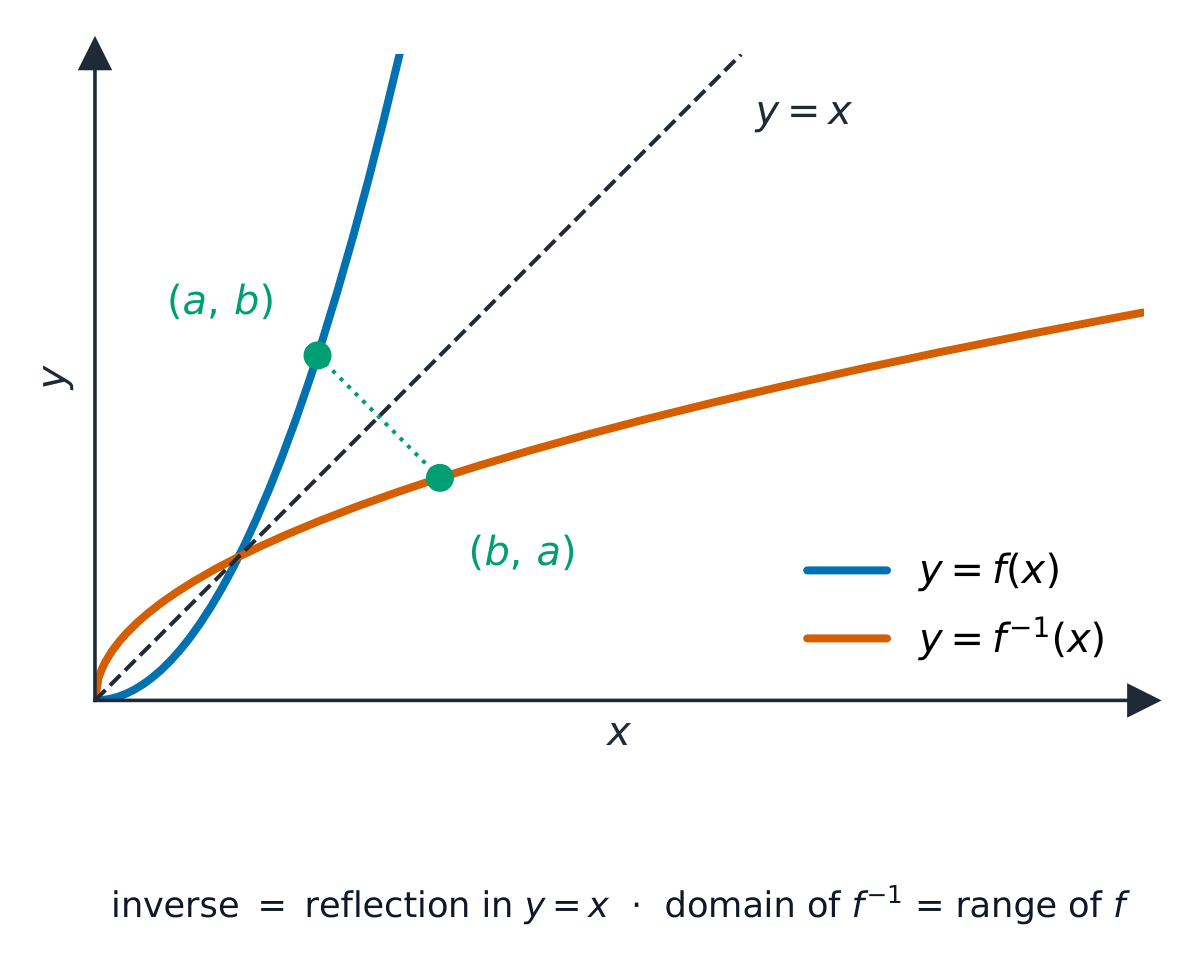
The graph of $y = f^{-1}(x)$ is the reflection 反射 of $y = f(x)$ in the line $y = x$.
Reflecting $y=f(x)$ in the line $y=x$ gives its inverse; a point $(a,b)$ becomes $(b,a)$. You should know these transformations 变换 of $y = f(x)$:
New equation Effect on the graph $y = f(x) + a$ translation 平移 up by $a$ $y = f(x + a)$ translation left by $a$ $y = a\,f(x)$ stretch 伸缩 in the $y$-direction, scale factor $a$ $y = f(ax)$ stretch in the $x$-direction, scale factor $\tfrac{1}{a}$ When two transformations are combined, the order can matter. State each one fully (type, direction, and amount).

Adding to the output or input slides the curve; a multiplier stretches it. Explore · JelajahiExplore a function · Jelajahi sebuah fungsi
y = ax³ + bx² + cx + d
A function turns each input into exactly one output — drag the coefficients and watch where the curve rises and falls. · Sebuah fungsi mengubah setiap masukan menjadi tepat satu keluaran — seret koefisiennya dan lihat di mana kurva naik dan turun.
Vocabulary · Kosa kata Train · LatihEnglish Bahasa Indonesia function/ˈfʌŋkʃn/ fungsi composition of functions/ˌkɒmpəˈzɪʃn ɒv ˈfʌŋkʃnz/ komposisi fungsi domain/dəˈmeɪn/ domain range/reɪndʒ/ jangkauannya one-one/wʌn wʌn/ satu-satu inverse function/ɪnˈvɜːs ˈfʌŋkʃn/ fungsi invers composition/ˌkɒmpəˈzɪʃn/ komposisi reflection/rɪˈflekʃn/ pemantulan transformations/trænsfɔːˈmeɪʃnz/ transformasi translation/trænˈsleɪʃn/ terjemahan stretch/stretʃ/ peregangan 1.3
Coordinate geometry

Syllabus · Silabus
EnglishCandidates should be able to: Notes and examples find the equation of a straight line given sufficient information e.g. given two points, or one point and the gradient. interpret and use any of the forms $y = mx + c$, $y - y_1 = m(x - x_1)$, $ax + by + c = 0$ in solving problems Including calculations of distances, gradients, midpoints, points of intersection and use of the relationship between the gradients of parallel and perpendicular lines. understand that the equation $(x - a)^2 + (y - b)^2 = r^2$ represents the circle with centre $(a, b)$ and radius $r$ Including use of the expanded form $x^2 + y^2 + 2gx + 2fy + c = 0$. use algebraic methods to solve problems involving lines and circles Including use of elementary geometrical properties of circles, e.g. tangent perpendicular to radius, angle in a semicircle, symmetry. Implicit differentiation is not included. understand the relationship between a graph and its associated algebraic equation, and use the relationship between points of intersection of graphs and solutions of equations. e.g. to determine the set of values of $k$ for which the line $y = x + k$ intersects, touches or does not meet a quadratic curve. Bahasa IndonesiaCalon peserta harus mampu: Catatan dan contoh temukan persamaan dari garis lurus jika informasi yang cukup diberikan mis. diberikan dua titik, atau satu titik dan gradien. tafsirkan dan gunakan salah satu bentuk $y = mx + c$, $y - y_1 = m(x - x_1)$, $ax + by + c = 0$ dalam pemecahan masalah Termasuk perhitungan jarak, gradien, titik tengah, titik potong, dan penggunaan hubungan antara gradien sejajar dan tegak lurus garis. pahami bahwa persamaan $(x - a)^2 + (y - b)^2 = r^2$ merepresentasikan lingkaran dengan pusat $(a, b)$ dan jari-jari $r$ Termasuk penggunaan bentuk diperluas $x^2 + y^2 + 2gx + 2fy + c = 0$. gunakan metode aljabar untuk menyelesaikan masalah yang melibatkan garis dan lingkaran Termasuk penggunaan sifat geometri dasar lingkaran, mis. garis singgung tegak lurus terhadap jari-jari, sudut dalam setengah lingkaran, simetri. Diferensiasi implisit tidak termasuk. pahami hubungan antara grafik dan persamaan aljabar yang terkait dengannya, dan gunakan hubungan antara titik potong grafik dan solusi persamaan. mis. untuk menentukan himpunan nilai $k$ di mana garis $y = x + k$ berpotongan, menyinggung, atau tidak bertemu dengan kurva kuadrat. Source: Cambridge International syllabus · Sumber: Silabus Cambridge International
Coordinate geometry 坐标几何 studies lines and circles using their equations.
Straight lines
The gradient 斜率 (steepness) of the line joining $(x_1, y_1)$ and $(x_2, y_2)$ is
$$m = \frac{y_2 - y_1}{x_2 - x_1}.$$You can write the equation of a straight line 直线方程 in any of these forms:$$y = mx + c, \qquad y - y_1 = m(x - x_1), \qquad ax + by + c = 0.$$Two lines are parallel 平行 when their gradients are equal, and perpendicular 垂直 (at right angles) when the product of their gradients is $-1$.Circles
The circle 圆 with centre 圆心 $(a, b)$ and radius 半径 $r$ has equation
$$(x - a)^2 + (y - b)^2 = r^2.$$An expanded form like $x^2 + y^2 - 6x + 10y - 27 = 0$ is the same circle: complete the square in $x$ and in $y$ to find the centre and radius.A tangent 切线 to a circle touches it at one point and is perpendicular to the radius at that point. This right-angle fact solves most circle problems.
A tangent touches the circle once and meets the radius at a right angle. Worked example. The points $P(1, 1)$ and $Q(7, 11)$ are the ends of a diameter 直径 of a circle. Find the equation of the circle.
The centre is the midpoint of $PQ$:
$$\left(\frac{1 + 7}{2},\ \frac{1 + 11}{2}\right) = (4, 6).$$The radius is half the length of $PQ$:$$r = \tfrac12\sqrt{(7 - 1)^2 + (11 - 1)^2} = \tfrac12\sqrt{36 + 100} = \tfrac12\sqrt{136} = \sqrt{34}.$$So the circle is $(x - 4)^2 + (y - 6)^2 = 34$.Explore · JelajahiThe straight line · Garis lurus
y = ax + b
The gradient a tilts the line; the intercept b slides it up and down. · Gradien miringkan garis; intersep menggesernya naik dan turun.
Vocabulary · Kosa kata Train · LatihEnglish Bahasa Indonesia Coordinate geometry/kəʊˈɔːdɪnət dʒiˈɒmətri/ Geometri koordinat gradient/ˈɡreɪdɪənt/ gradien equation of a straight line/ɪˈkweɪʒn əvə streɪt laɪn/ persamaan garis lurus parallel/ˈpærəlel/ paralel perpendicular/ˌpɜːpənˈdɪkjʊlə/ tegak lurus circle/ˈsɜːkl/ lingkaran centre/ˈsentə/ pusat radius/ˈreɪdɪəs/ jari-jari tangent/ˈtændʒənt/ tangens diameter/daɪˈæmɪtə/ diameter 1.4
Circular measure

Syllabus · Silabus
EnglishCandidates should be able to: Notes and examples understand the definition of a radian, and use the relationship between radians and degrees use the formulae $s = r\theta$ and $A = \frac{1}{2}r^2\theta$ in solving problems concerning the arc length and sector area of a circle. Including calculation of lengths and angles in triangles and areas of triangles. Bahasa IndonesiaCalon peserta harus mampu: Catatan dan contoh pahami definisi radian, dan gunakan hubungan antara radian dan derajat gunakan rumus $s = r\theta$ dan $A = \frac{1}{2}r^2\theta$ dalam menyelesaikan masalah mengenai panjang busur dan luas juring lingkaran. Termasuk perhitungan panjang dan sudut dalam segitiga serta luas segitiga. Source: Cambridge International syllabus · Sumber: Silabus Cambridge International
What is a radian? Radians
A radian 弧度 is another way to measure angles. One radian is the angle at the centre of a circle that cuts off an arc 弧 equal in length to the radius. The link between radians and degrees 度 is
$$\pi \text{ radians} = 180^\circ.$$So to change degrees to radians, multiply by $\dfrac{\pi}{180}$; to change radians to degrees, multiply by $\dfrac{180}{\pi}$.One radian: the angle whose arc equals the radius Arc length and sector area
For a sector 扇形 with radius $r$ and angle $\theta$ in radians:
$$\text{arc length} = s = r\theta, \qquad \text{sector area} = A = \tfrac12 r^2 \theta.$$A chord 弦 cuts the sector into a triangle and a segment 弓形. The segment area is the sector minus the triangle:$$\text{segment} = \tfrac12 r^2 \theta - \tfrac12 r^2 \sin\theta = \tfrac12 r^2(\theta - \sin\theta).$$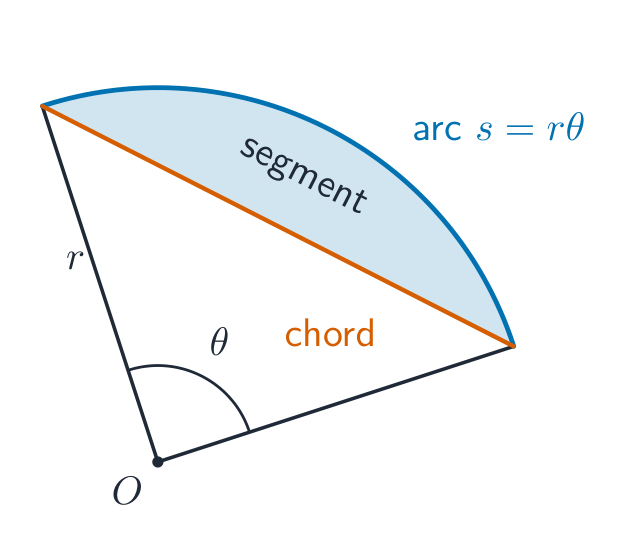
The shaded segment is the part of the sector between the chord and the arc. Worked example. A sector has centre $O$ and the angle at $O$ is $\tfrac{2}{3}\pi$ radians. Show that the segment cut off by the chord has area about $0.614 r^2$.
$$\text{segment} = \tfrac12 r^2\left(\tfrac{2}{3}\pi - \sin\tfrac{2}{3}\pi\right) = \tfrac12 r^2(2.0944 - 0.8660) = \tfrac12 r^2(1.2284) \approx 0.614 r^2.$$Explore · JelajahiRadians, arcs and sectors · Radian, busur, dan juringan
Change the angle (in radians) and radius. See the arc length $s = r\theta$ and the sector area $\tfrac12 r^2\theta$ update. · Ubah sudut (dalam radian) dan jari-jari. Lihat panjang busur $s = r\theta$ dan luas juringan $\tfrac12 r^2\theta$ diperbarui.
Vocabulary · Kosa kata Train · LatihEnglish Bahasa Indonesia radian/ˈreɪdɪən/ radian arc/ɑːk/ busur degrees/dɪˈɡriːz/ derajat sector/ˈsektə/ sektor chord/kɔːd/ tali busur segment/ˈseɡmənt/ segmen 1.5
Trigonometry

Syllabus · Silabus
EnglishCandidates should be able to: Notes and examples sketch and use graphs of the sine, cosine and tangent functions (for angles of any size, and using either degrees or radians) Including e.g. $y = 3 \sin x$, $y = 1 - \cos 2x$, $y = \tan(x + \frac{1}{4}\pi)$. use the exact values of the sine, cosine and tangent of $30^\circ$, $45^\circ$, $60^\circ$, and related angles e.g. $\cos 150^\circ = -\frac{1}{2}\sqrt{3}$, $\sin \frac{3}{4}\pi = \frac{1}{\sqrt{2}}$. use the notations $\sin^{-1} x$, $\cos^{-1} x$, $\tan^{-1} x$ to denote the principal values of the inverse trigonometric relations No specialised knowledge of these functions is required, but understanding of them as examples of inverse functions is expected. use the identities $\frac{\sin \theta}{\cos \theta} \equiv \tan \theta$ and $\sin^2 \theta + \cos^2 \theta \equiv 1$ e.g. in proving identities, simplifying expressions and solving equations. find all the solutions of simple trigonometrical equations lying in a specified interval (general forms of solution are not included). e.g. solve $3 \sin 2x + 1 = 0$ for $-\pi < x < \pi$, $3 \sin^2 \theta - 5 \cos \theta - 1 = 0$ for $0^\circ \leqslant \theta \leqslant 360^\circ$. Bahasa IndonesiaCalon peserta harus mampu: Catatan dan contoh gambar sketsa dan gunakan grafik fungsi sine, cosine dan tangent (untuk sudut dengan ukuran apa pun, dan menggunakan baik derajat maupun radian) Termasuk misal $y = 3 \sin x$, $y = 1 - \cos 2x$, $y = \tan(x + \frac{1}{4}\pi)$. gunakan nilai eksak dari sine, cosine dan tangent dari $30^\circ$, $45^\circ$, $60^\circ$, dan sudut-sudut yang terkait misal $\cos 150^\circ = -\frac{1}{2}\sqrt{3}$, $\sin \frac{3}{4}\pi = \frac{1}{\sqrt{2}}$. gunakan notasi $\sin^{-1} x$, $\cos^{-1} x$, $\tan^{-1} x$ untuk menunjukkan nilai utama dari hubungan trigonometri invers Tidak diperlukan pengetahuan khusus tentang fungsi-fungsi ini, tetapi pemahaman tentang mereka sebagai contoh fungsi invers diharapkan. gunakan identitas $\frac{\sin \theta}{\cos \theta} \equiv \tan \theta$ dan $\sin^2 \theta + \cos^2 \theta \equiv 1$ misal dalam membuktikan identitas, menyederhanakan ekspresi dan menyelesaikan persamaan. temukan semua solusi dari persamaan trigonometri sederhana yang terletak dalam interval tertentu (bentuk umum solusi tidak termasuk). misal selesaikan $3 \sin 2x + 1 = 0$ untuk $-\pi < x < \pi$, $3 \sin^2 \theta - 5 \cos \theta - 1 = 0$ untuk $0^\circ \leqslant \theta \leqslant 360^\circ$. Source: Cambridge International syllabus · Sumber: Silabus Cambridge International
Amplitude, period and midline of a sine curve The unit circle draws the sine curve A Ferris wheel: a point on the rim rises and falls like a sine curve. Graphs and exact values
You must know the shape of the graphs of the sine 正弦, cosine 余弦 and tangent function 正切 (written $\sin$, $\cos$, $\tan$). The sine and cosine graphs wave between $-1$ and $1$ and repeat every $360^\circ$ ($2\pi$). Learn these exact values:
$\theta$ $30^\circ$ $45^\circ$ $60^\circ$ $\sin\theta$ $\tfrac12$ $\tfrac{1}{\sqrt2}$ $\tfrac{\sqrt3}{2}$ $\cos\theta$ $\tfrac{\sqrt3}{2}$ $\tfrac{1}{\sqrt2}$ $\tfrac12$ $\tan\theta$ $\tfrac{1}{\sqrt3}$ $1$ $\sqrt3$ 
Over one turn $\sin$ and $\cos$ stay between $-1$ and $1$; $\tan$ shoots off at $90^\circ$ and $270^\circ$. The notations $\sin^{-1}x$, $\cos^{-1}x$, $\tan^{-1}x$ mean the inverse angle (the principal value 主值).
Identities
An identity 恒等式 is true for every value of the angle. The two you must know are
$$\tan\theta \equiv \frac{\sin\theta}{\cos\theta}, \qquad \sin^2\theta + \cos^2\theta \equiv 1.$$Use them to rewrite an equation so it contains only one trig function.Solving trigonometric equations
To solve a trigonometric equation 三角方程, first reduce it to one function, then find every solution in the given interval.
Worked example. Solve $6\sin\theta = 1 + \dfrac{2}{\sin\theta}$ for $-180^\circ < \theta < 180^\circ$.
Multiply through by $\sin\theta$ to clear the fraction. This makes a quadratic in $\sin\theta$:
$$6\sin^2\theta - \sin\theta - 2 = 0 \;\Rightarrow\; (3\sin\theta - 2)(2\sin\theta + 1) = 0.$$So $\sin\theta = \tfrac23$ or $\sin\theta = -\tfrac12$.- $\sin\theta = \tfrac23$: $\theta = 41.8^\circ$ or $\theta = 180^\circ - 41.8^\circ = 138.2^\circ$.
- $\sin\theta = -\tfrac12$: $\theta = -30^\circ$ or $\theta = -150^\circ$.
The four solutions are $\theta = -150^\circ,\ -30^\circ,\ 41.8^\circ,\ 138.2^\circ$.
Explore · JelajahiSine & cosine graphs · Grafik sinus & kosinus
Drag the amplitude, period and shifts of y = a·sin(bx + c) + d and watch the curve change against the base wave. · Seret amplitudo, periode, dan pergeseran dari y = a·sin(bx + c) + d dan lihat kurva berubah melawan gelombang dasar.
Explore · JelajahiSine and cosine on the unit circle · Sinus dan kosinus pada lingkaran satuan
Drag the angle round the unit circle. The height is $\sin\theta$, the across-distance is $\cos\theta$ — that's where the graphs come from. · Seret sudut di sekitar lingkaran satuan. Ketinggian adalah $\sin\theta$, jarak melintang adalah $\cos\theta$ — dari situlah grafik berasal.
Vocabulary · Kosa kata Train · LatihEnglish Bahasa Indonesia sine/saɪn/ sine cosine/ˈkəʊsaɪn/ kosinus tangent function/ˈtændʒənt ˈfʌŋkʃn/ fungsi tangen principal value/ˈprɪnsɪpl ˈvæljuː/ nilai utama identity/aɪˈdentɪti/ identitas trigonometric equation/ˌtrɪɡənəʊˈmetrɪk ɪˈkweɪʒn/ persamaan trigonometri 1.6
Series

Syllabus · Silabus
EnglishCandidates should be able to: Notes and examples use the expansion of $(a + b)^n$, where $n$ is a positive integer Including the notations $\begin{pmatrix} n \\ r \end{pmatrix}$ and $n!$ Knowledge of the greatest term and properties of the coefficients are not required. recognise arithmetic and geometric progressions use the formulae for the $n$th term and for the sum of the first $n$ terms to solve problems involving arithmetic or geometric progressions Including knowledge that numbers $a$, $b$, $c$ are 'in arithmetic progression' if $2b = a + c$ (or equivalent) and are 'in geometric progression' if $b^2 = ac$ (or equivalent). Questions may involve more than one progression. use the condition for the convergence of a geometric progression, and the formula for the sum to infinity of a convergent geometric progression. Bahasa IndonesiaCalon peserta harus mampu: Catatan dan contoh gunakan perluasan dari $(a + b)^n$, di mana $n$ adalah bilangan bulat positif Termasuk notasi $\begin{pmatrix} n \\ r \end{pmatrix}$ dan $n!$ Pengetahuan tentang suku terbesar dan sifat koefisien tidak diperlukan. kenali barisan aritmetika dan barisan geometri gunakan rumus untuk suku ke-$n$ dan untuk jumlah dari $n$ suku pertama untuk menyelesaikan masalah yang melibatkan barisan aritmetika atau barisan geometri Termasuk pengetahuan bahwa bilangan-bilangan $a$, $b$, $c$ 'berada dalam barisan aritmetika' jika $2b = a + c$ (atau ekuivalen) dan berada dalam 'barisan geometri' jika $b^2 = ac$ (atau ekuivalen). Pertanyaan dapat melibatkan lebih dari satu barisan. gunakan kondisi untuk konvergensi dari barisan geometri, dan rumus untuk jumlah tak hingga dari barisan geometri konvergen. Source: Cambridge International syllabus · Sumber: Silabus Cambridge International
Pascal's triangle gives the coefficients Sum to infinity fills the square The binomial expansion
For a positive integer $n$, the binomial expansion 二项展开式 is
$$(a + b)^n = a^n + \binom{n}{1}a^{n-1}b + \binom{n}{2}a^{n-2}b^2 + \cdots + b^n,$$where $\binom{n}{r} = \dfrac{n!}{r!\,(n - r)!}$ is a binomial coefficient 二项式系数.Worked example. Find the first three terms, in ascending powers of $x$, of $(2 - px)^5$.
$$(2 - px)^5 = 2^5 + \binom{5}{1}2^4(-px) + \binom{5}{2}2^3(-px)^2 + \cdots = 32 - 80px + 80p^2x^2 + \cdots$$Arithmetic and geometric progressions
A progression 数列 (sequence) is a list of terms following a rule.
- An arithmetic progression 等差数列 (AP) adds a fixed common difference 公差 $d$ each step. The $n$th term 项 is $u_n = a + (n - 1)d$, and the sum of the first $n$ terms is $S_n = \tfrac{n}{2}\big(2a + (n - 1)d\big)$.
- A geometric progression 等比数列 (GP) multiplies by a fixed common ratio 公比 $r$ each step. The $n$th term is $u_n = ar^{\,n-1}$, and $S_n = \dfrac{a(1 - r^n)}{1 - r}$.
An AP climbs in equal steps; a GP's steps grow by the same ratio A GP is convergent — it converges 收敛 (settles to a limit) — when $|r| < 1$. Then it has a sum to infinity 无穷和
$$S_\infty = \frac{a}{1 - r}.$$Worked example. The third term of a GP is $18$ and the sum of the first three terms is $26$. The common ratio is negative. Find the sum to infinity.
From $ar^2 = 18$ you get $a = \dfrac{18}{r^2}$. Put this into $a(1 + r + r^2) = 26$:
$$18(1 + r + r^2) = 26r^2 \;\Rightarrow\; 8r^2 - 18r - 18 = 0 \;\Rightarrow\; (4r + 3)(r - 3) = 0.$$The ratio is negative, so $r = -\tfrac34$ and $a = \dfrac{18}{(3/4)^2} = 32$. Then$$S_\infty = \frac{32}{1 - (-\tfrac34)} = \frac{32}{\tfrac74} = \frac{128}{7}.$$
Convergent GP: bars shrink toward zero while the running sum approaches S infinity = a/(1-r) Explore · JelajahiArithmetic and geometric sequences · Urutan aritmatika dan geometri
Switch between an arithmetic (add d) and a geometric (multiply by r) sequence and watch the terms and their sum build up. · Beralih antara aritmatika (tambah d) dan geometri (kali r) urutan dan saksikan suku-suku dan jumlahnya meningkat.
Vocabulary · Kosa kata Train · LatihEnglish Bahasa Indonesia binomial expansion/baɪˈnəʊmɪəl ekˈspænʃn/ ekspansi binomial binomial coefficient/baɪˈnəʊmɪəl ˌkəʊɪˈfɪʃənt/ koefisien binomial progression/prəˈɡreʃn/ progresi arithmetic progression/əˈrɪθmətɪk prəˈɡreʃn/ barisan aritmatika common difference/ˈkɒmən ˈdɪfrəns/ beda tetap term/tɜːm/ suku geometric progression/ˌdʒiːəʊˈmetrɪk prəˈɡreʃn/ barisan geometri common ratio/ˈkɒmən ˈreɪʃɪəʊ/ rasio tetap converges/kənˈvɜːdʒɪz/ konvergen sum to infinity/sʌm tʊ ɪnˈfɪnɪti/ jumlah ke tak hingga 1.7
Differentiation

Syllabus · Silabus
EnglishCandidates should be able to: Notes and examples understand the gradient of a curve at a point as the limit of the gradients of a suitable sequence of chords, and use the notations $f'(x)$, $f''(x)$, $\frac{\text{d}y}{\text{d}x}$, and $\frac{\text{d}^2y}{\text{d}x^2}$ for first and second derivatives Only an informal understanding of the idea of a limit is expected. e.g. includes consideration of the gradient of the chord joining the points with $x$ coordinates $2$ and $(2 + h)$ on the curve $y = x^3$. Formal use of the general method of differentiation from first principles is not required. use the derivative of $x^n$ (for any rational $n$), together with constant multiples, sums and differences of functions, and of composite functions using the chain rule e.g. find $\frac{\text{d}y}{\text{d}x}$, given $y = \sqrt{2x^3 + 5}$. apply differentiation to gradients, tangents and normals, increasing and decreasing functions and rates of change Including connected rates of change, e.g. given the rate of increase of the radius of a circle, find the rate of increase of the area for a specific value of one of the variables. locate stationary points and determine their nature, and use information about stationary points in sketching graphs. Including use of the second derivative for identifying maxima and minima; alternatives may be used in questions where no method is specified. Knowledge of points of inflexion is not included. Bahasa IndonesiaCalon peserta harus mampu: Catatan dan contoh pahami gradien kurva pada suatu titik sebagai limit dari gradien dari deretan tali busur yang sesuai, dan gunakan notasi $f'(x)$, $f''(x)$, $\frac{\text{d}y}{\text{d}x}$, dan $\frac{\text{d}^2y}{\text{d}x^2}$ untuk turunan pertama dan kedua Hanya pemahaman informal tentang konsep limit yang diharapkan. misal termasuk pertimbangan gradien dari tali busur yang menghubungkan titik-titik dengan koordinat $x$ $2$ dan $(2 + h)$ pada kurva $y = x^3$. Penggunaan formal dari metode umum diferensiasi dari prinsip pertama tidak diperlukan. gunakan turunan dari $x^n$ (untuk setiap rasional $n$), bersama dengan kelipatan konstan, jumlah dan selisih fungsi, serta fungsi komposit menggunakan aturan rantai misal cari $\frac{\text{d}y}{\text{d}x}$, diberikan $y = \sqrt{2x^3 + 5}$. terapkan diferensiasi pada gradien, garis singgung dan garis normal, fungsi naik dan turun serta laju perubahan Termasuk laju perubahan yang terhubung, misal diberikan laju peningkatan jari-jari lingkaran, cari laju peningkatan luas untuk nilai spesifik dari salah satu variabel. tentukan titik stasioner dan tentukan sifatnya, dan gunakan informasi tentang titik stasioner dalam menggambar sketsa grafik. Termasuk penggunaan turunan kedua untuk mengidentifikasi maksimum dan minimum; alternatif dapat digunakan dalam pertanyaan di mana tidak ada metode yang ditentukan. Pengetahuan tentang titik belok tidak termasuk. Source: Cambridge International syllabus · Sumber: Silabus Cambridge International
Differentiation from first principles Differentiation 微分 finds the gradient of a curve 曲线斜率 at each point. The gradient is the limit 极限 of the gradients of shorter and shorter chords, called the derivative 导数.
The rules
Write the derivative as $f'(x)$ or $\dfrac{dy}{dx}$. The basic rule is
$$\frac{d}{dx}\left(x^n\right) = n x^{n-1} \quad \text{for any rational } n.$$Differentiate sums term by term, and use the chain rule 链式法则 for a function inside a function:$$\frac{d}{dx}\,f(g(x)) = f'(g(x)) \cdot g'(x).$$Differentiating again gives the second derivative 二阶导数 $f''(x)$ or $\dfrac{d^2y}{dx^2}$.Using the derivative
- Tangent and normal. The gradient of the curve at a point is the gradient of the tangent there. The normal 法线 is perpendicular to the tangent, so its gradient is $-\dfrac{1}{\text{(tangent gradient)}}$.
- Increasing or decreasing. The function is an increasing function 增函数 where $\dfrac{dy}{dx} > 0$, and a decreasing function 减函数 where $\dfrac{dy}{dx} < 0$.
- Rate of change. A derivative is a rate of change 变化率. Linked rates use the chain rule, e.g. $\dfrac{dy}{dt} = \dfrac{dy}{dx}\cdot\dfrac{dx}{dt}$.
Stationary points
A stationary point 驻点 is where $\dfrac{dy}{dx} = 0$. Test its nature with the second derivative: $f''(x) > 0$ gives a minimum point 极小值点, and $f''(x) < 0$ gives a maximum point 极大值点. When $f''(x) = 0$ the test is inconclusive: the point may be a point of inflexion 拐点, where the curve changes concavity (the way it bends) – check the sign of $\dfrac{dy}{dx}$ just before and after to decide.
At a maximum or a minimum the tangent is flat, so $\frac{dy}{dx}=0$. Worked example. The curve $y = 4x^{1/2} - x$ has a maximum point at $x = a$. Find $a$.
$$\frac{dy}{dx} = 2x^{-1/2} - 1 = 0 \;\Rightarrow\; \frac{2}{\sqrt{x}} = 1 \;\Rightarrow\; \sqrt{x} = 2 \;\Rightarrow\; x = 4.$$So $a = 4$.Explore · JelajahiThe gradient at a point · Gradien pada suatu titik
y = ax³ + bx² + cx + d
Slide the point along the curve. The tangent shows the gradient $\frac{dy}{dx}$ there — steeper where the curve bends more. · Geser titik sepanjang kurva. Garis singgung menunjukkan gradien $\frac{dy}{dx}$ di sana — lebih curam di mana kurva membengkok lebih banyak.
Vocabulary · Kosa kata Train · LatihEnglish Bahasa Indonesia Differentiation/ˌdɪfəˌrenʃɪˈeɪʃn/ Pembahagian gradient of a curve/ˈɡreɪdɪənt əvə kɜːv/ gradien kurva limit/ˈlɪmɪt/ batas derivative/dɪˈrɪvətɪv/ turunan chain rule/tʃeɪn ruːl/ aturan rantai second derivative/ˈsekənd dɪˈrɪvətɪv/ turunan kedua normal/ˈnɔːml/ normal increasing function/ɪnˈkriːsɪŋ ˈfʌŋkʃn/ fungsi naik decreasing function/ˈdiːkriːsɪŋ ˈfʌŋkʃn/ fungsi turun rate of change/reɪt ɒv tʃeɪndʒ/ laju perubahan stationary point/ˈsteɪʃənəri pɔɪnt/ titik stasioner minimum point/ˈmɪnɪməm pɔɪnt/ titik minimum maximum point/ˈmæksɪməm pɔɪnt/ titik maksimum point of inflexion/pɔɪnt ɒv ɪnˈflekʃn/ titik belok 1.8
Integration

Syllabus · Silabus
EnglishCandidates should be able to: Notes and examples understand integration as the reverse process of differentiation, and integrate $(ax + b)^n$ (for any rational $n$ except $-1$), together with constant multiples, sums and differences e.g. $\int (2x^3 - 5x + 1) \text{d}x$, $\int \frac{1}{(2x + 3)^2} \text{d}x$. solve problems involving the evaluation of a constant of integration e.g. to find the equation of the curve through $(1, -2)$ for which $\frac{\text{d}y}{\text{d}x} = \sqrt{2x + 1}$. evaluate definite integrals Including simple cases of 'improper' integrals, such as $\int_{0}^{1} x^{-\frac{1}{2}} \text{d}x$ and $\int_{1}^{\infty} x^{-2} \text{d}x$. use definite integration to find: - the area of a region bounded by a curve and lines parallel to the axes, or between a curve and a line or between two curves - a volume of revolution about one of the axes. A volume of revolution may involve a region not bounded by the axis of rotation, e.g. the region between $y = 9 - x^2$ and $y = 5$ rotated about the $x$-axis. Bahasa IndonesiaCalon peserta harus mampu: Catatan dan contoh pahami integrasi sebagai proses kebalikan dari diferensiasi, dan integralkan $(ax + b)^n$ (untuk setiap rasional $n$ kecuali $-1$), bersama dengan kelipatan konstan, jumlah dan selisih misal $\int (2x^3 - 5x + 1) \text{d}x$, $\int \frac{1}{(2x + 3)^2} \text{d}x$. selesaikan masalah yang melibatkan evaluasi konstanta integrasi misal untuk mencari persamaan kurva melalui $(1, -2)$ untuk mana $\frac{\text{d}y}{\text{d}x} = \sqrt{2x + 1}$. evaluasi integral tentu Termasuk kasus-kasus sederhana dari integral 'tidak wajar', seperti $\int_{0}^{1} x^{-\frac{1}{2}} \text{d}x$ dan $\int_{1}^{\infty} x^{-2} \text{d}x$. gunakan integral tentu untuk menemukan: - luas daerah yang dibatasi oleh kurva dan garis-garis sejajar sumbu, atau antara kurva dan garis atau antara dua kurva - volume putar terhadap salah satu sumbu. Volume putar dapat melibatkan daerah yang tidak dibatasi oleh sumbu rotasi, misal daerah antara $y = 9 - x^2$ dan $y = 5$ diputar sekitar sumbu $x$. Source: Cambridge International syllabus · Sumber: Silabus Cambridge International
Integration as area: Riemann rectangles Integration 积分 is the reverse of differentiation. Reversing the power rule gives
$$\int (ax + b)^n \, dx = \frac{(ax + b)^{n+1}}{a(n + 1)} + C \quad (n \neq -1).$$The $+\,C$ is the constant of integration 积分常数. If you know one point on the curve, substitute it to find $C$.Definite integrals and area
A definite integral 定积分 has limits and gives a number:
$$\int_p^q f(x)\, dx = \big[F(x)\big]_p^q = F(q) - F(p).$$The area of the region 区域 between a curve and the $x$-axis, from $x = p$ to $x = q$, is $\displaystyle\int_p^q y \, dx$. For the area between two curves, integrate (top curve $-$ bottom curve).The definite integral $\int_0^4 y\,dx$ is the shaded area under the curve. Worked example. The curve $y = 4x^{1/2} - x$ meets the $x$-axis again at $x = 16$. Find the area between the curve and the $x$-axis from $x = 0$ to $x = 4$.
$$\int_0^4 \left(4x^{1/2} - x\right) dx = \left[\frac{8}{3}x^{3/2} - \frac{x^2}{2}\right]_0^4 = \frac{8}{3}(8) - \frac{16}{2} = \frac{64}{3} - 8 = \frac{40}{3}.$$An improper integral 广义积分 has an infinite limit or an endpoint where the integrand is undefined; evaluate it as a limit. For example,
$$\int_1^{\infty}x^{-2}\, dx=\lim_{b\to\infty}\left[-\frac1x\right]_1^{b}=\lim_{b\to\infty}\left(1-\frac1b\right)=1,$$and $\displaystyle\int_0^{1}x^{-1/2}\, dx=\left[2x^{1/2}\right]_0^{1}=2$, which is finite even though the integrand blows up at $x=0$.Volume of revolution
When a region is turned all the way around an axis it sweeps out a solid. The volume of revolution 旋转体体积 about the $x$-axis is
$$V = \pi \int_p^q y^2 \, dx,$$and about the $y$-axis it is $V = \pi \displaystyle\int x^2 \, dy$. For example, the region under $y = \sqrt{x}$ from $x = 0$ to $x = 4$, turned about the $x$-axis, has volume $\pi\displaystyle\int_0^4 x\, dx = \pi\big[\tfrac{x^2}{2}\big]_0^4 = 8\pi$.
Rotating the region under a curve around the $x$-axis sweeps out a solid; each thin slice is a disc of area $\pi y^2$, so $V = \pi\int y^2\,dx$ Explore · JelajahiArea under a curve · Luas di bawah kurva
y = ax³ + bx² + cx + d
Drag the limits. The definite integral is the shaded area between the curve and the x-axis. · Seret batas-batasnya. Integral tentu adalah area arsiran antara kurva dan sumbu-x.
Vocabulary · Kosa kata Train · LatihEnglish Bahasa Indonesia Integration/ˌɪntɪˈɡreɪʃn/ Integrasi constant of integration/ˈkɒnstənt ɒv ˌɪntɪˈɡreɪʃn/ konstanta integrasi definite integral/ˈdefɪnət ˈɪntɪɡrəl/ integral tentu region/ˈriːdʒn/ wilayah improper integral/ɪmˈprɒpə ˈɪntɪɡrəl/ integral tak wajar volume of revolution/ˈvɒljuːm ɒv ˌrevəˈluːʃn/ volume putar 1.8
Exam tips
- Show every line of algebra — method marks are lost by jumping steps; use the discriminant $b^2 - 4ac$ to decide the number of real roots.
- Work in radians for circular measure (arc $= r\theta$, sector area $= \frac{1}{2}r^2\theta$) and for calculus of trig functions.
- For differentiation, set $\frac{dy}{dx} = 0$ for stationary points and use the second derivative to classify them.
- For integration, add $+ c$ to an indefinite integral and use limits for area; an area below the axis gives a negative integral.
Vocabulary · Kosa kata Train · LatihEnglish Bahasa Indonesia algebra/ˈældʒɪbrə/ aljabar calculus/ˈkælkjʊləs/ kalkulus -
2
Pure Mathematics 2 · Matematika Murni 2
Watch lesson · Tonton pelajaranThis handout covers Topic 2: Pure Mathematics 纯数学 2. It adds the modulus and polynomial algebra, logarithms 对数 and the exponential function 指数函数, more trigonometry, and new ways to differentiate and integrate.
2.1
Algebra

Syllabus · Silabus
EnglishCandidates should be able to: Notes and examples understand the meaning of $|x|$, sketch the graph of $y = |ax + b|$ and use relations such as $|a| = |b| \iff a^2 = b^2$ and $|x - a| < b \iff a - b < x < a + b$ when solving equations and inequalities Graphs of $y = |f(x)|$ and $y = f(|x|)$ for non-linear functions $f$ are not included. e.g. $|3x - 2| = |2x + 7|$, $2x + 5 < |x + 1|$ divide a polynomial, of degree not exceeding 4, by a linear or quadratic polynomial, and identify the quotient and remainder (which may be zero) use the factor theorem and the remainder theorem. e.g. to find factors and remainders, solve polynomial equations or evaluate unknown coefficients. Including factors of the form $(ax + b)$ in which the coefficient of $x$ is not unity, and including calculation of remainders. Bahasa IndonesiaCalon peserta harus mampu: Catatan dan contoh pahami makna dari $|x|$, gambar sketsa grafik dari $y = |ax + b|$ dan gunakan relasi seperti $|a| = |b| \iff a^2 = b^2$ dan $|x - a| < b \iff a - b < x < a + b$ saat menyelesaikan persamaan dan ketaksamaan Grafik dari $y = |f(x)|$ dan $y = f(|x|)$ untuk fungsi non-linear $f$ tidak termasuk. misal $|3x - 2| = |2x + 7|$, $2x + 5 < |x + 1|$ bagilah polinomial, dengan derajat tidak melebihi 4, oleh polinomial linear atau kuadrat, dan identifikasi hasil bagi dan sisa (yang mungkin nol) gunakan teorema faktor dan teorema sisa. misal untuk mencari faktor dan sisa, menyelesaikan persamaan polinomial atau mengevaluasi koefisien tak diketahui. Termasuk faktor dari bentuk $(ax + b)$ di mana koefisien dari $x$ bukan kesatuan, dan termasuk perhitungan sisa. Source: Cambridge International syllabus · Sumber: Silabus Cambridge International
The modulus
The modulus 绝对值 $|x|$ is the size of a number with its sign removed, so $|x| \geqslant 0$ always. The graph of $y = |ax + b|$ is a "V" shape that bounces off the $x$-axis. Two useful rules for solving equations and inequalities are
$$|a| = |b| \;\Leftrightarrow\; a^2 = b^2, \qquad |x - a| < b \;\Leftrightarrow\; a - b < x < a + b.$$Taking the modulus folds the part of the line below the axis upward into a V. Worked example. Solve $|3x + 8| < 9$.
Using the second rule with the inequality written as $-9 < 3x + 8 < 9$:
$$-9 < 3x + 8 < 9 \;\Rightarrow\; -17 < 3x < 1 \;\Rightarrow\; -\tfrac{17}{3} < x < \tfrac13.$$Polynomial division and the factor and remainder theorems
A polynomial 多项式 is a sum of powers of $x$, such as $2x^4 + 3x^2 - 5$. Its degree 次数 is the highest power. When you divide one polynomial by another you get a quotient 商 and a remainder 余数.
- Remainder theorem 余数定理: the remainder when $p(x)$ is divided by $(x - a)$ is $p(a)$.
- Factor theorem 因式定理: $(x - a)$ is a factor of $p(x)$ exactly when $p(a) = 0$.
Worked example. The polynomial $p(x) = 2x^4 + kx^3 + kx^2 + 17x + 18$ has factor $(x + 2)$. Find $k$.
By the factor theorem $p(-2) = 0$:
$$2(16) + k(-8) + k(4) + 17(-2) + 18 = 0 \;\Rightarrow\; 16 - 4k = 0 \;\Rightarrow\; k = 4.$$Explore · JelajahiThe modulus function · Fungsi modulus
y = a|x − b| + c
The modulus makes a V-shape. Move its vertex with b and c; change how steep the arms are with a. · Modulus membentuk bentuk V. Gerakkan puncaknya dengan b dan c; ubah kecuraman lengan-lengan dengan a.
Vocabulary · Kosa kata Train · LatihEnglish Bahasa Indonesia modulus/ˈmɒdjʊləs/ modulus polynomial/ˌpɒlɪˈnəʊmɪəl/ polinomial degree/dɪˈɡriː/ derajat quotient/ˈkwəʊʃənt/ hasil bagi remainder/rɪˈmeɪndə/ sisa remainder theorem/rɪˈmeɪndə ˈθɪərəm/ teorem sisa factor theorem/ˈfæktə ˈθɪərəm/ teorem faktor 2.2
Logarithmic and exponential functions

Syllabus · Silabus
EnglishCandidates should be able to: Notes and examples understand the relationship between logarithms and indices, and use the laws of logarithms (excluding change of base) understand the definition and properties of $e^x$ and $\ln x$, including their relationship as inverse functions and their graphs Including knowledge of the graph of $y = e^{kx}$ for both positive and negative values of $k$. use logarithms to solve equations and inequalities in which the unknown appears in indices e.g. $2^x < 5$, $3 \times 2^{3x-1} < 5$, $3^{x+1} = 4^{2x-1}$ use logarithms to transform a given relationship to linear form, and hence determine unknown constants by considering the gradient and/or intercept. e.g. $y = kx^n$ gives $\ln y = \ln k + n \ln x$ which is linear in $\ln x$ and $\ln y$ $y = k(a^x)$ gives $\ln y = \ln k + x \ln a$ which is linear in $x$ and $\ln y$. Bahasa IndonesiaCalon peserta harus mampu: Catatan dan contoh pahami hubungan antara logaritma dan indeks, dan gunakan hukum-hukum logaritma (kecuali perubahan basis) pahami definisi dan sifat dari $e^x$ dan $\ln x$, termasuk hubungan mereka sebagai fungsi invers dan grafiknya Termasuk pengetahuan tentang grafik dari $y = e^{kx}$ untuk nilai positif dan negatif dari $k$. gunakan logaritma untuk menyelesaikan persamaan dan ketaksamaan di mana variabel tak diketahui muncul dalam indeks misal $2^x < 5$, $3 \times 2^{3x-1} < 5$, $3^{x+1} = 4^{2x-1}$ gunakan logaritma untuk mengubah hubungan tertentu menjadi bentuk linear, dan karenanya menentukan konstan yang tidak diketahui dengan mempertimbangkan gradien dan/atau intersep. mis. $y = kx^n$ memberikan $\ln y = \ln k + n \ln x$ yang linear dalam $\ln x$ dan $\ln y$ $y = k(a^x)$ memberikan $\ln y = \ln k + x \ln a$ yang linear dalam $x$ dan $\ln y$. Source: Cambridge International syllabus · Sumber: Silabus Cambridge International
Earthquake strength is measured on the logarithmic Richter scale. 
Populations can grow exponentially when resources are plentiful. A logarithm answers the question "what power?". If $a^x = y$ then $x = \log_a y$. Logarithms and indices 指数 (powers) are reverse ideas. The laws of logarithms 对数定律 are
$$\log(mn) = \log m + \log n, \qquad \log\!\frac{m}{n} = \log m - \log n, \qquad \log(m^k) = k\log m.$$The exponential function $e^x$ and the natural logarithm 自然对数 $\ln x$ are inverse functions, so $\ln(e^x) = x$ and $e^{\ln x} = x$. When the unknown is in the power, take logs of both sides.

$e^x$ and $\ln x$ undo each other, so each is the other reflected in $y=x$. Worked example. Solve $4^x < 0.05$.
$$4^x < 0.05 \;\Rightarrow\; x\ln 4 < \ln 0.05 \;\Rightarrow\; x < \frac{\ln 0.05}{\ln 4} = -2.16 \ (\text{3 s.f.}).$$Linear form 线性形式: a relationship like $y = Ax^n$ becomes a straight line if you take logs: $\ln y = \ln A + n\ln x$. Plotting $\ln y$ against $\ln x$ gives a line with gradient $n$ and intercept $\ln A$, so you can find the unknown constants.
Explore · JelajahiExponential growth · Pertumbuhan eksponen
y = a·bˣ
Change the base b: when b > 1 the curve grows, when 0 < b < 1 it decays — and it always passes through (0, a). · Tukar asas b: apabila b > 1 lengkung tumbuh, apabila 0 < b < 1 ia menurun — dan ia sentiasa melalui (0, a).
Vocabulary · Kosa kata Train · LatihEnglish Bahasa Indonesia Pure Mathematics/pjʊə ˌmæθɪˈmætɪks/ Matematika Murni logarithms/ˈlɒɡərɪθəmz/ logaritma exponential function/ˌekspəˈnenʃl ˈfʌŋkʃn/ fungsi eksponensial indices/ˈɪndɪsiːz/ eksponen laws of logarithms/lɔːz ɒv ˈlɒɡərɪθəmz/ hukum logaritma natural logarithm/ˈnætʃərəl ˈlɒɡərɪθəm/ logaritma natural linear form/ˈlɪnɪə fɔːm/ bentuk linear 2.3
Trigonometry
Syllabus · Silabus
EnglishCandidates should be able to: Notes and examples understand the relationship of the secant, cosecant and cotangent functions to cosine, sine and tangent, and use properties and graphs of all six trigonometric functions for angles of any magnitude use trigonometrical identities for the simplification and exact evaluation of expressions, and in the course of solving equations, and select an identity or identities appropriate to the context, showing familiarity in particular with the use of: – $\sec^2 \theta \equiv 1 + \tan^2 \theta$ and $\csc^2 \theta \equiv 1 + \cot^2 \theta$ – the expansions of $\sin(A \pm B)$, $\cos(A \pm B)$ and $\tan(A \pm B)$ – the formulae for $\sin 2A$, $\cos 2A$ and $\tan 2A$ – the expression of $a \sin \theta + b \cos \theta$ in the forms $R \sin(\theta \pm \alpha)$ and $R \cos(\theta \pm \alpha)$. e.g. simplifying $\cos(x - 30^\circ) - 3 \sin(x - 60^\circ)$. e.g. solving $\tan \theta + \cot \theta = 4$, $2 \sec^2 \theta - \tan \theta = 5$, $3 \cos \theta + 2 \sin \theta = 1$. Bahasa IndonesiaCalon peserta harus mampu: Catatan dan contoh pahami hubungan fungsi sekans, kosekans dan kotangens dengan kosinus, sinus dan tangens, serta gunakan sifat dan grafik dari keenam fungsi trigonometri untuk sudut berapapun magnitudonya gunakan identitas trigonometri untuk penyederhanaan dan evaluasi eksak ekspresi, dan dalam proses penyelesaian persamaan, pilih satu atau lebih identitas yang sesuai dengan konteks, menunjukkan familiarity terutama dengan penggunaan: – $\sec^2 \theta \equiv 1 + \tan^2 \theta$ dan $\csc^2 \theta \equiv 1 + \cot^2 \theta$ – pengembangan dari $\sin(A \pm B)$, $\cos(A \pm B)$ dan $\tan(A \pm B)$ – rumus-rumus untuk $\sin 2A$, $\cos 2A$ dan $\tan 2A$ – penulisan $a \sin \theta + b \cos \theta$ dalam bentuk $R \sin(\theta \pm \alpha)$ dan $R \cos(\theta \pm \alpha)$. mis. menyederhanakan $\cos(x - 30^\circ) - 3 \sin(x - 60^\circ)$. mis. menyelesaikan $\tan \theta + \cot \theta = 4$, $2 \sec^2 \theta - \tan \theta = 5$, $3 \cos \theta + 2 \sin \theta = 1$. Source: Cambridge International syllabus · Sumber: Silabus Cambridge International
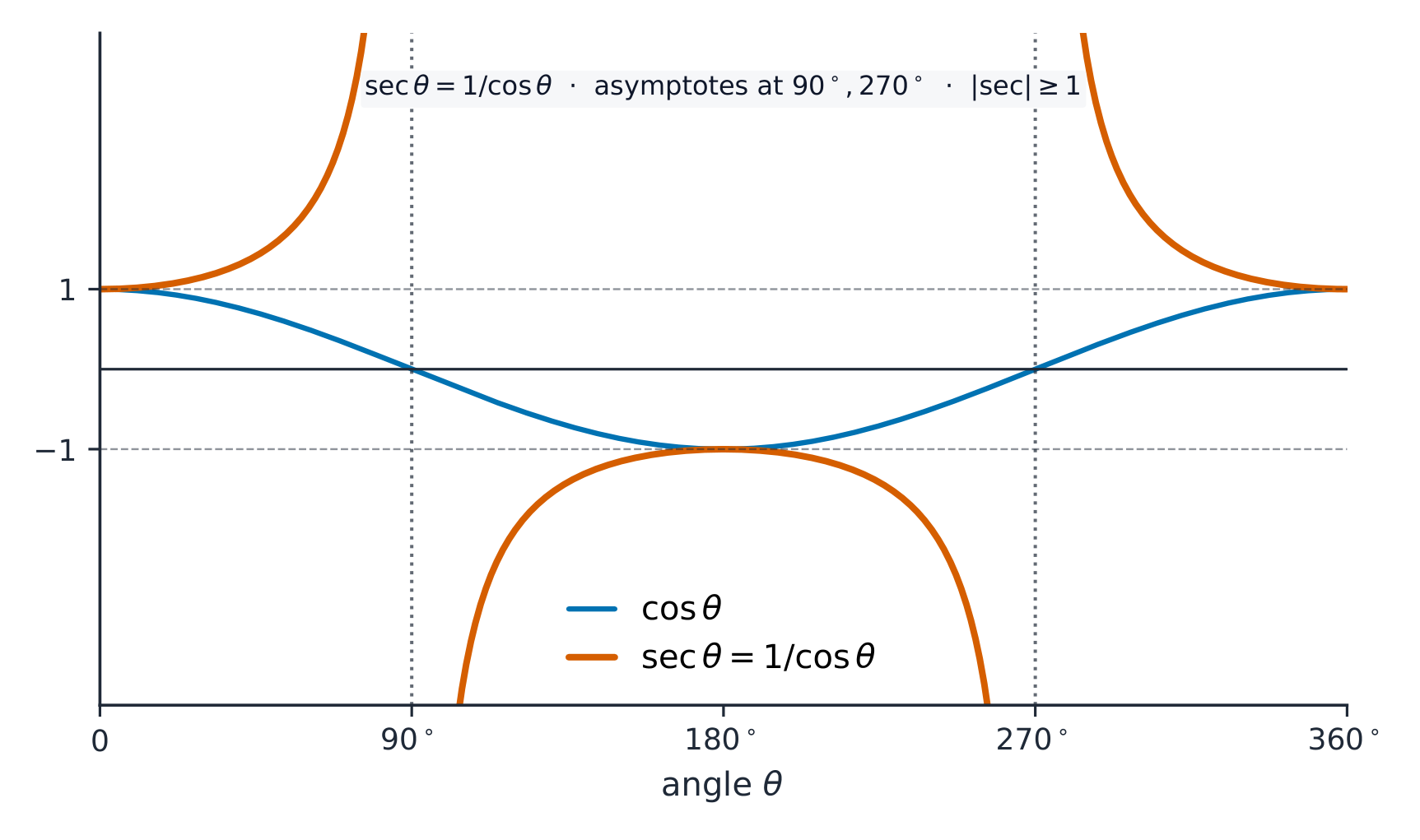
There are three more functions, each the reciprocal of one you know: the secant 正割 $\sec\theta = \dfrac{1}{\cos\theta}$, the cosecant 余割 $\csc\theta = \dfrac{1}{\sin\theta}$, and the cotangent 余切 $\cot\theta = \dfrac{1}{\tan\theta}$.
$\sec\theta=1/\cos\theta$ rises to an asymptote wherever $\cos\theta=0$. You must know these trigonometric identities 三角恒等式 and choose the right one for each problem:
$$\sec^2\theta \equiv 1 + \tan^2\theta, \qquad \csc^2\theta \equiv 1 + \cot^2\theta.$$You also use the compound angle 复合角 formulae for $\sin(A \pm B)$, $\cos(A \pm B)$, $\tan(A \pm B)$, the double angle 二倍角 formulae$$\sin 2A = 2\sin A\cos A, \quad \cos 2A = 2\cos^2 A - 1, \quad \tan 2A = \frac{2\tan A}{1 - \tan^2 A},$$and the R-formula 辅助角公式 $a\sin\theta + b\cos\theta = R\sin(\theta + \alpha)$, where $R = \sqrt{a^2 + b^2}$ and $\tan\alpha = \dfrac{b}{a}$.Worked example. Solve $2\tan^2\theta + 3\sec\theta = 18$ for $-180^\circ < \theta < 180^\circ$.
Replace $\tan^2\theta$ with $\sec^2\theta - 1$ to get one function:
$$2(\sec^2\theta - 1) + 3\sec\theta = 18 \;\Rightarrow\; 2\sec^2\theta + 3\sec\theta - 20 = 0 \;\Rightarrow\; (2\sec\theta - 5)(\sec\theta + 4) = 0.$$So $\sec\theta = \tfrac52$ or $\sec\theta = -4$, giving $\cos\theta = \tfrac25$ or $\cos\theta = -\tfrac14$. The solutions are $\theta = \pm 66.4^\circ$ and $\theta = \pm 104.5^\circ$.Explore · JelajahiThe unit circle · Lingkaran satuan
Drag the angle to see how $\sin$, $\cos$ and $\tan$ relate — the key to solving trig equations. · Seret sudut untuk melihat bagaimana $\sin$, $\cos$, dan $\tan$ saling berkaitan — kunci untuk menyelesaikan persamaan trigonometri.
Vocabulary · Kosa kata Train · LatihEnglish Bahasa Indonesia secant/ˈsiːkənt/ sekans cosecant/ˈkəʊsekənt/ kosekan cotangent/ˈkəʊtændʒənt/ kotangen trigonometric identities/ˌtrɪɡənəʊˈmetrɪk aɪˈdentɪtiz/ identitas trigonometri compound angle/ˈkɒmpaʊnd ˈæŋɡl/ sudut majemuk double angle/ˈdʌbl ˈæŋɡl/ sudut ganda R-formula/ɑː ˈfɔːmjʊlə/ R-rumus 2.4
Differentiation
Syllabus · Silabus
EnglishCandidates should be able to: Notes and examples use the derivatives of $e^x$, $\ln x$, $\sin x$, $\cos x$, $\tan x$, together with constant multiples, sums, differences and composites differentiate products and quotients e.g. $\frac{2x - 4}{3x + 2}$, $x^2 \ln x$, $x e^{1 - x^2}$. find and use the first derivative of a function which is defined parametrically or implicitly. e.g. $x = t - e^{2t}$, $y = t + e^{2t}$. e.g. $x^2 + y^2 = xy + 7$. Including use in problems involving tangents and normals. Bahasa IndonesiaCalon peserta harus mampu: Catatan dan contoh gunakan turunan dari $e^x$, $\ln x$, $\sin x$, $\cos x$, $\tan x$, bersama dengan perkalian konstanta, penjumlahan, pengurangan, dan komposisi diferensiasikan hasil kali dan hasil bagi mis. $\frac{2x - 4}{3x + 2}$, $x^2 \ln x$, $x e^{1 - x^2}$. temukan dan gunakan turunan pertama dari suatu fungsi yang didefinisikan secara parametrik atau implisit. mis. $x = t - e^{2t}$, $y = t + e^{2t}$. mis. $x^2 + y^2 = xy + 7$. Termasuk penggunaan dalam masalah yang melibatkan garis singgung dan garis normal. Source: Cambridge International syllabus · Sumber: Silabus Cambridge International
Learn these standard derivatives:
$$\frac{d}{dx}e^x = e^x, \quad \frac{d}{dx}\ln x = \frac{1}{x}, \quad \frac{d}{dx}\sin x = \cos x, \quad \frac{d}{dx}\cos x = -\sin x, \quad \frac{d}{dx}\tan x = \sec^2 x.$$For a product or a quotient of two functions, use:
- the product rule 乘积法则: $(uv)' = u'v + uv'$;
- the quotient rule 商法则: $\left(\dfrac{u}{v}\right)' = \dfrac{u'v - uv'}{v^2}$.
When a curve is given by parametric equations 参数方程 $x = x(t)$, $y = y(t)$, the gradient is $\dfrac{dy}{dx} = \dfrac{dy/dt}{dx/dt}$. When $y$ is defined implicitly 隐式 (not made the subject), differentiate every term with respect to $x$, using the chain rule on the $y$ terms, then solve for $\dfrac{dy}{dx}$.
Worked example. Given $y = 6x\cos(x^2 + 1)$, find $\dfrac{dy}{dx}$.
Use the product rule with $u = 6x$ and $v = \cos(x^2 + 1)$ (and the chain rule for $v$):
$$\frac{dy}{dx} = 6\cos(x^2 + 1) + 6x\cdot\big(-2x\sin(x^2 + 1)\big) = 6\cos(x^2 + 1) - 12x^2\sin(x^2 + 1).$$Explore · JelajahiTangent and gradient · Garis singgung dan gradien
y = ax³ + bx² + cx + d
Move the point: the tangent line is the derivative at that x. Where the curve turns, the gradient is zero. · Gerakkan titik: garis singgung adalah turunan pada x tersebut. Di mana kurva berbelok, gradiennya nol.
Vocabulary · Kosa kata Train · LatihEnglish Bahasa Indonesia product rule/ˈprɒdʌkt ruːl/ aturan hasil kali quotient rule/ˈkwəʊʃənt ruːl/ aturan hasil bagi parametric equations/ˌpærəˈmetrɪk ɪˈkweɪʒnz/ persamaan parametrik implicitly/ɪmˈplɪsɪtli/ secara implisit 2.5
Integration

Syllabus · Silabus
EnglishCandidates should be able to: Notes and examples • extend the idea of ‘reverse differentiation’ to include the integration of $e^{ax + b}$, $\frac{1}{ax + b}$, $\sin(ax + b)$, $\cos(ax + b)$ and $\sec^2(ax + b)$ Knowledge of the general method of integration by substitution is not required. • use trigonometrical relationships in carrying out integration e.g. use of double-angle formulae to integrate $\sin^2 x$ or $\cos^2(2x)$. • understand and use the trapezium rule to estimate the value of a definite integral. Including use of sketch graphs in simple cases to determine whether the trapezium rule gives an over-estimate or an under-estimate. Bahasa IndonesiaCalon peserta harus mampu: Catatan dan contoh • perluas konsep ‘diferensiasi terbalik’ untuk mencakup integrasi dari $e^{ax + b}$, $\frac{1}{ax + b}$, $\sin(ax + b)$, $\cos(ax + b)$, dan $\sec^2(ax + b)$ Pengetahuan tentang metode umum integrasi substitusi tidak diperlukan. • gunakan hubungan trigonometri dalam melakukan integrasi mis. penggunaan rumus sudut ganda untuk mengintegralkan $\sin^2 x$ atau $\cos^2(2x)$. • pahami dan gunakan aturan trapesium untuk memperkirakan nilai integral tentu. Termasuk penggunaan grafik sketsa dalam kasus sederhana untuk menentukan apakah aturan trapesium memberikan estimasi berlebihan atau estimasi kurang. Source: Cambridge International syllabus · Sumber: Silabus Cambridge International
Integration is reverse differentiation — reverse each new derivative; harder integrals may need integration by substitution 换元积分 (developed in Pure 3). For a linear inside function $(ax + b)$:
$$\int e^{ax+b}\,dx = \frac{1}{a}e^{ax+b} + C, \qquad \int \frac{1}{ax+b}\,dx = \frac{1}{a}\ln|ax + b| + C,$$$$\int \sin(ax+b)\,dx = -\frac{1}{a}\cos(ax+b) + C, \qquad \int \cos(ax+b)\,dx = \frac{1}{a}\sin(ax+b) + C, \qquad \int \sec^2(ax+b)\,dx = \frac{1}{a}\tan(ax+b) + C.$$To integrate a power of $\sin$ or $\cos$, first use an identity to remove the power. When you cannot integrate exactly, the trapezium rule 梯形法则 estimates a definite integral:$$\int_a^b y\,dx \approx \tfrac{h}{2}\big[y_0 + y_n + 2(y_1 + y_2 + \cdots + y_{n-1})\big].$$Each strip of width $h$ is a trapezium; their areas add up to estimate the integral. Worked example. Find $\displaystyle\int 6\sin^2 x\,dx$.
Use $\sin^2 x = \tfrac12(1 - \cos 2x)$:
$$\int 6\sin^2 x\,dx = \int (3 - 3\cos 2x)\,dx = 3x - \tfrac32\sin 2x + C.$$Explore · JelajahiThe area under the curve · Luas di bawah kurva
area = ∫ f(x) dx · luas = ∫ f(x) dx
The integral still measures area — drag a and b to total the strip under the curve. · Integral tetap mengukur luas — seret a dan b untuk menjumlahkan strip di bawah kurva.
Vocabulary · Kosa kata Train · LatihEnglish Bahasa Indonesia trapezium rule/trəˈpiːzɪəm ruːl/ aturan trapesium integration by substitution/ˌɪntɪˈɡreɪʃn baɪ ˌsʌbstɪˈtjuːʃn/ integrasi substitusi 2.6
Numerical solution of equations

Syllabus · Silabus
EnglishCandidates should be able to: Notes and examples • locate approximately a root of an equation, by means of graphical considerations and/or searching for a sign change e.g. finding a pair of consecutive integers between which a root lies. • understand the idea of, and use the notation for, a sequence of approximations which converges to a root of an equation • understand how a given simple iterative formula of the form $x_{n + 1} = \text{F}(x_n)$ relates to the equation being solved, and use a given iteration, or an iteration based on a given rearrangement of an equation, to determine a root to a prescribed degree of accuracy. Knowledge of the condition for convergence is not included, but an understanding that an iteration may fail to converge is expected. Bahasa IndonesiaCalon peserta harus mampu: Catatan dan contoh • taksir akar dari suatu persamaan, melalui pertimbangan grafika dan/atau pencarian perubahan tanda mis. menemukan sepasang bilangan bulat berurutan di antara mana sebuah akar terletak. • pahami gagasan dan gunakan notasi untuk deret pendekatan yang konvergen ke akar suatu persamaan • pahami bagaimana rumus iteratif sederhana yang diberikan $x_{n + 1} = \text{F}(x_n)$ berkaitan dengan persamaan yang diselesaikan, dan gunakan iterasi yang diberikan atau iterasi berdasarkan penyusunan ulang persamaan tertentu untuk menentukan akar dengan tingkat ketepatan yang ditetapkan. Pengetahuan tentang kondisi konvergensi tidak termasuk, tetapi pemahaman bahwa sebuah iterasi mungkin gagal konvergen diharapkan. Source: Cambridge International syllabus · Sumber: Silabus Cambridge International
Iterating to a root: ride the tangent Many equations cannot be solved exactly. Two ideas help you find a root 根 (a solution).
- Sign change 变号: if $f(a)$ and $f(b)$ have opposite signs (and the graph has no break between them), a root lies between $a$ and $b$.
- Iteration 迭代: rearrange the equation into the form $x = F(x)$, then use the iterative formula 迭代公式 $x_{n+1} = F(x_n)$. Start from a first guess $x_0$ and repeat. If the values are convergent they settle down and converge 收敛 to a root. Keep going until the answer is steady to the accuracy asked for.
$f(a)$ and $f(b)$ have opposite signs, so a root is trapped between $a$ and $b$. 
Each step goes up to $y=F(x)$ then across to $y=x$; the staircase closes in on the root. Worked example. A root $\beta$ of an equation satisfies $x = \sqrt[3]{-2x - 4.5}$, and $-1.4 < \beta < -1.0$. Use the iteration $x_{n+1} = \sqrt[3]{-2x_n - 4.5}$ with $x_0 = -1.2$.
$$x_1 = \sqrt[3]{-2(-1.2) - 4.5} = \sqrt[3]{-2.1} = -1.281, \qquad x_2 = \sqrt[3]{-2(-1.281) - 4.5} = -1.247, \quad \ldots$$The values settle near $-1.26$, so $\beta = -1.26$ (3 s.f.).Explore · JelajahiWhere is the root? · Di mana akar-akarnya?
y = ax³ + bx² + cx + d
A root is where the curve crosses zero. A sign change in f(x) traps a root between two x-values. · Sebuah akar adalah tempat kurva memotong nol. Sebuah perubahan tanda pada f(x) menjebak akar di antara dua nilai x.
Vocabulary · Kosa kata Train · LatihEnglish Bahasa Indonesia root/ruːt/ akar sign change/saɪn tʃeɪndʒ/ perubahan tanda iteration/ˌɪtəˈreɪʃn/ iterasi iterative formula/ˈɪtərətɪv ˈfɔːmjʊlə/ rumus iteratif converge/kənˈvɜːdʒ/ konvergen 2.6
Exam tips
- Use the laws of logarithms to solve equations; remember $\ln$ and $e^x$ are inverses.
- For numerical methods, show a sign change to locate a root, set out the iteration clearly, and give the answer to the stated accuracy.
- Learn the chain, product and quotient rules and identify which the function needs.
- Solve modulus equations $|f(x)| = g(x)$ by considering both the positive and negative cases, and sketch to check.
-
3
Pure Mathematics 3 · Matematika Murni 3
Watch lesson · Tonton pelajaranThis handout covers Topic 3: Pure Mathematics 纯数学 3. Subtopics 3.1–3.6 build on the algebra, logarithms, trigonometry, differentiation, integration and numerical methods of Pure Mathematics 2, so this handout explains what is new in Pure 3 and then covers the three big new areas: vectors, differential equations and complex numbers.
3.1
Algebra

Syllabus · Silabus
EnglishCandidates should be able to: Notes and examples • understand the meaning of $|x|$, sketch the graph of $y = |ax + b|$ and use relations such as $|a| = |b| \iff a^2 = b^2$ and $|x - a| < b \iff a - b < x < a + b$ when solving equations and inequalities Graphs of $y = |\text{f}(x)|$ and $y = \text{f}(|x|)$ for non-linear functions $\text{f}$ are not included. e.g. $|3x - 2| = |2x + 7|$, $2x + 5 < |x + 1|$. • divide a polynomial, of degree not exceeding 4, by a linear or quadratic polynomial, and identify the quotient and remainder (which may be zero) • use the factor theorem and the remainder theorem e.g. to find factors and remainders, solve polynomial equations or evaluate unknown coefficients. Including factors of the form $(ax + b)$ in which the coefficient of $x$ is not unity, and including calculation of remainders. • recall an appropriate form for expressing rational functions in partial fractions, and carry out the decomposition, in cases where the denominator is no more complicated than – $(ax + b)(cx + d)(ex + f)$ – $(ax + b)(cx + d)^2$ – $(ax + b)(cx^2 + d)$ Excluding cases where the degree of the numerator exceeds that of the denominator • use the expansion of $(1 + x)^n$, where $n$ is a rational number and $|x| < 1$. Finding the general term in an expansion is not included. Adapting the standard series to expand e.g. $(2 - \frac{1}{2}x)^{-1}$ is included, and determining the set of values of $x$ for which the expansion is valid in such cases is also included. Bahasa IndonesiaCalon peserta harus mampu: Catatan dan contoh • pahami makna dari $|x|$, sketsa grafik dari $y = |ax + b|$ dan gunakan relasi seperti $|a| = |b| \iff a^2 = b^2$ dan $|x - a| < b \iff a - b < x < a + b$ saat menyelesaikan persamaan dan ketaksamaan Grafik dari $y = |\text{f}(x)|$ dan $y = \text{f}(|x|)$ untuk fungsi non-linear $\text{f}$ tidak termasuk. mis. $|3x - 2| = |2x + 7|$, $2x + 5 < |x + 1|$. • bagi polinomial berderajat tidak lebih dari 4 dengan polinomial linear atau kuadrat, dan identifikasi hasil bagi dan sisa (yang dapat bernilai nol) gunakan teorema faktor dan teorema sisa mis. untuk mencari faktor dan sisa, menyelesaikan persamaan polinomial atau mengevaluasi koefisien yang tidak diketahui. Termasuk faktor berbentuk $(ax + b)$ di mana koefisien dari $x$ bukan kesatuan, dan termasuk perhitungan sisa. • ingat bentuk yang sesuai untuk menyatakan fungsi rasional dalam pecahan parsial, dan lakukan dekomposisinya, pada kasus di mana penyebutnya tidak lebih rumit daripada – $(ax + b)(cx + d)(ex + f)$ – $(ax + b)(cx + d)^2$ – $(ax + b)(cx^2 + d)$ Kecuali kasus di mana derajat pembilang melebihi derajat penyebut • gunakan ekspansi $(1 + x)^n$, di mana $n$ adalah bilangan rasional dan $|x| < 1$. Menentukan suku umum dalam ekspansi tidak termasuk. Menyesuaikan deret standar untuk menguraikan misal $(2 - \frac{1}{2}x)^{-1}$ termasuk, dan menentukan himpunan nilai $x$ agar ekspansi tersebut valid pada kasus seperti itu juga termasuk. Source: Cambridge International syllabus · Sumber: Silabus Cambridge International
Two new tools join the algebra from Pure 2.
Partial fractions
A single fraction with a factorised bottom can be split into a sum of simpler fractions. This is called writing it in partial fractions 部分分式, and it makes a rational function 有理函数 (a fraction of polynomials) easy to integrate or expand. Match the form to the bottom:
First check the top is lower degree than the bottom. If it is not ("top-heavy"), divide the polynomial first: dividing gives a quotient 商 plus a remainder 余数 over the original bottom, and you split only that remaining proper fraction.
One fraction with a factorised bottom splits into a sum of simpler fractions.
$$\frac{1}{(ax+b)(cx+d)} = \frac{A}{ax+b} + \frac{B}{cx+d}, \qquad \frac{1}{(ax+b)(cx+d)^2} = \frac{A}{ax+b} + \frac{B}{cx+d} + \frac{C}{(cx+d)^2}.$$Worked example. Express $\dfrac{x+4}{(x+1)(x-2)}$ in partial fractions.
Write $\dfrac{x+4}{(x+1)(x-2)} = \dfrac{A}{x+1} + \dfrac{B}{x-2}$, so $x + 4 = A(x-2) + B(x+1)$. Put $x = 2$: $6 = 3B$, so $B = 2$. Put $x = -1$: $3 = -3A$, so $A = -1$. Hence
$$\frac{x+4}{(x+1)(x-2)} = \frac{2}{x-2} - \frac{1}{x+1}.$$The binomial expansion for a rational power
The binomial expansion 二项展开式 also works when the power is a fraction or is negative, as long as $|x| < 1$:
$$(1 + x)^n = 1 + nx + \frac{n(n-1)}{2!}x^2 + \frac{n(n-1)(n-2)}{3!}x^3 + \cdots$$For example $(1 + x)^{1/2} = 1 + \tfrac12 x - \tfrac18 x^2 + \cdots$ for $|x| < 1$.Explore · JelajahiReciprocal curves · Kurva resiprokal
y = a/(x − b) + c
Partial fractions split a hard fraction into simple reciprocal pieces — each with a vertical and a horizontal asymptote. · Pecahan parsial memecah pecahan sulit menjadi bagian resiprokal sederhana — masing-masing memiliki asimtot vertikal dan asimtot horizontal.
Vocabulary · Kosa kata Train · LatihEnglish Bahasa Indonesia Pure Mathematics/pjʊə ˌmæθɪˈmætɪks/ Matematika Murni partial fractions/ˈpɑːʃl ˈfrækʃnz/ pecahan parsial rational function/ˈræʃənl ˈfʌŋkʃn/ fungsi rasional quotient/ˈkwəʊʃənt/ hasil bagi remainder/rɪˈmeɪndə/ sisa binomial expansion/baɪˈnəʊmɪəl ekˈspænʃn/ ekspansi binomial 3.2 3.3 3.6
Logarithms, trigonometry and numerical methods (from Pure 2)
Syllabus · Silabus
EnglishCandidates should be able to: Notes and examples understand the relationship between logarithms and indices, and use the laws of logarithms (excluding change of base) understand the definition and properties of $e^x$ and $\ln x$, including their relationship as inverse functions and their graphs Including knowledge of the graph of $y = e^{kx}$ for both positive and negative values of $k$. use logarithms to solve equations and inequalities in which the unknown appears in indices e.g. $2^x < 5$, $3 \times 2^{3x-1} < 5$, $3^{x+1} = 4^{2x-1}$. use logarithms to transform a given relationship to linear form, and hence determine unknown constants by considering the gradient and/or intercept. e.g. $y = kx^n$ gives $\ln y = \ln k + n \ln x$ which is linear in $\ln x$ and $\ln y$. $y = k(a^x)$ gives $\ln y = \ln k + x \ln a$ which is linear in $x$ and $\ln y$. Bahasa IndonesiaCalon peserta harus mampu: Catatan dan contoh pahami hubungan antara logaritma dan eksponen, serta gunakan hukum-hukum logaritma (kecuali perubahan basis) pahami definisi dan sifat dari $e^x$ dan $\ln x$, termasuk hubungan mereka sebagai fungsi invers dan grafiknya Termasuk pengetahuan tentang grafik dari $y = e^{kx}$ untuk nilai positif dan negatif dari $k$. gunakan logaritma untuk menyelesaikan persamaan dan ketaksamaan di mana variabel tak diketahui muncul pada indeks mis. $2^x < 5$, $3 \times 2^{3x-1} < 5$, $3^{x+1} = 4^{2x-1}$. gunakan logaritma untuk mengubah hubungan yang diberikan menjadi bentuk linear, dan dengan demikian tentukan konstanta yang tidak diketahui dengan mempertimbangkan gradien dan/atau intersep. mis. $y = kx^n$ menghasilkan $\ln y = \ln k + n \ln x$ yang linear dalam $\ln x$ dan $\ln y$. $y = k(a^x)$ menghasilkan $\ln y = \ln k + x \ln a$ yang linear dalam $x$ dan $\ln y$. EnglishCandidates should be able to: Notes and examples understand the relationship of the secant, cosecant and cotangent functions to cosine, sine and tangent, and use properties and graphs of all six trigonometric functions for angles of any magnitude use trigonometrical identities for the simplification and exact evaluation of expressions, and in the course of solving equations, and select an identity or identities appropriate to the context, showing familiarity in particular with the use of: – $\sec^2 \theta \equiv 1 + \tan^2 \theta$ and $\cosec^2 \theta \equiv 1 + \cot^2 \theta$ – the expansions of $\sin(A \pm B)$, $\cos(A \pm B)$ and $\tan(A \pm B)$ – the formulae for $\sin 2A$, $\cos 2A$ and $\tan 2A$ – the expression of $a \sin \theta + b \cos \theta$ in the forms $R \sin(\theta \pm \alpha)$ and $R \cos(\theta \pm \alpha)$. e.g. simplifying $\cos(x - 30^\circ) - 3 \sin(x - 60^\circ)$. e.g. solving $\tan \theta + \cot \theta = 4$, $2 \sec^2 \theta - \tan \theta = 5$, $3 \cos \theta + 2 \sin \theta = 1$. Bahasa IndonesiaCalon peserta harus mampu: Catatan dan contoh pahami hubungan fungsi sekans, kosekans dan kotangens dengan kosinus, sinus dan tangens, serta gunakan sifat dan grafik dari keenam fungsi trigonometri untuk sudut berapapun magnitudonya gunakan identitas trigonometri untuk penyederhanaan dan evaluasi eksak ekspresi, dan dalam proses penyelesaian persamaan, pilih satu atau lebih identitas yang sesuai dengan konteks, menunjukkan familiarity terutama dengan penggunaan: – $\sec^2 \theta \equiv 1 + \tan^2 \theta$ dan $\cosec^2 \theta \equiv 1 + \cot^2 \theta$ – pengembangan dari $\sin(A \pm B)$, $\cos(A \pm B)$ dan $\tan(A \pm B)$ – rumus-rumus untuk $\sin 2A$, $\cos 2A$ dan $\tan 2A$ – penulisan $a \sin \theta + b \cos \theta$ dalam bentuk $R \sin(\theta \pm \alpha)$ dan $R \cos(\theta \pm \alpha)$. mis. menyederhanakan $\cos(x - 30^\circ) - 3 \sin(x - 60^\circ)$. mis. menyelesaikan $\tan \theta + \cot \theta = 4$, $2 \sec^2 \theta - \tan \theta = 5$, $3 \cos \theta + 2 \sin \theta = 1$. EnglishCandidates should be able to: Notes and examples • locate approximately a root of an equation, by means of graphical considerations and/or searching for a sign change e.g. finding a pair of consecutive integers between which a root lies. • understand the idea of, and use the notation for, a sequence of approximations which converges to a root of an equation • understand how a given simple iterative formula of the form $x_{n+1} = \text{F}(x_n)$ relates to the equation being solved, and use a given iteration, or an iteration based on a given rearrangement of an equation, to determine a root to a prescribed degree of accuracy. Knowledge of the condition for convergence is not included, but an understanding that an iteration may fail to converge is expected. Bahasa IndonesiaCalon peserta harus mampu: Catatan dan contoh • temukan secara kasar akar dari suatu persamaan, melalui pertimbangan grafik dan/atau pencarian perubahan tanda mis. menemukan sepasang bilangan bulat berurutan di mana akar terletak. • pahami ide, dan gunakan notasi, untuk barisan pendekatan yang konvergen ke akar dari suatu persamaan • pahami bagaimana rumus iterasi sederhana yang diberikan berbentuk $x_{n+1} = \text{F}(x_n)$ berkaitan dengan persamaan yang diselesaikan, dan gunakan iterasi yang diberikan, atau iterasi berdasarkan penyusunan ulang persamaan yang diberikan, untuk menentukan akar hingga tingkat ketelitian yang ditetapkan. Pengetahuan tentang syarat konvergensi tidak termasuk, tetapi pemahaman bahwa iterasi mungkin gagal konvergen diharapkan. Source: Cambridge International syllabus · Sumber: Silabus Cambridge International
Iterating to a root: ride the tangent Subtopics 3.2, 3.3 and 3.6 are the same skills you met in Pure 2: the laws of logarithms with $e^x$ and $\ln x$; the identities $\sec^2\theta \equiv 1 + \tan^2\theta$ and $\csc^2\theta \equiv 1 + \cot^2\theta$, the compound- and double-angle formulae, and the $R$-form of $a\sin\theta + b\cos\theta$; and solving an equation numerically by a sign change 变号 and an iterative formula 迭代公式 $x_{n+1} = F(x_n)$. Use them exactly as before.
The three new trig functions are the reciprocals 倒数 of the familiar ones: the secant 正割 $\sec\theta = \dfrac{1}{\cos\theta}$, the cosecant 余割 $\csc\theta = \dfrac{1}{\sin\theta}$, and the cotangent 余切 $\cot\theta = \dfrac{1}{\tan\theta} = \dfrac{\cos\theta}{\sin\theta}$. (Memory aid: match the third letter — sec goes with cosine.) The two Pythagorean identities above come straight from dividing $\sin^2\theta + \cos^2\theta \equiv 1$ by $\cos^2\theta$ or $\sin^2\theta$. For a numerical method, an iteration $x_{n+1}=F(x_n)$ converges 收敛 to the root when successive values get closer together.
Explore · JelajahiThe unit circle · Lingkaran satuan
(cos θ, sin θ)
The R-formula rewrites a sin θ + b cos θ as one wave — and it all lives on this circle. · Rumus-R menulis ulang a sin θ + b cos θ sebagai satu gelombang — dan semuanya hidup di lingkaran ini.
Vocabulary · Kosa kata Train · LatihEnglish Bahasa Indonesia sign change/saɪn tʃeɪndʒ/ perubahan tanda iterative formula/ˈɪtərətɪv ˈfɔːmjʊlə/ rumus iteratif reciprocals/rɪˈsɪprəklz/ resiprokal secant/ˈsiːkənt/ sekans cosecant/ˈkəʊsekənt/ kosekan cotangent/ˈkəʊtændʒənt/ kotangen converges/kənˈvɜːdʒɪz/ konvergen 3.4
Differentiation
Syllabus · Silabus
EnglishCandidates should be able to: Notes and examples use the derivatives of $e^x$, $\ln x$, $\sin x$, $\cos x$, $\tan x$, $\tan^{-1} x$, together with constant multiples, sums, differences and composites Derivatives of $\sin^{-1} x$ and $\cos^{-1} x$ are not required. differentiate products and quotients e.g. $\frac{2x - 4}{3x + 2}$, $x^2 \ln x$, $x e^{1-x^2}$. find and use the first derivative of a function which is defined parametrically or implicitly. e.g. $x = t - e^{2t}$, $y = t + e^{2t}$. e.g. $x^2 + y^2 = xy + 7$. Including use in problems involving tangents and normals. Bahasa IndonesiaCalon peserta harus mampu: Catatan dan contoh gunakan turunan dari $e^x$, $\ln x$, $\sin x$, $\cos x$, $\tan x$, $\tan^{-1} x$, bersama dengan perkalian konstan, jumlah, selisih dan komposisi Turunan dari $\sin^{-1} x$ dan $\cos^{-1} x$ tidak diperlukan. diferensiasikan hasil kali dan hasil bagi mis. $\frac{2x - 4}{3x + 2}$, $x^2 \ln x$, $x e^{1-x^2}$. temukan dan gunakan turunan pertama dari suatu fungsi yang didefinisikan secara parametrik atau implisit. mis. $x = t - e^{2t}$, $y = t + e^{2t}$. mis. $x^2 + y^2 = xy + 7$. Termasuk penggunaan dalam masalah yang melibatkan garis singgung dan garis normal. Source: Cambridge International syllabus · Sumber: Silabus Cambridge International
The methods are those of Pure 2 (the product, quotient and chain rules, with parametric and implicit curves). One derivative is added — the inverse tangent 反正切:
$$\frac{d}{dx}\tan^{-1} x = \frac{1}{1 + x^2}.$$Worked example. Differentiate $y = \tan^{-1}(3x)$.
Use the chain rule with the result above: $\dfrac{dy}{dx} = \dfrac{1}{1 + (3x)^2} \times 3 = \dfrac{3}{1 + 9x^2}.$
Explore · JelajahiThe gradient at a point · Gradien pada suatu titik
gradient = dy/dx · gradien = dy/dx
Implicit or not, the derivative is still the slope of the tangent — slide the point to see it. · Bersifat implisit atau tidak, turunan tetap merupakan kemiringan tangens — geser titik untuk melihatnya.
Vocabulary · Kosa kata Train · LatihEnglish Bahasa Indonesia inverse tangent/ɪnˈvɜːs ˈtændʒənt/ tangens invers 3.5
Integration
Syllabus · Silabus
EnglishCandidates should be able to: Notes and examples extend the idea of 'reverse differentiation' to include the integration of $e^{ax + b}$, $\frac{1}{ax + b}$, $\sin(ax + b)$, $\cos(ax + b)$, $\sec^2(ax + b)$ and $\frac{1}{x^2 + a^2}$ Including examples such as $\frac{1}{2 + 3x^2}$. use trigonometrical relationships in carrying out integration e.g. use of double-angle formulae to integrate $\sin^2 x$ or $\cos^2(2x)$. integrate rational functions by means of decomposition into partial fractions Restricted to types of partial fractions as specified in topic 3.1 above. recognise an integrand of the form $\frac{k f'(x)}{f(x)}$, and integrate such functions e.g. integration of $\frac{x}{x^2 + 1}$, $\tan x$. recognise when an integrand can usefully be regarded as a product, and use integration by parts e.g. integration of $x \sin 2x$, $x^2 e^{-x}$, $\ln x$, $x \tan^{-1} x$. use a given substitution to simplify and evaluate either a definite or an indefinite integral. e.g. to integrate $\sin^2 2x \cos x$ using the substitution $u = \sin x$. Bahasa IndonesiaCalon peserta harus mampu: Catatan dan contoh perluas ide 'diferensiasi terbalik' untuk mencakup integrasi dari $e^{ax + b}$, $\frac{1}{ax + b}$, $\sin(ax + b)$, $\cos(ax + b)$, $\sec^2(ax + b)$ dan $\frac{1}{x^2 + a^2}$ Termasuk contoh seperti $\frac{1}{2 + 3x^2}$. gunakan hubungan trigonometri dalam melakukan integrasi mis. penggunaan rumus sudut ganda untuk mengintegralkan $\sin^2 x$ atau $\cos^2(2x)$. integralkan fungsi rasional dengan menggunakan dekomposisi menjadi pecahan parsial Dibatasi pada jenis pecahan parsial seperti yang ditentukan dalam topik 3.1 di atas. kenali integran berbentuk $\frac{k f'(x)}{f(x)}$, dan integralkan fungsi-fungsi semacam itu mis. integrasi $\frac{x}{x^2 + 1}$, $\tan x$. kenali kapan sebuah integran dapat berguna dianggap sebagai hasil kali, dan gunakan integrasi parsial mis. integrasi $x \sin 2x$, $x^2 e^{-x}$, $\ln x$, $x \tan^{-1} x$. gunakan substitusi yang diberikan untuk menyederhanakan dan mengevaluasi integral tertentu atau tak tentu. mis. untuk mengintegrasikan $\sin^2 2x \cos x$ menggunakan substitusi $u = \sin x$. Source: Cambridge International syllabus · Sumber: Silabus Cambridge International
Pure 3 adds several powerful methods.
- A new standard integral: $\displaystyle\int \frac{1}{x^2 + a^2}\,dx = \frac{1}{a}\tan^{-1}\frac{x}{a} + C$.
- Partial fractions: split a rational function first, then integrate each piece as a logarithm.
- The pattern $\dfrac{k\,f'(x)}{f(x)}$: this integrates to $k\ln|f(x)| + C$. For example $\displaystyle\int \frac{2x}{x^2 + 1}\,dx = \ln(x^2 + 1) + C$.
- Integration by parts 分部积分, used for a product: $\displaystyle\int u\,\frac{dv}{dx}\,dx = uv - \int v\,\frac{du}{dx}\,dx$.
- Integration by substitution 换元积分: a given change of variable turns a hard integral into an easy one.
Worked example. Find $\displaystyle\int x\cos x\,dx$.
Use integration by parts with $u = x$ and $\dfrac{dv}{dx} = \cos x$, so $\dfrac{du}{dx} = 1$ and $v = \sin x$:
$$\int x\cos x\,dx = x\sin x - \int \sin x\,dx = x\sin x + \cos x + C.$$Explore · JelajahiThe area under the curve · Luas di bawah kurva
area = ∫ f(x) dx · luas = ∫ f(x) dx
Every integration method just measures this area — drag the limits to total it. · Setiap metode integrasi hanya mengukur luas ini — geser batas-batasnya untuk menjumlahkannya.
Vocabulary · Kosa kata Train · LatihEnglish Bahasa Indonesia Integration by parts/ˌɪntɪˈɡreɪʃn baɪ pɑːts/ integrasi dengan bagian Integration by substitution/ˌɪntɪˈɡreɪʃn baɪ ˌsʌbstɪˈtjuːʃn/ Integrasi dengan substitusi 3.7
Vectors

Syllabus · Silabus
EnglishCandidates should be able to: Notes and examples • use standard notations for vectors, i.e. $\begin{pmatrix} x \\ y \end{pmatrix}$, $x\mathbf{i} + y\mathbf{j}$, $\begin{pmatrix} x \\ y \\ z \end{pmatrix}$, $x\mathbf{i} + y\mathbf{j} + z\mathbf{k}$, $\overrightarrow{AB}$, $\mathbf{a}$ • carry out addition and subtraction of vectors and multiplication of a vector by a scalar, and interpret these operations in geometrical terms e.g. ‘$OABC$ is a parallelogram’ is equivalent to $\overrightarrow{OB} = \overrightarrow{OA} + \overrightarrow{OC}$. The general form of the ratio theorem is not included, but understanding that the midpoint of $AB$ has position vector $\frac{1}{2}(\overrightarrow{OA} + \overrightarrow{OB})$ is expected. • calculate the magnitude of a vector, and use unit vectors, displacement vectors and position vectors In 2 or 3 dimensions. • understand the significance of all the symbols used when the equation of a straight line is expressed in the form $\mathbf{r} = \mathbf{a} + t\mathbf{b}$, and find the equation of a line, given sufficient information e.g. finding the equation of a line given the position vector of a point on the line and a direction vector, or the position vectors of two points on the line. • determine whether two lines are parallel, intersect or are skew, and find the point of intersection of two lines when it exists Calculation of the shortest distance between two skew lines is not required. Finding the equation of the common perpendicular to two skew lines is also not required. • use formulae to calculate the scalar product of two vectors, and use scalar products in problems involving lines and points. e.g. finding the angle between two lines, and finding the foot of the perpendicular from a point to a line; questions may involve 3D objects such as cuboids, tetrahedra (pyramids), etc. Knowledge of the vector product is not required. Bahasa IndonesiaCalon peserta harus mampu: Catatan dan contoh • gunakan notasi standar untuk vektor, yaitu $\begin{pmatrix} x \\ y \end{pmatrix}$, $x\mathbf{i} + y\mathbf{j}$, $\begin{pmatrix} x \\ y \\ z \end{pmatrix}$, $x\mathbf{i} + y\mathbf{j} + z\mathbf{k}$, $\overrightarrow{AB}$, $\mathbf{a}$ • lakukan penjumlahan dan pengurangan vektor serta perkalian vektor dengan skalar, dan artikan operasi-operasi ini secara geometris mis. ‘$OABC$ adalah jajar genjang’ ekuivalen dengan $\overrightarrow{OB} = \overrightarrow{OA} + \overrightarrow{OC}$. Bentuk umum teorema rasio tidak termasuk, tetapi pemahaman bahwa titik tengah dari $AB$ memiliki vektor posisi $\frac{1}{2}(\overrightarrow{OA} + \overrightarrow{OB})$ diharapkan. • hitung magnitudo (besar) dari sebuah vektor, dan gunakan vektor satuan, vektor perpindahan, dan vektor posisi Dalam 2 atau 3 dimensi. • pahami arti semua simbol yang digunakan ketika persamaan garis lurus dinyatakan dalam bentuk $\mathbf{r} = \mathbf{a} + t\mathbf{b}$, dan tentukan persamaan garis, jika informasi yang cukup diberikan mis. menemukan persamaan garis jika diketahui vektor posisi titik pada garis tersebut dan vektor arah, atau vektor posisi dua titik pada garis tersebut. • tentukan apakah dua garis sejajar, berpotongan, atau skew (menceng), dan temukan titik potong dua garis jika ada Perhitungan jarak terpendek antara dua garis skew tidak diperlukan. Menemukan persamaan garis tegak persekutuan untuk dua garis skew juga tidak diperlukan. gunakan rumus untuk menghitung hasil kali skalar dari dua vektor, dan gunakan hasil kali skalar dalam masalah yang melibatkan garis dan titik. mis. mencari sudut antara dua garis, dan mencari kaki garis tegak dari suatu titik ke garis; soal mungkin melibatkan benda 3D seperti balok, tetrahedron (limas), dll. Pengetahuan tentang hasil kali vektor tidak diperlukan. Source: Cambridge International syllabus · Sumber: Silabus Cambridge International
Forces like wind and water are vectors — they have both size and direction. A vector 向量 has both size and direction. Write it as a column, or as $x\mathbf{i} + y\mathbf{j} + z\mathbf{k}$, or as $\overrightarrow{AB}$.
- The magnitude 模长 (length) of $\mathbf{v} = x\mathbf{i} + y\mathbf{j} + z\mathbf{k}$ is $|\mathbf{v}| = \sqrt{x^2 + y^2 + z^2}$.
- A unit vector 单位向量 has magnitude $1$; divide a vector by its magnitude to make one.
- A position vector 位置向量 gives a point's place from the origin; a displacement vector 位移向量 $\overrightarrow{AB} = \mathbf{b} - \mathbf{a}$ goes from one point to another. Multiplying by a scalar 标量 (a plain number) stretches a vector.
Lines and the scalar product
A straight line through point $\mathbf{a}$ in direction $\mathbf{b}$ has vector equation $\mathbf{r} = \mathbf{a} + t\mathbf{b}$. Two lines may be parallel 平行, may intersect 相交 at a point, or may be skew lines 异面直线 (not parallel and never meeting).
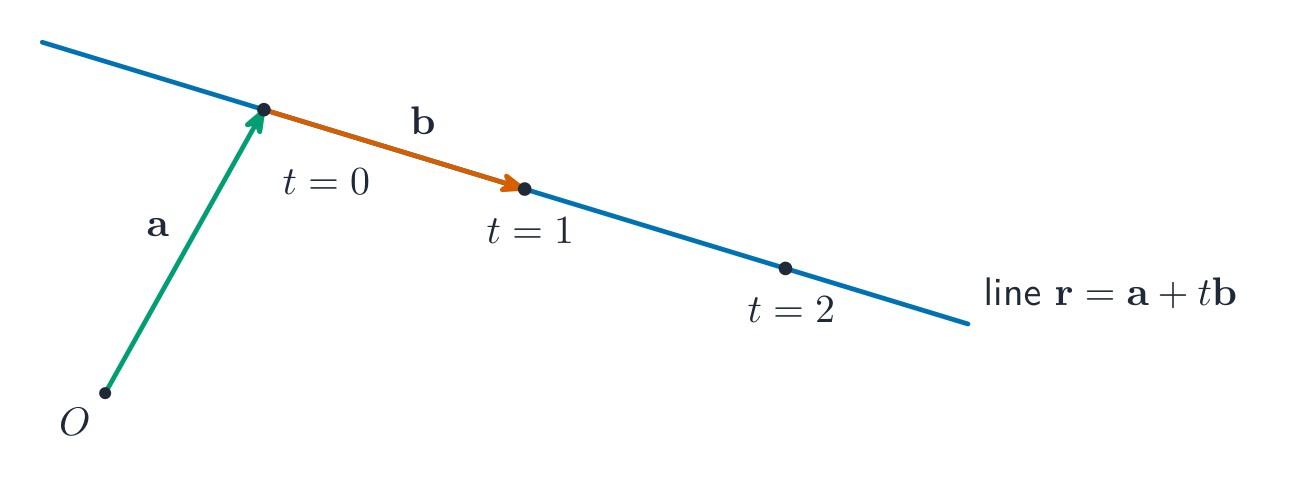
Start at the point $\mathbf{a}$, then add $t$ copies of the direction $\mathbf{b}$ to reach any point on the line. The scalar product 数量积 (dot product) of $\mathbf{a}$ and $\mathbf{b}$ is
$$\mathbf{a}\cdot\mathbf{b} = a_1 b_1 + a_2 b_2 + a_3 b_3 = |\mathbf{a}|\,|\mathbf{b}|\cos\theta,$$where $\theta$ is the angle between them. So $\mathbf{a}\cdot\mathbf{b} = 0$ means the vectors are perpendicular.
The scalar product picks out $|\mathbf{b}|\cos\theta$, how far $\mathbf{b}$ reaches along $\mathbf{a}$. Worked example. Find the angle between $\mathbf{a} = \mathbf{i} + 2\mathbf{j} + 2\mathbf{k}$ and $\mathbf{b} = 2\mathbf{i} + 2\mathbf{j} + \mathbf{k}$.
$$\mathbf{a}\cdot\mathbf{b} = (1)(2) + (2)(2) + (2)(1) = 8, \qquad |\mathbf{a}| = |\mathbf{b}| = 3.$$So $\cos\theta = \dfrac{8}{3\times 3} = \dfrac{8}{9}$, giving $\theta = 27.3^\circ$.Explore · JelajahiAdding vectors and the dot product · Penjumlahan vektor dan perkalian titik
Drag the two vectors. See the resultant (tip-to-tail) and the dot product, which is zero when they are perpendicular. · Seret dua vektor. Lihat resultan (ujung-ke-ujung) dan perkalian titik, yang bernilai nol ketika mereka tegak lurus.
Vocabulary · Kosa kata Train · LatihEnglish Bahasa Indonesia vector/ˈvektə/ vektor magnitude/ˈmæɡnɪtjuːd/ besarnya unit vector/ˈjuːnɪt ˈvektə/ vektor satuan position vector/pəˈzɪʃn ˈvektə/ vektor posisi displacement vector/dɪˈspleɪsmənt ˈvektə/ vektor perpindahan scalar/ˈskeɪlə/ skalar parallel/ˈpærəlel/ paralel intersect/ˌɪntəˈsekt/ berpotongan skew lines/skjuː laɪnz/ garis miring scalar product/ˈskeɪlə ˈprɒdʌkt/ perkalian skalar 3.8
Differential equations

Syllabus · Silabus
EnglishCandidates should be able to: Notes and examples formulate a simple statement involving a rate of change as a differential equation The introduction and evaluation of a constant of proportionality, where necessary, is included. find by integration a general form of solution for a first order differential equation in which the variables are separable Including any of the integration techniques from topic 3.5 above. use an initial condition to find a particular solution interpret the solution of a differential equation in the context of a problem being modelled by the equation. Where a differential equation is used to model a 'real-life' situation, no specialised knowledge of the context will be required. Bahasa IndonesiaCalon peserta harus mampu: Catatan dan contoh susun pernyataan sederhana yang melibatkan laju perubahan sebagai persamaan diferensial Pengenalan dan evaluasi konstanta proporsionalitas, jika perlu, termasuk. temukan melalui integrasi bentuk solusi umum untuk persamaan diferensial orde pertama di mana variabelnya dapat dipisahkan Termasuk teknik integrasi apa pun dari topik 3.5 di atas. gunakan kondisi awal untuk menemukan solusi khusus interpretasikan solusi dari persamaan diferensial dalam konteks masalah yang dimodelkan oleh persamaan tersebut. Di mana persamaan diferensial digunakan untuk memodelkan situasi 'nyata', pengetahuan khusus tentang konteks tersebut tidak akan diperlukan. Source: Cambridge International syllabus · Sumber: Silabus Cambridge International
A differential equation 微分方程 links a quantity to its rate of change. To solve a first-order equation whose variables are separable 可分离变量, put all the $y$ terms on one side and all the $x$ terms on the other, then integrate both sides. This gives the general solution 通解, which contains a constant. An initial condition 初始条件 (a known value) fixes the constant and gives the particular solution 特解.
Worked example. Solve $\dfrac{dy}{dx} = xy$, given that $y = 1$ when $x = 0$.
Separate the variables and integrate:
$$\int \frac{1}{y}\,dy = \int x\,dx \;\Rightarrow\; \ln y = \tfrac12 x^2 + c \;\Rightarrow\; y = A e^{x^2/2}.$$Using $y = 1$ at $x = 0$ gives $A = 1$, so $y = e^{x^2/2}$.The constant $A$ gives a whole family of curves; the condition $y=1$ at $x=0$ selects $y=e^{x^2/2}$. Explore · JelajahiA slope field · Medan kemiringan
Each little line shows the gradient $\frac{dy}{dx}$ there. A solution curve follows the arrows — change the starting point to see a different one. · Setiap garis kecil menunjukkan gradien $\frac{dy}{dx}$ di sana. Kurva solusi mengikuti panah — ubah titik awal untuk melihat yang berbeda.
Vocabulary · Kosa kata Train · LatihEnglish Bahasa Indonesia differential equation/ˌdɪfəˈrenʃl ɪˈkweɪʒn/ persamaan diferensial separable/ˈsepərəbl/ dapat dipisahkan general solution/ˈdʒenərəl səˈluːʃn/ solusi umum initial condition/ɪˈnɪʃl kənˈdɪʃn/ syarat awal particular solution/pəˈtɪkjʊlə səˈluːʃn/ solusi khusus 3.9
Complex numbers

Syllabus · Silabus
EnglishCandidates should be able to: Notes and examples understand the idea of a complex number, recall the meaning of the terms real part, imaginary part, modulus, argument, conjugate, and use the fact that two complex numbers are equal if and only if both real and imaginary parts are equal Notations $\text{Re } z$, $\text{Im } z$, $|z|$, $\arg z$, $z^*$ should be known. The argument of a complex number will usually refer to an angle $\theta$ such that $-\pi < \theta \leqslant \pi$, but in some cases the interval $0 \leqslant \theta < 2\pi$ may be more convenient. Answers may use either interval unless the question specifies otherwise. carry out operations of addition, subtraction, multiplication and division of two complex numbers expressed in Cartesian form $x + \text{i}y$ For calculations involving multiplication or division, full details of the working should be shown. use the result that, for a polynomial equation with real coefficients, any non-real roots occur in conjugate pairs e.g. in solving a cubic or quartic equation where one complex root is given. represent complex numbers geometrically by means of an Argand diagram carry out operations of multiplication and division of two complex numbers expressed in polar form $r(\cos \theta + \text{i}\sin \theta) \equiv r\text{e}^{\text{i}\theta}$ Including the results $|z_1 z_2| = |z_1||z_2|$ and $\arg(z_1 z_2) = \arg(z_1) + \arg(z_2)$, and corresponding results for division. find the two square roots of a complex number e.g. the square roots of $5 + 12\text{i}$ in exact Cartesian form. Full details of the working should be shown. understand in simple terms the geometrical effects of conjugating a complex number and of adding, subtracting, multiplying and dividing two complex numbers illustrate simple equations and inequalities involving complex numbers by means of loci in an Argand diagram e.g. $|z - a| < k$, $|z - a| = |z - b|$, $\arg(z - a) = \alpha$. Bahasa IndonesiaCalon peserta harus mampu: Catatan dan contoh pahami gagasan bilangan kompleks, ingat arti istilah bagian real, bagian imajiner, modulus, argumen, konjugat, dan gunakan fakta bahwa dua bilangan kompleks sama jika dan hanya jika bagian real dan imajinernya sama Notasi $\text{Re } z$, $\text{Im } z$, $|z|$, $\arg z$, $z^*$ harus diketahui. Argumen bilangan kompleks biasanya merujuk pada sudut $\theta$ sedemikian rupa sehingga $-\pi < \theta \leqslant \pi$, tetapi dalam beberapa kasus interval $0 \leqslant \theta < 2\pi$ mungkin lebih nyaman. Jawaban dapat menggunakan interval mana pun kecuali soal menetapkan sebaliknya. lakukan operasi penjumlahan, pengurangan, perkalian, dan pembagian dua bilangan kompleks yang dinyatakan dalam bentuk Kartesius $x + \text{i}y$ Untuk perhitungan yang melibatkan perkalian atau pembagian, detail lengkap cara pengerjaan harus ditunjukkan. gunakan hasil bahwa, untuk persamaan polinomial dengan koefisien real, akar-akar non-reals terjadi dalam pasangan konjugat mis. dalam menyelesaikan persamaan kubik atau kuartik di mana satu akar kompleks diberikan. representasikan bilangan kompleks secara geometris melalui diagram Argand lakukan operasi perkalian dan pembagian dua bilangan kompleks yang dinyatakan dalam bentuk polar $r(\cos \theta + \text{i}\sin \theta) \equiv r\text{e}^{\text{i}\theta}$ Termasuk hasil $|z_1 z_2| = |z_1||z_2|$ dan $\arg(z_1 z_2) = \arg(z_1) + \arg(z_2)$, serta hasil yang sesuai untuk pembagian. temukan dua akar kuadrat dari sebuah bilangan kompleks mis. akar kuadrat dari $5 + 12\text{i}$ dalam bentuk Kartesius eksak. Detail lengkap cara pengerjaan harus ditunjukkan. pahami secara sederhana efek geometris dari mengkonjugasikan bilangan kompleks dan dari menambahkan, mengurangi, mengalikan, dan membagi dua bilangan kompleks ilustrasikan persamaan dan pertidaksamaan sederhana yang melibatkan bilangan kompleks melalui lokus dalam diagram Argand mis. $|z - a| < k$, $|z - a| = |z - b|$, $\arg(z - a) = \alpha$. Source: Cambridge International syllabus · Sumber: Silabus Cambridge International
Multiplying complex numbers: lengths multiply, angles add Multiplying by i is a rotation Self-similar patterns like Romanesco arise from iterating functions in the complex plane. A complex number 复数 has the form $z = x + iy$, where $i^2 = -1$. Here $x$ is the real part 实部 and $y$ is the imaginary part 虚部. This $x + iy$ is the Cartesian form 直角坐标形式. Two complex numbers are equal only when their real parts match and their imaginary parts match.
- The conjugate 共轭 of $z = x + iy$ is $z^* = x - iy$. For a polynomial with real coefficients, any non-real roots come in conjugate pairs.
- The modulus 模 is $|z| = \sqrt{x^2 + y^2}$ (its distance from the origin) and the argument 辐角 is the angle the point makes, measured from the positive real axis.
- You can plot $z$ as a point on an Argand diagram 阿干图 (the complex plane).
- The polar form 极坐标形式 is $z = r(\cos\theta + i\sin\theta) = re^{i\theta}$, where $r = |z|$ and $\theta$ is the argument. Multiplying multiplies the moduli and adds the arguments.
- The loci of points satisfying a condition on $z$ are drawn on the Argand diagram — e.g. $|z - a| = r$ is a circle, $|z - a| = |z - b|$ a perpendicular bisector, and $\arg(z - a) = \theta$ a half-line. The square roots of a complex number come from solving $w^2 = z$.

On the Argand diagram $|z|$ is the distance from $O$, $\arg z$ the angle, and $z^{*}$ the reflection in the real axis. To divide, multiply top and bottom by the conjugate of the bottom.
Worked example. Write $\dfrac{3 + i}{1 - i}$ in the form $x + iy$.
$$\frac{3 + i}{1 - i} = \frac{(3 + i)(1 + i)}{(1 - i)(1 + i)} = \frac{3 + 3i + i + i^2}{1 + 1} = \frac{2 + 4i}{2} = 1 + 2i.$$An equation or inequality in $z$ describes a locus 轨迹 (a path or region) on the Argand diagram. For example $|z - a| = r$ is a circle of radius $r$ centred at $a$.

$|z-a|=r$ is the set of points a fixed distance $r$ from $a$ — a circle. Explore · JelajahiThe Argand diagram · Diagram Argand
Drag the point. A complex number $a + bi$ is a point on the plane; its modulus is the distance from the origin and its argument is the angle. · Seret titik. Bilangan kompleks $a + bi$ adalah titik pada bidang; modulus-nya adalah jarak dari titik asal dan argumen-nya adalah sudut.
Vocabulary · Kosa kata Train · LatihEnglish Bahasa Indonesia complex number/ˈkɒmpleks ˈnʌmbə/ bilangan kompleks real part/rɪəl pɑːt/ bagian real imaginary part/ɪˈmædʒɪnəri pɑːt/ bagian imajiner Cartesian form/kɑːˈtiːzɪən fɔːm/ bentuk Kartesius conjugate/ˈkɒndʒuːɡeɪt/ konjugat modulus/ˈmɒdjʊləs/ modulus argument/ˈɑːɡjuːmənt/ argumen Argand diagram/ˈɑːɡænd ˈdaɪəɡræm/ diagram Argand polar form/ˈpəʊlə fɔːm/ bentuk polar locus/ˈləʊkəs/ lokus 3.9
Exam tips
- Split a rational function into partial fractions before integrating or expanding.
- Choose the right integration technique (substitution, by parts, or partial fractions) from the form of the integrand.
- Use the scalar (dot) product for the angle between vectors and to test for perpendicularity; write a line as $\mathbf{r} = \mathbf{a} + t\mathbf{b}$.
- Give complex numbers in the form asked for (Cartesian or modulus-argument) and show them on an Argand diagram.
-
4
Mechanics · Mekanika
Watch lesson · Tonton pelajaranEnglishThis handout covers Topic 4: Mechanics 力学. It studies how forces make objects move. Throughout this topic, take the acceleration of free fall as $g = 10\ \text{m s}^{-2}$.
Bahasa IndonesiaLembar kerja ini mencakup Topik 4: Mekanika. Materi ini mempelajari bagaimana gaya membuat benda bergerak. Sepanjang topik ini, anggap percepatan jatuh bebas sebagai $g = 10\ \text{m s}^{-2}$.
4.1
Forces and equilibrium · Gaya dan kesetimbangan

Syllabus · Silabus
EnglishCandidates should be able to: Notes and examples identify the forces acting in a given situation e.g. by drawing a force diagram. understand the vector nature of force, and find and use components and resultants Calculations are always required, not approximate solutions by scale drawing. use the principle that, when a particle is in equilibrium, the vector sum of the forces acting is zero, or equivalently, that the sum of the components in any direction is zero Solutions by resolving are usually expected, but equivalent methods (e.g. triangle of forces, Lami's Theorem, where suitable) are also acceptable; these other methods are not required knowledge, and will not be referred to in questions. understand that a contact force between two surfaces can be represented by two components, the normal component and the frictional component use the model of a 'smooth' contact, and understand the limitations of this model understand the concepts of limiting friction and limiting equilibrium, recall the definition of coefficient of friction, and use the relationship $F = \mu R$ or $F \leqslant \mu R$, as appropriate Terminology such as 'about to slip' may be used to mean 'in limiting equilibrium' in questions. use Newton's third law. e.g. the force exerted by a particle on the ground is equal and opposite to the force exerted by the ground on the particle. Bahasa IndonesiaCalon peserta harus mampu: Catatan dan contoh identifikasi gaya-gaya yang bekerja dalam situasi yang diberikan mis. dengan menggambar diagram gaya. pahami sifat vektor gaya, dan tentukan serta gunakan komponen dan resultan Perhitungan selalu diperlukan, bukan solusi perkiraan dengan menggambar skala. gunakan prinsip bahwa, ketika partikel berada dalam kesetimbangan, jumlah vektor gaya yang bekerja adalah nol, atau ekuivalennya, jumlah komponen dalam arah apa pun adalah nol Solusi dengan menguraikan biasanya diharapkan, tetapi metode ekuivalen (misalnya segitiga gaya, Teorema Lami, jika sesuai) juga dapat diterima; metode lain ini tidak diperlukan sebagai pengetahuan, dan tidak akan dirujuk dalam soal. pahami bahwa gaya kontak antara dua permukaan dapat direpresentasikan oleh dua komponen, yaitu komponen normal dan komponen gesekan gunakan model 'permukaan licin', dan pahami keterbatasan model ini pahami konsep gesekan batas dan kesetimbangan batas, ingat definisi koefisien gesekan, dan gunakan hubungan $F = \mu R$ atau $F \leqslant \mu R$, sesuai keadaan Terminologi seperti 'akan tergelincir' mungkin digunakan untuk berarti 'dalam kesetimbangan batas' dalam soal. gunakan hukum ketiga Newton. mis. gaya yang diberikan partikel pada tanah sama besar dan berlawanan arah dengan gaya yang diberikan tanah pada partikel tersebut. Source: Cambridge International syllabus · Sumber: Silabus Cambridge International
EnglishA force 力 is a push or a pull. It is a vector, so it has size and direction. Because it is a vector, you can split a force into components 分量 (usually horizontal and vertical), and you can add several forces into one resultant 合力.
A particle is in equilibrium 平衡 when the forces are balanced: the vector sum of the forces is zero. In practice this means the components in any direction add to zero.
Friction
When two surfaces touch, the contact force 接触力 between them has two parts: the normal reaction 法向反作用力 $R$, at right angles to the surface, and the friction 摩擦力 $F$, along the surface, which opposes sliding. A "smooth" surface is a model with no friction.
Friction can only grow up to a maximum. At that maximum the body is in limiting equilibrium 极限平衡, about to slip, and the friction is limiting friction 最大静摩擦力. The maximum is set by the coefficient of friction 摩擦系数 $\mu$:
$$F \leqslant \mu R, \qquad \text{with } F = \mu R \text{ at the point of slipping}.$$By Newton's third law 牛顿第三定律, the two surfaces push on each other with equal and opposite forces.
Worked example. A block of weight $20\text{ N}$ rests on a rough horizontal table with coefficient of friction $\mu = 0.4$. Find the largest horizontal force that can be applied before the block slides.
The table's normal reaction balances the weight, so $R = 20\text{ N}$. The block is on the point of slipping when friction reaches its maximum $F = \mu R = 0.4 \times 20 = 8\text{ N}$. In equilibrium the applied force equals the friction, so the largest force it can resist is $8\text{ N}$.
Bahasa IndonesiaSebuah gaya adalah dorongan atau tarikan. Gaya merupakan vektor, sehingga memiliki besar dan arah. Karena merupakan vektor, Anda dapat memecah gaya menjadi komponen (biasanya horizontal dan vertikal), dan Anda dapat menggabungkan beberapa gaya menjadi satu resultan.
Gaya dengan sudut $\theta$ memiliki komponen horizontal $F\cos\theta$ dan komponen vertikal $F\sin\theta$. Sebuah partikel berada dalam kesetimbangan ketika gaya-gayanya seimbang: jumlah vektor dari gaya-gaya tersebut adalah nol. Secara praktis, ini berarti komponen-komponennya dalam arah apa pun menjumlahkan nol.

Setiap masalah mekanika adalah gambar seperti ini. Tiga gaya bekerja pada pendaki — berat lurus ke bawah, tegangan sepanjang tali, dan dorongan dari batuan — dan karena mereka seimbang, pendaki tergantung diam dalam kesetimbangan. Menguraikan setiap gaya menjadi komponen horizontal dan vertikal mengubah gambar tersebut menjadi persamaan Gesekan
Ketika dua permukaan bersentuhan, gaya kontak di antara keduanya memiliki dua bagian: reaksi normal $R$, tegak lurus terhadap permukaan, dan gesekan $F$, sejajar dengan permukaan, yang melawan geser. Permukaan "halus" adalah model tanpa gesekan.
Gesekan hanya dapat meningkat hingga suatu maksimum. Pada titik maksimum itu, benda berada dalam kesetimbangan batas, akan segera tergelincir, dan gesekannya disebut gesekan batas. Nilai maksimum ditentukan oleh koefisien gesekan $\mu$:
$$F \leqslant \mu R, \qquad \text{with } F = \mu R \text{ at the point of slipping}.$$
Di atas permukaan kasar, gaya kontak terurai menjadi reaksi normal $R$ dan gesekan $F$ (paling banyak $\mu R$). Berdasarkan hukum ketiga Newton, kedua permukaan saling mendorong satu sama lain dengan gaya yang sama besar namun berlawanan arah.
Contoh terpecahkan. Sebuah balok dengan berat $20\text{ N}$ beristirahat di atas meja horizontal kasar dengan koefisien gesekan $\mu = 0.4$. Tentukan gaya horizontal terbesar yang dapat diterapkan sebelum balok bergeser.
Reaksi normal meja menyeimbangkan berat, sehingga $R = 20\text{ N}$. Balok berada pada titik akan tergelincir ketika gesekan mencapai nilai maksimumnya $F = \mu R = 0.4 \times 20 = 8\text{ N}$. Dalam kesetimbangan, gaya yang diberikan sama dengan gesekan, sehingga gaya terbesar yang dapat ditahannya adalah $8\text{ N}$.
Explore · JelajahiAdding forces · Penjumlahan gaya
resultant = a + b · resultan = a + b
Forces add tip-to-tail. They are in equilibrium when the resultant is zero. · Gaya ditambahkan ujung ke ujung. Mereka berada dalam kesetimbangan ketika resultannya nol.
Vocabulary · Kosa kata Train · LatihEnglish Bahasa Indonesia Mechanics/mɪˈkænɪks/ Mekanika force/fɔːs/ gaya components/kəmˈpəʊnənts/ komponen resultant/rɪˈzʌltənt/ resultan equilibrium/ˌiːkwɪˈlɪbrɪəm/ kesetimbangan contact force/ˈkɒntækt fɔːs/ gaya kontak normal reaction/ˈnɔːml rɪˈækʃn/ gaya reaksi normal friction/ˈfrɪkʃn/ gesekan limiting friction/ˈlɪmɪtɪŋ ˈfrɪkʃn/ gesekan batas coefficient of friction/ˌkəʊɪˈfɪʃənt ɒv ˈfrɪkʃn/ koefisien gesekan Newton's third law/ˈnjuːtnz θɜːd lɔː/ hukum ketiga Newton distance/ˈdɪstəns/ jarak tempuh speed/spiːd/ kecepatan (besaran skalar) displacement/dɪˈspleɪsmənt/ pindahan 4.2
Kinematics of motion in a straight line · Kinematika gerak lurus

Syllabus · Silabus
EnglishCandidates should be able to: Notes and examples understand the concepts of distance and speed as scalar quantities, and of displacement, velocity and acceleration as vector quantities Restricted to motion in one dimension only. The term 'deceleration' may sometimes be used in the context of decreasing speed. sketch and interpret displacement–time graphs and velocity–time graphs, and in particular appreciate that – the area under a velocity–time graph represents displacement, – the gradient of a displacement–time graph represents velocity, – the gradient of a velocity–time graph represents acceleration use differentiation and integration with respect to time to solve simple problems concerning displacement, velocity and acceleration Calculus required is restricted to techniques from the content for Paper 1: Pure Mathematics 1. use appropriate formulae for motion with constant acceleration in a straight line. Questions may involve setting up more than one equation, using information about the motion of different particles. Bahasa IndonesiaCalon peserta harus mampu: Catatan dan contoh pahami konsep jarak dan kelajuan sebagai besaran skalar, serta perpindahan, kecepatan dan percepatan sebagai besaran vektor Terbatas pada gerak satu dimensi saja. Istilah 'perlambatan' terkadang digunakan dalam konteks penurunan kelajuan. sketsa dan tafsirkan grafik perpindahan–waktu dan grafik kecepatan–waktu, dan khususnya pahami bahwa – luas di bawah grafik kecepatan–waktu merepresentasikan perpindahan, – kemiringan grafik perpindahan–waktu merepresentasikan kecepatan, – kemiringan grafik kecepatan–waktu merepresentasikan percepatan gunakan diferensiasi dan integrasi terhadap waktu untuk menyelesaikan masalah sederhana mengenai perpindahan, kecepatan dan percepatan Kalkulus yang diperlukan terbatas pada teknik dari materi Paper 1: Matematika Murni 1. gunakan rumus yang sesuai untuk gerak dengan percepatan konstan pada garis lurus. Soal mungkin melibatkan penyusunan lebih dari satu persamaan, menggunakan informasi tentang gerak partikel berbeda. Source: Cambridge International syllabus · Sumber: Silabus Cambridge International
EnglishDistance 距离 and speed 速率 are scalars (size only). Displacement 位移, velocity 速度 and acceleration 加速度 are vectors (size and direction).
On a velocity-time graph 速度时间图, the area under the graph is the displacement and the gradient is the acceleration (a negative acceleration is a deceleration 减速度). On a displacement-time graph, the gradient is the velocity. More generally, differentiate with respect to time to go from displacement to velocity to acceleration, and integrate to go back.
For motion with constant acceleration 匀加速, use these formulae (the "suvat" equations):
$$v = u + at, \qquad s = ut + \tfrac12 at^2, \qquad v^2 = u^2 + 2as, \qquad s = \tfrac12(u + v)t.$$Worked example. A car starts from rest and accelerates at $2.5\ \text{m s}^{-2}$ for $4\ \text{s}$. Find its speed and the distance travelled.
$$v = 0 + 2.5\times 4 = 10\ \text{m s}^{-1}, \qquad s = 0 + \tfrac12(2.5)(4^2) = 20\ \text{m}.$$Bahasa IndonesiaJarak dan kelajuan adalah besaran skalar (hanya ukuran). Pergeseran, kecepatan, dan percepatan adalah besaran vektor (ukuran dan arah).
Pada grafik kecepatan-waktu, luas di bawah grafik adalah pergeseran dan kemiringan adalah percepatan (percepatan negatif adalah perlambatan). Pada grafik perpindahan-waktu, kemiringan adalah kecepatan. Secara umum, turunkan terhadap waktu untuk berpindah dari perpindahan ke kecepatan ke percepatan, dan integralkan untuk kembali.
Area arsiran memberikan jarak tempuh; kemiringan garis memberikan percepatan. Untuk gerak dengan percepatan konstan, gunakan rumus-rumus berikut (persamaan "suvat"):
$$v = u + at, \qquad s = ut + \tfrac12 at^2, \qquad v^2 = u^2 + 2as, \qquad s = \tfrac12(u + v)t.$$Contoh terpecahkan. Sebuah mobil mulai dari keadaan diam dan dipercepat sebesar $2.5\ \text{m s}^{-2}$ selama $4\ \text{s}$. Tentukan kecepatannya dan jarak yang ditempuh.
$$v = 0 + 2.5\times 4 = 10\ \text{m s}^{-1}, \qquad s = 0 + \tfrac12(2.5)(4^2) = 20\ \text{m}.$$Explore · JelajahiVelocity–time graph · Grafik kecepatan–waktu
Change the start velocity and acceleration. The gradient is the acceleration; the area under the line is the displacement. · Ubah kecepatan awal dan percepatan. Gradien adalah percepatan; luas di bawah garis adalah perpindahan.
Vocabulary · Kosa kata Train · LatihEnglish Bahasa Indonesia velocity/vəˈlɒsɪti/ kecepatan (vektor) acceleration/əkˌseləˈreɪʃn/ percepatan velocity-time graph/vəˈlɒsɪti taɪm ɡræf/ grafik kecepatan-waktu constant acceleration/ˈkɒnstənt əkˌseləˈreɪʃn/ percepatan konstan 4.3
Momentum

Syllabus · Silabus
EnglishCandidates should be able to: Notes and examples use the definition of linear momentum and show understanding of its vector nature For motion in one dimension only. use conservation of linear momentum to solve problems that may be modelled as the direct impact of two bodies. Including direct impact of two bodies where the bodies coalesce on impact. Knowledge of impulse and the coefficient of restitution is not required. Bahasa IndonesiaCalon peserta harus mampu: Catatan dan contoh gunakan definisi momentum linear dan tunjukkan pemahaman atas sifat vektornya Untuk gerak satu dimensi saja. gunakan hukum kekekalan momentum linear untuk menyelesaikan masalah yang dapat dimodelkan sebagai benturan langsung dua benda. Termasuk benturan langsung dua benda di mana benda-benda tersebut menyatu saat benturan. Pengetahuan tentang impuls dan koefisien restitusi tidak diperlukan. Source: Cambridge International syllabus · Sumber: Silabus Cambridge International
EnglishThe linear momentum 动量 of a body is $\text{mass} \times \text{velocity}$. It is a vector. In a direct collision of two bodies, the total momentum is unchanged. This is the conservation of linear momentum 动量守恒:
$$m_1 u_1 + m_2 u_2 = m_1 v_1 + m_2 v_2.$$Worked example. A body of mass $2\ \text{kg}$ moving at $3\ \text{m s}^{-1}$ hits a stationary body of mass $1\ \text{kg}$, and they stick together. Find their common speed afterwards.
$$2(3) + 1(0) = (2 + 1)v \;\Rightarrow\; v = \frac{6}{3} = 2\ \text{m s}^{-1}.$$Bahasa IndonesiaPulau Newton mendemonstrasikan kekekalan momentum dalam tumbukan. Momentum linear suatu benda adalah $\text{mass} \times \text{velocity}$. Ini adalah vektor. Dalam tabrakan langsung dua benda, total momentum tidak berubah. Ini adalah hukum kekekalan momentum linear:
$$m_1 u_1 + m_2 u_2 = m_1 v_1 + m_2 v_2.$$
Total momentum sama sebelum dan sesudah tabrakan. Contoh terpecahkan. Benda bermassa $2\ \text{kg}$ bergerak dengan kecepatan $3\ \text{m s}^{-1}$ menabrak benda diam bermassa $1\ \text{kg}$, lalu mereka menyatu. Tentukan kecepatan bersama mereka afterwards.
$$2(3) + 1(0) = (2 + 1)v \;\Rightarrow\; v = \frac{6}{3} = 2\ \text{m s}^{-1}.$$Explore · JelajahiA collision · Sebuah tabrakan
Set each mass and speed and collide them. Total momentum stays the same before and after. · Setel massa dan kecepatan masing-masing dan tabrakan mereka. Total momentum tetap sama sebelum dan sesudah.
Vocabulary · Kosa kata Train · LatihEnglish Bahasa Indonesia momentum/məʊˈmentəm/ momentum conservation of momentum/ˌkɒnsəˈveɪʃn ɒv məʊˈmentəm/ kekekalan momentum Newton's laws of motion/ˈnjuːtnz lɔːz ɒv ˈməʊʃn/ Hukum-hukum gerak Newton mass/mæs/ massa weight/weɪt/ berat tension/ˈtenʃn/ tegangan 4.4
Newton's laws of motion · Hukum-hukum gerak Newton

Syllabus · Silabus
EnglishCandidates should be able to: Notes and examples • apply Newton’s laws of motion to the linear motion of a particle of constant mass moving under the action of constant forces, which may include friction, tension in an inextensible string and thrust in a connecting rod If any other forces resisting motion are to be considered (e.g. air resistance) this will be indicated in the question. • use the relationship between mass and weight $W = mg$. In this component, questions are mainly numerical, and use of the approximate numerical value $10\text{ (ms}^{-2}\text{)}$ for $g$ is expected. • solve simple problems which may be modelled as the motion of a particle moving vertically or on an inclined plane with constant acceleration Including, for example, motion of a particle on a rough plane where the acceleration while moving up the plane is different from the acceleration while moving down the plane. • solve simple problems which may be modelled as the motion of connected particles. e.g. particles connected by a light inextensible string passing over a smooth pulley, or a car towing a trailer by means of either a light rope or a light rigid tow-bar. Bahasa IndonesiaCalon peserta harus mampu: Catatan dan contoh • terapkan hukum-hukum Newton tentang gerak pada gerak linear partikel bermassa konstan yang bergerak di bawah pengaruh gaya-gaya konstan, yang mungkin mencakup gesekan, tegangan pada tali tak elastis dan daya dorong pada batang penghubung Jika ada gaya lain yang menahan gerak harus dipertimbangkan (mis. hambatan udara) hal ini akan ditunjukkan dalam soal. • gunakan hubungan antara massa dan berat $W = mg$. Dalam komponen ini, soal terutama bersifat numerik, dan penggunaan nilai numerik pendekatan $10\text{ (ms}^{-2}\text{)}$ untuk $g$ diharapkan. • selesaikan masalah sederhana yang dapat dimodelkan sebagai gerak partikel yang bergerak vertikal atau pada bidang miring dengan percepatan konstan Termasuk, misalnya, gerak partikel pada bidang kasar di mana percepatan saat bergerak naik bidang berbeda dari percepatan saat bergerak turun bidang. • selesaikan masalah sederhana yang dapat dimodelkan sebagai gerak partikel terhubung. mis. partikel yang dihubungkan oleh tali ringan tak elastis yang melintasi katrol licin, atau mobil yang menarik trailer dengan tali ringan atau batang penarik kaku ringan. Source: Cambridge International syllabus · Sumber: Silabus Cambridge International
EnglishNewton's laws of motion 牛顿运动定律 connect force and acceleration. The key one is: resultant force $=$ mass 质量 $\times$ acceleration,
$$F = ma.$$The weight 重力 of a body is the force of gravity on it: $W = mg$. Forces in a problem may include weight, friction, tension 张力 in a string, the thrust 推力 (push) in a rod, and air resistance 空气阻力.For motion on an inclined plane 斜面, split each force into a part along the slope and a part at right angles to it, then apply $F = ma$ along the slope. For connected particles 连接质点 (joined by a string), apply $F = ma$ to each body, or to the whole system.
Worked example. A block of mass $12\ \text{kg}$ is pulled up a rough plane by a rope parallel to the slope. The plane is at $20^\circ$ to the horizontal, the coefficient of friction is $0.4$, and the acceleration is $2\ \text{m s}^{-2}$. Find the tension in the rope.
The normal reaction is $R = mg\cos 20^\circ = 120\cos 20^\circ = 112.8\ \text{N}$, so the friction is $F = \mu R = 0.4 \times 112.8 = 45.1\ \text{N}$. Along the slope, $T - mg\sin 20^\circ - F = ma$:
$$T = ma + mg\sin 20^\circ + F = 12(2) + 120\sin 20^\circ + 45.1 = 24 + 41.0 + 45.1 = 110\ \text{N (3 s.f.)}.$$Bahasa IndonesiaHukum-hukum gerak Newton menghubungkan gaya dan percepatan. Hukum utamanya adalah: resultan gaya $=$ massa $\times$ percepatan,
$$F = ma.$$Berat suatu benda adalah gaya gravitasi yang bekerja padanya: $W = mg$. Gaya-gaya dalam sebuah masalah mungkin mencakup berat, gesekan, tegangan pada tali, dorong (push) pada batang, dan hambatan udara.Untuk gerak pada bidang miring, uraikan setiap gaya menjadi komponen sejajar lereng dan tegak lurus lereng, lalu terapkan $F = ma$ sepanjang lereng. Untuk benda terhubung (dihubungkan dengan tali), terapkan $F = ma$ pada masing-masing benda, atau pada seluruh sistem.
Di atas bidang miring, uraikan gaya-gaya sepanjang lereng dan tegak lurus lereng. Contoh terpecahkan. Balok bermassa $12\ \text{kg}$ ditarik ke atas bidang kasar oleh tali sejajar lereng. Bidang tersebut membentuk sudut $20^\circ$ terhadap horizontal, koefisien gesekannya $0.4$, dan percepatannya $2\ \text{m s}^{-2}$. Tentukan tegangan pada tali.
Reaksi normal adalah $R = mg\cos 20^\circ = 120\cos 20^\circ = 112.8\ \text{N}$, sehingga gesekannya adalah $F = \mu R = 0.4 \times 112.8 = 45.1\ \text{N}$. Sepanjang lereng, $T - mg\sin 20^\circ - F = ma$:
$$T = ma + mg\sin 20^\circ + F = 12(2) + 120\sin 20^\circ + 45.1 = 24 + 41.0 + 45.1 = 110\ \text{N (3 s.f.)}.$$Explore · JelajahiResultant force · Resultan gaya
F = ma
The resultant force sets the acceleration. Balanced forces ⇒ no acceleration. · Resultan gaya menyebabkan percepatan. Gaya seimbang ⇒ tidak ada percepatan.
Vocabulary · Kosa kata Train · LatihEnglish Bahasa Indonesia inclined plane/ɪnˈklaɪnd pleɪn/ bidang miring connected particles/kəˈnektɪd ˈpɑːtɪklz/ benda terhubung work done/wɜːk dʌn/ kerja yang dilakukan kinetic energy/kɪˈnetɪk ˈenədʒi/ energi kinetik gravitational potential energy/ˌɡrævɪˈteɪʃənl pəˈtenʃl ˈenədʒi/ energi potensial gravitasi conservation of energy/ˌkɒnsəˈveɪʃn ɒv ˈenədʒi/ hukum kekekalan energi power/ˈpaʊə/ kuasa limiting equilibrium/ˈlɪmɪtɪŋ ˌiːkwɪˈlɪbrɪəm/ ekuilibrium batas deceleration/dɪˌseləˈreɪʃn/ perlambatan thrust/θrʌst/ dorongan air resistance/eə rɪˈzɪstəns/ hambatan udara 4.5
Energy, work and power · Energi, usaha, dan daya

Syllabus · Silabus
EnglishCandidates should be able to: Notes and examples • understand the concept of the work done by a force, and calculate the work done by a constant force when its point of application undergoes a displacement not necessarily parallel to the force $W = Fd \cos \theta$; Use of the scalar product is not required. • understand the concepts of gravitational potential energy and kinetic energy, and use appropriate formulae • understand and use the relationship between the change in energy of a system and the work done by the external forces, and use in appropriate cases the principle of conservation of energy Including cases where the motion may not be linear (e.g. a child on a smooth curved ‘slide’), where only overall energy changes need to be considered. • use the definition of power as the rate at which a force does work, and use the relationship between power, force and velocity for a force acting in the direction of motion Including calculation of (average) power as $$\frac{\text{Work done}}{\text{Time taken}}$$$P = Fv$.• solve problems involving, for example, the instantaneous acceleration of a car moving on a hill against a resistance. Bahasa IndonesiaCalon peserta harus mampu: Catatan dan contoh • pahami konsep usaha yang dilakukan oleh gaya, dan hitung usaha yang dilakukan oleh gaya konstan ketika titik aplikasinya mengalami perpindahan yang tidak perlu sejajar dengan gaya $W = Fd \cos \theta$; Penggunaan perkalian skalar tidak diperlukan. • pahami konsep energi potensial gravitasi dan energi kinetik, dan gunakan rumus yang sesuai • pahami dan gunakan hubungan antara perubahan energi suatu sistem dan usaha yang dilakukan oleh gaya eksternal, dan gunakan dalam kasus yang sesuai prinsip kekekalan energi Termasuk kasus di mana gerak mungkin tidak linear (mis. anak di atas 'luncuran' lengkung licin), di mana hanya perubahan energi keseluruhan yang perlu dipertimbangkan. • gunakan definisi daya sebagai laju gaya melakukan usaha, dan gunakan hubungan antara daya, gaya dan kecepatan untuk gaya yang bekerja searah gerak Termasuk perhitungan (rata-rata) daya sebagai $$\frac{\text{Work done}}{\text{Time taken}}$$$P = Fv$.• selesaikan masalah yang melibatkan, misalnya, percepatan sesaat mobil yang bergerak di tanjakan melawan hambatan. Source: Cambridge International syllabus · Sumber: Silabus Cambridge International
EnglishThe work done 功 by a constant force is the scalar product of force and displacement — the force times the distance moved in the direction of the force: $W = Fd\cos\theta$, where $\theta$ is the angle between the force and the motion. Work is measured in joules (J).
Energy comes in forms you can calculate:
- Kinetic energy 动能 (energy of movement): $\text{KE} = \tfrac12 mv^2$.
- Gravitational potential energy 重力势能 (energy of height): $\text{PE} = mgh$.
The work done by the outside forces equals the change in the total energy. When no friction acts, the total energy stays the same — the conservation of energy 能量守恒.
Power 功率 is the rate of doing work. For a force pulling in the direction of motion, $P = Fv$ (power $=$ force $\times$ velocity). Power is measured in watts (W).
Worked example. A car engine works at $12\ \text{kW}$ while the car moves at $20\ \text{m s}^{-1}$ on a level road. Find the driving force.
$$P = Fv \;\Rightarrow\; F = \frac{P}{v} = \frac{12000}{20} = 600\ \text{N}.$$Bahasa IndonesiaLuncuran bukit menukar energi potensial dengan energi kinetik saat naik dan turun. Usaha yang dilakukan oleh gaya konstan adalah hasil kali skalar antara gaya dan perpindahan — yaitu gaya dikalikan jarak yang ditempuh searah gaya: $W = Fd\cos\theta$, di mana $\theta$ adalah sudut antara gaya dan gerakan. Usaha diukur dalam joule (J).
Energi hadir dalam bentuk yang dapat dihitung:
- Energi kinetik (energi gerak): $\text{KE} = \tfrac12 mv^2$.
- Energi potensial gravitasi (energi ketinggian): $\text{PE} = mgh$.
Usaha yang dilakukan oleh gaya luar sama dengan perubahan total energi. Ketika tidak ada gesekan, total energi tetap sama — hukum kekekalan energi.
Daya adalah laju melakukan usaha. Untuk gaya yang menarik searah dengan gerak, $P = Fv$ (daya $=$ gaya $\times$ kecepatan). Daya diukur dalam watt (W).
Contoh terpecahkan. Mesin mobil menghasilkan daya $12\ \text{kW}$ sementara mobil bergerak dengan kecepatan $20\ \text{m s}^{-1}$ di jalan datar. Tentukan gaya penggeraknya.
$$P = Fv \;\Rightarrow\; F = \frac{P}{v} = \frac{12000}{20} = 600\ \text{N}.$$Explore · JelajahiConservation of energy · Kekekalan energi
Drop the object and watch energy change form. With no friction, GPE + KE stays constant the whole way down. · Jatuhkan benda dan saksikan energi berubah bentuk. Tanpa gesekan, GPE + KE tetap konstan sepanjang jalan turun.
4.5
Exam tips · Tips ujian
English- Draw a clear force diagram and resolve into perpendicular components; for equilibrium, each direction sums to zero.
- Use SUVAT only for constant acceleration and keep a consistent positive direction.
- Apply $F = ma$ along the direction of motion, including friction ($F = \mu R$) on a rough surface.
- State your assumptions (light inextensible string, smooth pulley, particle) — they are often worth a mark.
Bahasa Indonesia- Gambar diagram gaya yang jelas dan uraikan menjadi komponen tegak lurus; untuk kesetimbangan, jumlah setiap arah adalah nol.
- Gunakan SUVAT hanya untuk percepatan konstan dan pertahankan arah positif yang konsisten.
- Terapkan $F = ma$ sepanjang arah gerakan, termasuk gesekan ($F = \mu R$) pada permukaan kasar.
- Nyatakan asumsi Anda (tali ringan tak kenyal, katrol halus, partikel) — hal ini sering bernilai poin.
-
5
Probability & Statistics 1 · Probabilitas & Statistik 1
Watch lesson · Tonton pelajaranEnglishThis handout covers Topic 5: Probability & Statistics 概率统计 1. It is about describing data, counting choices, and working out the chance of events.
Bahasa IndonesiaLembar ini membahas Topik 5: Probabilitas & Statistika 1. Materi ini berkaitan dengan penggambaran data, perhitungan pilihan, dan penentuan peluang suatu peristiwa.
5.1
Representation of data · Representasi Data

Syllabus · Silabus
EnglishCandidates should be able to: Notes and examples • select a suitable way of presenting raw statistical data, and discuss advantages and/or disadvantages that particular representations may have • draw and interpret stem-and-leaf diagrams, box-and-whisker plots, histograms and cumulative frequency graphs Including back-to-back stem-and-leaf diagrams. • understand and use different measures of central tendency (mean, median, mode) and variation (range, interquartile range, standard deviation) e.g. in comparing and contrasting sets of data. • use a cumulative frequency graph e.g. to estimate medians, quartiles, percentiles, the proportion of a distribution above (or below) a given value, or between two values. • calculate and use the mean and standard deviation of a set of data (including grouped data) either from the data itself or from given totals $\Sigma x$ and $\Sigma x^2$, or coded totals $\Sigma(x - a)$ and $\Sigma(x - a)^2$, and use such totals in solving problems which may involve up to two data sets. Bahasa IndonesiaCalon peserta harus mampu: Catatan dan contoh • pilih cara yang sesuai untuk menyajikan data statistik mentah, dan diskusikan keunggulan dan/atau kelemahan representasi tertentu gambar dan tafsirkan diagram batang-daun, box-and-whisker plot, histogram dan grafik frekuensi kumulatif Termasuk diagram batang-daun berbalik. pahami dan gunakan berbagai ukuran pusat kecenderungan (rata-rata, median, modus) dan variasi (jangkauan, jangkauan antar-kuartil, simpangan baku) mis. dalam membandingkan dan mengkontraskan himpunan data. • gunakan grafik frekuensi kumulatif mis. untuk mengestimasi median, kuartil, persentil, proporsi distribusi di atas (atau di bawah) nilai tertentu, atau antara dua nilai. • hitung dan gunakan rata-rata dan simpangan baku dari suatu himpunan data (termasuk data berkelompok) baik dari data itu sendiri maupun dari total yang diberikan $\Sigma x$ dan $\Sigma x^2$, atau total kode $\Sigma(x - a)$ dan $\Sigma(x - a)^2$, dan gunakan total tersebut dalam menyelesaikan masalah yang mungkin melibatkan hingga dua himpunan data. Source: Cambridge International syllabus · Sumber: Silabus Cambridge International
EnglishChoose a diagram that suits the data. You should be able to draw and read:
- a stem-and-leaf diagram 茎叶图 (keeps the original values and shows the shape); two data sets are compared with a back-to-back 背靠背 version – a shared central stem, one set's leaves increasing to the left and the other's to the right, so you can compare their medians and spreads at a glance;
- a box-and-whisker plot 箱线图 (shows the lowest value, the three quartiles, and the highest value);
- a histogram 直方图 (for grouped data, where the area of each bar shows the frequency);
- a cumulative frequency 累积频数 graph (running totals, used to estimate the median and quartiles).
Averages and spread
A measure of central tendency 集中趋势 is a single "middle" value:
- the mean 平均数 $\bar{x} = \dfrac{\sum x}{n}$ (the average);
- the median 中位数 (the middle value when the data is in order);
- the mode 众数 (the most common value).
A measure of variation 离散程度 shows how spread out the data is:
- the range (of data) 极差 (highest $-$ lowest);
- the interquartile range 四分位距 (upper quartile $-$ lower quartile);
- the standard deviation 标准差 $\sigma = \sqrt{\dfrac{\sum x^2}{n} - \bar{x}^2}$.
You often work from the totals $\sum x$ and $\sum x^2$. The square of the standard deviation is the variance 方差.
Worked example. For $10$ values, $\sum x = 50$ and $\sum x^2 = 300$. Find the mean and standard deviation.
$$\bar{x} = \frac{50}{10} = 5, \qquad \sigma = \sqrt{\frac{300}{10} - 5^2} = \sqrt{30 - 25} = \sqrt{5} = 2.24.$$Coding 编码 makes big numbers easier. Replace each value by $t=x-a$ for a convenient assumed mean 假定平均数 $a$. Then $\bar{x}=a+\bar{t}$, while the standard deviation is unchanged (shifting every value does not spread the data). So from the coded totals $\sum(x-a)$ and $\sum(x-a)^2$ you get $\bar x$ and $\sigma$ directly, and two data sets can be compared through their coded totals.
Bahasa IndonesiaPilihlah diagram yang sesuai dengan data. Anda harus mampu menggambar dan membaca:
- diagram batang-daun (menjaga nilai asli dan menunjukkan bentuk); dua himpunan data dibandingkan menggunakan versi belakang-ke-belakang – batang tengah bersama, daun satu set bertambah ke kiri dan daun set lainnya ke kanan, sehingga median dan sebarannya dapat dibandingkan sekilas;
- diagram kotak-garis (menunjukkan nilai terendah, tiga kuartil, dan nilai tertinggi);
- histogram (untuk data berkelompok, di mana luas setiap balok menunjukkan frekuensi);
- grafik frekuensi kumulatif (total berjalan, digunakan untuk memperkirakan median dan kuartil).
Kurva frekuensi kumulatif berbentuk S; bacalah median secara horizontal dari setengah frekuensi total, dan kuartil dari satu perempat dan tiga perempat 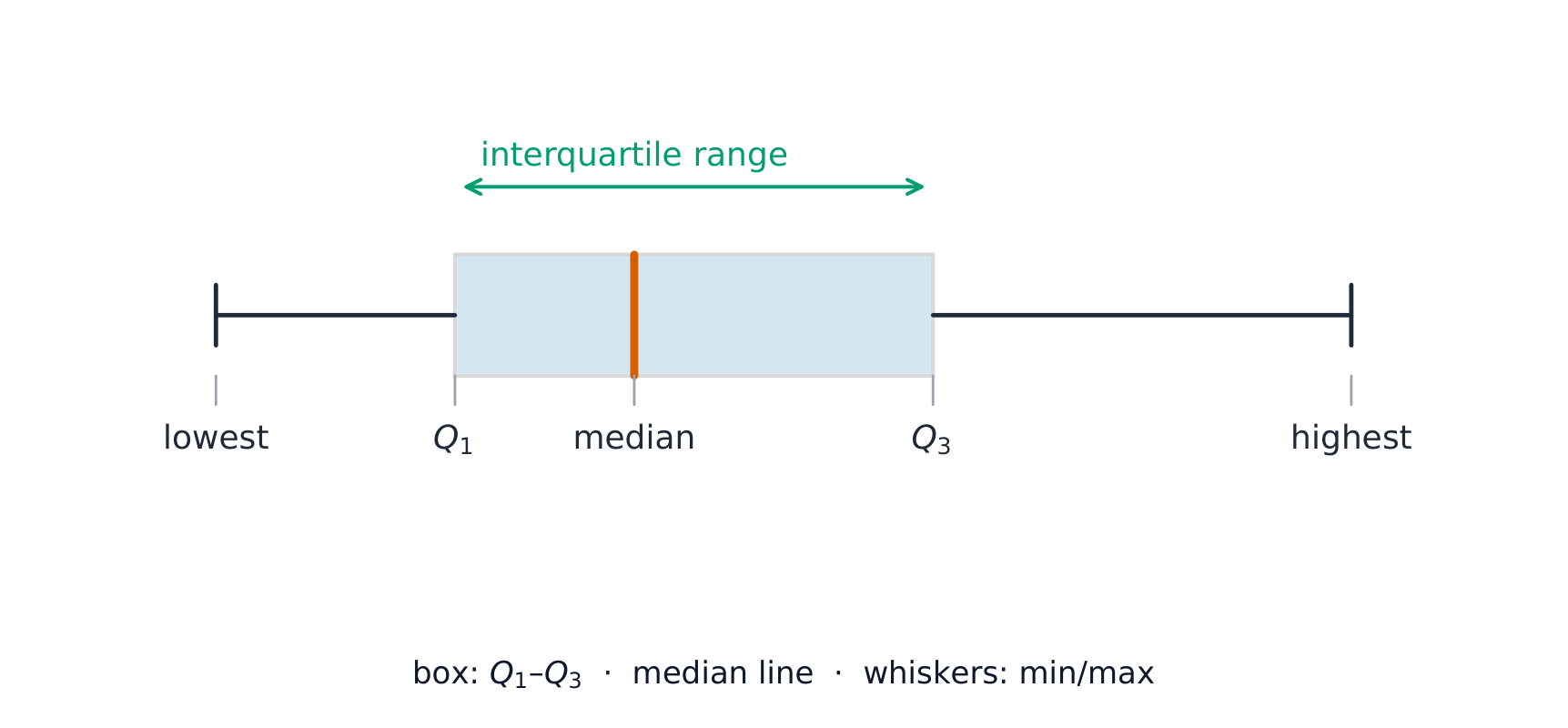
Kotak membentang dari kuartil $Q_1$ hingga $Q_3$; garis mencapai nilai terendah dan tertinggi. Rata-rata dan Sebaran
Ukuran kecenderungan sentral adalah satu nilai "tengah":
- mean $\bar{x} = \dfrac{\sum x}{n}$ (rata-rata);
- median (nilai tengah ketika data diurutkan);
- moda (nilai yang paling sering muncul).
Ukuran variasi menunjukkan seberapa tersebar datanya:
- jangkauan (data) (tertinggi $-$ terendah);
- jangkauan antarkuartil (kuartil atas $-$ kuartil bawah);
- simpangan baku $\sigma = \sqrt{\dfrac{\sum x^2}{n} - \bar{x}^2}$.
Anda sering bekerja dari total $\sum x$ dan $\sum x^2$. Kuadrat dari simpangan baku adalah varians.
Contoh terarah. Untuk $10$ nilai, $\sum x = 50$ dan $\sum x^2 = 300$. Temukan mean dan simpangan baku.
$$\bar{x} = \frac{50}{10} = 5, \qquad \sigma = \sqrt{\frac{300}{10} - 5^2} = \sqrt{30 - 25} = \sqrt{5} = 2.24.$$Pengkodean membuat angka besar lebih mudah. Ganti setiap nilai dengan $t=x-a$ untuk mean asumsi yang praktis $a$. Kemudian $\bar{x}=a+\bar{t}$, sementara simpangan baku tetap tidak berubah (menggeser setiap nilai tidak menyebarkan data). Jadi dari total terkode $\sum(x-a)$ dan $\sum(x-a)^2$ Anda mendapatkan $\bar x$ dan $\sigma$ secara langsung, dan dua himpunan data dapat dibandingkan melalui total terkodenya.
Explore · JelajahiSpread and the bell · Penyebaran dan lonceng
P(−k < Z < k)
Spread is measured in standard deviations — about 68% of data lies within 1 sd, 95% within 2. · Penyebaran diukur dalam standar deviasi — sekitar 68% data berada dalam 1 sd, 95% dalam 2.
Vocabulary · Kosa kata Train · LatihEnglish Bahasa Indonesia stem-and-leaf diagram/stem ænd liːf ˈdaɪəɡræm/ diagram batang dan daun back-to-back/bæk tə bæk/ belakang ke belakang box-and-whisker plot/bɒks ænd ˈwɪskə plɒt/ box-and-whisker plot histogram/ˈhɪstəɡræm/ histogram cumulative frequency/ˈkjuːmjʊlətɪv ˈfriːkwənsi/ frekuensi kumulatif measure of central tendency/ˈmeʒə ɒv ˈsentrəl ˈtendənsi/ ukur kecenderungan tengah mean/miːn/ rata-rata median/ˈmiːdiːən/ median 5.2
Permutations and combinations · Permutasi dan Kombinasi

Syllabus · Silabus
EnglishCandidates should be able to: Notes and examples • understand the terms permutation and combination, and solve simple problems involving selections • solve problems about arrangements of objects in a line, including those involving – repetition (e.g. the number of ways of arranging the letters of the word ‘NEEDLESS’) – restriction (e.g. the number of ways several people can stand in a line if two particular people must, or must not, stand next to each other). Questions may include cases such as people sitting in two (or more) rows. Questions about objects arranged in a circle will not be included. Bahasa IndonesiaCalon peserta harus mampu: Catatan dan contoh • pahami istilah permutasi dan kombinasi, serta selesaikan masalah sederhana yang melibatkan pemilihan • selesaikan masalah tentang susunan objek dalam garis lurus, termasuk yang melibatkan – pengulangan (mis. jumlah cara menyusun huruf kata ‘NEEDLESS’) – batasan (mis. jumlah cara beberapa orang dapat berdiri berbaris jika dua orang tertentu harus, atau tidak boleh, berdiri berdampingan). Soal dapat mencakup kasus seperti orang duduk dalam dua (atau lebih) baris. Soal tentang objek yang disusun dalam lingkaran tidak akan disertakan. Source: Cambridge International syllabus · Sumber: Silabus Cambridge International
EnglishA permutation 排列 is an arrangement where order matters; a combination 组合 is a selection where order does not matter. The numbers are
$${}^nP_r = \frac{n!}{(n-r)!}, \qquad {}^nC_r = \binom{n}{r} = \frac{n!}{r!\,(n-r)!}.$$To arrange objects in a line when some are repeated, divide by the factorial of each repeat count.Worked example. How many different arrangements are there of the letters of the word NEEDLESS?
There are $8$ letters, with E repeated $3$ times and S repeated $2$ times:
$$\frac{8!}{3!\,2!} = \frac{40320}{6 \times 2} = 3360.$$Bahasa IndonesiaPermutasi adalah susunan di mana urutan penting; kombinasi adalah pemilihan di mana urutan tidak penting. Angkanya adalah
$${}^nP_r = \frac{n!}{(n-r)!}, \qquad {}^nC_r = \binom{n}{r} = \frac{n!}{r!\,(n-r)!}.$$Untuk menyusun objek dalam baris ketika beberapa berulang, bagilah dengan faktorial dari setiap jumlah pengulangan.Urutan penting untuk permutasi, tetapi tidak untuk kombinasi Contoh terarah. Berapa banyak susunan berbeda dari huruf-huruf kata NEEDLESS?
Terdapat $8$ huruf, dengan E berulang $3$ kali dan S berulang $2$ kali:
$$\frac{8!}{3!\,2!} = \frac{40320}{6 \times 2} = 3360.$$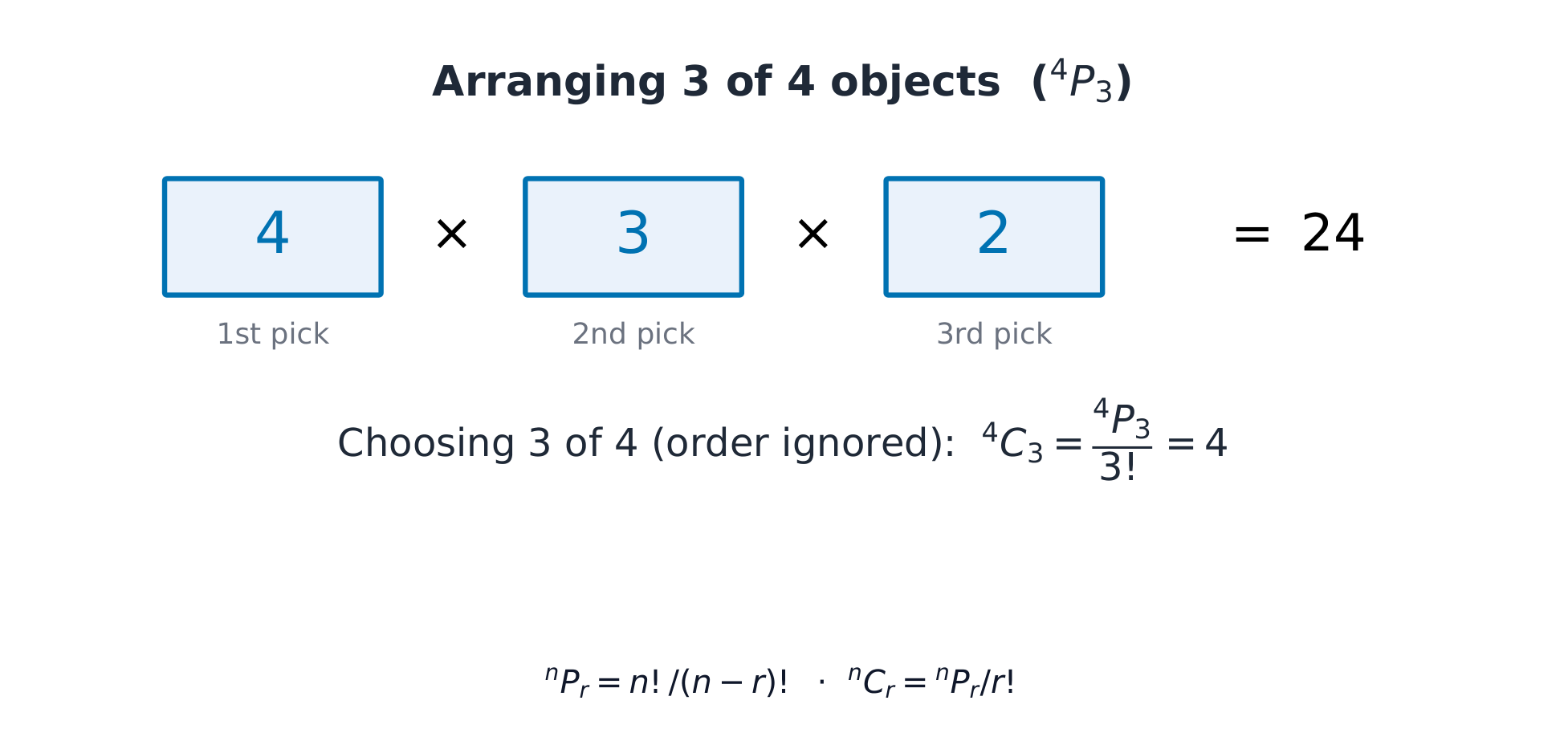
nPr = n!/(n−r)!; nCr = nPr/r! Explore · JelajahiPermutation or combination lab · Laboratorium permutasi atau kombinasi
Choose whether order matters in a counting problem. · Pilih apakah urutan penting dalam masalah penghitungan.
Vocabulary · Kosa kata Train · LatihEnglish Bahasa Indonesia range (of data)/reɪndʒ/ jangkauan (data) interquartile range/ˌɪntəˈkwɔːtaɪl reɪndʒ/ jangkauan interkuartil standard deviation/ˈstændəd ˌdiːvɪˈeɪʃn/ simpangan baku variance/ˈveərɪəns/ variansi Coding/ˈkəʊdɪŋ/ Pengodean assumed mean/əˈsjuːmd miːn/ rata-rata yang diasumsikan permutation/ˌpɜːmjuːˈteɪʃn/ permutasi combination/ˌkɒmbɪˈneɪʃn/ kombinasi mutually exclusive events/ˈmjuːtʃuːəli eksˈkluːsɪv ɪˈvents/ peristiwa saling eksklusif independent events/ˌɪndɪˈpendənt ɪˈvents/ peristiwa independen conditional probability/kənˈdɪʃənl ˌprɒbəˈbɪlɪti/ probabilitas bersyarat discrete random variable/dɪˈskriːt ˈrændəm ˈveərɪəbl/ variabel acak diskrit probability distribution table/ˌprɒbəˈbɪlɪti ˌdɪstrɪˈbjuːʃn ˈteɪbl/ tabel distribusi probabilitas expectation/ekspɪkˈteɪʃn/ ekspektasi binomial distribution/baɪˈnəʊmɪəl ˌdɪstrɪˈbjuːʃn/ taburan binomial geometric distribution/ˌdʒiːəʊˈmetrɪk ˌdɪstrɪˈbjuːʃn/ distribusi geometrik 5.3
Probability · Probabilitas

Syllabus · Silabus
EnglishCandidates should be able to: Notes and examples evaluate probabilities in simple cases by means of enumeration of equiprobable elementary events, or by calculation using permutations or combinations e.g. the total score when two fair dice are thrown. e.g. drawing balls at random from a bag containing balls of different colours. use addition and multiplication of probabilities, as appropriate, in simple cases Explicit use of the general formula $\text{P}(A \cup B) = \text{P}(A) + \text{P}(B) - \text{P}(A \cap B)$ is not required. understand the meaning of exclusive and independent events, including determination of whether events $A$ and $B$ are independent by comparing the values of $\text{P}(A \cap B)$ and $\text{P}(A) \times \text{P}(B)$ calculate and use conditional probabilities in simple cases. e.g. situations that can be represented by a sample space of equiprobable elementary events, or a tree diagram. The use of $\text{P}(A|B) = \frac{\text{P}(A \cap B)}{\text{P}(B)}$ may be required in simple cases. Bahasa IndonesiaCalon peserta harus mampu: Catatan dan contoh evaluasi probabilitas dalam kasus sederhana dengan enumeration peristiwa elementer yang ekuiprobabel, atau dengan perhitungan menggunakan permutasi atau kombinasi mis. total skor ketika dua dadu adil dilempar. mis. pengambilan bola secara acak dari sebuah tas berisi bola berwarna berbeda. gunakan penjumlahan dan perkalian probabilitas, sesuai, dalam kasus sederhana Penggunaan eksplisit rumus umum $\text{P}(A \cup B) = \text{P}(A) + \text{P}(B) - \text{P}(A \cap B)$ tidak diperlukan. pahami arti peristiwa eksklusif dan independen, termasuk penentuan apakah peristiwa $A$ dan $B$ independen dengan membandingkan nilai $\text{P}(A \cap B)$ dan $\text{P}(A) \times \text{P}(B)$ hitung dan gunakan probabilitas bersyarat dalam kasus sederhana. mis. situasi yang dapat direpresentasikan oleh ruang sampel peristiwa elementer ekuiprobabel, atau diagram pohon. Penggunaan $\text{P}(A|B) = \frac{\text{P}(A \cap B)}{\text{P}(B)}$ mungkin diperlukan dalam kasus sederhana. Source: Cambridge International syllabus · Sumber: Silabus Cambridge International
EnglishFind a probability by counting equally likely outcomes, or by using permutations and combinations. Combine probabilities with these rules:
- addition for "or": $P(A \cup B) = P(A) + P(B) - P(A \cap B)$;
- multiplication for "and" when events are independent: $P(A \cap B) = P(A)\,P(B)$.
Two events are mutually exclusive events 互斥事件 if they cannot both happen, and independent events 独立事件 if one happening does not change the chance of the other. To test independence, check whether $P(A \cap B) = P(A)\times P(B)$. A conditional probability 条件概率 is the chance of $A$ given that $B$ has happened: $P(A \mid B) = \dfrac{P(A \cap B)}{P(B)}$.
Worked example. Events have $P(A) = 0.5$, $P(B) = 0.4$ and $P(A \cap B) = 0.2$. Are $A$ and $B$ independent?
Test: $P(A)\times P(B) = 0.5 \times 0.4 = 0.2 = P(A \cap B)$. The values are equal, so $A$ and $B$ are independent.
Bahasa IndonesiaDadu: titik awal yang familiar untuk probabilitas. Temukan probabilitas dengan menghitung hasil yang sama mungkin, atau dengan menggunakan permutasi dan kombinasi. Gabungkan probabilitas dengan aturan berikut:
- penjumlahan untuk "atau": $P(A \cup B) = P(A) + P(B) - P(A \cap B)$;
- perkalian untuk "dan" ketika peristiwa saling bebas: $P(A \cap B) = P(A)\,P(B)$.
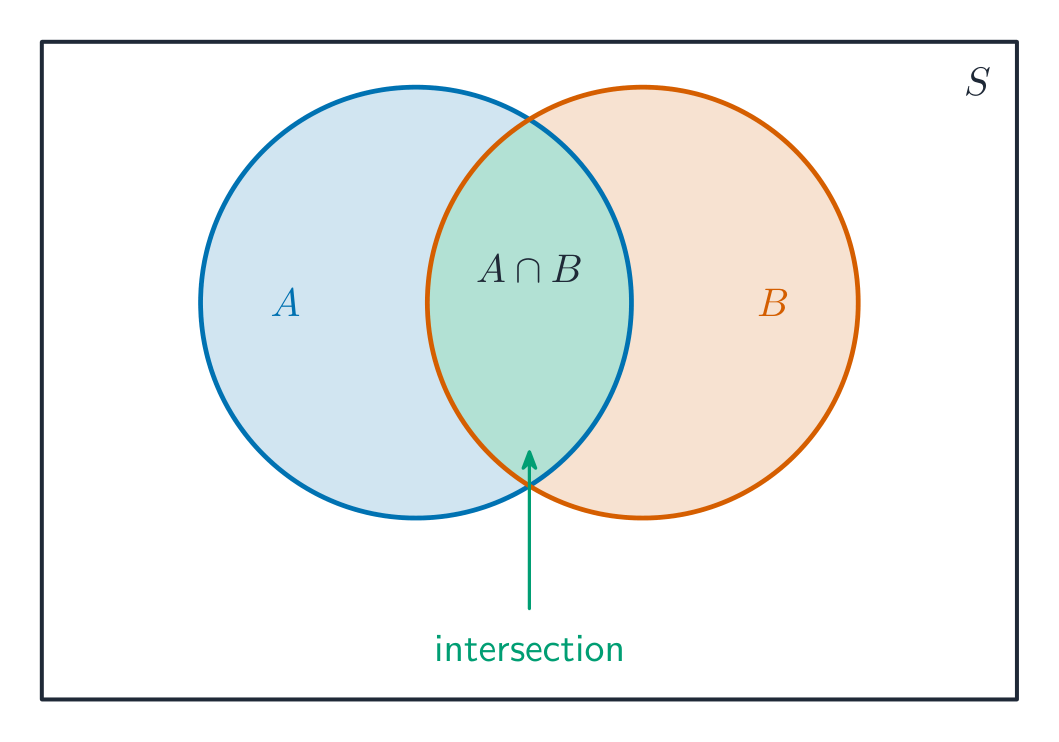
Irisan kedua lingkaran adalah $A\cap B$; aturan penjumlahan menguranginya sekali agar tidak dihitung dua kali. Dua peristiwa disebut peristiwa saling lepas jika keduanya tidak bisa terjadi bersamaan, dan peristiwa independen jika terjadinya satu peristiwa tidak mengubah peluang peristiwa lain. Untuk menguji independensi, periksa apakah $P(A \cap B) = P(A)\times P(B)$. Probabilitas bersyarat adalah peluang $A$ mengingat bahwa $B$ telah terjadi: $P(A \mid B) = \dfrac{P(A \cap B)}{P(B)}$.
Contoh terarah. Peristiwa memiliki $P(A) = 0.5$, $P(B) = 0.4$ dan $P(A \cap B) = 0.2$. Apakah $A$ dan $B$ independen?
Uji: $P(A)\times P(B) = 0.5 \times 0.4 = 0.2 = P(A \cap B)$. Nilainya sama, jadi $A$ dan $B$ adalah independen.
Explore · JelajahiConditional probability · Probabilitas bersyarat
Change the probabilities and read the tree. This is how P(A and B) and conditional probability fit together. · Ubah probabilitas dan baca pohon. Inilah cara P(A dan B) dan probabilitas bersyarat saling menyatu.
5.4
Discrete random variables · Variabel acak diskrit
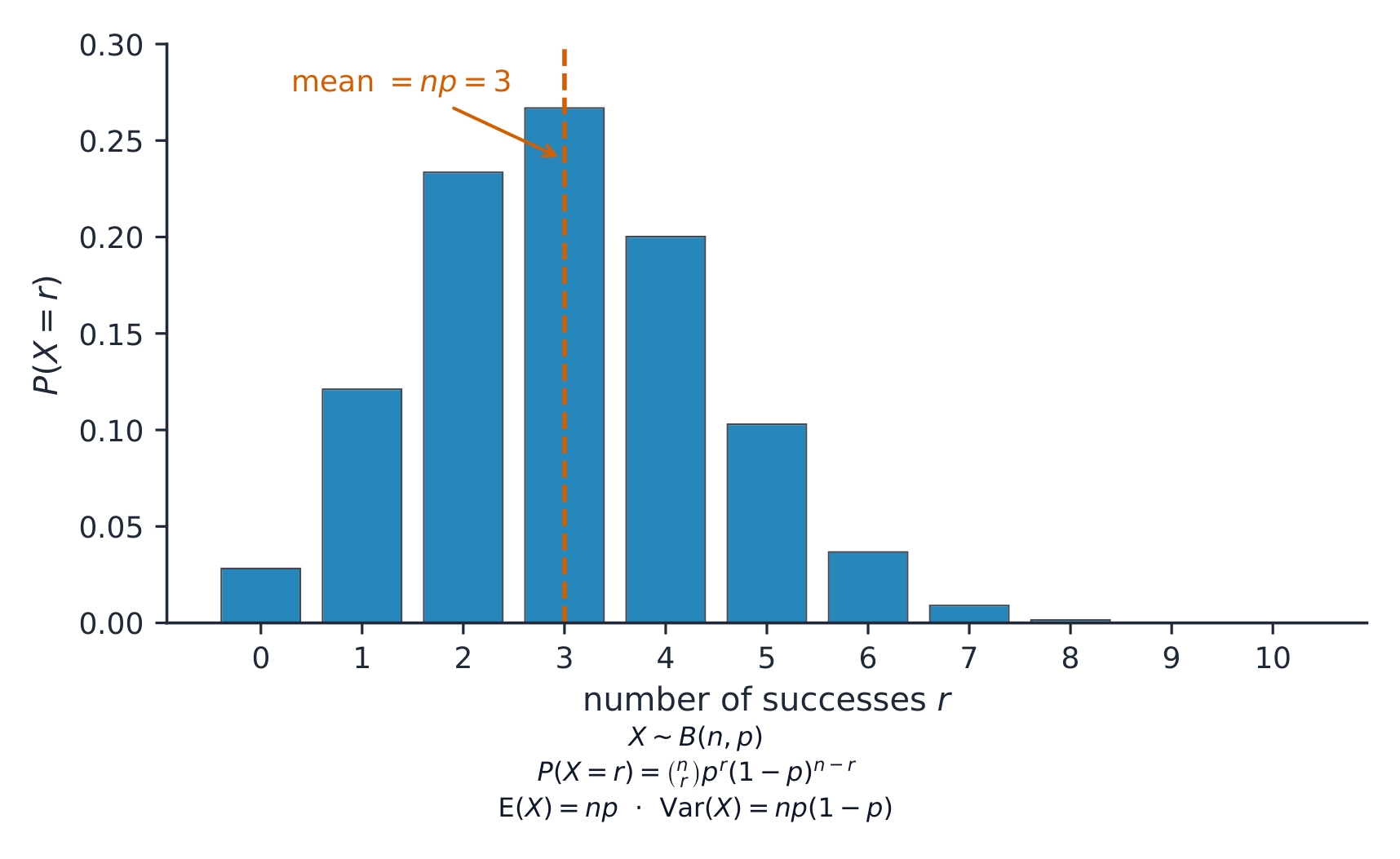
Syllabus · Silabus
EnglishCandidates should be able to: Notes and examples draw up a probability distribution table relating to a given situation involving a discrete random variable $X$, and calculate $\text{E}(X)$ and $\text{Var}(X)$ use formulae for probabilities for the binomial and geometric distributions, and recognise practical situations where these distributions are suitable models Including the notations $\text{B}(n, p)$ and $\text{Geo}(p)$. $\text{Geo}(p)$ denotes the distribution in which $p_r = p(1 - p)^{r-1}$ for $r = 1, 2, 3, \dots$. use formulae for the expectation and variance of the binomial distribution and for the expectation of the geometric distribution. Proofs of formulae are not required. Bahasa IndonesiaCalon peserta harus mampu: Catatan dan contoh buat tabel distribusi probabilitas yang berkaitan dengan situasi tertentu yang melibatkan variabel acak diskrit $X$, dan hitung $\text{E}(X)$ dan $\text{Var}(X)$ gunakan rumus untuk probabilitas pada distribusi binomial dan geometrik, dan kenali situasi praktis di mana distribusi ini merupakan model yang sesuai Termasuk notasi $\text{B}(n, p)$ dan $\text{Geo}(p)$. $\text{Geo}(p)$ menunjukkan distribusi di mana $p_r = p(1 - p)^{r-1}$ untuk $r = 1, 2, 3, \dots$. gunakan rumus untuk ekspektasi dan variansi distribusi binomial serta untuk ekspektasi distribusi geometrik. Bukti rumus tidak diperlukan. Source: Cambridge International syllabus · Sumber: Silabus Cambridge International
EnglishA discrete random variable 离散型随机变量 $X$ takes separate values, each with a probability. List them in a probability distribution table 概率分布表; the probabilities must add to $1$. Then the expectation 期望 (mean) and variance are
$$E(X) = \sum x\,P(X = x), \qquad \mathrm{Var}(X) = \sum x^2\,P(X = x) - \big(E(X)\big)^2.$$Two special models:
- the binomial distribution 二项分布 $X \sim B(n, p)$, for the number of successes in $n$ independent trials: $P(X = r) = \binom{n}{r}p^r(1-p)^{n-r}$, with $E(X) = np$ and $\mathrm{Var}(X) = np(1-p)$;
- the geometric distribution 几何分布, for the trial on which the first success happens: $P(X = r) = (1-p)^{r-1}p$, with $E(X) = \dfrac{1}{p}$.
Worked example. $X \sim B(10, 0.3)$. Find $P(X = 2)$ and $E(X)$.
$$P(X = 2) = \binom{10}{2}(0.3)^2(0.7)^8 = 45 \times 0.09 \times 0.05765 = 0.233, \qquad E(X) = 10 \times 0.3 = 3.$$Bahasa IndonesiaVariabel acak diskrit $X$ mengambil nilai terpisah, masing-masing dengan probabilitas. Daftarkan mereka dalam tabel distribusi probabilitas; probabilitas harus menjumlahkan ke $1$. Kemudian ekspektasi (mean) dan varians adalah
$$E(X) = \sum x\,P(X = x), \qquad \mathrm{Var}(X) = \sum x^2\,P(X = x) - \big(E(X)\big)^2.$$Dua model khusus:
- distribusi binomial $X \sim B(n, p)$, untuk jumlah keberhasilan dalam $n$ percobaan independen: $P(X = r) = \binom{n}{r}p^r(1-p)^{n-r}$, dengan $E(X) = np$ dan $\mathrm{Var}(X) = np(1-p)$;
- distribusi geometrik, untuk percobaan di mana keberhasilan pertama terjadi: $P(X = r) = (1-p)^{r-1}p$, dengan $E(X) = \dfrac{1}{p}$.
Contoh terarah. $X \sim B(10, 0.3)$. Temukan $P(X = 2)$ dan $E(X)$.
$$P(X = 2) = \binom{10}{2}(0.3)^2(0.7)^8 = 45 \times 0.09 \times 0.05765 = 0.233, \qquad E(X) = 10 \times 0.3 = 3.$$Distribusi $B(10,0.3)$: setiap balok adalah $P(X=r)$, mengelompok di sekitar mean $np=3$. Explore · JelajahiA discrete distribution · Distribusi diskrit
Change n and p for a binomial distribution and watch the bars — the probability of each number of successes. · Ubah n dan p untuk distribusi binomial dan saksikan bilah-bilahnya — probabilitas setiap jumlah keberhasilan.
Vocabulary · Kosa kata Train · LatihEnglish Bahasa Indonesia mode/məʊd/ moda variation/ˌveərɪˈeɪʃn/ variasi 5.5
The normal distribution · Distribusi Normal

Syllabus · Silabus
EnglishCandidates should be able to: Notes and examples understand the use of a normal distribution to model a continuous random variable, and use normal distribution tables Sketches of normal curves to illustrate distributions or probabilities may be required. solve problems concerning a variable $X$, where $X \sim N(\mu, \sigma^2)$, including: – finding the value of $P(X > x_1)$, or a related probability, given the values of $x_1$, $\mu$, $\sigma$. – finding a relationship between $x_1$, $\mu$ and $\sigma$ given the value of $P(X > x_1)$ or a related probability For calculations involving standardisation, full details of the working should be shown. e.g. $Z = \frac{(X - \mu)}{\sigma}$ recall conditions under which the normal distribution can be used as an approximation to the binomial distribution, and use this approximation, with a continuity correction, in solving problems. $n$ sufficiently large to ensure that both $np > 5$ and $nq > 5$. Bahasa IndonesiaCalon peserta harus mampu: Catatan dan contoh pahami penggunaan distribusi normal untuk memodelkan variabel acak kontinu, dan gunakan tabel distribusi normal Sketsa kurva normal untuk mengilustrasikan distribusi atau probabilitas mungkin diperlukan. selesaikan masalah mengenai variabel $X$, di mana $X \sim N(\mu, \sigma^2)$, termasuk: – menemukan nilai $P(X > x_1)$, atau probabilitas terkait, diberikan nilai $x_1$, $\mu$, $\sigma$. – menemukan hubungan antara $x_1$, $\mu$ dan $\sigma$ given the value of $P(X > x_1)$ or a related probability Untuk perhitungan yang melibatkan standarisasi, detail lengkap proses pengerjaan harus ditampilkan. mis. $Z = \frac{(X - \mu)}{\sigma}$ ingat kondisi di mana distribusi normal dapat digunakan sebagai aproksimasi untuk distribusi binomial, dan gunakan aproksimasi ini, dengan koreksi kontinuitas, dalam menyelesaikan masalah. $n$ cukup besar untuk memastikan bahwa kedua $np > 5$ dan $nq > 5$. Source: Cambridge International syllabus · Sumber: Silabus Cambridge International
EnglishThe 68-95-99.7 rule The normal distribution 正态分布 models a continuous random variable 连续型随机变量 with a symmetric bell shape. Write $X \sim N(\mu, \sigma^2)$, where $\mu$ is the mean and $\sigma$ is the standard deviation. To use the tables, by standardisation 标准化 convert to the variable $Z \sim N(0, 1)$:
$$Z = \frac{X - \mu}{\sigma}.$$Then $P(X < x) = P\!\left(Z < \dfrac{x - \mu}{\sigma}\right)$, which you read from the normal table $\Phi$.
The normal distribution is also a good approximation 近似 to the binomial when $n$ is large. Because you replace a discrete variable by a continuous one, apply a continuity correction 连续性校正 (adjust by $0.5$).
Worked example. Bags of rice have mass $X \sim N(\mu, 0.14^2)$. Given that $P(X < 1.48) = 0.22$, find $\mu$.
From the table, $P(Z < z) = 0.22$ gives $z = -0.772$. So
$$\frac{1.48 - \mu}{0.14} = -0.772 \;\Rightarrow\; \mu = 1.48 + 0.772 \times 0.14 = 1.59\ \text{kg (3 s.f.)}.$$Bahasa IndonesiaAturan 68-95-99.7 Papan Galton: bola jatuh melalui pin menumpuk menjadi distribusi normal berbentuk lonceng. Distribusi normal memodelkan variabel acak kontinu dengan bentuk lonceng simetris. Tulis $X \sim N(\mu, \sigma^2)$, di mana $\mu$ adalah mean dan $\sigma$ adalah simpangan baku. Untuk menggunakan tabel, melalui standarisasi ubah menjadi variabel $Z \sim N(0, 1)$:
$$Z = \frac{X - \mu}{\sigma}.$$Kemudian $P(X < x) = P\!\left(Z < \dfrac{x - \mu}{\sigma}\right)$, yang Anda baca dari tabel normal $\Phi$.
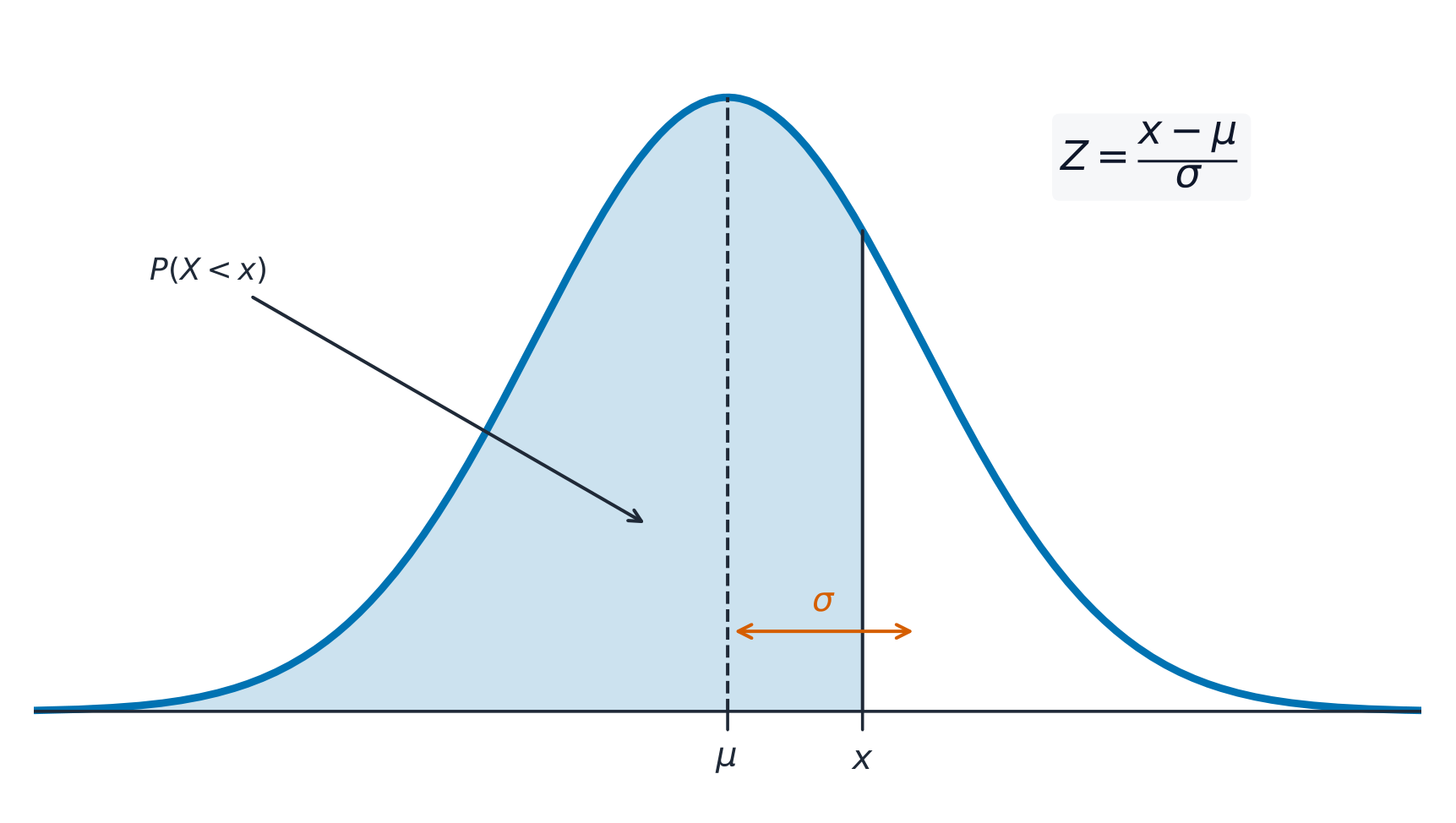
Probabilitas normal adalah area di bawah kurva lonceng; menstandarkan menskalanya kembali ke $Z\sim N(0,1)$. Distribusi normal juga merupakan pendekatan yang baik untuk binomial ketika $n$ besar. Karena Anda mengganti variabel diskrit dengan variabel kontinu, terapkan koreksi kontinuitas (sesuaikan dengan $0.5$).
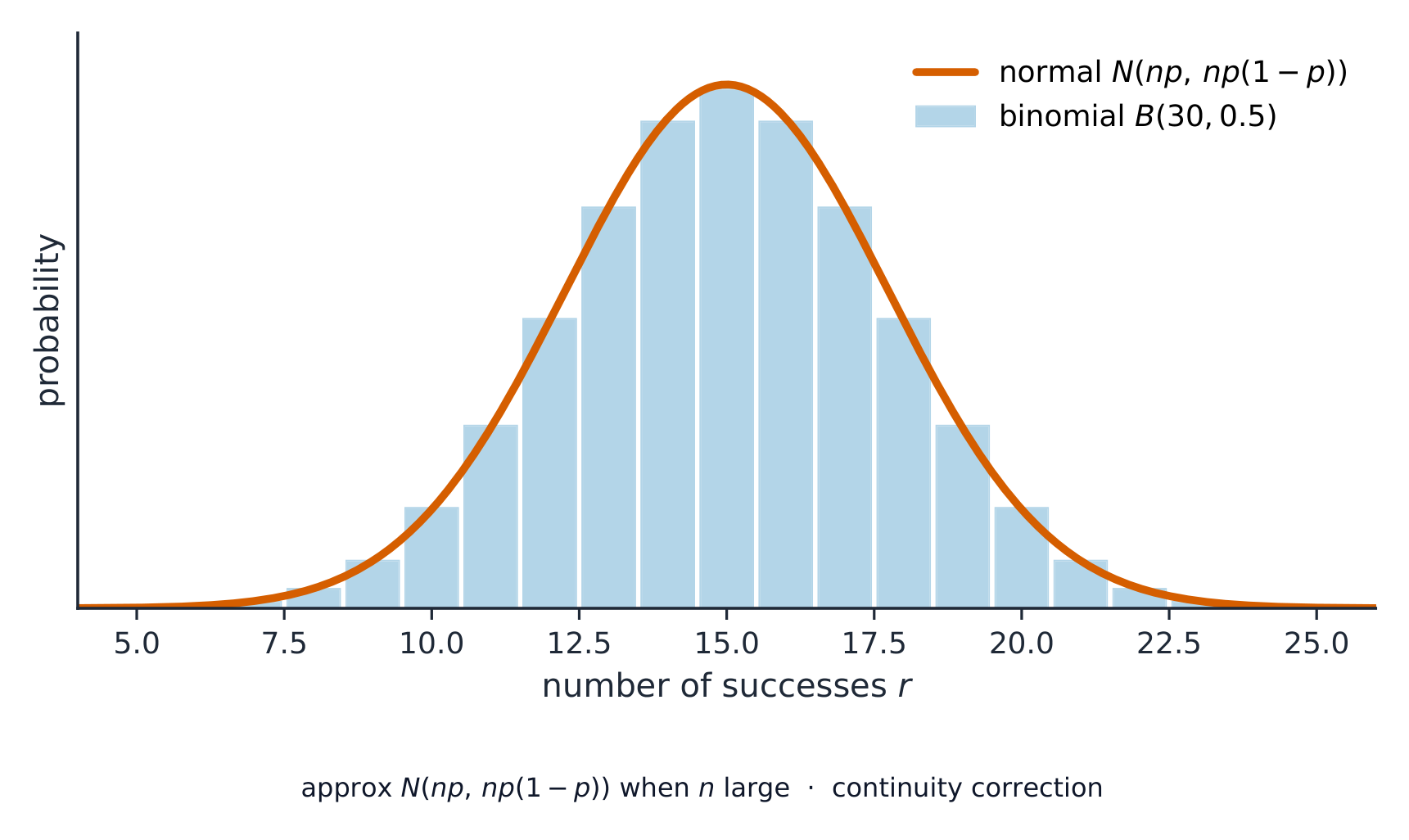
Ketika $n$ besar, batang-batang binomial mengikuti kurva normal dengan rata-rata dan variansi yang sama. Contoh worked. Karung beras memiliki massa $X \sim N(\mu, 0.14^2)$. Diketahui bahwa $P(X < 1.48) = 0.22$, temukan $\mu$.
Dari tabel, $P(Z < z) = 0.22$ memberikan $z = -0.772$. Maka
$$\frac{1.48 - \mu}{0.14} = -0.772 \;\Rightarrow\; \mu = 1.48 + 0.772 \times 0.14 = 1.59\ \text{kg (3 s.f.)}.$$Explore · JelajahiThe normal distribution · Distribusi normal
Shade the area to find a probability. A z-value measures how many standard deviations a point is from the mean. · Arsir area untuk menemukan probabilitas. Nilai-z mengukur berapa banyak simpangan baku suatu titik dari rata-rata.
Vocabulary · Kosa kata Train · LatihEnglish Bahasa Indonesia normal distribution/ˈnɔːml ˌdɪstrɪˈbjuːʃn/ normal distribution continuous random variable/kənˈtɪnjuːəs ˈrændəm ˈveərɪəbl/ variabel acak kontinu standardisation/ˌstændədaɪˈzeɪʃn/ standarisasi approximation/əˌprɒksɪˈmeɪʃn/ aproksimasi continuity correction/kɒntɪˈnjuːɪti kəˈrekʃn/ koreksi kontinuitas Probability & Statistics/ˌprɒbəˈbɪlɪti ænd stəˈtɪstɪks/ Probabilitas & Statistik central tendency/ˈsentrəl ˈtendənsi/ kecenderungan tengah 5.5
Exam tips · Tips ujian
English- Decide whether order matters: permutations ($^nP_r$) when it does, combinations ($^nC_r$) when it does not.
- For a discrete random variable, check the probabilities sum to $1$ and use $E(X) = \sum x\,P(X=x)$.
- For the normal distribution, standardise with $z = (x - \mu)/\sigma$, sketch and shade, then read the table.
- Apply a continuity correction when approximating a discrete variable by the normal.
Bahasa Indonesia- Tentukan apakah urutan penting: permutasi ($^nP_r$) jika ya, kombinasi ($^nC_r$) jika tidak.
- Untuk variabel acak diskrit, periksa apakah probabilitas menjumlahkan ke $1$ dan gunakan $E(X) = \sum x\,P(X=x)$.
- Untuk distribusi normal, standarisasi dengan $z = (x - \mu)/\sigma$, gambar sketsa dan arsir, lalu baca tabel.
- Terapkan koreksi kontinuitas saat mengaproksimasi variabel diskrit dengan normal.
-
6
Probability & Statistics 2 · Probabilitas & Statistik 2
Watch lesson · Tonton pelajaranThis handout covers Topic 6: Probability & Statistics 概率统计 2. It adds the Poisson model, combining random variables, continuous distributions, and the ideas of estimation and testing.
6.1
The Poisson distribution
Syllabus · Silabus
EnglishCandidates should be able to: Notes and examples • use formulae to calculate probabilities for the distribution $\text{Po}(\lambda)$ • use the fact that if $X \sim \text{Po}(\lambda)$ then the mean and variance of $X$ are each equal to $\lambda$ Proofs are not required. • understand the relevance of the Poisson distribution to the distribution of random events, and use the Poisson distribution as a model • use the Poisson distribution as an approximation to the binomial distribution where appropriate The conditions that $n$ is large and $p$ is small should be known; $n > 50$ and $np < 5$, approximately. • use the normal distribution, with continuity correction, as an approximation to the Poisson distribution where appropriate. The condition that $\lambda$ is large should be known; $\lambda > 15$, approximately. Bahasa IndonesiaCalon peserta harus mampu: Catatan dan contoh • gunakan rumus untuk menghitung probabilitas untuk distribusi $\text{Po}(\lambda)$ • gunakan fakta bahwa jika $X \sim \text{Po}(\lambda)$ maka rata-rata dan variansi dari $X$ masing-masing sama dengan $\lambda$ Bukti tidak diperlukan. • pahami relevansi distribusi Poisson terhadap distribusi peristiwa acak, dan gunakan distribusi Poisson sebagai model • gunakan distribusi Poisson sebagai aproksimasi untuk distribusi binomial di mana sesuai Kondisi bahwa $n$ besar dan $p$ kecil harus diketahui; $n > 50$ dan $np < 5$, kira-kira. • gunakan distribusi normal, dengan koreksi kontinuitas, sebagai aproksimasi untuk distribusi Poisson di mana sesuai. Kondisi bahwa $\lambda$ besar harus diketahui; $\lambda > 15$, kira-kira. Source: Cambridge International syllabus · Sumber: Silabus Cambridge International
People arriving at random in a queue follow a Poisson distribution. The Poisson distribution 泊松分布 $X \sim \mathrm{Po}(\lambda)$ models the number of random events in a fixed interval, when events happen at a steady average rate $\lambda$:
$$P(X = r) = e^{-\lambda}\frac{\lambda^r}{r!}.$$For a Poisson variable the mean and the variance are both equal to $\lambda$. The Poisson distribution is a good approximation 近似 to the binomial distribution when $n$ is large and $p$ is small. The normal distribution (with continuity correction) approximates the Poisson when $\lambda$ is large.Worked example. $X \sim \mathrm{Po}(3)$. Find $P(X = 2)$.
$$P(X = 2) = e^{-3}\frac{3^2}{2!} = e^{-3}\times 4.5 = 0.224.$$
The Poisson distribution $\mathrm{Po}(3)$: for a Poisson variable the mean and variance both equal $\lambda$. Explore · JelajahiThe Poisson distribution · Distribusi Poisson
Change the mean λ. Poisson models the number of random events in a fixed interval — rare events give a skewed shape. · Ubah rata-rata λ. Poisson memodelkan jumlah kejadian acak dalam interval tetap — kejadian langka menghasilkan bentuk miring.
Vocabulary · Kosa kata Train · LatihEnglish Bahasa Indonesia Poisson distribution/ˈpɔɪsn ˌdɪstrɪˈbjuːʃn/ distribusi Poisson approximation/əˌprɒksɪˈmeɪʃn/ aproksimasi 6.2
Linear combinations of random variables
Syllabus · Silabus
EnglishCandidates should be able to: Notes and examples • use, when solving problems, the results that – $\text{E}(aX + b) = a\text{E}(X) + b$ and $\text{Var}(aX + b) = a^2\text{Var}(X)$ – $\text{E}(aX + bY) = a\text{E}(X) + b\text{E}(Y)$ – $\text{Var}(aX + bY) = a^2\text{Var}(X) + b^2\text{Var}(Y)$ for independent $X$ and $Y$ – if $X$ has a normal distribution then so does $aX + b$ – if $X$ and $Y$ have independent normal distributions then $aX + bY$ has a normal distribution – if $X$ and $Y$ have independent Poisson distributions then $X + Y$ has a Poisson distribution. Proofs of these results are not required. Bahasa IndonesiaCalon peserta harus mampu: Catatan dan contoh • gunakan, saat menyelesaikan masalah, hasil berikut – $\text{E}(aX + b) = a\text{E}(X) + b$ dan $\text{Var}(aX + b) = a^2\text{Var}(X)$ – $\text{E}(aX + bY) = a\text{E}(X) + b\text{E}(Y)$ – $\text{Var}(aX + bY) = a^2\text{Var}(X) + b^2\text{Var}(Y)$ untuk $X$ independen dan $Y$ – jika $X$ memiliki distribusi normal maka begitu pula $aX + b$ – jika $X$ dan $Y$ memiliki distribusi normal independen maka $aX + bY$ memiliki distribusi normal – jika $X$ dan $Y$ memiliki distribusi Poisson independen maka $X + Y$ memiliki distribusi Poisson. Bukti hasil-hasil ini tidak diperlukan. Source: Cambridge International syllabus · Sumber: Silabus Cambridge International
When you change a variable by a linear rule, the expectation 期望 (mean) and variance 方差 follow these rules:
$$E(aX + b) = aE(X) + b, \qquad \mathrm{Var}(aX + b) = a^2\,\mathrm{Var}(X).$$For two independent variables $X$ and $Y$:$$E(aX + bY) = aE(X) + bE(Y), \qquad \mathrm{Var}(aX + bY) = a^2\,\mathrm{Var}(X) + b^2\,\mathrm{Var}(Y).$$Two useful facts: if $X$ has a normal distribution 正态分布 then so does $aX + b$; and the sum of independent Poisson variables is again Poisson.Worked example. $X$ has mean $5$ and variance $4$. Find $E(3X - 1)$ and $\mathrm{Var}(3X - 1)$.
$$E(3X - 1) = 3(5) - 1 = 14, \qquad \mathrm{Var}(3X - 1) = 3^2 \times 4 = 36.$$Explore · JelajahiLinear combination lab · Lab gabungan linear
E(aX + b) = aE(X) + b
Change a scaling factor and see how the expected value scales. · Tukar faktor skala dan lihat bagaimana nilai jangkaan berskala.
Vocabulary · Kosa kata Train · LatihEnglish Bahasa Indonesia expectation/ekspɪkˈteɪʃn/ ekspektasi variance/ˈveərɪəns/ variansi normal distribution/ˈnɔːml ˌdɪstrɪˈbjuːʃn/ normal distribution 6.3
Continuous random variables
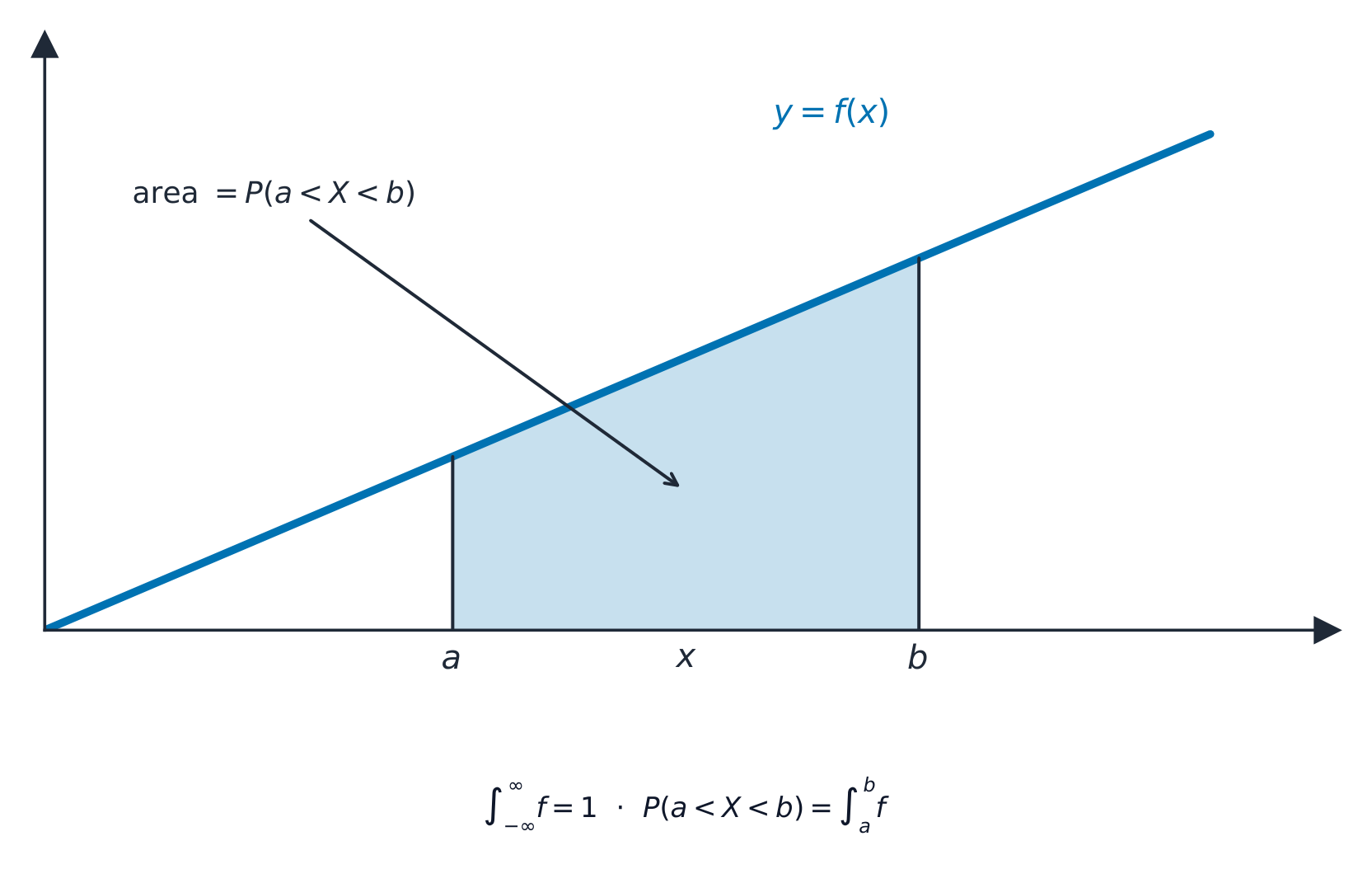
Syllabus · Silabus
EnglishCandidates should be able to: Notes and examples • understand the concept of a continuous random variable, and recall and use properties of a probability density function For density functions defined over a single interval only; the domain may be infinite, e.g. $\frac{3}{x^4}$ for $x \geqslant 1$. • use a probability density function to solve problems involving probabilities, and to calculate the mean and variance of a distribution. Including location of the median or other percentiles of a distribution by direct consideration of an area using the density function. Explicit knowledge of the cumulative distribution function is not included. Bahasa IndonesiaCalon peserta harus mampu: Catatan dan contoh • pahami konsep variabel acak kontinu, dan ingat serta gunakan sifat-sifat fungsi kepadatan probabilitas Untuk fungsi kepadatan yang didefinisikan hanya atas satu interval; domainnya bisa tak terhingga, mis. $\frac{3}{x^4}$ untuk $x \geqslant 1$. • gunakan fungsi kepadatan probabilitas untuk menyelesaikan masalah yang melibatkan probabilitas, dan untuk menghitung rata-rata dan variansi dari suatu distribusi. Termasuk penentuan median atau persentil lain dari distribusi melalui pertimbangan langsung area menggunakan fungsi kepadatan. Pengetahuan eksplisit tentang fungsi distribusi kumulatif tidak termasuk. Source: Cambridge International syllabus · Sumber: Silabus Cambridge International
A continuous random variable 连续型随机变量 can take any value in a range. Its probabilities come from a probability density function 概率密度函数 $f(x)$, with two key properties:
$$f(x) \geqslant 0, \qquad \int_{-\infty}^{\infty} f(x)\,dx = 1.$$A probability is the area under $f$, and the mean is found by integration:$$P(a < X < b) = \int_a^b f(x)\,dx, \qquad E(X) = \int_{-\infty}^{\infty} x\,f(x)\,dx.$$The cumulative distribution function 累积分布函数 is $F(x) = P(X \leqslant x) = \int_{-\infty}^{x} f(t)\,dt$; the median 中位数 solves $F(m) = 0.5$, and other percentiles 百分位数 solve $F(x) = p$.
For a continuous variable, the probability $P(a Worked example. A continuous variable has $f(x) = \tfrac12 x$ for $0 \leqslant x \leqslant 2$ (and $0$ elsewhere). Find $E(X)$.
$$E(X) = \int_0^2 x\cdot\tfrac12 x\,dx = \int_0^2 \tfrac12 x^2\,dx = \left[\tfrac{x^3}{6}\right]_0^2 = \frac{8}{6} = \frac{4}{3}.$$The variance uses the same idea, $\mathrm{Var}(X)=\displaystyle\int_{-\infty}^{\infty}x^2 f(x)\,dx-\big(E(X)\big)^2$. For the same $f(x)=\tfrac12 x$ on $[0,2]$: $\displaystyle\int_0^2 x^2\cdot\tfrac12 x\,dx=\left[\tfrac{x^4}{8}\right]_0^2=2$, so $\mathrm{Var}(X)=2-\left(\tfrac43\right)^2=2-\tfrac{16}{9}=\tfrac{2}{9}$.
Explore · JelajahiArea = probability · Kawasan = kebarangkalian
P(a < X < b) = ∫ f(x) dx
For a continuous variable, probability is the area under the density curve between two values. · Bagi pemboleh ubah berterusan, kebarangkalian ialah kawasan di bawah lengkung ketumpatan antara dua nilai.
Vocabulary · Kosa kata Train · LatihEnglish Bahasa Indonesia continuous random variable/kənˈtɪnjuːəs ˈrændəm ˈveərɪəbl/ variabel acak kontinu probability density function/ˌprɒbəˈbɪlɪti ˈdensɪti ˈfʌŋkʃn/ fungsi kepadatan peluang cumulative distribution function/ˈkjuːmjʊlətɪv ˌdɪstrɪˈbjuːʃn ˈfʌŋkʃn/ fungsi distribusi kumulatif median/ˈmiːdiːən/ median percentiles/pəˈsentaɪlz/ persentil 6.4
Sampling and estimation

Syllabus · Silabus
EnglishCandidates should be able to: Notes and examples • understand the distinction between a sample and a population, and appreciate the necessity for randomness in choosing samples • explain in simple terms why a given sampling method may be unsatisfactory Including an elementary understanding of the use of random numbers in producing random samples. Knowledge of particular sampling methods, such as quota or stratified sampling, is not required. • recognise that a sample mean can be regarded as a random variable, and use the facts that $\text{E}(\overline{X}) = \mu$ and that $\text{Var}(\overline{X}) = \frac{\sigma^2}{n}$ • use the fact that $\overline{X}$ has a normal distribution if $X$ has a normal distribution • use the Central Limit Theorem where appropriate Only an informal understanding of the Central Limit Theorem (CLT) is required; for large sample sizes, the distribution of a sample mean is approximately normal. • calculate unbiased estimates of the population mean and variance from a sample, using either raw or summarised data Only a simple understanding of the term 'unbiased' is required, e.g. that although individual estimates will vary the process gives an accurate result 'on average'. • determine and interpret a confidence interval for a population mean in cases where the population is normally distributed with known variance or where a large sample is used • determine, from a large sample, an approximate confidence interval for a population proportion. Bahasa IndonesiaCalon peserta harus mampu: Catatan dan contoh • pahami perbedaan antara sampel dan populasi, serta apresiasi akan pentingnya keacakan dalam pemilihan sampel • jelaskan dengan bahasa sederhana mengapa suatu metode sampling mungkin tidak memuaskan Termasuk pemahaman dasar tentang penggunaan angka acak dalam menghasilkan sampel acak. Pengetahuan tentang metode sampling tertentu, seperti kuota atau stratified sampling, tidak diperlukan. • sadari bahwa rata-rata sampel dapat dianggap sebagai variabel acak, dan gunakan fakta bahwa $\text{E}(\overline{X}) = \mu$ dan bahwa $\text{Var}(\overline{X}) = \frac{\sigma^2}{n}$ • gunakan fakta bahwa $\overline{X}$ memiliki distribusi normal jika $X$ memiliki distribusi normal • gunakan Teorema Limit Pusat di mana sesuai Hanya pemahaman informal tentang Teorema Limit Pusat (CLT) yang diperlukan; untuk ukuran sampel besar, distribusi rata-rata sampel mendekati normal. • hitung estimasi tak bias dari mean populasi dan variansi dari sebuah sampel, menggunakan data mentah maupun terangkum Hanya pemahaman sederhana tentang istilah 'tak bias' yang diperlukan, misalnya bahwa meskipun estimasi individu akan bervariasi, proses tersebut memberikan hasil akurat 'rata-rata'. • tentukan dan tafsirkan interval kepercayaan untuk mean populasi dalam kasus di mana populasi berdistribusi normal dengan varians diketahui atau di mana sampel besar digunakan • tentukan, dari sampel besar, interval kepercayaan pendekatan untuk proporsi populasi. Source: Cambridge International syllabus · Sumber: Silabus Cambridge International
Statistics studies a sample to learn about a whole population. A sample 样本 is a small group chosen from the whole population 总体. A random sample needs randomness 随机性, so that every member has a fair chance of being chosen.
Some methods are unsatisfactory because they are biased 有偏: sampling only volunteers, or the first 20 people to arrive, over-represents certain kinds of people. A genuinely random sample uses random numbers – number every member of the population, then draw numbers (from a table or a generator) to decide who is in the sample.
The sample mean $\bar{X}$ is itself a random variable, with
$$E(\bar{X}) = \mu, \qquad \mathrm{Var}(\bar{X}) = \frac{\sigma^2}{n}.$$By the Central Limit Theorem 中心极限定理, for a large sample $\bar{X}$ is approximately normal, whatever the shape of the population.
Whatever the population's shape, the sample mean $\bar{X}$ has a narrow, near-normal distribution centred on $\mu$. From a sample you can find unbiased estimates 无偏估计 of the population mean and variance. A confidence interval 置信区间 gives a range that probably contains the true mean. When the population is normal with known $\sigma$ (or the sample is large), a $95\%$ interval is
$$\bar{x} \pm 1.96\,\frac{\sigma}{\sqrt{n}}.$$
A $95\%$ confidence interval stretches $1.96$ standard errors each side of the sample mean. You can also find a confidence interval for a population proportion 总体比例 from a large sample.
Worked example. A sample of $n = 64$ has mean $\bar{x} = 50$, from a population with $\sigma = 8$. Find a $95\%$ confidence interval for the population mean.
$$50 \pm 1.96\times\frac{8}{\sqrt{64}} = 50 \pm 1.96 \;\Rightarrow\; (48.0,\ 52.0).$$Explore · JelajahiThe sampling distribution · Taburan pensampelan
X̄ ~ N(μ, σ²/n)
By the Central Limit Theorem, sample means follow a normal curve — narrower for bigger samples. · Mengikut Teorem Had Pusat, min sampel mengikuti lengkung normal — lebih sempit untuk sampel yang lebih besar.
Vocabulary · Kosa kata Train · LatihEnglish Bahasa Indonesia sample/ˈsæmpl/ sampel population/ˌpɒpjʊˈleɪʃn/ populasi randomness/ˈrændəmnəs/ keacakan biased/ˈbaɪəst/ bias Central Limit Theorem/ˈsentrəl ˈlɪmɪt ˈθɪərəm/ Teorem Had Pusat unbiased estimates/ʌnˈbaɪəst ˈestɪməts/ estimasi tak bias confidence interval/ˈkɒnfɪdəns ˈɪntəvl/ interval kepercayaan population proportion/ˌpɒpjʊˈleɪʃn prəˈpɔːʃn/ proporsi populasi 6.5
Hypothesis tests
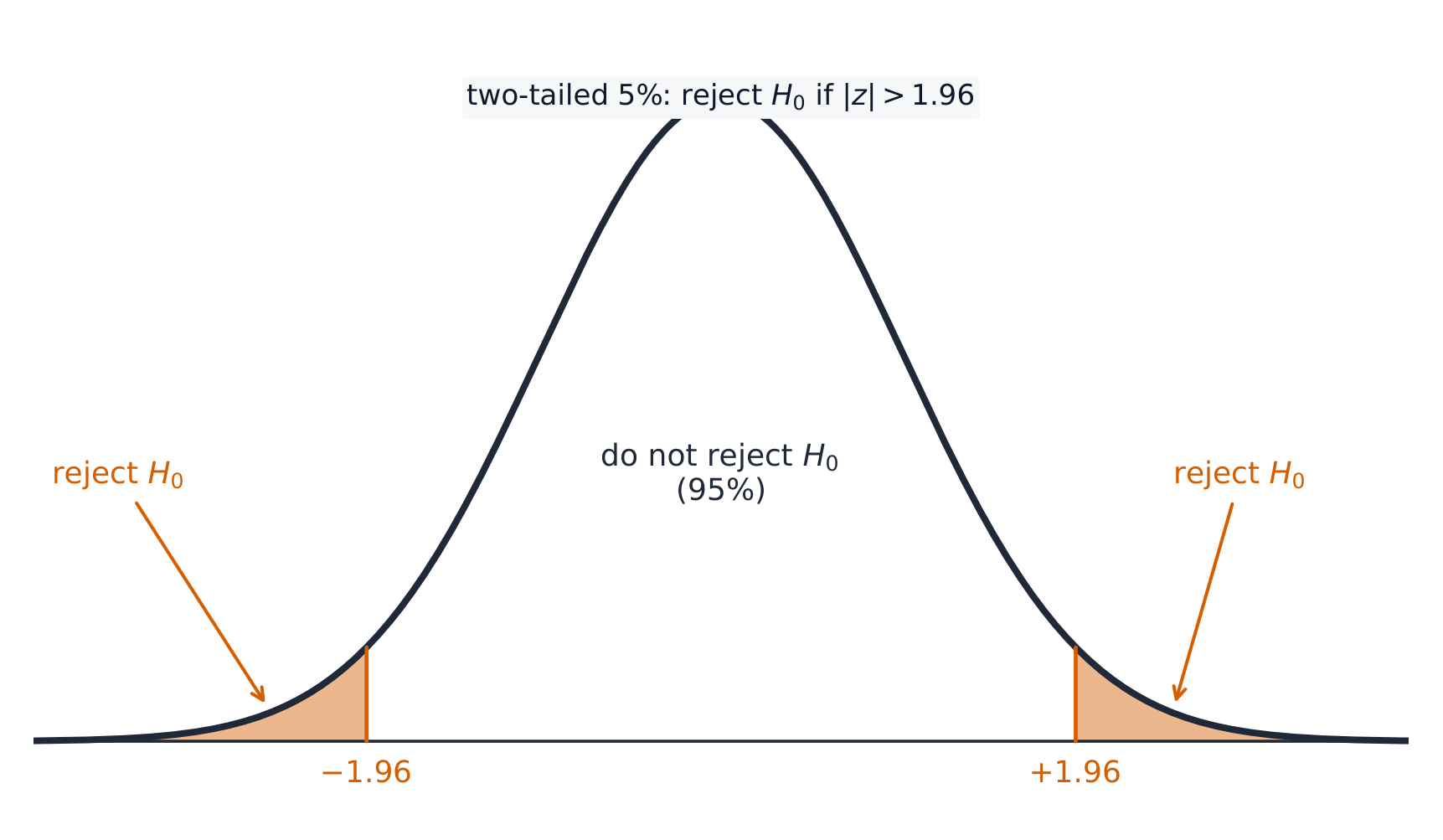
Syllabus · Silabus
EnglishCandidates should be able to: Notes and examples • understand the nature of a hypothesis test, the difference between one-tailed and two-tailed tests, and the terms null hypothesis, alternative hypothesis, significance level, rejection region (or critical region), acceptance region and test statistic Outcomes of hypothesis tests are expected to be interpreted in terms of the contexts in which questions are set. • formulate hypotheses and carry out a hypothesis test in the context of a single observation from a population which has a binomial or Poisson distribution, using – direct evaluation of probabilities – a normal approximation to the binomial or the Poisson distribution, where appropriate • formulate hypotheses and carry out a hypothesis test concerning the population mean in cases where the population is normally distributed with known variance or where a large sample is used • understand the terms Type I error and Type II error in relation to hypothesis tests • calculate the probabilities of making Type I and Type II errors in specific situations involving tests based on a normal distribution or direct evaluation of binomial or Poisson probabilities. Bahasa IndonesiaCalon peserta harus mampu: Catatan dan contoh • pahami sifat uji hipotesis, perbedaan antara uji satu arah dan dua arah, serta istilah hipotesis nol, hipotesis alternatif, tingkat signifikansi, daerah penolakan (atau daerah kritis), daerah penerimaan dan statistik uji Hasil uji hipotesis diharapkan ditafsirkan dalam konteks di mana pertanyaan disusun. • susun hipotesis dan lakukan uji hipotesis dalam konteks pengamatan tunggal dari populasi yang memiliki distribusi binomial atau Poisson, menggunakan – evaluasi probabilitas langsung – pendekatan normal terhadap distribusi binomial atau Poisson, di mana sesuai • susun hipotesis dan lakukan uji hipotesis mengenai mean populasi dalam kasus di mana populasi berdistribusi normal dengan varians diketahui atau di mana sampel besar digunakan • pahami istilah kesalahan Tipe I dan kesalahan Tipe II terkait dengan uji hipotesis • hitung probabilitas melakukan kesalahan Tipe I dan kesalahan Tipe II dalam situasi spesifik yang melibatkan uji berdasarkan distribusi normal atau evaluasi langsung probabilitas binomial atau Poisson. Source: Cambridge International syllabus · Sumber: Silabus Cambridge International
A hypothesis test 假设检验 uses sample data to judge a claim. You set up two statements: the null hypothesis 原假设 $H_0$ (the claim being tested, usually "no change") and the alternative hypothesis 备择假设 $H_1$ (what you suspect instead). The test is one-tailed 单尾 if $H_1$ points one way (e.g. $\mu > 50$) and two-tailed 双尾 if it allows both ways ($\mu \neq 50$).
You fix a significance level 显著性水平 (often $5\%$), work out a test statistic 检验统计量 from the data, and see whether it lands in the rejection region 拒绝域 (also called the critical region); if it does you reject $H_0$, otherwise the statistic is in the acceptance region.
A two-tailed test at $5\%$ rejects $H_0$ only if the test statistic falls in a shaded tail beyond $\pm1.96$. Two mistakes are possible: a Type I error 第一类错误 is rejecting $H_0$ when it is actually true; a Type II error 第二类错误 is accepting $H_0$ when it is actually false. You can find their probabilities from the rejection region: $P(\text{Type I})=P(\text{statistic in the rejection region}\mid H_0)$ – this equals the significance level – and $P(\text{Type II})=P(\text{statistic in the acceptance region}\mid H_1$ true for a stated value$)$, computed from the binomial, Poisson, or normal distribution.
Worked example. A population is claimed to have mean $50$, with $\sigma = 8$. A sample of $n = 64$ gives $\bar{x} = 52$. Test at the $5\%$ level whether the mean has changed.
$H_0\!: \mu = 50$ and $H_1\!: \mu \neq 50$ (two-tailed). The test statistic is
$$z = \frac{\bar{x} - \mu}{\sigma/\sqrt{n}} = \frac{52 - 50}{8/8} = 2.$$The critical value at $5\%$ (two-tailed) is $1.96$. Since $2 > 1.96$, you reject $H_0$: there is evidence the mean has changed.Worked example (a binomial test). A coin is claimed fair but suspected of landing heads too rarely: $H_0\!:p=0.5$, $H_1\!:p<0.5$. In $n=30$ tosses you see $X=9$ heads. Under $H_0$, $X\sim B(30,0.5)$, so the one-tailed tail probability is
$$P(X\leqslant 9)=\sum_{k=0}^{9}\binom{30}{k}(0.5)^{30}\approx 0.021.$$Since $0.021<0.05$, reject $H_0$: the coin does seem biased against heads. (For large $n$ the binomial is approximated by a normal; a Poisson test works the same way for rare events. And here, if the rule is "reject when $X\leqslant 9$", then $P(\text{Type I})=P(X\leqslant 9\mid p=0.5)\approx0.021$.)Explore · JelajahiThe rejection region · Kawasan penolakan
reject H₀ if z < −z* · tolak H₀ jika z < −z*
The shaded tail is the rejection region — if the test statistic lands there, reject H₀. · Bahagian ekor yang diarsir ialah kawasan penolakan — jika statistik ujian jatuh di sana, tolak H₀.
Vocabulary · Kosa kata Train · LatihEnglish Bahasa Indonesia hypothesis test/haɪˈpɒθəsɪs test/ uji hipotesis null hypothesis/nʌl haɪˈpɒθəsɪs/ hipotesis nol alternative hypothesis/ɔːlˈtɜːnətɪv haɪˈpɒθəsɪs/ hipotesis alternatif one-tailed/wʌn teɪld/ satu-ekor two-tailed/tuː teɪld/ dua-ekor significance level/sɪɡˈnɪfɪkəns ˈlevl/ tingkat signifikansi test statistic/test stəˈtɪstɪk/ statistik uji rejection region/rɪˈdʒekʃn ˈriːdʒn/ daerah penolakan Type I error/taɪp aɪ ˈerə/ kesalahan Tipe I Type II error/taɪp ˈtuː ˈerə/ kesalahan Tipe II Probability & Statistics/ˌprɒbəˈbɪlɪti ænd stəˈtɪstɪks/ Probabilitas & Statistik 6.5
Exam tips
- Use the Poisson distribution for rare, random, independent events; its mean equals its variance ($= \lambda$).
- When combining independent random variables, variances add (they never subtract).
- For a hypothesis test, state $H_0$ and $H_1$, the significance level, the test statistic, and a conclusion in context.
- For a confidence interval, use the correct $z$ (or $t$) value and interpret it in words.