בשנת אלף ושניים מאתיים ואחת, רעידת אדמה מחוץ ליפן נמדדה בעוצמה 9 בסולם ריכטר. רעידה קטנה יותר עשויה להיערך בעוצמה 6. רק שלושה נקודות הפרידה — ועם זאת הרעידה הראשונה…
English narration · English + 中文 subtitles burned in · קריאת קול באנגלית · תרגום אנגלי + סינית שרוף בתוך הסרטון
English
This handout covers Topic 2: Pure Mathematics 纯数学 2. It adds the modulus and polynomial algebra, logarithms 对数 and the exponential function 指数函数, more trigonometry, and new ways to differentiate and integrate.
עברית
חומר זה מכסה נושא 2: מתמטיקה נקייה 2. הוא מוסיף את הערך המוחלט ואלגברת פולינומים, לוגריתמים ופונקציית האקספוננץ, עוד טריגונומטריה ודרכים חדשות לגזור ולהינטגרל.
2.1
Algebra · אלגברה
Syllabus · סיילבוס
English
Candidates should be able to:
Notes and examples
understand the meaning of $|x|$, sketch the graph of $y = |ax + b|$ and use relations such as $|a| = |b| \iff a^2 = b^2$ and $|x - a| < b \iff a - b < x < a + b$ when solving equations and inequalities
Graphs of $y = |f(x)|$ and $y = f(|x|)$ for non-linear functions $f$ are not included. e.g. $|3x - 2| = |2x + 7|$, $2x + 5 < |x + 1|$
divide a polynomial, of degree not exceeding 4, by a linear or quadratic polynomial, and identify the quotient and remainder (which may be zero)
use the factor theorem and the remainder theorem.
e.g. to find factors and remainders, solve polynomial equations or evaluate unknown coefficients. Including factors of the form $(ax + b)$ in which the coefficient of $x$ is not unity, and including calculation of remainders.
עברית
המועמדים אמורים להיות מסוגלים:
הערות לדוגמאות
להבין את המשמעות של $|x|$, לצייר גרף של $y = |ax + b|$ ולהשתמש בקשרים כמו $|a| = |b| \iff a^2 = b^2$ ו-$|x - a| < b \iff a - b < x < a + b$ בעת פתירת משוואות ואי-שוויונות
גרפים של $y = |f(x)|$ ו-$y = f(|x|)$ לפונקציות לא ליניאריות $f$ אינם כלולים. לדוגמה: $|3x - 2| = |2x + 7|$, $2x + 5 < |x + 1|$
לחלק פולינום בעל דרגה上不 exceeding 4, על ידי פולינום ליניארי או ריבועי, ולזהות את המנה ואת השארית (שהן עשויות להיות אפס)
להשתמש במשפט הגורם ובמשפט השארית.
לדוגמה: למצוא גורמים ושאריות, לפתור משוואות פולינומיות או להעריך מקדמים לא ידועים. כולל גורמים בצורת $(ax + b)$ שבהם המקדם של $x$ אינו אחיד, וכולל חישוב של שאריות.
Source: Cambridge International syllabus · מקור: הסיילבוס הבינלאומי של קמבריד'ג'
English
The modulus
The modulus 绝对值$|x|$ is the size of a number with its sign removed, so $|x| \geqslant 0$ always. The graph of $y = |ax + b|$ is a "V" shape that bounces off the $x$-axis. Two useful rules for solving equations and inequalities are
$$|a| = |b| \;\Leftrightarrow\; a^2 = b^2, \qquad |x - a| < b \;\Leftrightarrow\; a - b < x < a + b.$$
Worked example. Solve $|3x + 8| < 9$.
Using the second rule with the inequality written as $-9 < 3x + 8 < 9$:
Polynomial division and the factor and remainder theorems
A polynomial 多项式 is a sum of powers of $x$, such as $2x^4 + 3x^2 - 5$. Its degree 次数 is the highest power. When you divide one polynomial by another you get a quotient 商 and a remainder 余数.
Remainder theorem 余数定理: the remainder when $p(x)$ is divided by $(x - a)$ is $p(a)$.
Factor theorem 因式定理: $(x - a)$ is a factor of $p(x)$ exactly when $p(a) = 0$.
Worked example. The polynomial $p(x) = 2x^4 + kx^3 + kx^2 + 17x + 18$ has factor $(x + 2)$. Find $k$.
הערך המוחלט$|x|$ הוא הגודל של מספר ללא הסימן שלו, ולכן $|x| \geqslant 0$ תמיד. הגרף של $y = |ax + b|$ הוא בצורת "V" שמסתובבת מהציר $x$. שתי כללים שימושיים לפתרון משוואות ואי-שוויונות הם
$$|a| = |b| \;\Leftrightarrow\; a^2 = b^2, \qquad |x - a| < b \;\Leftrightarrow\; a - b < x < a + b.$$
השחתת הערך המוחלט מקפלת את החלק של הקו מתחת לציר למעלה לתוך V.
דוגמה מופתרת. פתור את $|3x + 8| < 9$.
השתמשו בכלל השני עם האי-שוויון הכתוב כ$-9 < 3x + 8 < 9$:
The modulus makes a V-shape. Move its vertex with b and c; change how steep the arms are with a. · הערך המוחלט יוצר צורת V. הזיזו את הראש עם b ו-c; שינו את הזווית של הזרועות עם a.
use logarithms to transform a given relationship to linear form, and hence determine unknown constants by considering the gradient and/or intercept.
e.g. $y = kx^n$ gives $\ln y = \ln k + n \ln x$ which is linear in $\ln x$ and $\ln y$$y = k(a^x)$ gives $\ln y = \ln k + x \ln a$ which is linear in $x$ and $\ln y$.
עברית
המועמדים אמורים להיות מסוגלים:
הערות לדוגמאות
להבין את הקשר בין לוגריתמים לבין מעריכים, ולהשתמש בחוקי הלוגריתמים (למעט שינוי בסיס)
הבנת ההגדרה והמאפיינים של $e^x$ ו-$\ln x$, כולל הקשר ביניהם כפונקציות הפוכות וגרפים שלהן
כולל ידע לגבי הגרף של $y = e^{kx}$ גם לערכים חיוביים וגם לערכים שליליים של $k$.
להשתמש בלוגריתמים כדי לפתור משוואות ואי-שוויונים שבהם המשתנה נמצא במעריכים
להשתמש בלוגריתמים כדי למירט קשר נתון לצורה ליניארית, ולכן לקבוע קבועים לא ידועים על ידי התבוננות במשפיעה וב/או בחיתוך עם ציר ה-y.
לדוגמה: $y = kx^n$ מניב $\ln y = \ln k + n \ln x$ שהוא ליניארי ב$\ln x$ ו$\ln y$; $y = k(a^x)$ מניב $\ln y = \ln k + x \ln a$ שהוא ליניארי ב$x$ ו$\ln y$.
Source: Cambridge International syllabus · מקור: הסיילבוס הבינלאומי של קמבריד'ג'
English
A logarithm answers the question "what power?". If $a^x = y$ then $x = \log_a y$. Logarithms and indices 指数 (powers) are reverse ideas. The laws of logarithms 对数定律 are
$$\log(mn) = \log m + \log n, \qquad \log\!\frac{m}{n} = \log m - \log n, \qquad \log(m^k) = k\log m.$$
The exponential function $e^x$ and the natural logarithm 自然对数$\ln x$ are inverse functions, so $\ln(e^x) = x$ and $e^{\ln x} = x$. When the unknown is in the power, take logs of both sides.
Linear form 线性形式: a relationship like $y = Ax^n$ becomes a straight line if you take logs: $\ln y = \ln A + n\ln x$. Plotting $\ln y$ against $\ln x$ gives a line with gradient $n$ and intercept $\ln A$, so you can find the unknown constants.
עברית
חוזק רעידת האדמה נמדד על סולם ריכטר הלוגריתמי.אוכלוסיות יכולות לגדול באופן אקספוננציאלי כאשר המשאבים זמינים בכמות גדולה.
לוגריתם מענה לשאלה "איזה חזקה?". אם $a^x = y$ אזי $x = \log_a y$. לוגריתמים ו-מערכים (חזקות) הם רעיונות הפוכים זה לזה. חוקי הלוגריתמים הם
$$\log(mn) = \log m + \log n, \qquad \log\!\frac{m}{n} = \log m - \log n, \qquad \log(m^k) = k\log m.$$
הפונקציה האקספוננציאלית $e^x$ וה-לוגריתם הטבעי$\ln x$ הן פונקציות הדופקות זו את זו, ולכן $\ln(e^x) = x$ ו-$e^{\ln x} = x$. כאשר המשתנה הנעלם נמצא בחזקה, יש לקחת לוגריתם משני הצדדים.
$e^x$ ו-$\ln x$ מבטלים זה את זה, ולכן כל אחת מהן היא השנייה בהשתקפות ביחס ל-$y=x$.
צורה ליניארית: קשר כמו $y = Ax^n$ הופך לקו ישר כאשר לוקחים לוגריתם: $\ln y = \ln A + n\ln x$. ציור גרף של $\ln y$ מול $\ln x$ נותן קו עם שיפוע $n$ וחיתוך עם ציר ה-y $\ln A$, ולכן ניתן למצוא את הקבועים הנעלמים.
Explore · חקור
Exponential growth · גידול אקספוננציאלי
y = a·bˣ
Change the base b: when b > 1 the curve grows, when 0 < b < 1 it decays — and it always passes through (0, a). · שינוי הבסיס b: כאשר b > 1 הפונקציה גוברת, כאשר 0 < b < 1 היא דועכת — והיא תמיד עוברת דרך הנקודה (0, a).
2.3
Trigonometry · טריגונומטריה
Syllabus · סיילבוס
English
Candidates should be able to:
Notes and examples
understand the relationship of the secant, cosecant and cotangent functions to cosine, sine and tangent, and use properties and graphs of all six trigonometric functions for angles of any magnitude
use trigonometrical identities for the simplification and exact evaluation of expressions, and in the course of solving equations, and select an identity or identities appropriate to the context, showing familiarity in particular with the use of: – $\sec^2 \theta \equiv 1 + \tan^2 \theta$ and $\csc^2 \theta \equiv 1 + \cot^2 \theta$ – the expansions of $\sin(A \pm B)$, $\cos(A \pm B)$ and $\tan(A \pm B)$ – the formulae for $\sin 2A$, $\cos 2A$ and $\tan 2A$ – the expression of $a \sin \theta + b \cos \theta$ in the forms $R \sin(\theta \pm \alpha)$ and $R \cos(\theta \pm \alpha)$.
להבין את הקשר בין פונקציות הסקנט, הקוסקנט והקוטנגנס לפונקציות הקוסינוס, הסינוס והטנגנס, ולהשתמש בתכונות ובגרפים של כל שש הפונקציות הטריגונומטריות עבור זוויות בכל גודל
שימוש בזהויות טריגונומטריות לפישוט ולחישוב מדויק של ביטויים, ובמהלך פתרון משוואות, ובחירת זהות או זהויות המתאימות להקשר, תוך הצגת היכרות בפרט עם השימוש ב-: – $\sec^2 \theta \equiv 1 + \tan^2 \theta$ ו-$\csc^2 \theta \equiv 1 + \cot^2 \theta$ – הרחבות של $\sin(A \pm B)$, $\cos(A \pm B)$ ו-$\tan(A \pm B)$ – הנוסחאות עבור $\sin 2A$, $\cos 2A$ ו-$\tan 2A$ – הביטוי של $a \sin \theta + b \cos \theta$ בצורות $R \sin(\theta \pm \alpha)$ ו-$R \cos(\theta \pm \alpha)$.
Source: Cambridge International syllabus · מקור: הסיילבוס הבינלאומי של קמבריד'ג'
English
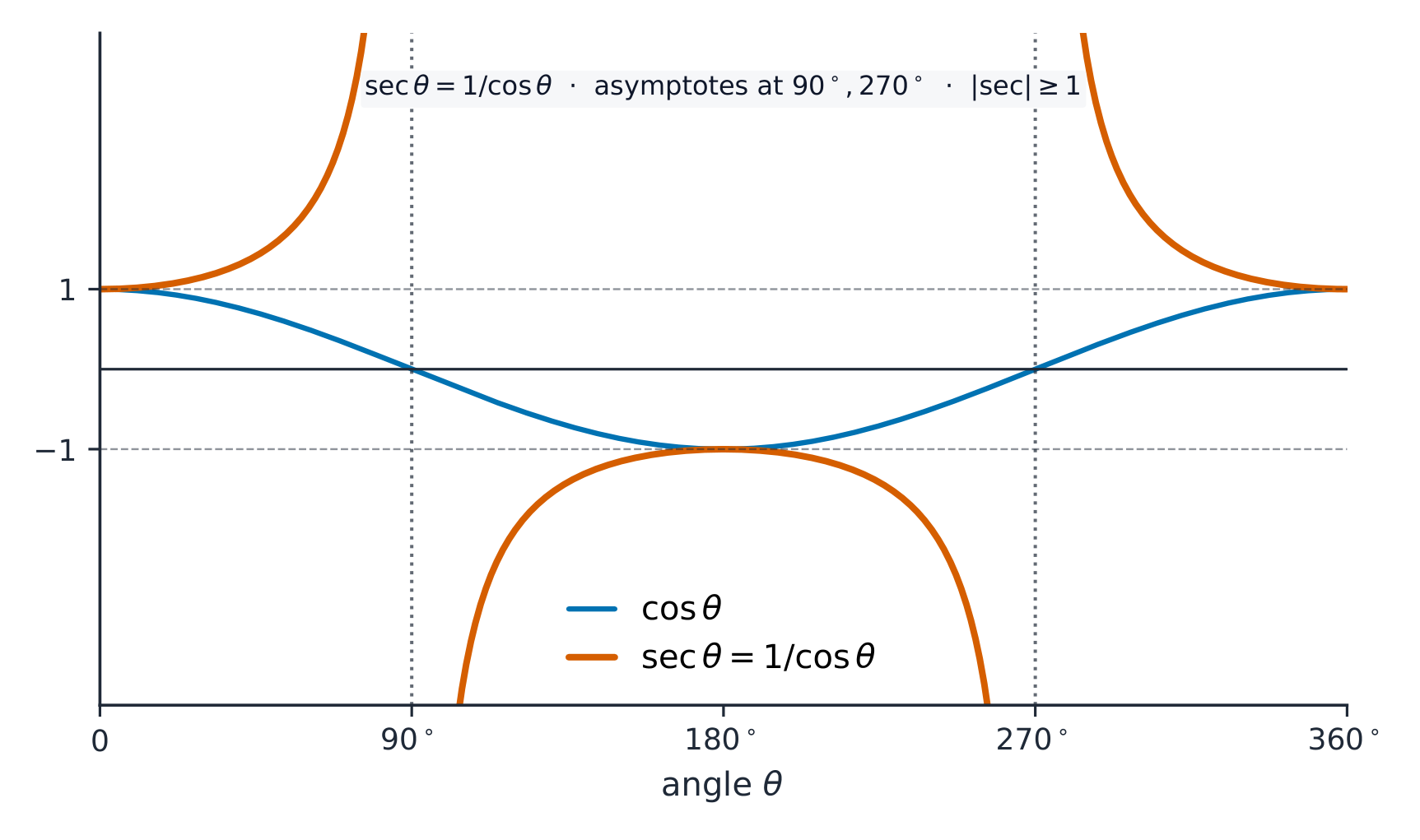
There are three more functions, each the reciprocal of one you know: the secant 正割$\sec\theta = \dfrac{1}{\cos\theta}$, the cosecant 余割$\csc\theta = \dfrac{1}{\sin\theta}$, and the cotangent 余切$\cot\theta = \dfrac{1}{\tan\theta}$.
You must know these trigonometric identities 三角恒等式 and choose the right one for each problem:
So $\sec\theta = \tfrac52$ or $\sec\theta = -4$, giving $\cos\theta = \tfrac25$ or $\cos\theta = -\tfrac14$. The solutions are $\theta = \pm 66.4^\circ$ and $\theta = \pm 104.5^\circ$.
עברית
ישנן עוד שלוש פונקציות, כל אחת מהן ההפוך של אחת שאתם מכירים: סקאנט$\sec\theta = \dfrac{1}{\cos\theta}$, קוסקאנט$\csc\theta = \dfrac{1}{\sin\theta}$, וקוטנג'נט$\cot\theta = \dfrac{1}{\tan\theta}$.
$\sec\theta=1/\cos\theta$ עולה לעומס בכל מקום שבו $\cos\theta=0$.
חובה לדעת זהויות טריגונומטריות אלו לבחור את הנכונה לכל בעיה:
לכן $\sec\theta = \tfrac52$ או $\sec\theta = -4$, מה שמוביל ל-$\cos\theta = \tfrac25$ או $\cos\theta = -\tfrac14$. הפתרונות הם $\theta = \pm 66.4^\circ$ ו$\theta = \pm 104.5^\circ$.
Explore · חקור
The unit circle · המעגל היחידתי
Drag the angle to see how $\sin$, $\cos$ and $\tan$ relate — the key to solving trig equations. · גרור את הזווית כדי לראות כיצד $\sin$, $\cos$ ו-$\tan$ קשורים זה לזה — המפתח לפתרון משוואות טריגונומטריות.
למצוא ולהשתמש בגזירה הראשונה של פונקציה המוגדרת פרמטרית או איplcitly.
לדוגמה: $x = t - e^{2t}$, $y = t + e^{2t}$. לדוגמה: $x^2 + y^2 = xy + 7$. כולל שימוש בבעיות הקשורות למשיקים ונירמלים.
Source: Cambridge International syllabus · מקור: הסיילבוס הבינלאומי של קמבריד'ג'
English
Learn these standard derivatives:
$$\frac{d}{dx}e^x = e^x, \quad \frac{d}{dx}\ln x = \frac{1}{x}, \quad \frac{d}{dx}\sin x = \cos x, \quad \frac{d}{dx}\cos x = -\sin x, \quad \frac{d}{dx}\tan x = \sec^2 x.$$
For a product or a quotient of two functions, use:
the product rule 乘积法则: $(uv)' = u'v + uv'$;
the quotient rule 商法则: $\left(\dfrac{u}{v}\right)' = \dfrac{u'v - uv'}{v^2}$.
When a curve is given by parametric equations 参数方程$x = x(t)$, $y = y(t)$, the gradient is $\dfrac{dy}{dx} = \dfrac{dy/dt}{dx/dt}$. When $y$ is defined implicitly 隐式 (not made the subject), differentiate every term with respect to $x$, using the chain rule on the $y$ terms, then solve for $\dfrac{dy}{dx}$.
Worked example. Given $y = 6x\cos(x^2 + 1)$, find $\dfrac{dy}{dx}$.
Use the product rule with $u = 6x$ and $v = \cos(x^2 + 1)$ (and the chain rule for $v$):
$$\frac{d}{dx}e^x = e^x, \quad \frac{d}{dx}\ln x = \frac{1}{x}, \quad \frac{d}{dx}\sin x = \cos x, \quad \frac{d}{dx}\cos x = -\sin x, \quad \frac{d}{dx}\tan x = \sec^2 x.$$
למכפלה או למנה של שתי פונקציות, השתמשו ב:
כלל המכפלה: $(uv)' = u'v + uv'$;
כלל המנה: $\left(\dfrac{u}{v}\right)' = \dfrac{u'v - uv'}{v^2}$.
כאשר עקומה נתונה על ידי משוואות פרמטריות$x = x(t)$, $y = y(t)$, השיפוע הוא $\dfrac{dy}{dx} = \dfrac{dy/dt}{dx/dt}$. כאשר $y$ מוגדר אינסופית (לא הוצג כנושא), גזרו כל איבר לפי $x$, תוך שימוש בכלל השרשרת באיברים $y$, ולאחר מכן פתרו עבור $\dfrac{dy}{dx}$.
דוגמה מפורטת. נתון $y = 6x\cos(x^2 + 1)$, מצאו $\dfrac{dy}{dx}$.
השתמשו בכלל המכפלה עם $u = 6x$ ו$v = \cos(x^2 + 1)$ (וגם בכלל השרשרת עבור $v$):
Move the point: the tangent line is the derivative at that x. Where the curve turns, the gradient is zero. · הזז את הנקודה: המשיק הוא הנגזרת בנקודה זו ב-x. במקום שבו העקומה משנה כיוון, השיפוע הוא אפס.
2.5
Integration · אינטגרציה
Syllabus · סיילבוס
English
Candidates should be able to:
Notes and examples
• extend the idea of ‘reverse differentiation’ to include the integration of $e^{ax + b}$, $\frac{1}{ax + b}$, $\sin(ax + b)$, $\cos(ax + b)$ and $\sec^2(ax + b)$
Knowledge of the general method of integration by substitution is not required.
• use trigonometrical relationships in carrying out integration
e.g. use of double-angle formulae to integrate $\sin^2 x$ or $\cos^2(2x)$.
• understand and use the trapezium rule to estimate the value of a definite integral.
Including use of sketch graphs in simple cases to determine whether the trapezium rule gives an over-estimate or an under-estimate.
עברית
המועמדים אמורים להיות מסוגלים:
הערות לדוגמאות
• להרחיב את הרעיון של 'גזירה הפוכה' כדי לכלול את האינטגרציה של $e^{ax + b}$, $\frac{1}{ax + b}$, $\sin(ax + b)$, $\cos(ax + b)$ ו$\sec^2(ax + b)$
ידע בשיטה הכללית של אינטגרציה בהצבה אינו נדרש.
• להשתמש בקשרים טריגונומטריים בביצוע אינטגרציה
לדוגמה: שימוש בנוסחת זווית כפולה כדי לאינטגרל $\sin^2 x$ או $\cos^2(2x)$.
• להבין ולהשתמש בכלל הטרפז כדי להעריך את ערך אינטגרל מסוים.
כולל שימוש בגרפי סקיצה במקרים פשוטים כדי לקבוע האם כלל הטרפז נותן הערכת יתר או הערכת חסר.
Source: Cambridge International syllabus · מקור: הסיילבוס הבינלאומי של קמבריד'ג'
English
Integration is reverse differentiation — reverse each new derivative; harder integrals may need integration by substitution 换元积分 (developed in Pure 3). For a linear inside function $(ax + b)$:
To integrate a power of $\sin$ or $\cos$, first use an identity to remove the power. When you cannot integrate exactly, the trapezium rule 梯形法则 estimates a definite integral:
אינטגרציה היא נגזירה הפוכה — הפכו כל נגזרה חדשה; אינטגרציות קשות יותר עשויות לדורש אינטגרציה בהצבה (פותחת ב-Pure 3). עבור פונקציה ליניארית בתוך הפונקציה $(ax + b)$:
כדי לבצע אינטגרציה של חזקה של $\sin$ או $\cos$, השתמשו תחילה במזהות כדי להסיר את החזקה. כאשר אין אפשרות לבצע אינטגרציה מדויקת, כלל הטרפז מעריך אינטגרל מוגדר:
The integral still measures area — drag a and b to total the strip under the curve. · האינטגרל עדין מודד שטח — גרור את a ו-b כדי לחשב את סך הרצועה מתחת לעקומה.
Numerical solution of equations · פתרון מספרי של משוואות
Syllabus · סיילבוס
English
Candidates should be able to:
Notes and examples
• locate approximately a root of an equation, by means of graphical considerations and/or searching for a sign change
e.g. finding a pair of consecutive integers between which a root lies.
• understand the idea of, and use the notation for, a sequence of approximations which converges to a root of an equation
• understand how a given simple iterative formula of the form $x_{n + 1} = \text{F}(x_n)$ relates to the equation being solved, and use a given iteration, or an iteration based on a given rearrangement of an equation, to determine a root to a prescribed degree of accuracy.
Knowledge of the condition for convergence is not included, but an understanding that an iteration may fail to converge is expected.
עברית
המועמדים אמורים להיות מסוגלים:
הערות לדוגמאות
• למקם בקירוב שורש של משוואה, באמצעות considerations גרפיים וב/או חיפוש אחר שינוי סימן
לדוגמה: מציאת זוג של מספרים שלמים רצופים שביניהם נמצא שורש.
• להבין את הרעיון ולשתמש בסימון עבור סדרה של קירובים הנכנסים לשורש של משוואה
• הבנת הקשר בין נוסחת איטרציה פשוטה נתונה מהצורה $x_{n + 1} = \text{F}(x_n)$ למשוואה הנפתרת, ושימוש באיטרציה נתונה או איטרציה המבוססת על סידור מחדש נתון של משוואה כדי לקבוע שורש ברמת דיוק נקובה.
אינו כלול ידע בתנאי התכנסות, אך מצופה הבנה שאיטרציה עשויה להכשל ולהתכנס.
Source: Cambridge International syllabus · מקור: הסיילבוס הבינלאומי של קמבריד'ג'
English
Iterating to a root: ride the tangent
Many equations cannot be solved exactly. Two ideas help you find a root 根 (a solution).
Sign change 变号: if $f(a)$ and $f(b)$ have opposite signs (and the graph has no break between them), a root lies between $a$ and $b$.
Iteration 迭代: rearrange the equation into the form $x = F(x)$, then use the iterative formula 迭代公式$x_{n+1} = F(x_n)$. Start from a first guess $x_0$ and repeat. If the values are convergent they settle down and converge 收敛 to a root. Keep going until the answer is steady to the accuracy asked for.
Worked example. A root $\beta$ of an equation satisfies $x = \sqrt[3]{-2x - 4.5}$, and $-1.4 < \beta < -1.0$. Use the iteration $x_{n+1} = \sqrt[3]{-2x_n - 4.5}$ with $x_0 = -1.2$.
The values settle near $-1.26$, so $\beta = -1.26$ (3 s.f.).
עברית
חיזור לשורש: רכיבה על המשיק
מספר משוואות אינן ניתנות לפתרון מדויק. שתי רעיונות עוזרים לך למצוא שורש (פתרון).
שינוי סימן: אם $f(a)$ ו-$f(b)$ הם בעלי סימנים הפוכים (ועד הגרף אינו נשבר ביניהם), שורש נמצא בין $a$ ל-$b$.
איטרציה: סדר מחדש את המשוואה לצורה $x = F(x)$, ולאחר מכן השתמש ב-נוסחת האיטרציה$x_{n+1} = F(x_n)$. התחל מערך ראשוני $x_0$ וחזור על הפעולה. אם הערכים הם מתכנסים, הם יתייצבו ו-יתכנסו לשורש. המשך לעבוד עד שהתשובה תתייצב ברמת הדיוק הנדרשת.
$f(a)$ ו-$f(b)$ הם בעלי סימנים הפוכים, ולכן שורש נתפס בין $a$ ל-$b$.כל צעד עולה ל-$y=F(x)$ ואז חוצה ל-$y=x$; מערכת המדרגות מתקרבת לשורש.
דוגמה פתורה. שורש $\beta$ של משוואה מקיים $x = \sqrt[3]{-2x - 4.5}$, ועבור $-1.4 < \beta < -1.0$. השתמש באיטרציה $x_{n+1} = \sqrt[3]{-2x_n - 4.5}$ עם $x_0 = -1.2$.
הערכים מתייצבים סביב $-1.26$, ולכן $\beta = -1.26$ (3 ספרות משמעותיות).
Explore · חקור
Where is the root? · איפה שורש המשוואה?
y = ax³ + bx² + cx + d
A root is where the curve crosses zero. A sign change in f(x) traps a root between two x-values. · שורש הוא הנקודה בה הגרף חוצה אפס. שינוי סימן ב-f(x) לוכד שורש בין שני ערכי x.
Pick one and the site follows you — notes, papers, videos and practice all open on it. · בחרו נושא אחד והאתר יעקוב אחריו — הערות, מסמכים, וידאו ותרגולים פתוחים בו.
Type to search notes, lessons, code, vocabulary and past-paper questions across every subject. · הקלד כדי לחפש הערות, שיעורים, קוד, אוצר מילים ושאלות מבחנים בכל הנושאים.