This handout covers Topic 1: Pure Mathematics 纯数学 1. It is the algebra 代数 and calculus 微积分 core of the course. Each ## section is one syllabus subtopic.
Tips · טיפים
מתמטיקה A-Level (9709) בנויה מרכיבים, לא מלמדת כבלוק אחד: מתמטיקה נקייה 1, 2 ו-3, מכניקה, והסתברות וסטטיסטיקה 1 ו-2. מה שתבצע תלוי בכניסה של בית הספר שלך — בדוק זאת לפני שתתכנן תכנית לימודים. אין טעם להתעמל במכניקה אם נרשמת לסטטיסטיקה.
המתמטיקה הנקייה היא הגב. הכל其余 מניח שאתה יכול לבצע נגזרות, אינטגרציה ולטפל באלגברה ללא חשיבה. חולשה שם תתבטא באובדן נקודות במכניקה ובסטטיסטיקה, ולא במתמטיקה נקייה.
נקודות שיטה נדיבות, והן מוענקות על מה שכתבת. הצגת כל שורה היא ההרגל עם הת return הגבוה ביותר בנושא זה.
-
1
Pure Mathematics 1 · מתמטיקה נקודתית 1
Watch lesson · צפה בשיעור1.1
Quadratics

Syllabus · סיילבוס
EnglishCandidates should be able to: Notes and examples carry out the process of completing the square for a quadratic polynomial $ax^2 + bx + c$ and use a completed square form e.g. to locate the vertex of the graph of $y = ax^2 + bx + c$ or to sketch the graph find the discriminant of a quadratic polynomial $ax^2 + bx + c$ and use the discriminant e.g. to determine the number of real roots of the equation $ax^2 + bx + c = 0$. Knowledge of the term ‘repeated root’ is included. solve quadratic equations, and quadratic inequalities, in one unknown By factorising, completing the square and using the formula. solve by substitution a pair of simultaneous equations of which one is linear and one is quadratic e.g. $x + y + 1 = 0$ and $x^2 + y^2 = 25$, $2x + 3y = 7$ and $3x^2 = 4 + 4xy$. recognise and solve equations in $x$ which are quadratic in some function of $x$. e.g. $x^4 - 5x^2 + 4 = 0$, $6x + \sqrt{x} - 1 = 0$, $\tan^2 x = 1 + \tan x$. עבריתהמועמדים אמורים להיות מסוגלים: הערות לדוגמאות ביצוע תהליך השלמה לריבוע עבור פולינום ריבועי $ax^2 + bx + c$ ושימוש בצורת ריבוע מושלמת לדוגמה: כדי למצוא את הקודקוד של גרף $y = ax^2 + bx + c$ או לערוך גרף. מציאת הדיסקרימיננטה של פולינום ריבועי $ax^2 + bx + c$ ושימוש בדיסקרימיננטה לדוגמה: כדי לקבוע את מספר השורשים הממשיים של המשוואה $ax^2 + bx + c = 0$. ידע במונח "שורש כפול" כלול. פתרון משוואות ריבועיות ואי-שוויונות ריבועיים במשתנה אחד על ידי פירוק לגורמים, השלמה לריבוע ושימוש בנוסחה. פתרון באמצעות הצבה של מערכת משוואות בו-זמניות שבהן אחת היא ליניארית ואחת ריבועית לדוגמה: $x + y + 1 = 0$ ו$x^2 + y^2 = 25$, $2x + 3y = 7$ ו$3x^2 = 4 + 4xy$. זיהוי ופתרון משוואות ב$x$ שהן ריבועיות בפונקציה כלשהי של $x$. לדוגמה: $x^4 - 5x^2 + 4 = 0$, $6x + \sqrt{x} - 1 = 0$, $\tan^2 x = 1 + \tan x$. Source: Cambridge International syllabus · מקור: הסיילבוס הבינלאומי של קמבריד'ג'
Completing the square finds the vertex A suspension bridge: the main cable hangs in a parabola. A quadratic 二次式 is an expression of the form $ax^2 + bx + c$, where $a \neq 0$. The letters $a$, $b$, $c$ are the coefficients 系数 (the fixed numbers). Much of this section is about solving the equation $ax^2 + bx + c = 0$.
Completing the square
To complete the square 配方 means to write the quadratic in the form
$$a(x + p)^2 + q.$$This form is useful: it shows the vertex 顶点 (turning point) of the curve at $(-p,\ q)$, and it gives a quick way to solve the equation.Worked example. Write $9x^2 - 36x + 8$ in the form $p(x + q)^2 + r$.
Take the factor $9$ out of the first two terms, then complete the square inside:
$$\begin{aligned} 9x^2 - 36x + 8 &= 9\left(x^2 - 4x\right) + 8 \\ &= 9\left((x - 2)^2 - 4\right) + 8 \\ &= 9(x - 2)^2 - 36 + 8 = 9(x - 2)^2 - 28. \end{aligned}$$So $p = 9$, $q = -2$, $r = -28$.
The completed square hands you the vertex: least value -28 at x equals 2 The discriminant
The discriminant 判别式 of $ax^2 + bx + c$ is
$$\Delta = b^2 - 4ac.$$It tells you how many real roots 实根 (real solutions) the equation $ax^2 + bx + c = 0$ has:Discriminant Roots $b^2 - 4ac > 0$ two distinct 相异 real roots $b^2 - 4ac = 0$ one repeated real root $b^2 - 4ac < 0$ no real roots 
The sign of $b^2-4ac$ decides how many times the parabola meets the $x$-axis. Worked example. Find the values of the constant $k$ for which $3kx^2 + (k + 8)x + 3 = 0$ has two distinct real roots.
Here $a = 3k$, $b = k + 8$, $c = 3$. For two distinct real roots you need $b^2 - 4ac > 0$:
$$(k + 8)^2 - 4(3k)(3) > 0 \;\Rightarrow\; k^2 + 16k + 64 - 36k > 0 \;\Rightarrow\; k^2 - 20k + 64 > 0.$$Factorise: $(k - 4)(k - 16) > 0$, so $k < 4$ or $k > 16$. You also need $a \neq 0$, so $k \neq 0$.Quadratic equations and inequalities
To solve a quadratic equation 二次方程, factorise, complete the square, or use the formula
$$x = \frac{-b \pm \sqrt{b^2 - 4ac}}{2a}.$$To solve a quadratic inequality 二次不等式 such as $(k - 4)(k - 16) > 0$, find the two roots, then decide which side of each root makes the statement true. A sketch of the parabola 抛物线 helps: the curve is above the $x$-axis (positive) outside the roots and below it (negative) between them.Simultaneous equations
To solve a pair of simultaneous equations 联立方程 where one is linear and one is quadratic, use substitution 代入: rearrange the linear equation for one letter, then put that into the quadratic. This gives a single quadratic to solve.
Equations that are quadratic in disguise
Some equations are quadratic in some function of $x$. For example $x^4 - 5x^2 + 4 = 0$ is quadratic in $x^2$: let $u = x^2$, solve $u^2 - 5u + 4 = 0$, then go back to $x$. You will use this idea again in trigonometry.
Explore · חקורThe shape of a quadratic · הצורה של פונקציה ריבועית
y = ax² + bx + c
Drag a, b and c. Watch the vertex, the line of symmetry and the roots (where it cuts the x-axis) move as the coefficients change. · גררו את a, b ו-c. צפו ב-קודקוד, בקו הסימטריה וב-שורשים (הנקודות שבהן העקומה חותכת את ציר x) זזים כאשר המקדמים משתנים.
Vocabulary · מילון מונחים Train · אימוןEnglish עברית Pure Mathematics/pjʊə ˌmæθɪˈmætɪks/ מתמטיקה טהורה quadratic/kwɒˈdrætɪk/ ריבועי complete the square/kəmˈpliːt ðə skweə/ השלמה לריבוע מלא vertex/ˈvɜːteks/ קודקוד discriminant/dɪˈskrɪmɪnənt/ דיסקרימיננטה real roots/rɪəl ruːts/ שורשים ממשיים distinct/dɪˈstɪŋkt/ נפרדים quadratic equation/kwɒˈdrætɪk ɪˈkweɪʒn/ משוואה ריבועית quadratic inequality/kwɒˈdrætɪk ɪniːˈkwɒlɪti/ אי-שוויון ריבועי simultaneous equations/ˌsɪməlˈteɪnɪəs ɪˈkweɪʒnz/ משוואות בשני נעלמים substitution/ˌsʌbstɪˈtjuːʃn/ החלפה coefficient/ˌkəʊɪˈfɪʃənt/ מקדם parabola/pəˈræbələ/ פרבולה 1.2
Functions
Syllabus · סיילבוס
EnglishCandidates should be able to: Notes and examples understand the terms function, domain, range, one-one function, inverse function and composition of functions identify the range of a given function in simple cases, and find the composition of two given functions e.g. range of $f : x \mapsto \frac{1}{x}$ for $x \geqslant 1$ and range of $g : x \mapsto x^2 + 1$ for $x \in \mathbb{R}$. Including the condition that a composite function $gf$ can only be formed when the range of $f$ is within the domain of $g$. determine whether or not a given function is one-one, and find the inverse of a one-one function in simple cases e.g. finding the inverse of $h : x \mapsto (2x + 3)^2 - 4$ for $x < -\frac{3}{2}$. illustrate in graphical terms the relation between a one-one function and its inverse Sketches should include an indication of the mirror line $y = x$. understand and use the transformations of the graph of $y = f(x)$ given by $y = f(x) + a$, $y = f(x + a)$, $y = af(x)$, $y = f(ax)$ and simple combinations of these. Including use of the terms ‘translation’, ‘reflection’ and ‘stretch’ in describing transformations. Questions may involve algebraic or trigonometric functions, or other graphs with given features. עבריתהמועמדים אמורים להיות מסוגלים: הערות לדוגמאות להבין את המונחים פונקציה, תחום הגדרה, טווח ערכים, פונקציה חד-חד-ערכית, פונקציית הפוך ו-הרכבת פונקציות לזהות את הטווח הערכים של פונקציה נתונה במקרים פשוטים, ולמצוא את ההרכבה של שתי פונקציות נתונות לדוגמה: טווח הערכים של $f : x \mapsto \frac{1}{x}$ עבור $x \geqslant 1$ וטווח הערכים של $g : x \mapsto x^2 + 1$ עבור $x \in \mathbb{R}$. כולל התנאי לפיו פונקציית הרכבה $gf$ יכולה להיות מוגדרת רק כאשר טווח הערכים של $f$ נכלל בתחום ההגדרה של $g$. לקבוע האם פונקציה נתונה היא חד-חד-ערכית, ולמצוא את הפונקציית ההפוך שלה במקרים פשוטים לדוגמה: מציאת הפוך של $h : x \mapsto (2x + 3)^2 - 4$ עבור $x < -\frac{3}{2}$. להמחיש במובן גרפי את הקשר בין פונקציה חד-חד-ערכית לבין הפונקצייה ההפוך שלה יש לכלול בפסקאות גרף רמז על קו ההשתקפות $y = x$. להבין ולהשתמש בהמרות של הגרף של $y = f(x)$ הנגזרות מ$y = f(x) + a$, $y = f(x + a)$, $y = af(x)$, $y = f(ax)$ ומשילובים פשוטים של אלו. כולל שימוש במונחים 'הזחה', 'השתקפות' ו'מתיחה' בתיאור המרות. ייתכנו שאלות הכוללות פונקציות אלגבריות או טריגונומטריות, או גרפים אחרים עם מאפיינים נתונים. Source: Cambridge International syllabus · מקור: הסיילבוס הבינלאומי של קמבריד'ג'
Transforming graphs: shift and stretch A function 函数 is a rule that sends each input to exactly one output. Write it as $f(x)$. The composition of functions 复合函数 $fg(x)$ means apply $g$ first, then apply $f$ to the result.
- The domain 定义域 is the set of allowed inputs $x$.
- The range 值域 is the set of outputs the function actually produces.
A function is one-one 一一对应 if different inputs always give different outputs. (No output is repeated.) Only a one-one function has an inverse function 反函数 $f^{-1}$, which reverses the rule.
The composition 复合 of two functions means doing one after the other. $fg(x)$ means "do $g$ first, then $f$": $fg(x) = f(g(x))$. The composite function $fg$ exists only when the range of $g$ lies inside the domain of $f$.
Finding an inverse
To find $f^{-1}$: write $y = f(x)$, make $x$ the subject, then swap letters.
Worked example. The function $f(x) = (x + 3)^2 - 12$ is defined for $x \geqslant 0$. Find $f^{-1}(x)$.
Write $y = (x + 3)^2 - 12$ and solve for $x$:
$$(x + 3)^2 = y + 12 \;\Rightarrow\; x + 3 = \sqrt{y + 12} \;\Rightarrow\; x = \sqrt{y + 12} - 3.$$You take the positive square root because $x \geqslant 0$ means $x + 3 \geqslant 3 > 0$. So$$f^{-1}(x) = \sqrt{x + 12} - 3.$$Graphs of inverses and transformations
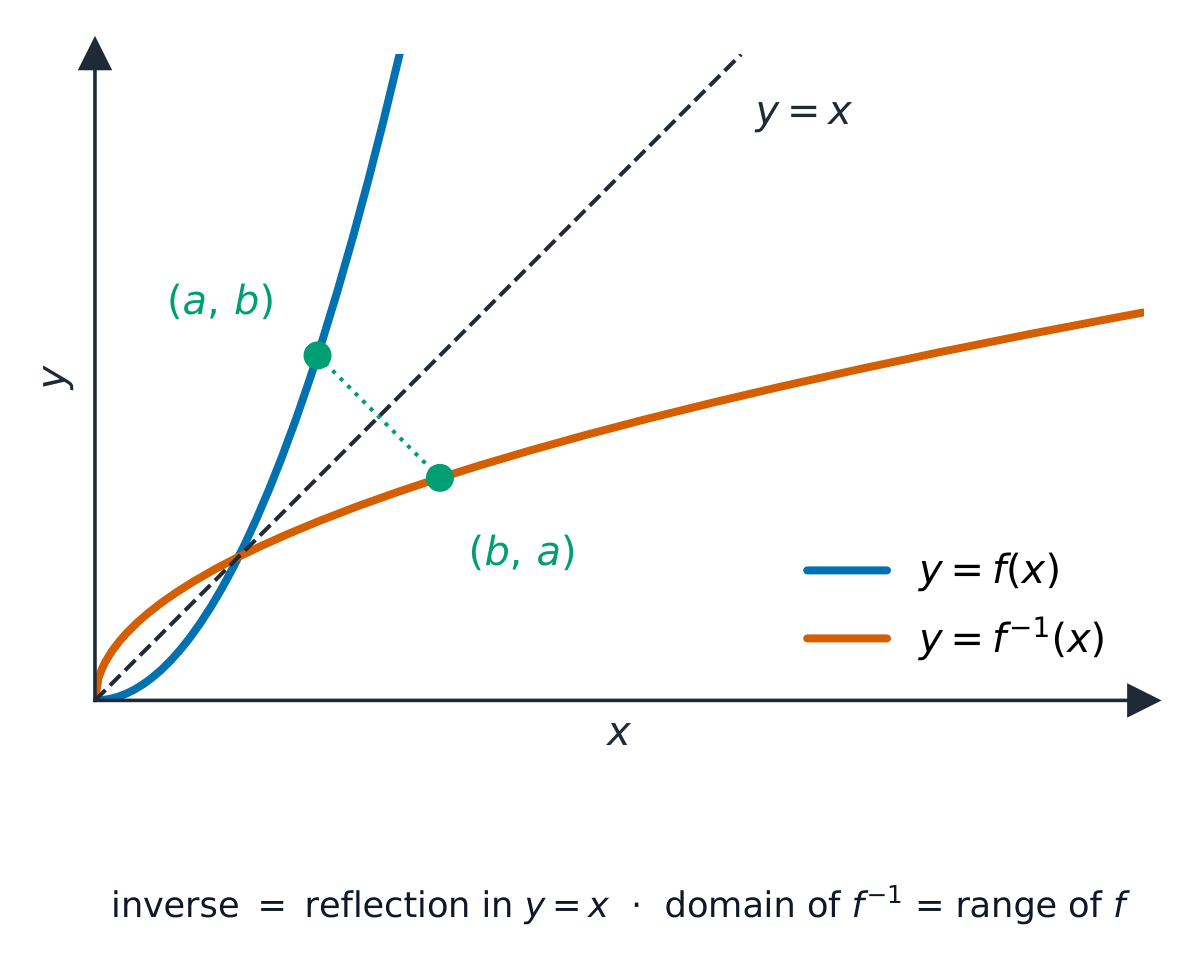
The graph of $y = f^{-1}(x)$ is the reflection 反射 of $y = f(x)$ in the line $y = x$.
Reflecting $y=f(x)$ in the line $y=x$ gives its inverse; a point $(a,b)$ becomes $(b,a)$. You should know these transformations 变换 of $y = f(x)$:
New equation Effect on the graph $y = f(x) + a$ translation 平移 up by $a$ $y = f(x + a)$ translation left by $a$ $y = a\,f(x)$ stretch 伸缩 in the $y$-direction, scale factor $a$ $y = f(ax)$ stretch in the $x$-direction, scale factor $\tfrac{1}{a}$ When two transformations are combined, the order can matter. State each one fully (type, direction, and amount).

Adding to the output or input slides the curve; a multiplier stretches it. Explore · חקורExplore a function · חקור פונקציה
y = ax³ + bx² + cx + d
A function turns each input into exactly one output — drag the coefficients and watch where the curve rises and falls. · פונקציה מייצרת כל קלט בדיוק לתפוקה אחת — גרור את המקדמים וצפה היכן העקומה עולה ויורדת.
Vocabulary · מילון מונחים Train · אימוןEnglish עברית function/ˈfʌŋkʃn/ פונקציה composition of functions/ˌkɒmpəˈzɪʃn ɒv ˈfʌŋkʃnz/ הרכבת פונקציות domain/dəˈmeɪn/ תחום range/reɪndʒ/ טווח one-one/wʌn wʌn/ חד-ל-אחד inverse function/ɪnˈvɜːs ˈfʌŋkʃn/ פונקציה הפוכה composition/ˌkɒmpəˈzɪʃn/ הרכבה reflection/rɪˈflekʃn/ השתקפות transformations/trænsfɔːˈmeɪʃnz/ שפירות translation/trænˈsleɪʃn/ טרנסלציה stretch/stretʃ/ מתיחה 1.3
Coordinate geometry

Syllabus · סיילבוס
EnglishCandidates should be able to: Notes and examples find the equation of a straight line given sufficient information e.g. given two points, or one point and the gradient. interpret and use any of the forms $y = mx + c$, $y - y_1 = m(x - x_1)$, $ax + by + c = 0$ in solving problems Including calculations of distances, gradients, midpoints, points of intersection and use of the relationship between the gradients of parallel and perpendicular lines. understand that the equation $(x - a)^2 + (y - b)^2 = r^2$ represents the circle with centre $(a, b)$ and radius $r$ Including use of the expanded form $x^2 + y^2 + 2gx + 2fy + c = 0$. use algebraic methods to solve problems involving lines and circles Including use of elementary geometrical properties of circles, e.g. tangent perpendicular to radius, angle in a semicircle, symmetry. Implicit differentiation is not included. understand the relationship between a graph and its associated algebraic equation, and use the relationship between points of intersection of graphs and solutions of equations. e.g. to determine the set of values of $k$ for which the line $y = x + k$ intersects, touches or does not meet a quadratic curve. עבריתהמועמדים אמורים להיות מסוגלים: הערות לדוגמאות למצוא את משוואת הישר הנתון מספיק מידע לדוגמה: בהינתן שני נקודות, או נקודה אחת והשיפוע. לפרש ולהשתמש בכל אחד מהצורות $y = mx + c$, $y - y_1 = m(x - x_1)$, $ax + by + c = 0$ בפתרון בעיות כולל חישובים של מרחקים, שיפועים, נקודות אמצע, נקודות חיתוך והשתמש בקשר בין השיפועים של ישרים מקבילים ואנכיים. להבין שמשוואה $(x - a)^2 + (y - b)^2 = r^2$ מייצגת את העיגול שמוקדו $(a, b)$ ורדיוסו $r$ כולל שימוש בצורה המורחבת $x^2 + y^2 + 2gx + 2fy + c = 0$. להשתמש בשיטות אלגבריות לפתרון בעיות המעורבות ישרים ועיגולים כולל שימוש במאפיינים גיאומטריים בסיסיים של עיגולים, לדוגמה: משיק אנכי לרדיוס, זווית בתוך חצי עיגול, סימטריה. גזירה סתומה אינה כלולה. להבין את הקשר בין גרף למשוואה האלגברית המקושרת לו, ולהשתמש בקשר בין נקודות החיתוך של גרפים לפתרונות משוואות. לדוגמה: כדי לקבוע את קבוצת הערכים של $k$ עבורה הישר $y = x + k$ חותך, נוגע או אינו נוגע לעקומה ריבועית. Source: Cambridge International syllabus · מקור: הסיילבוס הבינלאומי של קמבריד'ג'
Coordinate geometry 坐标几何 studies lines and circles using their equations.
Straight lines
The gradient 斜率 (steepness) of the line joining $(x_1, y_1)$ and $(x_2, y_2)$ is
$$m = \frac{y_2 - y_1}{x_2 - x_1}.$$You can write the equation of a straight line 直线方程 in any of these forms:$$y = mx + c, \qquad y - y_1 = m(x - x_1), \qquad ax + by + c = 0.$$Two lines are parallel 平行 when their gradients are equal, and perpendicular 垂直 (at right angles) when the product of their gradients is $-1$.Circles
The circle 圆 with centre 圆心 $(a, b)$ and radius 半径 $r$ has equation
$$(x - a)^2 + (y - b)^2 = r^2.$$An expanded form like $x^2 + y^2 - 6x + 10y - 27 = 0$ is the same circle: complete the square in $x$ and in $y$ to find the centre and radius.A tangent 切线 to a circle touches it at one point and is perpendicular to the radius at that point. This right-angle fact solves most circle problems.
A tangent touches the circle once and meets the radius at a right angle. Worked example. The points $P(1, 1)$ and $Q(7, 11)$ are the ends of a diameter 直径 of a circle. Find the equation of the circle.
The centre is the midpoint of $PQ$:
$$\left(\frac{1 + 7}{2},\ \frac{1 + 11}{2}\right) = (4, 6).$$The radius is half the length of $PQ$:$$r = \tfrac12\sqrt{(7 - 1)^2 + (11 - 1)^2} = \tfrac12\sqrt{36 + 100} = \tfrac12\sqrt{136} = \sqrt{34}.$$So the circle is $(x - 4)^2 + (y - 6)^2 = 34$.Explore · חקורThe straight line · הקו הישר
y = ax + b
The gradient a tilts the line; the intercept b slides it up and down. · השיפוע a גורם לקו להטיה; המסך b מזיז אותו למעלה ולמטה.
Vocabulary · מילון מונחים Train · אימוןEnglish עברית Coordinate geometry/kəʊˈɔːdɪnət dʒiˈɒmətri/ גיאומטריה אנליטית gradient/ˈɡreɪdɪənt/ שיפוע equation of a straight line/ɪˈkweɪʒn əvə streɪt laɪn/ משוואת ישר parallel/ˈpærəlel/ מקביל perpendicular/ˌpɜːpənˈdɪkjʊlə/ ניצב circle/ˈsɜːkl/ מעגל centre/ˈsentə/ מרכז radius/ˈreɪdɪəs/ רדיוס tangent/ˈtændʒənt/ טנגנס diameter/daɪˈæmɪtə/ קוטר 1.4
Circular measure

Syllabus · סיילבוס
EnglishCandidates should be able to: Notes and examples understand the definition of a radian, and use the relationship between radians and degrees use the formulae $s = r\theta$ and $A = \frac{1}{2}r^2\theta$ in solving problems concerning the arc length and sector area of a circle. Including calculation of lengths and angles in triangles and areas of triangles. עבריתהמועמדים אמורים להיות מסוגלים: הערות לדוגמאות להבין את ההגדרה של רדיאן, ולהשתמש בקשר בין רדיאנים למעלות להשתמש בנוסחאות $s = r\theta$ ו$A = \frac{1}{2}r^2\theta$ בפתרון בעיות הקשורות לאורך קשת ושטח מסלה של עיגול. כולל חישוב אורכים וזוויות במثلשים ושטחים של משולשים. Source: Cambridge International syllabus · מקור: הסיילבוס הבינלאומי של קמבריד'ג'
What is a radian? Radians
A radian 弧度 is another way to measure angles. One radian is the angle at the centre of a circle that cuts off an arc 弧 equal in length to the radius. The link between radians and degrees 度 is
$$\pi \text{ radians} = 180^\circ.$$So to change degrees to radians, multiply by $\dfrac{\pi}{180}$; to change radians to degrees, multiply by $\dfrac{180}{\pi}$.One radian: the angle whose arc equals the radius Arc length and sector area
For a sector 扇形 with radius $r$ and angle $\theta$ in radians:
$$\text{arc length} = s = r\theta, \qquad \text{sector area} = A = \tfrac12 r^2 \theta.$$A chord 弦 cuts the sector into a triangle and a segment 弓形. The segment area is the sector minus the triangle:$$\text{segment} = \tfrac12 r^2 \theta - \tfrac12 r^2 \sin\theta = \tfrac12 r^2(\theta - \sin\theta).$$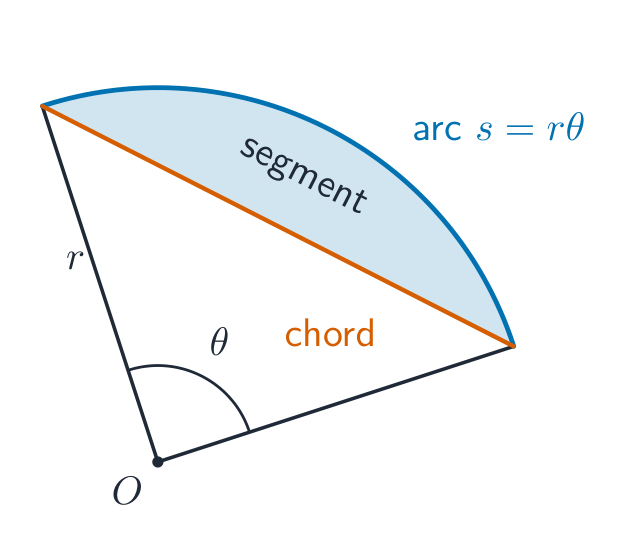
The shaded segment is the part of the sector between the chord and the arc. Worked example. A sector has centre $O$ and the angle at $O$ is $\tfrac{2}{3}\pi$ radians. Show that the segment cut off by the chord has area about $0.614 r^2$.
$$\text{segment} = \tfrac12 r^2\left(\tfrac{2}{3}\pi - \sin\tfrac{2}{3}\pi\right) = \tfrac12 r^2(2.0944 - 0.8660) = \tfrac12 r^2(1.2284) \approx 0.614 r^2.$$Explore · חקורRadians, arcs and sectors · רדיאנים, קשתות וסקטורים
Change the angle (in radians) and radius. See the arc length $s = r\theta$ and the sector area $\tfrac12 r^2\theta$ update. · שנה את הזווית (ברדיאנים) ואת הרדיוס. ראה איך אורך הקשת $s = r\theta$ ו-שטח המס扇ה $\tfrac12 r^2\theta$ מתעדכנים.
Vocabulary · מילון מונחים Train · אימוןEnglish עברית radian/ˈreɪdɪən/ רדיאן arc/ɑːk/ קשת degrees/dɪˈɡriːz/ מעלות sector/ˈsektə/ תחום chord/kɔːd/ מיתר segment/ˈseɡmənt/ מחלקת שוק 1.5
Trigonometry

Syllabus · סיילבוס
EnglishCandidates should be able to: Notes and examples sketch and use graphs of the sine, cosine and tangent functions (for angles of any size, and using either degrees or radians) Including e.g. $y = 3 \sin x$, $y = 1 - \cos 2x$, $y = \tan(x + \frac{1}{4}\pi)$. use the exact values of the sine, cosine and tangent of $30^\circ$, $45^\circ$, $60^\circ$, and related angles e.g. $\cos 150^\circ = -\frac{1}{2}\sqrt{3}$, $\sin \frac{3}{4}\pi = \frac{1}{\sqrt{2}}$. use the notations $\sin^{-1} x$, $\cos^{-1} x$, $\tan^{-1} x$ to denote the principal values of the inverse trigonometric relations No specialised knowledge of these functions is required, but understanding of them as examples of inverse functions is expected. use the identities $\frac{\sin \theta}{\cos \theta} \equiv \tan \theta$ and $\sin^2 \theta + \cos^2 \theta \equiv 1$ e.g. in proving identities, simplifying expressions and solving equations. find all the solutions of simple trigonometrical equations lying in a specified interval (general forms of solution are not included). e.g. solve $3 \sin 2x + 1 = 0$ for $-\pi < x < \pi$, $3 \sin^2 \theta - 5 \cos \theta - 1 = 0$ for $0^\circ \leqslant \theta \leqslant 360^\circ$. עבריתהמועמדים אמורים להיות מסוגלים: הערות לדוגמאות לשרטט ולהשתמש בגרפים של פונקציות הסינוס, קוסינוס והטנגנס (עבור זוויות מכל גודל, ובשימוש גם במעלות וגם ברדיאנים) כולל לדוגמה $y = 3 \sin x$, $y = 1 - \cos 2x$, $y = \tan(x + \frac{1}{4}\pi)$. להשתמש בערכים המדויקים של הסינוס, קוסינוס והטנגנס של $30^\circ$, $45^\circ$, $60^\circ$, וזוויות קשורות לדוגמה $\cos 150^\circ = -\frac{1}{2}\sqrt{3}$, $\sin \frac{3}{4}\pi = \frac{1}{\sqrt{2}}$. להשתמש בסימנויות $\sin^{-1} x$, $\cos^{-1} x$, $\tan^{-1} x$ כדי לסמן את הערכים הראשיים של יחסים טריגונומטריים הפוכים אין צורך בידע מקצועי ספציפי בפונקציות אלו, אך מצופה הבנתן כדוגמאות לפונקציות הפוך. להשתמש באותנטיות $\frac{\sin \theta}{\cos \theta} \equiv \tan \theta$ ו$\sin^2 \theta + \cos^2 \theta \equiv 1$ לדוגמה: בהוכחות אותנטיות, פישוט ביטויים ופתרון משוואות. למצוא את כל הפתרונות של משוואות טריגונומטריות פשוטות הנמצאות בטווח מסוים (אין לכלול צורות כלליות לפתרון). לדוגמה: פתור $3 \sin 2x + 1 = 0$ עבור $-\pi < x < \pi$, $3 \sin^2 \theta - 5 \cos \theta - 1 = 0$ עבור $0^\circ \leqslant \theta \leqslant 360^\circ$. Source: Cambridge International syllabus · מקור: הסיילבוס הבינלאומי של קמבריד'ג'
Amplitude, period and midline of a sine curve The unit circle draws the sine curve A Ferris wheel: a point on the rim rises and falls like a sine curve. Graphs and exact values
You must know the shape of the graphs of the sine 正弦, cosine 余弦 and tangent function 正切 (written $\sin$, $\cos$, $\tan$). The sine and cosine graphs wave between $-1$ and $1$ and repeat every $360^\circ$ ($2\pi$). Learn these exact values:
$\theta$ $30^\circ$ $45^\circ$ $60^\circ$ $\sin\theta$ $\tfrac12$ $\tfrac{1}{\sqrt2}$ $\tfrac{\sqrt3}{2}$ $\cos\theta$ $\tfrac{\sqrt3}{2}$ $\tfrac{1}{\sqrt2}$ $\tfrac12$ $\tan\theta$ $\tfrac{1}{\sqrt3}$ $1$ $\sqrt3$ 
Over one turn $\sin$ and $\cos$ stay between $-1$ and $1$; $\tan$ shoots off at $90^\circ$ and $270^\circ$. The notations $\sin^{-1}x$, $\cos^{-1}x$, $\tan^{-1}x$ mean the inverse angle (the principal value 主值).
Identities
An identity 恒等式 is true for every value of the angle. The two you must know are
$$\tan\theta \equiv \frac{\sin\theta}{\cos\theta}, \qquad \sin^2\theta + \cos^2\theta \equiv 1.$$Use them to rewrite an equation so it contains only one trig function.Solving trigonometric equations
To solve a trigonometric equation 三角方程, first reduce it to one function, then find every solution in the given interval.
Worked example. Solve $6\sin\theta = 1 + \dfrac{2}{\sin\theta}$ for $-180^\circ < \theta < 180^\circ$.
Multiply through by $\sin\theta$ to clear the fraction. This makes a quadratic in $\sin\theta$:
$$6\sin^2\theta - \sin\theta - 2 = 0 \;\Rightarrow\; (3\sin\theta - 2)(2\sin\theta + 1) = 0.$$So $\sin\theta = \tfrac23$ or $\sin\theta = -\tfrac12$.- $\sin\theta = \tfrac23$: $\theta = 41.8^\circ$ or $\theta = 180^\circ - 41.8^\circ = 138.2^\circ$.
- $\sin\theta = -\tfrac12$: $\theta = -30^\circ$ or $\theta = -150^\circ$.
The four solutions are $\theta = -150^\circ,\ -30^\circ,\ 41.8^\circ,\ 138.2^\circ$.
Explore · חקורSine & cosine graphs · גרפים של סינוס וקוסינוס
Drag the amplitude, period and shifts of y = a·sin(bx + c) + d and watch the curve change against the base wave. · גרור את המידה, המחזור וההזזות של y = a·sin(bx + c) + d וצפו כיצד העקומה משתנה ביחס לגל הבסיס.
Explore · חקורSine and cosine on the unit circle · סינוס וקוסינוס על המעגל היחיד
Drag the angle round the unit circle. The height is $\sin\theta$, the across-distance is $\cos\theta$ — that's where the graphs come from. · גרור את הזווית סביב המעגל היחיד. הגובה הוא $\sin\theta$, המרחק האופקי הוא $\cos\theta$ — מכאן נובעים הגרפים.
Vocabulary · מילון מונחים Train · אימוןEnglish עברית sine/saɪn/ סינו⟦number⟧ cosine/ˈkəʊsaɪn/ קוסינו⟦number⟧ tangent function/ˈtændʒənt ˈfʌŋkʃn/ פונקציית טנגנס principal value/ˈprɪnsɪpl ˈvæljuː/ ערך ראשי identity/aɪˈdentɪti/ זהות trigonometric equation/ˌtrɪɡənəʊˈmetrɪk ɪˈkweɪʒn/ משוואה טריגונומטרית 1.6
Series

Syllabus · סיילבוס
EnglishCandidates should be able to: Notes and examples use the expansion of $(a + b)^n$, where $n$ is a positive integer Including the notations $\begin{pmatrix} n \\ r \end{pmatrix}$ and $n!$ Knowledge of the greatest term and properties of the coefficients are not required. recognise arithmetic and geometric progressions use the formulae for the $n$th term and for the sum of the first $n$ terms to solve problems involving arithmetic or geometric progressions Including knowledge that numbers $a$, $b$, $c$ are 'in arithmetic progression' if $2b = a + c$ (or equivalent) and are 'in geometric progression' if $b^2 = ac$ (or equivalent). Questions may involve more than one progression. use the condition for the convergence of a geometric progression, and the formula for the sum to infinity of a convergent geometric progression. עבריתהמועמדים אמורים להיות מסוגלים: הערות לדוגמאות להשתמש בפיתוח של $(a + b)^n$, כאשר $n$ הוא מספר טבעי כולל הסימונים $\begin{pmatrix} n \\ r \end{pmatrix}$ ו-$n!$. ידע לגבי האיבר הגדול ביותר ותכונות המקדמים אינו נדרש. לזהות התקדמות אריתמטית ו-התקדמות גיאומטרית להשתמש בנוסחאות לאיבר ה-$n$ ולסכום $n$ האיברים הראשונים כדי לפתור בעיות הקשורות ב-התקדמות אריתמטית או גיאומטרית כולל ידע ש-MAS-numbers $a$, $b$, $c$ נמצאים ב-התקדמות אריתמטית אם $2b = a + c$ (או שקול), והם נמצאים ב-התקדמות גיאומטרית אם $b^2 = ac$ (או שקול). יתכנו שאלות המכללות יותר מהתקדמות אחת. להשתמש בתנאי ה-התכנסות של התקדמות גיאומטרית, ובנוסחה ל-סכום לאינסוף של התקדמות גיאומטרית מתכנסת. Source: Cambridge International syllabus · מקור: הסיילבוס הבינלאומי של קמבריד'ג'
Pascal's triangle gives the coefficients Sum to infinity fills the square The binomial expansion
For a positive integer $n$, the binomial expansion 二项展开式 is
$$(a + b)^n = a^n + \binom{n}{1}a^{n-1}b + \binom{n}{2}a^{n-2}b^2 + \cdots + b^n,$$where $\binom{n}{r} = \dfrac{n!}{r!\,(n - r)!}$ is a binomial coefficient 二项式系数.Worked example. Find the first three terms, in ascending powers of $x$, of $(2 - px)^5$.
$$(2 - px)^5 = 2^5 + \binom{5}{1}2^4(-px) + \binom{5}{2}2^3(-px)^2 + \cdots = 32 - 80px + 80p^2x^2 + \cdots$$Arithmetic and geometric progressions
A progression 数列 (sequence) is a list of terms following a rule.
- An arithmetic progression 等差数列 (AP) adds a fixed common difference 公差 $d$ each step. The $n$th term 项 is $u_n = a + (n - 1)d$, and the sum of the first $n$ terms is $S_n = \tfrac{n}{2}\big(2a + (n - 1)d\big)$.
- A geometric progression 等比数列 (GP) multiplies by a fixed common ratio 公比 $r$ each step. The $n$th term is $u_n = ar^{\,n-1}$, and $S_n = \dfrac{a(1 - r^n)}{1 - r}$.
An AP climbs in equal steps; a GP's steps grow by the same ratio A GP is convergent — it converges 收敛 (settles to a limit) — when $|r| < 1$. Then it has a sum to infinity 无穷和
$$S_\infty = \frac{a}{1 - r}.$$Worked example. The third term of a GP is $18$ and the sum of the first three terms is $26$. The common ratio is negative. Find the sum to infinity.
From $ar^2 = 18$ you get $a = \dfrac{18}{r^2}$. Put this into $a(1 + r + r^2) = 26$:
$$18(1 + r + r^2) = 26r^2 \;\Rightarrow\; 8r^2 - 18r - 18 = 0 \;\Rightarrow\; (4r + 3)(r - 3) = 0.$$The ratio is negative, so $r = -\tfrac34$ and $a = \dfrac{18}{(3/4)^2} = 32$. Then$$S_\infty = \frac{32}{1 - (-\tfrac34)} = \frac{32}{\tfrac74} = \frac{128}{7}.$$
Convergent GP: bars shrink toward zero while the running sum approaches S infinity = a/(1-r) Explore · חקורArithmetic and geometric sequences · סדרות אריתמטיות וגיאומטריות
Switch between an arithmetic (add d) and a geometric (multiply by r) sequence and watch the terms and their sum build up. · החליפו בין סדרה אריתמטית (חיבור d) לבין סדרה גיאומטרית (כפל ב-r) וצפו בכיצד האיברים והסכום שלהם נבנים.
Vocabulary · מילון מונחים Train · אימוןEnglish עברית binomial expansion/baɪˈnəʊmɪəl ekˈspænʃn/ פתיחת בינום binomial coefficient/baɪˈnəʊmɪəl ˌkəʊɪˈfɪʃənt/ מקדם בינומי progression/prəˈɡreʃn/ תנועה arithmetic progression/əˈrɪθmətɪk prəˈɡreʃn/ סדרה חישוקית common difference/ˈkɒmən ˈdɪfrəns/ הפרש שווה term/tɜːm/ איבר geometric progression/ˌdʒiːəʊˈmetrɪk prəˈɡreʃn/ סדרה גיאומטרית common ratio/ˈkɒmən ˈreɪʃɪəʊ/ יחס דומה converges/kənˈvɜːdʒɪz/ מתכנס sum to infinity/sʌm tʊ ɪnˈfɪnɪti/ סכום אינסופי 1.7
Differentiation

Syllabus · סיילבוס
EnglishCandidates should be able to: Notes and examples understand the gradient of a curve at a point as the limit of the gradients of a suitable sequence of chords, and use the notations $f'(x)$, $f''(x)$, $\frac{\text{d}y}{\text{d}x}$, and $\frac{\text{d}^2y}{\text{d}x^2}$ for first and second derivatives Only an informal understanding of the idea of a limit is expected. e.g. includes consideration of the gradient of the chord joining the points with $x$ coordinates $2$ and $(2 + h)$ on the curve $y = x^3$. Formal use of the general method of differentiation from first principles is not required. use the derivative of $x^n$ (for any rational $n$), together with constant multiples, sums and differences of functions, and of composite functions using the chain rule e.g. find $\frac{\text{d}y}{\text{d}x}$, given $y = \sqrt{2x^3 + 5}$. apply differentiation to gradients, tangents and normals, increasing and decreasing functions and rates of change Including connected rates of change, e.g. given the rate of increase of the radius of a circle, find the rate of increase of the area for a specific value of one of the variables. locate stationary points and determine their nature, and use information about stationary points in sketching graphs. Including use of the second derivative for identifying maxima and minima; alternatives may be used in questions where no method is specified. Knowledge of points of inflexion is not included. עבריתהמועמדים אמורים להיות מסוגלים: הערות לדוגמאות להבין את השיפוע של עקומה בנקודה כגבול של שיפועי סדרה מתאימה של מיתרים, ולהשתמש בסימנויות $f'(x)$, $f''(x)$, $\frac{\text{d}y}{\text{d}x}$, ו$\frac{\text{d}^2y}{\text{d}x^2}$ עבור נגזרות ראשונה ושנייה מצופה הבנה אינטואיטיבית בלבד של רעיון הגבול. לדוגמה: שיקול השיפוע של המיתר המחבר את הנקודות עם $x$ הקואורדינטות $2$ ו$(2 + h)$ על העקומה $y = x^3$. שימוש פורמלי בשיטה הכללית לגזירה מעקרונות הראשונים אינו נדרש. להשתמש בנגזרת של $x^n$ (עבור כל $n$ רציונלי), יחד עם כפולות קבועות, סכומים והפרשים של פונקציות, ושל פונקציות מורכבות באמצעות כלל השרשרת לדוגמה: מצא $\frac{\text{d}y}{\text{d}x}$, נתון $y = \sqrt{2x^3 + 5}$. להשתמש בנגזירות ב-שיפועים, משיקים ו-ניצבים, פונקציות עולות וירידות ו-קצבי שינוי כולל קצבי שינוי מקושרים, לדוגמה: נתון קצב העלייה של רדיוס של עיגול, מצא את קצב העלייה של השטח עבור ערך ספציפי של אחד המשתנים. למקם נקודות עצירה ולקבוע את טבען, ולהשתמש במידע על נקודות עצירה בעת ציור גרפים. כולל שימוש בנגזרת השנייה לזיהוי מקסימומים ומינימום; יתכנו חלופות בשאלות בהן לא צוטה שיטה. ידע על נקודות קעירות אינו כלול. Source: Cambridge International syllabus · מקור: הסיילבוס הבינלאומי של קמבריד'ג'
Differentiation from first principles Differentiation 微分 finds the gradient of a curve 曲线斜率 at each point. The gradient is the limit 极限 of the gradients of shorter and shorter chords, called the derivative 导数.
The rules
Write the derivative as $f'(x)$ or $\dfrac{dy}{dx}$. The basic rule is
$$\frac{d}{dx}\left(x^n\right) = n x^{n-1} \quad \text{for any rational } n.$$Differentiate sums term by term, and use the chain rule 链式法则 for a function inside a function:$$\frac{d}{dx}\,f(g(x)) = f'(g(x)) \cdot g'(x).$$Differentiating again gives the second derivative 二阶导数 $f''(x)$ or $\dfrac{d^2y}{dx^2}$.Using the derivative
- Tangent and normal. The gradient of the curve at a point is the gradient of the tangent there. The normal 法线 is perpendicular to the tangent, so its gradient is $-\dfrac{1}{\text{(tangent gradient)}}$.
- Increasing or decreasing. The function is an increasing function 增函数 where $\dfrac{dy}{dx} > 0$, and a decreasing function 减函数 where $\dfrac{dy}{dx} < 0$.
- Rate of change. A derivative is a rate of change 变化率. Linked rates use the chain rule, e.g. $\dfrac{dy}{dt} = \dfrac{dy}{dx}\cdot\dfrac{dx}{dt}$.
Stationary points
A stationary point 驻点 is where $\dfrac{dy}{dx} = 0$. Test its nature with the second derivative: $f''(x) > 0$ gives a minimum point 极小值点, and $f''(x) < 0$ gives a maximum point 极大值点. When $f''(x) = 0$ the test is inconclusive: the point may be a point of inflexion 拐点, where the curve changes concavity (the way it bends) – check the sign of $\dfrac{dy}{dx}$ just before and after to decide.
At a maximum or a minimum the tangent is flat, so $\frac{dy}{dx}=0$. Worked example. The curve $y = 4x^{1/2} - x$ has a maximum point at $x = a$. Find $a$.
$$\frac{dy}{dx} = 2x^{-1/2} - 1 = 0 \;\Rightarrow\; \frac{2}{\sqrt{x}} = 1 \;\Rightarrow\; \sqrt{x} = 2 \;\Rightarrow\; x = 4.$$So $a = 4$.Explore · חקורThe gradient at a point · השיפוע בנקודה
y = ax³ + bx² + cx + d
Slide the point along the curve. The tangent shows the gradient $\frac{dy}{dx}$ there — steeper where the curve bends more. · החלק את הנקודה לאורך העקומה. ה-משיק מראה את השיפוע $\frac{dy}{dx}$ שם — תלול יותר כשהעקומה מתכופפת יותר.
Vocabulary · מילון מונחים Train · אימוןEnglish עברית Differentiation/ˌdɪfəˌrenʃɪˈeɪʃn/ גזירה gradient of a curve/ˈɡreɪdɪənt əvə kɜːv/ שיפוע של עקומה limit/ˈlɪmɪt/ גבול derivative/dɪˈrɪvətɪv/ נגזרת chain rule/tʃeɪn ruːl/ כלל שרשרת second derivative/ˈsekənd dɪˈrɪvətɪv/ גזירה שנייה normal/ˈnɔːml/ אנך increasing function/ɪnˈkriːsɪŋ ˈfʌŋkʃn/ פונקציה עולה decreasing function/ˈdiːkriːsɪŋ ˈfʌŋkʃn/ פונקציה יורדת rate of change/reɪt ɒv tʃeɪndʒ/ קצב שינוי stationary point/ˈsteɪʃənəri pɔɪnt/ נקודה סטציונרית minimum point/ˈmɪnɪməm pɔɪnt/ נקודת מינימום maximum point/ˈmæksɪməm pɔɪnt/ נקודת מקסימום point of inflexion/pɔɪnt ɒv ɪnˈflekʃn/ נקודת פיתול 1.8
Integration

Syllabus · סיילבוס
EnglishCandidates should be able to: Notes and examples understand integration as the reverse process of differentiation, and integrate $(ax + b)^n$ (for any rational $n$ except $-1$), together with constant multiples, sums and differences e.g. $\int (2x^3 - 5x + 1) \text{d}x$, $\int \frac{1}{(2x + 3)^2} \text{d}x$. solve problems involving the evaluation of a constant of integration e.g. to find the equation of the curve through $(1, -2)$ for which $\frac{\text{d}y}{\text{d}x} = \sqrt{2x + 1}$. evaluate definite integrals Including simple cases of 'improper' integrals, such as $\int_{0}^{1} x^{-\frac{1}{2}} \text{d}x$ and $\int_{1}^{\infty} x^{-2} \text{d}x$. use definite integration to find: - the area of a region bounded by a curve and lines parallel to the axes, or between a curve and a line or between two curves - a volume of revolution about one of the axes. A volume of revolution may involve a region not bounded by the axis of rotation, e.g. the region between $y = 9 - x^2$ and $y = 5$ rotated about the $x$-axis. עבריתהמועמדים אמורים להיות מסוגלים: הערות לדוגמאות להבין אינטגרציה כתהליך ההפוך לנגזירה, ולאנטגרל $(ax + b)^n$ (עבור כל $n$ רציונלי למעט $-1$), יחד עם כפולות קבועות, סכומים והפרשים לדוגמה: $\int (2x^3 - 5x + 1) \text{d}x$, $\int \frac{1}{(2x + 3)^2} \text{d}x$. לפתור בעיות הקשורות לחישוב קבוע אינטגרציה לדוגמה: למצוא את משוואת העקומה העוברת דרך $(1, -2)$ עבורה $\frac{\text{d}y}{\text{d}x} = \sqrt{2x + 1}$. לחשב אינטגרלים מוגדרים כולל מקרים פשוטים של אינטגרלים 'לא תקינים', כמו $\int_{0}^{1} x^{-\frac{1}{2}} \text{d}x$ ו-$\int_{1}^{\infty} x^{-2} \text{d}x$. להשתמש באינטגרציה מוגדרת כדי למצוא: - שטח של אזור המוגבל על ידי עקומה וקווים מקבילים לצירים, או בין עקומה לקו או בין שתי עקומות - נפח סיבוב סביב אחד הצירים. נפח סיבוב עשוי להכליל אזור שאינו מוגבל על ידי ציר הסיבוב, לדוגמה: האזור בין $y = 9 - x^2$ ל-$y = 5$ מסובב סביב ציר ה-$x$. Source: Cambridge International syllabus · מקור: הסיילבוס הבינלאומי של קמבריד'ג'
Integration as area: Riemann rectangles Integration 积分 is the reverse of differentiation. Reversing the power rule gives
$$\int (ax + b)^n \, dx = \frac{(ax + b)^{n+1}}{a(n + 1)} + C \quad (n \neq -1).$$The $+\,C$ is the constant of integration 积分常数. If you know one point on the curve, substitute it to find $C$.Definite integrals and area
A definite integral 定积分 has limits and gives a number:
$$\int_p^q f(x)\, dx = \big[F(x)\big]_p^q = F(q) - F(p).$$The area of the region 区域 between a curve and the $x$-axis, from $x = p$ to $x = q$, is $\displaystyle\int_p^q y \, dx$. For the area between two curves, integrate (top curve $-$ bottom curve).The definite integral $\int_0^4 y\,dx$ is the shaded area under the curve. Worked example. The curve $y = 4x^{1/2} - x$ meets the $x$-axis again at $x = 16$. Find the area between the curve and the $x$-axis from $x = 0$ to $x = 4$.
$$\int_0^4 \left(4x^{1/2} - x\right) dx = \left[\frac{8}{3}x^{3/2} - \frac{x^2}{2}\right]_0^4 = \frac{8}{3}(8) - \frac{16}{2} = \frac{64}{3} - 8 = \frac{40}{3}.$$An improper integral 广义积分 has an infinite limit or an endpoint where the integrand is undefined; evaluate it as a limit. For example,
$$\int_1^{\infty}x^{-2}\, dx=\lim_{b\to\infty}\left[-\frac1x\right]_1^{b}=\lim_{b\to\infty}\left(1-\frac1b\right)=1,$$and $\displaystyle\int_0^{1}x^{-1/2}\, dx=\left[2x^{1/2}\right]_0^{1}=2$, which is finite even though the integrand blows up at $x=0$.Volume of revolution
When a region is turned all the way around an axis it sweeps out a solid. The volume of revolution 旋转体体积 about the $x$-axis is
$$V = \pi \int_p^q y^2 \, dx,$$and about the $y$-axis it is $V = \pi \displaystyle\int x^2 \, dy$. For example, the region under $y = \sqrt{x}$ from $x = 0$ to $x = 4$, turned about the $x$-axis, has volume $\pi\displaystyle\int_0^4 x\, dx = \pi\big[\tfrac{x^2}{2}\big]_0^4 = 8\pi$.
Rotating the region under a curve around the $x$-axis sweeps out a solid; each thin slice is a disc of area $\pi y^2$, so $V = \pi\int y^2\,dx$ Explore · חקורArea under a curve · שטח מתחת לעקומה
y = ax³ + bx² + cx + d
Drag the limits. The definite integral is the shaded area between the curve and the x-axis. · גררו את הגבולות. ה-אינטגרל המוגדר הוא השטח הצלול בין העקומה לציר x.
Vocabulary · מילון מונחים Train · אימוןEnglish עברית Integration/ˌɪntɪˈɡreɪʃn/ אינטגרציה constant of integration/ˈkɒnstənt ɒv ˌɪntɪˈɡreɪʃn/ קבוע אינטגרציה definite integral/ˈdefɪnət ˈɪntɪɡrəl/ אינטגרל מוגדר region/ˈriːdʒn/ אזור improper integral/ɪmˈprɒpə ˈɪntɪɡrəl/ אינטגרל בלתי-רגילי volume of revolution/ˈvɒljuːm ɒv ˌrevəˈluːʃn/ נפח סיבוב 1.8
Exam tips
- Show every line of algebra — method marks are lost by jumping steps; use the discriminant $b^2 - 4ac$ to decide the number of real roots.
- Work in radians for circular measure (arc $= r\theta$, sector area $= \frac{1}{2}r^2\theta$) and for calculus of trig functions.
- For differentiation, set $\frac{dy}{dx} = 0$ for stationary points and use the second derivative to classify them.
- For integration, add $+ c$ to an indefinite integral and use limits for area; an area below the axis gives a negative integral.
Vocabulary · מילון מונחים Train · אימוןEnglish עברית algebra/ˈældʒɪbrə/ אלגברה calculus/ˈkælkjʊləs/ אנליזה מתמטית -
2
Pure Mathematics 2 · מתמטיקה נקודתית 2
Watch lesson · צפה בשיעורEnglishThis handout covers Topic 2: Pure Mathematics 纯数学 2. It adds the modulus and polynomial algebra, logarithms 对数 and the exponential function 指数函数, more trigonometry, and new ways to differentiate and integrate.
עבריתחומר זה מכסה נושא 2: מתמטיקה נקייה 2. הוא מוסיף את הערך המוחלט ואלגברת פולינומים, לוגריתמים ופונקציית האקספוננץ, עוד טריגונומטריה ודרכים חדשות לגזור ולהינטגרל.
2.1
Algebra · אלגברה

Syllabus · סיילבוס
EnglishCandidates should be able to: Notes and examples understand the meaning of $|x|$, sketch the graph of $y = |ax + b|$ and use relations such as $|a| = |b| \iff a^2 = b^2$ and $|x - a| < b \iff a - b < x < a + b$ when solving equations and inequalities Graphs of $y = |f(x)|$ and $y = f(|x|)$ for non-linear functions $f$ are not included. e.g. $|3x - 2| = |2x + 7|$, $2x + 5 < |x + 1|$ divide a polynomial, of degree not exceeding 4, by a linear or quadratic polynomial, and identify the quotient and remainder (which may be zero) use the factor theorem and the remainder theorem. e.g. to find factors and remainders, solve polynomial equations or evaluate unknown coefficients. Including factors of the form $(ax + b)$ in which the coefficient of $x$ is not unity, and including calculation of remainders. עבריתהמועמדים אמורים להיות מסוגלים: הערות לדוגמאות להבין את המשמעות של $|x|$, לצייר גרף של $y = |ax + b|$ ולהשתמש בקשרים כמו $|a| = |b| \iff a^2 = b^2$ ו-$|x - a| < b \iff a - b < x < a + b$ בעת פתירת משוואות ואי-שוויונות גרפים של $y = |f(x)|$ ו-$y = f(|x|)$ לפונקציות לא ליניאריות $f$ אינם כלולים. לדוגמה: $|3x - 2| = |2x + 7|$, $2x + 5 < |x + 1|$ לחלק פולינום בעל דרגה上不 exceeding 4, על ידי פולינום ליניארי או ריבועי, ולזהות את המנה ואת השארית (שהן עשויות להיות אפס) להשתמש במשפט הגורם ובמשפט השארית. לדוגמה: למצוא גורמים ושאריות, לפתור משוואות פולינומיות או להעריך מקדמים לא ידועים. כולל גורמים בצורת $(ax + b)$ שבהם המקדם של $x$ אינו אחיד, וכולל חישוב של שאריות. Source: Cambridge International syllabus · מקור: הסיילבוס הבינלאומי של קמבריד'ג'
EnglishThe modulus
The modulus 绝对值 $|x|$ is the size of a number with its sign removed, so $|x| \geqslant 0$ always. The graph of $y = |ax + b|$ is a "V" shape that bounces off the $x$-axis. Two useful rules for solving equations and inequalities are
$$|a| = |b| \;\Leftrightarrow\; a^2 = b^2, \qquad |x - a| < b \;\Leftrightarrow\; a - b < x < a + b.$$Worked example. Solve $|3x + 8| < 9$.
Using the second rule with the inequality written as $-9 < 3x + 8 < 9$:
$$-9 < 3x + 8 < 9 \;\Rightarrow\; -17 < 3x < 1 \;\Rightarrow\; -\tfrac{17}{3} < x < \tfrac13.$$Polynomial division and the factor and remainder theorems
A polynomial 多项式 is a sum of powers of $x$, such as $2x^4 + 3x^2 - 5$. Its degree 次数 is the highest power. When you divide one polynomial by another you get a quotient 商 and a remainder 余数.
- Remainder theorem 余数定理: the remainder when $p(x)$ is divided by $(x - a)$ is $p(a)$.
- Factor theorem 因式定理: $(x - a)$ is a factor of $p(x)$ exactly when $p(a) = 0$.
Worked example. The polynomial $p(x) = 2x^4 + kx^3 + kx^2 + 17x + 18$ has factor $(x + 2)$. Find $k$.
By the factor theorem $p(-2) = 0$:
$$2(16) + k(-8) + k(4) + 17(-2) + 18 = 0 \;\Rightarrow\; 16 - 4k = 0 \;\Rightarrow\; k = 4.$$עבריתהערך המוחלט
הערך המוחלט $|x|$ הוא הגודל של מספר ללא הסימן שלו, ולכן $|x| \geqslant 0$ תמיד. הגרף של $y = |ax + b|$ הוא בצורת "V" שמסתובבת מהציר $x$. שתי כללים שימושיים לפתרון משוואות ואי-שוויונות הם
$$|a| = |b| \;\Leftrightarrow\; a^2 = b^2, \qquad |x - a| < b \;\Leftrightarrow\; a - b < x < a + b.$$השחתת הערך המוחלט מקפלת את החלק של הקו מתחת לציר למעלה לתוך V. דוגמה מופתרת. פתור את $|3x + 8| < 9$.
השתמשו בכלל השני עם האי-שוויון הכתוב כ$-9 < 3x + 8 < 9$:
$$-9 < 3x + 8 < 9 \;\Rightarrow\; -17 < 3x < 1 \;\Rightarrow\; -\tfrac{17}{3} < x < \tfrac13.$$חלוקת פולינומים ומשפטי הגורם והשארית
פולינום הוא סכום של חזקות של $x$, כמו $2x^4 + 3x^2 - 5$. המעלה שלו היא החזקה הגבוהה ביותר. כאשר מחלקים פולינום אחד באחר, מקבלים מנה ושארית.
- משפט השארית: השארית כאשר $p(x)$ מחולק ב$(x - a)$ היא $p(a)$.
- משפט הגורם: $(x - a)$ הוא גורם של $p(x)$ בדיוק כאשר $p(a) = 0$.
דוגמה מפורטת. הפולינום $p(x) = 2x^4 + kx^3 + kx^2 + 17x + 18$ מכיל גורם $(x + 2)$. מצאו את $k$.
על פי משפט הגורמים $p(-2) = 0$:
$$2(16) + k(-8) + k(4) + 17(-2) + 18 = 0 \;\Rightarrow\; 16 - 4k = 0 \;\Rightarrow\; k = 4.$$Explore · חקורThe modulus function · פונקציית הערך המוחלט
y = a|x − b| + c
The modulus makes a V-shape. Move its vertex with b and c; change how steep the arms are with a. · הערך המוחלט יוצר צורת V. הזיזו את הראש עם b ו-c; שינו את הזווית של הזרועות עם a.
Vocabulary · מילון מונחים Train · אימוןEnglish עברית Pure Mathematics/pjʊə ˌmæθɪˈmætɪks/ מתמטיקה טהורה logarithms/ˈlɒɡərɪθəmz/ לוגריתמים exponential function/ˌekspəˈnenʃl ˈfʌŋkʃn/ פונקציה מעריכית modulus/ˈmɒdjʊləs/ מודולוס polynomial/ˌpɒlɪˈnəʊmɪəl/ פולינום degree/dɪˈɡriː/ מעלה quotient/ˈkwəʊʃənt/ מכפיל remainder/rɪˈmeɪndə/ שארית remainder theorem/rɪˈmeɪndə ˈθɪərəm/ משפט שארית factor theorem/ˈfæktə ˈθɪərəm/ משפט גורם indices/ˈɪndɪsiːz/ מעריכים laws of logarithms/lɔːz ɒv ˈlɒɡərɪθəmz/ חוקי לוגריתמים natural logarithm/ˈnætʃərəl ˈlɒɡərɪθəm/ לוגריתם טבעי linear form/ˈlɪnɪə fɔːm/ צורה ליניארית 2.2
Logarithmic and exponential functions · פונקציות לוגריתמיות ואקספוננציאליות

Syllabus · סיילבוס
EnglishCandidates should be able to: Notes and examples understand the relationship between logarithms and indices, and use the laws of logarithms (excluding change of base) understand the definition and properties of $e^x$ and $\ln x$, including their relationship as inverse functions and their graphs Including knowledge of the graph of $y = e^{kx}$ for both positive and negative values of $k$. use logarithms to solve equations and inequalities in which the unknown appears in indices e.g. $2^x < 5$, $3 \times 2^{3x-1} < 5$, $3^{x+1} = 4^{2x-1}$ use logarithms to transform a given relationship to linear form, and hence determine unknown constants by considering the gradient and/or intercept. e.g. $y = kx^n$ gives $\ln y = \ln k + n \ln x$ which is linear in $\ln x$ and $\ln y$ $y = k(a^x)$ gives $\ln y = \ln k + x \ln a$ which is linear in $x$ and $\ln y$. עבריתהמועמדים אמורים להיות מסוגלים: הערות לדוגמאות להבין את הקשר בין לוגריתמים לבין מעריכים, ולהשתמש בחוקי הלוגריתמים (למעט שינוי בסיס) הבנת ההגדרה והמאפיינים של $e^x$ ו-$\ln x$, כולל הקשר ביניהם כפונקציות הפוכות וגרפים שלהן כולל ידע לגבי הגרף של $y = e^{kx}$ גם לערכים חיוביים וגם לערכים שליליים של $k$. להשתמש בלוגריתמים כדי לפתור משוואות ואי-שוויונים שבהם המשתנה נמצא במעריכים לדוגמה: $2^x < 5$, $3 \times 2^{3x-1} < 5$, $3^{x+1} = 4^{2x-1}$ להשתמש בלוגריתמים כדי למירט קשר נתון לצורה ליניארית, ולכן לקבוע קבועים לא ידועים על ידי התבוננות במשפיעה וב/או בחיתוך עם ציר ה-y. לדוגמה: $y = kx^n$ מניב $\ln y = \ln k + n \ln x$ שהוא ליניארי ב$\ln x$ ו$\ln y$; $y = k(a^x)$ מניב $\ln y = \ln k + x \ln a$ שהוא ליניארי ב$x$ ו$\ln y$. Source: Cambridge International syllabus · מקור: הסיילבוס הבינלאומי של קמבריד'ג'
EnglishA logarithm answers the question "what power?". If $a^x = y$ then $x = \log_a y$. Logarithms and indices 指数 (powers) are reverse ideas. The laws of logarithms 对数定律 are
$$\log(mn) = \log m + \log n, \qquad \log\!\frac{m}{n} = \log m - \log n, \qquad \log(m^k) = k\log m.$$The exponential function $e^x$ and the natural logarithm 自然对数 $\ln x$ are inverse functions, so $\ln(e^x) = x$ and $e^{\ln x} = x$. When the unknown is in the power, take logs of both sides.
Worked example. Solve $4^x < 0.05$.
$$4^x < 0.05 \;\Rightarrow\; x\ln 4 < \ln 0.05 \;\Rightarrow\; x < \frac{\ln 0.05}{\ln 4} = -2.16 \ (\text{3 s.f.}).$$Linear form 线性形式: a relationship like $y = Ax^n$ becomes a straight line if you take logs: $\ln y = \ln A + n\ln x$. Plotting $\ln y$ against $\ln x$ gives a line with gradient $n$ and intercept $\ln A$, so you can find the unknown constants.
עבריתחוזק רעידת האדמה נמדד על סולם ריכטר הלוגריתמי. 
אוכלוסיות יכולות לגדול באופן אקספוננציאלי כאשר המשאבים זמינים בכמות גדולה. לוגריתם מענה לשאלה "איזה חזקה?". אם $a^x = y$ אזי $x = \log_a y$. לוגריתמים ו-מערכים (חזקות) הם רעיונות הפוכים זה לזה. חוקי הלוגריתמים הם
$$\log(mn) = \log m + \log n, \qquad \log\!\frac{m}{n} = \log m - \log n, \qquad \log(m^k) = k\log m.$$הפונקציה האקספוננציאלית $e^x$ וה-לוגריתם הטבעי $\ln x$ הן פונקציות הדופקות זו את זו, ולכן $\ln(e^x) = x$ ו-$e^{\ln x} = x$. כאשר המשתנה הנעלם נמצא בחזקה, יש לקחת לוגריתם משני הצדדים.

$e^x$ ו-$\ln x$ מבטלים זה את זה, ולכן כל אחת מהן היא השנייה בהשתקפות ביחס ל-$y=x$. דוגמה מופתרת. פתור את $4^x < 0.05$.
$$4^x < 0.05 \;\Rightarrow\; x\ln 4 < \ln 0.05 \;\Rightarrow\; x < \frac{\ln 0.05}{\ln 4} = -2.16 \ (\text{3 ספרות משמעותיות}).$$צורה ליניארית: קשר כמו $y = Ax^n$ הופך לקו ישר כאשר לוקחים לוגריתם: $\ln y = \ln A + n\ln x$. ציור גרף של $\ln y$ מול $\ln x$ נותן קו עם שיפוע $n$ וחיתוך עם ציר ה-y $\ln A$, ולכן ניתן למצוא את הקבועים הנעלמים.
Explore · חקורExponential growth · גידול אקספוננציאלי
y = a·bˣ
Change the base b: when b > 1 the curve grows, when 0 < b < 1 it decays — and it always passes through (0, a). · שינוי הבסיס b: כאשר b > 1 הפונקציה גוברת, כאשר 0 < b < 1 היא דועכת — והיא תמיד עוברת דרך הנקודה (0, a).
2.3
Trigonometry · טריגונומטריה
Syllabus · סיילבוס
EnglishCandidates should be able to: Notes and examples understand the relationship of the secant, cosecant and cotangent functions to cosine, sine and tangent, and use properties and graphs of all six trigonometric functions for angles of any magnitude use trigonometrical identities for the simplification and exact evaluation of expressions, and in the course of solving equations, and select an identity or identities appropriate to the context, showing familiarity in particular with the use of: – $\sec^2 \theta \equiv 1 + \tan^2 \theta$ and $\csc^2 \theta \equiv 1 + \cot^2 \theta$ – the expansions of $\sin(A \pm B)$, $\cos(A \pm B)$ and $\tan(A \pm B)$ – the formulae for $\sin 2A$, $\cos 2A$ and $\tan 2A$ – the expression of $a \sin \theta + b \cos \theta$ in the forms $R \sin(\theta \pm \alpha)$ and $R \cos(\theta \pm \alpha)$. e.g. simplifying $\cos(x - 30^\circ) - 3 \sin(x - 60^\circ)$. e.g. solving $\tan \theta + \cot \theta = 4$, $2 \sec^2 \theta - \tan \theta = 5$, $3 \cos \theta + 2 \sin \theta = 1$. עבריתהמועמדים אמורים להיות מסוגלים: הערות לדוגמאות להבין את הקשר בין פונקציות הסקנט, הקוסקנט והקוטנגנס לפונקציות הקוסינוס, הסינוס והטנגנס, ולהשתמש בתכונות ובגרפים של כל שש הפונקציות הטריגונומטריות עבור זוויות בכל גודל שימוש בזהויות טריגונומטריות לפישוט ולחישוב מדויק של ביטויים, ובמהלך פתרון משוואות, ובחירת זהות או זהויות המתאימות להקשר, תוך הצגת היכרות בפרט עם השימוש ב-: – $\sec^2 \theta \equiv 1 + \tan^2 \theta$ ו-$\csc^2 \theta \equiv 1 + \cot^2 \theta$ – הרחבות של $\sin(A \pm B)$, $\cos(A \pm B)$ ו-$\tan(A \pm B)$ – הנוסחאות עבור $\sin 2A$, $\cos 2A$ ו-$\tan 2A$ – הביטוי של $a \sin \theta + b \cos \theta$ בצורות $R \sin(\theta \pm \alpha)$ ו-$R \cos(\theta \pm \alpha)$. לדוגמה: פישוט $\cos(x - 30^\circ) - 3 \sin(x - 60^\circ)$. לדוגמה: פתרון $\tan \theta + \cot \theta = 4$, $2 \sec^2 \theta - \tan \theta = 5$, $3 \cos \theta + 2 \sin \theta = 1$. Source: Cambridge International syllabus · מקור: הסיילבוס הבינלאומי של קמבריד'ג'
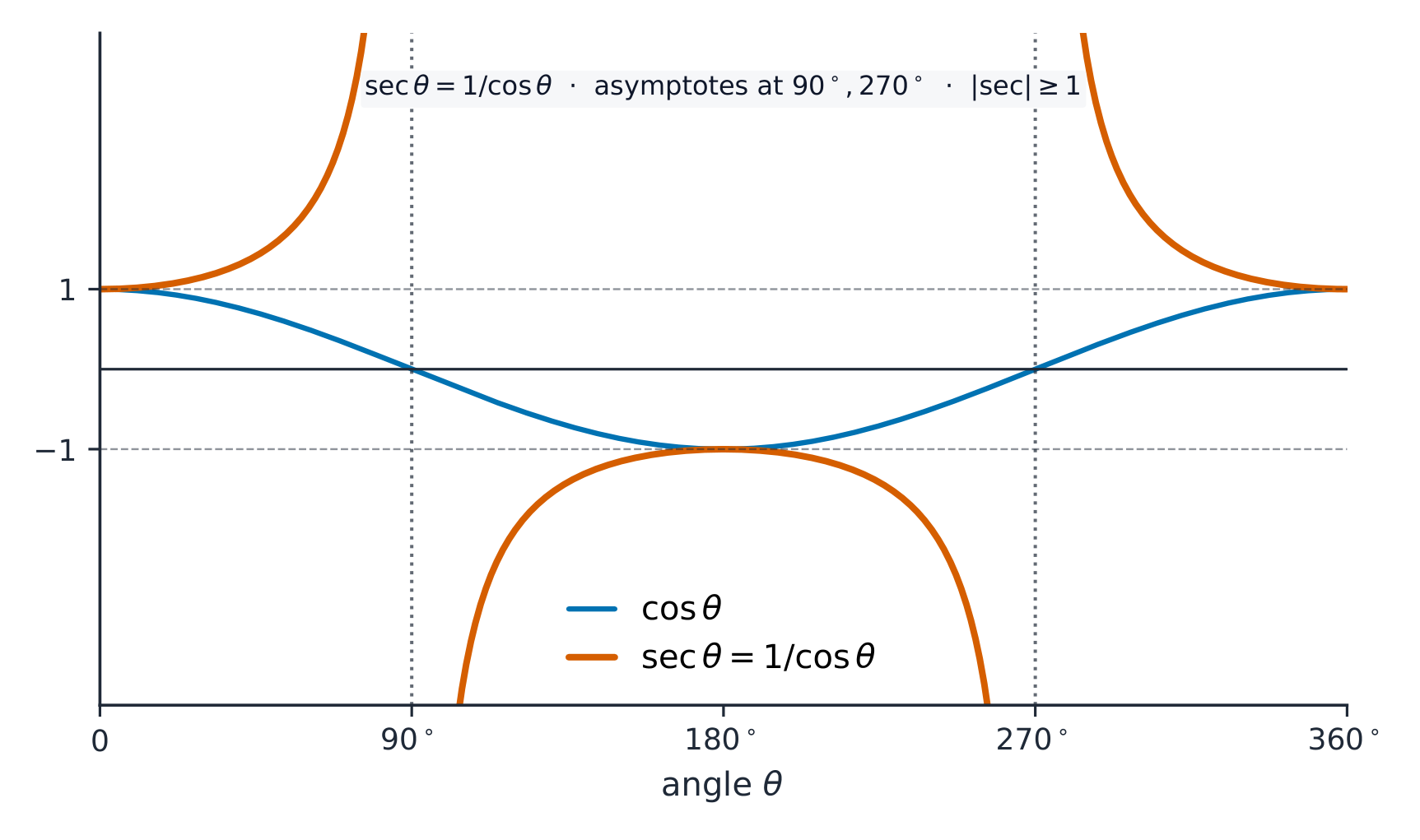
EnglishThere are three more functions, each the reciprocal of one you know: the secant 正割 $\sec\theta = \dfrac{1}{\cos\theta}$, the cosecant 余割 $\csc\theta = \dfrac{1}{\sin\theta}$, and the cotangent 余切 $\cot\theta = \dfrac{1}{\tan\theta}$.
You must know these trigonometric identities 三角恒等式 and choose the right one for each problem:
$$\sec^2\theta \equiv 1 + \tan^2\theta, \qquad \csc^2\theta \equiv 1 + \cot^2\theta.$$You also use the compound angle 复合角 formulae for $\sin(A \pm B)$, $\cos(A \pm B)$, $\tan(A \pm B)$, the double angle 二倍角 formulae$$\sin 2A = 2\sin A\cos A, \quad \cos 2A = 2\cos^2 A - 1, \quad \tan 2A = \frac{2\tan A}{1 - \tan^2 A},$$and the R-formula 辅助角公式 $a\sin\theta + b\cos\theta = R\sin(\theta + \alpha)$, where $R = \sqrt{a^2 + b^2}$ and $\tan\alpha = \dfrac{b}{a}$.Worked example. Solve $2\tan^2\theta + 3\sec\theta = 18$ for $-180^\circ < \theta < 180^\circ$.
Replace $\tan^2\theta$ with $\sec^2\theta - 1$ to get one function:
$$2(\sec^2\theta - 1) + 3\sec\theta = 18 \;\Rightarrow\; 2\sec^2\theta + 3\sec\theta - 20 = 0 \;\Rightarrow\; (2\sec\theta - 5)(\sec\theta + 4) = 0.$$So $\sec\theta = \tfrac52$ or $\sec\theta = -4$, giving $\cos\theta = \tfrac25$ or $\cos\theta = -\tfrac14$. The solutions are $\theta = \pm 66.4^\circ$ and $\theta = \pm 104.5^\circ$.עבריתישנן עוד שלוש פונקציות, כל אחת מהן ההפוך של אחת שאתם מכירים: סקאנט $\sec\theta = \dfrac{1}{\cos\theta}$, קוסקאנט $\csc\theta = \dfrac{1}{\sin\theta}$, וקוטנג'נט $\cot\theta = \dfrac{1}{\tan\theta}$.
$\sec\theta=1/\cos\theta$ עולה לעומס בכל מקום שבו $\cos\theta=0$. חובה לדעת זהויות טריגונומטריות אלו לבחור את הנכונה לכל בעיה:
$$\sec^2\theta \equiv 1 + \tan^2\theta, \qquad \csc^2\theta \equiv 1 + \cot^2\theta.$$גם משוואות הזווית המרוכבת עבור $\sin(A \pm B)$, $\cos(A \pm B)$, $\tan(A \pm B)$, ומשוואות הזווית הכפולה$$\sin 2A = 2\sin A\cos A, \quad \cos 2A = 2\cos^2 A - 1, \quad \tan 2A = \frac{2\tan A}{1 - \tan^2 A},$$וגם פורמולת R $a\sin\theta + b\cos\theta = R\sin(\theta + \alpha)$, כאשר $R = \sqrt{a^2 + b^2}$ ו-$\tan\alpha = \dfrac{b}{a}$.דוגמה מופת. פתרו $2\tan^2\theta + 3\sec\theta = 18$ עבור $-180^\circ < \theta < 180^\circ$.
החלף את $\tan^2\theta$ ב-$\sec^2\theta - 1$ כדי לקבל פונקציה אחת:
$$2(\sec^2\theta - 1) + 3\sec\theta = 18 \;\Rightarrow\; 2\sec^2\theta + 3\sec\theta - 20 = 0 \;\Rightarrow\; (2\sec\theta - 5)(\sec\theta + 4) = 0.$$לכן $\sec\theta = \tfrac52$ או $\sec\theta = -4$, מה שמוביל ל-$\cos\theta = \tfrac25$ או $\cos\theta = -\tfrac14$. הפתרונות הם $\theta = \pm 66.4^\circ$ ו$\theta = \pm 104.5^\circ$.Explore · חקורThe unit circle · המעגל היחידתי
Drag the angle to see how $\sin$, $\cos$ and $\tan$ relate — the key to solving trig equations. · גרור את הזווית כדי לראות כיצד $\sin$, $\cos$ ו-$\tan$ קשורים זה לזה — המפתח לפתרון משוואות טריגונומטריות.
Vocabulary · מילון מונחים Train · אימוןEnglish עברית secant/ˈsiːkənt/ סקנט cosecant/ˈkəʊsekənt/ קוסקנט cotangent/ˈkəʊtændʒənt/ קוטנגנס trigonometric identities/ˌtrɪɡənəʊˈmetrɪk aɪˈdentɪtiz/ זהויות טריגונומטריות compound angle/ˈkɒmpaʊnd ˈæŋɡl/ זווית מורכבת double angle/ˈdʌbl ˈæŋɡl/ זווית כפולה R-formula/ɑː ˈfɔːmjʊlə/ נוסחת R product rule/ˈprɒdʌkt ruːl/ כלל המכפלה quotient rule/ˈkwəʊʃənt ruːl/ כלל המנה parametric equations/ˌpærəˈmetrɪk ɪˈkweɪʒnz/ משוואות פרמטריות implicitly/ɪmˈplɪsɪtli/ באופן אי-מפורש 2.4
Differentiation · גזירה
Syllabus · סיילבוס
EnglishCandidates should be able to: Notes and examples use the derivatives of $e^x$, $\ln x$, $\sin x$, $\cos x$, $\tan x$, together with constant multiples, sums, differences and composites differentiate products and quotients e.g. $\frac{2x - 4}{3x + 2}$, $x^2 \ln x$, $x e^{1 - x^2}$. find and use the first derivative of a function which is defined parametrically or implicitly. e.g. $x = t - e^{2t}$, $y = t + e^{2t}$. e.g. $x^2 + y^2 = xy + 7$. Including use in problems involving tangents and normals. עבריתהמועמדים אמורים להיות מסוגלים: הערות לדוגמאות להשתמש בגזירות של $e^x$, $\ln x$, $\sin x$, $\cos x$, $\tan x$, יחד עם כפילות קבועה, סכומים, הפרשים וקומפוזיציות לגזור מכפלות ומכסים לדוגמה: $\frac{2x - 4}{3x + 2}$, $x^2 \ln x$, $x e^{1 - x^2}$. למצוא ולהשתמש בגזירה הראשונה של פונקציה המוגדרת פרמטרית או איplcitly. לדוגמה: $x = t - e^{2t}$, $y = t + e^{2t}$. לדוגמה: $x^2 + y^2 = xy + 7$. כולל שימוש בבעיות הקשורות למשיקים ונירמלים. Source: Cambridge International syllabus · מקור: הסיילבוס הבינלאומי של קמבריד'ג'
EnglishLearn these standard derivatives:
$$\frac{d}{dx}e^x = e^x, \quad \frac{d}{dx}\ln x = \frac{1}{x}, \quad \frac{d}{dx}\sin x = \cos x, \quad \frac{d}{dx}\cos x = -\sin x, \quad \frac{d}{dx}\tan x = \sec^2 x.$$For a product or a quotient of two functions, use:
- the product rule 乘积法则: $(uv)' = u'v + uv'$;
- the quotient rule 商法则: $\left(\dfrac{u}{v}\right)' = \dfrac{u'v - uv'}{v^2}$.
When a curve is given by parametric equations 参数方程 $x = x(t)$, $y = y(t)$, the gradient is $\dfrac{dy}{dx} = \dfrac{dy/dt}{dx/dt}$. When $y$ is defined implicitly 隐式 (not made the subject), differentiate every term with respect to $x$, using the chain rule on the $y$ terms, then solve for $\dfrac{dy}{dx}$.
Worked example. Given $y = 6x\cos(x^2 + 1)$, find $\dfrac{dy}{dx}$.
Use the product rule with $u = 6x$ and $v = \cos(x^2 + 1)$ (and the chain rule for $v$):
$$\frac{dy}{dx} = 6\cos(x^2 + 1) + 6x\cdot\big(-2x\sin(x^2 + 1)\big) = 6\cos(x^2 + 1) - 12x^2\sin(x^2 + 1).$$עבריתלמדו נגזרות סטנדרטיות אלו:
$$\frac{d}{dx}e^x = e^x, \quad \frac{d}{dx}\ln x = \frac{1}{x}, \quad \frac{d}{dx}\sin x = \cos x, \quad \frac{d}{dx}\cos x = -\sin x, \quad \frac{d}{dx}\tan x = \sec^2 x.$$למכפלה או למנה של שתי פונקציות, השתמשו ב:
- כלל המכפלה: $(uv)' = u'v + uv'$;
- כלל המנה: $\left(\dfrac{u}{v}\right)' = \dfrac{u'v - uv'}{v^2}$.
כאשר עקומה נתונה על ידי משוואות פרמטריות $x = x(t)$, $y = y(t)$, השיפוע הוא $\dfrac{dy}{dx} = \dfrac{dy/dt}{dx/dt}$. כאשר $y$ מוגדר אינסופית (לא הוצג כנושא), גזרו כל איבר לפי $x$, תוך שימוש בכלל השרשרת באיברים $y$, ולאחר מכן פתרו עבור $\dfrac{dy}{dx}$.
דוגמה מפורטת. נתון $y = 6x\cos(x^2 + 1)$, מצאו $\dfrac{dy}{dx}$.
השתמשו בכלל המכפלה עם $u = 6x$ ו$v = \cos(x^2 + 1)$ (וגם בכלל השרשרת עבור $v$):
$$\frac{dy}{dx} = 6\cos(x^2 + 1) + 6x\cdot\big(-2x\sin(x^2 + 1)\big) = 6\cos(x^2 + 1) - 12x^2\sin(x^2 + 1).$$Explore · חקורTangent and gradient · משיק ושיפוע
y = ax³ + bx² + cx + d
Move the point: the tangent line is the derivative at that x. Where the curve turns, the gradient is zero. · הזז את הנקודה: המשיק הוא הנגזרת בנקודה זו ב-x. במקום שבו העקומה משנה כיוון, השיפוע הוא אפס.
2.5
Integration · אינטגרציה

Syllabus · סיילבוס
EnglishCandidates should be able to: Notes and examples • extend the idea of ‘reverse differentiation’ to include the integration of $e^{ax + b}$, $\frac{1}{ax + b}$, $\sin(ax + b)$, $\cos(ax + b)$ and $\sec^2(ax + b)$ Knowledge of the general method of integration by substitution is not required. • use trigonometrical relationships in carrying out integration e.g. use of double-angle formulae to integrate $\sin^2 x$ or $\cos^2(2x)$. • understand and use the trapezium rule to estimate the value of a definite integral. Including use of sketch graphs in simple cases to determine whether the trapezium rule gives an over-estimate or an under-estimate. עבריתהמועמדים אמורים להיות מסוגלים: הערות לדוגמאות • להרחיב את הרעיון של 'גזירה הפוכה' כדי לכלול את האינטגרציה של $e^{ax + b}$, $\frac{1}{ax + b}$, $\sin(ax + b)$, $\cos(ax + b)$ ו$\sec^2(ax + b)$ ידע בשיטה הכללית של אינטגרציה בהצבה אינו נדרש. • להשתמש בקשרים טריגונומטריים בביצוע אינטגרציה לדוגמה: שימוש בנוסחת זווית כפולה כדי לאינטגרל $\sin^2 x$ או $\cos^2(2x)$. • להבין ולהשתמש בכלל הטרפז כדי להעריך את ערך אינטגרל מסוים. כולל שימוש בגרפי סקיצה במקרים פשוטים כדי לקבוע האם כלל הטרפז נותן הערכת יתר או הערכת חסר. Source: Cambridge International syllabus · מקור: הסיילבוס הבינלאומי של קמבריד'ג'
EnglishIntegration is reverse differentiation — reverse each new derivative; harder integrals may need integration by substitution 换元积分 (developed in Pure 3). For a linear inside function $(ax + b)$:
$$\int e^{ax+b}\,dx = \frac{1}{a}e^{ax+b} + C, \qquad \int \frac{1}{ax+b}\,dx = \frac{1}{a}\ln|ax + b| + C,$$$$\int \sin(ax+b)\,dx = -\frac{1}{a}\cos(ax+b) + C, \qquad \int \cos(ax+b)\,dx = \frac{1}{a}\sin(ax+b) + C, \qquad \int \sec^2(ax+b)\,dx = \frac{1}{a}\tan(ax+b) + C.$$To integrate a power of $\sin$ or $\cos$, first use an identity to remove the power. When you cannot integrate exactly, the trapezium rule 梯形法则 estimates a definite integral:$$\int_a^b y\,dx \approx \tfrac{h}{2}\big[y_0 + y_n + 2(y_1 + y_2 + \cdots + y_{n-1})\big].$$Worked example. Find $\displaystyle\int 6\sin^2 x\,dx$.
Use $\sin^2 x = \tfrac12(1 - \cos 2x)$:
$$\int 6\sin^2 x\,dx = \int (3 - 3\cos 2x)\,dx = 3x - \tfrac32\sin 2x + C.$$עבריתאינטגרציה היא נגזירה הפוכה — הפכו כל נגזרה חדשה; אינטגרציות קשות יותר עשויות לדורש אינטגרציה בהצבה (פותחת ב-Pure 3). עבור פונקציה ליניארית בתוך הפונקציה $(ax + b)$:
$$\int e^{ax+b}\,dx = \frac{1}{a}e^{ax+b} + C, \qquad \int \frac{1}{ax+b}\,dx = \frac{1}{a}\ln|ax + b| + C,$$$$\int \sin(ax+b)\,dx = -\frac{1}{a}\cos(ax+b) + C, \qquad \int \cos(ax+b)\,dx = \frac{1}{a}\sin(ax+b) + C, \qquad \int \sec^2(ax+b)\,dx = \frac{1}{a}\tan(ax+b) + C.$$כדי לבצע אינטגרציה של חזקה של $\sin$ או $\cos$, השתמשו תחילה במזהות כדי להסיר את החזקה. כאשר אין אפשרות לבצע אינטגרציה מדויקת, כלל הטרפז מעריך אינטגרל מוגדר:$$\int_a^b y\,dx \approx \tfrac{h}{2}\big[y_0 + y_n + 2(y_1 + y_2 + \cdots + y_{n-1})\big].$$כל רצועה בעלת רוחב $h$ היא טרפז; סכום השטחים שלהם מעריך את האינטגרל. דוגמה מפורטת. מצא $\displaystyle\int 6\sin^2 x\,dx$.
השתמשו ב$\sin^2 x = \tfrac12(1 - \cos 2x)$:
$$\int 6\sin^2 x\,dx = \int (3 - 3\cos 2x)\,dx = 3x - \tfrac32\sin 2x + C.$$Explore · חקורThe area under the curve · השטח תחת העקומה
area = ∫ f(x) dx · שטח = ∫ f(x) dx
The integral still measures area — drag a and b to total the strip under the curve. · האינטגרל עדין מודד שטח — גרור את a ו-b כדי לחשב את סך הרצועה מתחת לעקומה.
Vocabulary · מילון מונחים Train · אימוןEnglish עברית trapezium rule/trəˈpiːzɪəm ruːl/ שיטת טרפזים root/ruːt/ שורש 2.6
Numerical solution of equations · פתרון מספרי של משוואות

Syllabus · סיילבוס
EnglishCandidates should be able to: Notes and examples • locate approximately a root of an equation, by means of graphical considerations and/or searching for a sign change e.g. finding a pair of consecutive integers between which a root lies. • understand the idea of, and use the notation for, a sequence of approximations which converges to a root of an equation • understand how a given simple iterative formula of the form $x_{n + 1} = \text{F}(x_n)$ relates to the equation being solved, and use a given iteration, or an iteration based on a given rearrangement of an equation, to determine a root to a prescribed degree of accuracy. Knowledge of the condition for convergence is not included, but an understanding that an iteration may fail to converge is expected. עבריתהמועמדים אמורים להיות מסוגלים: הערות לדוגמאות • למקם בקירוב שורש של משוואה, באמצעות considerations גרפיים וב/או חיפוש אחר שינוי סימן לדוגמה: מציאת זוג של מספרים שלמים רצופים שביניהם נמצא שורש. • להבין את הרעיון ולשתמש בסימון עבור סדרה של קירובים הנכנסים לשורש של משוואה • הבנת הקשר בין נוסחת איטרציה פשוטה נתונה מהצורה $x_{n + 1} = \text{F}(x_n)$ למשוואה הנפתרת, ושימוש באיטרציה נתונה או איטרציה המבוססת על סידור מחדש נתון של משוואה כדי לקבוע שורש ברמת דיוק נקובה. אינו כלול ידע בתנאי התכנסות, אך מצופה הבנה שאיטרציה עשויה להכשל ולהתכנס. Source: Cambridge International syllabus · מקור: הסיילבוס הבינלאומי של קמבריד'ג'
EnglishIterating to a root: ride the tangent Many equations cannot be solved exactly. Two ideas help you find a root 根 (a solution).
- Sign change 变号: if $f(a)$ and $f(b)$ have opposite signs (and the graph has no break between them), a root lies between $a$ and $b$.
- Iteration 迭代: rearrange the equation into the form $x = F(x)$, then use the iterative formula 迭代公式 $x_{n+1} = F(x_n)$. Start from a first guess $x_0$ and repeat. If the values are convergent they settle down and converge 收敛 to a root. Keep going until the answer is steady to the accuracy asked for.
Worked example. A root $\beta$ of an equation satisfies $x = \sqrt[3]{-2x - 4.5}$, and $-1.4 < \beta < -1.0$. Use the iteration $x_{n+1} = \sqrt[3]{-2x_n - 4.5}$ with $x_0 = -1.2$.
$$x_1 = \sqrt[3]{-2(-1.2) - 4.5} = \sqrt[3]{-2.1} = -1.281, \qquad x_2 = \sqrt[3]{-2(-1.281) - 4.5} = -1.247, \quad \ldots$$The values settle near $-1.26$, so $\beta = -1.26$ (3 s.f.).עבריתחיזור לשורש: רכיבה על המשיק מספר משוואות אינן ניתנות לפתרון מדויק. שתי רעיונות עוזרים לך למצוא שורש (פתרון).
- שינוי סימן: אם $f(a)$ ו-$f(b)$ הם בעלי סימנים הפוכים (ועד הגרף אינו נשבר ביניהם), שורש נמצא בין $a$ ל-$b$.
- איטרציה: סדר מחדש את המשוואה לצורה $x = F(x)$, ולאחר מכן השתמש ב-נוסחת האיטרציה $x_{n+1} = F(x_n)$. התחל מערך ראשוני $x_0$ וחזור על הפעולה. אם הערכים הם מתכנסים, הם יתייצבו ו-יתכנסו לשורש. המשך לעבוד עד שהתשובה תתייצב ברמת הדיוק הנדרשת.
$f(a)$ ו-$f(b)$ הם בעלי סימנים הפוכים, ולכן שורש נתפס בין $a$ ל-$b$. 
כל צעד עולה ל-$y=F(x)$ ואז חוצה ל-$y=x$; מערכת המדרגות מתקרבת לשורש. דוגמה פתורה. שורש $\beta$ של משוואה מקיים $x = \sqrt[3]{-2x - 4.5}$, ועבור $-1.4 < \beta < -1.0$. השתמש באיטרציה $x_{n+1} = \sqrt[3]{-2x_n - 4.5}$ עם $x_0 = -1.2$.
$$x_1 = \sqrt[3]{-2(-1.2) - 4.5} = \sqrt[3]{-2.1} = -1.281, \qquad x_2 = \sqrt[3]{-2(-1.281) - 4.5} = -1.247, \quad \ldots$$הערכים מתייצבים סביב $-1.26$, ולכן $\beta = -1.26$ (3 ספרות משמעותיות).Explore · חקורWhere is the root? · איפה שורש המשוואה?
y = ax³ + bx² + cx + d
A root is where the curve crosses zero. A sign change in f(x) traps a root between two x-values. · שורש הוא הנקודה בה הגרף חוצה אפס. שינוי סימן ב-f(x) לוכד שורש בין שני ערכי x.
Vocabulary · מילון מונחים Train · אימוןEnglish עברית sign change/saɪn tʃeɪndʒ/ שינוי סימן iteration/ˌɪtəˈreɪʃn/ איטרציה iterative formula/ˈɪtərətɪv ˈfɔːmjʊlə/ נוסחה איטרטיבית converge/kənˈvɜːdʒ/ מתכנס integration by substitution/ˌɪntɪˈɡreɪʃn baɪ ˌsʌbstɪˈtjuːʃn/ אינטגרציה על ידי הצבה 2.6
Exam tips · טיפים לבחינות
English- Use the laws of logarithms to solve equations; remember $\ln$ and $e^x$ are inverses.
- For numerical methods, show a sign change to locate a root, set out the iteration clearly, and give the answer to the stated accuracy.
- Learn the chain, product and quotient rules and identify which the function needs.
- Solve modulus equations $|f(x)| = g(x)$ by considering both the positive and negative cases, and sketch to check.
עברית- השתמש ב-חוקי הלוגריתמים לפתרון משוואות; זכור כי $\ln$ ו-$e^x$ הם הפוכים זה לזה.
- עבור שיטות נומריות, הצג שינוי סימן כדי למקם שורש, סדר את האיטרציה בבירור, ותן את התשובה ברמת הדיוק הנדרשת.
- למד את חוקי השרשרת, המכפלה והמנה וזהה האילו פונקציה דורשת אותם.
- פתר משוואות ערך מוחלט $|f(x)| = g(x)$ על ידי בחינת שני המקרים החיובי והשלילי, ושרטט גרף כדי לוודא.
-
3
Pure Mathematics 3 · מתמטיקה נקודתית 3
Watch lesson · צפה בשיעורThis handout covers Topic 3: Pure Mathematics 纯数学 3. Subtopics 3.1–3.6 build on the algebra, logarithms, trigonometry, differentiation, integration and numerical methods of Pure Mathematics 2, so this handout explains what is new in Pure 3 and then covers the three big new areas: vectors, differential equations and complex numbers.
3.1
Algebra

Syllabus · סיילבוס
EnglishCandidates should be able to: Notes and examples • understand the meaning of $|x|$, sketch the graph of $y = |ax + b|$ and use relations such as $|a| = |b| \iff a^2 = b^2$ and $|x - a| < b \iff a - b < x < a + b$ when solving equations and inequalities Graphs of $y = |\text{f}(x)|$ and $y = \text{f}(|x|)$ for non-linear functions $\text{f}$ are not included. e.g. $|3x - 2| = |2x + 7|$, $2x + 5 < |x + 1|$. • divide a polynomial, of degree not exceeding 4, by a linear or quadratic polynomial, and identify the quotient and remainder (which may be zero) • use the factor theorem and the remainder theorem e.g. to find factors and remainders, solve polynomial equations or evaluate unknown coefficients. Including factors of the form $(ax + b)$ in which the coefficient of $x$ is not unity, and including calculation of remainders. • recall an appropriate form for expressing rational functions in partial fractions, and carry out the decomposition, in cases where the denominator is no more complicated than – $(ax + b)(cx + d)(ex + f)$ – $(ax + b)(cx + d)^2$ – $(ax + b)(cx^2 + d)$ Excluding cases where the degree of the numerator exceeds that of the denominator • use the expansion of $(1 + x)^n$, where $n$ is a rational number and $|x| < 1$. Finding the general term in an expansion is not included. Adapting the standard series to expand e.g. $(2 - \frac{1}{2}x)^{-1}$ is included, and determining the set of values of $x$ for which the expansion is valid in such cases is also included. עבריתהמועמדים אמורים להיות מסוגלים: הערות לדוגמאות • להבין את משמעות $|x|$, לשרטט את הגרף של $y = |ax + b|$ ולשמש בקשרים כגון $|a| = |b| \iff a^2 = b^2$ ו-$|x - a| < b \iff a - b < x < a + b$ בפתרון משוואות ואי-שוויונות גרפים של $y = |\text{f}(x)|$ ו-$y = \text{f}(|x|)$ לפונקציות לא-ליניאריות $\text{f}$ אינם כלולים. לדוגמה: $|3x - 2| = |2x + 7|$, $2x + 5 < |x + 1|$. • לחלק פולינום בעל דרגה שאינה עולה על 4 בפולינום ליניארי או ריבועי, ולהזהות את ה-מכפיל וה-שארית (שעשויה להיות אפס) • להשתמש במשפט המכפיל ובמשפט השארית לדוגמה למציאת מכפילים ושאריות, פתרון משוואות פולינומיות או חישוב מקדמים נעלמים. כולל מכפילים מהצורה $(ax + b)$ שבהם המקדם של $x$ אינו אחד, וחישוב שאריות. • להזכיר צורה מתאימה לביטוי פונקציות רציונליות בשוברים חלקיים, ולבצע את הפירוק, במקרים שבהם המכנה אינו מורכב יותר מ- – $(ax + b)(cx + d)(ex + f)$ – $(ax + b)(cx + d)^2$ – $(ax + b)(cx^2 + d)$ אי-כלול מקרים שבהם דרגת המונה עולה על דרגת המכנה • להשתמש בפיתוח $(1 + x)^n$, כאשר $n$ הוא מספר רציונלי ו$|x| < 1$. מציאת האיבר הכללי בפיתוח אינה כלולה. התאמת הסדרה הסטנדרטית לפיתוח, למשל $(2 - \frac{1}{2}x)^{-1}$, כלולה, כמו גם קביעת תחום הערכים של $x$ עבורו הפיתוח תקף במקרים אלו. Source: Cambridge International syllabus · מקור: הסיילבוס הבינלאומי של קמבריד'ג'
Two new tools join the algebra from Pure 2.
Partial fractions
A single fraction with a factorised bottom can be split into a sum of simpler fractions. This is called writing it in partial fractions 部分分式, and it makes a rational function 有理函数 (a fraction of polynomials) easy to integrate or expand. Match the form to the bottom:
First check the top is lower degree than the bottom. If it is not ("top-heavy"), divide the polynomial first: dividing gives a quotient 商 plus a remainder 余数 over the original bottom, and you split only that remaining proper fraction.
One fraction with a factorised bottom splits into a sum of simpler fractions.
$$\frac{1}{(ax+b)(cx+d)} = \frac{A}{ax+b} + \frac{B}{cx+d}, \qquad \frac{1}{(ax+b)(cx+d)^2} = \frac{A}{ax+b} + \frac{B}{cx+d} + \frac{C}{(cx+d)^2}.$$Worked example. Express $\dfrac{x+4}{(x+1)(x-2)}$ in partial fractions.
Write $\dfrac{x+4}{(x+1)(x-2)} = \dfrac{A}{x+1} + \dfrac{B}{x-2}$, so $x + 4 = A(x-2) + B(x+1)$. Put $x = 2$: $6 = 3B$, so $B = 2$. Put $x = -1$: $3 = -3A$, so $A = -1$. Hence
$$\frac{x+4}{(x+1)(x-2)} = \frac{2}{x-2} - \frac{1}{x+1}.$$The binomial expansion for a rational power
The binomial expansion 二项展开式 also works when the power is a fraction or is negative, as long as $|x| < 1$:
$$(1 + x)^n = 1 + nx + \frac{n(n-1)}{2!}x^2 + \frac{n(n-1)(n-2)}{3!}x^3 + \cdots$$For example $(1 + x)^{1/2} = 1 + \tfrac12 x - \tfrac18 x^2 + \cdots$ for $|x| < 1$.Explore · חקורReciprocal curves · עקומים היפוכיים
y = a/(x − b) + c
Partial fractions split a hard fraction into simple reciprocal pieces — each with a vertical and a horizontal asymptote. · פירוק למשברים פרטיים מפצל שבר מורכב לחלקים היפוכיים פשוטים — לכל אחד מהם יש אסימפטורה אנכית ואסימפטורה אופקית.
Vocabulary · מילון מונחים Train · אימוןEnglish עברית Pure Mathematics/pjʊə ˌmæθɪˈmætɪks/ מתמטיקה טהורה partial fractions/ˈpɑːʃl ˈfrækʃnz/ שברים חלקיים rational function/ˈræʃənl ˈfʌŋkʃn/ פונקציה רציונלית quotient/ˈkwəʊʃənt/ מכפיל remainder/rɪˈmeɪndə/ שארית binomial expansion/baɪˈnəʊmɪəl ekˈspænʃn/ פתיחת בינום 3.2 3.3 3.6
Logarithms, trigonometry and numerical methods (from Pure 2)
Syllabus · סיילבוס
EnglishCandidates should be able to: Notes and examples understand the relationship between logarithms and indices, and use the laws of logarithms (excluding change of base) understand the definition and properties of $e^x$ and $\ln x$, including their relationship as inverse functions and their graphs Including knowledge of the graph of $y = e^{kx}$ for both positive and negative values of $k$. use logarithms to solve equations and inequalities in which the unknown appears in indices e.g. $2^x < 5$, $3 \times 2^{3x-1} < 5$, $3^{x+1} = 4^{2x-1}$. use logarithms to transform a given relationship to linear form, and hence determine unknown constants by considering the gradient and/or intercept. e.g. $y = kx^n$ gives $\ln y = \ln k + n \ln x$ which is linear in $\ln x$ and $\ln y$. $y = k(a^x)$ gives $\ln y = \ln k + x \ln a$ which is linear in $x$ and $\ln y$. עבריתהמועמדים אמורים להיות מסוגלים: הערות לדוגמאות להבין את הקשר בין לוגריתמים לבין מעריכים, ולשמש בחוקי הלוגריתמים (למעט שינוי בסיס) הבנת ההגדרה והמאפיינים של $e^x$ ו-$\ln x$, כולל הקשר ביניהם כפונקציות הפוכות וגרפים שלהן כולל ידע לגבי הגרף של $y = e^{kx}$ גם לערכים חיוביים וגם לערכים שליליים של $k$. להשתמש בלוגריתמים לפתרון משוואות ואי-שוויונים שבהם הנעלם מופיע במעריכים לדוגמה: $2^x < 5$, $3 \times 2^{3x-1} < 5$, $3^{x+1} = 4^{2x-1}$. להשתמש בלוגריתמים כדי להמיר קשר נתון לצורה ליניארית, ומכאן לקבועים לא ידועים על ידי שיקול השיפוע ו/או החיתוך. לדוגמה: $y = kx^n$ נותן $\ln y = \ln k + n \ln x$ שהוא ליניארי ב$\ln x$ וב$\ln y$. $y = k(a^x)$ נותן $\ln y = \ln k + x \ln a$ שהוא ליניארי ב$x$ וב$\ln y$. EnglishCandidates should be able to: Notes and examples understand the relationship of the secant, cosecant and cotangent functions to cosine, sine and tangent, and use properties and graphs of all six trigonometric functions for angles of any magnitude use trigonometrical identities for the simplification and exact evaluation of expressions, and in the course of solving equations, and select an identity or identities appropriate to the context, showing familiarity in particular with the use of: – $\sec^2 \theta \equiv 1 + \tan^2 \theta$ and $\cosec^2 \theta \equiv 1 + \cot^2 \theta$ – the expansions of $\sin(A \pm B)$, $\cos(A \pm B)$ and $\tan(A \pm B)$ – the formulae for $\sin 2A$, $\cos 2A$ and $\tan 2A$ – the expression of $a \sin \theta + b \cos \theta$ in the forms $R \sin(\theta \pm \alpha)$ and $R \cos(\theta \pm \alpha)$. e.g. simplifying $\cos(x - 30^\circ) - 3 \sin(x - 60^\circ)$. e.g. solving $\tan \theta + \cot \theta = 4$, $2 \sec^2 \theta - \tan \theta = 5$, $3 \cos \theta + 2 \sin \theta = 1$. עבריתהמועמדים אמורים להיות מסוגלים: הערות לדוגמאות להבין את הקשר בין פונקציות הסקנט, הקוסקנט והקוטנגנס לפונקציות הקוסינוס, הסינוס והטנגנס, ולהשתמש בתכונות ובגרפים של כל שש הפונקציות הטריגונומטריות עבור זוויות בכל גודל שימוש בזהויות טריגונומטריות לפישוט ולחישוב מדויק של ביטויים, ובמהלך פתרון משוואות, ובחירת זהות או זהויות המתאימות להקשר, תוך הצגת היכרות בפרט עם השימוש ב-: – $\sec^2 \theta \equiv 1 + \tan^2 \theta$ ו-$\cosec^2 \theta \equiv 1 + \cot^2 \theta$ – הרחבות של $\sin(A \pm B)$, $\cos(A \pm B)$ ו-$\tan(A \pm B)$ – הנוסחאות עבור $\sin 2A$, $\cos 2A$ ו-$\tan 2A$ – הביטוי של $a \sin \theta + b \cos \theta$ בצורות $R \sin(\theta \pm \alpha)$ ו-$R \cos(\theta \pm \alpha)$. לדוגמה: פישוט $\cos(x - 30^\circ) - 3 \sin(x - 60^\circ)$. לדוגמה: פתרון $\tan \theta + \cot \theta = 4$, $2 \sec^2 \theta - \tan \theta = 5$, $3 \cos \theta + 2 \sin \theta = 1$. EnglishCandidates should be able to: Notes and examples • locate approximately a root of an equation, by means of graphical considerations and/or searching for a sign change e.g. finding a pair of consecutive integers between which a root lies. • understand the idea of, and use the notation for, a sequence of approximations which converges to a root of an equation • understand how a given simple iterative formula of the form $x_{n+1} = \text{F}(x_n)$ relates to the equation being solved, and use a given iteration, or an iteration based on a given rearrangement of an equation, to determine a root to a prescribed degree of accuracy. Knowledge of the condition for convergence is not included, but an understanding that an iteration may fail to converge is expected. עבריתהמועמדים אמורים להיות מסוגלים: הערות לדוגמאות • למצוא בקירוב שורש של משוואה, על ידי שיקולים גרפיים ו/או חיפוש אחר שינוי סימן לדוגמה: מציאת זוג של מספרים שלמים עוקבים שביניהם נמצא השורש. • להבין את רעיון ההתכנסות ולשתמש בסימון עבור סדרת קירובים הנכנסת לשורש של משוואה • להבין כיצד נוסחת איטרציה פשוטה נתונה מהצורה $x_{n+1} = \text{F}(x_n)$ קשורה למשוואה הפתורה, ולהשתמש באיטרציה נתונה, או באיטרציה המבוססת על פירוק מחדש של משוואה, כדי לקבוע שורש בדיוק הנדרש. ידע בתנאי ההתכנסות אינו נכלל, אך מצופה הבנה שאיטרציה עשויה לא להתכנס. Source: Cambridge International syllabus · מקור: הסיילבוס הבינלאומי של קמבריד'ג'
Iterating to a root: ride the tangent Subtopics 3.2, 3.3 and 3.6 are the same skills you met in Pure 2: the laws of logarithms with $e^x$ and $\ln x$; the identities $\sec^2\theta \equiv 1 + \tan^2\theta$ and $\csc^2\theta \equiv 1 + \cot^2\theta$, the compound- and double-angle formulae, and the $R$-form of $a\sin\theta + b\cos\theta$; and solving an equation numerically by a sign change 变号 and an iterative formula 迭代公式 $x_{n+1} = F(x_n)$. Use them exactly as before.
The three new trig functions are the reciprocals 倒数 of the familiar ones: the secant 正割 $\sec\theta = \dfrac{1}{\cos\theta}$, the cosecant 余割 $\csc\theta = \dfrac{1}{\sin\theta}$, and the cotangent 余切 $\cot\theta = \dfrac{1}{\tan\theta} = \dfrac{\cos\theta}{\sin\theta}$. (Memory aid: match the third letter — sec goes with cosine.) The two Pythagorean identities above come straight from dividing $\sin^2\theta + \cos^2\theta \equiv 1$ by $\cos^2\theta$ or $\sin^2\theta$. For a numerical method, an iteration $x_{n+1}=F(x_n)$ converges 收敛 to the root when successive values get closer together.
Explore · חקורThe unit circle · המעגל היחידתי
(cos θ, sin θ)
The R-formula rewrites a sin θ + b cos θ as one wave — and it all lives on this circle. · הנוסחת R מכתבת ביטוי a sin θ + b cos θ כגל אחד — והכל נמצא על המעגל הזה.
Vocabulary · מילון מונחים Train · אימוןEnglish עברית sign change/saɪn tʃeɪndʒ/ שינוי סימן iterative formula/ˈɪtərətɪv ˈfɔːmjʊlə/ נוסחה איטרטיבית reciprocals/rɪˈsɪprəklz/ הופכים secant/ˈsiːkənt/ סקנט cosecant/ˈkəʊsekənt/ קוסקנט cotangent/ˈkəʊtændʒənt/ קוטנגנס converges/kənˈvɜːdʒɪz/ מתכנס 3.4
Differentiation
Syllabus · סיילבוס
EnglishCandidates should be able to: Notes and examples use the derivatives of $e^x$, $\ln x$, $\sin x$, $\cos x$, $\tan x$, $\tan^{-1} x$, together with constant multiples, sums, differences and composites Derivatives of $\sin^{-1} x$ and $\cos^{-1} x$ are not required. differentiate products and quotients e.g. $\frac{2x - 4}{3x + 2}$, $x^2 \ln x$, $x e^{1-x^2}$. find and use the first derivative of a function which is defined parametrically or implicitly. e.g. $x = t - e^{2t}$, $y = t + e^{2t}$. e.g. $x^2 + y^2 = xy + 7$. Including use in problems involving tangents and normals. עבריתהמועמדים אמורים להיות מסוגלים: הערות לדוגמאות להשתמש בגזירות של $e^x$, $\ln x$, $\sin x$, $\cos x$, $\tan x$, $\tan^{-1} x$, יחד עם כפלים קבועים, סכומים, הפרשים וקומפוזיציות גזירות של $\sin^{-1} x$ ו-$\cos^{-1} x$ אינן נדרשות. לגזור מכפלות ו-מנה לדוגמה: $\frac{2x - 4}{3x + 2}$, $x^2 \ln x$, $x e^{1-x^2}$. למצוא ולהשתמש בגזירה הראשונה של פונקציה המוגדרת פרמטרית או איפלטית. לדוגמה: $x = t - e^{2t}$, $y = t + e^{2t}$. לדוגמה: $x^2 + y^2 = xy + 7$. כולל שימוש בבעיות הקשורות למשיקים ונירמלים. Source: Cambridge International syllabus · מקור: הסיילבוס הבינלאומי של קמבריד'ג'
The methods are those of Pure 2 (the product, quotient and chain rules, with parametric and implicit curves). One derivative is added — the inverse tangent 反正切:
$$\frac{d}{dx}\tan^{-1} x = \frac{1}{1 + x^2}.$$Worked example. Differentiate $y = \tan^{-1}(3x)$.
Use the chain rule with the result above: $\dfrac{dy}{dx} = \dfrac{1}{1 + (3x)^2} \times 3 = \dfrac{3}{1 + 9x^2}.$
Explore · חקורThe gradient at a point · השיפוע בנקודה
gradient = dy/dx · שיפוע = dy/dx
Implicit or not, the derivative is still the slope of the tangent — slide the point to see it. · לא משנה האם הגזירה היא גזירה מפורשת או סמויה, ה-גזירה עדיין מייצגת את שיפוע המשיק — הזיזו את הנקודה כדי לראות זאת.
Vocabulary · מילון מונחים Train · אימוןEnglish עברית inverse tangent/ɪnˈvɜːs ˈtændʒənt/ טנגנס הפוך 3.5
Integration
Syllabus · סיילבוס
EnglishCandidates should be able to: Notes and examples extend the idea of 'reverse differentiation' to include the integration of $e^{ax + b}$, $\frac{1}{ax + b}$, $\sin(ax + b)$, $\cos(ax + b)$, $\sec^2(ax + b)$ and $\frac{1}{x^2 + a^2}$ Including examples such as $\frac{1}{2 + 3x^2}$. use trigonometrical relationships in carrying out integration e.g. use of double-angle formulae to integrate $\sin^2 x$ or $\cos^2(2x)$. integrate rational functions by means of decomposition into partial fractions Restricted to types of partial fractions as specified in topic 3.1 above. recognise an integrand of the form $\frac{k f'(x)}{f(x)}$, and integrate such functions e.g. integration of $\frac{x}{x^2 + 1}$, $\tan x$. recognise when an integrand can usefully be regarded as a product, and use integration by parts e.g. integration of $x \sin 2x$, $x^2 e^{-x}$, $\ln x$, $x \tan^{-1} x$. use a given substitution to simplify and evaluate either a definite or an indefinite integral. e.g. to integrate $\sin^2 2x \cos x$ using the substitution $u = \sin x$. עבריתהמועמדים אמורים להיות מסוגלים: הערות לדוגמאות להרחיב את הרעיון של 'גזירה הפוכה' כדי לכלול את אינטגרציה של $e^{ax + b}$, $\frac{1}{ax + b}$, $\sin(ax + b)$, $\cos(ax + b)$, $\sec^2(ax + b)$ ו-$\frac{1}{x^2 + a^2}$ כולל דוגמאות כמו $\frac{1}{2 + 3x^2}$. להשתמש בקשרים טריגונומטריים בביצוע אינטגרציה לדוגמה: שימוש בנוסחות זווית כפולה לאינטגרציה של $\sin^2 x$ או $\cos^2(2x)$. לבצע אינטגרציה של פונקציות רציונליות באמצעות פירוק לשוברים חלקיים מוגבל לסוגי שברים חלקיים כפי שנקבע בנושא 3.1 לעיל. לזהות אינטגרנד מהצורה $\frac{k f'(x)}{f(x)}$, ולבצע אינטגרציה של פונקציות כאלה לדוגמה: אינטגרציה של $\frac{x}{x^2 + 1}$, $\tan x$. לזהות מתי פונקציית אינטגרציה יכולה לשמש כמכפלה, ולבצע אינטגרציה בחלקים לדוגמה: אינטגרציה של $x \sin 2x$, $x^2 e^{-x}$, $\ln x$, $x \tan^{-1} x$. להשתמש בהצבה הנתונה לפישוט וחישוב של אינטגרל גבולי או לא-גבולי. לדוגמה: אינטגרציה של $\sin^2 2x \cos x$ באמצעות ההצבה $u = \sin x$. Source: Cambridge International syllabus · מקור: הסיילבוס הבינלאומי של קמבריד'ג'
Pure 3 adds several powerful methods.
- A new standard integral: $\displaystyle\int \frac{1}{x^2 + a^2}\,dx = \frac{1}{a}\tan^{-1}\frac{x}{a} + C$.
- Partial fractions: split a rational function first, then integrate each piece as a logarithm.
- The pattern $\dfrac{k\,f'(x)}{f(x)}$: this integrates to $k\ln|f(x)| + C$. For example $\displaystyle\int \frac{2x}{x^2 + 1}\,dx = \ln(x^2 + 1) + C$.
- Integration by parts 分部积分, used for a product: $\displaystyle\int u\,\frac{dv}{dx}\,dx = uv - \int v\,\frac{du}{dx}\,dx$.
- Integration by substitution 换元积分: a given change of variable turns a hard integral into an easy one.
Worked example. Find $\displaystyle\int x\cos x\,dx$.
Use integration by parts with $u = x$ and $\dfrac{dv}{dx} = \cos x$, so $\dfrac{du}{dx} = 1$ and $v = \sin x$:
$$\int x\cos x\,dx = x\sin x - \int \sin x\,dx = x\sin x + \cos x + C.$$Explore · חקורThe area under the curve · השטח תחת העקומה
area = ∫ f(x) dx · שטח = ∫ f(x) dx
Every integration method just measures this area — drag the limits to total it. · כל שיטת אינטגרציה מדד בעצם שטח זה — גרור את הגבולות כדי לחשב אותו כולו.
Vocabulary · מילון מונחים Train · אימוןEnglish עברית Integration by parts/ˌɪntɪˈɡreɪʃn baɪ pɑːts/ אינטגרציה בחלקים Integration by substitution/ˌɪntɪˈɡreɪʃn baɪ ˌsʌbstɪˈtjuːʃn/ אינטגרציה בהצבה 3.7
Vectors

Syllabus · סיילבוס
EnglishCandidates should be able to: Notes and examples • use standard notations for vectors, i.e. $\begin{pmatrix} x \\ y \end{pmatrix}$, $x\mathbf{i} + y\mathbf{j}$, $\begin{pmatrix} x \\ y \\ z \end{pmatrix}$, $x\mathbf{i} + y\mathbf{j} + z\mathbf{k}$, $\overrightarrow{AB}$, $\mathbf{a}$ • carry out addition and subtraction of vectors and multiplication of a vector by a scalar, and interpret these operations in geometrical terms e.g. ‘$OABC$ is a parallelogram’ is equivalent to $\overrightarrow{OB} = \overrightarrow{OA} + \overrightarrow{OC}$. The general form of the ratio theorem is not included, but understanding that the midpoint of $AB$ has position vector $\frac{1}{2}(\overrightarrow{OA} + \overrightarrow{OB})$ is expected. • calculate the magnitude of a vector, and use unit vectors, displacement vectors and position vectors In 2 or 3 dimensions. • understand the significance of all the symbols used when the equation of a straight line is expressed in the form $\mathbf{r} = \mathbf{a} + t\mathbf{b}$, and find the equation of a line, given sufficient information e.g. finding the equation of a line given the position vector of a point on the line and a direction vector, or the position vectors of two points on the line. • determine whether two lines are parallel, intersect or are skew, and find the point of intersection of two lines when it exists Calculation of the shortest distance between two skew lines is not required. Finding the equation of the common perpendicular to two skew lines is also not required. • use formulae to calculate the scalar product of two vectors, and use scalar products in problems involving lines and points. e.g. finding the angle between two lines, and finding the foot of the perpendicular from a point to a line; questions may involve 3D objects such as cuboids, tetrahedra (pyramids), etc. Knowledge of the vector product is not required. עבריתהמועמדים אמורים להיות מסוגלים: הערות לדוגמאות • להשתמש בסימונים סטנדרטיים לוקטורים, כלומר $\begin{pmatrix} x \\ y \end{pmatrix}$, $x\mathbf{i} + y\mathbf{j}$, $\begin{pmatrix} x \\ y \\ z \end{pmatrix}$, $x\mathbf{i} + y\mathbf{j} + z\mathbf{k}$, $\overrightarrow{AB}$, $\mathbf{a}$ • לבצע חיבור וחיסור של וקטורים והכפלת וקטור בסקالر, ולפרש פעולות אלו בגיאומטריה לדוגמה: ‘$OABC$ הוא מקבילית’ שקול ל$\overrightarrow{OB} = \overrightarrow{OA} + \overrightarrow{OC}$. צורה כללית של משפט היחס אינה נכללת, אך מצופה הבנה שהנקודת האמצע של $AB$ היא בעלת וקטור מיקום $\frac{1}{2}(\overrightarrow{OA} + \overrightarrow{OB})$. • לחשב את הגודל של וקטור, ולהשתמש בווקטורים יחידה, ווקטורי הזזה וווקטורי מיקום בממדים 2 או 3. • להבין את המשמעות של כל הסמלים כאשר משוואת קו ישר מוצגת בצורה $\mathbf{r} = \mathbf{a} + t\mathbf{b}$, ולמצוא את משוואת הקו בהינתן מספיק מידע לדוגמה: מציאת משוואת קו בהינתן וקטור מיקום של נקודה על הקו ווקטור כיוון, או וקטורי מיקום של שתי נקודות על הקו. • לקבוע האם שני קווים הם מקבילים, נחתכים או זרים, ולמצוא את נקודת החיתוך שלהם אם היא קיימת אינה נדרשת חשיבת המרחק הקצר ביותר בין שני קווים זרים. מציאת משוואת המאונך המשותף לשני קווים זרים אינה נדרשת גם כן. • להשתמש בנוסחאות לחישוב המכפלה הסקלרית של שני וקטורים, ולהשתמש במכפלות סקלריות בבעיות הקשורות לקווים ונקודות. לדוגמה: מציאת הזווית בין שני קווים, ומציאת הרגל המאונך מנקודה לקו; שאלות עשויות לכלול אובייקטים בתלת-ממד (3D) כגון קוביות, טטרהדרונים (פירמידות), ועוד. ידע במכפלה וקטורית אינו נדרש. Source: Cambridge International syllabus · מקור: הסיילבוס הבינלאומי של קמבריד'ג'
Forces like wind and water are vectors — they have both size and direction. A vector 向量 has both size and direction. Write it as a column, or as $x\mathbf{i} + y\mathbf{j} + z\mathbf{k}$, or as $\overrightarrow{AB}$.
- The magnitude 模长 (length) of $\mathbf{v} = x\mathbf{i} + y\mathbf{j} + z\mathbf{k}$ is $|\mathbf{v}| = \sqrt{x^2 + y^2 + z^2}$.
- A unit vector 单位向量 has magnitude $1$; divide a vector by its magnitude to make one.
- A position vector 位置向量 gives a point's place from the origin; a displacement vector 位移向量 $\overrightarrow{AB} = \mathbf{b} - \mathbf{a}$ goes from one point to another. Multiplying by a scalar 标量 (a plain number) stretches a vector.
Lines and the scalar product
A straight line through point $\mathbf{a}$ in direction $\mathbf{b}$ has vector equation $\mathbf{r} = \mathbf{a} + t\mathbf{b}$. Two lines may be parallel 平行, may intersect 相交 at a point, or may be skew lines 异面直线 (not parallel and never meeting).
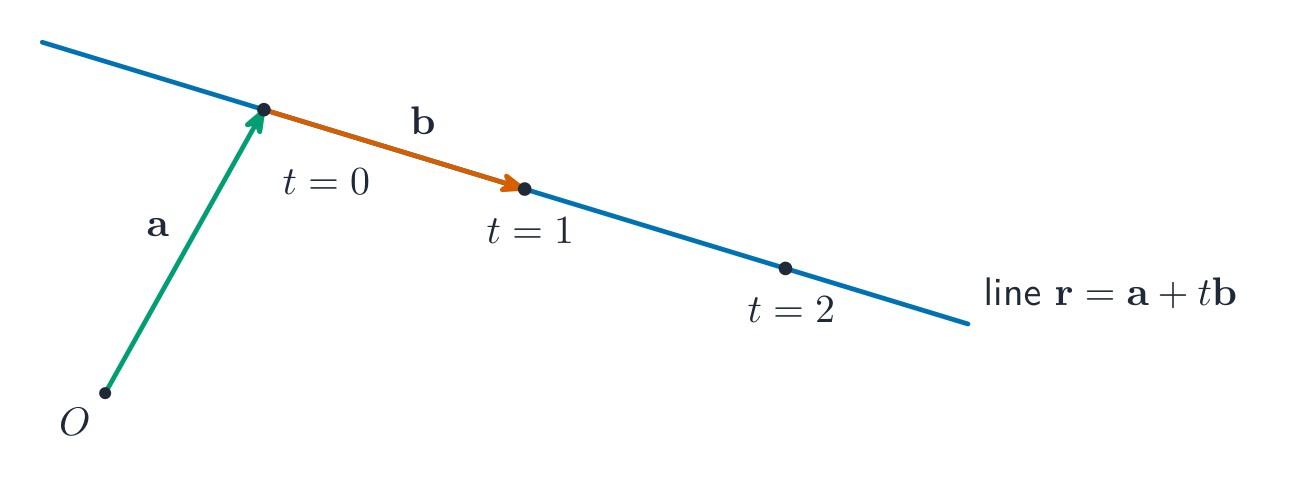
Start at the point $\mathbf{a}$, then add $t$ copies of the direction $\mathbf{b}$ to reach any point on the line. The scalar product 数量积 (dot product) of $\mathbf{a}$ and $\mathbf{b}$ is
$$\mathbf{a}\cdot\mathbf{b} = a_1 b_1 + a_2 b_2 + a_3 b_3 = |\mathbf{a}|\,|\mathbf{b}|\cos\theta,$$where $\theta$ is the angle between them. So $\mathbf{a}\cdot\mathbf{b} = 0$ means the vectors are perpendicular.
The scalar product picks out $|\mathbf{b}|\cos\theta$, how far $\mathbf{b}$ reaches along $\mathbf{a}$. Worked example. Find the angle between $\mathbf{a} = \mathbf{i} + 2\mathbf{j} + 2\mathbf{k}$ and $\mathbf{b} = 2\mathbf{i} + 2\mathbf{j} + \mathbf{k}$.
$$\mathbf{a}\cdot\mathbf{b} = (1)(2) + (2)(2) + (2)(1) = 8, \qquad |\mathbf{a}| = |\mathbf{b}| = 3.$$So $\cos\theta = \dfrac{8}{3\times 3} = \dfrac{8}{9}$, giving $\theta = 27.3^\circ$.Explore · חקורAdding vectors and the dot product · חיבור וקטורים ומכפלה נקודתית
Drag the two vectors. See the resultant (tip-to-tail) and the dot product, which is zero when they are perpendicular. · גרור את שני הווקטורים. ראה את ה-ווקטור התוצא (משוף-לראש) ואת המכפלה הנקודתית, המוגדרת כאפס כאשר הם מאונכים זה לזה.
Vocabulary · מילון מונחים Train · אימוןEnglish עברית vector/ˈvektə/ מסיר מחלות magnitude/ˈmæɡnɪtjuːd/ גודל unit vector/ˈjuːnɪt ˈvektə/ וקטור יחידה position vector/pəˈzɪʃn ˈvektə/ וקטור מיקום displacement vector/dɪˈspleɪsmənt ˈvektə/ וקטור תזוזה scalar/ˈskeɪlə/ סקאלר parallel/ˈpærəlel/ מקביל intersect/ˌɪntəˈsekt/ נחתך skew lines/skjuː laɪnz/ קווים אל-שטוחיים scalar product/ˈskeɪlə ˈprɒdʌkt/ כפלה סקלרית 3.8
Differential equations

Syllabus · סיילבוס
EnglishCandidates should be able to: Notes and examples formulate a simple statement involving a rate of change as a differential equation The introduction and evaluation of a constant of proportionality, where necessary, is included. find by integration a general form of solution for a first order differential equation in which the variables are separable Including any of the integration techniques from topic 3.5 above. use an initial condition to find a particular solution interpret the solution of a differential equation in the context of a problem being modelled by the equation. Where a differential equation is used to model a 'real-life' situation, no specialised knowledge of the context will be required. עבריתהמועמדים אמורים להיות מסוגלים: הערות לדוגמאות לניסוח ביטוי פשוט המעורב בקצב שינוי כמשוואה דיפרנציאלית ההקדמה והחישוב של קבוע פרופורציונליות, כאשר נדרש, נכללים. למצוא באינטגרציה צורה כללית של פתרון עבור משוואה דיפרנציאלית מסדר ראשון שבה המשתנים ניתנים להפרדה כולל כל אחת מטכניקות האינטגרציה מתחום 3.5 לעיל. להשתמש בתנאי התחלתי כדי למצוא פתרון פרטי לפרש את הפתרון של משוואה דיפרנציאלית בהקשר של בעיה המודל על ידי המשוואה. כאשר משוואה דיפרנציאלית משמשת למודל מצב 'מעשי', אין נדרשת ידע ספציפי בהקשר. Source: Cambridge International syllabus · מקור: הסיילבוס הבינלאומי של קמבריד'ג'
A differential equation 微分方程 links a quantity to its rate of change. To solve a first-order equation whose variables are separable 可分离变量, put all the $y$ terms on one side and all the $x$ terms on the other, then integrate both sides. This gives the general solution 通解, which contains a constant. An initial condition 初始条件 (a known value) fixes the constant and gives the particular solution 特解.
Worked example. Solve $\dfrac{dy}{dx} = xy$, given that $y = 1$ when $x = 0$.
Separate the variables and integrate:
$$\int \frac{1}{y}\,dy = \int x\,dx \;\Rightarrow\; \ln y = \tfrac12 x^2 + c \;\Rightarrow\; y = A e^{x^2/2}.$$Using $y = 1$ at $x = 0$ gives $A = 1$, so $y = e^{x^2/2}$.The constant $A$ gives a whole family of curves; the condition $y=1$ at $x=0$ selects $y=e^{x^2/2}$. Explore · חקורA slope field · שדה שיפועים
Each little line shows the gradient $\frac{dy}{dx}$ there. A solution curve follows the arrows — change the starting point to see a different one. · כל קו קטן מייצג את השיפוע $\frac{dy}{dx}$ בנקודה זו. עקומת פתרון עוקבת אחרי החצים — שינה את נקודת ההתחלה כדי לראות עקומה אחרת.
Vocabulary · מילון מונחים Train · אימוןEnglish עברית differential equation/ˌdɪfəˈrenʃl ɪˈkweɪʒn/ משוואה דיפרנציאלית separable/ˈsepərəbl/ ניתן להפרדה general solution/ˈdʒenərəl səˈluːʃn/ פתרון כללי initial condition/ɪˈnɪʃl kənˈdɪʃn/ תנאי התחלה particular solution/pəˈtɪkjʊlə səˈluːʃn/ פתרון פרטי 3.9
Complex numbers

Syllabus · סיילבוס
EnglishCandidates should be able to: Notes and examples understand the idea of a complex number, recall the meaning of the terms real part, imaginary part, modulus, argument, conjugate, and use the fact that two complex numbers are equal if and only if both real and imaginary parts are equal Notations $\text{Re } z$, $\text{Im } z$, $|z|$, $\arg z$, $z^*$ should be known. The argument of a complex number will usually refer to an angle $\theta$ such that $-\pi < \theta \leqslant \pi$, but in some cases the interval $0 \leqslant \theta < 2\pi$ may be more convenient. Answers may use either interval unless the question specifies otherwise. carry out operations of addition, subtraction, multiplication and division of two complex numbers expressed in Cartesian form $x + \text{i}y$ For calculations involving multiplication or division, full details of the working should be shown. use the result that, for a polynomial equation with real coefficients, any non-real roots occur in conjugate pairs e.g. in solving a cubic or quartic equation where one complex root is given. represent complex numbers geometrically by means of an Argand diagram carry out operations of multiplication and division of two complex numbers expressed in polar form $r(\cos \theta + \text{i}\sin \theta) \equiv r\text{e}^{\text{i}\theta}$ Including the results $|z_1 z_2| = |z_1||z_2|$ and $\arg(z_1 z_2) = \arg(z_1) + \arg(z_2)$, and corresponding results for division. find the two square roots of a complex number e.g. the square roots of $5 + 12\text{i}$ in exact Cartesian form. Full details of the working should be shown. understand in simple terms the geometrical effects of conjugating a complex number and of adding, subtracting, multiplying and dividing two complex numbers illustrate simple equations and inequalities involving complex numbers by means of loci in an Argand diagram e.g. $|z - a| < k$, $|z - a| = |z - b|$, $\arg(z - a) = \alpha$. עבריתהמועמדים אמורים להיות מסוגלים: הערות לדוגמאות הבנת רעיון של מספר מרוכב, זיכרון משמעות המונחים חלק ממשי, חלק מדומה, מודולוס, ארגומנט, צמוד, והשתמש בעובדה ששני מספרים מרוכבים שווים אם ורק אם גם החלק הממשי וגם החלק המדומה שלהם שווים יש להכיר את הסימונים $\text{Re } z$, $\text{Im } z$, $|z|$, $\arg z$, $z^*$. הארגומנט של מספר מרוכב יתייחס בדרך כלל לזווית $\theta$ כך ש$-\pi < \theta \leqslant \pi$, אך במקרים מסוימים התחום $0 \leqslant \theta < 2\pi$ עשוי להיות נוח יותר. תשובות עשויות להשתמש בתחום כלשהו אלא אם כן השאלה ציינה אחרת. לבצע פעולות של חיבור, חיסור, כפל וחילוק בין שני מספרים מרוכבים המופיעים בצורת קרטזית $x + \text{i}y$ עבור חישובים הכוללים כפל או חילוק, יש להציג את כל פרטי הפעולה. להשתמש בתוצאה לפיה, במשוואה פולינומית בעלת מקדמים ממשיים, שורשים לא-ממשיים מופיעים תמיד בזוגות צמודים לדוגמה: בפתרון משוואה מעריכית או רביעית כאשר נתון אחד השורשים המרוכבים. לייצג מספרים מרוכבים גיאומטרית באמצעות דיאגרמת ארגנד לבצע פעולות של כפל וחילוק בין שני מספרים מרוכבים המופיעים בצורה קוטבית $r(\cos \theta + \text{i}\sin \theta) \equiv r\text{e}^{\text{i}\theta}$ כולל התוצאות $|z_1 z_2| = |z_1||z_2|$ ו$\arg(z_1 z_2) = \arg(z_1) + \arg(z_2)$, והתוצאות המקבילות לחילוק. למצוא את שני השורשים הריבועיים של מספר מרוכב לדוגמה: השורשים הריבועיים של $5 + 12\text{i}$ בצורת קרטזית מדויקת. יש להציג את כל פרטי הפעולה. להבין בפשטות את ההשפעות הגיאומטריות של הצמדת מספר מרוכב, ושל חיבור, חיסור, כפל וחילוק בין שני מספרים מרוכבים להמחיש משוואות ואי-שוויונות פשוטים הקשורים למספרים מרוכבים באמצעות מקומות גיאומטריים בדיאגרמת ארגנד לדוגמה: $|z - a| < k$, $|z - a| = |z - b|$, $\arg(z - a) = \alpha$. Source: Cambridge International syllabus · מקור: הסיילבוס הבינלאומי של קמבריד'ג'
Multiplying complex numbers: lengths multiply, angles add Multiplying by i is a rotation Self-similar patterns like Romanesco arise from iterating functions in the complex plane. A complex number 复数 has the form $z = x + iy$, where $i^2 = -1$. Here $x$ is the real part 实部 and $y$ is the imaginary part 虚部. This $x + iy$ is the Cartesian form 直角坐标形式. Two complex numbers are equal only when their real parts match and their imaginary parts match.
- The conjugate 共轭 of $z = x + iy$ is $z^* = x - iy$. For a polynomial with real coefficients, any non-real roots come in conjugate pairs.
- The modulus 模 is $|z| = \sqrt{x^2 + y^2}$ (its distance from the origin) and the argument 辐角 is the angle the point makes, measured from the positive real axis.
- You can plot $z$ as a point on an Argand diagram 阿干图 (the complex plane).
- The polar form 极坐标形式 is $z = r(\cos\theta + i\sin\theta) = re^{i\theta}$, where $r = |z|$ and $\theta$ is the argument. Multiplying multiplies the moduli and adds the arguments.
- The loci of points satisfying a condition on $z$ are drawn on the Argand diagram — e.g. $|z - a| = r$ is a circle, $|z - a| = |z - b|$ a perpendicular bisector, and $\arg(z - a) = \theta$ a half-line. The square roots of a complex number come from solving $w^2 = z$.

On the Argand diagram $|z|$ is the distance from $O$, $\arg z$ the angle, and $z^{*}$ the reflection in the real axis. To divide, multiply top and bottom by the conjugate of the bottom.
Worked example. Write $\dfrac{3 + i}{1 - i}$ in the form $x + iy$.
$$\frac{3 + i}{1 - i} = \frac{(3 + i)(1 + i)}{(1 - i)(1 + i)} = \frac{3 + 3i + i + i^2}{1 + 1} = \frac{2 + 4i}{2} = 1 + 2i.$$An equation or inequality in $z$ describes a locus 轨迹 (a path or region) on the Argand diagram. For example $|z - a| = r$ is a circle of radius $r$ centred at $a$.

$|z-a|=r$ is the set of points a fixed distance $r$ from $a$ — a circle. Explore · חקורThe Argand diagram · דיאגרמת ארגנד
Drag the point. A complex number $a + bi$ is a point on the plane; its modulus is the distance from the origin and its argument is the angle. · גרור את הנקודה. מספר מרוכב $a + bi$ הוא נקודה במישור; המודולוס שלו הוא המרחק מהראשית ו-הארגומנט הוא הזווית.
Vocabulary · מילון מונחים Train · אימוןEnglish עברית complex number/ˈkɒmpleks ˈnʌmbə/ מספר מרוכב real part/rɪəl pɑːt/ חלק ממשי imaginary part/ɪˈmædʒɪnəri pɑːt/ חלק מדומה Cartesian form/kɑːˈtiːzɪən fɔːm/ צורה קרטוזית conjugate/ˈkɒndʒuːɡeɪt/ זוגי modulus/ˈmɒdjʊləs/ מודולוס argument/ˈɑːɡjuːmənt/ ארגומנט Argand diagram/ˈɑːɡænd ˈdaɪəɡræm/ דיאגרמת ארגנד polar form/ˈpəʊlə fɔːm/ צורה פולרית locus/ˈləʊkəs/ לוקוס 3.9
Exam tips
- Split a rational function into partial fractions before integrating or expanding.
- Choose the right integration technique (substitution, by parts, or partial fractions) from the form of the integrand.
- Use the scalar (dot) product for the angle between vectors and to test for perpendicularity; write a line as $\mathbf{r} = \mathbf{a} + t\mathbf{b}$.
- Give complex numbers in the form asked for (Cartesian or modulus-argument) and show them on an Argand diagram.
-
4
Mechanics · מכניקה
Watch lesson · צפה בשיעורEnglishThis handout covers Topic 4: Mechanics 力学. It studies how forces make objects move. Throughout this topic, take the acceleration of free fall as $g = 10\ \text{m s}^{-2}$.
עבריתחומר הדף עוסק בנושא 4: מכניקה. הוא לומד כיצד כוחות גורמים לגוף להזז. לאורך נושא זה, קבל את תאוצת הנפילה החופשית כ$g = 10\ \text{m s}^{-2}$.
4.1
Forces and equilibrium · כוחות ואיזון

Syllabus · סיילבוס
EnglishCandidates should be able to: Notes and examples identify the forces acting in a given situation e.g. by drawing a force diagram. understand the vector nature of force, and find and use components and resultants Calculations are always required, not approximate solutions by scale drawing. use the principle that, when a particle is in equilibrium, the vector sum of the forces acting is zero, or equivalently, that the sum of the components in any direction is zero Solutions by resolving are usually expected, but equivalent methods (e.g. triangle of forces, Lami's Theorem, where suitable) are also acceptable; these other methods are not required knowledge, and will not be referred to in questions. understand that a contact force between two surfaces can be represented by two components, the normal component and the frictional component use the model of a 'smooth' contact, and understand the limitations of this model understand the concepts of limiting friction and limiting equilibrium, recall the definition of coefficient of friction, and use the relationship $F = \mu R$ or $F \leqslant \mu R$, as appropriate Terminology such as 'about to slip' may be used to mean 'in limiting equilibrium' in questions. use Newton's third law. e.g. the force exerted by a particle on the ground is equal and opposite to the force exerted by the ground on the particle. עבריתהמועמדים אמורים להיות מסוגלים: הערות לדוגמאות לזהות את הכוחות הפועלים במצב נתון לדוגמה: על ידי ציור דיאגרמת כוחות. להבין את האופי הווקטורי של הכוח, ולמצוא ולהשתמש ברכיבים ובתוצרים נדרשים חישובים תמיד, ולא פתרונות מקורבים באמצעות ציור בקנה מידה. להשתמש בעיקרון לפיו, כאשר חלקיק נמצא באיזון, הסכום הוקטורי של הכוחות הפועלים הוא אפס, או בשווה לכך, שהסכום הרכיבים בכל כיוון הוא אפס בדרך כלל מצופים פתרונות באמצעות פירוק, אך שיטות מקבילות (לדוגמה: משולש כוחות, משפט למי, כאשר מתאים) מתקבלות גם כן; שיטות אלו אינן נדרשות ידע, ולא ייזכרו בשאלות. להבין שכוח מגע בין משטחים שניים ניתן לייצוג על ידי שני רכיבים, הרכיב הנורמלי והרכיב החיכוקי להשתמש בדגם של 'מגע חלק', ולהבין את הגבולות של דגם זה להבין את המושגים של חיכוך סופי ואיזון סופי, לשחזר את ההגדרה של מקדם החיכוך, ולהשתמש בקשר $F = \mu R$ או $F \leqslant \mu R$, בהתאם עשוי להשתמש במונח 'בסכנת החלקה' כדי להתייחס ל'איזון סופי' בשאלות. להשתמש בחוק השלישי של ניוטון. לדוגמה: הכוח שמפעיל חלקיק על הקרקע שווה בכמותו והפוך בכיוונו לכוח שמפעיל הקרקע על החלקיק. Source: Cambridge International syllabus · מקור: הסיילבוס הבינלאומי של קמבריד'ג'
EnglishA force 力 is a push or a pull. It is a vector, so it has size and direction. Because it is a vector, you can split a force into components 分量 (usually horizontal and vertical), and you can add several forces into one resultant 合力.
A particle is in equilibrium 平衡 when the forces are balanced: the vector sum of the forces is zero. In practice this means the components in any direction add to zero.
Friction
When two surfaces touch, the contact force 接触力 between them has two parts: the normal reaction 法向反作用力 $R$, at right angles to the surface, and the friction 摩擦力 $F$, along the surface, which opposes sliding. A "smooth" surface is a model with no friction.
Friction can only grow up to a maximum. At that maximum the body is in limiting equilibrium 极限平衡, about to slip, and the friction is limiting friction 最大静摩擦力. The maximum is set by the coefficient of friction 摩擦系数 $\mu$:
$$F \leqslant \mu R, \qquad \text{with } F = \mu R \text{ at the point of slipping}.$$By Newton's third law 牛顿第三定律, the two surfaces push on each other with equal and opposite forces.
Worked example. A block of weight $20\text{ N}$ rests on a rough horizontal table with coefficient of friction $\mu = 0.4$. Find the largest horizontal force that can be applied before the block slides.
The table's normal reaction balances the weight, so $R = 20\text{ N}$. The block is on the point of slipping when friction reaches its maximum $F = \mu R = 0.4 \times 20 = 8\text{ N}$. In equilibrium the applied force equals the friction, so the largest force it can resist is $8\text{ N}$.
עבריתכוח הוא דחיפה או משיכה. זהו וקטור, ולכן יש לו גודל וכיוון. מכיוון שהוא וקטור, ניתן לפצל כוח ל-רכיבים (בדרך כלל רכיב אנכי ורכיב אופקי), ולסכום מספר כוחות ל-כוח resultant אחד.
כוח בזווית $\theta$ כולל חלק אופקי $F\cos\theta$ וחלק אנכי $F\sin\theta$. נקודה נמצאת ב-איזון כאשר הכוחות מאוזנים: הסכום הווקטורי של הכוחות הוא אפס. בפועל, המשמעות היא שהרכיבים בכל כיוון מתאפסים.

כל בעיית מכניקה היא תמונה כזו. שלושה כוחות פועלים על המטפס — משקל הישר למטה, מתח לאורך הרצועה, ודחיפה מהסל — ומכיוון שהם מאוזנים, המטפס תלוי בשקט באיזון. פירוק כל כוח לחלקים אנכיים ואופקיים ממיר את התמונה למשוואות חיכוך
כששתי משטחים נוגעים, ל-כוח המגע ביניהם יש שני חלקים: תגובה נורמלית $R$, מאונכת למשטח, וחיכוך $F$, לאורך המשטח, שמונע החלקה. משטח "חלק" הוא מודל שאין בו חיכוך.
החיכוך יכול לגדול רק עד למקסימום. במקסימום הזה הגוף נמצא ב-איזון סופי, מוכן להחליק, והחיכוך הוא חיכוך סופי. המקסימום נקבע על ידי מקדם החיכוך $\mu$:
$$F \leqslant \mu R, \qquad \text{with } F = \mu R \text{ at the point of slipping}.$$
על משטח מחוספסת, כוח המגע מתפרק לתגובה נורמלית $R$ ולחיכוך $F$ (עד מקסימום $\mu R$). על פי חוק השלישי של ניוטון, שני המשטחים דוחפים זה את זה בכוחות שווים ובניגודים.
דוגמה מופיעה. בלוק במשקל $20\text{ N}$ מנוח על שולחן אופקי מחוספסת עם מקדם חיכוך $\mu = 0.4$. מצא את הכוח האופקי הגדול ביותר שיכול להיות מופעל לפני שהבלוק מחליק.
התגובה הנורמלית של השולחן מאזנת את המשקל, לכן $R = 20\text{ N}$. הבלוק על סף החלקה כאשר החיכוך מגיע למקסימום $F = \mu R = 0.4 \times 20 = 8\text{ N}$. באיזון, הכוח המופעל שווה לחיכוך, ולכן הכוח הגדול ביותר שהוא יכול לעמוד הוא $8\text{ N}$.
Explore · חקורAdding forces · חיבור כוחות
resultant = a + b · הכוח השקול = a + b
Forces add tip-to-tail. They are in equilibrium when the resultant is zero. · כוחות מתחברים ראש-לאחור. הם באיזון כאשר הכוח השקול הוא אפס.
Vocabulary · מילון מונחים Train · אימוןEnglish עברית Mechanics/mɪˈkænɪks/ מכניקה force/fɔːs/ כוח components/kəmˈpəʊnənts/ רכיבים resultant/rɪˈzʌltənt/ כוח נتيج equilibrium/ˌiːkwɪˈlɪbrɪəm/ איזון contact force/ˈkɒntækt fɔːs/ כוח מגע normal reaction/ˈnɔːml rɪˈækʃn/ תגובה נורמלית friction/ˈfrɪkʃn/ חיכוך limiting friction/ˈlɪmɪtɪŋ ˈfrɪkʃn/ שחיקה סופית coefficient of friction/ˌkəʊɪˈfɪʃənt ɒv ˈfrɪkʃn/ מקדם חיכוך Newton's third law/ˈnjuːtnz θɜːd lɔː/ חוק השלישי של ניוטון distance/ˈdɪstəns/ מרחק speed/spiːd/ מהירות displacement/dɪˈspleɪsmənt/ הזזה 4.2
Kinematics of motion in a straight line · קינמטיקה של תנועה בקו ישר

Syllabus · סיילבוס
EnglishCandidates should be able to: Notes and examples understand the concepts of distance and speed as scalar quantities, and of displacement, velocity and acceleration as vector quantities Restricted to motion in one dimension only. The term 'deceleration' may sometimes be used in the context of decreasing speed. sketch and interpret displacement–time graphs and velocity–time graphs, and in particular appreciate that – the area under a velocity–time graph represents displacement, – the gradient of a displacement–time graph represents velocity, – the gradient of a velocity–time graph represents acceleration use differentiation and integration with respect to time to solve simple problems concerning displacement, velocity and acceleration Calculus required is restricted to techniques from the content for Paper 1: Pure Mathematics 1. use appropriate formulae for motion with constant acceleration in a straight line. Questions may involve setting up more than one equation, using information about the motion of different particles. עבריתהמועמדים אמורים להיות מסוגלים: הערות לדוגמאות להבין את המושגים של מרחק ומהירות כמוערכים סקלאריים, ושל הזחה, מהירות ותאוצה כמוערכים ווקטוריים מוגבל לתנועה בממד אחד בלבד. המונח 'האטה' עשוי לעיתים להשתמש בהקשר של ירידה במהירות. לעלות גרפים של הזחה–זמן ומהירות–זמן ולפרש אותם, ובמיוחד להבין כי – השטח מתחת לגרף מהירות–זמן מייצג הזחה, – השיפוע של גרף הזחה–זמן מייצג מהירות, – השיפוע של גרף מהירות–זמן מייצג תאוצה להשתמש בגזירה ואינטגרציה ביחס לזמן לפתרון בעיות פשוטות הקשורות להזחה, מהירות ותאוצה הקלקולוס הנדרש מוגבל לטכניקות מתוכן של Paper 1: Pure Mathematics 1. להשתמש בנוסחאות המתאימות לתנועה עם תאוצה קבועה בקו ישר. שאלות עשויות לכלול הערכת יותר ממשוואה אחת, בהשתמשת במידע על תנועת חלקיקים שונים. Source: Cambridge International syllabus · מקור: הסיילבוס הבינלאומי של קמבריד'ג'
EnglishDistance 距离 and speed 速率 are scalars (size only). Displacement 位移, velocity 速度 and acceleration 加速度 are vectors (size and direction).
On a velocity-time graph 速度时间图, the area under the graph is the displacement and the gradient is the acceleration (a negative acceleration is a deceleration 减速度). On a displacement-time graph, the gradient is the velocity. More generally, differentiate with respect to time to go from displacement to velocity to acceleration, and integrate to go back.
For motion with constant acceleration 匀加速, use these formulae (the "suvat" equations):
$$v = u + at, \qquad s = ut + \tfrac12 at^2, \qquad v^2 = u^2 + 2as, \qquad s = \tfrac12(u + v)t.$$Worked example. A car starts from rest and accelerates at $2.5\ \text{m s}^{-2}$ for $4\ \text{s}$. Find its speed and the distance travelled.
$$v = 0 + 2.5\times 4 = 10\ \text{m s}^{-1}, \qquad s = 0 + \tfrac12(2.5)(4^2) = 20\ \text{m}.$$עבריתמרחק ומהירות הם סקלרים (גודל בלבד). הזזה, מהירות ותאוצה הם וקטורים (גודל וכיוון).
בגרף מהירות-זמן, השטח מתחת לגרף הוא ההזזה והשיפוע הוא התאוצה (תאוצה שלילית היא האטה). בגרף הזזה-זמן, השיפוע הוא המהירות. באופן כללי יותר, גזרו לפי הזמן כדי לעבור מהזזה למהירות ולאחר מכן לתאוצה, ואמננו כדי לחזור.
השטח הצלול מספק את המרחק שנסע; השיפוע של הקו מספק את התאוצה. עבור תנועה עם האצה קבועה, השתמש בנוסחאות אלו (משוואות "suvat"):
$$v = u + at, \qquad s = ut + \tfrac12 at^2, \qquad v^2 = u^2 + 2as, \qquad s = \tfrac12(u + v)t.$$דוגמה פותרת. רכב מתחיל ממצב רכישה ומאיץ ב$2.5\ \text{m s}^{-2}$ במשך $4\ \text{s}$. מצאו את מהירותו ואת המרחק שנסע.
$$v = 0 + 2.5\times 4 = 10\ \text{m s}^{-1}, \qquad s = 0 + \tfrac12(2.5)(4^2) = 20\ \text{m}.$$Explore · חקורVelocity–time graph · גרף מהירות-זמן
Change the start velocity and acceleration. The gradient is the acceleration; the area under the line is the displacement. · שנה את מהירות ההתחלה והתאוצה. השיפוע הוא התאוצה; השטח מתחת לקו הוא ההזחה.
Vocabulary · מילון מונחים Train · אימוןEnglish עברית velocity/vəˈlɒsɪti/ מהירות וקטורית acceleration/əkˌseləˈreɪʃn/ תאוצה velocity-time graph/vəˈlɒsɪti taɪm ɡræf/ גרף מהירות-זמן constant acceleration/ˈkɒnstənt əkˌseləˈreɪʃn/ תאוצה קבועה 4.3
Momentum · תנע

Syllabus · סיילבוס
EnglishCandidates should be able to: Notes and examples use the definition of linear momentum and show understanding of its vector nature For motion in one dimension only. use conservation of linear momentum to solve problems that may be modelled as the direct impact of two bodies. Including direct impact of two bodies where the bodies coalesce on impact. Knowledge of impulse and the coefficient of restitution is not required. עבריתהמועמדים אמורים להיות מסוגלים: הערות לדוגמאות להשתמש בהגדרת תנע ליניארי ולהראות הבנה של אופיו הווקטורי לתנועה בממד אחד בלבד. להשתמש בשימור התנע הליניארי לפתרון בעיות שיכולות להיות מודליות כהתנגשות ישירה בין שני גוף. כולל התנגשות ישירה בין שני גוף כאשר הגופים מתחברים זה לזה בהתנגשות. ידע באימפולס ובמקדם ההחזרה אינו נדרש. Source: Cambridge International syllabus · מקור: הסיילבוס הבינלאומי של קמבריד'ג'
EnglishThe linear momentum 动量 of a body is $\text{mass} \times \text{velocity}$. It is a vector. In a direct collision of two bodies, the total momentum is unchanged. This is the conservation of linear momentum 动量守恒:
$$m_1 u_1 + m_2 u_2 = m_1 v_1 + m_2 v_2.$$Worked example. A body of mass $2\ \text{kg}$ moving at $3\ \text{m s}^{-1}$ hits a stationary body of mass $1\ \text{kg}$, and they stick together. Find their common speed afterwards.
$$2(3) + 1(0) = (2 + 1)v \;\Rightarrow\; v = \frac{6}{3} = 2\ \text{m s}^{-1}.$$עבריתסדרת ניווט מדגימה שימור תנע בהתנגשויות. התנע הליניארי של גוף הוא $\text{mass} \times \text{velocity}$. זהו וקטור. בהתנגשות ישירה בין שני גופים, התנע הכולל אינו משתנה. זוהי שימור התנע הליניארי:
$$m_1 u_1 + m_2 u_2 = m_1 v_1 + m_2 v_2.$$
התנע הכולל הוא אותו דבר לפני ואחרי ההתנגשות. דוגמה פותרת. גוף בעל מסה $2\ \text{kg}$ הנע במהירות $3\ \text{m s}^{-1}$ פוגע בגוף עומד בעל מסה $1\ \text{kg}$, והם נדבקים יחד. מצאו את המהירות המשותפת שלהם לאחר מכן.
$$2(3) + 1(0) = (2 + 1)v \;\Rightarrow\; v = \frac{6}{3} = 2\ \text{m s}^{-1}.$$Explore · חקורA collision · פגישה
Set each mass and speed and collide them. Total momentum stays the same before and after. · הגדר את המסה ומהירות כל גוף והתרסק אותם. התנע הכולל נשאר זהה לפני ואחרי התנגשות.
Vocabulary · מילון מונחים Train · אימוןEnglish עברית momentum/məʊˈmentəm/ תנע conservation of momentum/ˌkɒnsəˈveɪʃn ɒv məʊˈmentəm/ שימור תנע Newton's laws of motion/ˈnjuːtnz lɔːz ɒv ˈməʊʃn/ חוקי ניוטון לתנועה mass/mæs/ מסה weight/weɪt/ משקל tension/ˈtenʃn/ מתח 4.4
Newton's laws of motion · חוקי התנועה של ניוטון

Syllabus · סיילבוס
EnglishCandidates should be able to: Notes and examples • apply Newton’s laws of motion to the linear motion of a particle of constant mass moving under the action of constant forces, which may include friction, tension in an inextensible string and thrust in a connecting rod If any other forces resisting motion are to be considered (e.g. air resistance) this will be indicated in the question. • use the relationship between mass and weight $W = mg$. In this component, questions are mainly numerical, and use of the approximate numerical value $10\text{ (ms}^{-2}\text{)}$ for $g$ is expected. • solve simple problems which may be modelled as the motion of a particle moving vertically or on an inclined plane with constant acceleration Including, for example, motion of a particle on a rough plane where the acceleration while moving up the plane is different from the acceleration while moving down the plane. • solve simple problems which may be modelled as the motion of connected particles. e.g. particles connected by a light inextensible string passing over a smooth pulley, or a car towing a trailer by means of either a light rope or a light rigid tow-bar. עבריתהמועמדים אמורים להיות מסוגלים: הערות לדוגמאות • להפעיל את חוקי ניוטון לתנועה על תנועה ליניארית של חלקיק בעל מסה קבועה הנע בתחתית פעולת כוחות קבועים, שיכללו עשויה להיות חיכוך, מתח בחוט שאינו ניתן למתיחה וכוח דחיפה במוט חיבור אם יש לקחת בחשבון כוחות נוספים המתנגדים לתנועה (למשל התנגדות אוויר) הדבר יצויין בשאלה. • להשתמש בקשר בין מסה לבין משקל $W = mg$. ברכיב זה, השאלות הן בעיקר מספריות, ומצופה שימוש בערך המספרי המשוער $10\text{ (ms}^{-2}\text{)}$ עבור $g$. • לפתור בעיות פשוטות שיכולות להיות מודליות כתנועת חלקיק הנע אנכית או על משטח שיפל עם תאוצה קבועה כולל, לדוגמה, תנועת חלקיק על משטח מחוספס שבו התאוצה בזמן העלייה על המישור שונה מהתאוצה בזמן הירידה על המישור. • לפתור בעיות פשוטות שיכולות להיות מודליות כתנועת חלקיקים מחוברים. לדוגמה: חלקיקים מחוברים בחוט קל שאינו ניתן למתיחה העובר על גלגלת חלקה, או רכב שמושך קרון באמצעות חבל קל או מוט גרירה קל וקשיח. Source: Cambridge International syllabus · מקור: הסיילבוס הבינלאומי של קמבריד'ג'
EnglishNewton's laws of motion 牛顿运动定律 connect force and acceleration. The key one is: resultant force $=$ mass 质量 $\times$ acceleration,
$$F = ma.$$The weight 重力 of a body is the force of gravity on it: $W = mg$. Forces in a problem may include weight, friction, tension 张力 in a string, the thrust 推力 (push) in a rod, and air resistance 空气阻力.For motion on an inclined plane 斜面, split each force into a part along the slope and a part at right angles to it, then apply $F = ma$ along the slope. For connected particles 连接质点 (joined by a string), apply $F = ma$ to each body, or to the whole system.
Worked example. A block of mass $12\ \text{kg}$ is pulled up a rough plane by a rope parallel to the slope. The plane is at $20^\circ$ to the horizontal, the coefficient of friction is $0.4$, and the acceleration is $2\ \text{m s}^{-2}$. Find the tension in the rope.
The normal reaction is $R = mg\cos 20^\circ = 120\cos 20^\circ = 112.8\ \text{N}$, so the friction is $F = \mu R = 0.4 \times 112.8 = 45.1\ \text{N}$. Along the slope, $T - mg\sin 20^\circ - F = ma$:
$$T = ma + mg\sin 20^\circ + F = 12(2) + 120\sin 20^\circ + 45.1 = 24 + 41.0 + 45.1 = 110\ \text{N (3 s.f.)}.$$עבריתחוקי התנועה של ניוטון מקשרים בין כוח לתאוצה. החוק המרכזי הוא: כוח תוצרת $=$ מסה $\times$ תאוצה,
$$F = ma.$$משקלו של גוף הוא הכוח הכבידתי הפועל עליו: $W = mg$. כוחות בבעיה עשויות לכלול משקל, חיכוך, מתח בחוט, דחיפה (דחיפה) בקורה, ועמידת אוויר.בתנועה על מדרון, חלקו כל כוח למרכיב לאורך המדרון ולמרכיב מאונך אליו, ואז יישמו $F = ma$ לאורך המדרון. עבור חלקיקים מחוברים (מחוברים בחוט), יישמו $F = ma$ לכל גוף או לכל המערכת.
על מדרון, פתחו את הכוחות לאורך המדרון ולאנכי אליו. דוגמה פותרת. בלוק בעל מסה $12\ \text{kg}$ נמשך מעלה על מדרון מחוספס על ידי חבל המקביל למדרון. המדרון נמצא בזווית $20^\circ$ לאופק, מקדם החיכוך הוא $0.4$, והתאוצה היא $2\ \text{m s}^{-2}$. מצאו את המתח בחבל.
התגובה הנורמלית היא $R = mg\cos 20^\circ = 120\cos 20^\circ = 112.8\ \text{N}$, ולכן החיכוך הוא $F = \mu R = 0.4 \times 112.8 = 45.1\ \text{N}$. לאורך המדרון, $T - mg\sin 20^\circ - F = ma$:
$$T = ma + mg\sin 20^\circ + F = 12(2) + 120\sin 20^\circ + 45.1 = 24 + 41.0 + 45.1 = 110\ \text{N (3 s.f.)}.$$Explore · חקורResultant force · כוח resultant (סכום הכוחות)
F = ma
The resultant force sets the acceleration. Balanced forces ⇒ no acceleration. · הכוח הresultant קובע את האיצול. כוחות מאוזנים ⇒ אין איצול.
Vocabulary · מילון מונחים Train · אימוןEnglish עברית inclined plane/ɪnˈklaɪnd pleɪn/ משטח משופע connected particles/kəˈnektɪd ˈpɑːtɪklz/ גופים מחוברים work done/wɜːk dʌn/ עבודה kinetic energy/kɪˈnetɪk ˈenədʒi/ אנרגיה קינטית gravitational potential energy/ˌɡrævɪˈteɪʃənl pəˈtenʃl ˈenədʒi/ אנרגיה פוטנציאלית כבידתית conservation of energy/ˌkɒnsəˈveɪʃn ɒv ˈenədʒi/ שימור אנרגיה power/ˈpaʊə/ הספק limiting equilibrium/ˈlɪmɪtɪŋ ˌiːkwɪˈlɪbrɪəm/ איזון גבולי deceleration/dɪˌseləˈreɪʃn/ האטה thrust/θrʌst/ דחיפה air resistance/eə rɪˈzɪstəns/ התנגדות אוויר 4.5
Energy, work and power · אנרגיה, עבודה והספק

Syllabus · סיילבוס
EnglishCandidates should be able to: Notes and examples • understand the concept of the work done by a force, and calculate the work done by a constant force when its point of application undergoes a displacement not necessarily parallel to the force $W = Fd \cos \theta$; Use of the scalar product is not required. • understand the concepts of gravitational potential energy and kinetic energy, and use appropriate formulae • understand and use the relationship between the change in energy of a system and the work done by the external forces, and use in appropriate cases the principle of conservation of energy Including cases where the motion may not be linear (e.g. a child on a smooth curved ‘slide’), where only overall energy changes need to be considered. • use the definition of power as the rate at which a force does work, and use the relationship between power, force and velocity for a force acting in the direction of motion Including calculation of (average) power as $$\frac{\text{Work done}}{\text{Time taken}}$$$P = Fv$.• solve problems involving, for example, the instantaneous acceleration of a car moving on a hill against a resistance. עבריתהמועמדים אמורים להיות מסוגלים: הערות לדוגמאות • להבין את מושג העבודה שנעשתה על ידי כוח, ולחשב את העבודה שנעשתה על ידי כוח קבוע כאשר נקודת הישומות שלו עוברת סטייה שאינה בהכרח מקבילה לכוח $W = Fd \cos \theta$; שימוש במכפלה סקלרית אינו נדרש. • להבין את מושגי אנרגיה פוטנציאלית כבידתית ואנרגיה קינטית, ולהשתמש בנוסחאות המתאימות • להבין ולהשתמש בקשר בין השינוי באנרגיה של מערכת לבין העבודה שנעשתה על ידי הכוחות החיצוניים, ולהשתמש במקרים המתאימים בעקרון השימור האנרגיה כולל מקרים שבהם התנועה עשויה לא להיות ליניארית (למשל ילד על 'מחליק' מעוגל וחלק), שבהם יש להתחשב רק בשינויים כוללים באנרגיה. • להשתמש בהגדרת הספק כקצב ביצוע העבודה על ידי כוח, ולהשתמש בקשר בין הספק, כוח ומהירות עבור כוח הפועל בכיוון התנועה כולל חישוב (ממוצע) הספק כ- $$\frac{\text{Work done}}{\text{Time taken}}$$$P = Fv$.• לפתור בעיות הקשורות, לדוגמה, לתאוצה מיידינה של רכב הנע על גבעה נגד התנגדות. Source: Cambridge International syllabus · מקור: הסיילבוס הבינלאומי של קמבריד'ג'
EnglishThe work done 功 by a constant force is the scalar product of force and displacement — the force times the distance moved in the direction of the force: $W = Fd\cos\theta$, where $\theta$ is the angle between the force and the motion. Work is measured in joules (J).
Energy comes in forms you can calculate:
- Kinetic energy 动能 (energy of movement): $\text{KE} = \tfrac12 mv^2$.
- Gravitational potential energy 重力势能 (energy of height): $\text{PE} = mgh$.
The work done by the outside forces equals the change in the total energy. When no friction acts, the total energy stays the same — the conservation of energy 能量守恒.
Power 功率 is the rate of doing work. For a force pulling in the direction of motion, $P = Fv$ (power $=$ force $\times$ velocity). Power is measured in watts (W).
Worked example. A car engine works at $12\ \text{kW}$ while the car moves at $20\ \text{m s}^{-1}$ on a level road. Find the driving force.
$$P = Fv \;\Rightarrow\; F = \frac{P}{v} = \frac{12000}{20} = 600\ \text{N}.$$עבריתמרכבת הרוסים ממירה אנרגיה פוטנציאלית לאנרגיה קינטית כשהיא עולה ויורדת. העבודה שנעשתה על ידי כוח קבוע היא המכפלה הסקלרית של הכוח וההזזה — הכוח כפול המרחק שהתגלגל בכיוון הכוח: $W = Fd\cos\theta$, כאשר $\theta$ הוא הזווית בין הכוח לבין התנועה. עבודה נמדדת ביחידות ג'ול (J).
אנרגיה באה בצורות שניתן לחשב:
- אנרגיה קינטית (אנרגיית תנועה): $\text{KE} = \tfrac12 mv^2$.
- אנרגיה פוטנציאלית כבידתית (אנרגיית גובה): $\text{PE} = mgh$.
העבודה שבוצעו על ידי כוחות חיצוניים שווה לשינוי באנרגיה הכוללת. כאשר אין חיכוך, האנרגיה הכוללת נשארת זהה — שימור האנרגיה.
הספק הוא קצב ביצוע העבודה. עבור כוח שמושך בכיוון התנועה, $P = Fv$ (הספק $=$ כוח $\times$ מהירות). ההספק נמדד בוואט (W).
דוגמה מופת. מנוע רכב פועל ב$12\ \text{kW}$ בעוד שהרכב נע ב$20\ \text{m s}^{-1}$ על כביש אופקי. מצאו את כוח הנגידה.
$$P = Fv \;\Rightarrow\; F = \frac{P}{v} = \frac{12000}{20} = 600\ \text{N}.$$Explore · חקורConservation of energy · שימור אנרגיה
Drop the object and watch energy change form. With no friction, GPE + KE stays constant the whole way down. · שחרר את הגוף וצפה בשינוי צורות האנרגיה. ללא חיכוך, GPE + KE נשארים קבועים לאורך כל הדרך למטה.
4.5
Exam tips · טיפים לבחינות
English- Draw a clear force diagram and resolve into perpendicular components; for equilibrium, each direction sums to zero.
- Use SUVAT only for constant acceleration and keep a consistent positive direction.
- Apply $F = ma$ along the direction of motion, including friction ($F = \mu R$) on a rough surface.
- State your assumptions (light inextensible string, smooth pulley, particle) — they are often worth a mark.
עברית- ציירו תרשים כוחות ברור ופרקו למרכיבים מאונכים; בשיווי משקל, סכום הכוחות בכל כיוון הוא אפס.
- השתמשו ב-SUVAT רק לתאוצה קבועה ושמרו על כיוון חיובי אחיד.
- יישמו את $F = ma$ לאורך כיוון התנועה, כולל חיכוך ($F = \mu R$) על פני משטח מחוספס.
- הצהירו את הנחותיכם (חוט קל ולא מתוח, גלגלת חלקה, חלקיק) — לעיתים קרובות הן זוכות לנקודה.
-
5
Probability & Statistics 1 · הסתברות וסטטיסטיקה 1
Watch lesson · צפה בשיעורEnglishThis handout covers Topic 5: Probability & Statistics 概率统计 1. It is about describing data, counting choices, and working out the chance of events.
עבריתחוברת זו מכסה נושא 5: הסתברות וסטטיסטיקה 1. מדובר בתיאור נתונים, ספירת אפשרויות וחילוף ההסתברות לאירועים.
5.1
Representation of data · היצגות נתונים

Syllabus · סיילבוס
EnglishCandidates should be able to: Notes and examples • select a suitable way of presenting raw statistical data, and discuss advantages and/or disadvantages that particular representations may have • draw and interpret stem-and-leaf diagrams, box-and-whisker plots, histograms and cumulative frequency graphs Including back-to-back stem-and-leaf diagrams. • understand and use different measures of central tendency (mean, median, mode) and variation (range, interquartile range, standard deviation) e.g. in comparing and contrasting sets of data. • use a cumulative frequency graph e.g. to estimate medians, quartiles, percentiles, the proportion of a distribution above (or below) a given value, or between two values. • calculate and use the mean and standard deviation of a set of data (including grouped data) either from the data itself or from given totals $\Sigma x$ and $\Sigma x^2$, or coded totals $\Sigma(x - a)$ and $\Sigma(x - a)^2$, and use such totals in solving problems which may involve up to two data sets. עבריתהמועמדים אמורים להיות מסוגלים: הערות לדוגמאות • לבחור בדרך מתאימה להצגת נתונים סטטיסטיים ראשוניים, לדון יתרונות ו/או חסרונות שמייצוגים מסוימים עשויים להיות להם • לצייר ול解读 דיאגרמות עמוד-עלים, תרשימי קופסה-שפך, היסטוגרמות וגרפי תדירות מצטברת כולל דיאגרמות עמוד-עלים הפוכות. • להבין ולהשתמש במדדים שונים של מרכזיות (ממוצע, חציון, מוֹד) וDispersion (מרווח, טווח רבעוני, סטיית תקן) לדוגמה: בהשוואה ובניגוד בין קבוצות נתונים. • להשתמש בגרף תדירות מצטברת לדוגמה: כדי להעריך חציונים, רבעונים, אחוזונים, את המ proportion של ההתפלגות מעל (או מתחת) לערך נתון, או בין שני ערכים. • לחשב ולהשתמש בממוצע ובסטיית התקן של קבוצת נתונים (כולל נתונים קבוצתיים) גם מהנתונים עצמם וגם ממספרים הנתונים $\Sigma x$ ו$\Sigma x^2$, או ממספרים קודדים $\Sigma(x - a)$ ו$\Sigma(x - a)^2$, ולהשתמש במספרים אלו בפתרון בעיות שיכללו עד שתי קבוצות נתונים. Source: Cambridge International syllabus · מקור: הסיילבוס הבינלאומי של קמבריד'ג'
EnglishChoose a diagram that suits the data. You should be able to draw and read:
- a stem-and-leaf diagram 茎叶图 (keeps the original values and shows the shape); two data sets are compared with a back-to-back 背靠背 version – a shared central stem, one set's leaves increasing to the left and the other's to the right, so you can compare their medians and spreads at a glance;
- a box-and-whisker plot 箱线图 (shows the lowest value, the three quartiles, and the highest value);
- a histogram 直方图 (for grouped data, where the area of each bar shows the frequency);
- a cumulative frequency 累积频数 graph (running totals, used to estimate the median and quartiles).
Averages and spread
A measure of central tendency 集中趋势 is a single "middle" value:
- the mean 平均数 $\bar{x} = \dfrac{\sum x}{n}$ (the average);
- the median 中位数 (the middle value when the data is in order);
- the mode 众数 (the most common value).
A measure of variation 离散程度 shows how spread out the data is:
- the range (of data) 极差 (highest $-$ lowest);
- the interquartile range 四分位距 (upper quartile $-$ lower quartile);
- the standard deviation 标准差 $\sigma = \sqrt{\dfrac{\sum x^2}{n} - \bar{x}^2}$.
You often work from the totals $\sum x$ and $\sum x^2$. The square of the standard deviation is the variance 方差.
Worked example. For $10$ values, $\sum x = 50$ and $\sum x^2 = 300$. Find the mean and standard deviation.
$$\bar{x} = \frac{50}{10} = 5, \qquad \sigma = \sqrt{\frac{300}{10} - 5^2} = \sqrt{30 - 25} = \sqrt{5} = 2.24.$$Coding 编码 makes big numbers easier. Replace each value by $t=x-a$ for a convenient assumed mean 假定平均数 $a$. Then $\bar{x}=a+\bar{t}$, while the standard deviation is unchanged (shifting every value does not spread the data). So from the coded totals $\sum(x-a)$ and $\sum(x-a)^2$ you get $\bar x$ and $\sigma$ directly, and two data sets can be compared through their coded totals.
עבריתבחרו גרף המתאים לנתונים. עליכם להיות מסוגלים לצייר ולקרוא:
- גרף עמוד-עלים (שומר על הערכים המקוריים ומראה את הצורה); שני קבוצות נתונים משווים עם גרף דו-צדדי – עמוד מרכזי משותף, עלי קבוצה אחת גדלים שמאלה ועלי הקבוצה השנייה ימינה, כך שתוכלו להשוות בין המדiane שלהם והתפוצה במבט ראשון;
- תרשים קופסה וזנבות (מראה את הערך הנמוך ביותר, שלושת הרבעונים והערך הגבוה ביותר);
- היסטוגרמה (לנתונים מקבוצות, כאשר השטח של כל עמודה מייצג את התדירות);
- גרף תדירות מצטברת (סיכומים רציפים, משמש להערכת המדiane ורבעונים).
עקומת תדירות מצטברת היא בצורת S; לקרוא את הממוצע החצי (המיון) באופן אופקי מול חצי התדירות הכוללת, ואת הרבעונים מתוך רביע ראשון ושלישי. 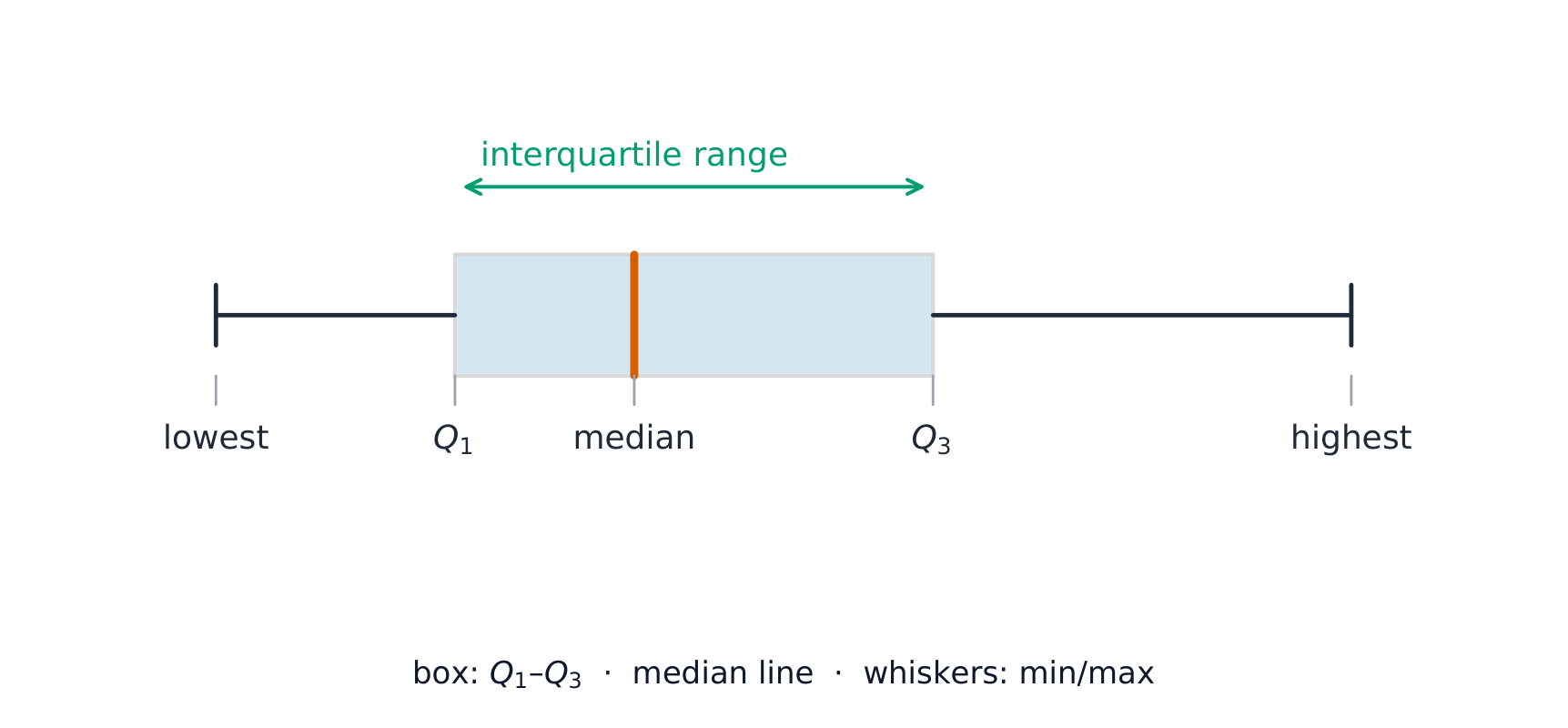
הקופסה משתרעת בין הרבעונים $Q_1$ ל$Q_3$; הזנבות מגיעים לערכים הנמוכים והגבוהים ביותר. ממוצעים פיזור
מדד מיקוד הוא ערך "אמצעי" יחיד:
- הממוצע $\bar{x} = \dfrac{\sum x}{n}$ (הממונה);
- המיון (הערך האמצעי כאשר הנתונים מסודרים);
- המודוס (הערך הנפוץ ביותר).
מדד בדידות מראה עד כמה הנתונים מפוזרים:
- הטווח (של נתונים) (הגבוה $-$ הנמוך);
- הטווח הרבעוני (רבעון עליון $-$ רבעון תחתון);
- סטיית התקן $\sigma = \sqrt{\dfrac{\sum x^2}{n} - \bar{x}^2}$.
לעיתים קרובות עובדים מהסכומים $\sum x$ ו$\sum x^2$. ריבוע סטיית התקן הוא שונות.
דוגמה פותרת. עבור $10$ ערכים, $\sum x = 50$ ו$\sum x^2 = 300$. מצאו את הממוצע ואת סטיית התקן.
$$\bar{x} = \frac{50}{10} = 5, \qquad \sigma = \sqrt{\frac{300}{10} - 5^2} = \sqrt{30 - 25} = \sqrt{5} = 2.24.$$קוד מקל על עבודה עם מספרים גדולים. החליפו כל ערך ב$t=x-a$ כדי לקבל ממוצע משוער נוח $a$. אזי $\bar{x}=a+\bar{t}$, בעוד שסטיית התקן נשארת לא משתנה (הזזת כל הערכים אינה מפזרת את הנתונים). לכן מהסכומים המקודדים $\sum(x-a)$ ו$\sum(x-a)^2$ תקבלו $\bar x$ ו$\sigma$ ישירות, וניתן להשוות בין שני קבוצות נתונים דרך הסכומים המקודדים שלהן.
Explore · חקורSpread and the bell · פיזור והפעמון
P(−k < Z < k)
Spread is measured in standard deviations — about 68% of data lies within 1 sd, 95% within 2. · פיזור נמדד ב-סטייות תקן — כ-68% מהנתונים נמצאים בתוך 1 sd, וכ-95% בתוך 2.
Vocabulary · מילון מונחים Train · אימוןEnglish עברית stem-and-leaf diagram/stem ænd liːf ˈdaɪəɡræm/ תרשים עלים וענפים back-to-back/bæk tə bæk/ גבול-לגבול box-and-whisker plot/bɒks ænd ˈwɪskə plɒt/ תרשים קופסה וזנבות histogram/ˈhɪstəɡræm/ היסטוגרמה cumulative frequency/ˈkjuːmjʊlətɪv ˈfriːkwənsi/ תדירות מצטברת measure of central tendency/ˈmeʒə ɒv ˈsentrəl ˈtendənsi/ מדד מיקום מרכזי mean/miːn/ ממוצע median/ˈmiːdiːən/ חציון mode/məʊd/ מודוס (תדירות השכיחה ביותר) variation/ˌveərɪˈeɪʃn/ וריאות 5.2
Permutations and combinations · פרמוטציות וקומבינציות

Syllabus · סיילבוס
EnglishCandidates should be able to: Notes and examples • understand the terms permutation and combination, and solve simple problems involving selections • solve problems about arrangements of objects in a line, including those involving – repetition (e.g. the number of ways of arranging the letters of the word ‘NEEDLESS’) – restriction (e.g. the number of ways several people can stand in a line if two particular people must, or must not, stand next to each other). Questions may include cases such as people sitting in two (or more) rows. Questions about objects arranged in a circle will not be included. עבריתהמועמדים אמורים להיות מסוגלים: הערות לדוגמאות • הבנת המונחים פרמוטציה וקומבינציה, פתרון בעיות פשוטות הקשורות לבחירות • פתרון בעיות הקשורות לסידור אובייקטים בשורה, כולל אלו העוסקות ב– חזרה (למשל, מספר הדרכים לסדר אותיות במילה ‘NEEDLESS’) – הגבלה (למשל, מספר הדרכים מספר אנשים יכולים לעמוד בשורה אם שניים מסוימים חייבים או אסור להם לעמוד זה לצד זה). ייתכן שהשאלות יכללו מקרים כמו אנשים היושבים בשתי (או יותר) שורות. שאלות הקשורות לאובייקטים מסודרים במעגל לא יכללו. Source: Cambridge International syllabus · מקור: הסיילבוס הבינלאומי של קמבריד'ג'
EnglishA permutation 排列 is an arrangement where order matters; a combination 组合 is a selection where order does not matter. The numbers are
$${}^nP_r = \frac{n!}{(n-r)!}, \qquad {}^nC_r = \binom{n}{r} = \frac{n!}{r!\,(n-r)!}.$$To arrange objects in a line when some are repeated, divide by the factorial of each repeat count.Worked example. How many different arrangements are there of the letters of the word NEEDLESS?
There are $8$ letters, with E repeated $3$ times and S repeated $2$ times:
$$\frac{8!}{3!\,2!} = \frac{40320}{6 \times 2} = 3360.$$עבריתפרמוטציה היא סידור בו הסדר חשוב; קומבינציה היא בחירה בה הסדר אינו חשוב. המספרים הם
$${}^nP_r = \frac{n!}{(n-r)!}, \qquad {}^nC_r = \binom{n}{r} = \frac{n!}{r!\,(n-r)!}.$$לסדר חפצים בשורה כאשר חלקם חוזרים, יש לחלק בפאקטוריאל של מספר החזרות בכל קבוצה.הסדר חשוב בהפרעה, אך לא בקומבינציה דוגמה פותרת. כמה סידורים שונים יש של אותיות המילה NEEDLESS?
יש $8$ אותיות, כאשר E מופיעה $3$ פעמים ו-S מופיעה $2$ פעמים:
$$\frac{8!}{3!\,2!} = \frac{40320}{6 \times 2} = 3360.$$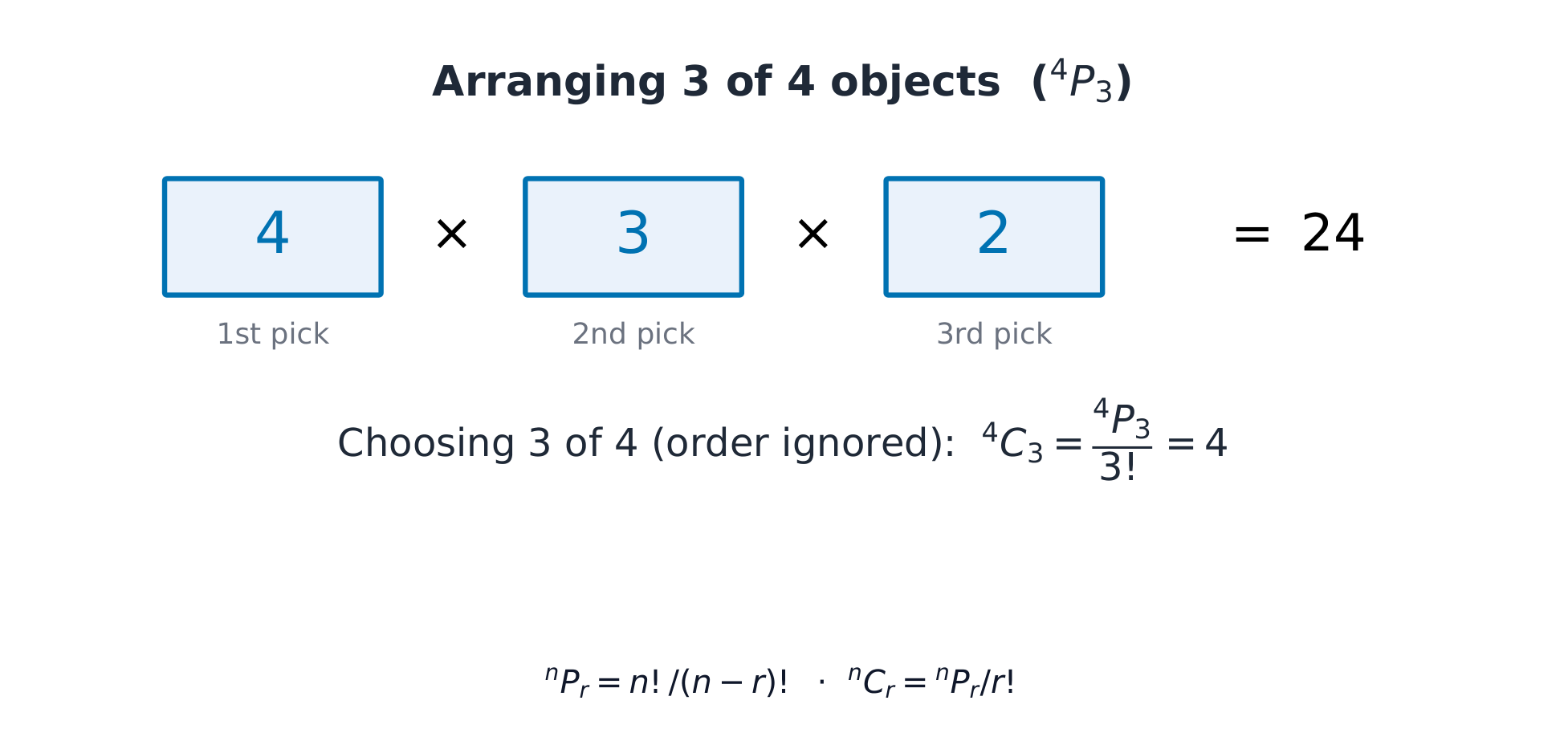
nPr = n!/(n−r)!; nCr = nPr/r! Explore · חקורPermutation or combination lab · מעבדה לפרמוטציה או קומבינציה
Choose whether order matters in a counting problem. · בחר האם סדר חשוב במשהו ספירה.
Vocabulary · מילון מונחים Train · אימוןEnglish עברית range (of data)/reɪndʒ/ תחום (של נתונים) interquartile range/ˌɪntəˈkwɔːtaɪl reɪndʒ/ טווח רביעי standard deviation/ˈstændəd ˌdiːvɪˈeɪʃn/ סטיית תקן variance/ˈveərɪəns/ סטייה Coding/ˈkəʊdɪŋ/ קידוד assumed mean/əˈsjuːmd miːn/ ממוצע משוער permutation/ˌpɜːmjuːˈteɪʃn/ פרימותציה combination/ˌkɒmbɪˈneɪʃn/ קבוצות (קומבינציה) mutually exclusive events/ˈmjuːtʃuːəli eksˈkluːsɪv ɪˈvents/ אירועים בלתי תואמים independent events/ˌɪndɪˈpendənt ɪˈvents/ אירועים בלתי תלויים conditional probability/kənˈdɪʃənl ˌprɒbəˈbɪlɪti/ הסתברות מותנית discrete random variable/dɪˈskriːt ˈrændəm ˈveərɪəbl/ משתנה אקראי בדיד probability distribution table/ˌprɒbəˈbɪlɪti ˌdɪstrɪˈbjuːʃn ˈteɪbl/ טבלת התפלגות הסתברות expectation/ekspɪkˈteɪʃn/ צפוי (תוחלת) binomial distribution/baɪˈnəʊmɪəl ˌdɪstrɪˈbjuːʃn/ חלוקה בינומית geometric distribution/ˌdʒiːəʊˈmetrɪk ˌdɪstrɪˈbjuːʃn/ התפלגות גיאומטרית 5.3
Probability · הסתברות

Syllabus · סיילבוס
EnglishCandidates should be able to: Notes and examples evaluate probabilities in simple cases by means of enumeration of equiprobable elementary events, or by calculation using permutations or combinations e.g. the total score when two fair dice are thrown. e.g. drawing balls at random from a bag containing balls of different colours. use addition and multiplication of probabilities, as appropriate, in simple cases Explicit use of the general formula $\text{P}(A \cup B) = \text{P}(A) + \text{P}(B) - \text{P}(A \cap B)$ is not required. understand the meaning of exclusive and independent events, including determination of whether events $A$ and $B$ are independent by comparing the values of $\text{P}(A \cap B)$ and $\text{P}(A) \times \text{P}(B)$ calculate and use conditional probabilities in simple cases. e.g. situations that can be represented by a sample space of equiprobable elementary events, or a tree diagram. The use of $\text{P}(A|B) = \frac{\text{P}(A \cap B)}{\text{P}(B)}$ may be required in simple cases. עבריתהמועמדים אמורים להיות מסוגלים: הערות לדוגמאות הערכת סיכויים במקרים פשוטים באמצעות ספירה של אירועים יסודיים שוווי-סיכוי, או חישוב באמצעות פרמוטציות או קומבינציות לדוגמה: סך הנקודות כאשר משליכים שני קוביות הוגנות. לדוגמה: גרירת כדורים באופן אקראי מתוך תיק המכיל כדורים בצבעים שונים. שימוש בחיבור ובכפל סיכויים, בהתאם, במקרים פשוטים שימוש מפורש בנוסחה הכללית $\text{P}(A \cup B) = \text{P}(A) + \text{P}(B) - \text{P}(A \cap B)$ אינו נדרש. הבנת המשמעות של אירועים בדידים ובלתי תלויים, כולל קביעה האם אירועים $A$ ו$B$ הם בלתי תלויים על ידי השוואת הערכים של $\text{P}(A \cap B)$ ו$\text{P}(A) \times \text{P}(B)$ חישוב והשתמש בסיכויים תנאי במקרים פשוטים. לדוגמה: מצבים שיכולים להיות מיוצגים על ידי מרחב דגימה של אירועים יסודיים שוווי-סיכוי, או על ידי דיאגרמת עץ. שימוש ב$\text{P}(A|B) = \frac{\text{P}(A \cap B)}{\text{P}(B)}$ עשוי להיות נדרש במקרים פשוטים. Source: Cambridge International syllabus · מקור: הסיילבוס הבינלאומי של קמבריד'ג'
EnglishFind a probability by counting equally likely outcomes, or by using permutations and combinations. Combine probabilities with these rules:
- addition for "or": $P(A \cup B) = P(A) + P(B) - P(A \cap B)$;
- multiplication for "and" when events are independent: $P(A \cap B) = P(A)\,P(B)$.
Two events are mutually exclusive events 互斥事件 if they cannot both happen, and independent events 独立事件 if one happening does not change the chance of the other. To test independence, check whether $P(A \cap B) = P(A)\times P(B)$. A conditional probability 条件概率 is the chance of $A$ given that $B$ has happened: $P(A \mid B) = \dfrac{P(A \cap B)}{P(B)}$.
Worked example. Events have $P(A) = 0.5$, $P(B) = 0.4$ and $P(A \cap B) = 0.2$. Are $A$ and $B$ independent?
Test: $P(A)\times P(B) = 0.5 \times 0.4 = 0.2 = P(A \cap B)$. The values are equal, so $A$ and $B$ are independent.
עבריתגרעש: נקודת התחלה מוכרת להסתברות. מצאו הסתברות על ידי ספירת תוצאות שוות-סיכוי, או על ידי שימוש בהפרעות ובקומבינציות. שילבו הסתברויות עם הכללים הבאים:
- חיבור עבור "או": $P(A \cup B) = P(A) + P(B) - P(A \cap B)$;
- כפל עבור "וגם" כאשר האירועים עצמאיים: $P(A \cap B) = P(A)\,P(B)$.
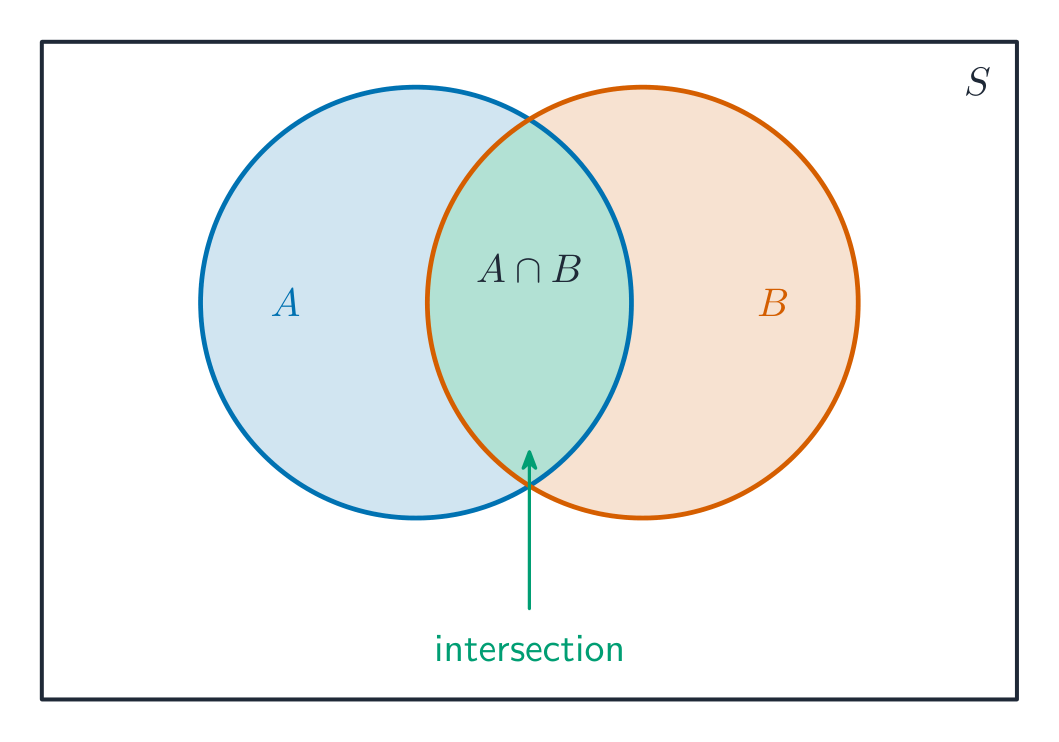
החפיפה של שני המעגלים היא $A\cap B$; כלל החיבור חוסר אותה פעם אחת כדי שלא תיספר פעמיים. שני אירועים הם אירועים בלתי תואמים אם לא יכול לקרות גם אחד וגם השני, ואירועים עצמאיים אם קרה אחד מהם אינו משנה את הסיכוי לשני. לבדוק עצמאות, בדקו האם $P(A \cap B) = P(A)\times P(B)$. הסתברות מותנית היא הסיכוי ל$A$ נתון שה$B$ קרה: $P(A \mid B) = \dfrac{P(A \cap B)}{P(B)}$.
דוגמה מפורטת. לאירועים יש $P(A) = 0.5$, $P(B) = 0.4$ ו$P(A \cap B) = 0.2$. האם $A$ ו$B$ עצמאיים?
בדיקה: $P(A)\times P(B) = 0.5 \times 0.4 = 0.2 = P(A \cap B)$. הערכים שווים, ולכן $A$ ו$B$ עצמאיים.
Explore · חקורConditional probability · הסתברות מותנית
Change the probabilities and read the tree. This is how P(A and B) and conditional probability fit together. · שנה את ההסתברותות וקרא את העץ. כך P(A and B) והסתברות תנאיית משלימים זה את זה.
5.4
Discrete random variables · משתנים מקריים דיסקרטיים
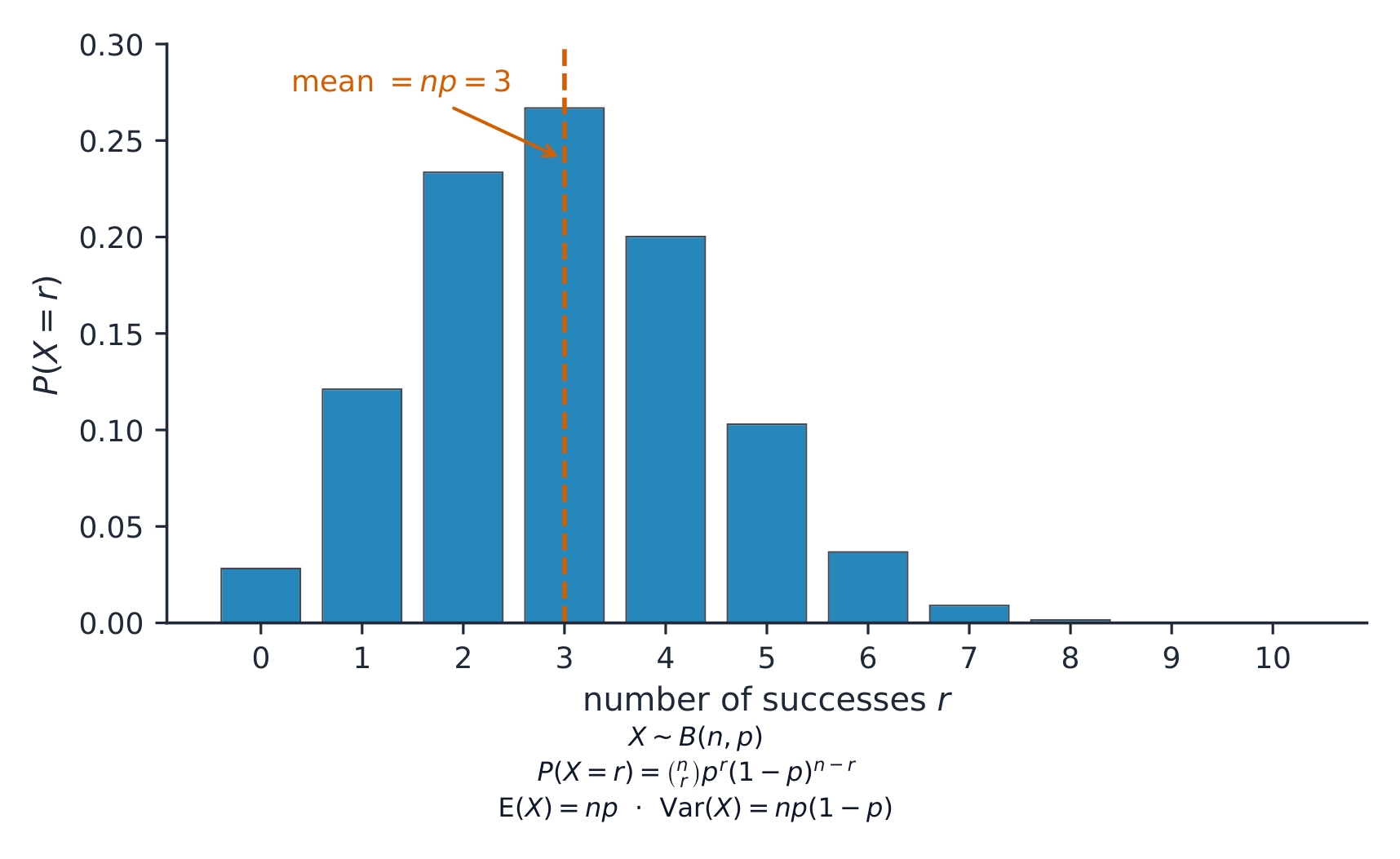
Syllabus · סיילבוס
EnglishCandidates should be able to: Notes and examples draw up a probability distribution table relating to a given situation involving a discrete random variable $X$, and calculate $\text{E}(X)$ and $\text{Var}(X)$ use formulae for probabilities for the binomial and geometric distributions, and recognise practical situations where these distributions are suitable models Including the notations $\text{B}(n, p)$ and $\text{Geo}(p)$. $\text{Geo}(p)$ denotes the distribution in which $p_r = p(1 - p)^{r-1}$ for $r = 1, 2, 3, \dots$. use formulae for the expectation and variance of the binomial distribution and for the expectation of the geometric distribution. Proofs of formulae are not required. עבריתהמועמדים אמורים להיות מסוגלים: הערות לדוגמאות הרכבת טבלת חלוקת סיכויים הקשורה למצב נתון המעורב במשתנה אקראי בדיד $X$, וחישוב $\text{E}(X)$ ו$\text{Var}(X)$ להשתמש בנוסחאות להסתברויות עבור החלוקות בינומית וגיאומטרית, ולזהות מצבים פרקטיים בהם חלוקות אלו מהוות מודלים מתאימים כולל סימנויות $\text{B}(n, p)$ ו$\text{Geo}(p)$. $\text{Geo}(p)$ מייצג את החלוקה שבה $p_r = p(1 - p)^{r-1}$ עבור $r = 1, 2, 3, \dots$. שימוש בנוסחאות עבור התצופה (הצפייה) והשונות של החלוקה הדו-תוצאתית ועבור התצופה של החלוקה הגיאומטרית. הוכחות לנוסחאות אינן נדרשות. Source: Cambridge International syllabus · מקור: הסיילבוס הבינלאומי של קמבריד'ג'
EnglishA discrete random variable 离散型随机变量 $X$ takes separate values, each with a probability. List them in a probability distribution table 概率分布表; the probabilities must add to $1$. Then the expectation 期望 (mean) and variance are
$$E(X) = \sum x\,P(X = x), \qquad \mathrm{Var}(X) = \sum x^2\,P(X = x) - \big(E(X)\big)^2.$$Two special models:
- the binomial distribution 二项分布 $X \sim B(n, p)$, for the number of successes in $n$ independent trials: $P(X = r) = \binom{n}{r}p^r(1-p)^{n-r}$, with $E(X) = np$ and $\mathrm{Var}(X) = np(1-p)$;
- the geometric distribution 几何分布, for the trial on which the first success happens: $P(X = r) = (1-p)^{r-1}p$, with $E(X) = \dfrac{1}{p}$.
Worked example. $X \sim B(10, 0.3)$. Find $P(X = 2)$ and $E(X)$.
$$P(X = 2) = \binom{10}{2}(0.3)^2(0.7)^8 = 45 \times 0.09 \times 0.05765 = 0.233, \qquad E(X) = 10 \times 0.3 = 3.$$עבריתמשתנה מקרי דיסקרטי $X$ לוקח ערכים נפרדים, לכל ערך יש הסתברות. רשמו אותם בטבלת חלוקת הסתברות; ההסתברויות חייבות לחבר לסך של $1$. לאחר מכן הציפוי (ממוצע) ושונות הם
$$E(X) = \sum x\,P(X = x), \qquad \mathrm{Var}(X) = \sum x^2\,P(X = x) - \big(E(X)\big)^2.$$שני מודלים מיוחדים:
- חלוקה בינומית $X \sim B(n, p)$, עבור מספר ההצלחות ב$n$ ניסויים עצמאיים: $P(X = r) = \binom{n}{r}p^r(1-p)^{n-r}$, עם $E(X) = np$ ו$\mathrm{Var}(X) = np(1-p)$;
- חלוקה גיאומטרית, עבור הניסוי בו מתרחשת ההצלחה הראשונה: $P(X = r) = (1-p)^{r-1}p$, עם $E(X) = \dfrac{1}{p}$.
דוגמה מפורטת. $X \sim B(10, 0.3)$. מצאו $P(X = 2)$ ו$E(X)$.
$$P(X = 2) = \binom{10}{2}(0.3)^2(0.7)^8 = 45 \times 0.09 \times 0.05765 = 0.233, \qquad E(X) = 10 \times 0.3 = 3.$$ההתפלגות $B(10,0.3)$: כל עמודה היא $P(X=r)$, מרוכזת סביב הממוצע $np=3$. Explore · חקורA discrete distribution · התפלגות דיסקרטית
Change n and p for a binomial distribution and watch the bars — the probability of each number of successes. · שנה את n ו-p עבור התפלגות בינומית וצפה בעמודות – ההסתברות של כל מספר הצלחות.
5.5
The normal distribution · ההתפלגות הנורמלית

Syllabus · סיילבוס
EnglishCandidates should be able to: Notes and examples understand the use of a normal distribution to model a continuous random variable, and use normal distribution tables Sketches of normal curves to illustrate distributions or probabilities may be required. solve problems concerning a variable $X$, where $X \sim N(\mu, \sigma^2)$, including: – finding the value of $P(X > x_1)$, or a related probability, given the values of $x_1$, $\mu$, $\sigma$. – finding a relationship between $x_1$, $\mu$ and $\sigma$ given the value of $P(X > x_1)$ or a related probability For calculations involving standardisation, full details of the working should be shown. e.g. $Z = \frac{(X - \mu)}{\sigma}$ recall conditions under which the normal distribution can be used as an approximation to the binomial distribution, and use this approximation, with a continuity correction, in solving problems. $n$ sufficiently large to ensure that both $np > 5$ and $nq > 5$. עבריתהמועמדים אמורים להיות מסוגלים: הערות לדוגמאות הבנת השימוש בחלוקה נורמלית לדגם של משתנה אקראי רציף, והשתמש בטבלאות חלוקה נורמלית ייתכן שתידרש עריכת סקיצות של עקומות נורמליות כדי להמחיש חלוקות או סיכויים. פתרון בעיות הקשורות למשתנה $X$, כאשר $X \sim N(\mu, \sigma^2)$, כולל: – מציאת הערך של $P(X > x_1)$, או סיכוי קשור, בהינתן הערכים של $x_1$, $\mu$, $\sigma$. – מציאת קשר בין $x_1$, $\mu$ ו$\sigma$ בהינתן הערך של $P(X > x_1)$ או סיכוי קשור לחישובים הקשורים בסטנדרטיזציה יש להציג פרטים מלאים של הפעולה. לדוגמה: $Z = \frac{(X - \mu)}{\sigma}$ זיכרון תנאים תחתיהם ניתן להשתמש בחלוקה הנורמלית כאפ approximate לחלוקה הדו-תוצאתית, והשתמש באפApproximation זו, עם תיקון רציפות, בפתרון בעיות. $n$ גדול מספיק כדי להבטיח שגם $np > 5$ וגם $nq > 5$. Source: Cambridge International syllabus · מקור: הסיילבוס הבינלאומי של קמבריד'ג'
EnglishThe 68-95-99.7 rule The normal distribution 正态分布 models a continuous random variable 连续型随机变量 with a symmetric bell shape. Write $X \sim N(\mu, \sigma^2)$, where $\mu$ is the mean and $\sigma$ is the standard deviation. To use the tables, by standardisation 标准化 convert to the variable $Z \sim N(0, 1)$:
$$Z = \frac{X - \mu}{\sigma}.$$Then $P(X < x) = P\!\left(Z < \dfrac{x - \mu}{\sigma}\right)$, which you read from the normal table $\Phi$.
The normal distribution is also a good approximation 近似 to the binomial when $n$ is large. Because you replace a discrete variable by a continuous one, apply a continuity correction 连续性校正 (adjust by $0.5$).
Worked example. Bags of rice have mass $X \sim N(\mu, 0.14^2)$. Given that $P(X < 1.48) = 0.22$, find $\mu$.
From the table, $P(Z < z) = 0.22$ gives $z = -0.772$. So
$$\frac{1.48 - \mu}{0.14} = -0.772 \;\Rightarrow\; \mu = 1.48 + 0.772 \times 0.14 = 1.59\ \text{kg (3 s.f.)}.$$עבריתחוק ה-68-95-99.7 לוח גלטון: כדורים הצופלים דרך סיכות מצטברים להתפלגות נורמלית בצורת פעמון. ההתפלגות הנורמלית מדגמת משתנה מקרי רציף בעל צורת פעמון סימטרית. כתוב $X \sim N(\mu, \sigma^2)$, כאשר $\mu$ הוא הממוצע ו$\sigma$ הוא הסטיית התקן. כדי להשתמש בטבלאות, באמצעות סטנדרטיזציה המר את המשתנה ל$Z \sim N(0, 1)$:
$$Z = \frac{X - \mu}{\sigma}.$$אז $P(X < x) = P\!\left(Z < \dfrac{x - \mu}{\sigma}\right)$, שנקרא מהטבלה הנורמלית $\Phi$.
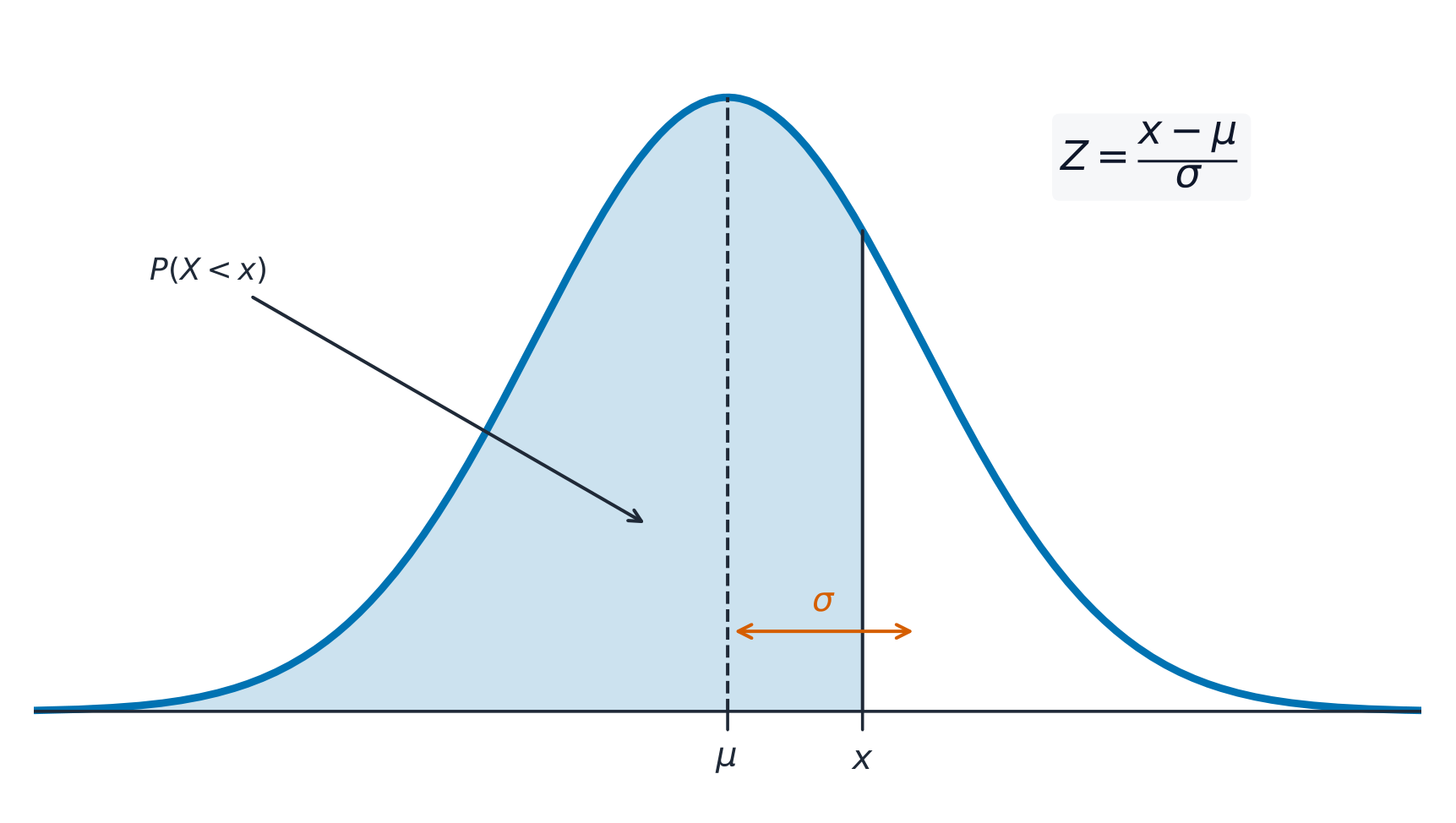
הסתברות נורמלית היא שטח מתחת לעקומת הפעמון; סטנדרטיזציה משנה את קנה המידה שלה ל$Z\sim N(0,1)$. ההתפלגות הנורמלית היא גם קירוב טוב להתפלגות דו-ספוגית כאשר $n$ גדול. מכיוון שאתה מחליף משתנה דיסקרטי ברציף, יש להפעיל תיקון רציפות (שינוי ב$0.5$).
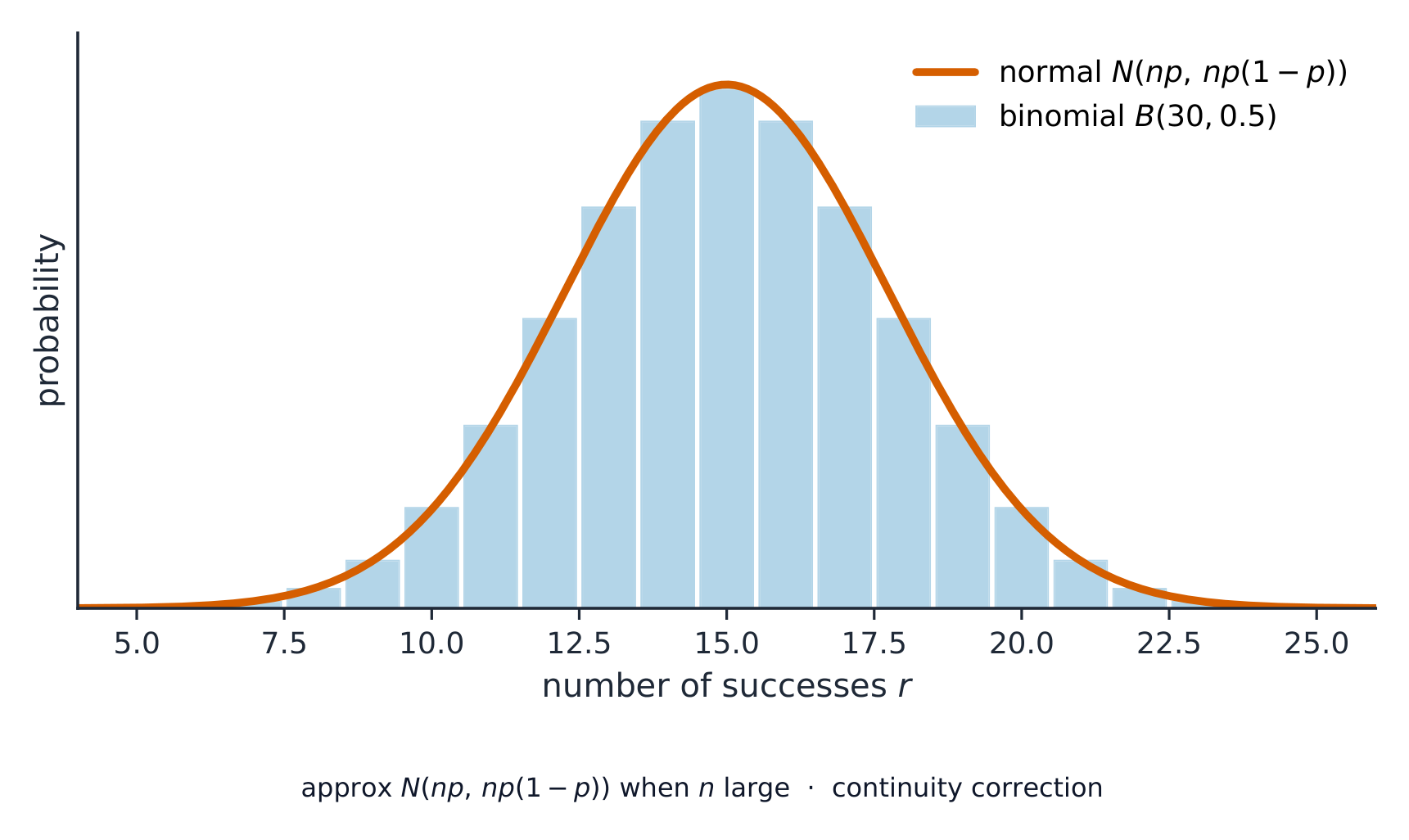
כאשר $n$ גדול, עמודות ההתפלגות הדו-ספוגית עוקבות אחרי עקומה נורמלית באותו ממוצע ושונות. דוגמה פתורה. שקיות אורז יש להן מסה $X \sim N(\mu, 0.14^2)$. נתון כי $P(X < 1.48) = 0.22$, מצא $\mu$.
מהטבלה, $P(Z < z) = 0.22$ נותן $z = -0.772$. לכן
$$\frac{1.48 - \mu}{0.14} = -0.772 \;\Rightarrow\; \mu = 1.48 + 0.772 \times 0.14 = 1.59\ \text{kg (3 s.f.)}.$$Explore · חקורThe normal distribution · החלוקה הנורמלית
Shade the area to find a probability. A z-value measures how many standard deviations a point is from the mean. · צל את השטח כדי למצוא הסתברות. ערך z מדד כמה סטיות תקן נקודה נמצאת מהמוצע.
Vocabulary · מילון מונחים Train · אימוןEnglish עברית normal distribution/ˈnɔːml ˌdɪstrɪˈbjuːʃn/ התפלגות נורמלית continuous random variable/kənˈtɪnjuːəs ˈrændəm ˈveərɪəbl/ משתנה אקראי רציף standardisation/ˌstændədaɪˈzeɪʃn/ סטנדרטיזציה approximation/əˌprɒksɪˈmeɪʃn/ הנחה continuity correction/kɒntɪˈnjuːɪti kəˈrekʃn/ תיקון רציפות Probability & Statistics/ˌprɒbəˈbɪlɪti ænd stəˈtɪstɪks/ הסתברות וסטטיסטיקה central tendency/ˈsentrəl ˈtendənsi/ מיקום מרכזי 5.5
Exam tips · טיפים לבחינות
English- Decide whether order matters: permutations ($^nP_r$) when it does, combinations ($^nC_r$) when it does not.
- For a discrete random variable, check the probabilities sum to $1$ and use $E(X) = \sum x\,P(X=x)$.
- For the normal distribution, standardise with $z = (x - \mu)/\sigma$, sketch and shade, then read the table.
- Apply a continuity correction when approximating a discrete variable by the normal.
עברית- החלט האם סדר חשוב: פרמוטציות ($^nP_r$) כשכן, קומבינציות ($^nC_r$) כשהלא.
- עבור משתנה מקרי דיסקרטי, בדוק שהסתברויות סוכמות ל$1$ והשתמש ב$E(X) = \sum x\,P(X=x)$.
- עבור ההתפלגות הנורמלית, סטנדרטיזציה עם $z = (x - \mu)/\sigma$, שרטוט והצללה, ואז קריאת הטבלה.
- הפעל תיקון רציפות בקירוב משתנה דיסקרטי על ידי הנורמלית.
-
6
Probability & Statistics 2 · הסתברות וסטטיסטיקה 2
Watch lesson · צפה בשיעורEnglishThis handout covers Topic 6: Probability & Statistics 概率统计 2. It adds the Poisson model, combining random variables, continuous distributions, and the ideas of estimation and testing.
עבריתחומר זה מכסה נושא 6: הסתברות וסטטיסטיקה 2. הוא מוסיף את מודל פואסון, שילוב משתנים מקריים, התפלגויות רציפות, וגם רעיונות הערכה ובדיקה.
6.1
The Poisson distribution · ההתפלגות פואסון
Syllabus · סיילבוס
EnglishCandidates should be able to: Notes and examples • use formulae to calculate probabilities for the distribution $\text{Po}(\lambda)$ • use the fact that if $X \sim \text{Po}(\lambda)$ then the mean and variance of $X$ are each equal to $\lambda$ Proofs are not required. • understand the relevance of the Poisson distribution to the distribution of random events, and use the Poisson distribution as a model • use the Poisson distribution as an approximation to the binomial distribution where appropriate The conditions that $n$ is large and $p$ is small should be known; $n > 50$ and $np < 5$, approximately. • use the normal distribution, with continuity correction, as an approximation to the Poisson distribution where appropriate. The condition that $\lambda$ is large should be known; $\lambda > 15$, approximately. עבריתהמועמדים אמורים להיות מסוגלים: הערות לדוגמאות • השתמש בנוסחאות כדי לחשב הסתברויות עבור ההתפלגות $\text{Po}(\lambda)$ • השתמש בעובדה כי אם $X \sim \text{Po}(\lambda)$, אזי הממוצע והשונות של $X$ שווים כולם ל-$\lambda$ הוכחות אינן נדרשות. • הבן את הרלוונטיות של ההתפלגות פואסון להתפלגות אירועים רנדומליים, והשתמש ב-התפלגות פואסון כמודל • השתמש בהתפלגות פואסון כקירוב להתפלגות בינומית כאשר מתאים יש לדעת שהתנאי $n$ גדול ו$p$ קטן; ידוע גם כי $n > 50$ ו$np < 5$ בקירוב. • השתמש בהתפלגות נורמלית, עם תיקון רציפות, כקירוב להתפלגות פואסון כאשר מתאים. יש לדעת שהתנאי $\lambda$ גדול; ידוע גם כי $\lambda > 15$ בקירוב. Source: Cambridge International syllabus · מקור: הסיילבוס הבינלאומי של קמבריד'ג'
EnglishThe Poisson distribution 泊松分布 $X \sim \mathrm{Po}(\lambda)$ models the number of random events in a fixed interval, when events happen at a steady average rate $\lambda$:
$$P(X = r) = e^{-\lambda}\frac{\lambda^r}{r!}.$$For a Poisson variable the mean and the variance are both equal to $\lambda$. The Poisson distribution is a good approximation 近似 to the binomial distribution when $n$ is large and $p$ is small. The normal distribution (with continuity correction) approximates the Poisson when $\lambda$ is large.Worked example. $X \sim \mathrm{Po}(3)$. Find $P(X = 2)$.
$$P(X = 2) = e^{-3}\frac{3^2}{2!} = e^{-3}\times 4.5 = 0.224.$$עבריתהגעת אנשים באופן אקראי לתור נמצאת בחלוקת פואסון. החלוקת פואסון $X \sim \mathrm{Po}(\lambda)$ מודל את מספר האירועים האקראיים במרווח קבוע, כאשר האירועים מתרחשים בקצב ממוצע יציב $\lambda$:
$$P(X = r) = e^{-\lambda}\frac{\lambda^r}{r!}.$$משתנה לפואסון יש ממוצע ושונות המשווים לשני $\lambda$. החלוקת פואסון היא קירוב טוב לחלוקה בינומית כאשר $n$ גדול ו$p$ קטן. החלוקה הנורמלית (עם תיקון רציפות) מקרבת את פואסון כאשר $\lambda$ גדול.דוגמה מפורטת. $X \sim \mathrm{Po}(3)$. מצאו $P(X = 2)$.
$$P(X = 2) = e^{-3}\frac{3^2}{2!} = e^{-3}\times 4.5 = 0.224.$$
החלוקת פואסון $\mathrm{Po}(3)$: למשתנה לפואסון הממוצע והשונות שווים לשני $\lambda$. Explore · חקורThe Poisson distribution · החלוקה הפואסונית
Change the mean λ. Poisson models the number of random events in a fixed interval — rare events give a skewed shape. · שנה את הממוצע λ. Poisson דומה למספר אירועים אקראיים ברווח זמן קבוע – אירועים נדירים נותנים צורה מעוותת.
6.2
Linear combinations of random variables · צירופים ליניאריים של משתנים אקראיים
Syllabus · סיילבוס
EnglishCandidates should be able to: Notes and examples • use, when solving problems, the results that – $\text{E}(aX + b) = a\text{E}(X) + b$ and $\text{Var}(aX + b) = a^2\text{Var}(X)$ – $\text{E}(aX + bY) = a\text{E}(X) + b\text{E}(Y)$ – $\text{Var}(aX + bY) = a^2\text{Var}(X) + b^2\text{Var}(Y)$ for independent $X$ and $Y$ – if $X$ has a normal distribution then so does $aX + b$ – if $X$ and $Y$ have independent normal distributions then $aX + bY$ has a normal distribution – if $X$ and $Y$ have independent Poisson distributions then $X + Y$ has a Poisson distribution. Proofs of these results are not required. עבריתהמועמדים אמורים להיות מסוגלים: הערות לדוגמאות • השתמש, בפתרון בעיות, בתוצאות הבאות – $\text{E}(aX + b) = a\text{E}(X) + b$ ו$\text{Var}(aX + b) = a^2\text{Var}(X)$ – $\text{E}(aX + bY) = a\text{E}(X) + b\text{E}(Y)$ – $\text{Var}(aX + bY) = a^2\text{Var}(X) + b^2\text{Var}(Y)$ עבור $X$ ו$Y$ עצמאיים – אם $X$ בעל התפלגות נורמלית, אזי גם $aX + b$ – אם ל$X$ ול$Y$ יש התפלגויות נורמליות עצמאיות, אזי ל$aX + bY$ יש התפלגות נורמלית – אם ל$X$ ול$Y$ יש התפלגויות פואסון עצמאיות, אזי ל$X + Y$ יש התפלגות פואסון. אינה דורשת הוכחות לתוצאות אלו. Source: Cambridge International syllabus · מקור: הסיילבוס הבינלאומי של קמבריד'ג'
EnglishWhen you change a variable by a linear rule, the expectation 期望 (mean) and variance 方差 follow these rules:
$$E(aX + b) = aE(X) + b, \qquad \mathrm{Var}(aX + b) = a^2\,\mathrm{Var}(X).$$For two independent variables $X$ and $Y$:$$E(aX + bY) = aE(X) + bE(Y), \qquad \mathrm{Var}(aX + bY) = a^2\,\mathrm{Var}(X) + b^2\,\mathrm{Var}(Y).$$Two useful facts: if $X$ has a normal distribution 正态分布 then so does $aX + b$; and the sum of independent Poisson variables is again Poisson.Worked example. $X$ has mean $5$ and variance $4$. Find $E(3X - 1)$ and $\mathrm{Var}(3X - 1)$.
$$E(3X - 1) = 3(5) - 1 = 14, \qquad \mathrm{Var}(3X - 1) = 3^2 \times 4 = 36.$$עבריתכאשר שינוי משתנה לפי כללי ליניארי, הצפוי (הממוצע) והשונות עוקבים אחרי הכללים הבאים:
$$E(aX + b) = aE(X) + b, \qquad \mathrm{Var}(aX + b) = a^2\,\mathrm{Var}(X).$$לשני משתנים בלתי תלויים $X$ ו$Y$:$$E(aX + bY) = aE(X) + bE(Y), \qquad \mathrm{Var}(aX + bY) = a^2\,\mathrm{Var}(X) + b^2\,\mathrm{Var}(Y).$$שתי עובדות שימושיות: אם $X$ בעל חלוקה נורמלית, אז גם $aX + b$; וסכום של משתנים לפואסון בלתי תלויים הוא שוב פואסון.דוגמה מפורטת. $X$ יש ממוצע $5$ ושונות $4$. מצאו $E(3X - 1)$ ו$\mathrm{Var}(3X - 1)$.
$$E(3X - 1) = 3(5) - 1 = 14, \qquad \mathrm{Var}(3X - 1) = 3^2 \times 4 = 36.$$Explore · חקורLinear combination lab · מעבדת צירוף ליניארי
E(aX + b) = aE(X) + b
Change a scaling factor and see how the expected value scales. · שנה מקדם סקינה וראה כיצד הערך הצפוי מתרחב.
6.3
Continuous random variables · משתנים אקראיים רציפים
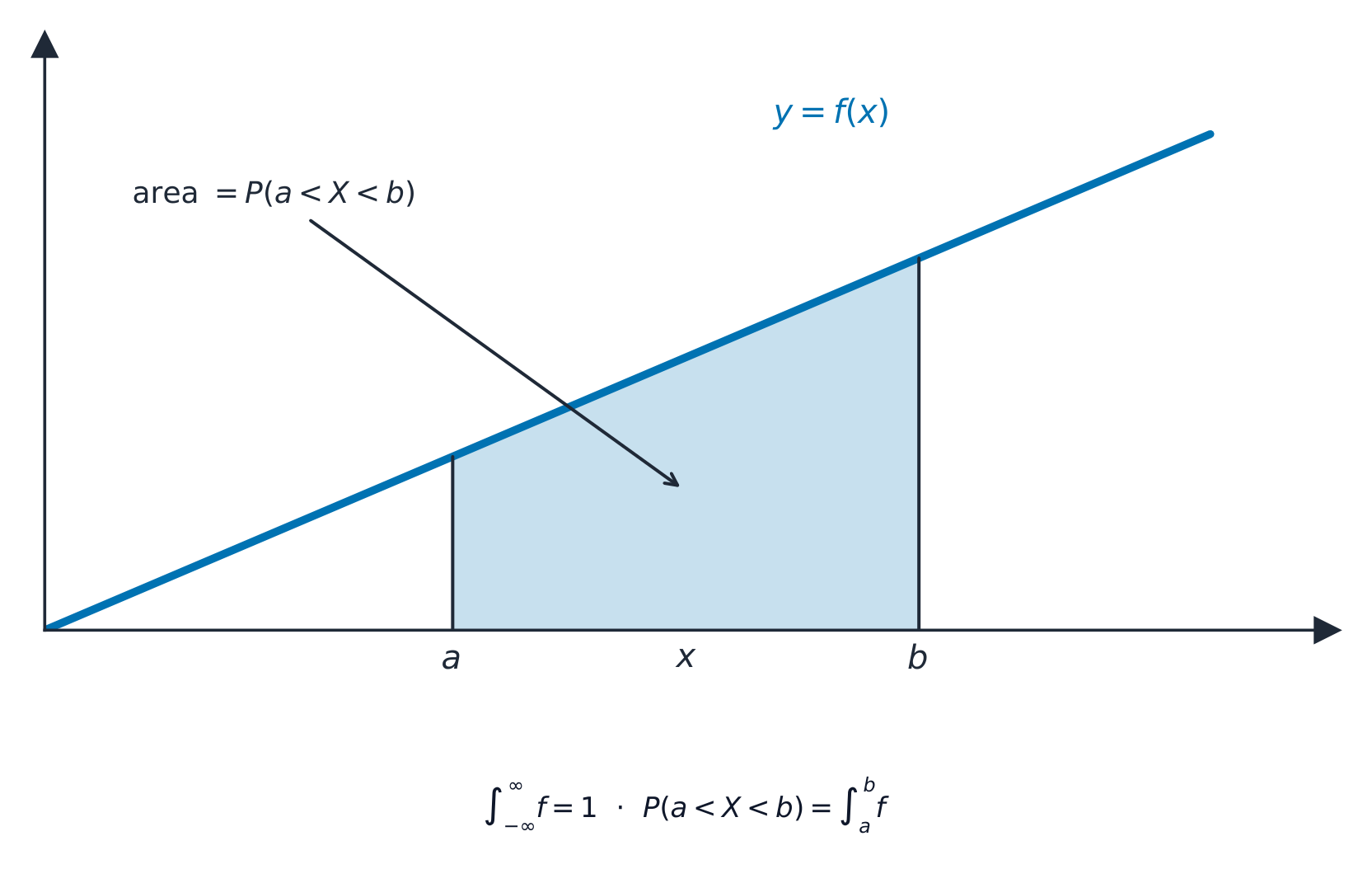
Syllabus · סיילבוס
EnglishCandidates should be able to: Notes and examples • understand the concept of a continuous random variable, and recall and use properties of a probability density function For density functions defined over a single interval only; the domain may be infinite, e.g. $\frac{3}{x^4}$ for $x \geqslant 1$. • use a probability density function to solve problems involving probabilities, and to calculate the mean and variance of a distribution. Including location of the median or other percentiles of a distribution by direct consideration of an area using the density function. Explicit knowledge of the cumulative distribution function is not included. עבריתהמועמדים אמורים להיות מסוגלים: הערות לדוגמאות • להבין את מושגמשתנה מקרי רציף, ולזכור ולהשתמש בתכונות שלפונקציית צפיפות הסתברות עבור פונקציות צפיפות המוגדרות רק על תחום אחד; התחום עשוי להיות אינסופי, למשל $\frac{3}{x^4}$ עבור $x \geqslant 1$. • להשתמש בפונקציית צפיפות הסתברות לפתרון בעיות הקשורות להסתברות, ולחשב אתהמוצע ואתהשונות של ההתפלגות. כולל מיקוםהמדIAN או אחוזים אחרים של ההתפלגות על ידי בחישה ישירה של שטח באמצעות פונקציית הצפיפות. ידע ספציפי בפונקציית ההתפלגות המצטברת אינו נכלל. Source: Cambridge International syllabus · מקור: הסיילבוס הבינלאומי של קמבריד'ג'
EnglishA continuous random variable 连续型随机变量 can take any value in a range. Its probabilities come from a probability density function 概率密度函数 $f(x)$, with two key properties:
$$f(x) \geqslant 0, \qquad \int_{-\infty}^{\infty} f(x)\,dx = 1.$$A probability is the area under $f$, and the mean is found by integration:$$P(a < X < b) = \int_a^b f(x)\,dx, \qquad E(X) = \int_{-\infty}^{\infty} x\,f(x)\,dx.$$The cumulative distribution function 累积分布函数 is $F(x) = P(X \leqslant x) = \int_{-\infty}^{x} f(t)\,dt$; the median 中位数 solves $F(m) = 0.5$, and other percentiles 百分位数 solve $F(x) = p$.
Worked example. A continuous variable has $f(x) = \tfrac12 x$ for $0 \leqslant x \leqslant 2$ (and $0$ elsewhere). Find $E(X)$.
$$E(X) = \int_0^2 x\cdot\tfrac12 x\,dx = \int_0^2 \tfrac12 x^2\,dx = \left[\tfrac{x^3}{6}\right]_0^2 = \frac{8}{6} = \frac{4}{3}.$$The variance uses the same idea, $\mathrm{Var}(X)=\displaystyle\int_{-\infty}^{\infty}x^2 f(x)\,dx-\big(E(X)\big)^2$. For the same $f(x)=\tfrac12 x$ on $[0,2]$: $\displaystyle\int_0^2 x^2\cdot\tfrac12 x\,dx=\left[\tfrac{x^4}{8}\right]_0^2=2$, so $\mathrm{Var}(X)=2-\left(\tfrac43\right)^2=2-\tfrac{16}{9}=\tfrac{2}{9}$.
עבריתמשתנה אקראי רציף יכול לקבל כל ערך בטווח נתון. ההסתברויות שלו נובעות מפונקציית צפיפות הסתברות $f(x)$, עם שתי תכונות מרכזיות:
$$f(x) \geqslant 0, \qquad \int_{-\infty}^{\infty} f(x)\,dx = 1.$$הסתברות היא השטח מתחת ל$f$, והממוצע נמצא על ידי אינטגרציה:$$P(a < X < b) = \int_a^b f(x)\,dx, \qquad E(X) = \int_{-\infty}^{\infty} x\,f(x)\,dx.$$פונקציית התפלגות מצטברת היא $F(x) = P(X \leqslant x) = \int_{-\infty}^{x} f(t)\,dt$; החציון פותר את $F(m) = 0.5$, ואחוזים אחרים פותרים את $F(x) = p$.
למשתנה רציף, ההסתברות $P(a דוגמה מפורטת. משתנה רציף יש לו $f(x) = \tfrac12 x$ עבור $0 \leqslant x \leqslant 2$ (ועבור $0$ במקום אחר). מצאו $E(X)$.
$$E(X) = \int_0^2 x\cdot\tfrac12 x\,dx = \int_0^2 \tfrac12 x^2\,dx = \left[\tfrac{x^3}{6}\right]_0^2 = \frac{8}{6} = \frac{4}{3}.$$השונות משתמשת באותה רעיון, $\mathrm{Var}(X)=\displaystyle\int_{-\infty}^{\infty}x^2 f(x)\,dx-\big(E(X)\big)^2$. עבור אותו $f(x)=\tfrac12 x$ ב$[0,2]$: $\displaystyle\int_0^2 x^2\cdot\tfrac12 x\,dx=\left[\tfrac{x^4}{8}\right]_0^2=2$, ולכן $\mathrm{Var}(X)=2-\left(\tfrac43\right)^2=2-\tfrac{16}{9}=\tfrac{2}{9}$.
Explore · חקורArea = probability · שטח = הסתברות
P(a < X < b) = ∫ f(x) dx
For a continuous variable, probability is the area under the density curve between two values. · עבור משתנה רציף, הסתברות היא שטח מתחת לעקומת הצפיפות בין שני ערכים.
6.4
Sampling and estimation · דגימה והערכה

Syllabus · סיילבוס
EnglishCandidates should be able to: Notes and examples • understand the distinction between a sample and a population, and appreciate the necessity for randomness in choosing samples • explain in simple terms why a given sampling method may be unsatisfactory Including an elementary understanding of the use of random numbers in producing random samples. Knowledge of particular sampling methods, such as quota or stratified sampling, is not required. • recognise that a sample mean can be regarded as a random variable, and use the facts that $\text{E}(\overline{X}) = \mu$ and that $\text{Var}(\overline{X}) = \frac{\sigma^2}{n}$ • use the fact that $\overline{X}$ has a normal distribution if $X$ has a normal distribution • use the Central Limit Theorem where appropriate Only an informal understanding of the Central Limit Theorem (CLT) is required; for large sample sizes, the distribution of a sample mean is approximately normal. • calculate unbiased estimates of the population mean and variance from a sample, using either raw or summarised data Only a simple understanding of the term 'unbiased' is required, e.g. that although individual estimates will vary the process gives an accurate result 'on average'. • determine and interpret a confidence interval for a population mean in cases where the population is normally distributed with known variance or where a large sample is used • determine, from a large sample, an approximate confidence interval for a population proportion. עבריתהמועמדים אמורים להיות מסוגלים: הערות לדוגמאות • להבין את ההבדל ביןדגימה לביןאוכלוסייה, ולהעריך את החשיבות שלאקראיות בבחירת הדגימות • להסביר בפשטות מדוע שיטתדגימה נתונה עשויה להיות לא מספקת כולל הבנה בסיסית לשימוש במספרים אקראיים בהפקתדגימות אקראיות. ידע בשיטות דגימה ספציפיות, כמו דגימת מכילה או דגימה שכבתית, אינו נדרש. • להבין שממוצע הדגימה ניתן להתייחס אליו כמשתנה מקרי, ולהשתמש בעובדות כי $\text{E}(\overline{X}) = \mu$ וכי $\text{Var}(\overline{X}) = \frac{\sigma^2}{n}$ • להשתמש בעובדה כי $\overline{X}$ בעלהתפלגות נורמלית אם $X$ בעל התפלגות נורמלית • להשתמש במשפט הגבול המרכזי כאשר מתאים נדרשת רק הבנה לא-רשמית שלמשפט הגבול המרכזי (CLT); עבור גודל דגימה גדול, ההתפלגות של ממוצע הדגימה היא בקירוב נורמלית. • לחשבאומדנים חסרי טעות שלמוצע האוכלוסייה ושלשונות האוכלוסייה מהדגימה, באמצעות נתונים ראשוניים או מסוכים נדרשת רק הבנה פשוטה למונח 'חסר טעות', למשל: למרות שהאומדנים הבודדים עשויים להשתנות, התהליך נותן תוצאה מדויקת 'במידה ממוצעת'. • לקבוע ולפרשמרווח סמך למוצע אוכלוסייה במקרים שבהם האוכלוסייה מחולקת נורמלית עם שונות ידועה או כאשר משתמשים בדגימה גדולה • לקבוע, ממדגימה גדולה, מרווח סמך מקריב לפרופורציה באוכלוסייה. Source: Cambridge International syllabus · מקור: הסיילבוס הבינלאומי של קמבריד'ג'
EnglishA sample 样本 is a small group chosen from the whole population 总体. A random sample needs randomness 随机性, so that every member has a fair chance of being chosen.
Some methods are unsatisfactory because they are biased 有偏: sampling only volunteers, or the first 20 people to arrive, over-represents certain kinds of people. A genuinely random sample uses random numbers – number every member of the population, then draw numbers (from a table or a generator) to decide who is in the sample.
The sample mean $\bar{X}$ is itself a random variable, with
$$E(\bar{X}) = \mu, \qquad \mathrm{Var}(\bar{X}) = \frac{\sigma^2}{n}.$$By the Central Limit Theorem 中心极限定理, for a large sample $\bar{X}$ is approximately normal, whatever the shape of the population.From a sample you can find unbiased estimates 无偏估计 of the population mean and variance. A confidence interval 置信区间 gives a range that probably contains the true mean. When the population is normal with known $\sigma$ (or the sample is large), a $95\%$ interval is
$$\bar{x} \pm 1.96\,\frac{\sigma}{\sqrt{n}}.$$You can also find a confidence interval for a population proportion 总体比例 from a large sample.
Worked example. A sample of $n = 64$ has mean $\bar{x} = 50$, from a population with $\sigma = 8$. Find a $95\%$ confidence interval for the population mean.
$$50 \pm 1.96\times\frac{8}{\sqrt{64}} = 50 \pm 1.96 \;\Rightarrow\; (48.0,\ 52.0).$$עבריתהסטטיסטיקה לומדת על אוכלוסייה כולה באמצעות דגימה. דגימה היא קבוצה קטנה שנבחרה מה-אוכלוסייה כולה. דגימה אקראית דורשת אקראיות, כך שכל חבר יזכה להזדמנות שווה לבחירה.
חלק מהשיטות הן לא מספקות מכיוון שהן מוטות: דגימת מתנדבים בלבד, או 20 האנשים הראשונים שהגיעו, מייצגים יתר-מדי סוגים מסוימים של אנשים. דגימה אקראית אמיתית משתמשת ב-מספרים אקראיים – מספרים את כל חברי האוכלוסייה, ואז גוררים מספרים (מתוך טבלה או יצרן) כדי לקבוע מי נכלל בדגימה.
תוחלת הדגימה $\bar{X}$ היא גם כן משתנה אקראי, עם
$$E(\bar{X}) = \mu, \qquad \mathrm{Var}(\bar{X}) = \frac{\sigma^2}{n}.$$על פי המשפט המרכזי לגבי סכומים, עבור דגימה גדולה $\bar{X}$ הוא בקירוב נורמלי, ללא תלות בצורת האוכלוסייה.
ללא תלות בצורת האוכלוסייה, לתוחלת הדגימה $\bar{X}$ יש התפלגות צרה וקרובה לנורמלית הממוקדת סביב $\mu$. מדגימה ניתן למצוא הערכות לא מוטות לתוחלת ולשונות האוכלוסייה. 区间 ביטחון נותן טווח שמסתבר שהוא מכיל את התוחלת האמיתית. כאשר האוכלוסייה נורמלית עם $\sigma$ ידוע (או הדגימה גדולה), $95\%$ interval is
$$\bar{x} \pm 1.96\,\frac{\sigma}{\sqrt{n}}.$$
מרווח סמך של $95\%$ משתרע $1.96$ טעויות סטנדרט משני צדי ממוצע הדוגמה. ניתן גם למצוא מרווח סמך עבור פרופורציית אוכלוסיה מתוך דוגמה גדולה.
דוגמה מפורטת. לדוגמה בגודל $n = 64$ יש ממוצע $\bar{x} = 50$, מאוכלוסיה עם $\sigma = 8$. מצאו מרווח סמך של $95\%$ לממוצע האוכלוסיה.
$$50 \pm 1.96\times\frac{8}{\sqrt{64}} = 50 \pm 1.96 \;\Rightarrow\; (48.0,\ 52.0).$$Explore · חקורThe sampling distribution · התפלגות הדגימה
X̄ ~ N(μ, σ²/n)
By the Central Limit Theorem, sample means follow a normal curve — narrower for bigger samples. · על פי משפט הגבול המרכזי, ממוצעי דגימה נשחזרים לפי עקומה נורמלית — הצרה יותר לדגימות גדולות יותר.
Vocabulary · מילון מונחים Train · אימוןEnglish עברית Poisson distribution/ˈpɔɪsn ˌdɪstrɪˈbjuːʃn/ התפלגות פואסון approximation/əˌprɒksɪˈmeɪʃn/ הנחה expectation/ekspɪkˈteɪʃn/ צפוי (תוחלת) variance/ˈveərɪəns/ סטייה normal distribution/ˈnɔːml ˌdɪstrɪˈbjuːʃn/ התפלגות נורמלית continuous random variable/kənˈtɪnjuːəs ˈrændəm ˈveərɪəbl/ משתנה אקראי רציף probability density function/ˌprɒbəˈbɪlɪti ˈdensɪti ˈfʌŋkʃn/ פונקציית צפיפות הסתברות cumulative distribution function/ˈkjuːmjʊlətɪv ˌdɪstrɪˈbjuːʃn ˈfʌŋkʃn/ פונקציית ההתפלגות המצטברת median/ˈmiːdiːən/ חציון percentiles/pəˈsentaɪlz/ אחוזונים sample/ˈsæmpl/ דוגמה population/ˌpɒpjʊˈleɪʃn/ אוכלוסייה randomness/ˈrændəmnəs/ אקראיות biased/ˈbaɪəst/ מטוי Central Limit Theorem/ˈsentrəl ˈlɪmɪt ˈθɪərəm/ משפט הגבול המרכזי unbiased estimates/ʌnˈbaɪəst ˈestɪməts/ הערכות ללא סטייה confidence interval/ˈkɒnfɪdəns ˈɪntəvl/ מרווח סמך population proportion/ˌpɒpjʊˈleɪʃn prəˈpɔːʃn/ פרופורציה באוכלוסייה 6.5
Hypothesis tests
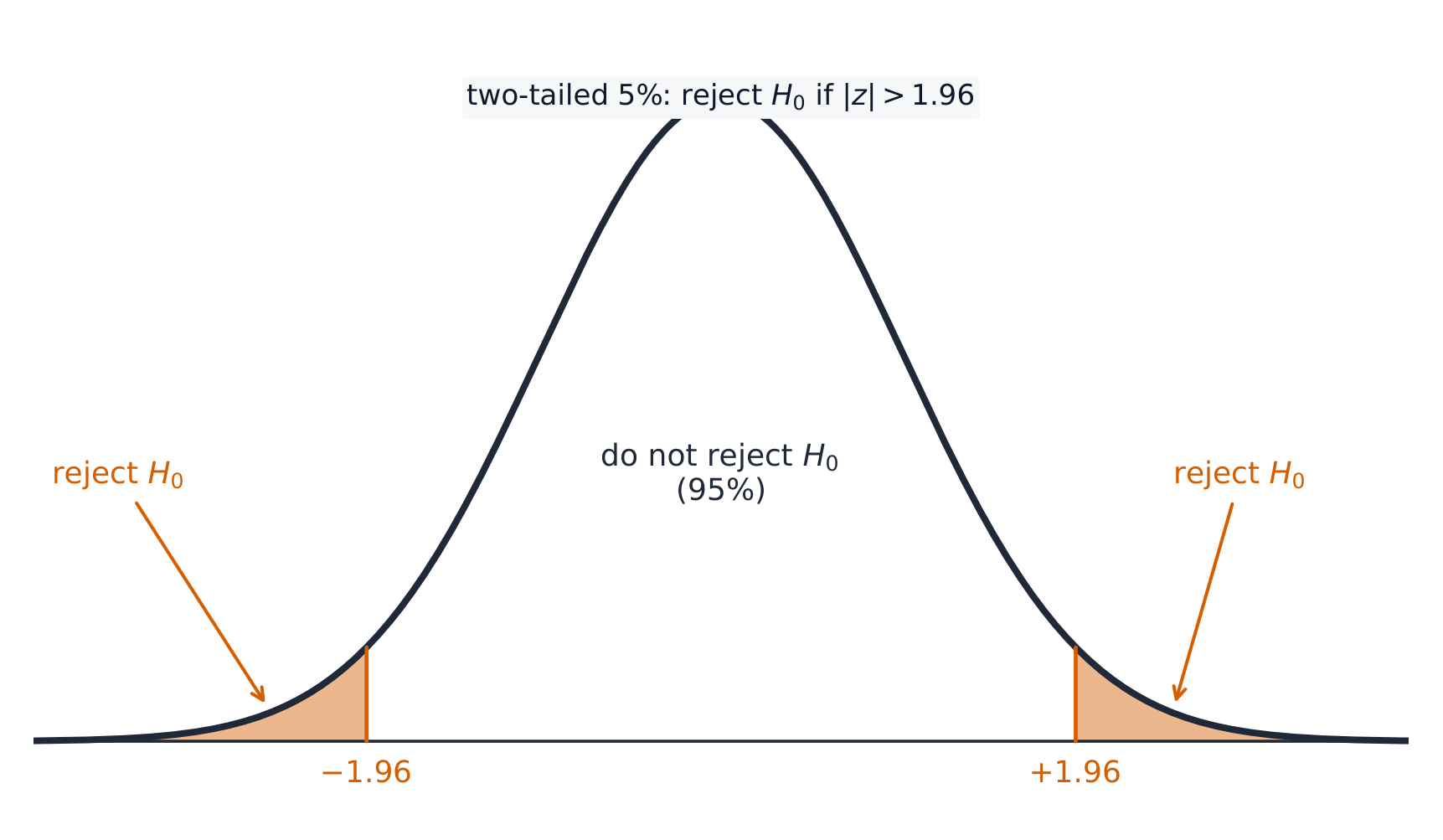
Syllabus · סיילבוס
EnglishCandidates should be able to: Notes and examples • understand the nature of a hypothesis test, the difference between one-tailed and two-tailed tests, and the terms null hypothesis, alternative hypothesis, significance level, rejection region (or critical region), acceptance region and test statistic Outcomes of hypothesis tests are expected to be interpreted in terms of the contexts in which questions are set. • formulate hypotheses and carry out a hypothesis test in the context of a single observation from a population which has a binomial or Poisson distribution, using – direct evaluation of probabilities – a normal approximation to the binomial or the Poisson distribution, where appropriate • formulate hypotheses and carry out a hypothesis test concerning the population mean in cases where the population is normally distributed with known variance or where a large sample is used • understand the terms Type I error and Type II error in relation to hypothesis tests • calculate the probabilities of making Type I and Type II errors in specific situations involving tests based on a normal distribution or direct evaluation of binomial or Poisson probabilities. עבריתהמועמדים אמורים להיות מסוגלים: הערות לדוגמאות • להבין את טבעו שלמבחן הנחה, ההבדל בין מבחניםחד-צדדיים ובין מבחניםדו-צדדיים, ואת המונחיםהנחת אפס, הנחת חלופית, רמת מובהקות, אזור דחייה (או אזור קריטי), אזור קבלה וסטטיסטי המבחן מצופה שתוצאות מבחני ההנחה יפורשו בהקשר של נושא השאלה. • לניסוח הנחות ולבצעמבחן הנחה בהקשר של תצפית אחת מאוכלוסייה בעלתהתפלגות בינומית אוהתפלגות פואסון, תוך שימוש ב– הערכה ישירה של הסתברות / קירוב נורמלי להתפלגות הבינומית או לפואסון, כאשר מתאים • לניסוח הנחות ולבצעמבחן הנחה לגבי ממוצע האוכלוסייה במקרים שבהם האוכלוסייה מחולקת נורמלית עם שונות ידועה או כאשר משתמשים בדגימה גדולה • להבין את המונחים שגיאת סוג I ושגיאת סוג II בהקשר של בדיקות הנחות • לחשב את הסיכויים לבצע שגיאות סוג I ושגיאות סוג II במצבים ספציפיים הכוללים בדיקות המבוססות על חלוקה נורמלית או הערכה ישירה של סיכויים בינומיים או פואסון. Source: Cambridge International syllabus · מקור: הסיילבוס הבינלאומי של קמבריד'ג'
EnglishA hypothesis test 假设检验 uses sample data to judge a claim. You set up two statements: the null hypothesis 原假设 $H_0$ (the claim being tested, usually "no change") and the alternative hypothesis 备择假设 $H_1$ (what you suspect instead). The test is one-tailed 单尾 if $H_1$ points one way (e.g. $\mu > 50$) and two-tailed 双尾 if it allows both ways ($\mu \neq 50$).
You fix a significance level 显著性水平 (often $5\%$), work out a test statistic 检验统计量 from the data, and see whether it lands in the rejection region 拒绝域 (also called the critical region); if it does you reject $H_0$, otherwise the statistic is in the acceptance region.
Two mistakes are possible: a Type I error 第一类错误 is rejecting $H_0$ when it is actually true; a Type II error 第二类错误 is accepting $H_0$ when it is actually false. You can find their probabilities from the rejection region: $P(\text{Type I})=P(\text{statistic in the rejection region}\mid H_0)$ – this equals the significance level – and $P(\text{Type II})=P(\text{statistic in the acceptance region}\mid H_1$ true for a stated value$)$, computed from the binomial, Poisson, or normal distribution.
Worked example. A population is claimed to have mean $50$, with $\sigma = 8$. A sample of $n = 64$ gives $\bar{x} = 52$. Test at the $5\%$ level whether the mean has changed.
$H_0\!: \mu = 50$ and $H_1\!: \mu \neq 50$ (two-tailed). The test statistic is
$$z = \frac{\bar{x} - \mu}{\sigma/\sqrt{n}} = \frac{52 - 50}{8/8} = 2.$$The critical value at $5\%$ (two-tailed) is $1.96$. Since $2 > 1.96$, you reject $H_0$: there is evidence the mean has changed.Worked example (a binomial test). A coin is claimed fair but suspected of landing heads too rarely: $H_0\!:p=0.5$, $H_1\!:p<0.5$. In $n=30$ tosses you see $X=9$ heads. Under $H_0$, $X\sim B(30,0.5)$, so the one-tailed tail probability is
$$P(X\leqslant 9)=\sum_{k=0}^{9}\binom{30}{k}(0.5)^{30}\approx 0.021.$$Since $0.021<0.05$, reject $H_0$: the coin does seem biased against heads. (For large $n$ the binomial is approximated by a normal; a Poisson test works the same way for rare events. And here, if the rule is "reject when $X\leqslant 9$", then $P(\text{Type I})=P(X\leqslant 9\mid p=0.5)\approx0.021$.)עבריתמבחן הישג משתמש בנתוני דוגמה כדי להעריך טענה. אתם מגדירים שתי טענות: ההיפוטזה הריקה $H_0$ (הטענה הנבדקת, בדרך כלל "שינוי לא נעשה") וההיפוטזה האלטרנטיבית $H_1$ (מה שאתם סוברים במקום זאת). המבחן הוא חד-צדדי אם $H_1$ מצביע לכיוון אחד (למשל $\mu > 50$) ודו-צדדי אם הוא מאפשר שני כיוונים ($\mu \neq 50$).
אתם קובעים רמת מובהקות (לרוב $5\%$), מחשבים סטטיסטיקת מבחן מהנתונים, ובוחנים האם היא נופלת באזור הדחייה (נקרא גם אזור קריטי); אם כן, אתם דוחים את $H_0$, ואחרת הסטטיסטיקה נמצאת באזור הקבלה.
מבחן דו-צדדי ברמת $5\%$ דוחה את $H_0$ רק אם סטטיסטיקת המבחן נופלת בזנב המוצל מעבר ל$\pm1.96$. שתי טעויות אפשריות: שגיאה מסוג I היא דחיית $H_0$ כשהיא אמיתית למעשה; שגיאה מסוג II היא קבלת $H_0$ כשהיא אמיתית למעשה. ניתן למצוא את ההסתברות שלהן מאזור הדחייה: $P(\text{Type I})=P(\text{statistic in the rejection region}\mid H_0)$ – שזה שווה לרמת המובהקות – ו$P(\text{Type II})=P(\text{statistic in the acceptance region}\mid H_1$ אמיתית לערך נתון$)$, שמחושבת מההתפלגות הבינומית, פואסון או נורמלית.
דוגמה מפורטת. טוענים שאוכלוסיה בעלת ממוצע $50$, עם $\sigma = 8$. דוגמה בגודל $n = 64$ נתנה ממוצע $\bar{x} = 52$. בדקו ברמת $5\%$ האם הממוצע השתנה.
$H_0\!: \mu = 50$ ו-$H_1\!: \mu \neq 50$ (דו-צדדי). ערך המבחן הוא
$$z = \frac{\bar{x} - \mu}{\sigma/\sqrt{n}} = \frac{52 - 50}{8/8} = 2.$$הערך הקריטי ב-$5\%$ (דו-צדדי) הוא $1.96$. מכיוון ש-$2 > 1.96$, דוחים את $H_0$: ישנן עדויות לכך שהממוצע השתנה.דוגמה פותרת (מבחן בינומי). נטול טענה שהוא הוגן אך חשוד כי הוא נוטה לצלול ראשים נדירות מדי: $H_0\!:p=0.5$, $H_1\!:p<0.5$. ב-$n=30$ זריקות ראינו $X=9$ ראשים. תחת $H_0$, $X\sim B(30,0.5)$, ולכן הסתברות הזנב חד-צדדית היא
$$P(X\leqslant 9)=\sum_{k=0}^{9}\binom{30}{k}(0.5)^{30}\approx 0.021.$$מכיוון ש-$0.021<0.05$, דוחים את $H_0$: הנטל אכן נראה כנטול איזון כלפי ראשים. (עבור $n$ גדולים, הבינומי מקורב על ידי התפלגות נורמלית; מבחן פואסון עובד באותו אופן לאירועים נדירים. וכאן, אם הכלל הוא "דוחים כאשר $X\leqslant 9$", אזי $P(\text{Type I})=P(X\leqslant 9\mid p=0.5)\approx0.021$).Explore · חקורThe rejection region · אזור הדחייה
reject H₀ if z < −z* · דוחים את H₀ אם z < −z*
The shaded tail is the rejection region — if the test statistic lands there, reject H₀. · הזנב המוצל הוא אזור הדחייה — אם המספר הסטטיסטי של הבדיקה נופל בתוכו, דוחים את H₀.
Vocabulary · מילון מונחים Train · אימוןEnglish עברית hypothesis test/haɪˈpɒθəsɪs test/ מבחן הנחות null hypothesis/nʌl haɪˈpɒθəsɪs/ הנחת אפס alternative hypothesis/ɔːlˈtɜːnətɪv haɪˈpɒθəsɪs/ היפותזה חלופית one-tailed/wʌn teɪld/ חד-צדדי two-tailed/tuː teɪld/ דו-צדדי significance level/sɪɡˈnɪfɪkəns ˈlevl/ רמת מובהקות test statistic/test stəˈtɪstɪk/ סטטיסת מבחן rejection region/rɪˈdʒekʃn ˈriːdʒn/ אזור דחייה Type I error/taɪp aɪ ˈerə/ שגיאה מסוג I Type II error/taɪp ˈtuː ˈerə/ שגיאה מסוג II Probability & Statistics/ˌprɒbəˈbɪlɪti ænd stəˈtɪstɪks/ הסתברות וסטטיסטיקה 6.5
Exam tips · טיפים לבחינות
English- Use the Poisson distribution for rare, random, independent events; its mean equals its variance ($= \lambda$).
- When combining independent random variables, variances add (they never subtract).
- For a hypothesis test, state $H_0$ and $H_1$, the significance level, the test statistic, and a conclusion in context.
- For a confidence interval, use the correct $z$ (or $t$) value and interpret it in words.
עברית- השתמש בהתפלגות פואסון לאירועים נדירים, אקראיים ותלויים זה בזה; הממוצע שלה שווה לשונות שלה ($= \lambda$).
- בעת סיכום משתנים אקראיים בלתי תלויים, השונות מתכנסות (הן לעולם לא מחוסרות).
- עבור מבחן הייפוטזה, נסח $H_0$ ו-$H_1$, את רמת המשמעות, את ערך המבחן, והסקה בהקשר.
- עבור רווח סמך, השתמש בערך $z$ הנכון (או $t$) ופרש אותו במילים.